PRESENTED BY 
RAJASEKAR G 
3rd MCA 
Madras University 
CONTENT BASED 
IMAGE RETRIEVAL 
(CBIR)
Introduction 
Definition 
Features of image 
History of image retrieval 
Filtering in image 
Clustering Algorithm 
Conclusion
1 Content-based image retrieval (CBIR) systems are capable to use 
query for visually related images by identifying similarity between a 
query Image and those in the image database. 
2 
3 
4 
5 
INTRODUCTION OF CBIR 
Content Based Image Retrieval (CBIR) is still a research area, 
which aims to retrieve images based on the content of the query 
image. 
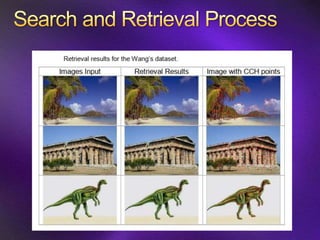
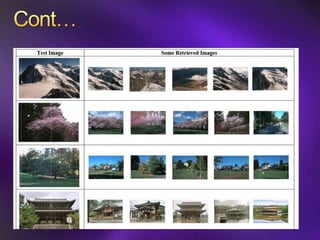
The results are the images that its features are most similar to the 
query image. 
we have proposed a CBIR based image retrieval system, which 
analyses innate properties of an image such as, the color, texture, and 
histogram for efficient and meaningful image retrieval. 
The system first extracts and stores the features of the query image 
then it go through all images in the database and extract the 
features of each image.
Definition: 
“The process of retrieving images 
from a collection on the basis of 
features (such as colour, texture and 
shape) automatically extracted from 
the images themselves”
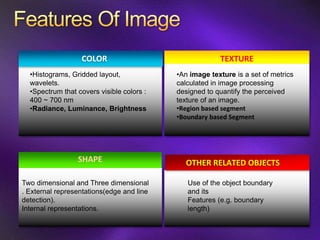
COLOR TEXTURE 
•Histograms, Gridded layout, 
wavelets. 
•Spectrum that covers visible colors : 
400 ~ 700 nm 
•Radiance, Luminance, Brightness 
•An image texture is a set of metrics 
calculated in image processing 
designed to quantify the perceived 
texture of an image. 
•Region based segment 
•Boundary based Segment 
SHAPE OTHER RELATED OBJECTS 
Two dimensional and Three dimensional 
. External representations(edge and line 
detection). 
Internal representations. 
Use of the object boundary 
and its 
Features (e.g. boundary 
length)
Motivation 
To efficiently search/retrieve 
relevant information that people 
want to use 
Goal 
To make it easy to 
search/retrieve/filter/exchange 
content to maintain archive, and to 
edit multimedia content etc.
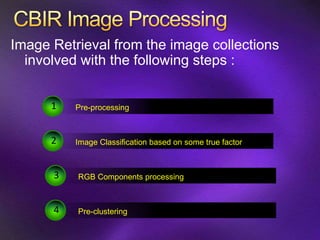
Image Retrieval from the image collections 
involved with the following steps : 
1 Pre-processing 
2 Image Classification based on some true factor 
3 RGB Components processing 
4 Pre-clustering
5 Texture feature extraction 
6 Similarity comparison 
7 Target image selection 
8 Target image is retrieved
Image 
Color Shape 
Color Shape 
Server 
Internet 
or 
Intranet 
or 
Extranet 
Query Interface 
Client 
Query by 
Color 
Query by 
Color Sensation 
Query by 
Shape 
Learning 
Mechanism 
Query by 
Images 
User Drawing 
Query by 
Spatial Relation 
Weight of Features 
Fectures Extraction 
Color Sensation 
Spatial Relation 
Similarity Measure 
Color Sensation 
Spatial Relation 
Indexing 
& 
Filtering Image Database 
Query 
Server
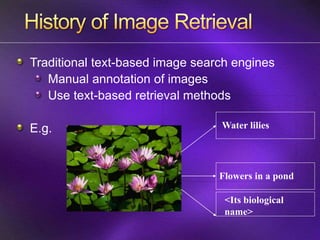
Traditional text-based image search engines 
Manual annotation of images 
Use text-based retrieval methods 
E.g. Water lilies 
Flowers in a pond 
<Its biological 
name>
by google 
by yahoo etc..
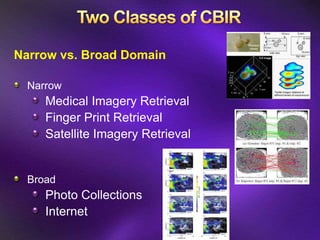
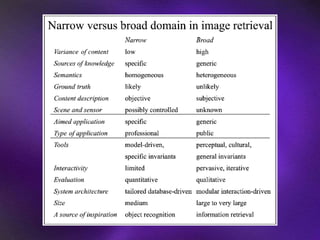
Narrow vs. Broad Domain 
Narrow 
Medical Imagery Retrieval 
Finger Print Retrieval 
Satellite Imagery Retrieval 
Broad 
Photo Collections 
Internet
One of the most important factors that 
greatly affect the quality of clinical nuclear 
medicine images is image filtering. 
Image filtering is a mathematical processing 
for noise removal and resolution recovery. 
The goal of the filtering is to compensate for 
loss of detail in an image while reducing 
noise.
Mean Filter : 
Mean filter is the simplest low pass linear filter. 
It is implemented by replacing each pixel 
value with the average value of its 
neighbourhood. Mean filter can be 
considered as a convolution filter.
Median Filter: 
Median filter is a non linear filter. Median 
filtering is done by replacing the central pixel 
with the median of all the pixels value in the 
current neighbourhood.
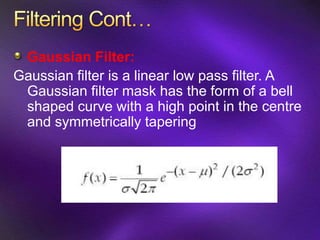
Gaussian Filter: 
Gaussian filter is a linear low pass filter. A 
Gaussian filter mask has the form of a bell 
shaped curve with a high point in the centre 
and symmetrically tapering
Clustering is a method of grouping data objects into 
different groups, such that similar data objects belong to 
the same group and dissimilar data objects to different 
clusters. 
Image clustering consists of two steps the former is 
feature extraction and second part is grouping. 
Clustering algorithm is applied over this extracted 
feature to form the group.
Planning and government: there is a lot of satellite 
imagery of the earth, which can be used to inform important 
political debates. 
Military intelligence: satellite imagery can contain 
important military information. Typical queries involve finding 
militarily interesting changes — for example, is there a 
concentration of force? how much damage was caused by the last 
bombing raid? what happened today? etc. — occurring at 
particular places on the earth
Stock photo and stock footage: commercial libraries — 
which often have extremely large and very diverse collections — 
survive by selling the rights to use particular images. Effective tools 
may unlock value in these collections by making it possible for 
relatively unsophisticated users to obtain images that are useful to 
them at acceptable expense in time and money. 
Access to museums: museums are increasingly creating 
web views of their collections, typically at restricted resolutions, to 
entice viewers into visiting the museum. Ideally, one would want 
viewers to get a sense of what is at the museum, why it is worth 
visiting and the particular virtues of the museum’s gift store. 
Trademark and copyright enforcement: as electronic 
commerce grows, so does the opportunity for automatic searches to 
do violations of trademark or of copyright. For example, at time of 
writing, the owner of rights to a picture could register it with an 
organization called BayTSP, who would then search for stolen copies 
of the picture on the web; recent changes in copyright law make it 
relatively easy to recover fines from violators (see 
http://www.baytsp.com/index.asp).
Managing the web: indexing web pages appears to be a 
profitable activity; the images present on a web page 
should give cues to the content of the page. Users may 
also wish to have tools that allow them to avoid offensive 
images or advertising. A number of tools have been built 
to support searches for images on the web using CBIR 
techniques. There are tools that check images for 
potentially offensive content, both in the academic and 
commercial domains. 
Medical information systems: recovering medical images 
“similar” to a given query example might give more 
information on which to base a diagnosis or to conduct 
epidemiological studies. Furthermore, one might be able 
to cluster medical images in ways that suggest interesting 
and novel hypotheses to experts.
Retrieving images based on the keywords is 
not only appropriate, but also time 
consuming. 
When compared to TBIR, CBIR is very 
effective and appropriate. 
Focused on effective FEATURE 
representation such as color, texture, shape. 
Easy to retrieve image databases.
There is a need for CBIR. 
It may be sufficient that a retrieval system present similar 
images, similar in some user-defined sense. 
CBIR has overcome all the limitation of Text Based Image 
Retrieval by considering the contents or features of image. 
To make it easy to search/retrieve/filter/exchange content 
to maintain archive, and to edit multimedia content etc. 
CBIR technology has been used and also using in several 
applications such as fingerprint identification, biodiversity 
information systems, digital libraries, crime prevention, 
medicine, historical research.
Remco, C.V., Mirela, T., “Content based 
image retrieval systems: a survey”. 
http://www.mathworks.in/matlabcentral 
http://stackoverflow.com/questions/1476836 
4/algorithms-used-for-content-based-image-retrieval- 
systems 
Content Based Image Retrieval(CBIR) 
System Based on the Clustering and 
Genetic Algorithm 
-Eng. Ahmed K. Mikhraq
That is all, folks… 
Thank you for your 
patience!
Content based image retrieval using clustering Algorithm(CBIR)

Content based image retrieval using clustering Algorithm(CBIR)

  • 1.
    PRESENTED BY RAJASEKARG 3rd MCA Madras University CONTENT BASED IMAGE RETRIEVAL (CBIR)
  • 2.
    Introduction Definition Featuresof image History of image retrieval Filtering in image Clustering Algorithm Conclusion
  • 3.
    1 Content-based imageretrieval (CBIR) systems are capable to use query for visually related images by identifying similarity between a query Image and those in the image database. 2 3 4 5 INTRODUCTION OF CBIR Content Based Image Retrieval (CBIR) is still a research area, which aims to retrieve images based on the content of the query image. The results are the images that its features are most similar to the query image. we have proposed a CBIR based image retrieval system, which analyses innate properties of an image such as, the color, texture, and histogram for efficient and meaningful image retrieval. The system first extracts and stores the features of the query image then it go through all images in the database and extract the features of each image.
  • 4.
    Definition: “The processof retrieving images from a collection on the basis of features (such as colour, texture and shape) automatically extracted from the images themselves”
  • 5.
    COLOR TEXTURE •Histograms,Gridded layout, wavelets. •Spectrum that covers visible colors : 400 ~ 700 nm •Radiance, Luminance, Brightness •An image texture is a set of metrics calculated in image processing designed to quantify the perceived texture of an image. •Region based segment •Boundary based Segment SHAPE OTHER RELATED OBJECTS Two dimensional and Three dimensional . External representations(edge and line detection). Internal representations. Use of the object boundary and its Features (e.g. boundary length)
  • 7.
    Motivation To efficientlysearch/retrieve relevant information that people want to use Goal To make it easy to search/retrieve/filter/exchange content to maintain archive, and to edit multimedia content etc.
  • 8.
    Image Retrieval fromthe image collections involved with the following steps : 1 Pre-processing 2 Image Classification based on some true factor 3 RGB Components processing 4 Pre-clustering
  • 9.
    5 Texture featureextraction 6 Similarity comparison 7 Target image selection 8 Target image is retrieved
  • 11.
    Image Color Shape Color Shape Server Internet or Intranet or Extranet Query Interface Client Query by Color Query by Color Sensation Query by Shape Learning Mechanism Query by Images User Drawing Query by Spatial Relation Weight of Features Fectures Extraction Color Sensation Spatial Relation Similarity Measure Color Sensation Spatial Relation Indexing & Filtering Image Database Query Server
  • 12.
    Traditional text-based imagesearch engines Manual annotation of images Use text-based retrieval methods E.g. Water lilies Flowers in a pond <Its biological name>
  • 13.
    by google byyahoo etc..
  • 14.
    Narrow vs. BroadDomain Narrow Medical Imagery Retrieval Finger Print Retrieval Satellite Imagery Retrieval Broad Photo Collections Internet
  • 16.
    One of themost important factors that greatly affect the quality of clinical nuclear medicine images is image filtering. Image filtering is a mathematical processing for noise removal and resolution recovery. The goal of the filtering is to compensate for loss of detail in an image while reducing noise.
  • 17.
    Mean Filter : Mean filter is the simplest low pass linear filter. It is implemented by replacing each pixel value with the average value of its neighbourhood. Mean filter can be considered as a convolution filter.
  • 18.
    Median Filter: Medianfilter is a non linear filter. Median filtering is done by replacing the central pixel with the median of all the pixels value in the current neighbourhood.
  • 19.
    Gaussian Filter: Gaussianfilter is a linear low pass filter. A Gaussian filter mask has the form of a bell shaped curve with a high point in the centre and symmetrically tapering
  • 20.
    Clustering is amethod of grouping data objects into different groups, such that similar data objects belong to the same group and dissimilar data objects to different clusters. Image clustering consists of two steps the former is feature extraction and second part is grouping. Clustering algorithm is applied over this extracted feature to form the group.
  • 22.
    Planning and government:there is a lot of satellite imagery of the earth, which can be used to inform important political debates. Military intelligence: satellite imagery can contain important military information. Typical queries involve finding militarily interesting changes — for example, is there a concentration of force? how much damage was caused by the last bombing raid? what happened today? etc. — occurring at particular places on the earth
  • 23.
    Stock photo andstock footage: commercial libraries — which often have extremely large and very diverse collections — survive by selling the rights to use particular images. Effective tools may unlock value in these collections by making it possible for relatively unsophisticated users to obtain images that are useful to them at acceptable expense in time and money. Access to museums: museums are increasingly creating web views of their collections, typically at restricted resolutions, to entice viewers into visiting the museum. Ideally, one would want viewers to get a sense of what is at the museum, why it is worth visiting and the particular virtues of the museum’s gift store. Trademark and copyright enforcement: as electronic commerce grows, so does the opportunity for automatic searches to do violations of trademark or of copyright. For example, at time of writing, the owner of rights to a picture could register it with an organization called BayTSP, who would then search for stolen copies of the picture on the web; recent changes in copyright law make it relatively easy to recover fines from violators (see http://www.baytsp.com/index.asp).
  • 24.
    Managing the web:indexing web pages appears to be a profitable activity; the images present on a web page should give cues to the content of the page. Users may also wish to have tools that allow them to avoid offensive images or advertising. A number of tools have been built to support searches for images on the web using CBIR techniques. There are tools that check images for potentially offensive content, both in the academic and commercial domains. Medical information systems: recovering medical images “similar” to a given query example might give more information on which to base a diagnosis or to conduct epidemiological studies. Furthermore, one might be able to cluster medical images in ways that suggest interesting and novel hypotheses to experts.
  • 26.
    Retrieving images basedon the keywords is not only appropriate, but also time consuming. When compared to TBIR, CBIR is very effective and appropriate. Focused on effective FEATURE representation such as color, texture, shape. Easy to retrieve image databases.
  • 31.
    There is aneed for CBIR. It may be sufficient that a retrieval system present similar images, similar in some user-defined sense. CBIR has overcome all the limitation of Text Based Image Retrieval by considering the contents or features of image. To make it easy to search/retrieve/filter/exchange content to maintain archive, and to edit multimedia content etc. CBIR technology has been used and also using in several applications such as fingerprint identification, biodiversity information systems, digital libraries, crime prevention, medicine, historical research.
  • 32.
    Remco, C.V., Mirela,T., “Content based image retrieval systems: a survey”. http://www.mathworks.in/matlabcentral http://stackoverflow.com/questions/1476836 4/algorithms-used-for-content-based-image-retrieval- systems Content Based Image Retrieval(CBIR) System Based on the Clustering and Genetic Algorithm -Eng. Ahmed K. Mikhraq
  • 33.
    That is all,folks… Thank you for your patience!