Patella Fractures & Extensor
Mechanism Injuries
Dr P. ROHIT RAJ
MBBS MS ORTHO
ASSISTANT PROFESSOR
ORTHOPAEDIC DEPARTMENT
VISHWABHARATHI MEDICAL
Patella Fractures & Extensor
Mechanism Injuries
Anatomy
• Largest sesamoid bone
• Thick articular
cartilage proximally
• Articular surface
divided into medial
and lateral facets by
longitudinal ridge
• Distal pole
nonarticular
Anatomy
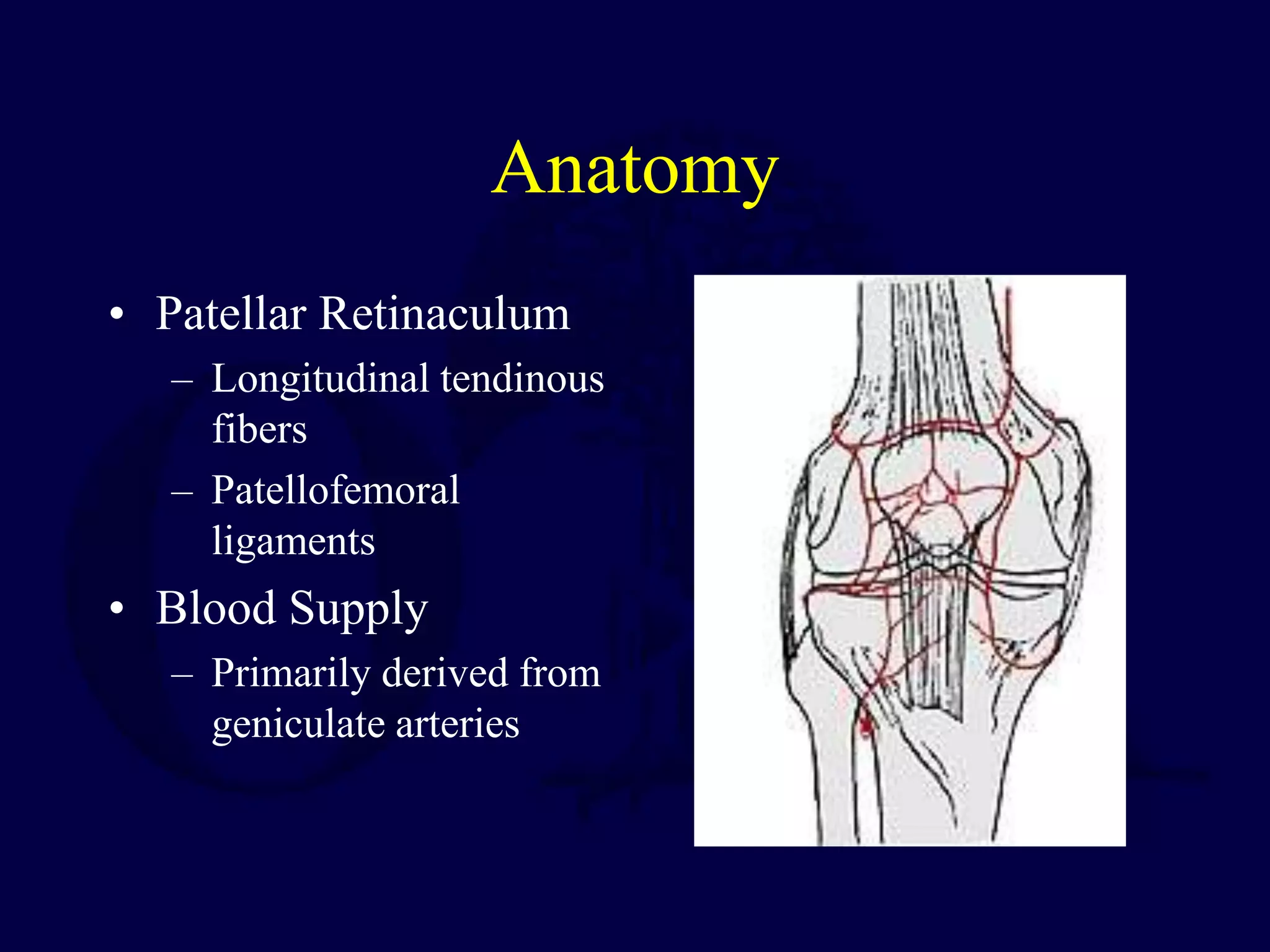
• Patellar Retinaculum
– Longitudinal tendinous
fibers
– Patellofemoral
ligaments
• Blood Supply
– Primarily derived from
geniculate arteries
Biomechanics
• The patella is a link between the quadriceps
tendon and patella tendon and is subject to
significant forces.
• The patella increases the leverage of the
quadriceps muscle and elevates the
extensor mechanism away from the axis of
rotation of the knee joint.
• The area of contact between the patella and
distal femur varies according to the position
of the knee.
Classification
• Allows guidance with
treatment
• Types
– Undisplaced
– Transverse
– Apex
– Comminuted
– Vertical
– Osteochondral
Tip: Vertical fractures may not result in disruption of extensor mechanism
Nondisplaced Fractures
Transverse fracture
• nondisplaced = medial and lateral
retinaculum usually intact
• Transverse fractures commonly result
in wide fragment separation due to
Strong ligamentous traction
Vertical Fractures
• Account for 22% of patella
fractures*
• Typically results from
compression of patella with
flexed knee
• Sometimes only seen on
sunrise view
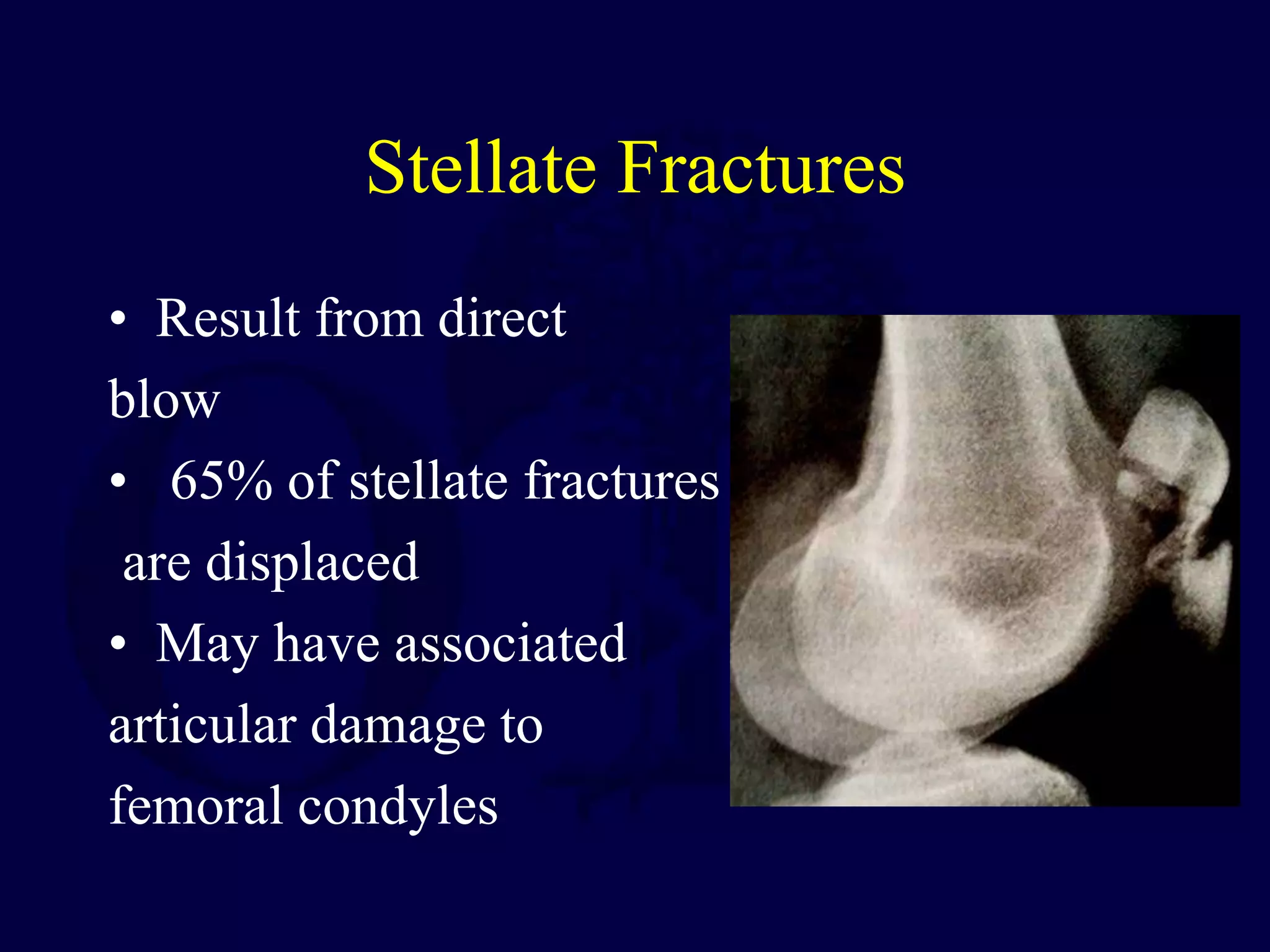
Stellate Fractures
• Result from direct
blow
• 65% of stellate fractures
are displaced
• May have associated
articular damage to
femoral condyles
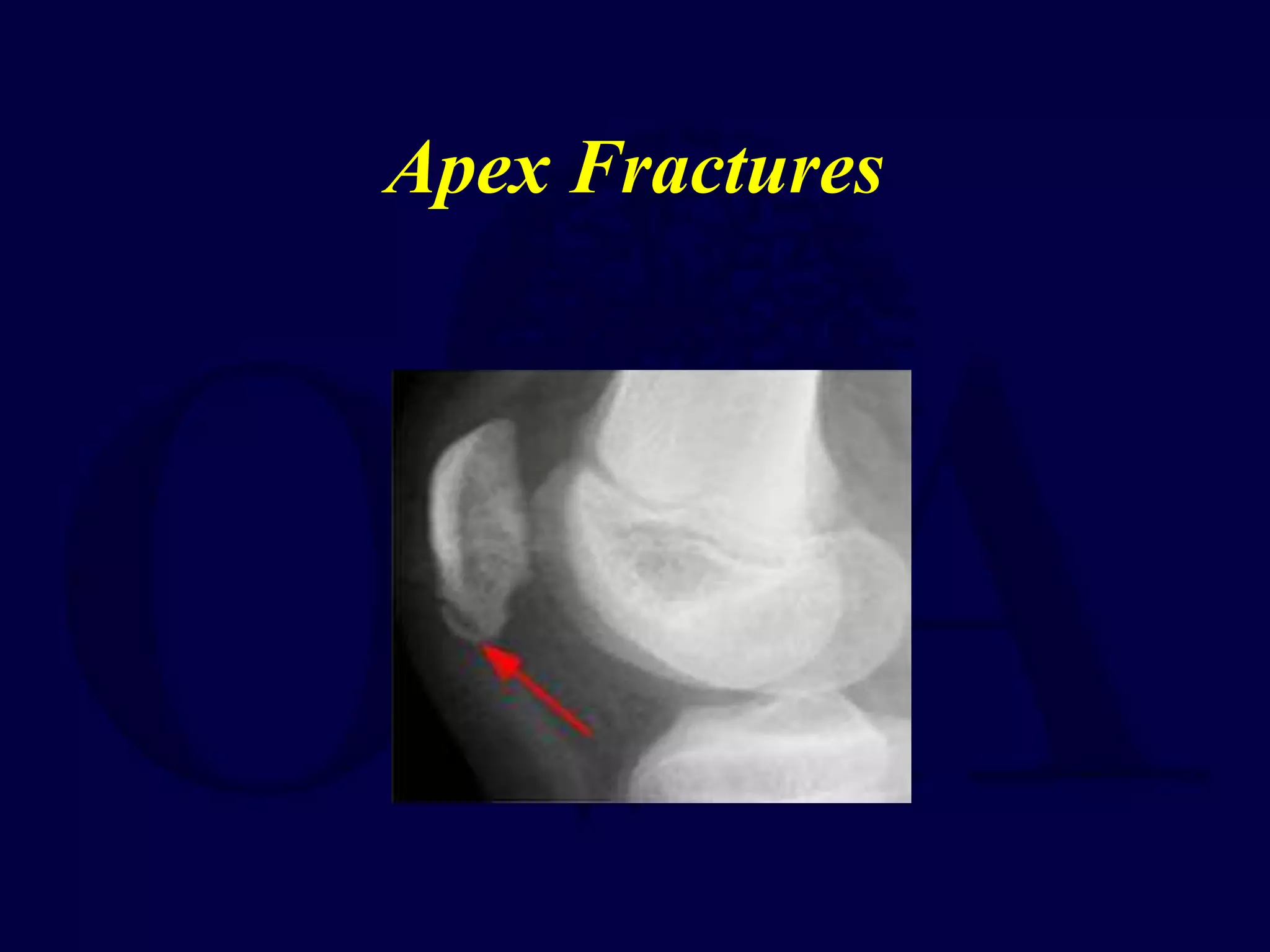
Apex Fractures
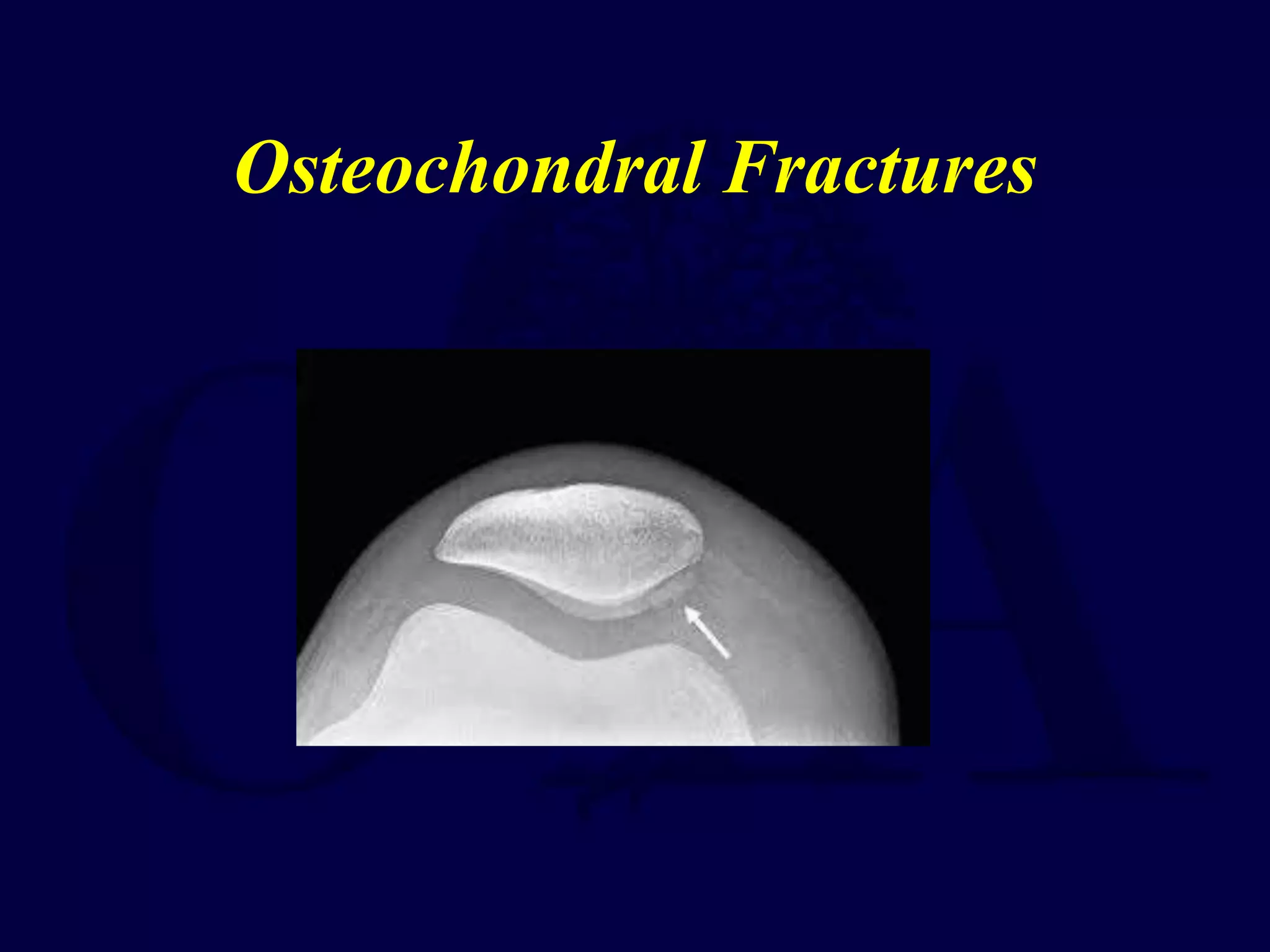
Osteochondral Fractures
Insall-
Salvati ratio,
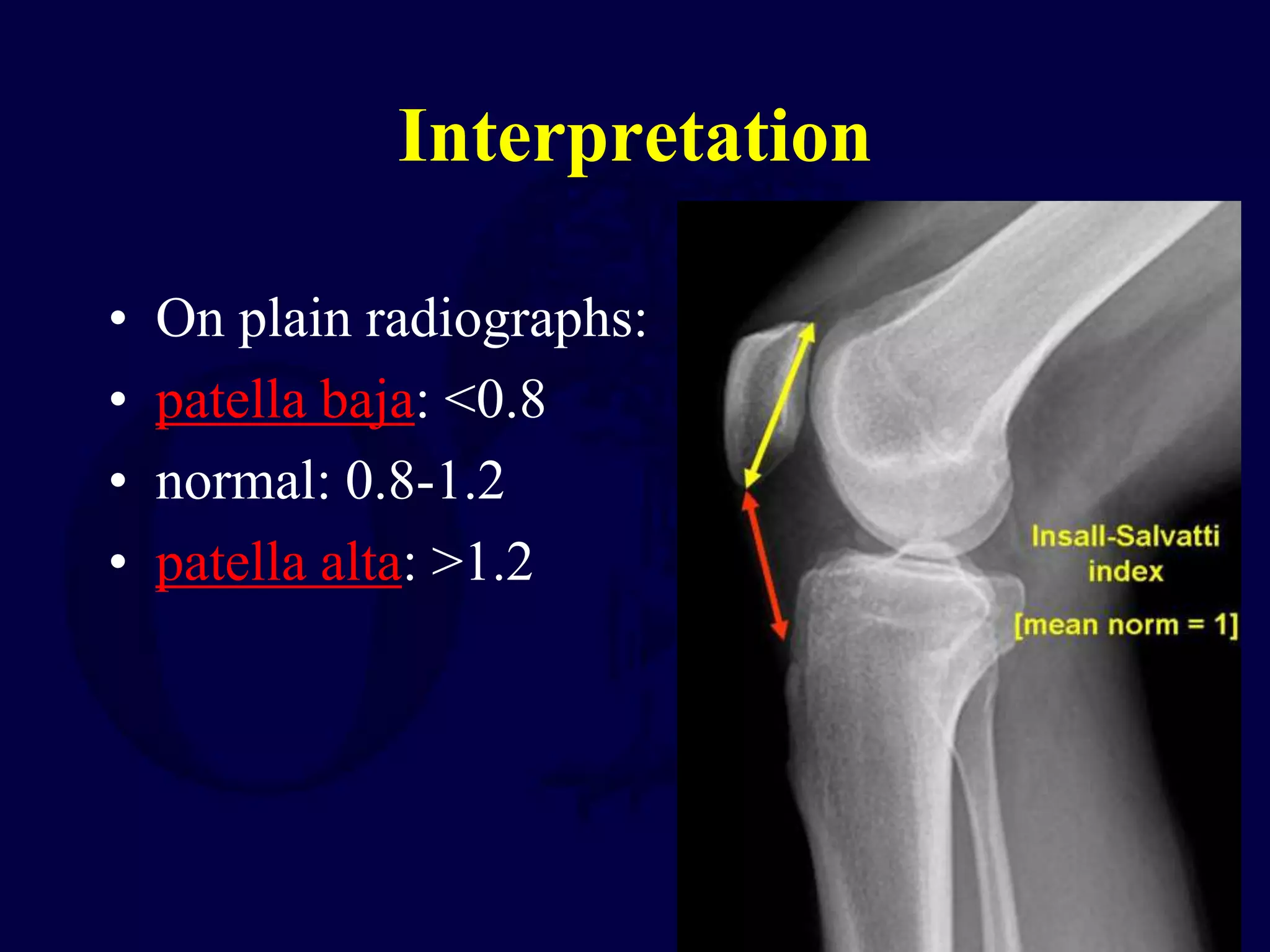
• The Insall-Salvati ratio or index is the ratio of the patella
tendon length to the length of the patella and is used to
determine patellar height.
• A: patellar tendon length (TL): length of the posterior
surface of the tendon from the lower pole of the patella to
its insertion on the tibia
• B: patellar length (PL): greatest pole-to-pole length
• Insall-Salvati ratio = A/B (or TL/PL)
Interpretation
• On plain radiographs:
• patella baja: <0.8
• normal: 0.8-1.2
• patella alta: >1.2
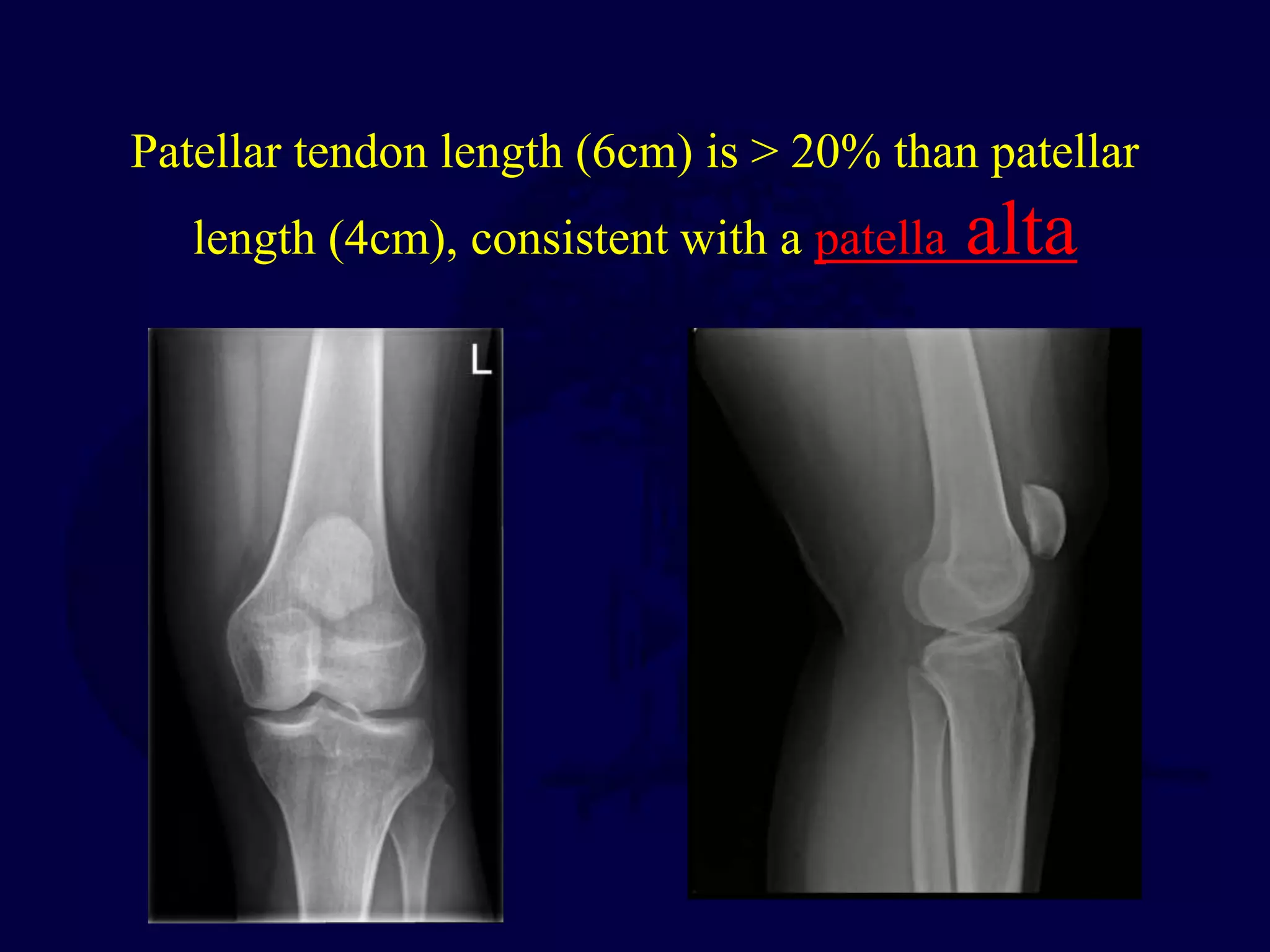
Patella alta
• high riding patella, describes a situation
where the position of the patella is
considered high. It may be idiopathic or
may result secondary to a patellar tendon
rupture.
Patellar tendon length (6cm) is > 20% than patellar
length (4cm), consistent with a patella alta
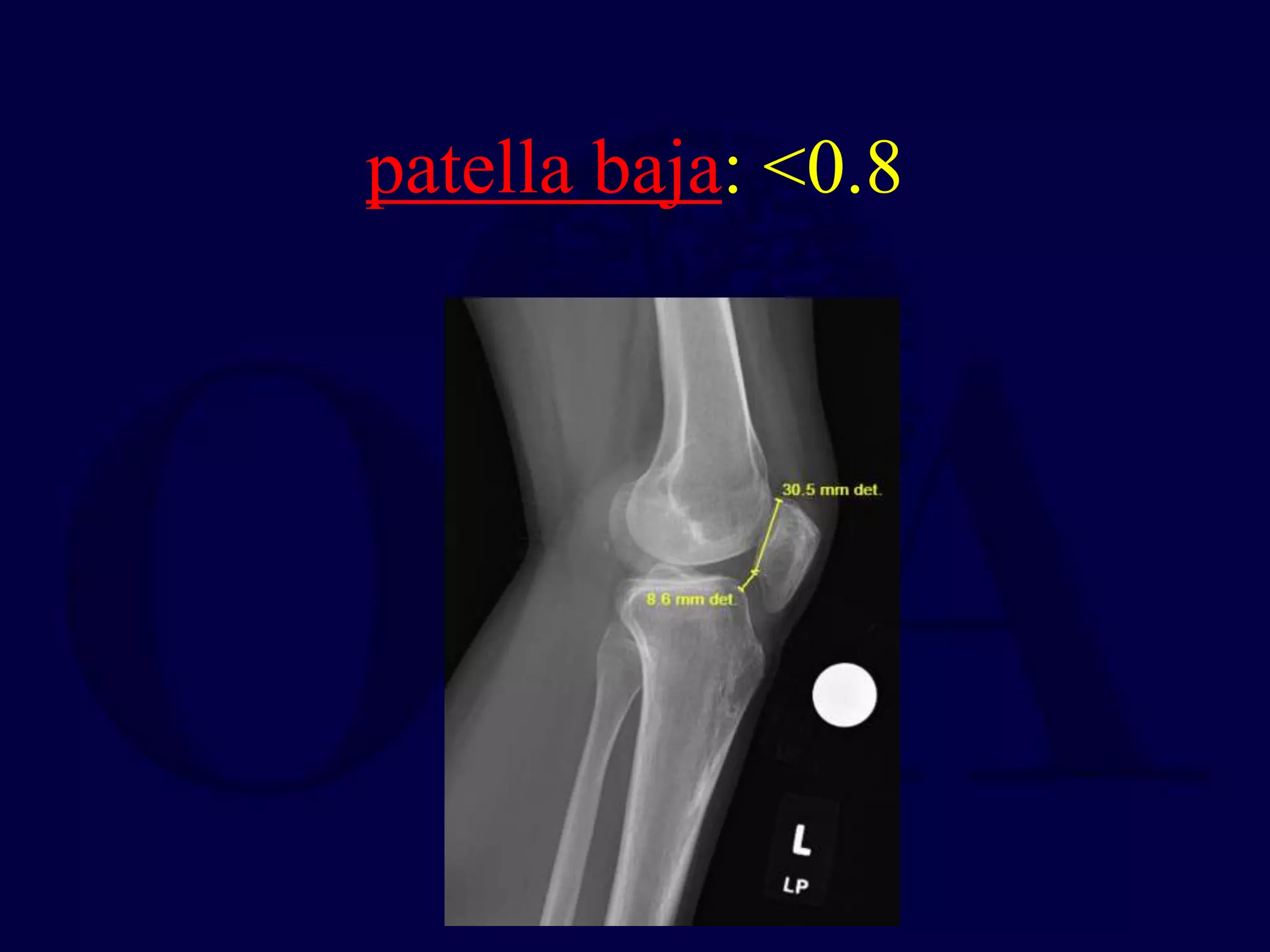
Patella baja
• Patella baja is an abnormally low lying
patella, which is associated with restricted
range of motion, crepitations, and
retropatellar pain. If longstanding, extensor
dysfunction may ensue with significant
morbidity.
patella baja: <0.8
Radiographic Evaluation
• AP & Lateral
– Note patella height (baja or alta)
– Note fracture pattern
• Articular step-off, diastasis
• Marginal impaction
• Special views
– Axial or sunrise
• CT Scan
- Occult Fractures
- Complex or Marginal Impaction
Fractures
sunrise (skyline) view of the
knee
Normal appearing lateral knee
radiograph in an elderly patient
Sunrise View: Non-displaced
Patellar Fracture of the
same elderly patient with normal
radiographs on the left.
Transverse and
displaced patellar
fracture
 Non-displaced patellar
fracture.
Comminuted Patellar Fracture
Radiographic Evaluation
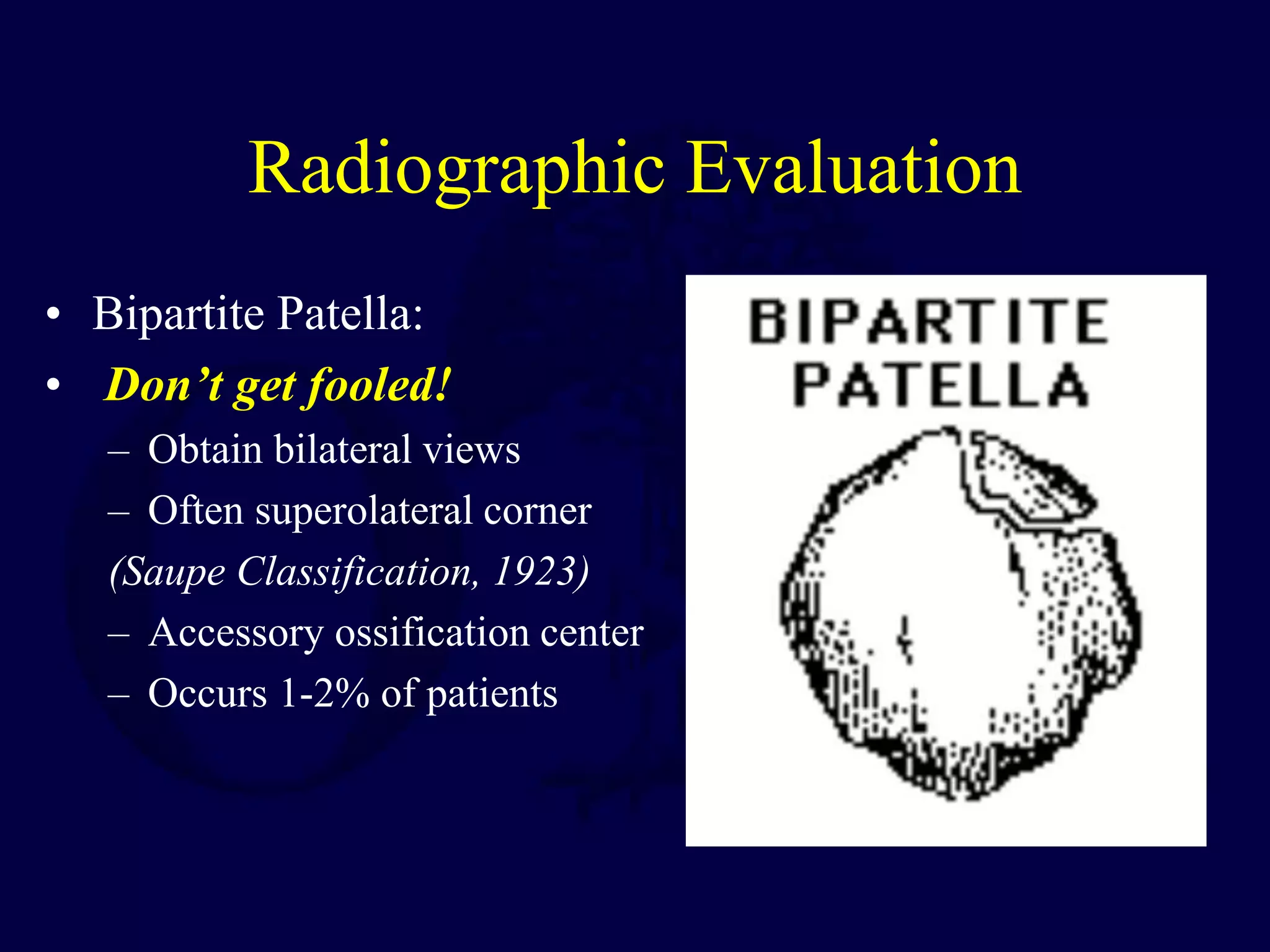
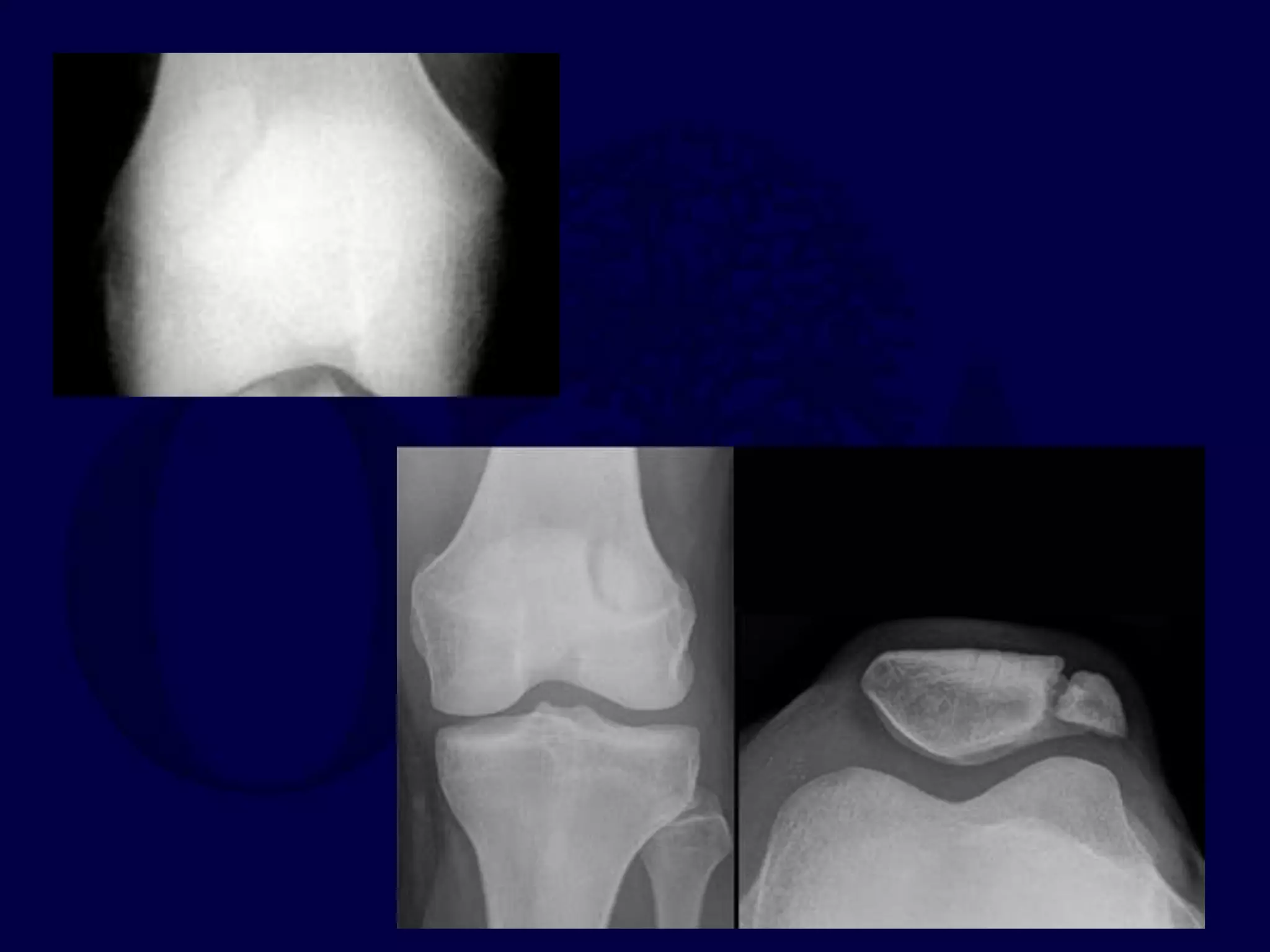
• Bipartite Patella:
• Don’t get fooled!
– Obtain bilateral views
– Often superolateral corner
(Saupe Classification, 1923)
– Accessory ossification center
– Occurs 1-2% of patients
Operative Treatment
• Goals
– Preserve extensor function
– Restore articular congruency
• indicated for displaced fractures and
disruption of the extensor
mechanism.
• Approach
– Longitudinal midline incision
recommended
– Transverse approach alternative (dotted
lines) – potentially higher risk wound
problems, can limit initiation of ROM
– Consider future surgeries!
Procedure
Longitudinal
Incision
Clean Fracture
Site
Torn
Retinaculum
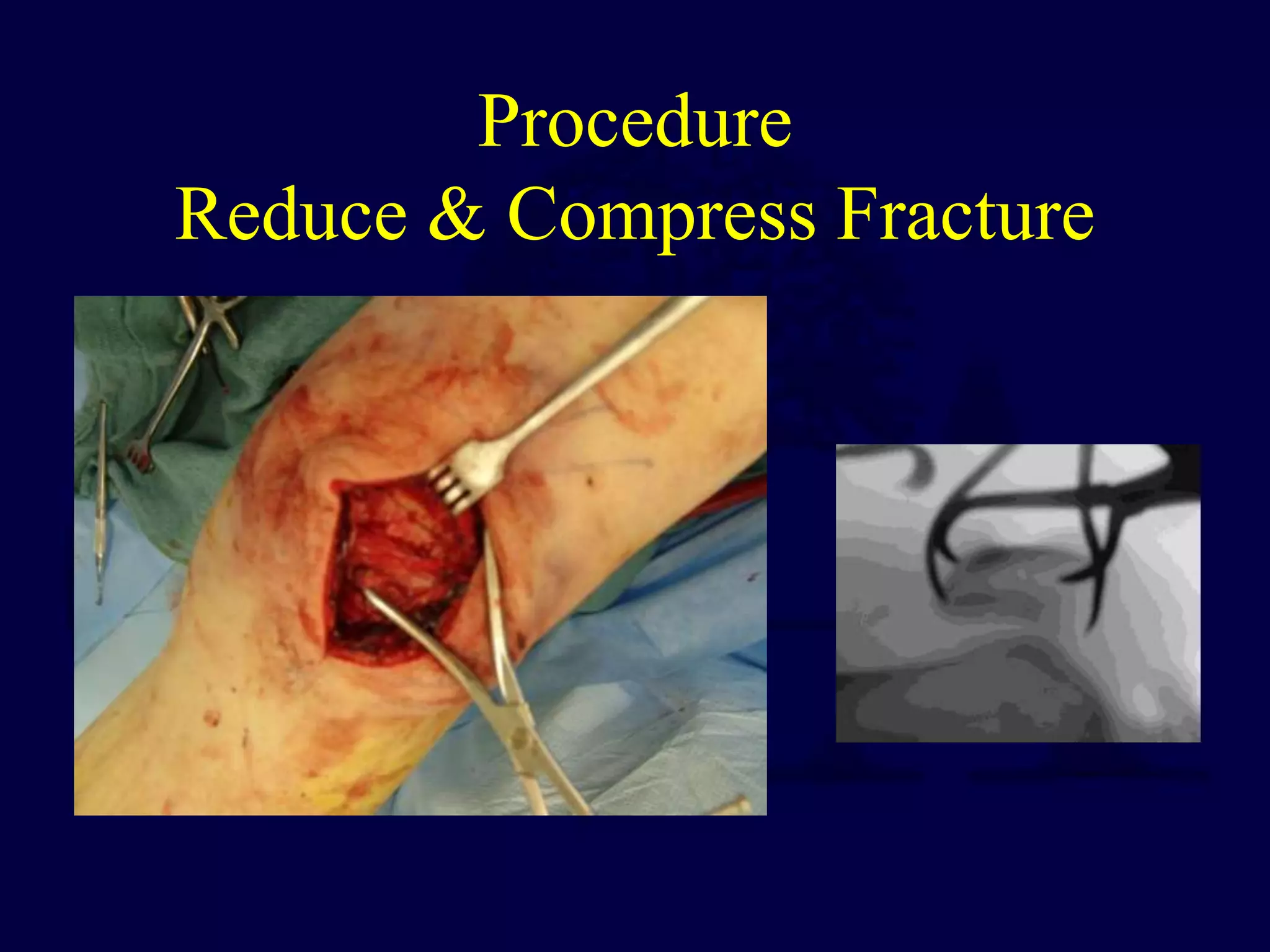
Procedure
Reduce & Compress Fracture
Operative Techniques
• K-wires w/ tension band wiring (TBW)
• Lag-screw fixation
• Cannulated lag-screw with TBW (tension
band screw – TBS)
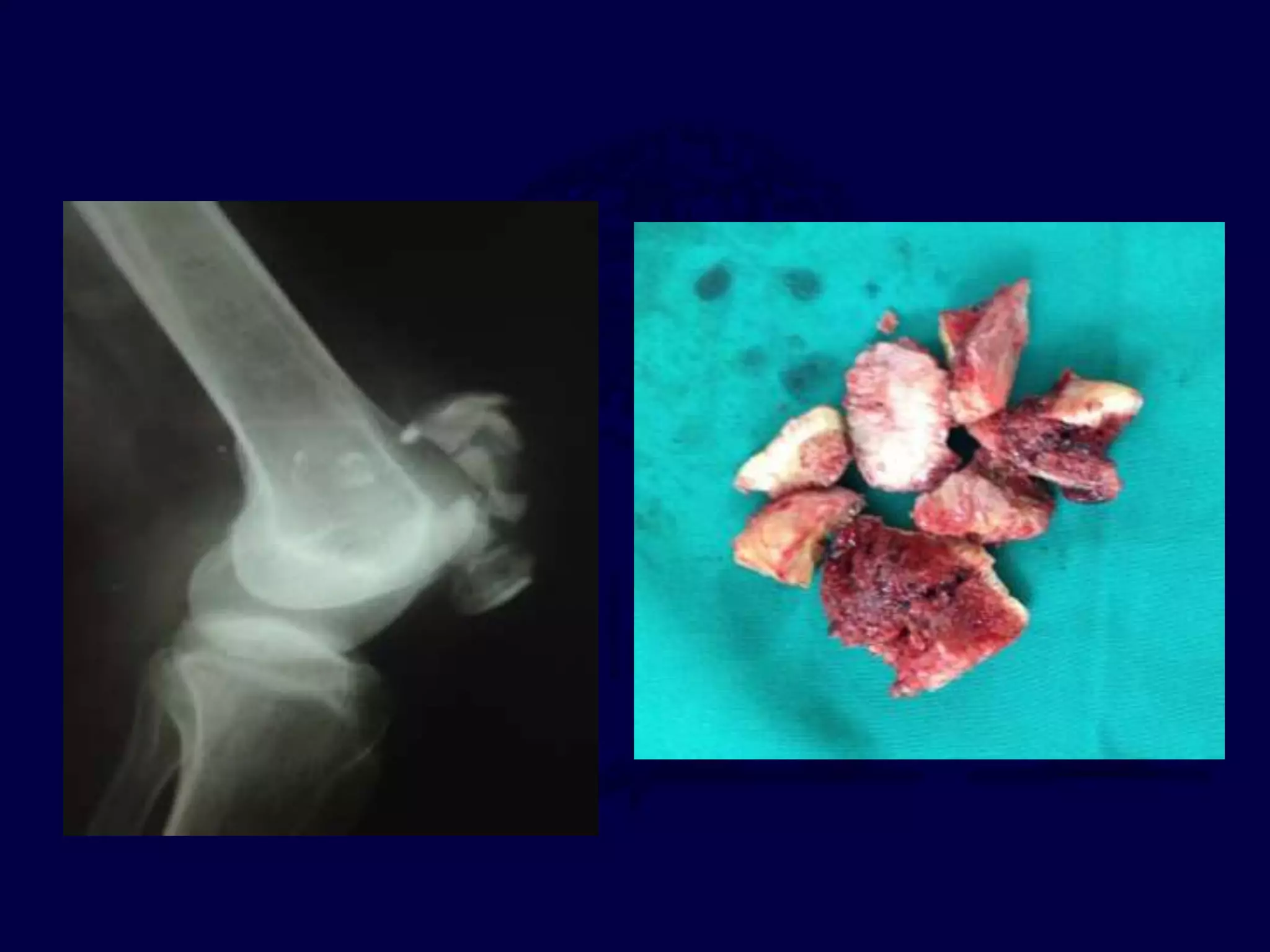
• Partial patellectomy
• Total Patellectomy
Tension Band Wiring
• Transverse, non-comminuted
fractures
• Double Figure-8 wire for equal
compression
Tension Band Wiring
• Wire converts anterior distractive
forces to compressive forces at the
articular surface
• Retinacular Injury
– Keep open until the end
– Window to assess articular reduction
– Repair the retinacular injury last
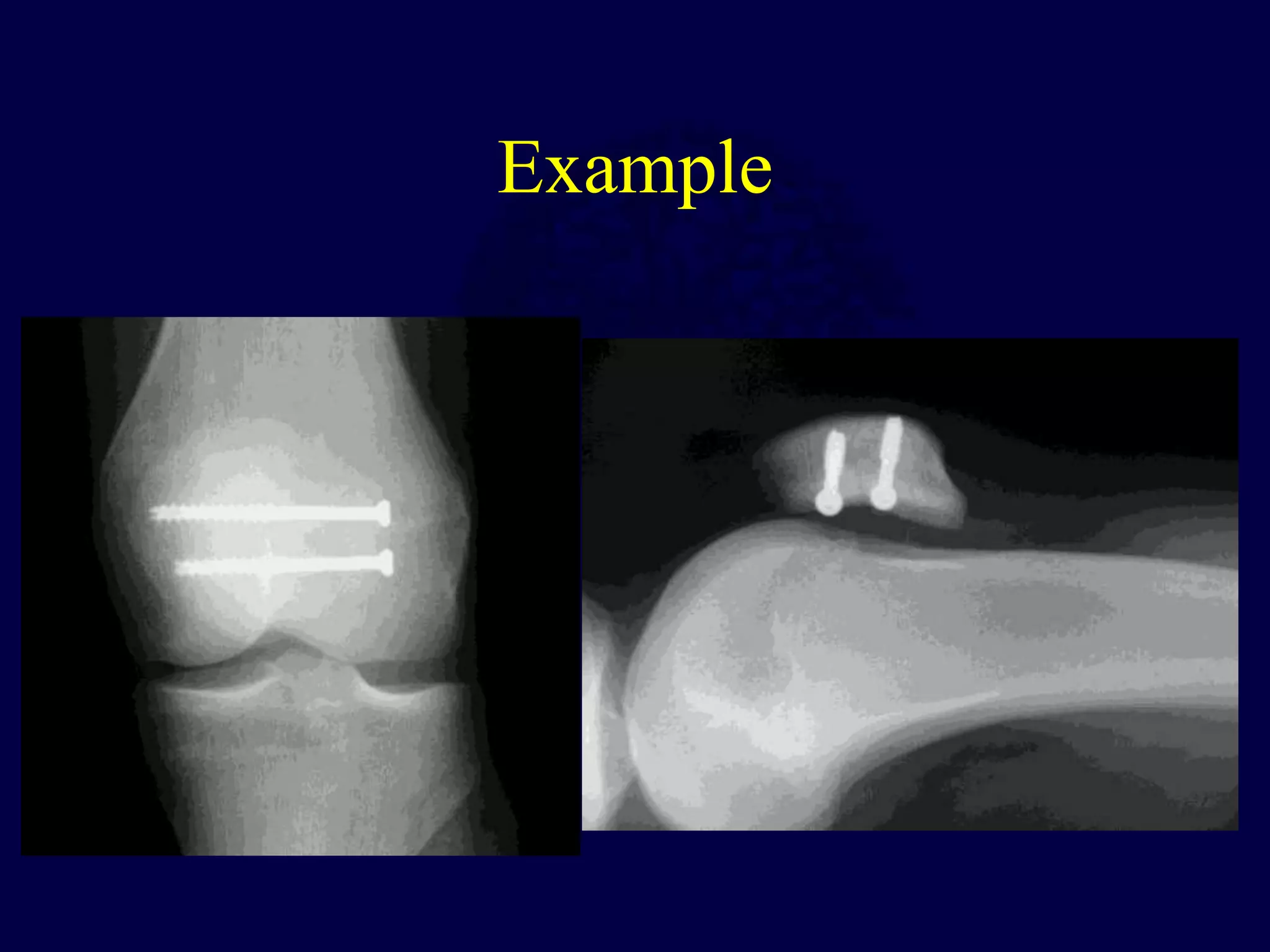
Lag-Screw Fixation
• Indicated for vertical
fractures
• Contraindicated for
extensive comminution
and osteopenic bone
Example
Cannulated Lag-Screw With
Tension Band (TBS)
• Partially threaded
cannulated screws
(4.0mm)
• Wire through screws
and across anterior
patella in figure of
eight tension band
• Make sure tip of
screw remains buried
in bone so it will not
compromise wire
Cannulated Lag-Screw With
Tension Band
• More stable construct
– Screws and tension band wire combination
eliminates both possible separation seen at the
fracture site with K wire/TBW and screw
failure due to excessive three point bending
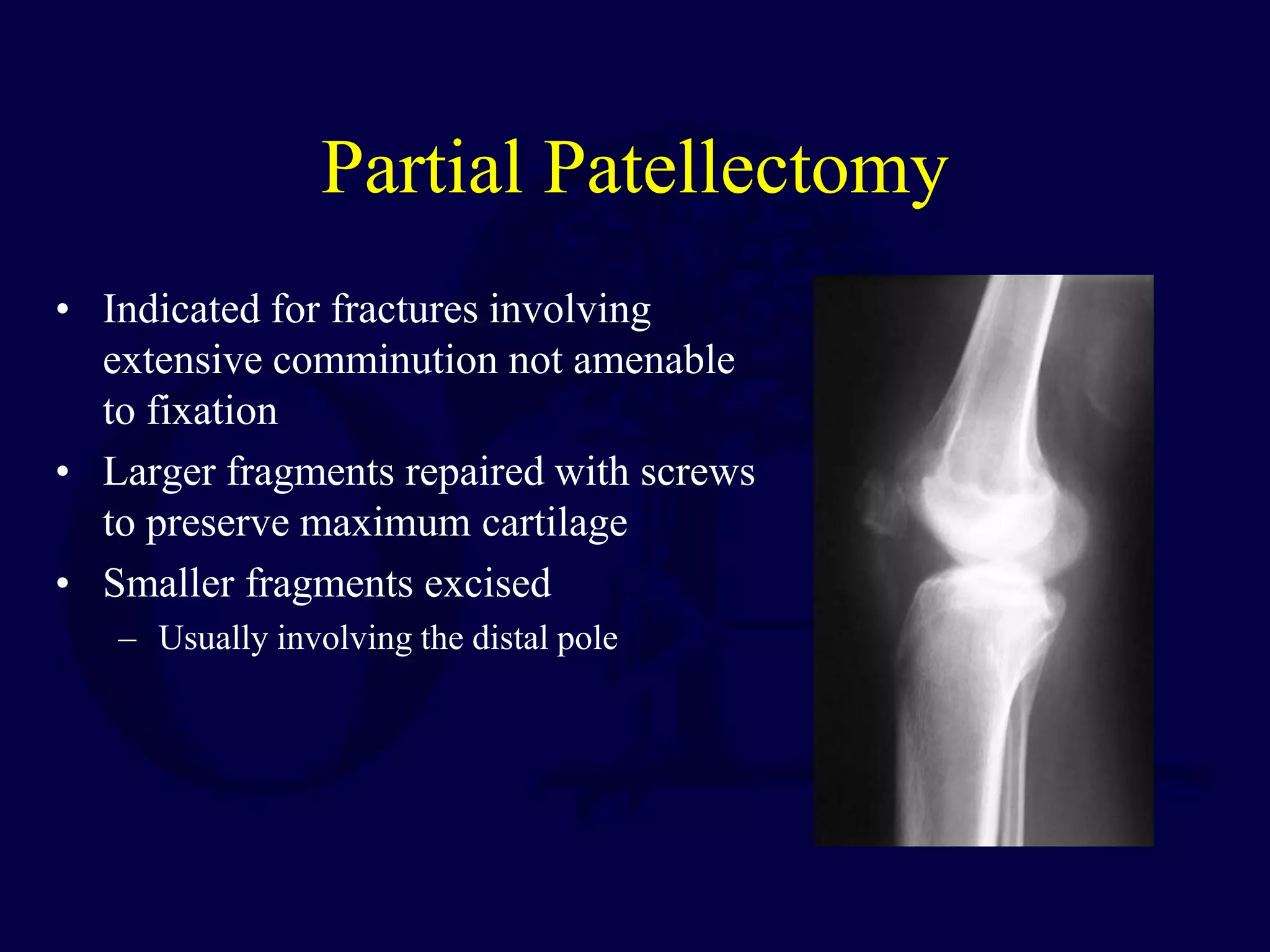
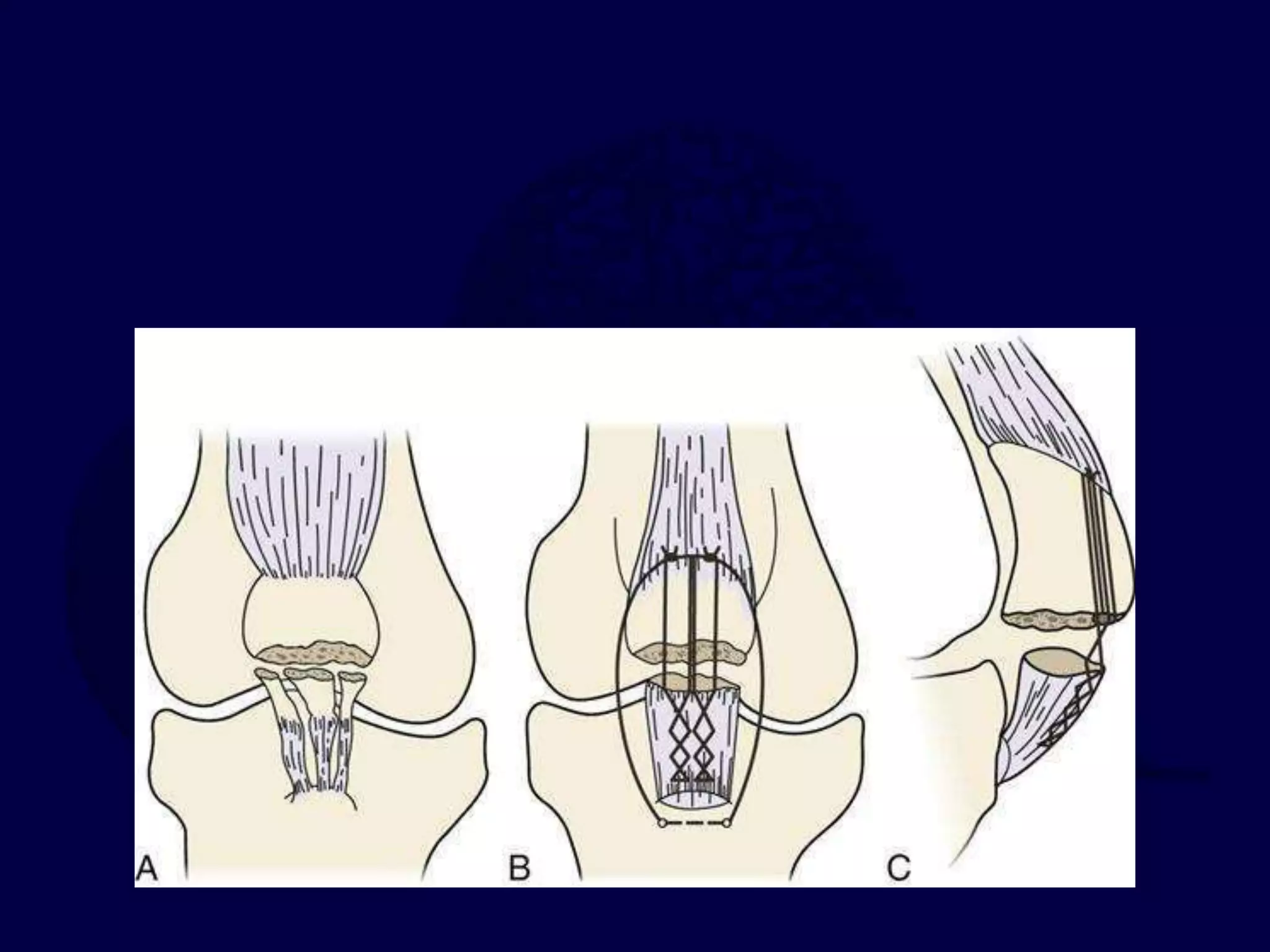
Partial Patellectomy
• Indicated for fractures involving
extensive comminution not amenable
to fixation
• Larger fragments repaired with screws
to preserve maximum cartilage
• Smaller fragments excised
– Usually involving the distal pole
Total Patellectomy
• Indicated for displaced, comminuted
fractures not amenable to reconstruction
• Bone fragments sharply dissected
• Defect may be repaired through a variety of
techniques
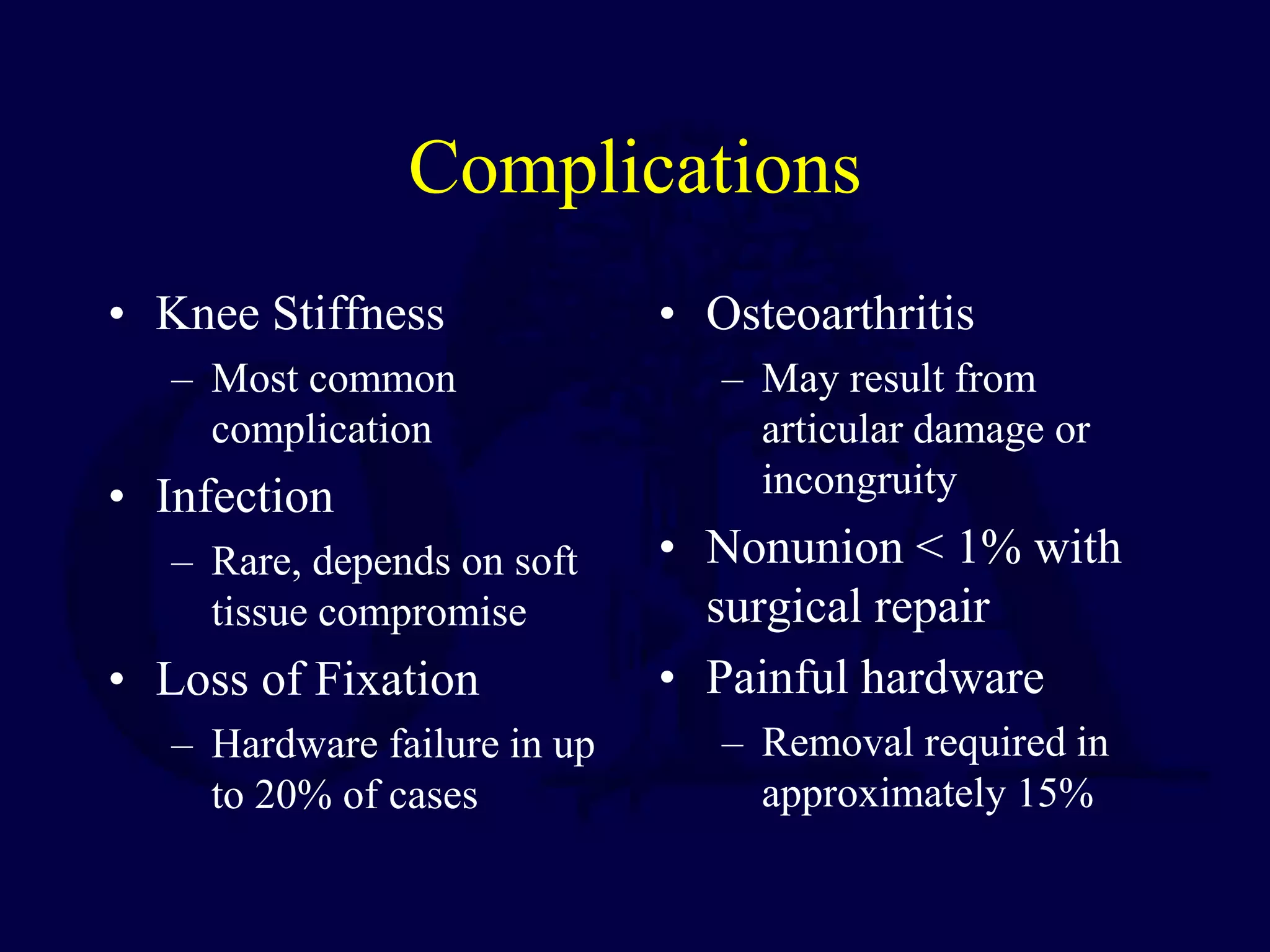
Complications
• Knee Stiffness
– Most common
complication
• Infection
– Rare, depends on soft
tissue compromise
• Loss of Fixation
– Hardware failure in up
to 20% of cases
• Osteoarthritis
– May result from
articular damage or
incongruity
• Nonunion < 1% with
surgical repair
• Painful hardware
– Removal required in
approximately 15%
Nonunion
Loss of Fixation
Malunion
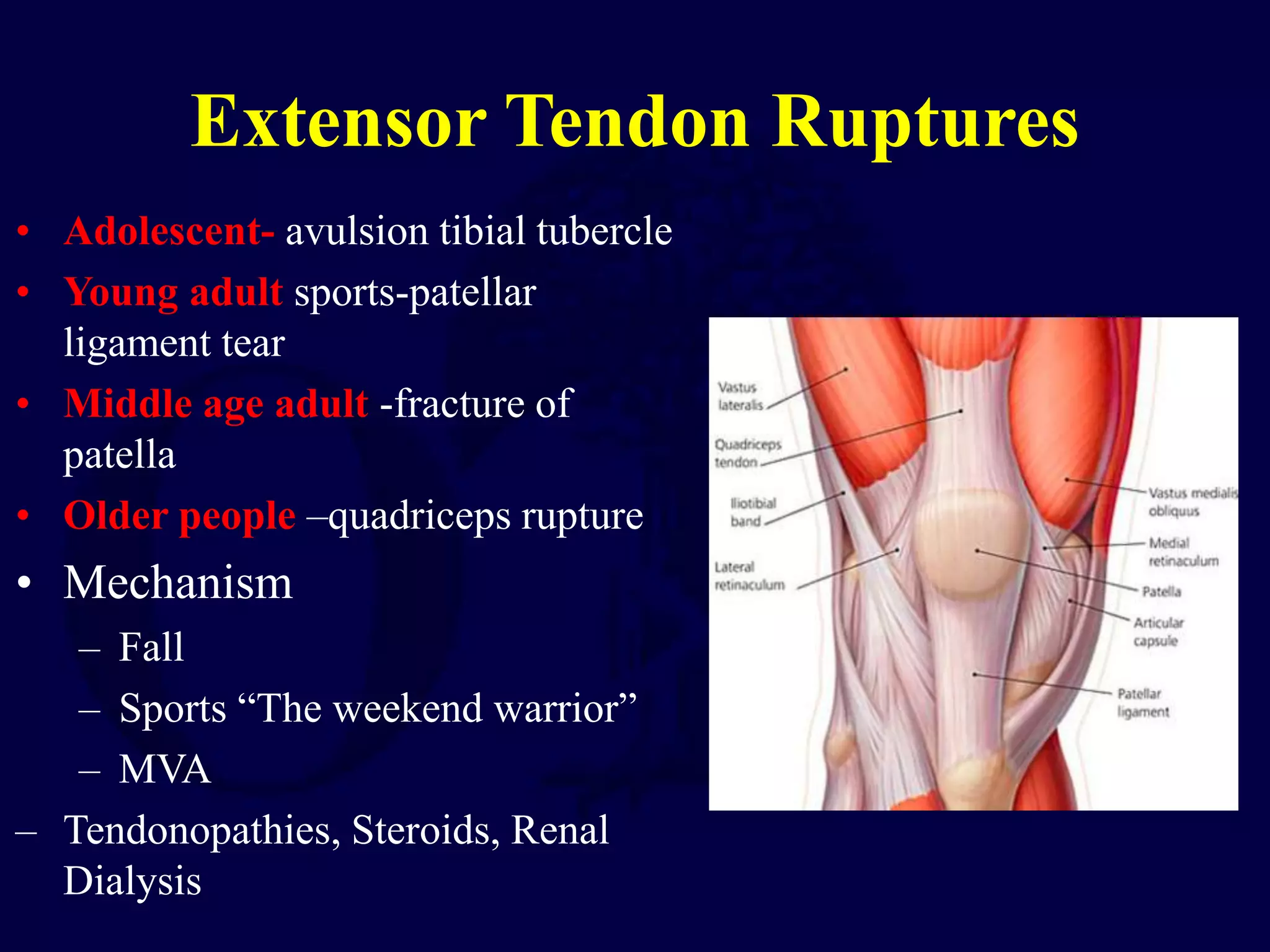
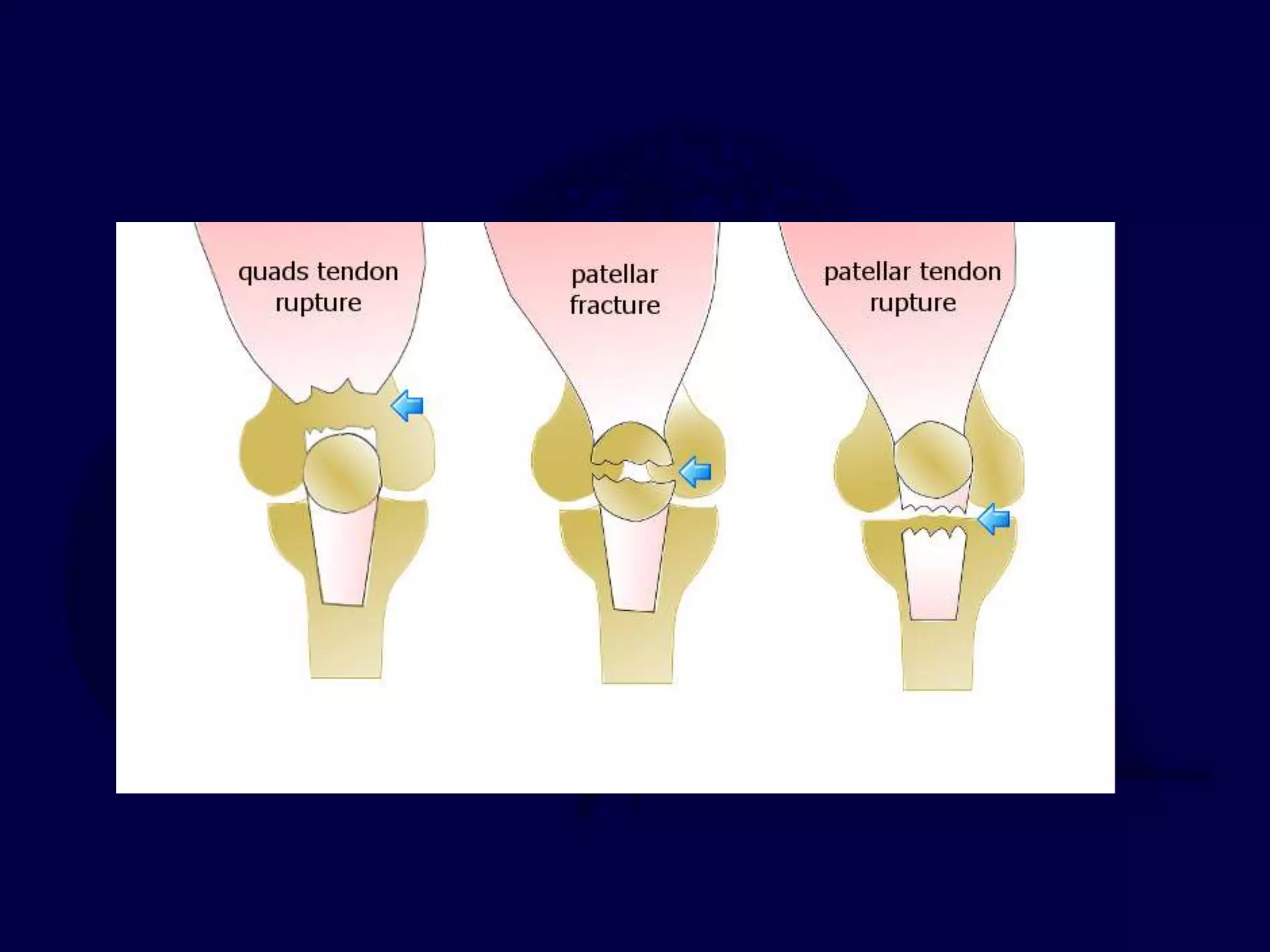
Extensor Tendon Ruptures
• Adolescent- avulsion tibial tubercle
• Young adult sports-patellar
ligament tear
• Middle age adult -fracture of
patella
• Older people –quadriceps rupture
• Mechanism
– Fall
– Sports “The weekend warrior”
– MVA
– Tendonopathies, Steroids, Renal
Dialysis
Quadriceps Tendon Rupture
• Typically occurs in patients > 40 years old
• Usually 0-2 cm above the superior pole
• Level often associated with age
– Rupture occurs at the bone-tendon junction in
majority of patients > 40 years old
– Rupture occurs at midsubstance in majority of
patients < 40 years old
Quadriceps Tendon Ruptures
• Risk Factors
– Chronic tendonitis
– Anabolic steroid use
– Local steroid injection
– Inflammatory arthropathy
– Chronic renal failure
– Systemic disease
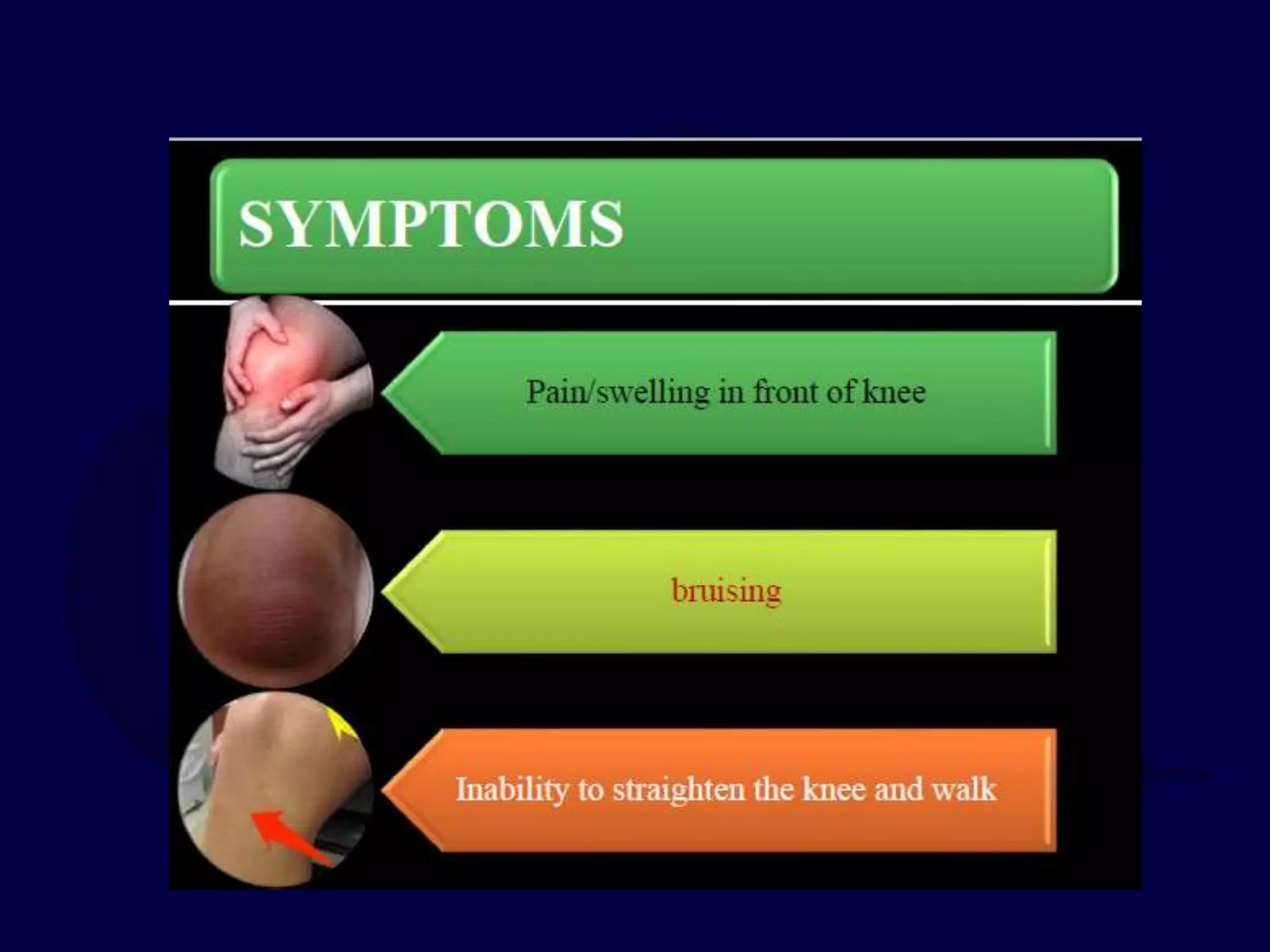
History
• Sensation of a sudden pop while stressing
the extensor mechanism (eccentric load)
• Pain at the site of injury
• Inability to extend the knee
• Difficulty weight-bearing
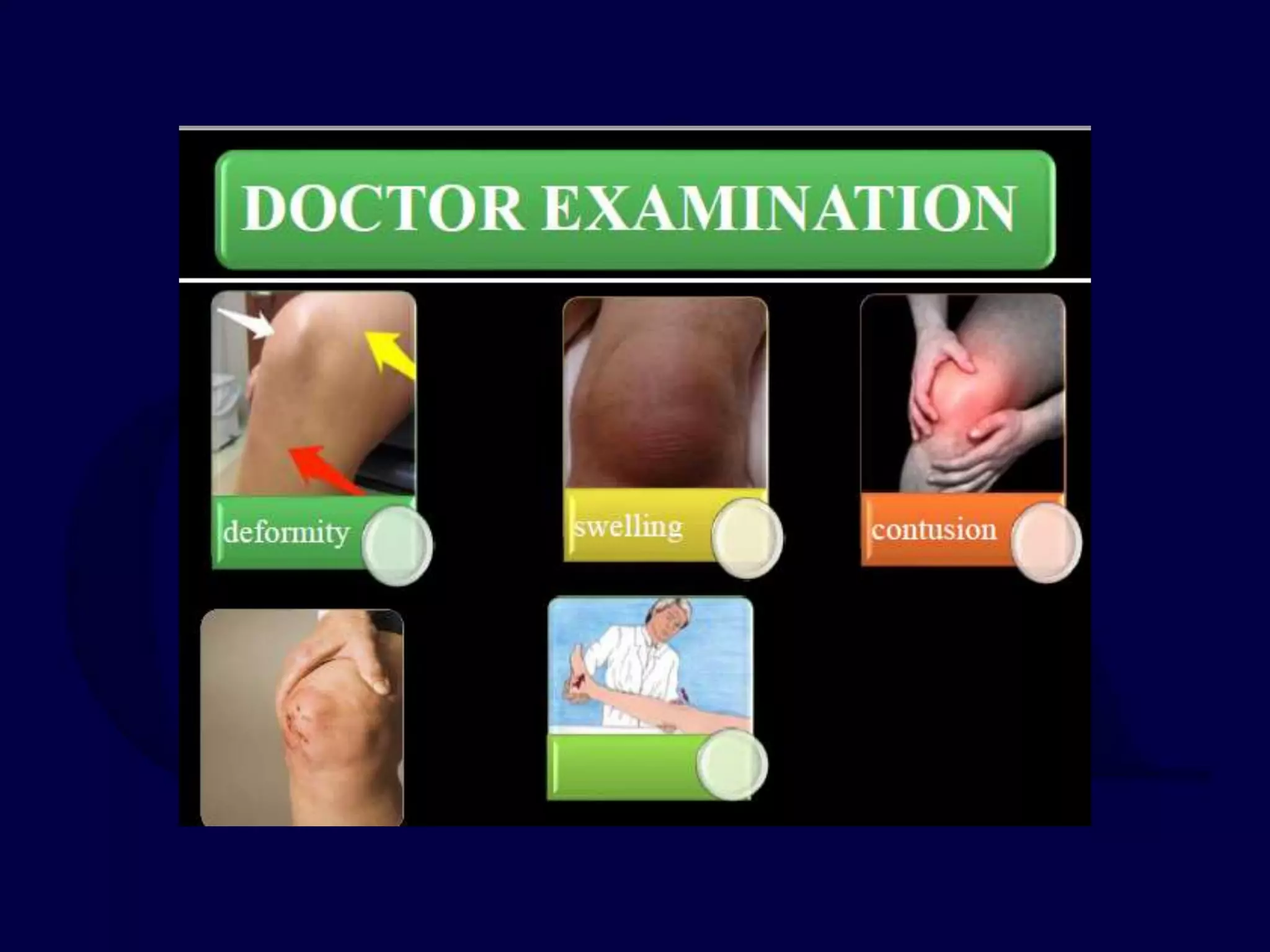
Physical Exam
• Effusion
• Tenderness at the
upper pole
• Palpable defect above
superior pole
• Loss of extension
• With partial tears,
extension will be
intact
MRI
• Palpable defect proximal to
superior pole of patella
• If defect present but patient
able to extend the knee then
the extensor retinaculum is
intact
• If no active extension, then
both tendon and retinaculum
completely torn
Quadriceps Tendon Rupture
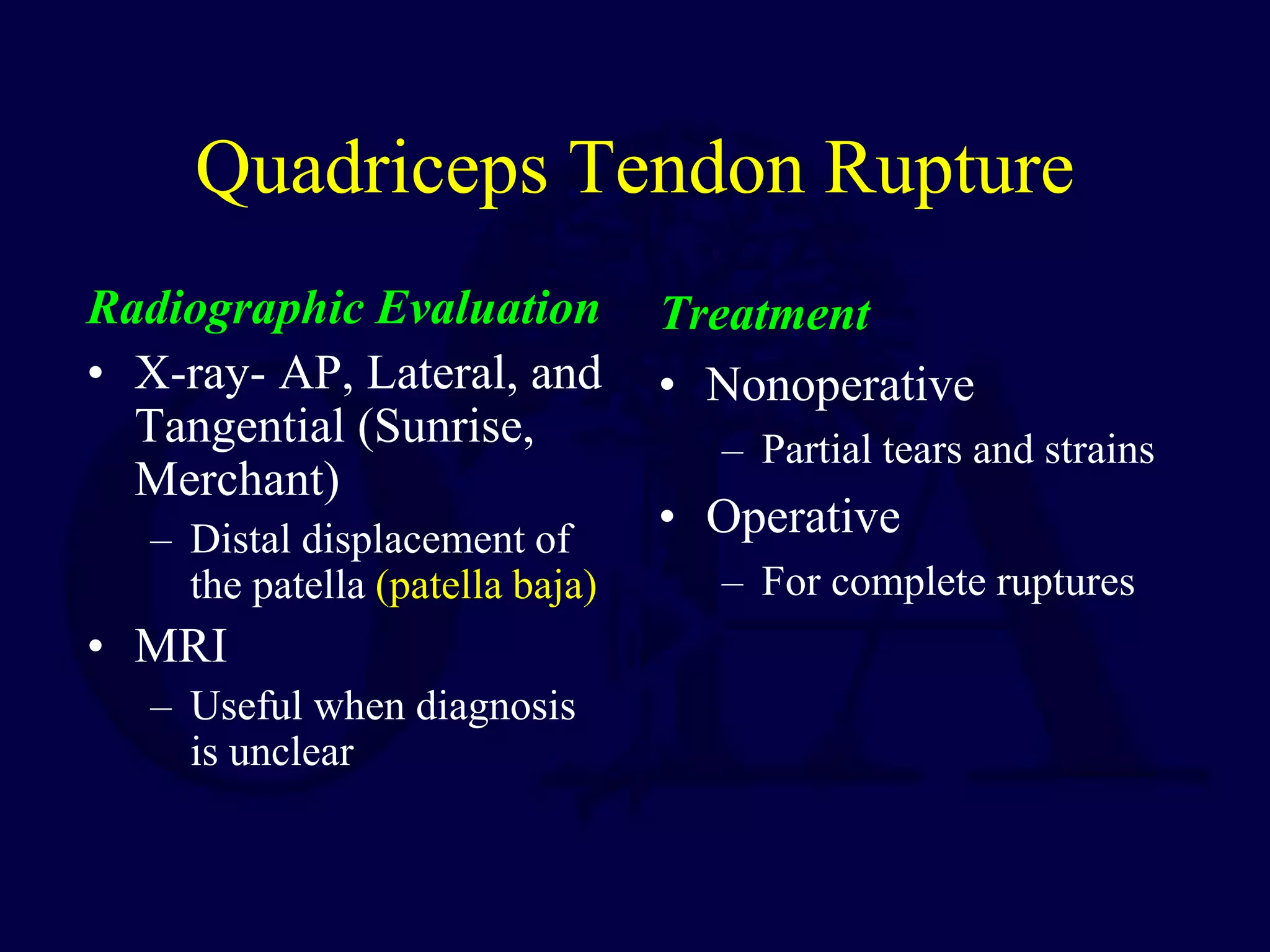
Radiographic Evaluation
• X-ray- AP, Lateral, and
Tangential (Sunrise,
Merchant)
– Distal displacement of
the patella (patella baja)
• MRI
– Useful when diagnosis
is unclear
Treatment
• Nonoperative
– Partial tears and strains
• Operative
– For complete ruptures
Nonoperative Treatment
Quadriceps Tendon Rupture
• Reserved for incomplete tears in which
active, full knee extension is preserved
• Immobilize leg in extension for
approximately 4-6 weeks
• Progressive physical therapy required to
regain strength and motion
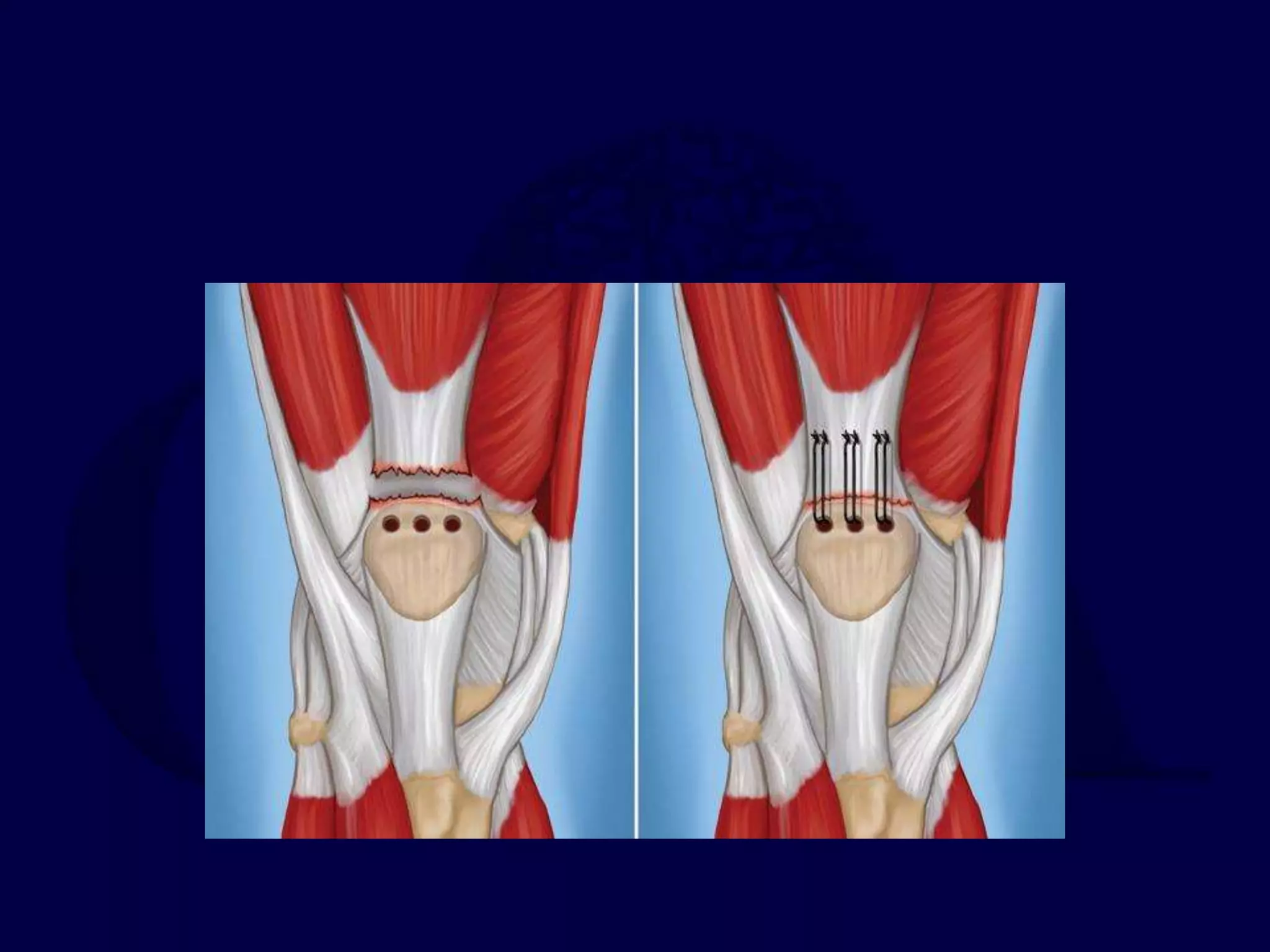
Operative Treatment-muscle-
tendon junction
• Reapproximation of tendon to bone using
nonabsorbable sutures with tears at the
muscle-tendon junction
• Early primary repair of quadriceps tendon
ruptures in recommended
Using suture anchor
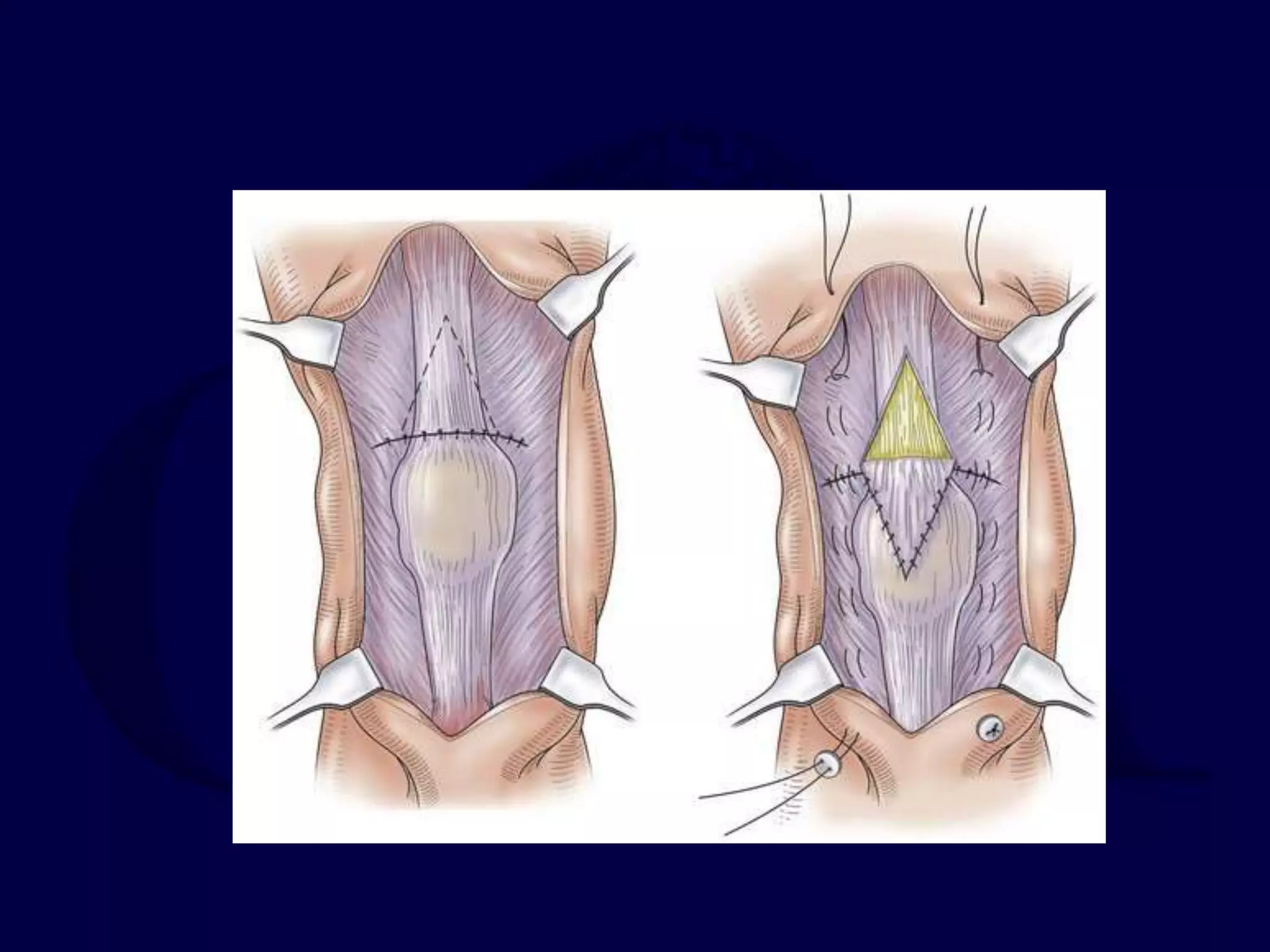
mid substance tear
mid substance tear –
acute -Scuderi technique
• The Scuderi technique for repairing acute
tears of the quadri- ceps tendon.
• (A) The torn edges of the quadriceps tendon
are debrided and repaired.
• (B) A triangular flap of the proximal
tendon is developed, folded distally over the
rupture, and sutured in place
chronic
Treatment
• Chronic tears may
require a V-Y
advancement of a
retracted quadriceps
tendon (Codivilla V-
Y-plasty Technique)
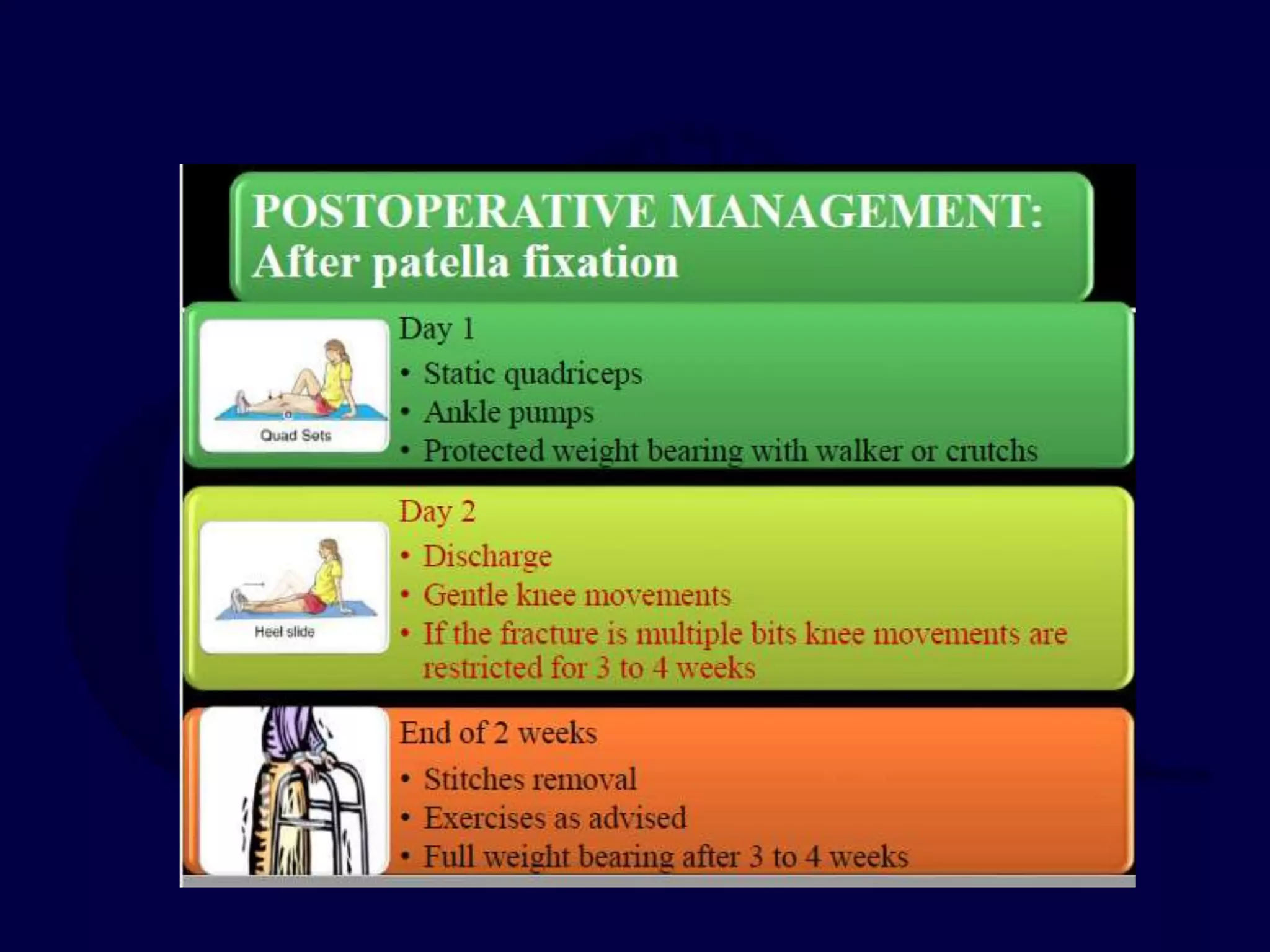
Postoperative Management
• Immediate weight-bearing as tolerated
• Knee immobilizer, Hinged Knee Brace, or
cylinder cast for 5-6 weeks
Complications
• Re rupture
• Persistent quadriceps
atrophy/weakness
• Loss of motion
• Infection
Patellar Tendon Rupture
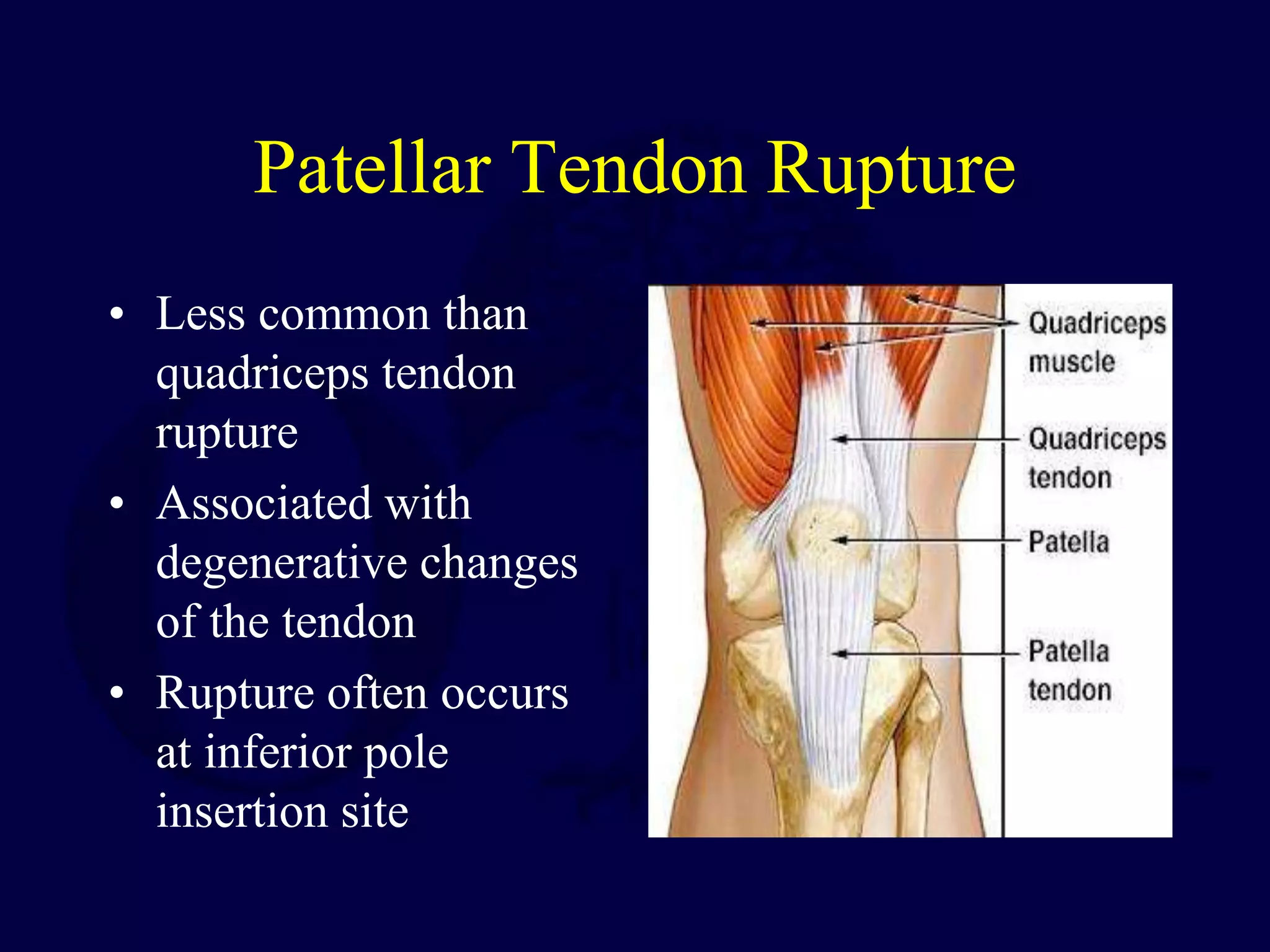
• Less common than
quadriceps tendon
rupture
• Associated with
degenerative changes
of the tendon
• Rupture often occurs
at inferior pole
insertion site
Patellar Tendon Rupture
• Risk Factors
– Rheumatoid arthritis
– Systemic Lupus
Erythematosus
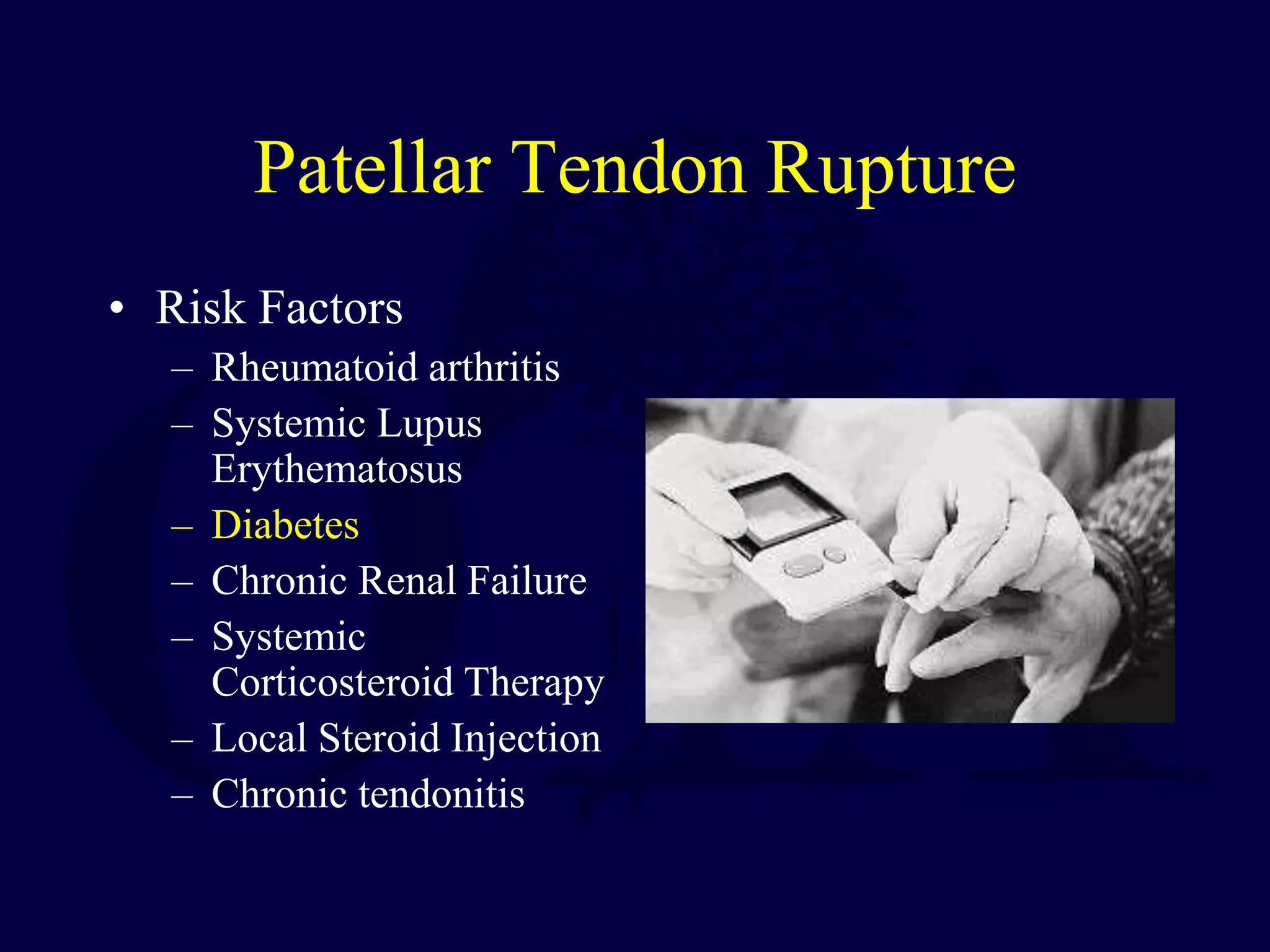
– Diabetes
– Chronic Renal Failure
– Systemic
Corticosteroid Therapy
– Local Steroid Injection
– Chronic tendonitis
History
• Often a report of
forceful quadriceps
contraction against a
flexed knee
• May experience and
audible “pop”
• Inability to weight
bear or extend the
knee
Physical Examination
• Palpable defect
• Hemarthrosis
• Painful passive knee
flexion
• Partial or complete
loss of active
extension
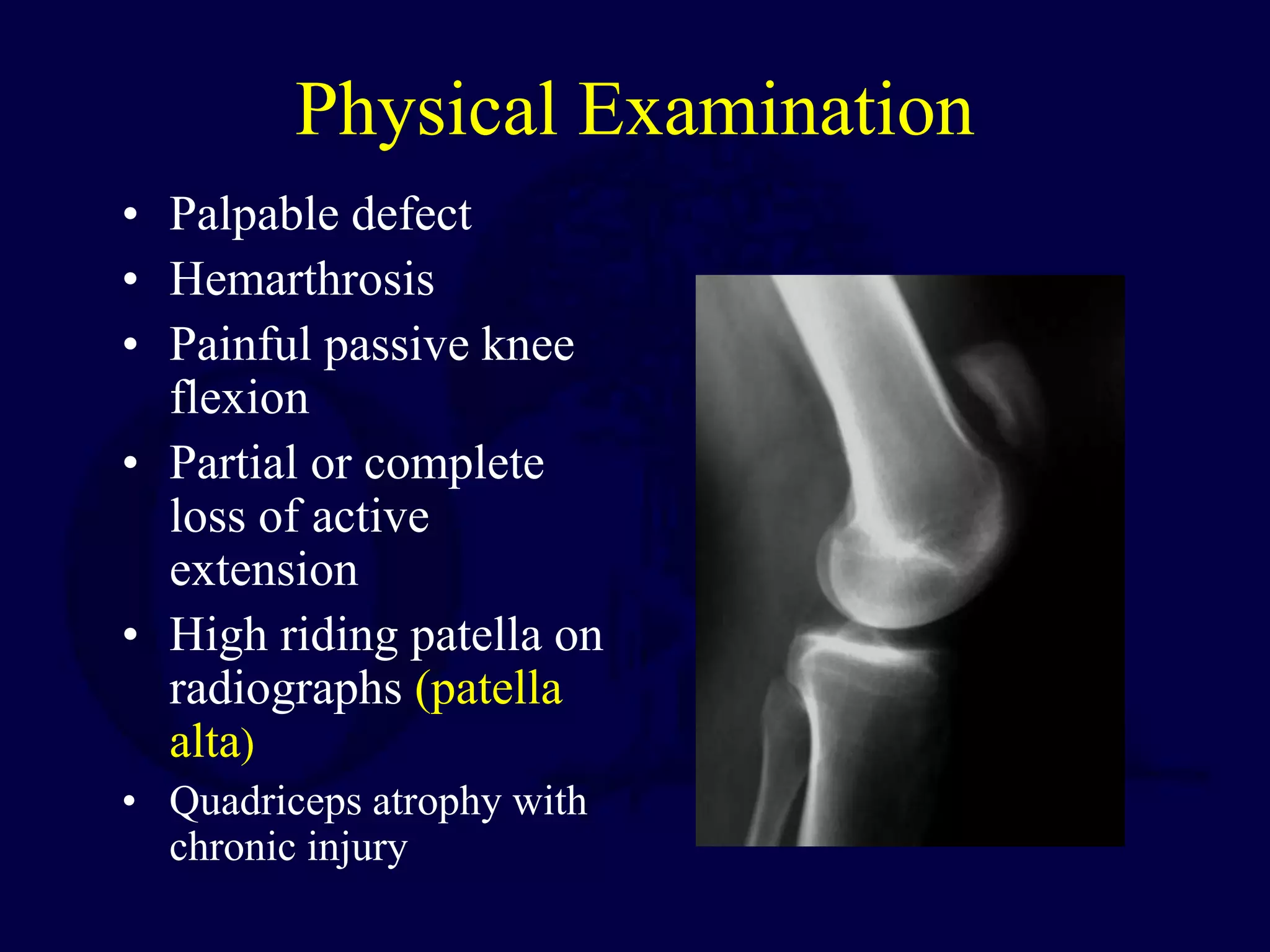
• High riding patella on
radiographs (patella
alta)
• Quadriceps atrophy with
chronic injury
Radiographic Evaluation
• AP and Lateral X-ray
– Patella alta seen on lateral view
• Patella superior to Blumensaat’s line
• Ultrasonagraphy
– Effective means to confirm diagnosis by determining
continuity of tendon
– Operator and reader dependant
• MRI
– Effective means to assess patellar tendon, especially if
other intraarticular or soft tissue injuries are suspected
– Relatively high cost
Patella alta
Classification
• No widely accepted means of classification
• Can be categorized by:
– Location of tear
• Proximal insertion most common
– Timing between injury and surgery
• Most important factor for prognosis
• Acute: < 2 weeks
• Chronic: > 2 weeks
Nonoperative Treatment of
Patellar Tedon Rupture
• Nonoperative treatment reserved for partial
tears in which patient able to fully extend
knee
• Treatment is immobilization in full
extension for 3-6 weeks
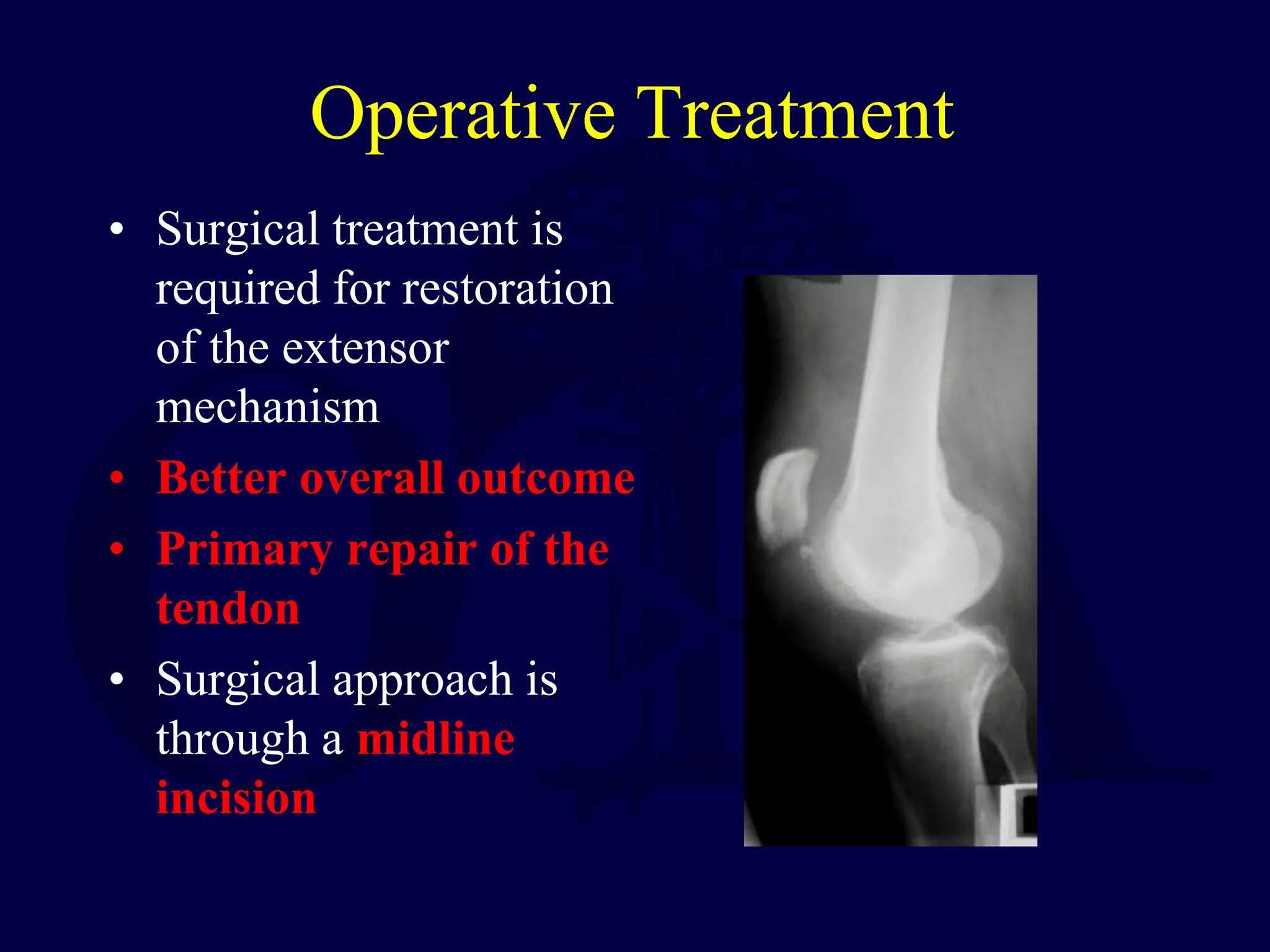
Operative Treatment
• Surgical treatment is
required for restoration
of the extensor
mechanism
• Better overall outcome
• Primary repair of the
tendon
• Surgical approach is
through a midline
incision
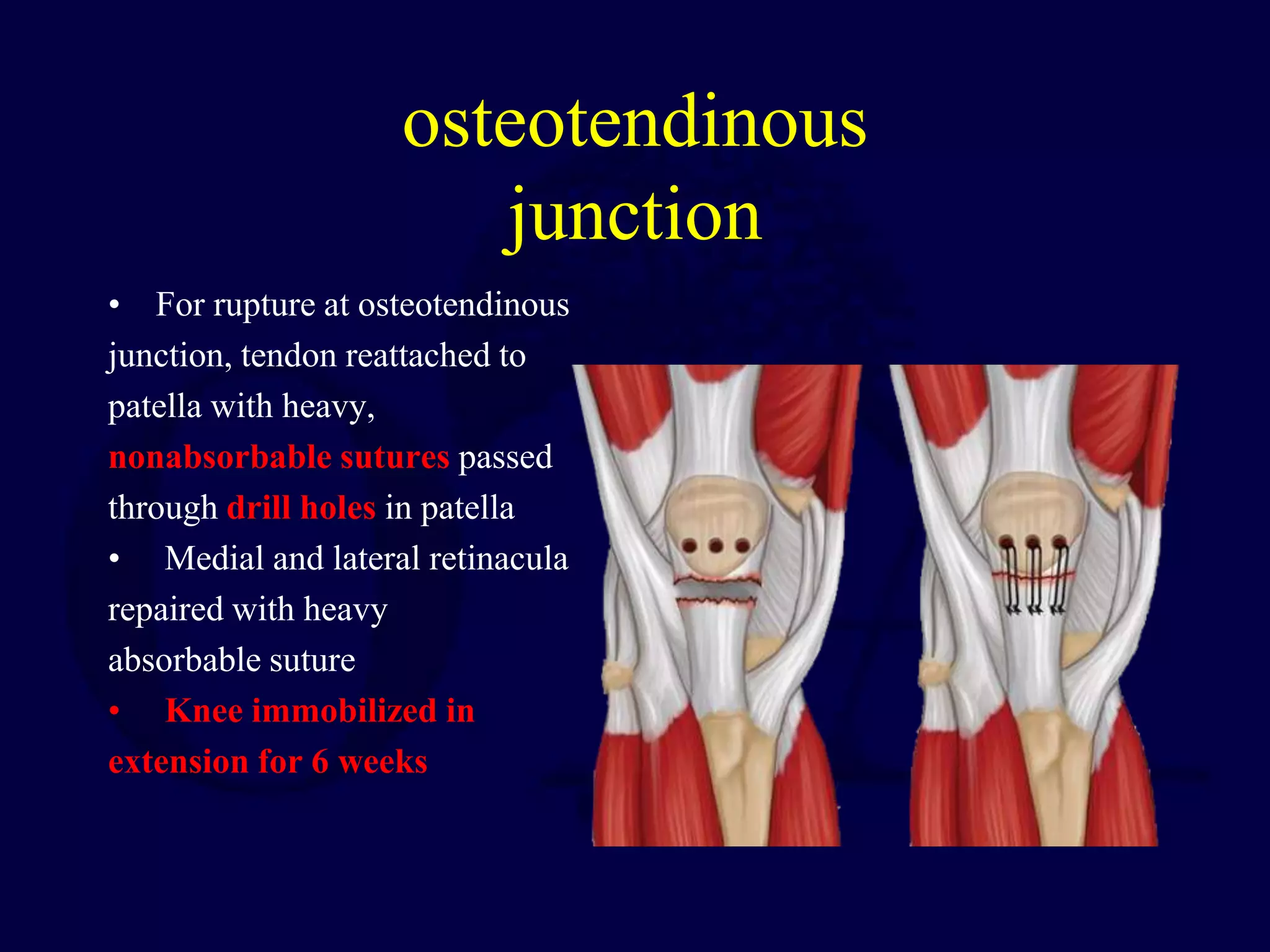
osteotendinous
junction
• For rupture at osteotendinous
junction, tendon reattached to
patella with heavy,
nonabsorbable sutures passed
through drill holes in patella
• Medial and lateral retinacula
repaired with heavy
absorbable suture
• Knee immobilized in
extension for 6 weeks
Postoperative Management
• More conservative when compared to early
repair
• Bivalved cylinder cast for 6 weeks; may
start passive range of motion
• Active range of motion is started at 6 weeks
Complications
• Knee stiffness
• Persistent extensor weakness
• Rerupture
• Infection
• Patella baja (Insall-Salvati ratio of < 0.8)
Thank You!

Patella fx and mechanism injuries

  • 1.
    Patella Fractures &Extensor Mechanism Injuries Dr P. ROHIT RAJ MBBS MS ORTHO ASSISTANT PROFESSOR ORTHOPAEDIC DEPARTMENT VISHWABHARATHI MEDICAL
  • 2.
    Patella Fractures &Extensor Mechanism Injuries
  • 4.
    Anatomy • Largest sesamoidbone • Thick articular cartilage proximally • Articular surface divided into medial and lateral facets by longitudinal ridge • Distal pole nonarticular
  • 5.
    Anatomy • Patellar Retinaculum –Longitudinal tendinous fibers – Patellofemoral ligaments • Blood Supply – Primarily derived from geniculate arteries
  • 6.
    Biomechanics • The patellais a link between the quadriceps tendon and patella tendon and is subject to significant forces. • The patella increases the leverage of the quadriceps muscle and elevates the extensor mechanism away from the axis of rotation of the knee joint. • The area of contact between the patella and distal femur varies according to the position of the knee.
  • 7.
    Classification • Allows guidancewith treatment • Types – Undisplaced – Transverse – Apex – Comminuted – Vertical – Osteochondral Tip: Vertical fractures may not result in disruption of extensor mechanism
  • 8.
  • 10.
    Transverse fracture • nondisplaced= medial and lateral retinaculum usually intact • Transverse fractures commonly result in wide fragment separation due to Strong ligamentous traction
  • 11.
    Vertical Fractures • Accountfor 22% of patella fractures* • Typically results from compression of patella with flexed knee • Sometimes only seen on sunrise view
  • 12.
    Stellate Fractures • Resultfrom direct blow • 65% of stellate fractures are displaced • May have associated articular damage to femoral condyles
  • 13.
  • 14.
  • 15.
    Insall- Salvati ratio, • TheInsall-Salvati ratio or index is the ratio of the patella tendon length to the length of the patella and is used to determine patellar height. • A: patellar tendon length (TL): length of the posterior surface of the tendon from the lower pole of the patella to its insertion on the tibia • B: patellar length (PL): greatest pole-to-pole length • Insall-Salvati ratio = A/B (or TL/PL)
  • 16.
    Interpretation • On plainradiographs: • patella baja: <0.8 • normal: 0.8-1.2 • patella alta: >1.2
  • 17.
    Patella alta • highriding patella, describes a situation where the position of the patella is considered high. It may be idiopathic or may result secondary to a patellar tendon rupture.
  • 18.
    Patellar tendon length(6cm) is > 20% than patellar length (4cm), consistent with a patella alta
  • 19.
    Patella baja • Patellabaja is an abnormally low lying patella, which is associated with restricted range of motion, crepitations, and retropatellar pain. If longstanding, extensor dysfunction may ensue with significant morbidity.
  • 20.
  • 24.
    Radiographic Evaluation • AP& Lateral – Note patella height (baja or alta) – Note fracture pattern • Articular step-off, diastasis • Marginal impaction • Special views – Axial or sunrise • CT Scan - Occult Fractures - Complex or Marginal Impaction Fractures
  • 26.
    sunrise (skyline) viewof the knee Normal appearing lateral knee radiograph in an elderly patient Sunrise View: Non-displaced Patellar Fracture of the same elderly patient with normal radiographs on the left.
  • 27.
  • 28.
  • 29.
    Radiographic Evaluation • BipartitePatella: • Don’t get fooled! – Obtain bilateral views – Often superolateral corner (Saupe Classification, 1923) – Accessory ossification center – Occurs 1-2% of patients
  • 32.
    Operative Treatment • Goals –Preserve extensor function – Restore articular congruency • indicated for displaced fractures and disruption of the extensor mechanism. • Approach – Longitudinal midline incision recommended – Transverse approach alternative (dotted lines) – potentially higher risk wound problems, can limit initiation of ROM – Consider future surgeries!
  • 33.
  • 34.
  • 35.
    Operative Techniques • K-wiresw/ tension band wiring (TBW) • Lag-screw fixation • Cannulated lag-screw with TBW (tension band screw – TBS) • Partial patellectomy • Total Patellectomy
  • 36.
    Tension Band Wiring •Transverse, non-comminuted fractures • Double Figure-8 wire for equal compression
  • 37.
    Tension Band Wiring •Wire converts anterior distractive forces to compressive forces at the articular surface • Retinacular Injury – Keep open until the end – Window to assess articular reduction – Repair the retinacular injury last
  • 39.
    Lag-Screw Fixation • Indicatedfor vertical fractures • Contraindicated for extensive comminution and osteopenic bone
  • 40.
  • 41.
    Cannulated Lag-Screw With TensionBand (TBS) • Partially threaded cannulated screws (4.0mm) • Wire through screws and across anterior patella in figure of eight tension band • Make sure tip of screw remains buried in bone so it will not compromise wire
  • 42.
    Cannulated Lag-Screw With TensionBand • More stable construct – Screws and tension band wire combination eliminates both possible separation seen at the fracture site with K wire/TBW and screw failure due to excessive three point bending
  • 43.
    Partial Patellectomy • Indicatedfor fractures involving extensive comminution not amenable to fixation • Larger fragments repaired with screws to preserve maximum cartilage • Smaller fragments excised – Usually involving the distal pole
  • 45.
    Total Patellectomy • Indicatedfor displaced, comminuted fractures not amenable to reconstruction • Bone fragments sharply dissected • Defect may be repaired through a variety of techniques
  • 49.
    Complications • Knee Stiffness –Most common complication • Infection – Rare, depends on soft tissue compromise • Loss of Fixation – Hardware failure in up to 20% of cases • Osteoarthritis – May result from articular damage or incongruity • Nonunion < 1% with surgical repair • Painful hardware – Removal required in approximately 15%
  • 50.
  • 51.
  • 52.
  • 53.
    Extensor Tendon Ruptures •Adolescent- avulsion tibial tubercle • Young adult sports-patellar ligament tear • Middle age adult -fracture of patella • Older people –quadriceps rupture • Mechanism – Fall – Sports “The weekend warrior” – MVA – Tendonopathies, Steroids, Renal Dialysis
  • 55.
    Quadriceps Tendon Rupture •Typically occurs in patients > 40 years old • Usually 0-2 cm above the superior pole • Level often associated with age – Rupture occurs at the bone-tendon junction in majority of patients > 40 years old – Rupture occurs at midsubstance in majority of patients < 40 years old
  • 56.
    Quadriceps Tendon Ruptures •Risk Factors – Chronic tendonitis – Anabolic steroid use – Local steroid injection – Inflammatory arthropathy – Chronic renal failure – Systemic disease
  • 57.
    History • Sensation ofa sudden pop while stressing the extensor mechanism (eccentric load) • Pain at the site of injury • Inability to extend the knee • Difficulty weight-bearing
  • 58.
    Physical Exam • Effusion •Tenderness at the upper pole • Palpable defect above superior pole • Loss of extension • With partial tears, extension will be intact
  • 60.
    MRI • Palpable defectproximal to superior pole of patella • If defect present but patient able to extend the knee then the extensor retinaculum is intact • If no active extension, then both tendon and retinaculum completely torn
  • 61.
    Quadriceps Tendon Rupture RadiographicEvaluation • X-ray- AP, Lateral, and Tangential (Sunrise, Merchant) – Distal displacement of the patella (patella baja) • MRI – Useful when diagnosis is unclear Treatment • Nonoperative – Partial tears and strains • Operative – For complete ruptures
  • 62.
    Nonoperative Treatment Quadriceps TendonRupture • Reserved for incomplete tears in which active, full knee extension is preserved • Immobilize leg in extension for approximately 4-6 weeks • Progressive physical therapy required to regain strength and motion
  • 63.
    Operative Treatment-muscle- tendon junction •Reapproximation of tendon to bone using nonabsorbable sutures with tears at the muscle-tendon junction • Early primary repair of quadriceps tendon ruptures in recommended
  • 65.
  • 66.
  • 67.
    mid substance tear– acute -Scuderi technique • The Scuderi technique for repairing acute tears of the quadri- ceps tendon. • (A) The torn edges of the quadriceps tendon are debrided and repaired. • (B) A triangular flap of the proximal tendon is developed, folded distally over the rupture, and sutured in place
  • 69.
    chronic Treatment • Chronic tearsmay require a V-Y advancement of a retracted quadriceps tendon (Codivilla V- Y-plasty Technique)
  • 70.
    Postoperative Management • Immediateweight-bearing as tolerated • Knee immobilizer, Hinged Knee Brace, or cylinder cast for 5-6 weeks
  • 71.
    Complications • Re rupture •Persistent quadriceps atrophy/weakness • Loss of motion • Infection
  • 72.
    Patellar Tendon Rupture •Less common than quadriceps tendon rupture • Associated with degenerative changes of the tendon • Rupture often occurs at inferior pole insertion site
  • 73.
    Patellar Tendon Rupture •Risk Factors – Rheumatoid arthritis – Systemic Lupus Erythematosus – Diabetes – Chronic Renal Failure – Systemic Corticosteroid Therapy – Local Steroid Injection – Chronic tendonitis
  • 74.
    History • Often areport of forceful quadriceps contraction against a flexed knee • May experience and audible “pop” • Inability to weight bear or extend the knee
  • 75.
    Physical Examination • Palpabledefect • Hemarthrosis • Painful passive knee flexion • Partial or complete loss of active extension • High riding patella on radiographs (patella alta) • Quadriceps atrophy with chronic injury
  • 77.
    Radiographic Evaluation • APand Lateral X-ray – Patella alta seen on lateral view • Patella superior to Blumensaat’s line • Ultrasonagraphy – Effective means to confirm diagnosis by determining continuity of tendon – Operator and reader dependant • MRI – Effective means to assess patellar tendon, especially if other intraarticular or soft tissue injuries are suspected – Relatively high cost
  • 78.
  • 79.
    Classification • No widelyaccepted means of classification • Can be categorized by: – Location of tear • Proximal insertion most common – Timing between injury and surgery • Most important factor for prognosis • Acute: < 2 weeks • Chronic: > 2 weeks
  • 81.
    Nonoperative Treatment of PatellarTedon Rupture • Nonoperative treatment reserved for partial tears in which patient able to fully extend knee • Treatment is immobilization in full extension for 3-6 weeks
  • 82.
    Operative Treatment • Surgicaltreatment is required for restoration of the extensor mechanism • Better overall outcome • Primary repair of the tendon • Surgical approach is through a midline incision
  • 83.
    osteotendinous junction • For ruptureat osteotendinous junction, tendon reattached to patella with heavy, nonabsorbable sutures passed through drill holes in patella • Medial and lateral retinacula repaired with heavy absorbable suture • Knee immobilized in extension for 6 weeks
  • 85.
    Postoperative Management • Moreconservative when compared to early repair • Bivalved cylinder cast for 6 weeks; may start passive range of motion • Active range of motion is started at 6 weeks
  • 86.
    Complications • Knee stiffness •Persistent extensor weakness • Rerupture • Infection • Patella baja (Insall-Salvati ratio of < 0.8)
  • 87.