
EXTENSOR MECHANISM OF
KNEE
INTRODUCTION
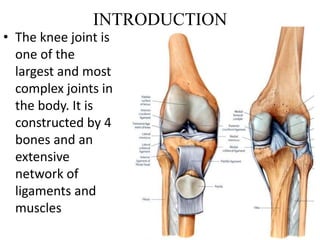
• The knee joint is
one of the
largest and most
complex joints in
the body. It is
constructed by 4
bones and an
extensive
network of
ligaments and
muscles
• Tibia femoral joint
rotation
translations
screw home mechanism
• Axial & rotation alignment of the knee
• Patello femoral joint
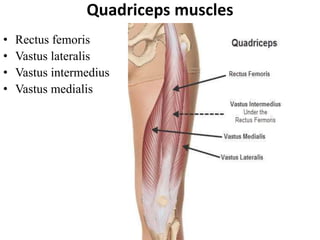
Quadriceps muscles
• Rectus femoris
• Vastus lateralis
• Vastus intermedius
• Vastus medialis
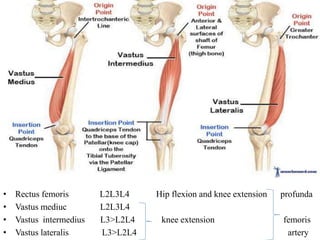
• Rectus femoris L2L3L4 Hip flexion and knee extension profunda
• Vastus mediuc L2L3L4
• Vastus intermedius L3>L2L4 knee extension femoris
• Vastus lateralis L3>L2L4 artery
• ANTERIOR LAYER : Direct attachment by RF
to patella
• INTERMEDIATE LAYER :
By attachment of VM and VL
VL blended with the lateral patellar retinaculum
and direct tibial insertion
VM is more distally attached to patella
• DEEP LAYER :Formed by tendon of vastus
intermedius
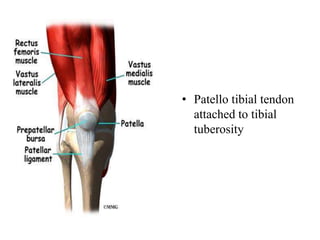
• Patello tibial tendon
attached to tibial
tuberosity
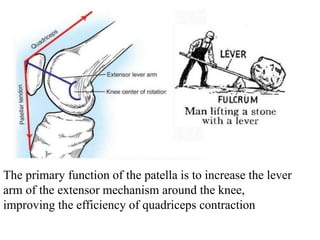
The primary function of the patella is to increase the lever
arm of the extensor mechanism around the knee,
improving the efficiency of quadriceps contraction
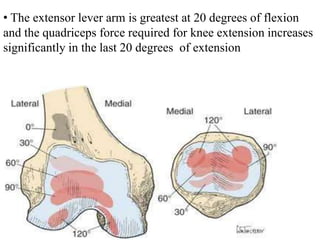
• The extensor lever arm is greatest at 20 degrees of flexion
and the quadriceps force required for knee extension increases
significantly in the last 20 degrees of extension
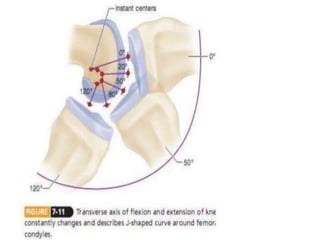
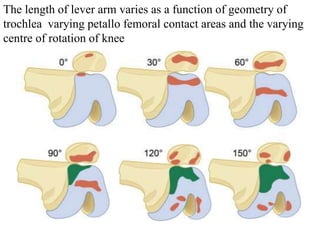
The length of lever arm varies as a function of geometry of
trochlea varying petallo femoral contact areas and the varying
centre of rotation of knee
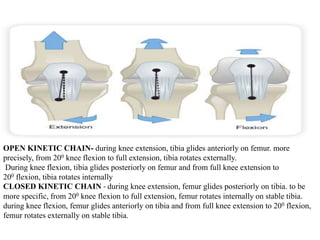
OPEN KINETIC CHAIN- during knee extension, tibia glides anteriorly on femur. more
precisely, from 200 knee flexion to full extension, tibia rotates externally.
During knee flexion, tibia glides posteriorly on femur and from full knee extension to
200 flexion, tibia rotates internally
CLOSED KINETIC CHAIN - during knee extension, femur glides posteriorly on tibia. to be
more specific, from 200 knee flexion to full extension, femur rotates internally on stable tibia.
during knee flexion, femur glides anteriorly on tibia and from full knee extension to 200 flexion,
femur rotates externally on stable tibia.
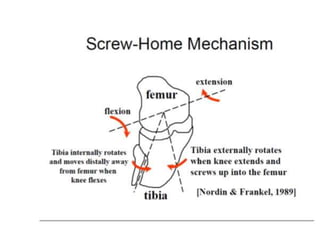
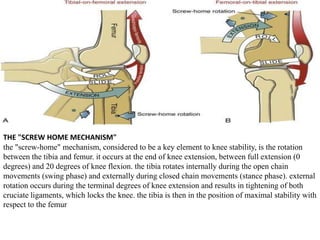
THE "SCREW HOME MECHANISM"
the "screw-home" mechanism, considered to be a key element to knee stability, is the rotation
between the tibia and femur. it occurs at the end of knee extension, between full extension (0
degrees) and 20 degrees of knee flexion. the tibia rotates internally during the open chain
movements (swing phase) and externally during closed chain movements (stance phase). external
rotation occurs during the terminal degrees of knee extension and results in tightening of both
cruciate ligaments, which locks the knee. the tibia is then in the position of maximal stability with
respect to the femur
THANK YOU

Extensor mechanism of knee

  • 1.
  • 2.
    INTRODUCTION • The kneejoint is one of the largest and most complex joints in the body. It is constructed by 4 bones and an extensive network of ligaments and muscles
  • 3.
    • Tibia femoraljoint rotation translations screw home mechanism • Axial & rotation alignment of the knee • Patello femoral joint
  • 4.
    Quadriceps muscles • Rectusfemoris • Vastus lateralis • Vastus intermedius • Vastus medialis
  • 5.
    • Rectus femorisL2L3L4 Hip flexion and knee extension profunda • Vastus mediuc L2L3L4 • Vastus intermedius L3>L2L4 knee extension femoris • Vastus lateralis L3>L2L4 artery
  • 6.
    • ANTERIOR LAYER: Direct attachment by RF to patella • INTERMEDIATE LAYER : By attachment of VM and VL VL blended with the lateral patellar retinaculum and direct tibial insertion VM is more distally attached to patella • DEEP LAYER :Formed by tendon of vastus intermedius
  • 7.
    • Patello tibialtendon attached to tibial tuberosity
  • 8.
    The primary functionof the patella is to increase the lever arm of the extensor mechanism around the knee, improving the efficiency of quadriceps contraction
  • 10.
    • The extensorlever arm is greatest at 20 degrees of flexion and the quadriceps force required for knee extension increases significantly in the last 20 degrees of extension
  • 11.
    The length oflever arm varies as a function of geometry of trochlea varying petallo femoral contact areas and the varying centre of rotation of knee
  • 12.
    OPEN KINETIC CHAIN-during knee extension, tibia glides anteriorly on femur. more precisely, from 200 knee flexion to full extension, tibia rotates externally. During knee flexion, tibia glides posteriorly on femur and from full knee extension to 200 flexion, tibia rotates internally CLOSED KINETIC CHAIN - during knee extension, femur glides posteriorly on tibia. to be more specific, from 200 knee flexion to full extension, femur rotates internally on stable tibia. during knee flexion, femur glides anteriorly on tibia and from full knee extension to 200 flexion, femur rotates externally on stable tibia.
  • 14.
    THE "SCREW HOMEMECHANISM" the "screw-home" mechanism, considered to be a key element to knee stability, is the rotation between the tibia and femur. it occurs at the end of knee extension, between full extension (0 degrees) and 20 degrees of knee flexion. the tibia rotates internally during the open chain movements (swing phase) and externally during closed chain movements (stance phase). external rotation occurs during the terminal degrees of knee extension and results in tightening of both cruciate ligaments, which locks the knee. the tibia is then in the position of maximal stability with respect to the femur
  • 15.