• Largest sesamoid
bone
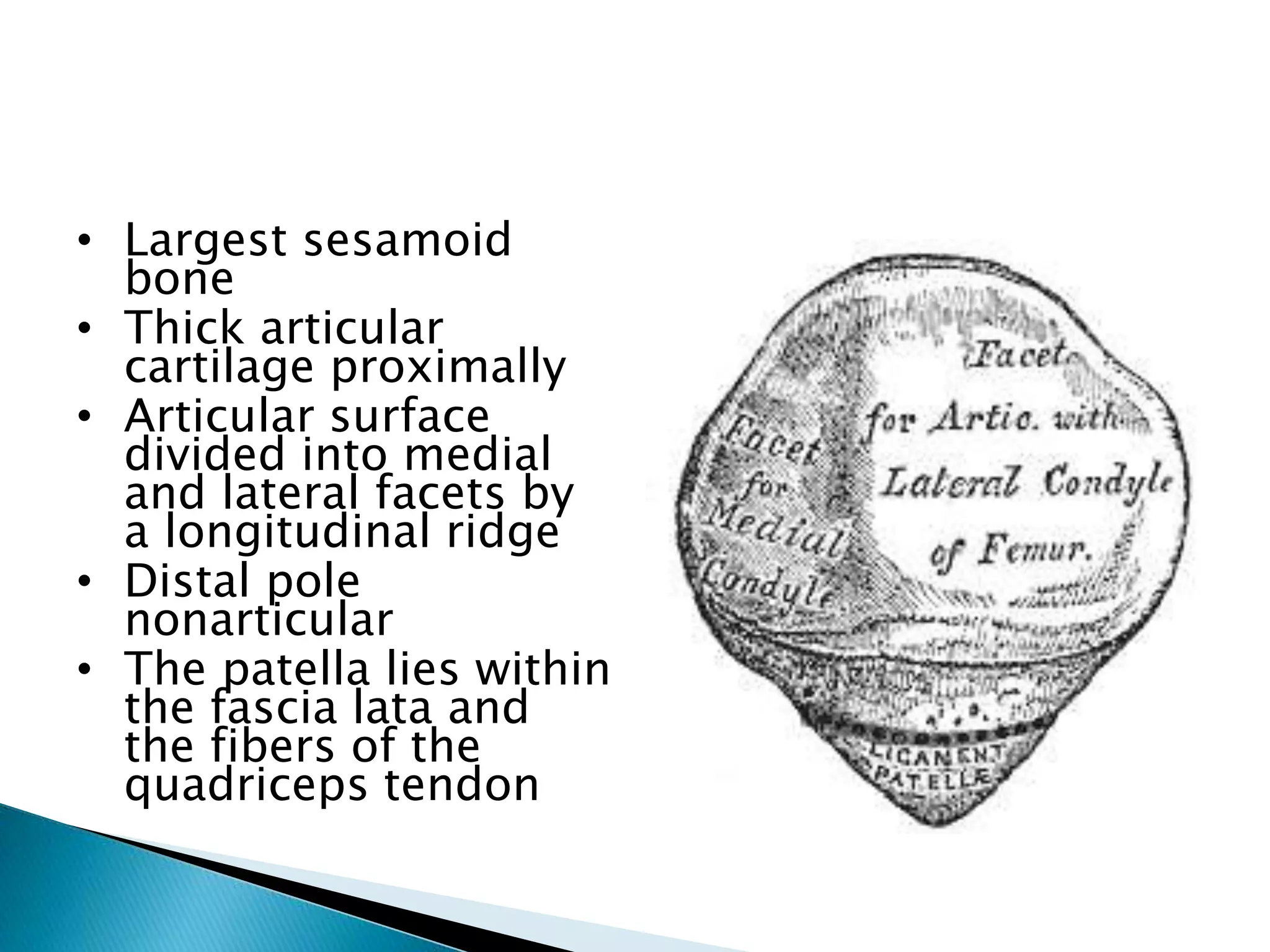
• Thick articular
cartilage proximally
• Articular surface
divided into medial
and lateral facets by
a longitudinal ridge
• Distal pole
nonarticular
• The patella lies within
the fascia lata and
the fibers of the
quadriceps tendon
 Extraosseous and Intraosseous vascular systems
 The primary blood supply to the patella is from a
dorsal arterial ring derived from branches of the
geniculate anastomotic system around the knee
 The arterial ring is made up of a central superior
geniculate vessel; medial, lateral superior, and
lateral inferior geniculate vessels; and an inferior
recurrent tibial vessel
 The primary intraosseous blood supply of the
patella enters the bone by vessels through the
middle of the anterior portion of the body of the
patella and through the distal pole vessels
 The patellar retinaculum derives from the deep
investing fascia lata in combination with the
aponeurotic fibers from the vastus medialis and
vastus lateralis
 The retinaculum inserts directly into the proximal
tibia
 Contributions from the lateral aspect of the vastus
lateralis, iliotibial tract, and patellofemoral ligaments
of the joint capsule help to complete the retinaculum
 The patella tendon originates at the apex of the
patella and inserts into the tibial tubercle
 The patella retinaculum and the iliotibial track fibers
blend into the patella tendon at the insertion on the
anterior portion of the proximal tibia.
 PATELLA CAN BE DISPLACED UPWARDS-
PATELLA ALTA
 DOWN WARDS-PATELLA INFERA
 LATERAL
 MEDIAL
 LATERAL COMMON, ALL OTHES RARE
 LATERAL DISLOCATION IS THE MOST LIABLE
TO RECURRENT DISLOCATION/HABITUAL
DISLOCATION.
 MORE COMMON IN FEMALES
 Q ANGLE-MALES 8-10
 FEMALES 15
 FACTORS THAT INCREASE Q ANGLE CAUSE
RECURRENT PATELLAR DISLOCATION
 The Q(quadriceps)
angle is measured
from the anterior
superior iliac spine
through the patella
and to the tibial
tubercle
 Subluxation or dislocation of the
patellofemoral joint most commonly occurs
secondary to a rotational or twisting injury
with simultaneous contraction of the
quadriceps.
 Less commonly glancing blows to the knee
can cause dislocation of the patella
 Increased Q angle (laterally inserted patellar
tendon, excessive tibial external rotation or
genu valgum, femoral anteversion or internal
rotation)
 Patella alta
 Insufficient lateral trochlea or shallow
patellofemoral groove
 Vastus medialis atrophy
 Insufficient medial patellofemoral ligament
 Genu recurvatum or patellar hypermobility
 Severe pain, deformity of the anterior knee and
flexed position is characteristic of an acutely
dislocated patella
 Palpation will reveal the abnormal position of the
patella
 Patellofempral crepitus is palpable
 Wasting of quadriceps and vastus medialis
 Frequently patella reduces spontaneous
 When the patella is reduced by the knee being
straightened manually by an observer, usually a
loud pop or crack is noted with significant
improvement in pain
 Examination of the reduced patellar
dislocation reveals a large effusion and
medial patellar tenderness
 Occasionally a defect in the medial
retinaculum can be palpated
 Flexion is limited due to the medial soft
tissue injury and the presence of the large
effusion
 Usually tenderness + in the area of the
superior medial pole of the patella
 Palpation of the undersurface of the patella
and the lateral femoral condylar edge are
helpful in identifying an acute osteochondral
fracture
 In the presence of a loose articular piece >
mechanical locking symptoms
 With a recurrent patellar dislocation or
subluxation, the swelling and pain are usually
less than those of the first injury
 Anteroposterior, tunnel, lateral and axial
patellofemoral views (most commonly the
technique of Merchant)
 Bilateral views
 Tunnel views – evaluating loose bodies that can
come to lie in the femoral notch
 Anteroposterior views – evaluation of patellar
shape, partition and evidence of fracture
 Lateral view – determination of patellar height,
fractures and patellofemoral arthritic changes
 Axial views (sunrise view) – evaluating
intraarticular fractures, trochlear position of the
patella, patellofemoral arthritis and avulsion
injury of the medial patellofemoral ligament
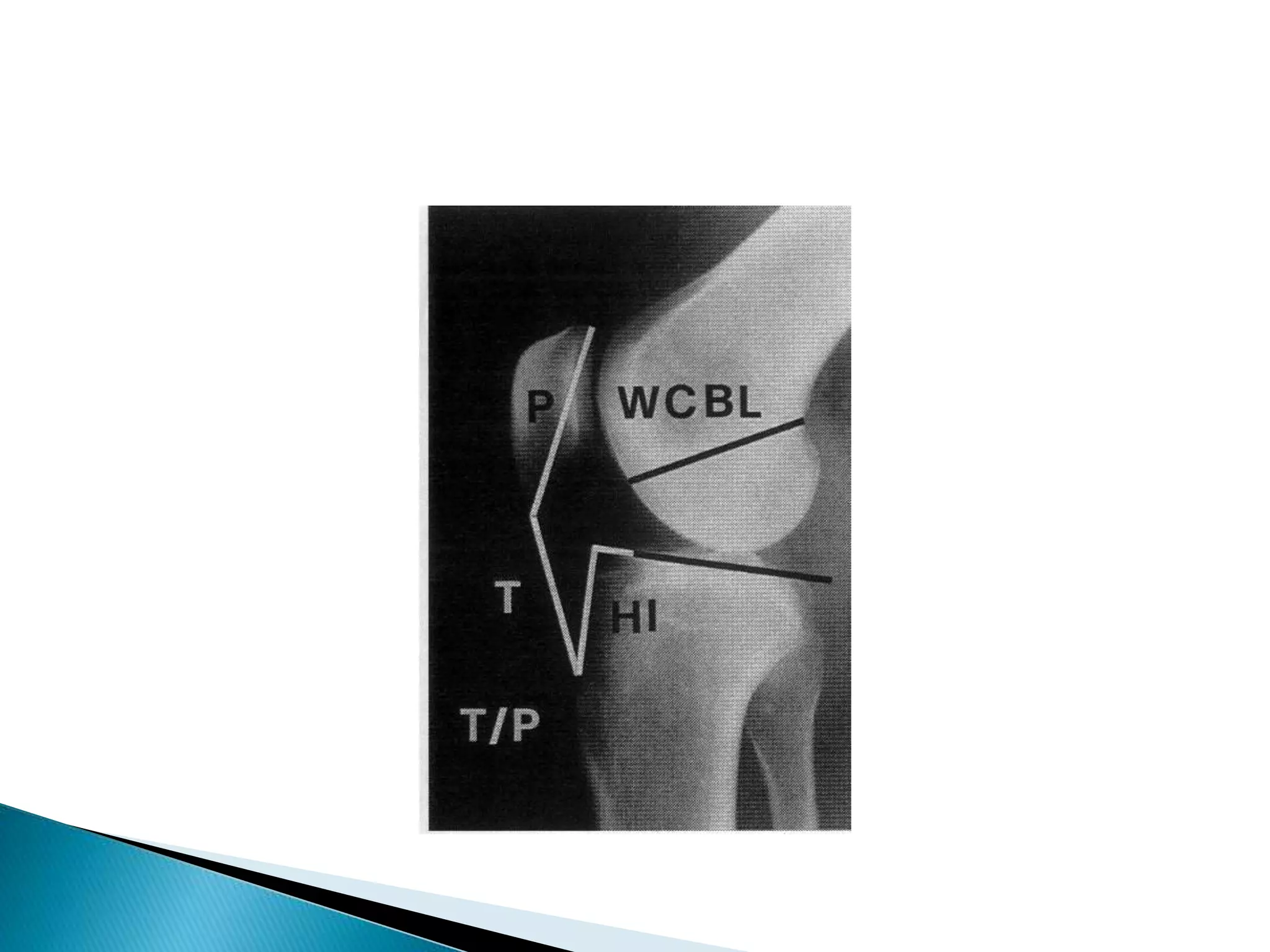
 Evaluation of patellar height for recognition
of patella alta or infera is routinely performed
on a lateral view
 Insall and Salvati
 A ratio is measured between the length of the
patella and that of the patellar tendon
 On average the ratio of LT/LP is 1.02 with a
standard deviation of 0.13
 A ratio of 0.80 or less > patella infera, >1.20
patella alta

 Conservative management should be used
when possible and includes maintenance of
quadriceps strength, functional retraining and
control of swelling and pain
 Surgical techniques should be used for
chronic patellar problems only after
conservative treatment has failed over a
significant time period usually 4 to 6 months
 Closed reduction can be performed
 Extensor mechanism integrity evaluated
 Quality of reduction assessed
 Intraarticular fragments looked for
 Asymmetrically subluxed or tilted patella or
evidence of an intraarticular fragment are
indications for operative treatment with repair
of the medial patellofemoral ligament, lateral
release and removal or internal fixation of the
osteochondral fragment
 Non Operative treatment includes casting in
extension for 6 weeks and early range of
motion exercises with functional
rehabilitation
 LATERAL RETINACULAR RELEASE
 PROXIMAL EXTENSOR REALIGNEMENT
 DISTAL EXTENSOR REALIGNMENT
 PROXIMAL AND DISTAL REALIGNEMENT
 PATELLECTOMY WITH EXTENSOR
REALIGNEMENT
 DURING ALL SURGICAL PROCEDURES
THOROUGH LOOK OF ARTICULAR SURFACE
NECCESARY
 Surgical repair involves EUA followed by a
thorough evaluation of the articular surfaces to
rule out a chondral or osteochondral fracture
 Small patellar fragments should be debrided
 Large fragments or those that involve the femoral
weight-bearing surface should be reduced and
fixed using biodegradable implants
 Repair of the medial patellofemoral ligament and
torn retinaculum
 Overtensioning may cause medial subluxation of
the patella
 Indications for a lateral release involve
preexisting tilt, increased Q angle and lateral
patellar subluxation
 Thank You

Dislocation of patella

  • 2.
    • Largest sesamoid bone •Thick articular cartilage proximally • Articular surface divided into medial and lateral facets by a longitudinal ridge • Distal pole nonarticular • The patella lies within the fascia lata and the fibers of the quadriceps tendon
  • 3.
     Extraosseous andIntraosseous vascular systems  The primary blood supply to the patella is from a dorsal arterial ring derived from branches of the geniculate anastomotic system around the knee  The arterial ring is made up of a central superior geniculate vessel; medial, lateral superior, and lateral inferior geniculate vessels; and an inferior recurrent tibial vessel  The primary intraosseous blood supply of the patella enters the bone by vessels through the middle of the anterior portion of the body of the patella and through the distal pole vessels
  • 4.
     The patellarretinaculum derives from the deep investing fascia lata in combination with the aponeurotic fibers from the vastus medialis and vastus lateralis  The retinaculum inserts directly into the proximal tibia  Contributions from the lateral aspect of the vastus lateralis, iliotibial tract, and patellofemoral ligaments of the joint capsule help to complete the retinaculum  The patella tendon originates at the apex of the patella and inserts into the tibial tubercle  The patella retinaculum and the iliotibial track fibers blend into the patella tendon at the insertion on the anterior portion of the proximal tibia.
  • 6.
     PATELLA CANBE DISPLACED UPWARDS- PATELLA ALTA  DOWN WARDS-PATELLA INFERA  LATERAL  MEDIAL  LATERAL COMMON, ALL OTHES RARE
  • 7.
     LATERAL DISLOCATIONIS THE MOST LIABLE TO RECURRENT DISLOCATION/HABITUAL DISLOCATION.  MORE COMMON IN FEMALES  Q ANGLE-MALES 8-10  FEMALES 15  FACTORS THAT INCREASE Q ANGLE CAUSE RECURRENT PATELLAR DISLOCATION
  • 8.
     The Q(quadriceps) angleis measured from the anterior superior iliac spine through the patella and to the tibial tubercle
  • 9.
     Subluxation ordislocation of the patellofemoral joint most commonly occurs secondary to a rotational or twisting injury with simultaneous contraction of the quadriceps.  Less commonly glancing blows to the knee can cause dislocation of the patella
  • 10.
     Increased Qangle (laterally inserted patellar tendon, excessive tibial external rotation or genu valgum, femoral anteversion or internal rotation)  Patella alta  Insufficient lateral trochlea or shallow patellofemoral groove  Vastus medialis atrophy  Insufficient medial patellofemoral ligament  Genu recurvatum or patellar hypermobility
  • 11.
     Severe pain,deformity of the anterior knee and flexed position is characteristic of an acutely dislocated patella  Palpation will reveal the abnormal position of the patella  Patellofempral crepitus is palpable  Wasting of quadriceps and vastus medialis  Frequently patella reduces spontaneous  When the patella is reduced by the knee being straightened manually by an observer, usually a loud pop or crack is noted with significant improvement in pain
  • 12.
     Examination ofthe reduced patellar dislocation reveals a large effusion and medial patellar tenderness  Occasionally a defect in the medial retinaculum can be palpated  Flexion is limited due to the medial soft tissue injury and the presence of the large effusion  Usually tenderness + in the area of the superior medial pole of the patella
  • 13.
     Palpation ofthe undersurface of the patella and the lateral femoral condylar edge are helpful in identifying an acute osteochondral fracture  In the presence of a loose articular piece > mechanical locking symptoms  With a recurrent patellar dislocation or subluxation, the swelling and pain are usually less than those of the first injury
  • 14.
     Anteroposterior, tunnel,lateral and axial patellofemoral views (most commonly the technique of Merchant)  Bilateral views
  • 15.
     Tunnel views– evaluating loose bodies that can come to lie in the femoral notch  Anteroposterior views – evaluation of patellar shape, partition and evidence of fracture  Lateral view – determination of patellar height, fractures and patellofemoral arthritic changes  Axial views (sunrise view) – evaluating intraarticular fractures, trochlear position of the patella, patellofemoral arthritis and avulsion injury of the medial patellofemoral ligament
  • 16.
     Evaluation ofpatellar height for recognition of patella alta or infera is routinely performed on a lateral view  Insall and Salvati  A ratio is measured between the length of the patella and that of the patellar tendon  On average the ratio of LT/LP is 1.02 with a standard deviation of 0.13  A ratio of 0.80 or less > patella infera, >1.20 patella alta 
  • 18.
     Conservative managementshould be used when possible and includes maintenance of quadriceps strength, functional retraining and control of swelling and pain  Surgical techniques should be used for chronic patellar problems only after conservative treatment has failed over a significant time period usually 4 to 6 months
  • 19.
     Closed reductioncan be performed  Extensor mechanism integrity evaluated  Quality of reduction assessed  Intraarticular fragments looked for  Asymmetrically subluxed or tilted patella or evidence of an intraarticular fragment are indications for operative treatment with repair of the medial patellofemoral ligament, lateral release and removal or internal fixation of the osteochondral fragment
  • 20.
     Non Operativetreatment includes casting in extension for 6 weeks and early range of motion exercises with functional rehabilitation
  • 21.
     LATERAL RETINACULARRELEASE  PROXIMAL EXTENSOR REALIGNEMENT  DISTAL EXTENSOR REALIGNMENT  PROXIMAL AND DISTAL REALIGNEMENT  PATELLECTOMY WITH EXTENSOR REALIGNEMENT  DURING ALL SURGICAL PROCEDURES THOROUGH LOOK OF ARTICULAR SURFACE NECCESARY
  • 22.
     Surgical repairinvolves EUA followed by a thorough evaluation of the articular surfaces to rule out a chondral or osteochondral fracture  Small patellar fragments should be debrided  Large fragments or those that involve the femoral weight-bearing surface should be reduced and fixed using biodegradable implants  Repair of the medial patellofemoral ligament and torn retinaculum  Overtensioning may cause medial subluxation of the patella
  • 23.
     Indications fora lateral release involve preexisting tilt, increased Q angle and lateral patellar subluxation
  • 24.