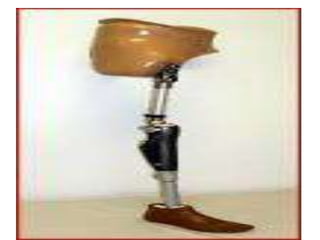
Disarticulation prosthesis
•Individuals with knee and hip disarticulation
wear prostheses that include the same distal
components as prostheses for lower levels.
•Any prosthetic foot can be used with either
an endoskeleton or exoskeleton shank. The
major distinction, therefore, is in the
proximal portion of the prostheses.
Hip disarticulation prostheses
•Fitted to a person with amputation above the
greater trochanter , removal of the femoral head
from acetabulum, or removal of the femur and
some portion of the pelvis (transfemoral
amputation or hemipelvectomy).
•Prostheses for proximal levels share common hip,
knee, and foot assemblies and alignment, but
differ with regard to socket design.
•The endoskeletal thigh and shank predominate b/c
they afford appreciable weight saving in these
massive prostheses.
SOCKET
Plastic molded to provide weightbearing on the
ipsilateral ischial tuberosity and buttocks. The
person with transpelvic amputation who does not
retain the ipsilateral tuberosity or iliac crest has a
socket with a higher proximal trimline, sometimes
encompassing the lower thorax.
Hip Unit
•The jt have an extension aid to bias the prosthesis
towards the stable neutral position.
•Positioning the mechanical hip ant to a point
corresponding to the anatomical hip also
contributes to hip stability.
•The jt is set below the normal hip, so that with
sitting , the prosthetic thigh will not protrude
unattractively.
Knee Unit
•Several units are specifically manufactured for
knee disarticulation. One may choose among
hydraulic, pneumatic, and sliding friction unit, with
or without polycentric linkage. Even with a special
knee unit , thigh will be slightly longer.
Consequently the shank is shortened equivalently,
so that when pt stands, the pelvis is level.
stability
•Several attributes combine ……. Stability
•Eg hip extension aid, ant placement of hip jt,
•Post placement of the knee unit & knee extension
aid.
•Pros may be shortened slightly, primarily to aid
clearance during swing phase, but also to
encourage the wearer to apply maximum weight
to the prosthesis and to increase stability.
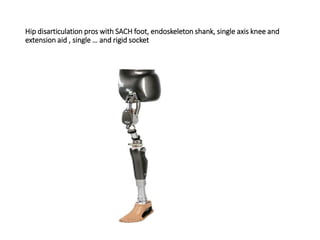
Hip disarticulation pros with SACH foot, endoskeleton shank, single axis knee and
extension aid , single … and rigid socket
Disarticulated arthosis

Disarticulated arthosis

  • 1.
  • 2.
    •Individuals with kneeand hip disarticulation wear prostheses that include the same distal components as prostheses for lower levels. •Any prosthetic foot can be used with either an endoskeleton or exoskeleton shank. The major distinction, therefore, is in the proximal portion of the prostheses.
  • 3.
    Hip disarticulation prostheses •Fittedto a person with amputation above the greater trochanter , removal of the femoral head from acetabulum, or removal of the femur and some portion of the pelvis (transfemoral amputation or hemipelvectomy). •Prostheses for proximal levels share common hip, knee, and foot assemblies and alignment, but differ with regard to socket design. •The endoskeletal thigh and shank predominate b/c they afford appreciable weight saving in these massive prostheses.
  • 4.
    SOCKET Plastic molded toprovide weightbearing on the ipsilateral ischial tuberosity and buttocks. The person with transpelvic amputation who does not retain the ipsilateral tuberosity or iliac crest has a socket with a higher proximal trimline, sometimes encompassing the lower thorax.
  • 5.
    Hip Unit •The jthave an extension aid to bias the prosthesis towards the stable neutral position. •Positioning the mechanical hip ant to a point corresponding to the anatomical hip also contributes to hip stability. •The jt is set below the normal hip, so that with sitting , the prosthetic thigh will not protrude unattractively.
  • 6.
    Knee Unit •Several unitsare specifically manufactured for knee disarticulation. One may choose among hydraulic, pneumatic, and sliding friction unit, with or without polycentric linkage. Even with a special knee unit , thigh will be slightly longer. Consequently the shank is shortened equivalently, so that when pt stands, the pelvis is level.
  • 7.
    stability •Several attributes combine……. Stability •Eg hip extension aid, ant placement of hip jt, •Post placement of the knee unit & knee extension aid. •Pros may be shortened slightly, primarily to aid clearance during swing phase, but also to encourage the wearer to apply maximum weight to the prosthesis and to increase stability.
  • 8.
    Hip disarticulation proswith SACH foot, endoskeleton shank, single axis knee and extension aid , single … and rigid socket