PARAPLEGIA
A TEXTBOOK CASE

   Chair:- Prof. Dr. Baby Paul
             Presenter: Dr.Shybin Usman
STRIKE ONE

 Mr. Gopakumar, 28 years from Neyyatinkara.
 Working in the BSF & posted in Bengal.
 Developed a nagging backache.
 Admitted in a local hospital near his base on
  17/10/07.
 D/D on 20/10/07 as he was better.
STRIKE TWO
 Backache was back by 23/10/07.
 Shooting pain radiating from back to
  umbilicus.
 Noticed gradually developing weakness of
  both lower limbs.
 Admitted from 23/10/07 to 31/10/07.
 Symptoms grew worse and he got on the next
  train home.
STRIKE THREE
 Reached here on 3/11/07.
 Weakness of lower limbs was complete.
 Had lost all sensation in both lower limbs.
 In the final day of journey high grade fever set
  in.
 Backache was very severe with difficulty in
  lying on his back.
SNIPPETS
 No significant medical past history.
 H/o haemorrhoidectomy 7 years ago.
 Occasional alcoholic.
 Non smoker.
PRESENTING PICTURE
 Moderately built and nourished.
 Concious and oriented.
 Febrile.
 No PICCLE, conjunctival congestion.
 Chest – Clear.
 CVS – WNL.
 Abdomen – Bladder distended.
 Spine - Tenderness at D12 spine.
NEUROLOGIC DEFICITS
 Grade 0 power both LL.
 Reflexes totally absent below the level of
  umbilicus.
 Sensations totally absent below the level of
  umbilicus.
 Bladder was distended.
 Rest of the nervous system examination was
  normal.
INVESTIGATIONS
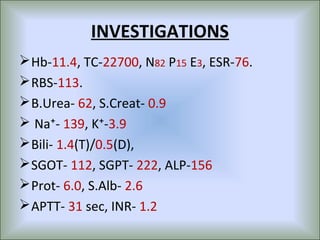
 Hb-11.4, TC-22700, N82 P15 E3, ESR-76.
 RBS-113.
 B.Urea- 62, S.Creat- 0.9
 Na⁺- 139, K⁺-3.9
 Bili- 1.4(T)/0.5(D),
 SGOT- 112, SGPT- 222, ALP-156
 Prot- 6.0, S.Alb- 2.6
 APTT- 31 sec, INR- 1.2
PRIMA FACIE


ACUTE TRANSVERSE
   MYELOPATHY
      with
  SPINAL SHOCK
SUSPECTS

 Pott’s spine
 Spinal extradural tumour with bleed
 Transverse myelitis
 Epidural abscess
 IVDP
M SP
 RI INE
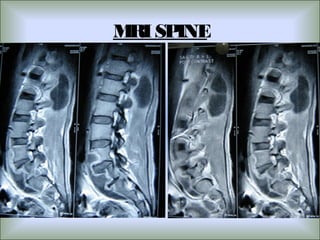
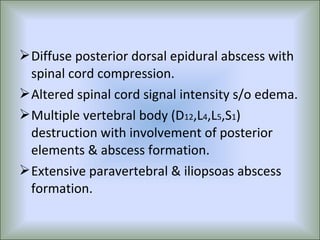
 Diffuse posterior dorsal epidural abscess with
  spinal cord compression.
 Altered spinal cord signal intensity s/o edema.
 Multiple vertebral body (D12,L4,L5,S1)
  destruction with involvement of posterior
  elements & abscess formation.
 Extensive paravertebral & iliopsoas abscess
  formation.
FINAL DIAGNOSIS


SPINAL EPIDURAL ABSCESS
EPILOGUE

Patient was handed over to the NS1 unit of the
        Dept.of Neurosurgery for further
           management on 6/11/07.
 He underwent posterior decompression with
        abscess evacuation on 13/11/07.
INNARDS
Histopathology report:-
     Section shows fragments of a lesion composed of
      numerous granulomas composed of epitheloid
      cells, multinucleated giant cells of Langhans
      type & inflammatory cells composed of mainly
      lymphocytes & also neutrophils. Areas show
      extensive caseation necrosis. The inflammatory
      infiltrate seems to invade the adjacent adipose
      tissue.
     Caseating granulomatous inflammatory lesion
      consistent with Tuberculosis.
FOOTNOTE

   Patient was put on daily regimen of ATT.

He bettered during the rest of his hospital stay.

He was discharged on 21/11/07 with grade 1+
              power in both LL.
SPINAL EPIDURAL ABSCESS

       AN OVERVIEW
Remains a challenging problem that often
   eludes diagnosis and receives suboptimal
                  treatment.

Vague symptomatology & non-specific clinical
 findings in the early stages can make diagnosis
                      difficult.
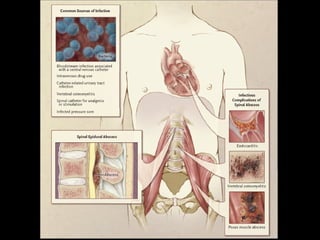
AETIOLOGY
 Predisposing factors:-
     • Underlying disease (DM, alcoholism, HIV, etc)
     • Spinal abnormality/intervention (Joint degeneration, Sx)
     • Source of infection- local/systemic
 Mode of spread:-
     • Hematogenous- 50% cases
     • Contiguous- 33% cases
     • Rest- unknown
• Abscess can spread locally or via bloodstream
ORGANISMS
 Staph. aureus- 67%
 MRSA on the increase
 S.epidermidis (invasive procedure)
 E.coli (UTI)
 P.aeruginosa (iv drug abuse)
 Rare- Actinomycetes, Nocardia, Mycobacteria,
  Fungi.
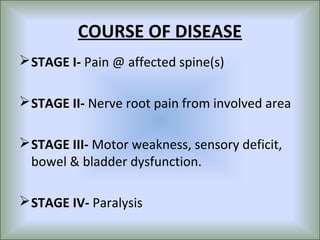
COURSE OF DISEASE
 STAGE I- Pain @ affected spine(s)

 STAGE II- Nerve root pain from involved area

 STAGE III- Motor weakness, sensory deficit,
  bowel & bladder dysfunction.

 STAGE IV- Paralysis
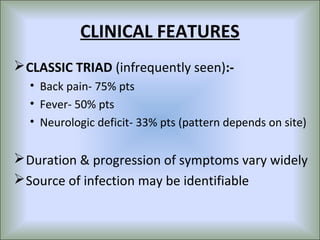
CLINICAL FEATURES
 CLASSIC TRIAD (infrequently seen):-
  • Back pain- 75% pts
  • Fever- 50% pts
  • Neurologic deficit- 33% pts (pattern depends on site)


 Duration & progression of symptoms vary widely
 Source of infection may be identifiable
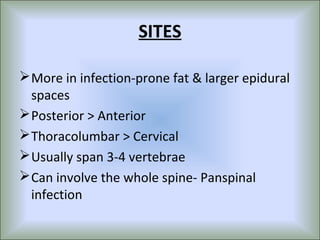
SITES

 More in infection-prone fat & larger epidural
  spaces
 Posterior > Anterior
 Thoracolumbar > Cervical
 Usually span 3-4 vertebrae
 Can involve the whole spine- Panspinal
  infection
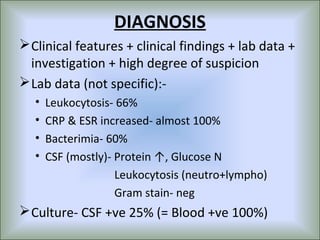
DIAGNOSIS
 Clinical features + clinical findings + lab data +
  investigation + high degree of suspicion
 Lab data (not specific):-
   •   Leukocytosis- 66%
   •   CRP & ESR increased- almost 100%
   •   Bacterimia- 60%
   •   CSF (mostly)- Protein ↑, Glucose N
                     Leukocytosis (neutro+lympho)
                     Gram stain- neg
 Culture- CSF +ve 25% (= Blood +ve 100%)
INVESTIGATIONS
 LP to be avoided:-
      Not much helpful
      Meningitis
      Subdural infection
      Neurologic deterioration if below complete block
 X-ray spine-
      Narrowed disc space
      Bone lysis
 CT myelography- 90% specific, but unadvisable
IMAGING MODALITY OF CHOICE

MRI + Gadolinium (best)
   Less invasive
   Delineates lesion best
   Diff b/w infection & tumours
DIFFERENTIALS
 Meningitis
 Transverse myelitis
 Spinal tumour
 Spinal hematoma
 Osteomyelitis of vertebrae
 Diskitis
 IVDP
 Degenerative joint disease
 Demyelinating illness
 Sepsis
TREATMENT
 Surgical- Decompression laminectomy and
  debridement. (Rate of progress of symptoms cannot be
  predicted. Sx as early as possible)


 Appropriate systemic antibiotics (min 6
  weeks)
       Emperical- Vancomycin + 3rd /4th gen Cephalosporin
                  MSSA- Cefazolin/Naficillin
MONITORING
 Neurological status (esp. antibiotic only)-
      Deterioration – Extension/incomplete evacuation


 Signs of sepsis

 Repeat imaging (esp. antibiotic only)
PROGNOSIS
 Best predictor of post-op final neurologic
  outcome is pre-op neurologic status.

 Paralysis of <24-36 hrs= better prognosis.

 Recovery can continue till about 1 year.
COMPLICATIONS

 Irreversible paralysis
 Bladder dysfunction
 Decubiti
 Supine hypertension
 Recurrent sepsis
THANK YOU

Paraplegia a textbook case

  • 1.
    PARAPLEGIA A TEXTBOOK CASE Chair:- Prof. Dr. Baby Paul Presenter: Dr.Shybin Usman
  • 2.
    STRIKE ONE  Mr.Gopakumar, 28 years from Neyyatinkara.  Working in the BSF & posted in Bengal.  Developed a nagging backache.  Admitted in a local hospital near his base on 17/10/07.  D/D on 20/10/07 as he was better.
  • 3.
    STRIKE TWO  Backachewas back by 23/10/07.  Shooting pain radiating from back to umbilicus.  Noticed gradually developing weakness of both lower limbs.  Admitted from 23/10/07 to 31/10/07.  Symptoms grew worse and he got on the next train home.
  • 4.
    STRIKE THREE  Reachedhere on 3/11/07.  Weakness of lower limbs was complete.  Had lost all sensation in both lower limbs.  In the final day of journey high grade fever set in.  Backache was very severe with difficulty in lying on his back.
  • 5.
    SNIPPETS  No significantmedical past history.  H/o haemorrhoidectomy 7 years ago.  Occasional alcoholic.  Non smoker.
  • 6.
    PRESENTING PICTURE  Moderatelybuilt and nourished.  Concious and oriented.  Febrile.  No PICCLE, conjunctival congestion.  Chest – Clear.  CVS – WNL.  Abdomen – Bladder distended.  Spine - Tenderness at D12 spine.
  • 7.
    NEUROLOGIC DEFICITS  Grade0 power both LL.  Reflexes totally absent below the level of umbilicus.  Sensations totally absent below the level of umbilicus.  Bladder was distended.  Rest of the nervous system examination was normal.
  • 8.
    INVESTIGATIONS  Hb-11.4, TC-22700,N82 P15 E3, ESR-76.  RBS-113.  B.Urea- 62, S.Creat- 0.9  Na⁺- 139, K⁺-3.9  Bili- 1.4(T)/0.5(D),  SGOT- 112, SGPT- 222, ALP-156  Prot- 6.0, S.Alb- 2.6  APTT- 31 sec, INR- 1.2
  • 9.
    PRIMA FACIE ACUTE TRANSVERSE MYELOPATHY with SPINAL SHOCK
  • 10.
    SUSPECTS  Pott’s spine Spinal extradural tumour with bleed  Transverse myelitis  Epidural abscess  IVDP
  • 11.
  • 12.
     Diffuse posteriordorsal epidural abscess with spinal cord compression.  Altered spinal cord signal intensity s/o edema.  Multiple vertebral body (D12,L4,L5,S1) destruction with involvement of posterior elements & abscess formation.  Extensive paravertebral & iliopsoas abscess formation.
  • 13.
  • 14.
    EPILOGUE Patient was handedover to the NS1 unit of the Dept.of Neurosurgery for further management on 6/11/07. He underwent posterior decompression with abscess evacuation on 13/11/07.
  • 15.
    INNARDS Histopathology report:- Section shows fragments of a lesion composed of numerous granulomas composed of epitheloid cells, multinucleated giant cells of Langhans type & inflammatory cells composed of mainly lymphocytes & also neutrophils. Areas show extensive caseation necrosis. The inflammatory infiltrate seems to invade the adjacent adipose tissue. Caseating granulomatous inflammatory lesion consistent with Tuberculosis.
  • 16.
    FOOTNOTE Patient was put on daily regimen of ATT. He bettered during the rest of his hospital stay. He was discharged on 21/11/07 with grade 1+ power in both LL.
  • 17.
  • 18.
    Remains a challengingproblem that often eludes diagnosis and receives suboptimal treatment. Vague symptomatology & non-specific clinical findings in the early stages can make diagnosis difficult.
  • 19.
    AETIOLOGY  Predisposing factors:- • Underlying disease (DM, alcoholism, HIV, etc) • Spinal abnormality/intervention (Joint degeneration, Sx) • Source of infection- local/systemic  Mode of spread:- • Hematogenous- 50% cases • Contiguous- 33% cases • Rest- unknown • Abscess can spread locally or via bloodstream
  • 20.
    ORGANISMS  Staph. aureus-67%  MRSA on the increase  S.epidermidis (invasive procedure)  E.coli (UTI)  P.aeruginosa (iv drug abuse)  Rare- Actinomycetes, Nocardia, Mycobacteria, Fungi.
  • 21.
    COURSE OF DISEASE STAGE I- Pain @ affected spine(s)  STAGE II- Nerve root pain from involved area  STAGE III- Motor weakness, sensory deficit, bowel & bladder dysfunction.  STAGE IV- Paralysis
  • 22.
    CLINICAL FEATURES  CLASSICTRIAD (infrequently seen):- • Back pain- 75% pts • Fever- 50% pts • Neurologic deficit- 33% pts (pattern depends on site)  Duration & progression of symptoms vary widely  Source of infection may be identifiable
  • 23.
    SITES  More ininfection-prone fat & larger epidural spaces  Posterior > Anterior  Thoracolumbar > Cervical  Usually span 3-4 vertebrae  Can involve the whole spine- Panspinal infection
  • 24.
    DIAGNOSIS  Clinical features+ clinical findings + lab data + investigation + high degree of suspicion  Lab data (not specific):- • Leukocytosis- 66% • CRP & ESR increased- almost 100% • Bacterimia- 60% • CSF (mostly)- Protein ↑, Glucose N Leukocytosis (neutro+lympho) Gram stain- neg  Culture- CSF +ve 25% (= Blood +ve 100%)
  • 25.
    INVESTIGATIONS  LP tobe avoided:-  Not much helpful  Meningitis  Subdural infection  Neurologic deterioration if below complete block  X-ray spine-  Narrowed disc space  Bone lysis  CT myelography- 90% specific, but unadvisable
  • 26.
    IMAGING MODALITY OFCHOICE MRI + Gadolinium (best) Less invasive Delineates lesion best Diff b/w infection & tumours
  • 27.
    DIFFERENTIALS  Meningitis  Transversemyelitis  Spinal tumour  Spinal hematoma  Osteomyelitis of vertebrae  Diskitis  IVDP  Degenerative joint disease  Demyelinating illness  Sepsis
  • 28.
    TREATMENT  Surgical- Decompressionlaminectomy and debridement. (Rate of progress of symptoms cannot be predicted. Sx as early as possible)  Appropriate systemic antibiotics (min 6 weeks)  Emperical- Vancomycin + 3rd /4th gen Cephalosporin MSSA- Cefazolin/Naficillin
  • 29.
    MONITORING  Neurological status(esp. antibiotic only)-  Deterioration – Extension/incomplete evacuation  Signs of sepsis  Repeat imaging (esp. antibiotic only)
  • 30.
    PROGNOSIS  Best predictorof post-op final neurologic outcome is pre-op neurologic status.  Paralysis of <24-36 hrs= better prognosis.  Recovery can continue till about 1 year.
  • 31.
    COMPLICATIONS  Irreversible paralysis Bladder dysfunction  Decubiti  Supine hypertension  Recurrent sepsis
  • 33.