SPINAL CORD
&
ITS COMPRESSIVE DISORDERS

SHRUTHI.S.JAYARAJ
53rd, Calicut Medical College
12/10/2013 8:40 AM

1
• Basics of spinal cord
• Determining the level of lesion
• Special pattern of spinal cord diseases
• Compressive disorders of spinal cord
12/10/2013 8:40 AM

2
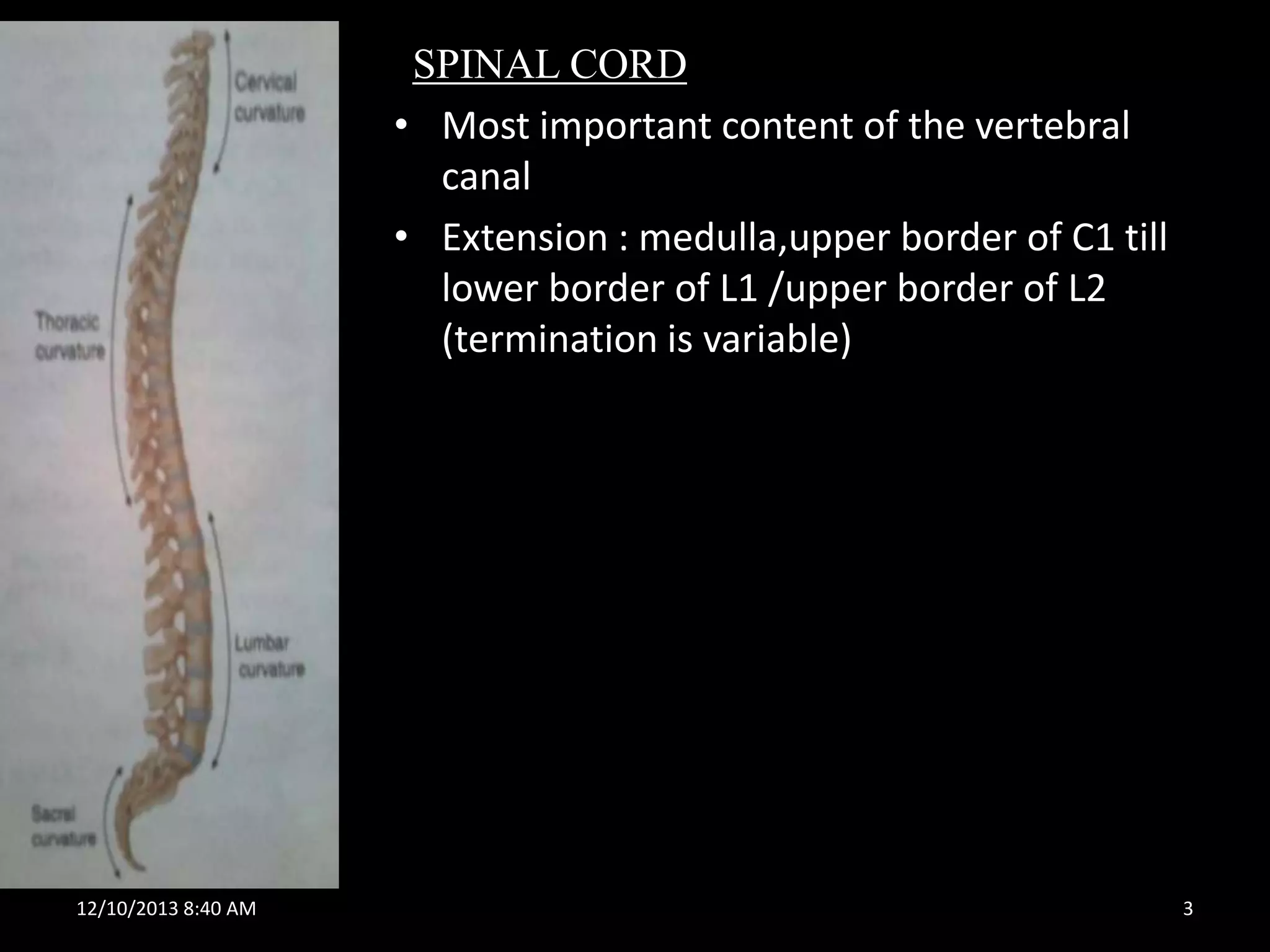
SPINAL CORD
• Most important content of the vertebral
canal
• Extension : medulla,upper border of C1 till
lower border of L1 /upper border of L2
(termination is variable)

12/10/2013 8:40 AM

3
•

12/10/2013 8:40 AM

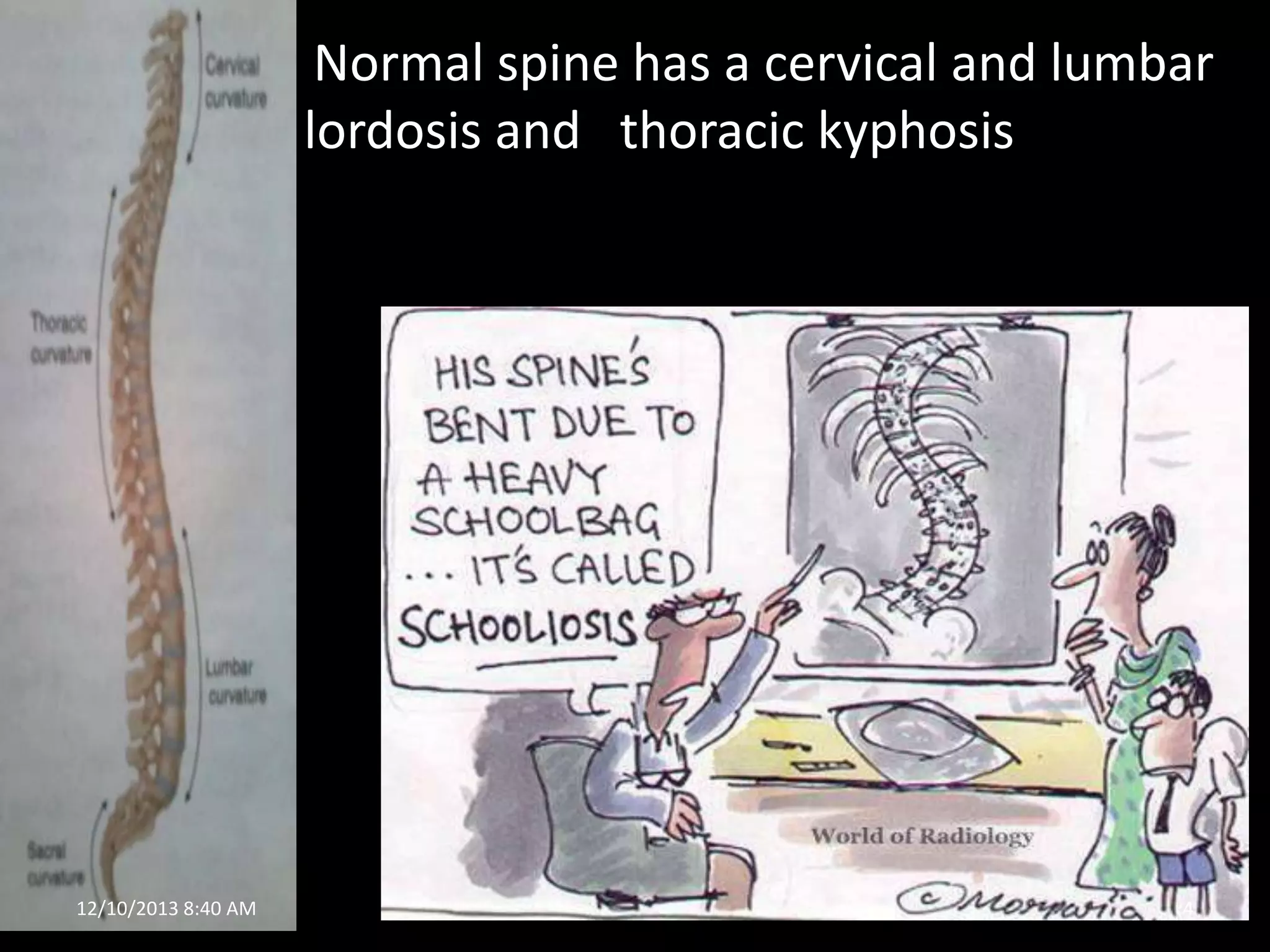
Normal spine has a cervical and lumbar
lordosis and thoracic kyphosis

4
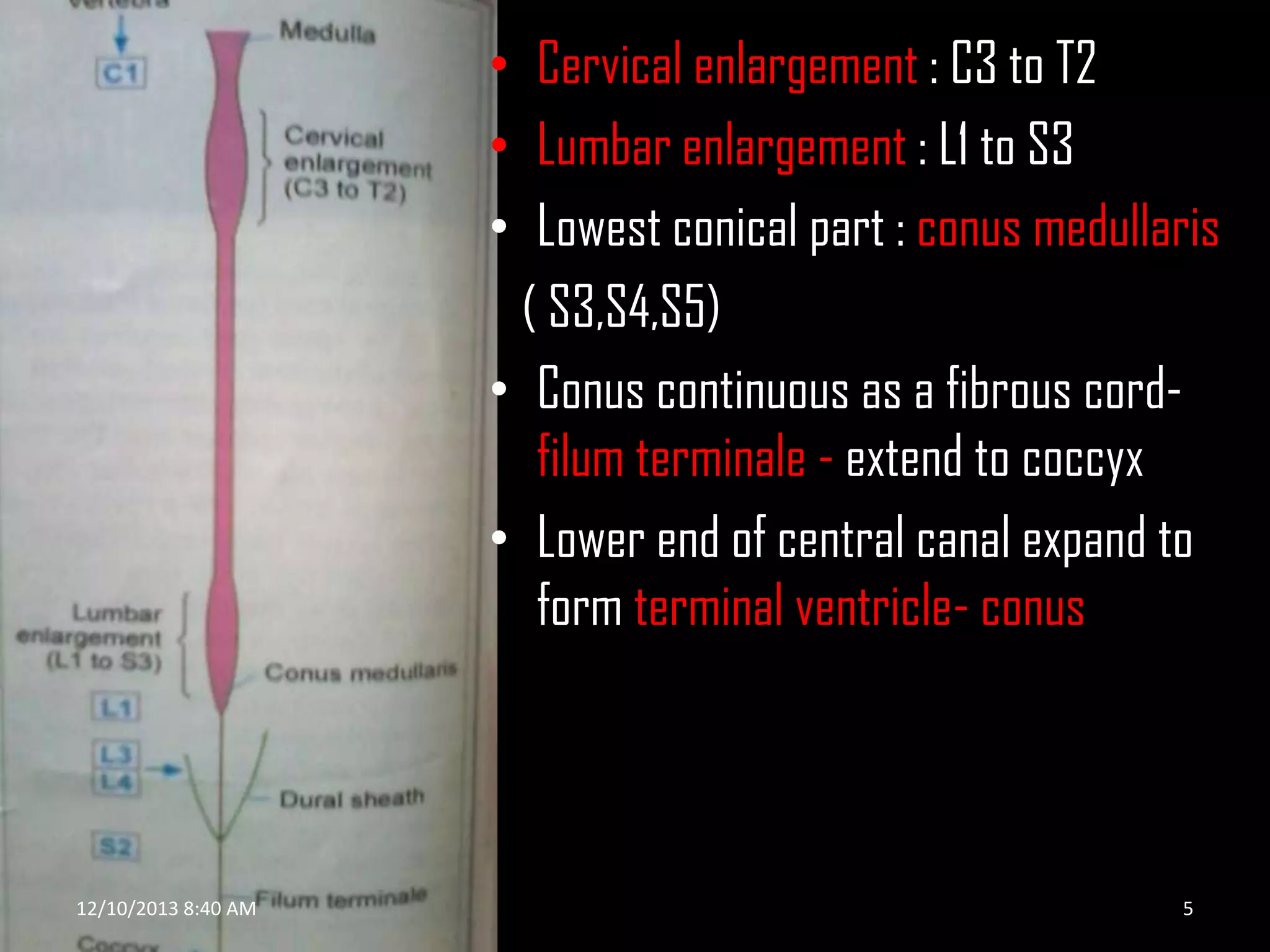
• Cervical enlargement : C3 to T2
• Lumbar enlargement : L1 to S3
• Lowest conical part : conus medullaris
( S3,S4,S5)
• Conus continuous as a fibrous cordfilum terminale - extend to coccyx
• Lower end of central canal expand to
form terminal ventricle- conus

12/10/2013 8:40 AM

5
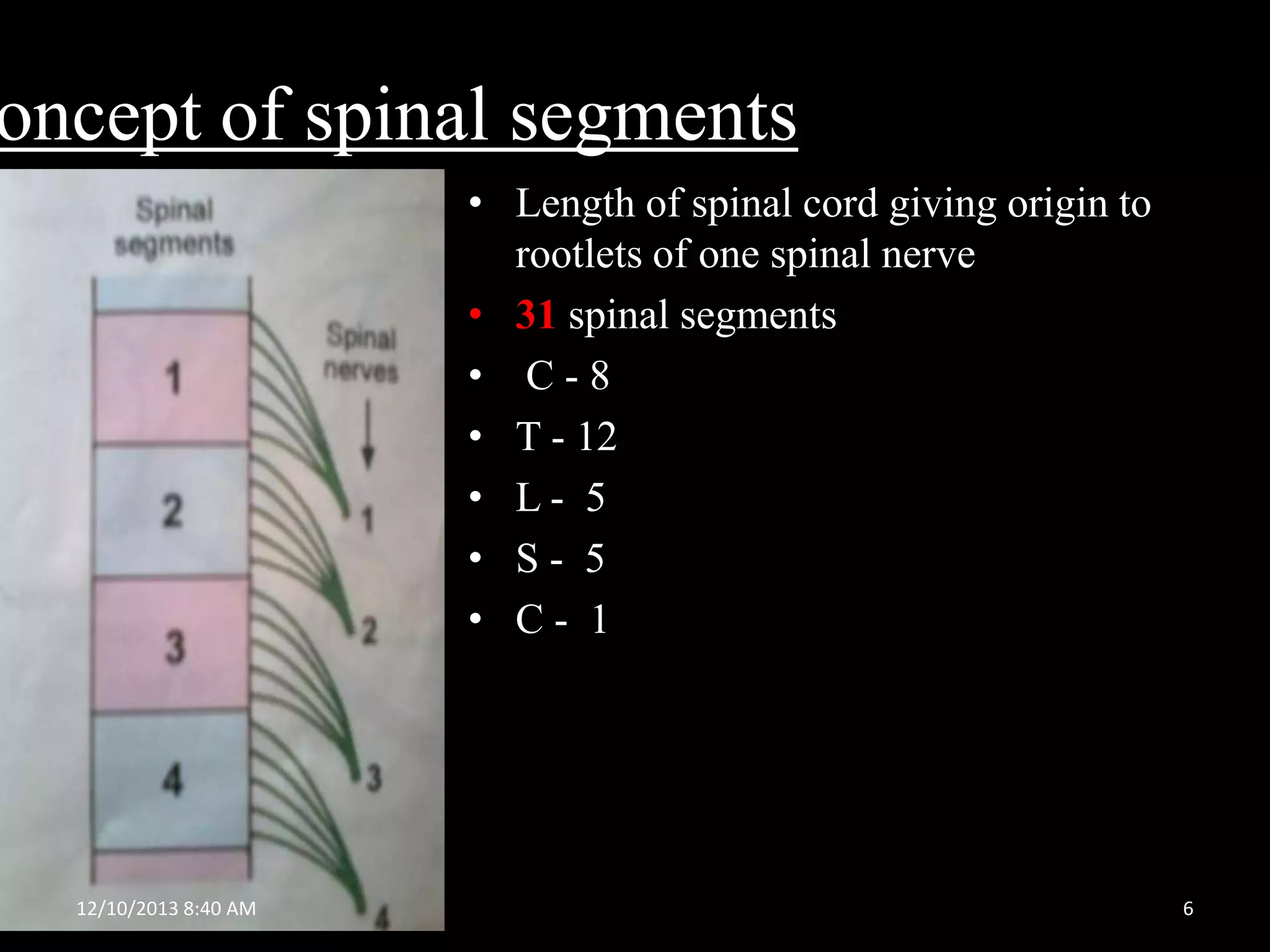
oncept of spinal segments
• Length of spinal cord giving origin to
rootlets of one spinal nerve
• 31 spinal segments
• C-8
• T - 12
• L- 5
• S- 5
• C- 1

12/10/2013 8:40 AM

6
• During embryological dvpt, growth of the cord lags behind
that of vertebral column
• Lower spinal nerves have to taka an increasingly downward
course to enter the corresponding intervertebral foraminabundle of nerves- cauda equina

12/10/2013 8:40 AM

7
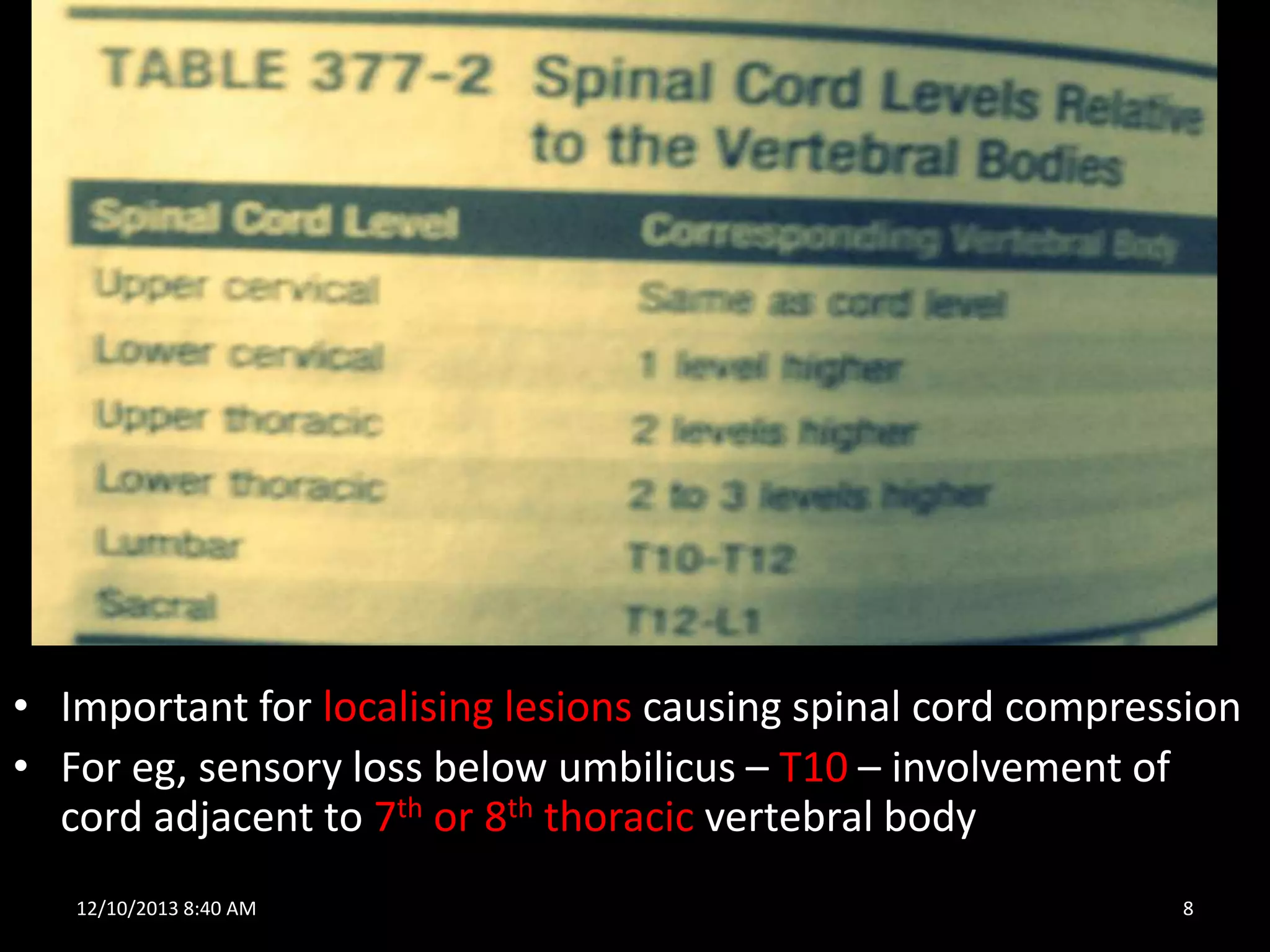
• Important for localising lesions causing spinal cord compression
• For eg, sensory loss below umbilicus – T10 – involvement of
cord adjacent to 7th or 8th thoracic vertebral body
12/10/2013 8:40 AM

8
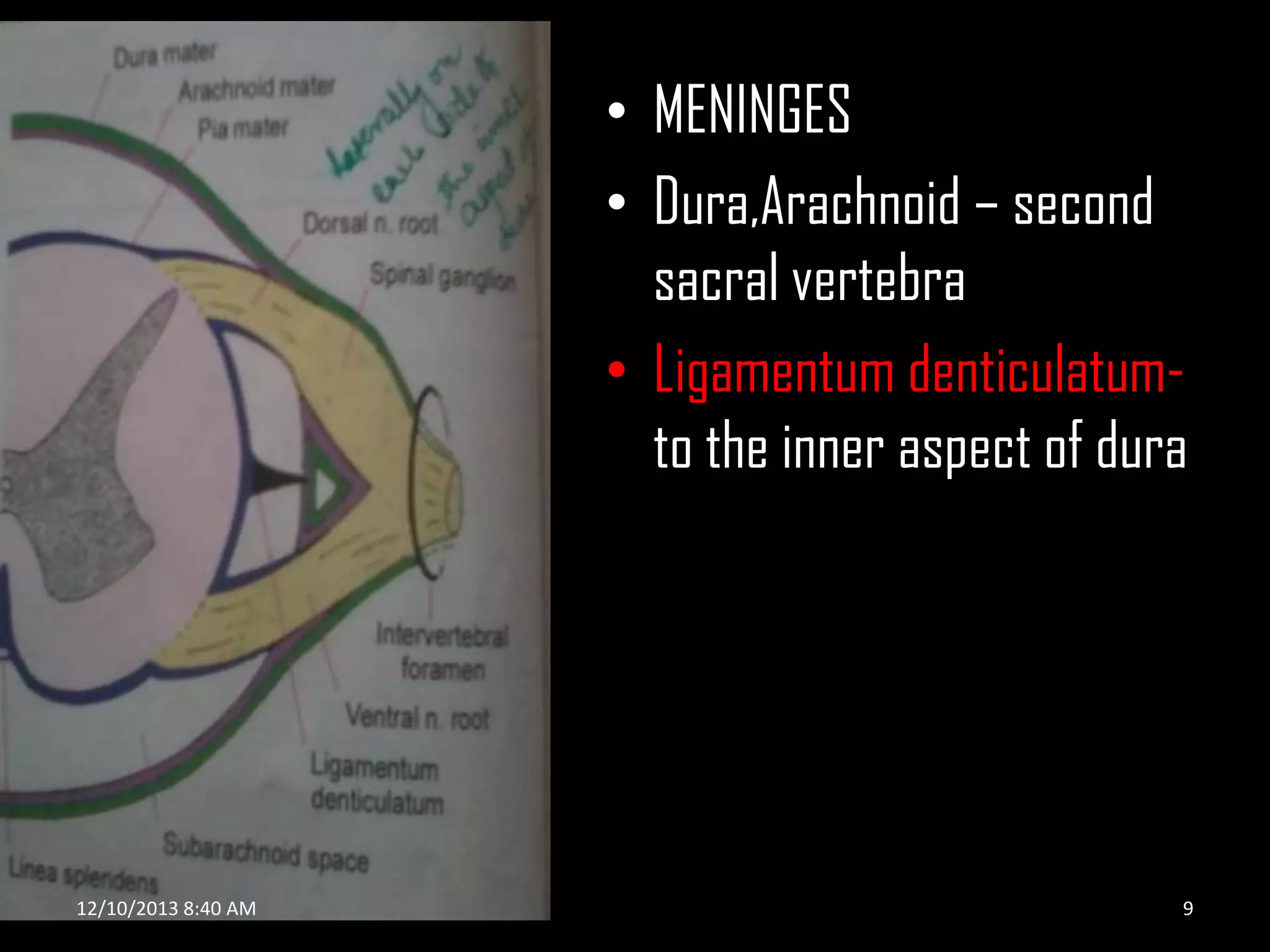
• MENINGES
• Dura,Arachnoid – second
sacral vertebra
• Ligamentum denticulatumto the inner aspect of dura

12/10/2013 8:40 AM

9
12/10/2013 8:40 AM

10
12/10/2013 8:40 AM

11
Determining the level of lesion

SENSORY !
MOTOR !
SPHINCTER
!

1. The presence of a horizontal level below which sensory
,motor and autonomic function is impaired is a hallmark of
spinal cord disease.
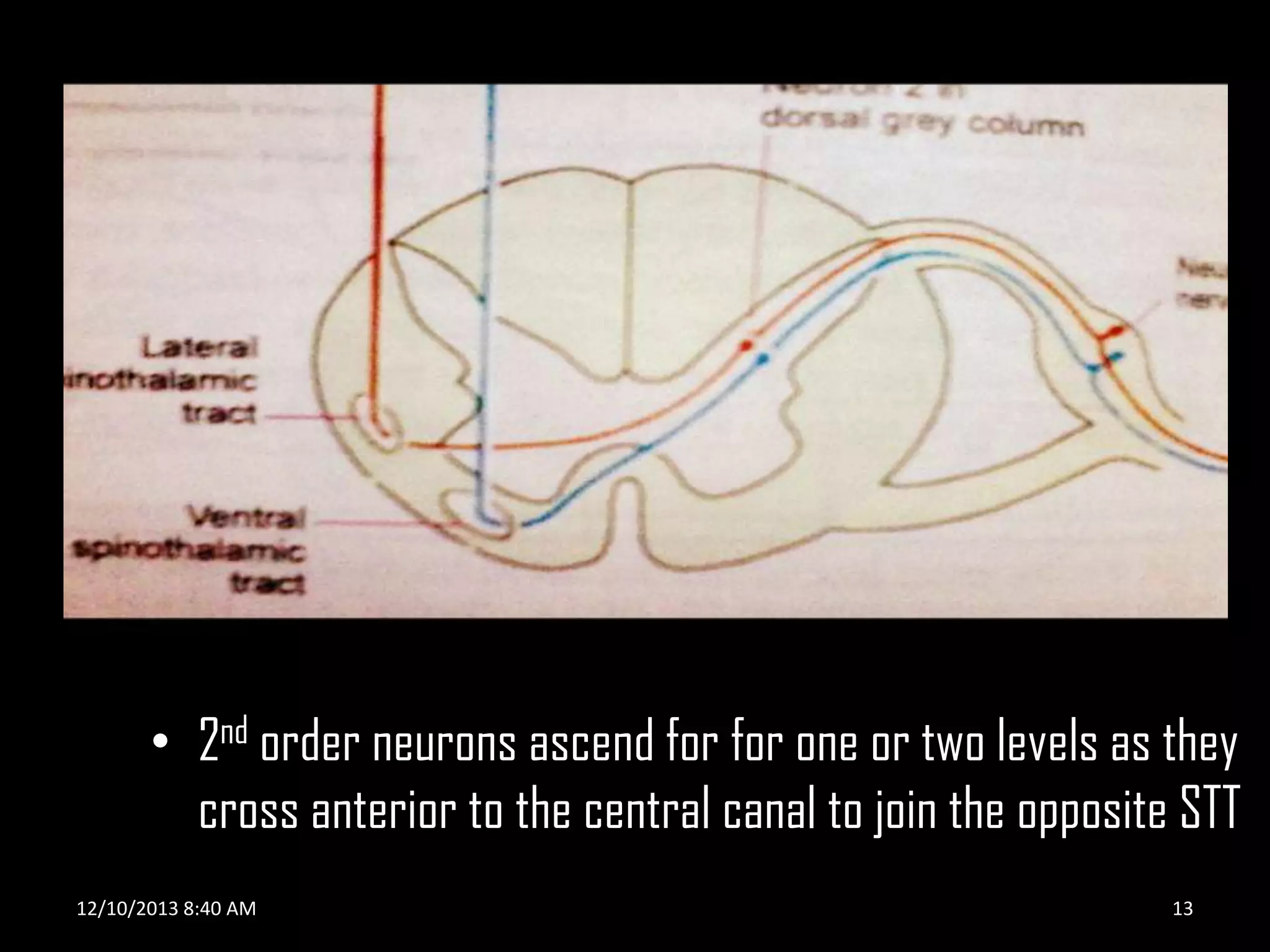
2. Sensory loss below a particular level is due to damage to
spinothalamic tract on the opposite side one or two
segments higher in case of a unilateral lesion.

12/10/2013 8:40 AM

12
• 2nd order neurons ascend for for one or two levels as they
cross anterior to the central canal to join the opposite STT
12/10/2013 8:40 AM

13
• Sensory symptoms include numbness, tingling ,pins and
needles, dermal hypersensitivity, burning sensation, altered
temperature sensation and tight band like sensation.
• A complete cord syndrome- loss of all sensory modalities
below the level of lesion.
• Partial syndromes produce variable findings

12/10/2013 8:40 AM

14
• Posterior column – loss of joint sense,vibration,tactile
discrimination,with positive romberg’s and ataxic gait
(sensory ataxia)
• STT – Contralateral loss of pain & temperature sensation

12/10/2013 8:40 AM

15
SENSORY LEVEL
• Zone of hyperaesthesia (dorsal column) :level of lesion is
just below it
• Girdle like sensation exaggerated by cough and sneezingdorsal column
• Involvement of specific dermatomes

12/10/2013 8:40 AM

16
3. At the level of lesion –
LMN signs – focal muscle wasting, fasciculations, hypo- or
areflexia due to involvement of AHCs

Radicular pain or dermatomal sensory loss d/t
involvement of sensory roots

12/10/2013 8:40 AM

17
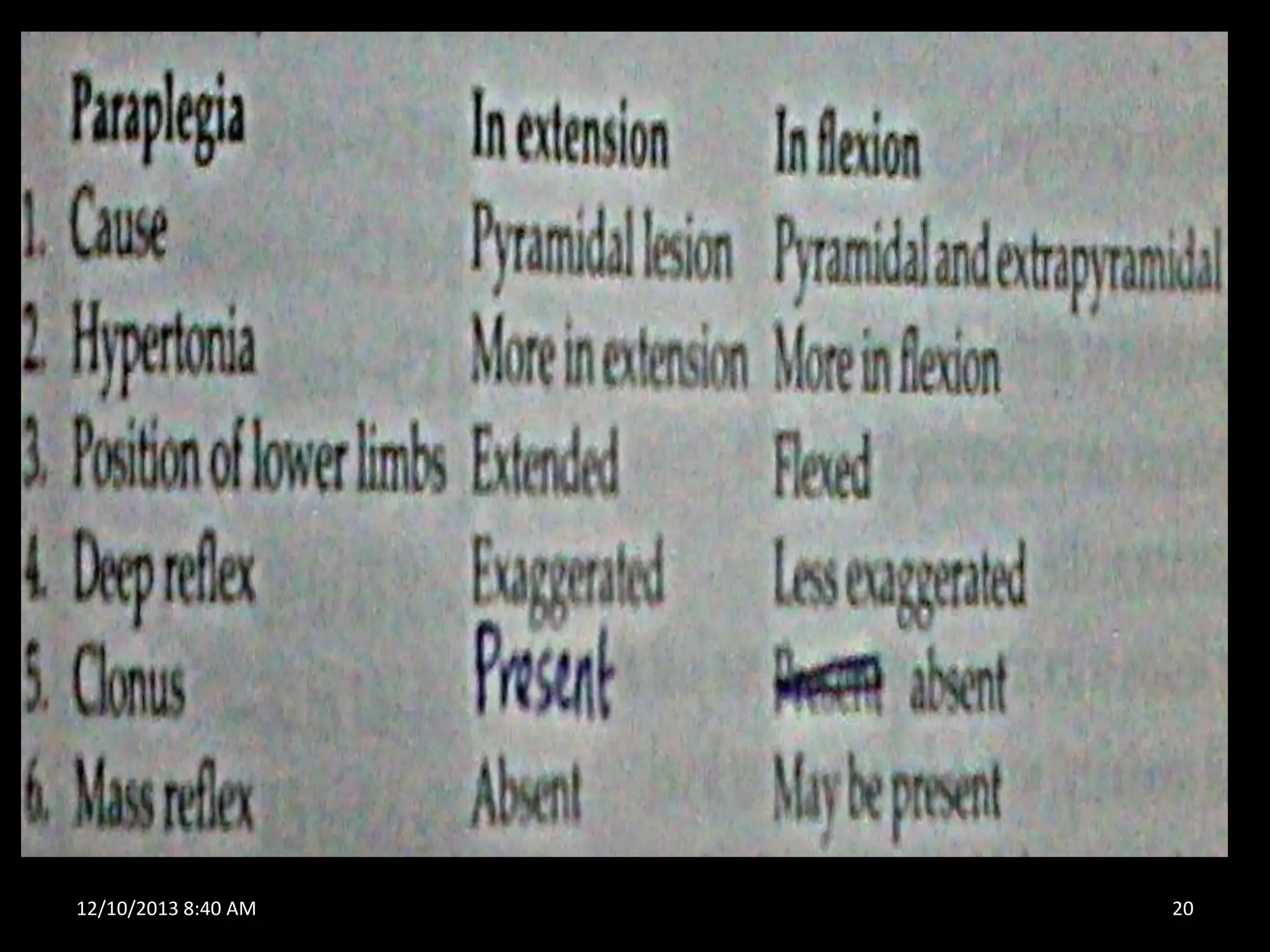
4. Interruption of motor tracts (pyramidal /extrapyramidal)
UMN signs below the level of lesion
if corticospinal tract – pyramidal pattern of weakness – greater in
the antigravity muscles – paraplegia in extension
if extrapyramidal tracts - progravity muscles are affected more –
paraplegia in flexion – may be associated with ‘mass reflex’

12/10/2013 8:40 AM

18
Mass reflex
• Spontaneous urination, defaecation, sweating on
scratching skin on the medial aspect of thigh
• a/w reflex ejaculation and erection on squeezing glans
penis

12/10/2013 8:40 AM

19
12/10/2013 8:40 AM

20
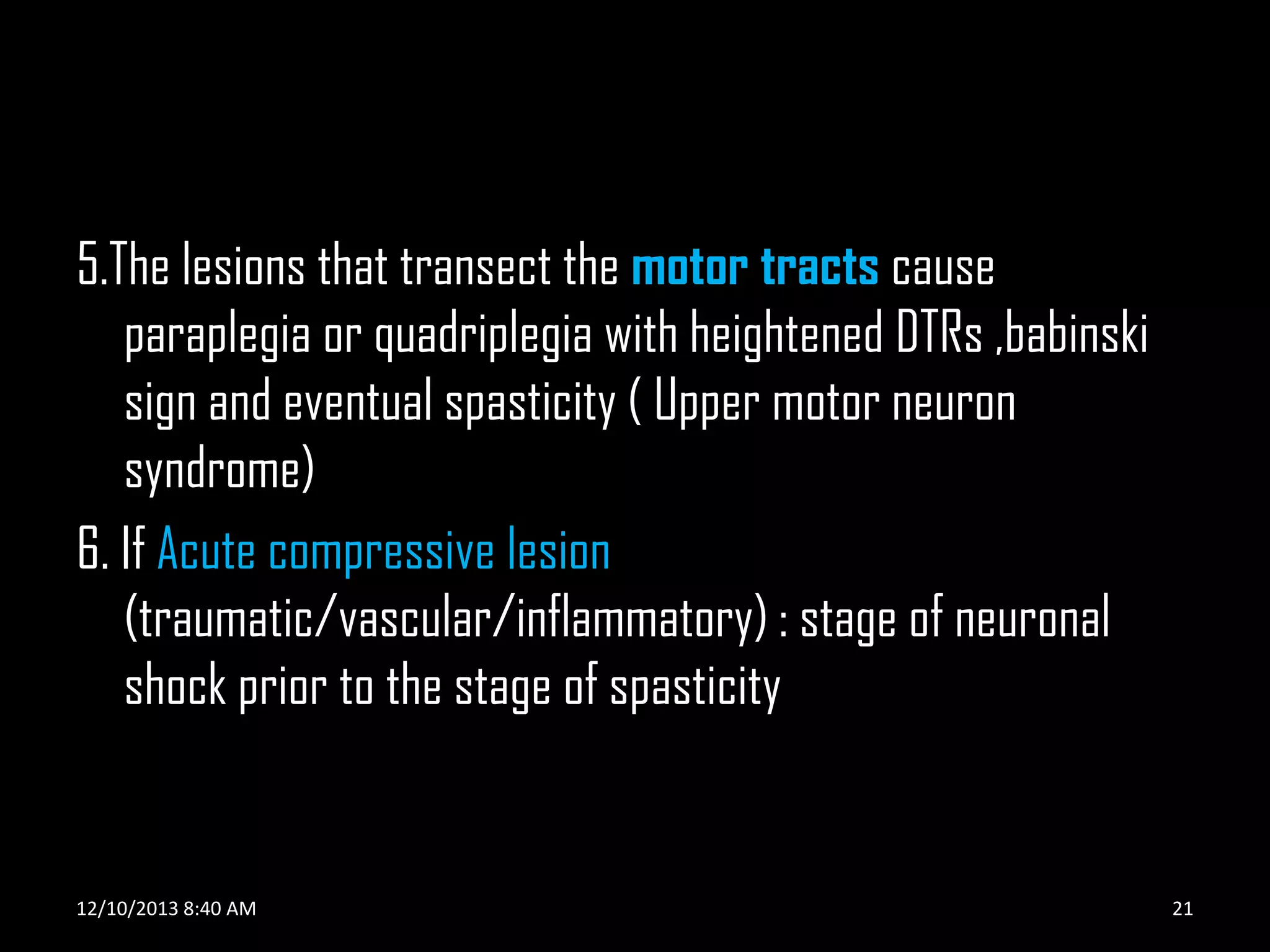
5.The lesions that transect the motor tracts cause
paraplegia or quadriplegia with heightened DTRs ,babinski
sign and eventual spasticity ( Upper motor neuron
syndrome)
6. If Acute compressive lesion
(traumatic/vascular/inflammatory) : stage of neuronal
shock prior to the stage of spasticity

12/10/2013 8:40 AM

21
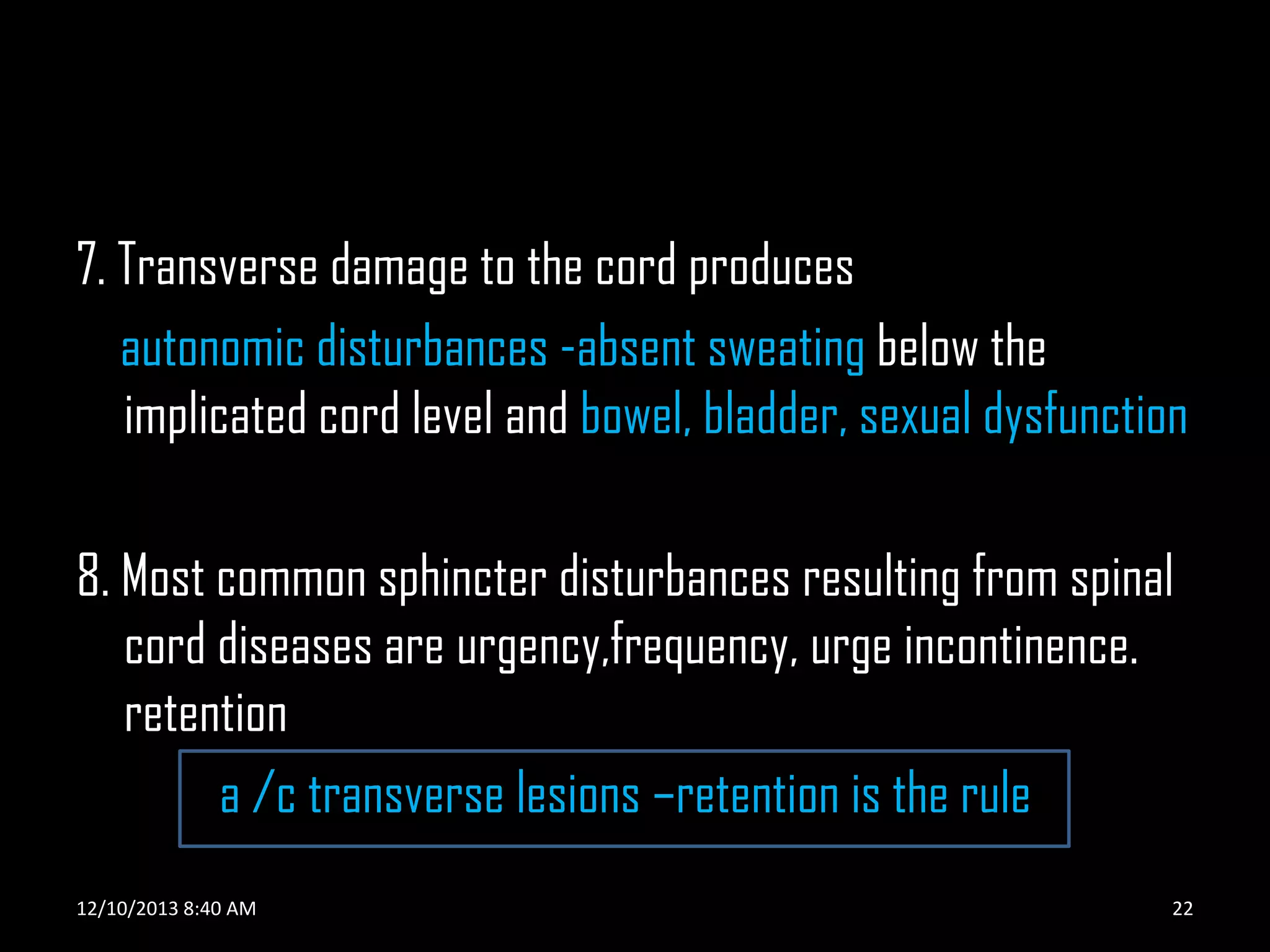
7. Transverse damage to the cord produces
autonomic disturbances -absent sweating below the
implicated cord level and bowel, bladder, sexual dysfunction

8. Most common sphincter disturbances resulting from spinal
cord diseases are urgency,frequency, urge incontinence.
retention
a /c transverse lesions –retention is the rule
12/10/2013 8:40 AM

22
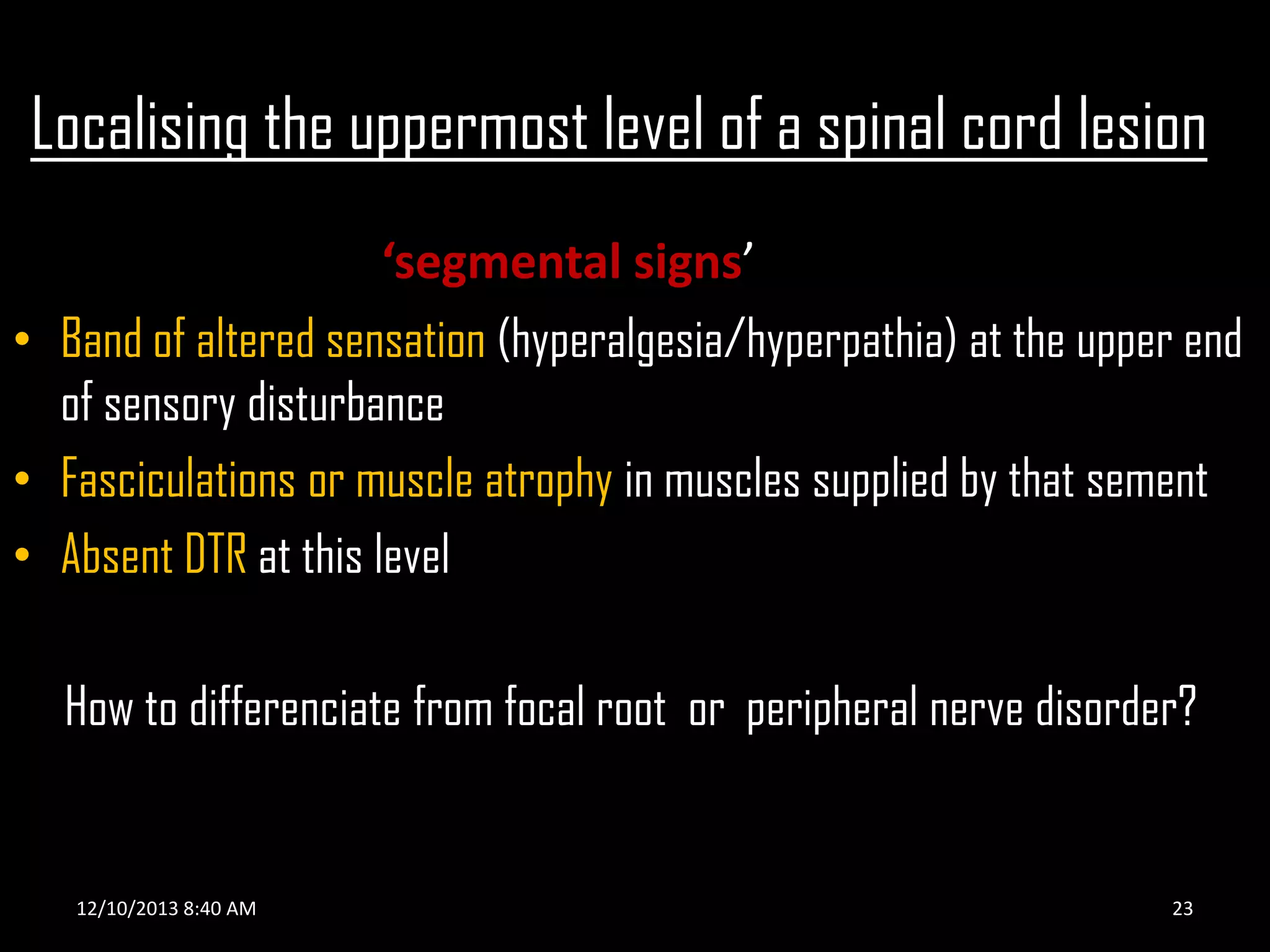
Localising the uppermost level of a spinal cord lesion
‘segmental signs’
• Band of altered sensation (hyperalgesia/hyperpathia) at the upper end
of sensory disturbance
• Fasciculations or muscle atrophy in muscles supplied by that sement
• Absent DTR at this level
How to differenciate from focal root or peripheral nerve disorder?

12/10/2013 8:40 AM

23
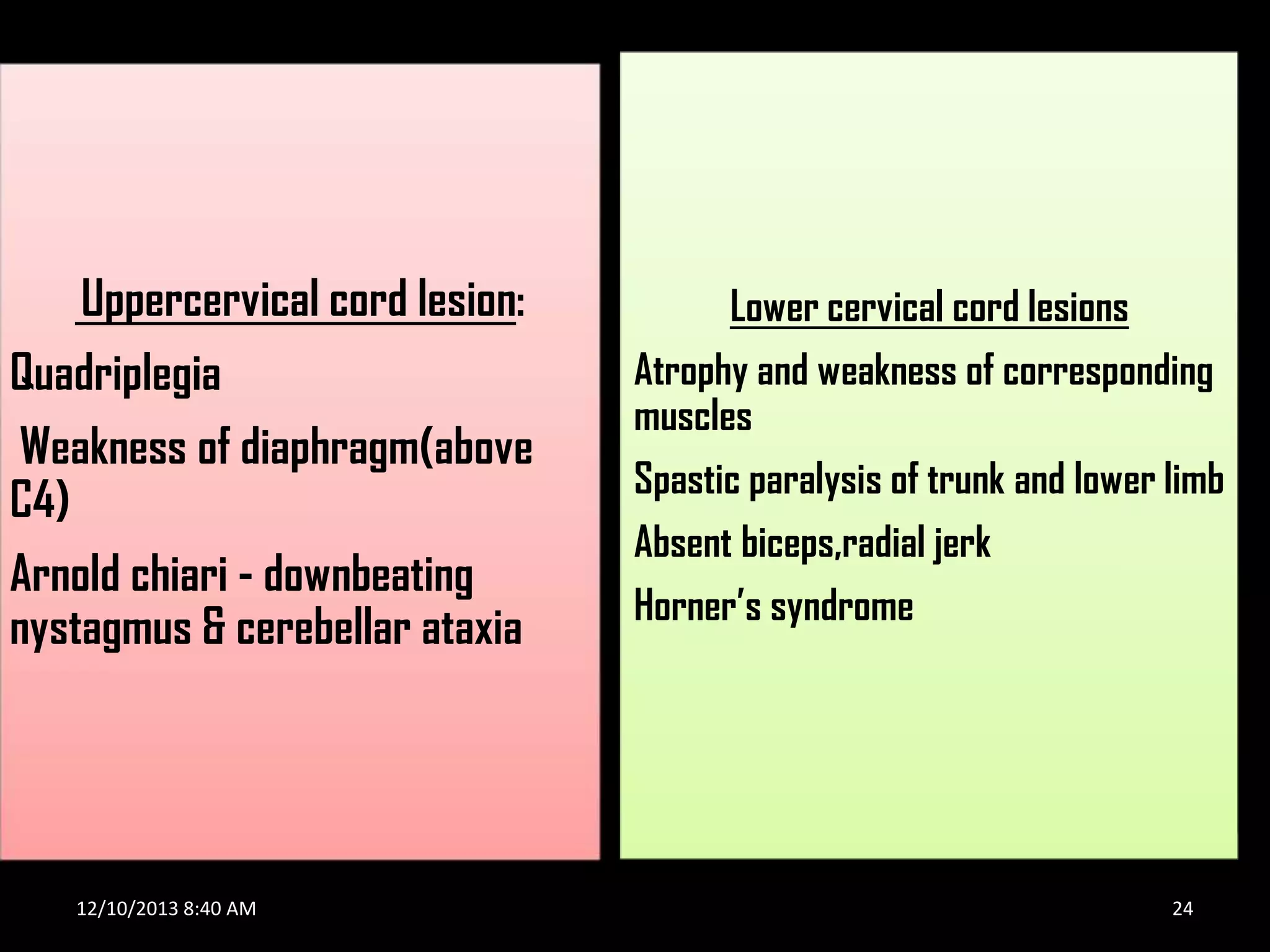
Uppercervical cord lesion:
Quadriplegia
Weakness of diaphragm(above
C4)
Arnold chiari - downbeating
nystagmus & cerebellar ataxia

12/10/2013 8:40 AM

Lower cervical cord lesions
Atrophy and weakness of corresponding
muscles
Spastic paralysis of trunk and lower limb
Absent biceps,radial jerk
Horner’s syndrome

24
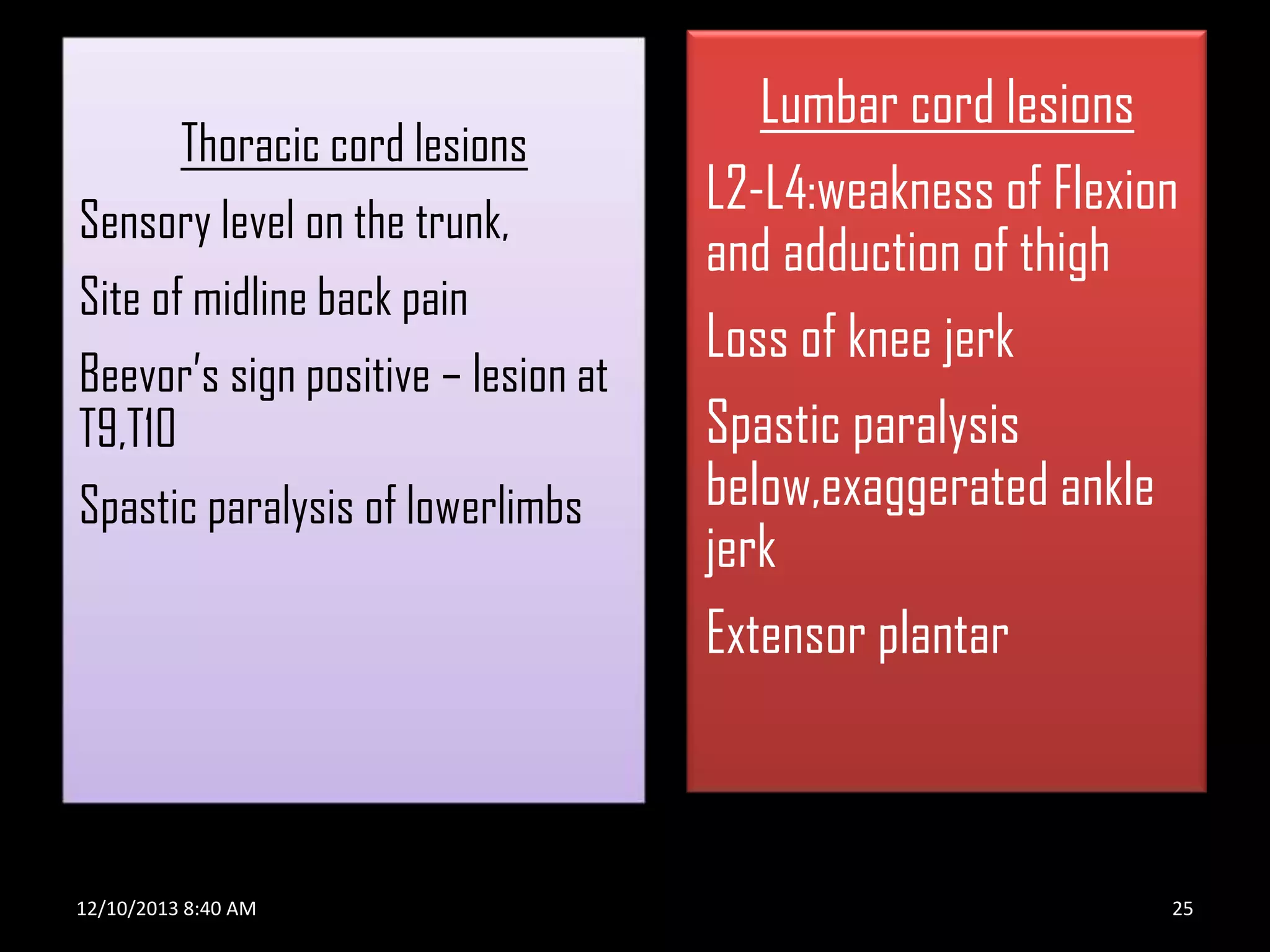
Thoracic cord lesions
Sensory level on the trunk,
Site of midline back pain
Beevor’s sign positive – lesion at
T9,T10
Spastic paralysis of lowerlimbs

12/10/2013 8:40 AM

Lumbar cord lesions
L2-L4:weakness of Flexion
and adduction of thigh
Loss of knee jerk
Spastic paralysis
below,exaggerated ankle
jerk
Extensor plantar

25
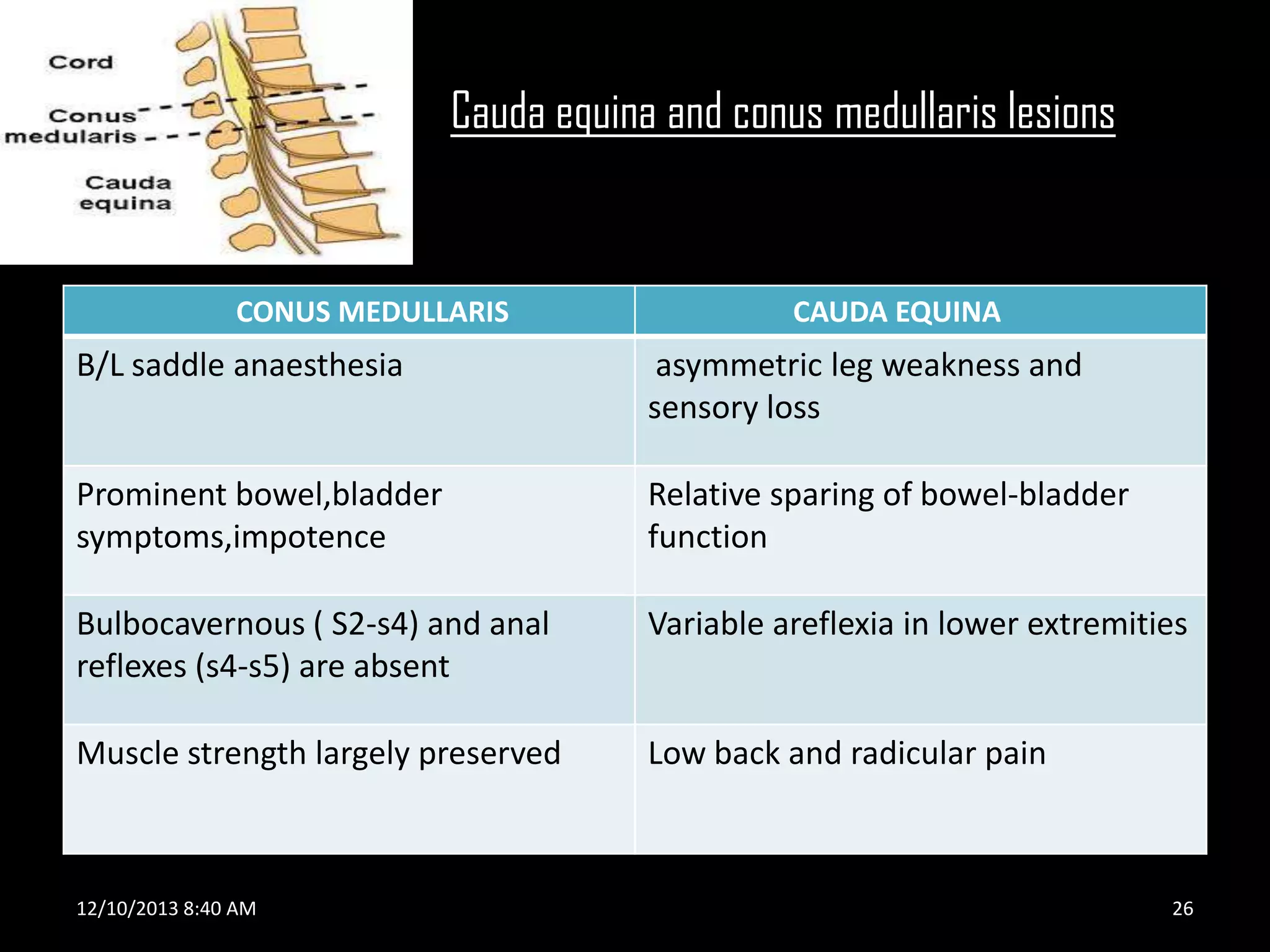
Cauda equina and conus medullaris lesions

CONUS MEDULLARIS

CAUDA EQUINA

B/L saddle anaesthesia

asymmetric leg weakness and
sensory loss

Prominent bowel,bladder
symptoms,impotence

Relative sparing of bowel-bladder
function

Bulbocavernous ( S2-s4) and anal
reflexes (s4-s5) are absent

Variable areflexia in lower extremities

Muscle strength largely preserved

Low back and radicular pain

12/10/2013 8:40 AM

26
SPECIAL PATTERNS OF SPINAL CORD DISEASES

12/10/2013 8:40 AM

27
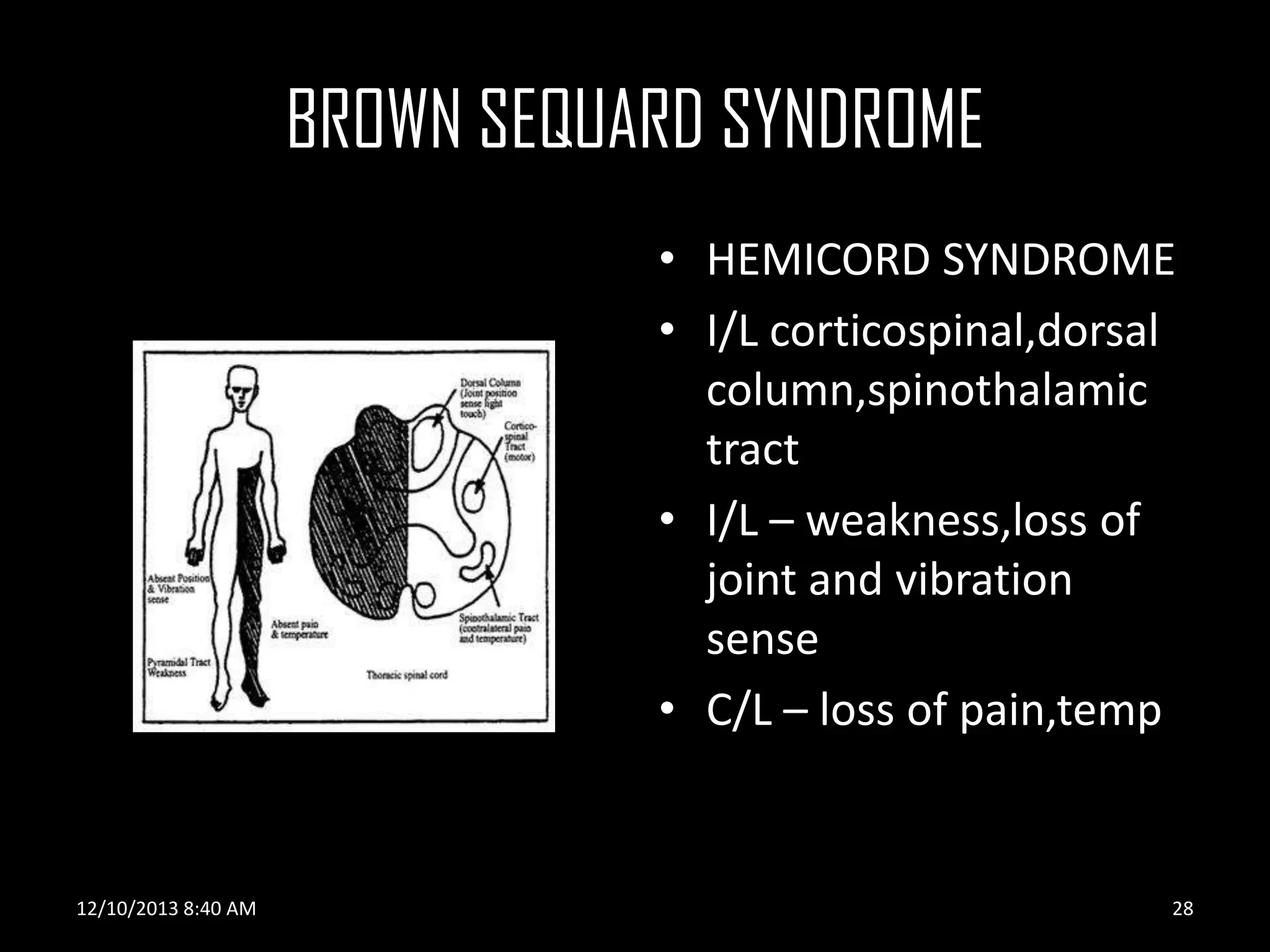
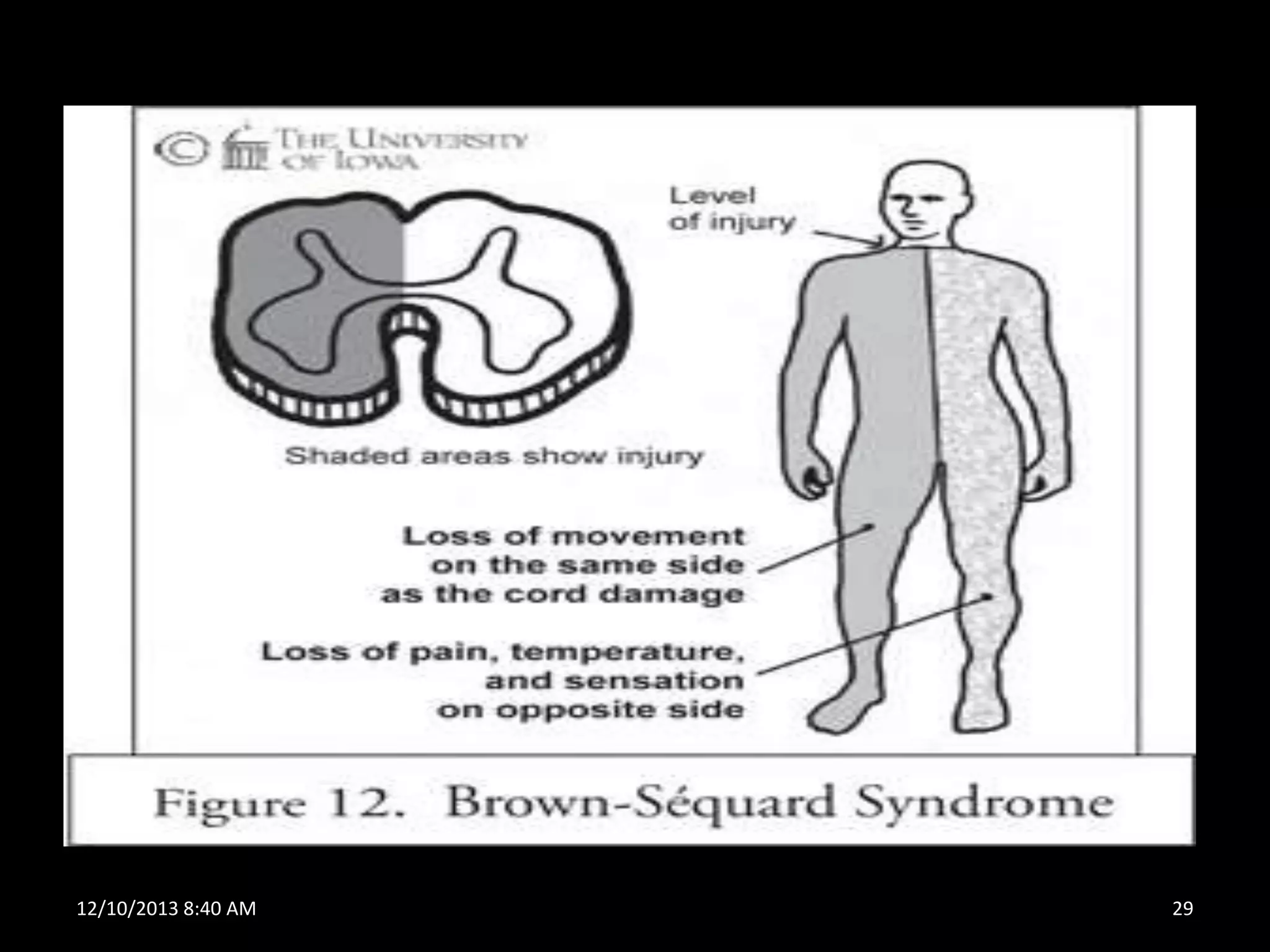
BROWN SEQUARD SYNDROME
• HEMICORD SYNDROME
• I/L corticospinal,dorsal
column,spinothalamic
tract
• I/L – weakness,loss of
joint and vibration
sense
• C/L – loss of pain,temp

12/10/2013 8:40 AM

28
12/10/2013 8:40 AM

29
Central cord syndrome
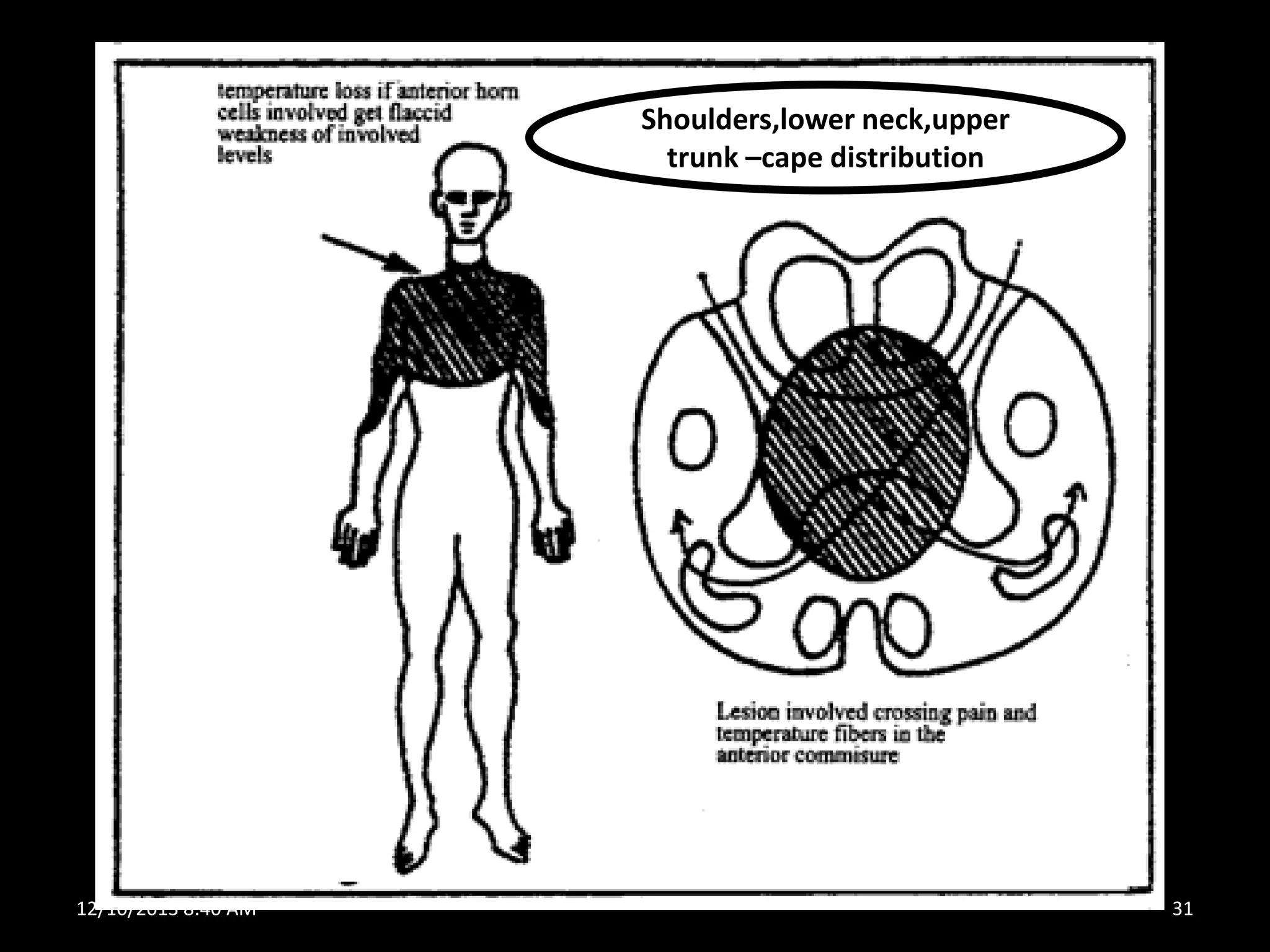
• Selective damage to grey matter and crossing
spinothalamic tracts
• Syringomyelia,intrinsic tumors of spinal cord,trauma
• Dissociated anaesthesia

12/10/2013 8:40 AM

30
Shoulders,lower neck,upper
trunk –cape distribution

12/10/2013 8:40 AM

31
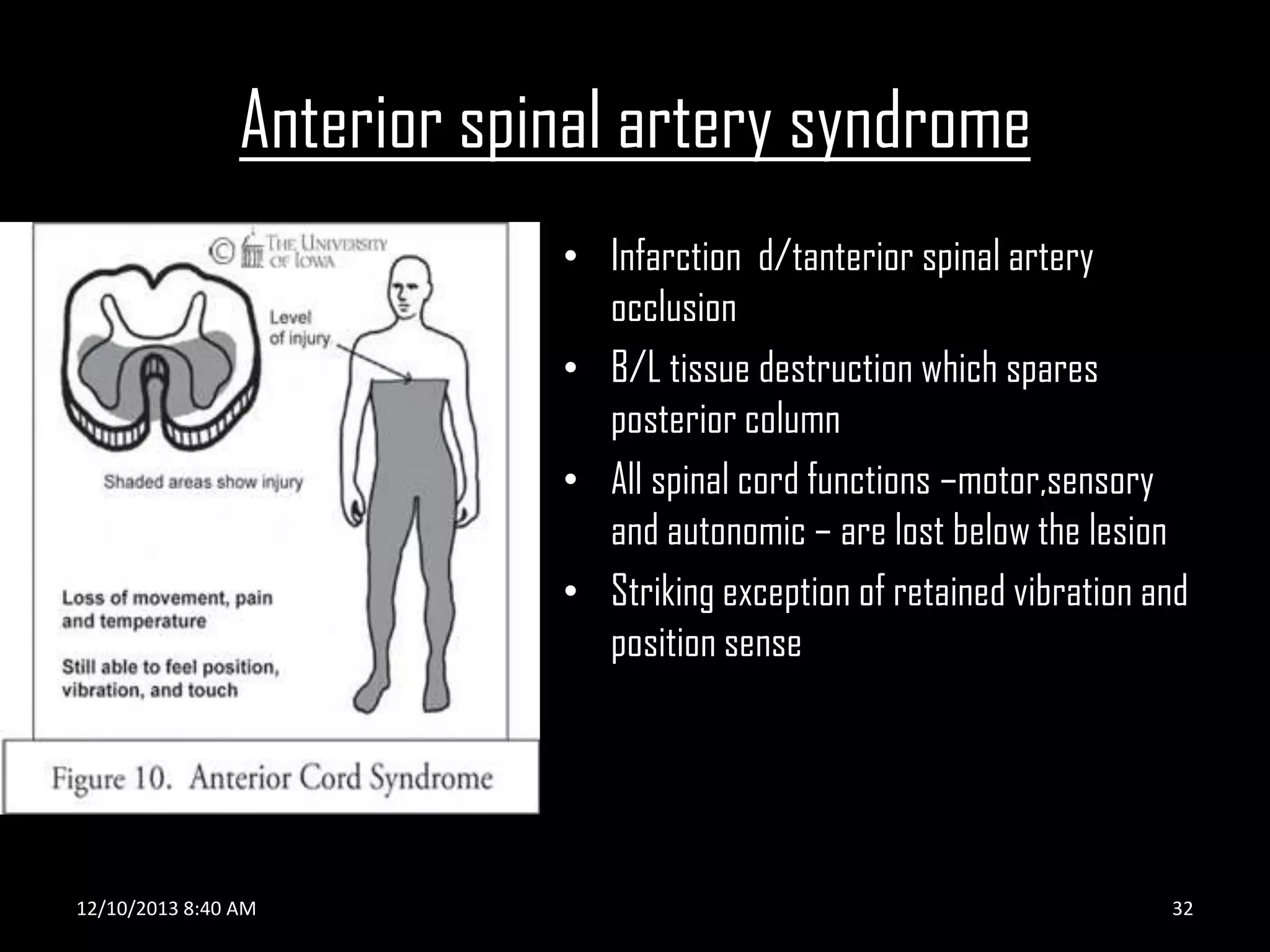
Anterior spinal artery syndrome
• Infarction d/tanterior spinal artery
occlusion
• B/L tissue destruction which spares
posterior column
• All spinal cord functions –motor,sensory
and autonomic – are lost below the lesion
• Striking exception of retained vibration and
position sense

12/10/2013 8:40 AM

32
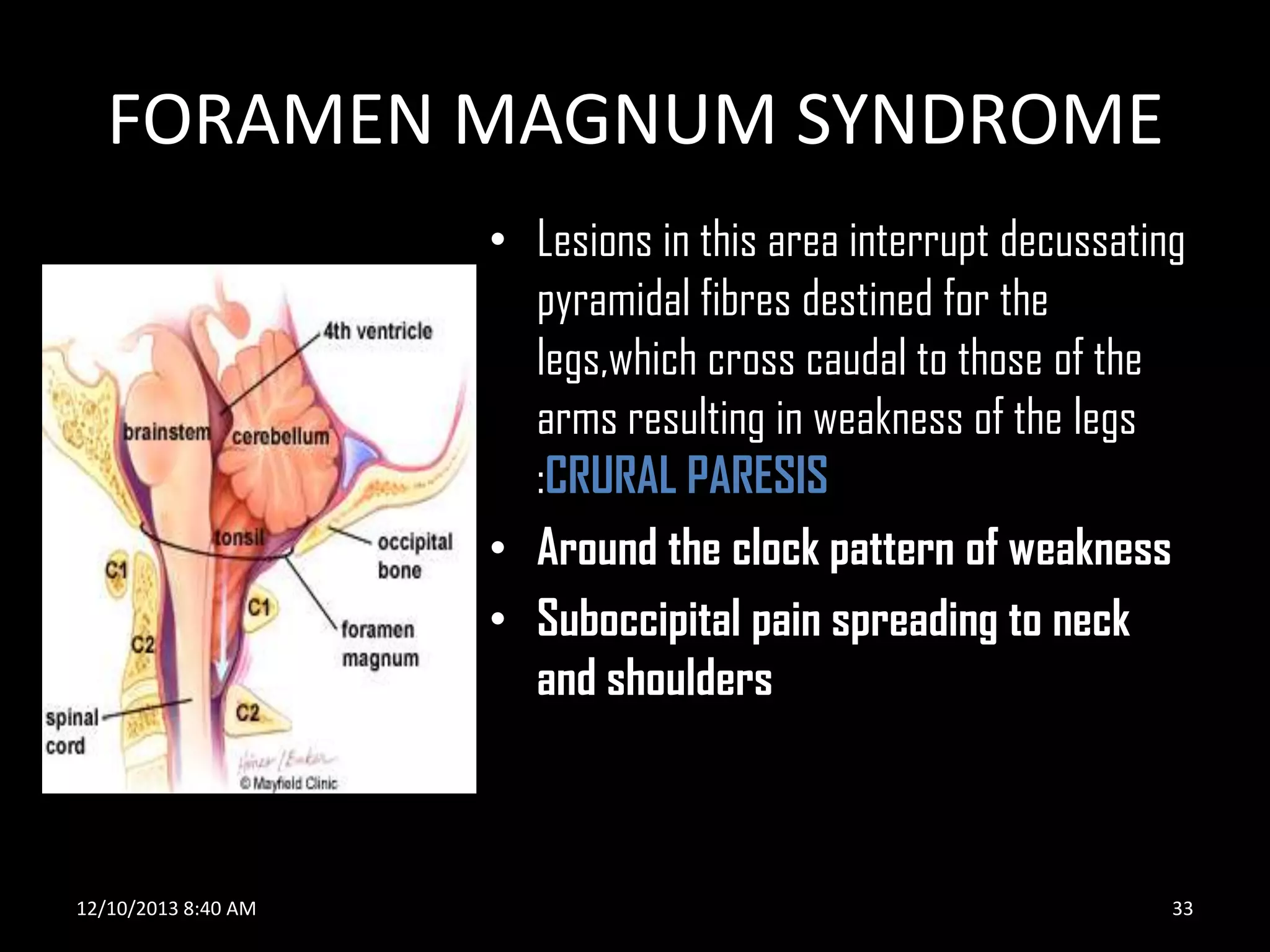
FORAMEN MAGNUM SYNDROME
• Lesions in this area interrupt decussating
pyramidal fibres destined for the
legs,which cross caudal to those of the
arms resulting in weakness of the legs
:CRURAL PARESIS
• Around the clock pattern of weakness
• Suboccipital pain spreading to neck
and shoulders

12/10/2013 8:40 AM

33
COMPRESSIVE DISORDERS OF SPINAL CORD

12/10/2013 8:40 AM

34
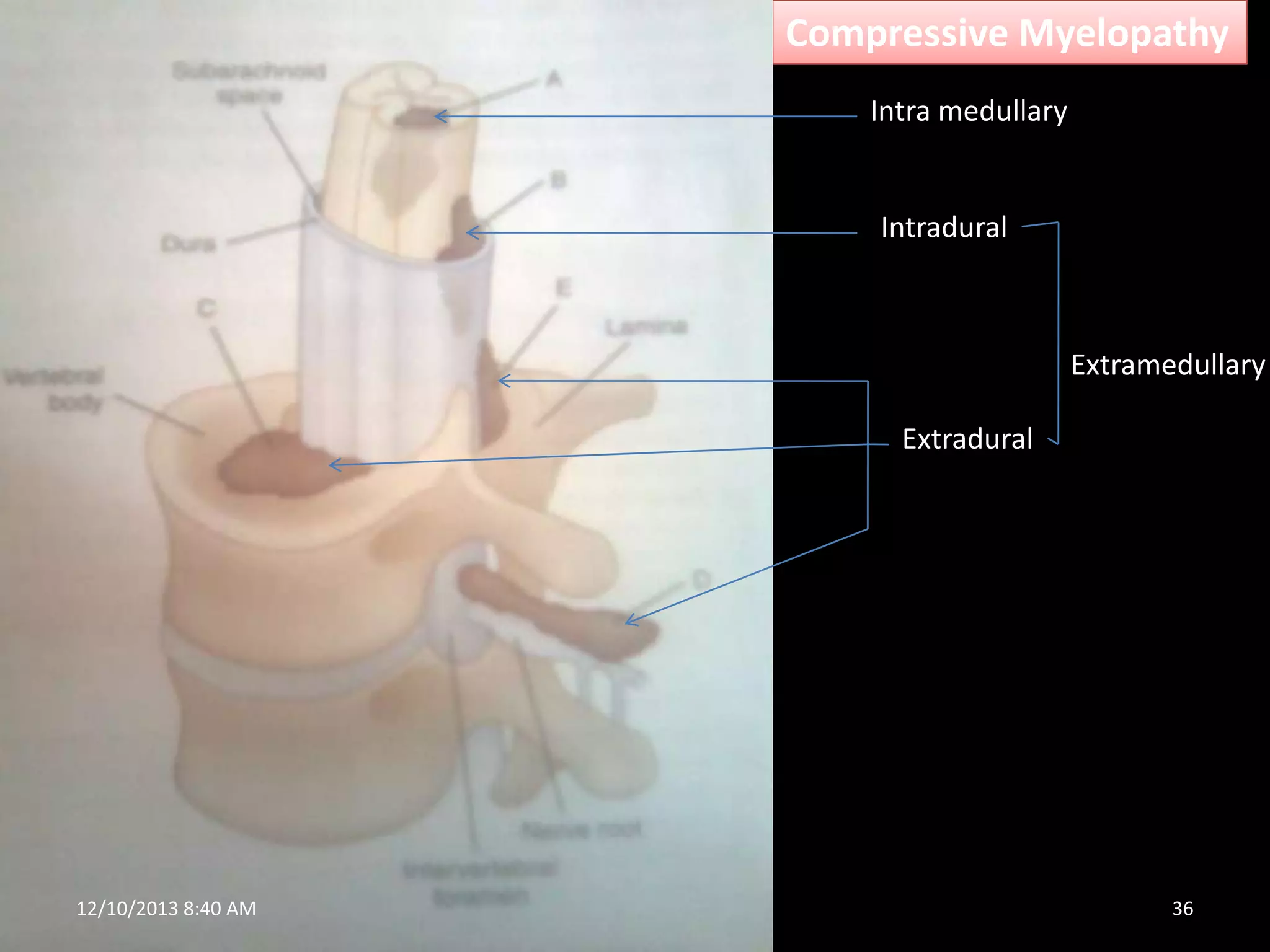
Compressive myelopathies
• Acute compressive Myelopathy / Chronic
Myelopathy
• Extramedullary / intramedullary

12/10/2013 8:40 AM

35
Compressive Myelopathy
Intra medullary

Intradural

Extramedullary
Extradural

12/10/2013 8:40 AM

36
•

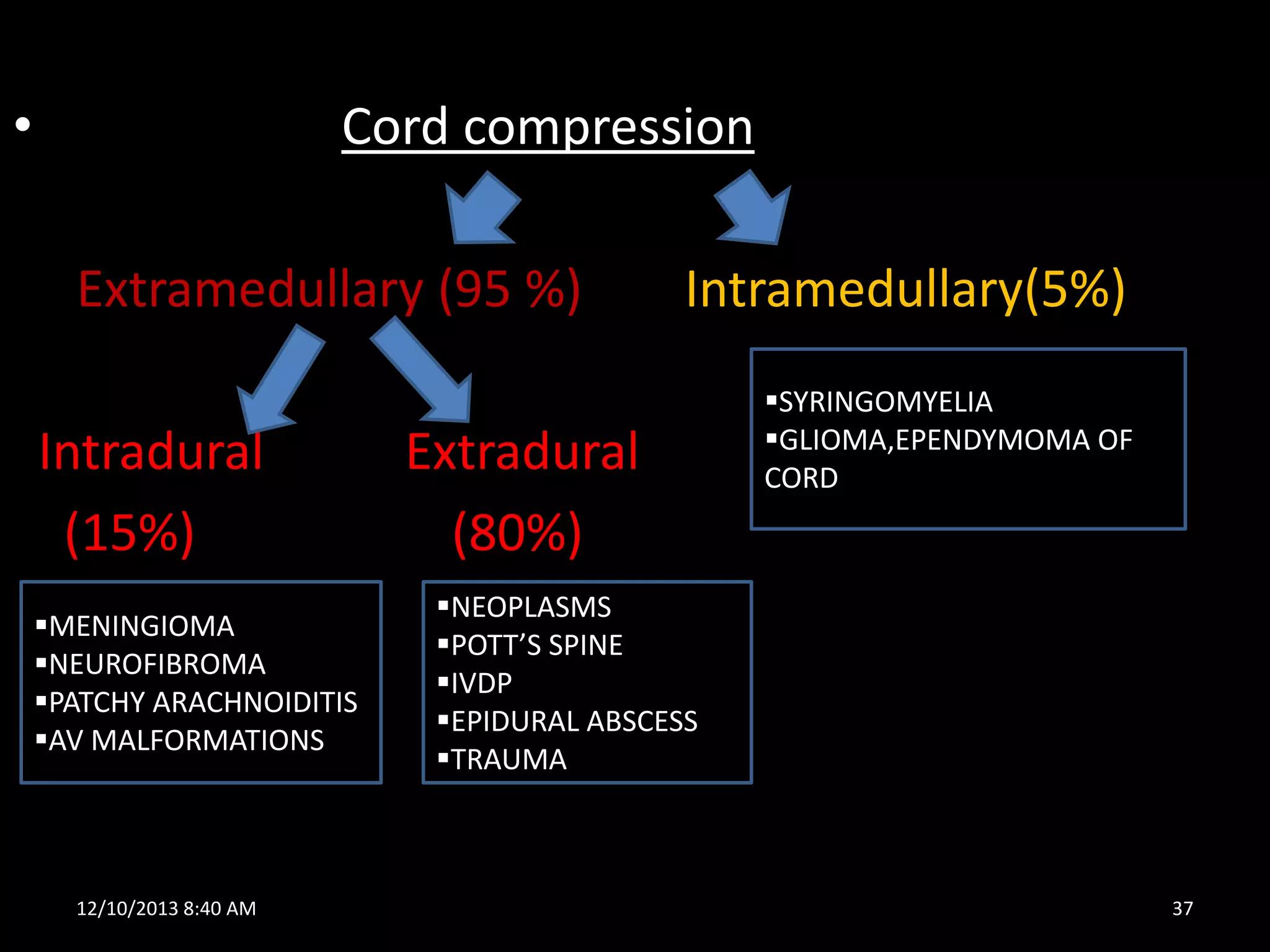
Cord compression
Extramedullary (95 %)
Intradural
(15%)
MENINGIOMA
NEUROFIBROMA
PATCHY ARACHNOIDITIS
AV MALFORMATIONS

12/10/2013 8:40 AM

Intramedullary(5%)

Extradural
(80%)

SYRINGOMYELIA
GLIOMA,EPENDYMOMA OF
CORD

NEOPLASMS
POTT’S SPINE
IVDP
EPIDURAL ABSCESS
TRAUMA

37
Extramedullary lesions
•
•
•
•
•
•
•

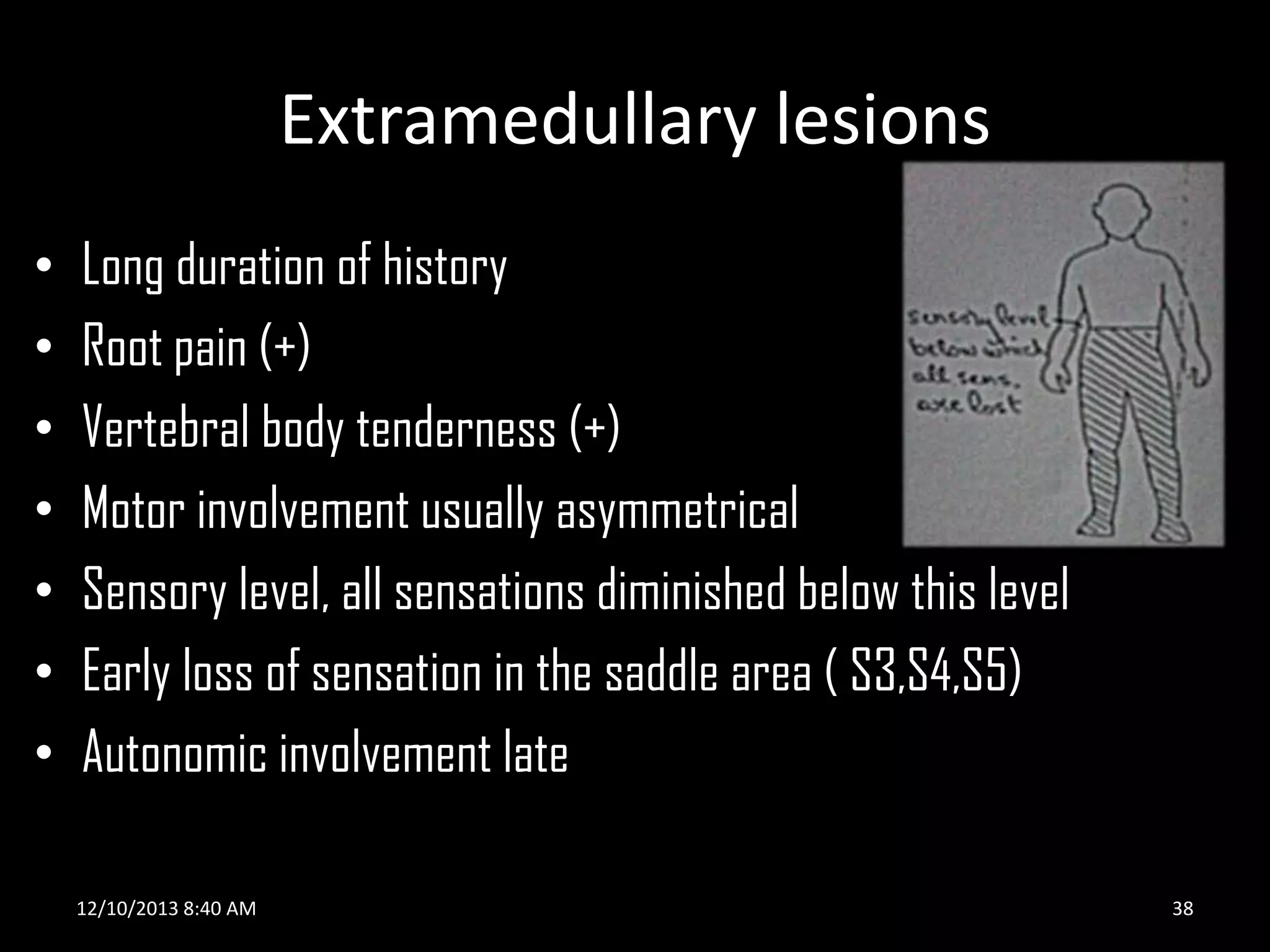
Long duration of history
Root pain (+)
Vertebral body tenderness (+)
Motor involvement usually asymmetrical
Sensory level, all sensations diminished below this level
Early loss of sensation in the saddle area ( S3,S4,S5)
Autonomic involvement late
12/10/2013 8:40 AM

38
Intramedullary lesions
•
•
•
•
•
•

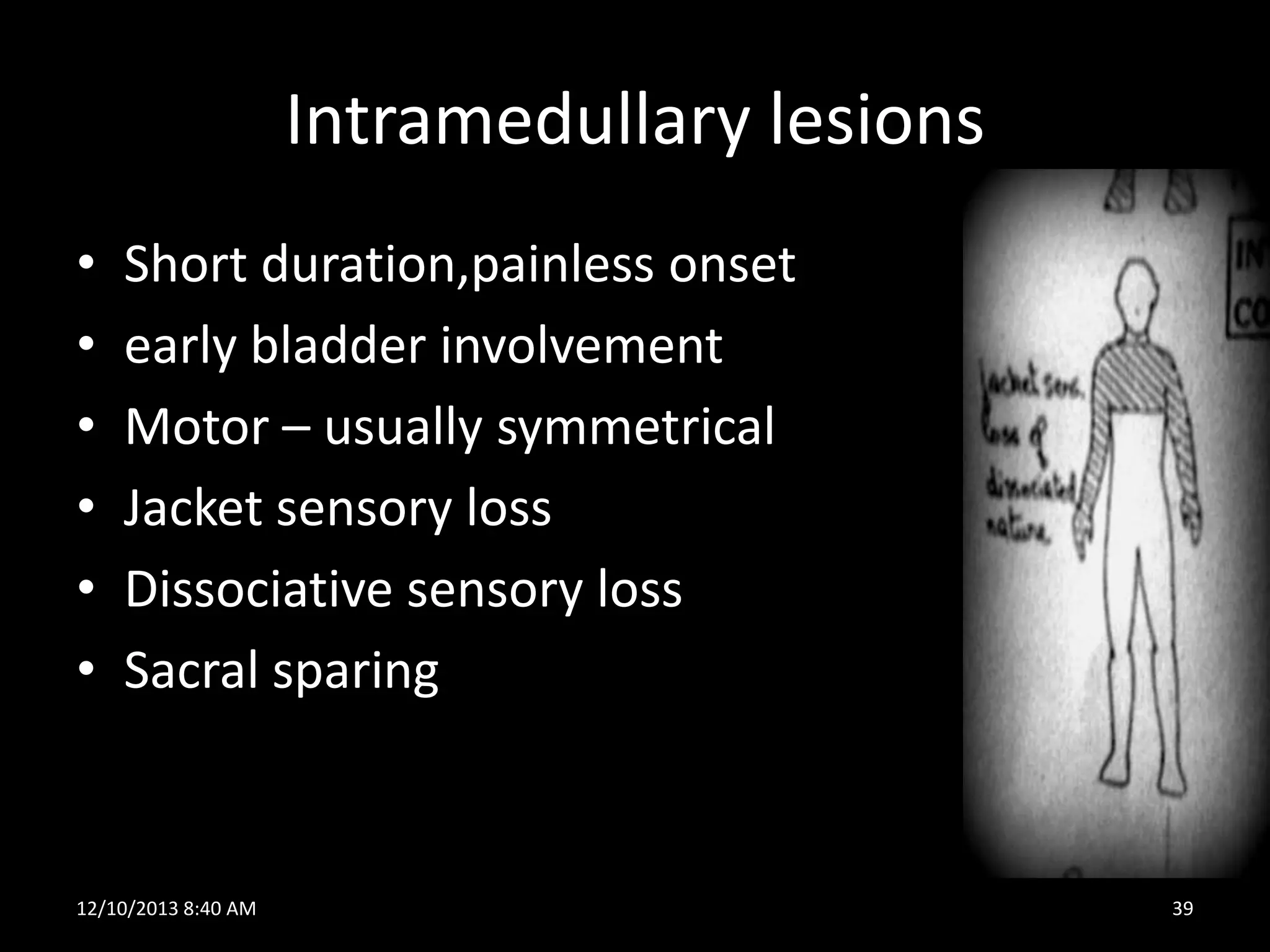
Short duration,painless onset
early bladder involvement
Motor – usually symmetrical
Jacket sensory loss
Dissociative sensory loss
Sacral sparing

12/10/2013 8:40 AM

39
EXTRADURAL EXTRAMEDULLARY CAUSES
• 1. DICS PROLAPSE :
 Cervical disc prolapse :most common
if centrally located, can cause acute or subacute cord
compression
 Thoracic disc protrusions : sub a/c or chronic cord
compression.Can cause paraparesis / brown sequard
syndrome due to asymmetrical compression

12/10/2013 8:40 AM

40
• Clear cut sensory level is usual
• Neurological symptoms may fluctuate over time
• MRI demonstrate the cord compression due to disc
prolapse.

12/10/2013 8:40 AM

41
•
•
•
•

Treatment :
immobilising in a cervical collar
If highly symptomatic – surgical decompression
Complication of cervical disc surgery – irreversible
paraplegia due to cord infarction

12/10/2013 8:40 AM

42
2. Spinal epidural abscess
clinical triad : Midline dorsal pain (Over spine / Radicular)
Fever (WBC,ESR,CRP elevation)
Progressive limb weakness
Prompt recognition to prevent permanent sequelae

12/10/2013 8:40 AM

43
• Abscess expand – venous congestion and thrombosis –
further cord damage
• Rapid progression once the features of myelopathy
develops
• a/w impaired immune status, IV drug abuse,skin and tissue
infections
(furunculosis,pharyngeal/dental abscess/bacterial endocarditis,pott’s spine,)
local causes :epidural anaesthesia, LP ,decubitus ulcer ,vertebral osteotomies
12/10/2013 8:40 AM

44
• S.aureus, Streptococcus, anaerobes, gram neg bacilli, fungi
• MRI ,sometimes LP
• Treatment :
Surgical evacuation, decompressive laminectomy , long
term antibiotics

12/10/2013 8:40 AM

45
TUMORS AND COMPRESSIVE MYELOPATHY

Metastasis - epidural
Thracic is common;
 Lumbar & Sacral – Prostate and ovarian
Breast > Lung > Prostate > Kidney > Lymphoma
 old age pt :Vertebral pain with a/c onset of
neurological deficit

12/10/2013 8:40 AM

46
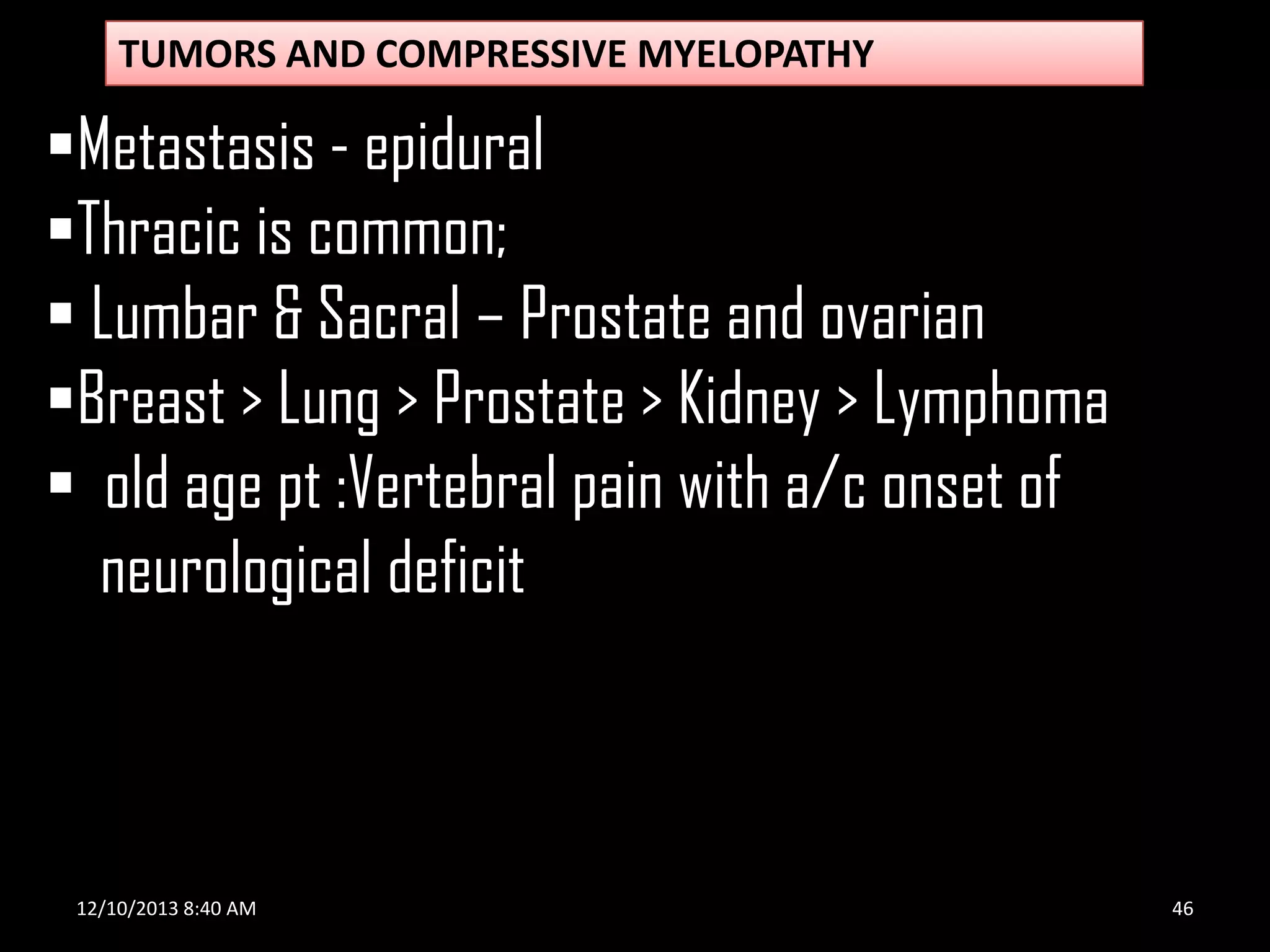
MRI – hypointense lesion in
T1; does not cross the
adjacent disc space
Bone scan may be useful to
detect the all other
metastasis
12/10/2013 8:40 AM

47
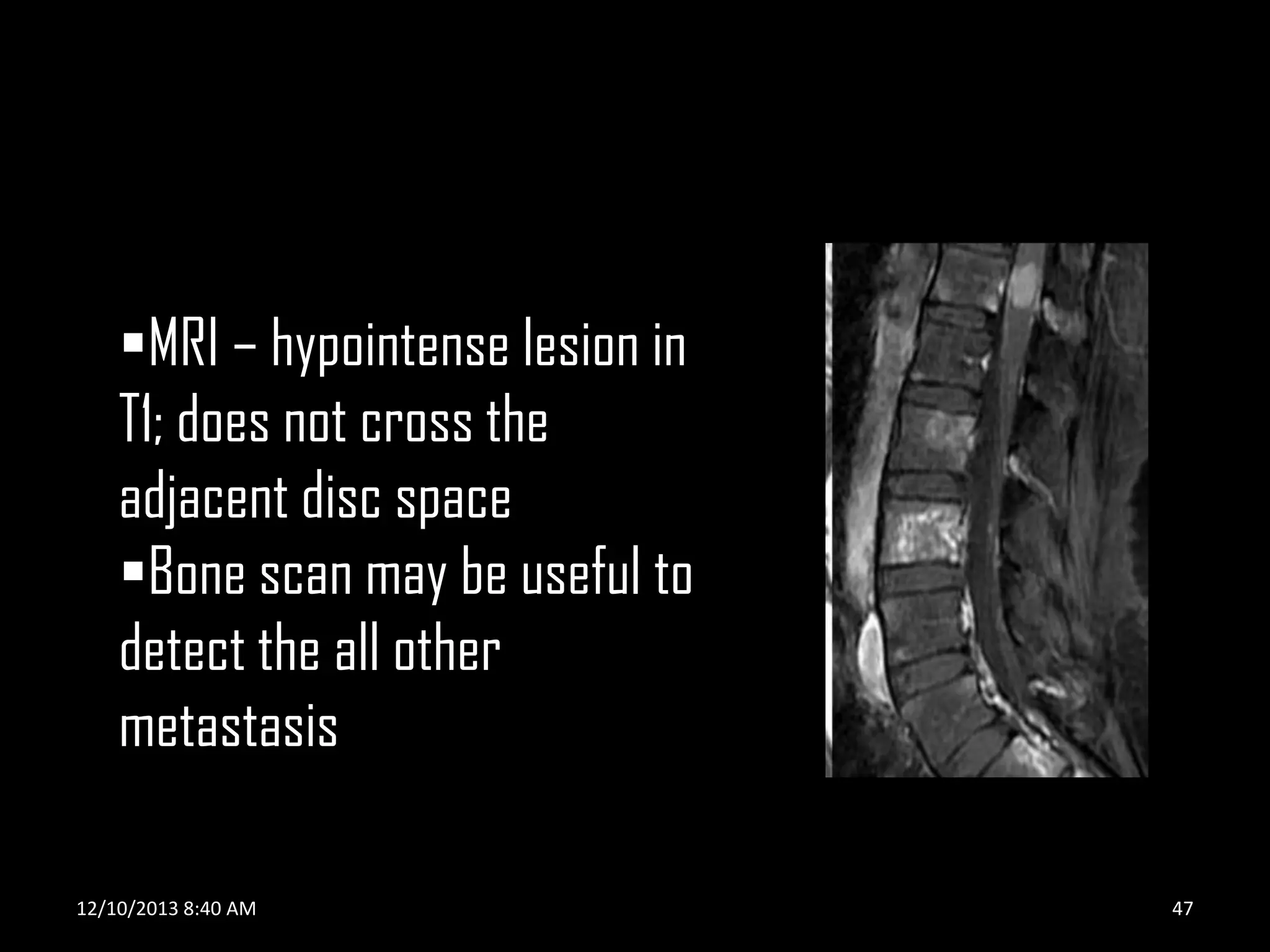
PAIN !!
Recent onset,particularly thoracic
(aching,localised,sharp,radiating quality)
Typically worsens with movement, coughing,
sneezing and
Characteristically awakens the patient at night
12/10/2013 8:40 AM

48
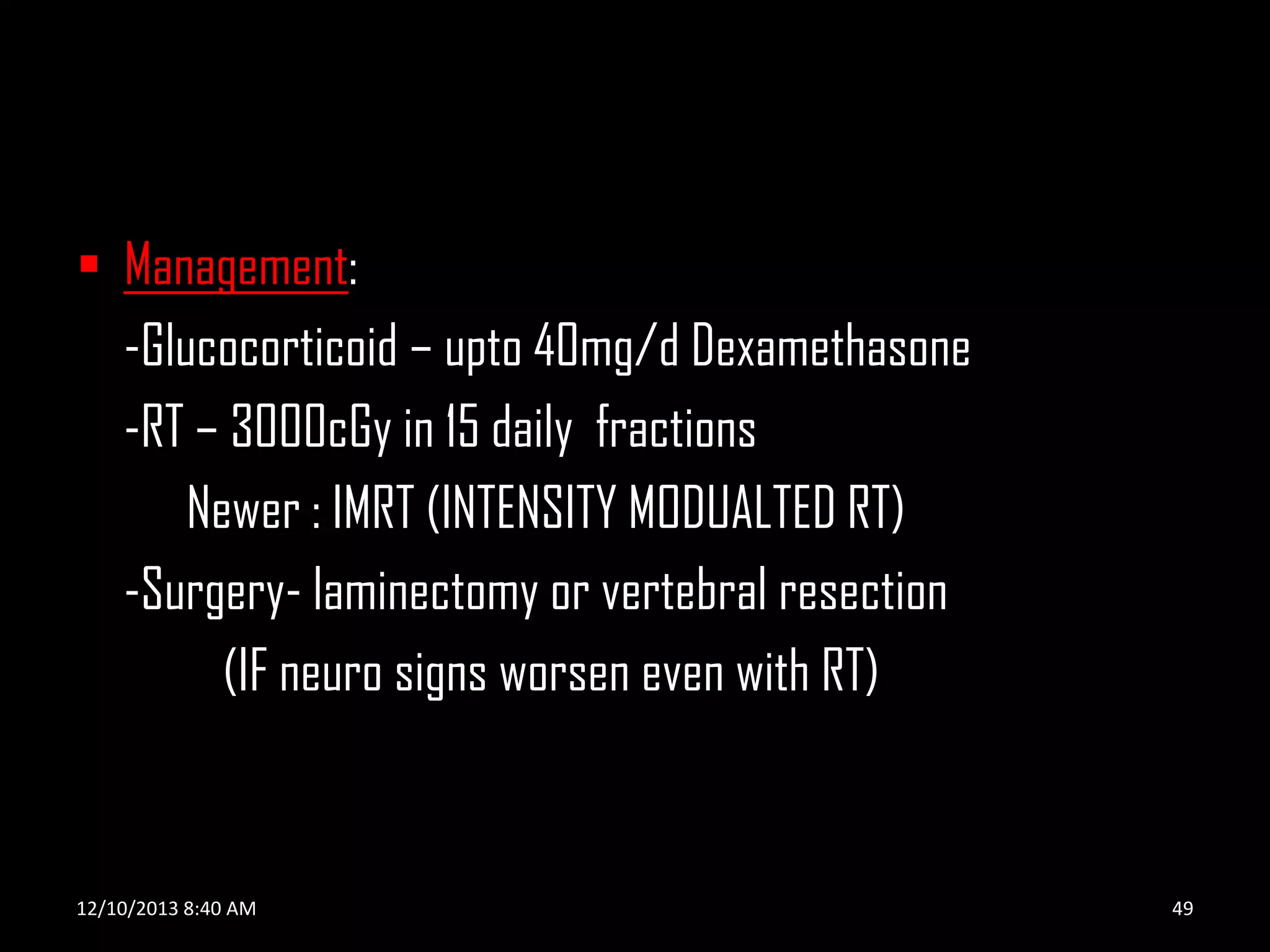
 Management:
-Glucocorticoid – upto 40mg/d Dexamethasone
-RT – 3000cGy in 15 daily fractions
Newer : IMRT (INTENSITY MODUALTED RT)
-Surgery- laminectomy or vertebral resection
(IF neuro signs worsen even with RT)

12/10/2013 8:40 AM

49
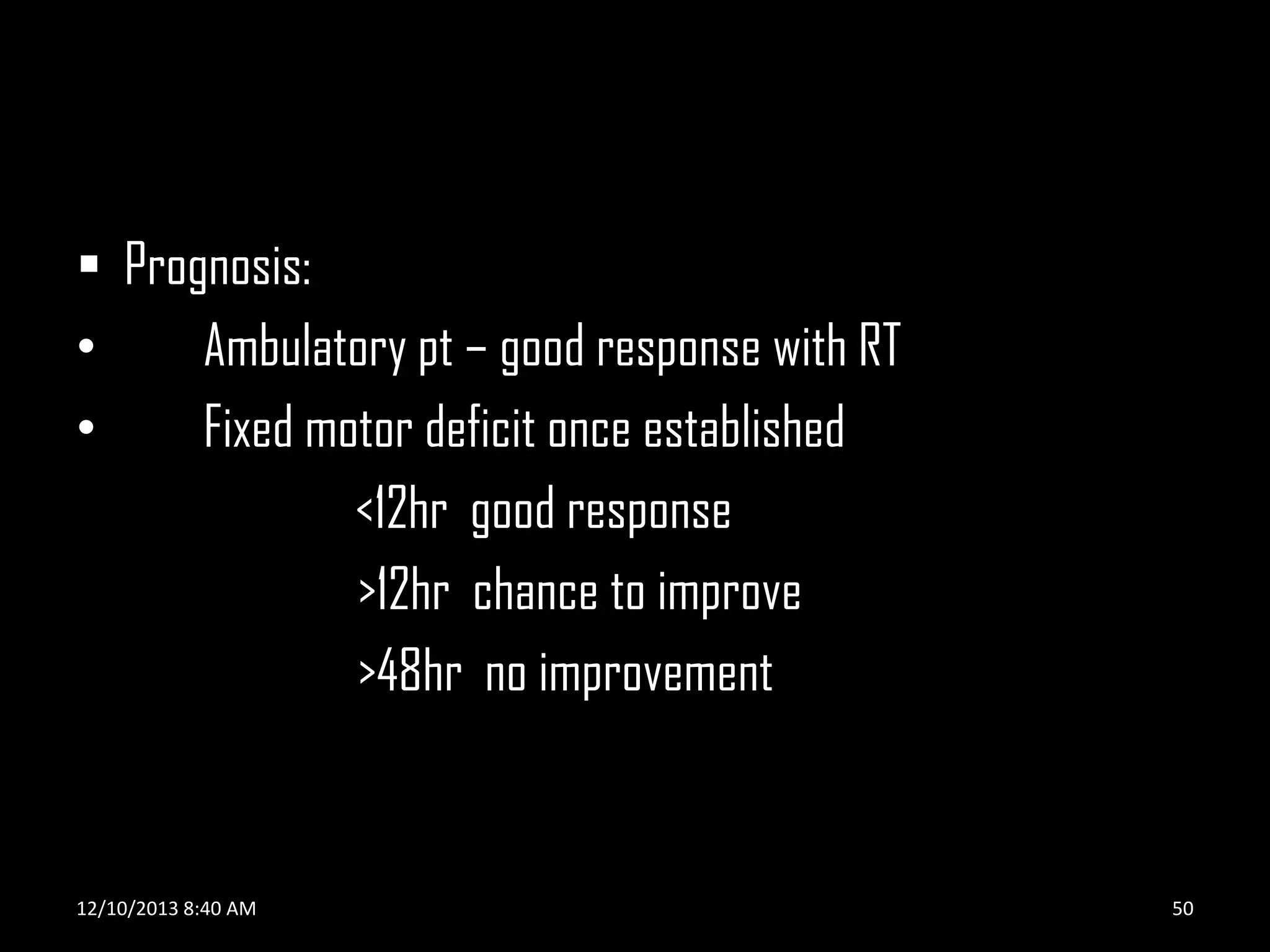
 Prognosis:
•
Ambulatory pt – good response with RT
•
Fixed motor deficit once established
<12hr good response
>12hr chance to improve
>48hr no improvement

12/10/2013 8:40 AM

50
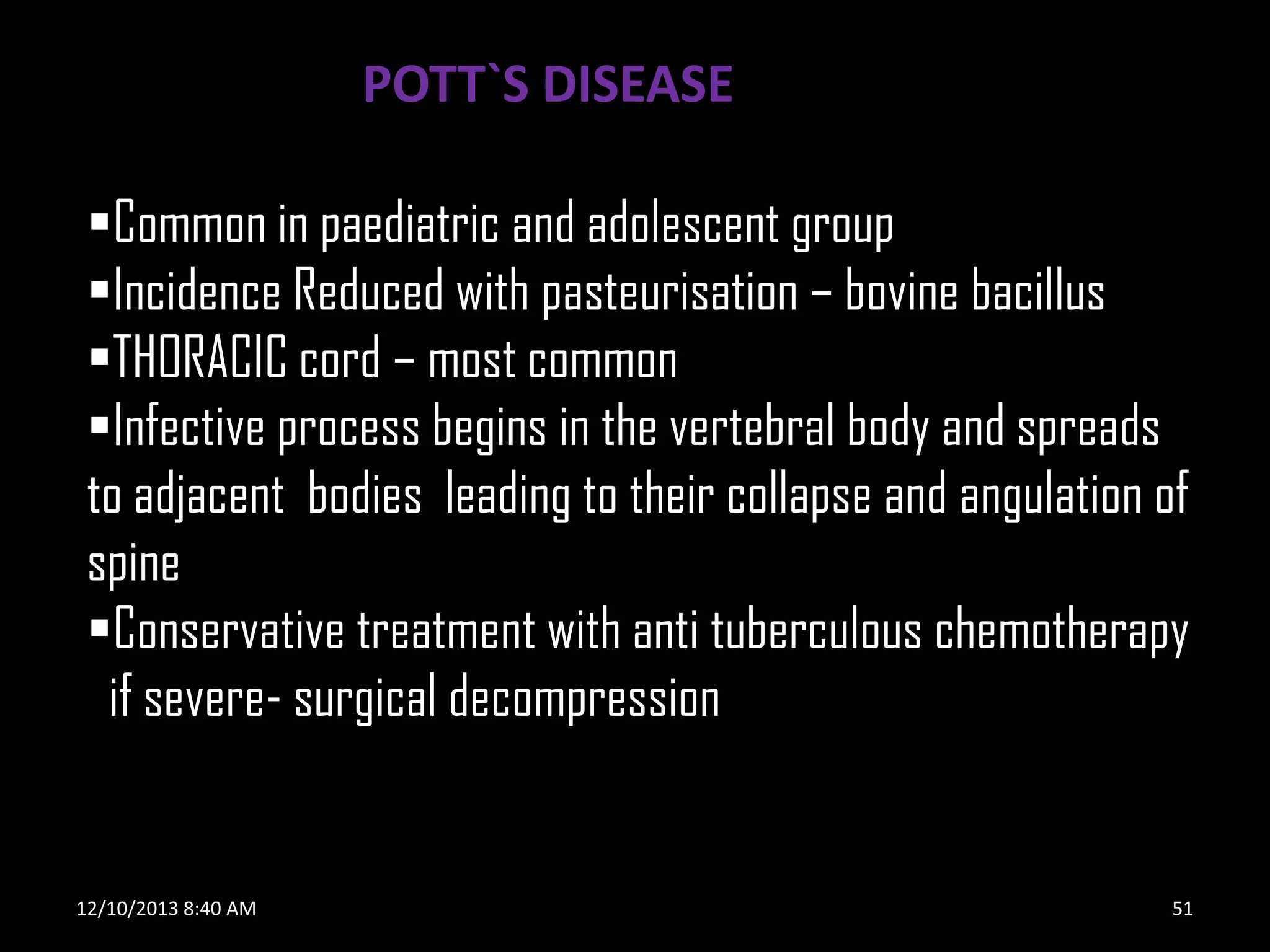
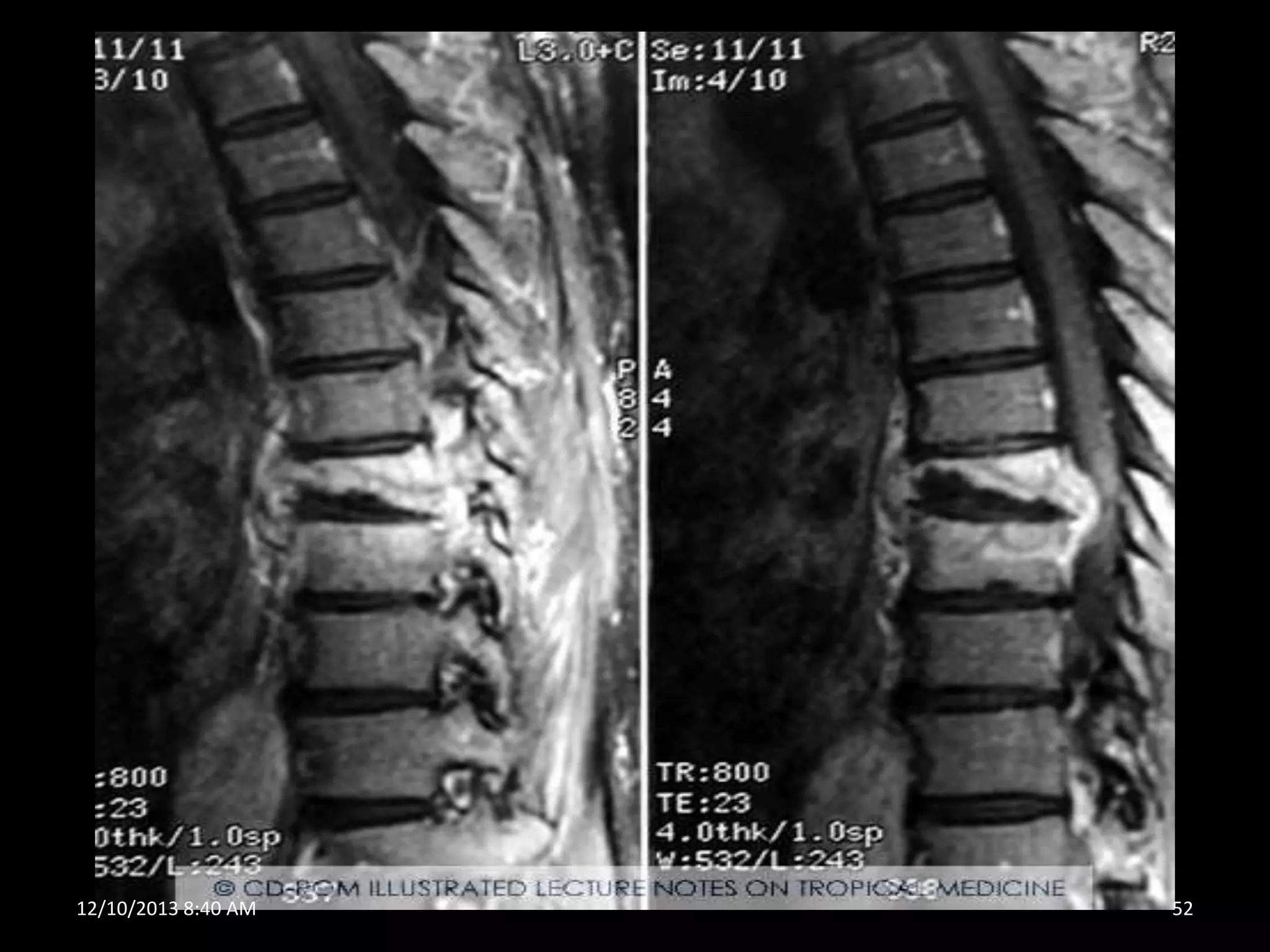
POTT`S DISEASE
Common in paediatric and adolescent group
Incidence Reduced with pasteurisation – bovine bacillus
THORACIC cord – most common
Infective process begins in the vertebral body and spreads
to adjacent bodies leading to their collapse and angulation of
spine
Conservative treatment with anti tuberculous chemotherapy
if severe- surgical decompression

12/10/2013 8:40 AM

51
12/10/2013 8:40 AM

52
NEUROFIBROMA:
• arises near posterior root
• May or may not be a/w generalised NF
• Can occur at any level of spinal cord
• Equally in both sexes
MENINGIOMA:
• Benign -thoracic cord level
more common in females
12/10/2013 8:40 AM

53
REFERENCE
• Brain’s book of neurology
• Harrison’s Principles of internal medicine, 18th
E
• Neuroanatomy,inderbir singh,8th edition

12/10/2013 8:40 AM

54
12/10/2013 8:40 AM

55

Spinal cord& its lesions,compressive myelopathy

  • 1.
    SPINAL CORD & ITS COMPRESSIVEDISORDERS SHRUTHI.S.JAYARAJ 53rd, Calicut Medical College 12/10/2013 8:40 AM 1
  • 2.
    • Basics ofspinal cord • Determining the level of lesion • Special pattern of spinal cord diseases • Compressive disorders of spinal cord 12/10/2013 8:40 AM 2
  • 3.
    SPINAL CORD • Mostimportant content of the vertebral canal • Extension : medulla,upper border of C1 till lower border of L1 /upper border of L2 (termination is variable) 12/10/2013 8:40 AM 3
  • 4.
    • 12/10/2013 8:40 AM Normalspine has a cervical and lumbar lordosis and thoracic kyphosis 4
  • 5.
    • Cervical enlargement: C3 to T2 • Lumbar enlargement : L1 to S3 • Lowest conical part : conus medullaris ( S3,S4,S5) • Conus continuous as a fibrous cordfilum terminale - extend to coccyx • Lower end of central canal expand to form terminal ventricle- conus 12/10/2013 8:40 AM 5
  • 6.
    oncept of spinalsegments • Length of spinal cord giving origin to rootlets of one spinal nerve • 31 spinal segments • C-8 • T - 12 • L- 5 • S- 5 • C- 1 12/10/2013 8:40 AM 6
  • 7.
    • During embryologicaldvpt, growth of the cord lags behind that of vertebral column • Lower spinal nerves have to taka an increasingly downward course to enter the corresponding intervertebral foraminabundle of nerves- cauda equina 12/10/2013 8:40 AM 7
  • 8.
    • Important forlocalising lesions causing spinal cord compression • For eg, sensory loss below umbilicus – T10 – involvement of cord adjacent to 7th or 8th thoracic vertebral body 12/10/2013 8:40 AM 8
  • 9.
    • MENINGES • Dura,Arachnoid– second sacral vertebra • Ligamentum denticulatumto the inner aspect of dura 12/10/2013 8:40 AM 9
  • 10.
  • 11.
  • 12.
    Determining the levelof lesion SENSORY ! MOTOR ! SPHINCTER ! 1. The presence of a horizontal level below which sensory ,motor and autonomic function is impaired is a hallmark of spinal cord disease. 2. Sensory loss below a particular level is due to damage to spinothalamic tract on the opposite side one or two segments higher in case of a unilateral lesion. 12/10/2013 8:40 AM 12
  • 13.
    • 2nd orderneurons ascend for for one or two levels as they cross anterior to the central canal to join the opposite STT 12/10/2013 8:40 AM 13
  • 14.
    • Sensory symptomsinclude numbness, tingling ,pins and needles, dermal hypersensitivity, burning sensation, altered temperature sensation and tight band like sensation. • A complete cord syndrome- loss of all sensory modalities below the level of lesion. • Partial syndromes produce variable findings 12/10/2013 8:40 AM 14
  • 15.
    • Posterior column– loss of joint sense,vibration,tactile discrimination,with positive romberg’s and ataxic gait (sensory ataxia) • STT – Contralateral loss of pain & temperature sensation 12/10/2013 8:40 AM 15
  • 16.
    SENSORY LEVEL • Zoneof hyperaesthesia (dorsal column) :level of lesion is just below it • Girdle like sensation exaggerated by cough and sneezingdorsal column • Involvement of specific dermatomes 12/10/2013 8:40 AM 16
  • 17.
    3. At thelevel of lesion – LMN signs – focal muscle wasting, fasciculations, hypo- or areflexia due to involvement of AHCs Radicular pain or dermatomal sensory loss d/t involvement of sensory roots 12/10/2013 8:40 AM 17
  • 18.
    4. Interruption ofmotor tracts (pyramidal /extrapyramidal) UMN signs below the level of lesion if corticospinal tract – pyramidal pattern of weakness – greater in the antigravity muscles – paraplegia in extension if extrapyramidal tracts - progravity muscles are affected more – paraplegia in flexion – may be associated with ‘mass reflex’ 12/10/2013 8:40 AM 18
  • 19.
    Mass reflex • Spontaneousurination, defaecation, sweating on scratching skin on the medial aspect of thigh • a/w reflex ejaculation and erection on squeezing glans penis 12/10/2013 8:40 AM 19
  • 20.
  • 21.
    5.The lesions thattransect the motor tracts cause paraplegia or quadriplegia with heightened DTRs ,babinski sign and eventual spasticity ( Upper motor neuron syndrome) 6. If Acute compressive lesion (traumatic/vascular/inflammatory) : stage of neuronal shock prior to the stage of spasticity 12/10/2013 8:40 AM 21
  • 22.
    7. Transverse damageto the cord produces autonomic disturbances -absent sweating below the implicated cord level and bowel, bladder, sexual dysfunction 8. Most common sphincter disturbances resulting from spinal cord diseases are urgency,frequency, urge incontinence. retention a /c transverse lesions –retention is the rule 12/10/2013 8:40 AM 22
  • 23.
    Localising the uppermostlevel of a spinal cord lesion ‘segmental signs’ • Band of altered sensation (hyperalgesia/hyperpathia) at the upper end of sensory disturbance • Fasciculations or muscle atrophy in muscles supplied by that sement • Absent DTR at this level How to differenciate from focal root or peripheral nerve disorder? 12/10/2013 8:40 AM 23
  • 24.
    Uppercervical cord lesion: Quadriplegia Weaknessof diaphragm(above C4) Arnold chiari - downbeating nystagmus & cerebellar ataxia 12/10/2013 8:40 AM Lower cervical cord lesions Atrophy and weakness of corresponding muscles Spastic paralysis of trunk and lower limb Absent biceps,radial jerk Horner’s syndrome 24
  • 25.
    Thoracic cord lesions Sensorylevel on the trunk, Site of midline back pain Beevor’s sign positive – lesion at T9,T10 Spastic paralysis of lowerlimbs 12/10/2013 8:40 AM Lumbar cord lesions L2-L4:weakness of Flexion and adduction of thigh Loss of knee jerk Spastic paralysis below,exaggerated ankle jerk Extensor plantar 25
  • 26.
    Cauda equina andconus medullaris lesions CONUS MEDULLARIS CAUDA EQUINA B/L saddle anaesthesia asymmetric leg weakness and sensory loss Prominent bowel,bladder symptoms,impotence Relative sparing of bowel-bladder function Bulbocavernous ( S2-s4) and anal reflexes (s4-s5) are absent Variable areflexia in lower extremities Muscle strength largely preserved Low back and radicular pain 12/10/2013 8:40 AM 26
  • 27.
    SPECIAL PATTERNS OFSPINAL CORD DISEASES 12/10/2013 8:40 AM 27
  • 28.
    BROWN SEQUARD SYNDROME •HEMICORD SYNDROME • I/L corticospinal,dorsal column,spinothalamic tract • I/L – weakness,loss of joint and vibration sense • C/L – loss of pain,temp 12/10/2013 8:40 AM 28
  • 29.
  • 30.
    Central cord syndrome •Selective damage to grey matter and crossing spinothalamic tracts • Syringomyelia,intrinsic tumors of spinal cord,trauma • Dissociated anaesthesia 12/10/2013 8:40 AM 30
  • 31.
    Shoulders,lower neck,upper trunk –capedistribution 12/10/2013 8:40 AM 31
  • 32.
    Anterior spinal arterysyndrome • Infarction d/tanterior spinal artery occlusion • B/L tissue destruction which spares posterior column • All spinal cord functions –motor,sensory and autonomic – are lost below the lesion • Striking exception of retained vibration and position sense 12/10/2013 8:40 AM 32
  • 33.
    FORAMEN MAGNUM SYNDROME •Lesions in this area interrupt decussating pyramidal fibres destined for the legs,which cross caudal to those of the arms resulting in weakness of the legs :CRURAL PARESIS • Around the clock pattern of weakness • Suboccipital pain spreading to neck and shoulders 12/10/2013 8:40 AM 33
  • 34.
    COMPRESSIVE DISORDERS OFSPINAL CORD 12/10/2013 8:40 AM 34
  • 35.
    Compressive myelopathies • Acutecompressive Myelopathy / Chronic Myelopathy • Extramedullary / intramedullary 12/10/2013 8:40 AM 35
  • 36.
  • 37.
    • Cord compression Extramedullary (95%) Intradural (15%) MENINGIOMA NEUROFIBROMA PATCHY ARACHNOIDITIS AV MALFORMATIONS 12/10/2013 8:40 AM Intramedullary(5%) Extradural (80%) SYRINGOMYELIA GLIOMA,EPENDYMOMA OF CORD NEOPLASMS POTT’S SPINE IVDP EPIDURAL ABSCESS TRAUMA 37
  • 38.
    Extramedullary lesions • • • • • • • Long durationof history Root pain (+) Vertebral body tenderness (+) Motor involvement usually asymmetrical Sensory level, all sensations diminished below this level Early loss of sensation in the saddle area ( S3,S4,S5) Autonomic involvement late 12/10/2013 8:40 AM 38
  • 39.
    Intramedullary lesions • • • • • • Short duration,painlessonset early bladder involvement Motor – usually symmetrical Jacket sensory loss Dissociative sensory loss Sacral sparing 12/10/2013 8:40 AM 39
  • 40.
    EXTRADURAL EXTRAMEDULLARY CAUSES •1. DICS PROLAPSE :  Cervical disc prolapse :most common if centrally located, can cause acute or subacute cord compression  Thoracic disc protrusions : sub a/c or chronic cord compression.Can cause paraparesis / brown sequard syndrome due to asymmetrical compression 12/10/2013 8:40 AM 40
  • 41.
    • Clear cutsensory level is usual • Neurological symptoms may fluctuate over time • MRI demonstrate the cord compression due to disc prolapse. 12/10/2013 8:40 AM 41
  • 42.
    • • • • Treatment : immobilising ina cervical collar If highly symptomatic – surgical decompression Complication of cervical disc surgery – irreversible paraplegia due to cord infarction 12/10/2013 8:40 AM 42
  • 43.
    2. Spinal epiduralabscess clinical triad : Midline dorsal pain (Over spine / Radicular) Fever (WBC,ESR,CRP elevation) Progressive limb weakness Prompt recognition to prevent permanent sequelae 12/10/2013 8:40 AM 43
  • 44.
    • Abscess expand– venous congestion and thrombosis – further cord damage • Rapid progression once the features of myelopathy develops • a/w impaired immune status, IV drug abuse,skin and tissue infections (furunculosis,pharyngeal/dental abscess/bacterial endocarditis,pott’s spine,) local causes :epidural anaesthesia, LP ,decubitus ulcer ,vertebral osteotomies 12/10/2013 8:40 AM 44
  • 45.
    • S.aureus, Streptococcus,anaerobes, gram neg bacilli, fungi • MRI ,sometimes LP • Treatment : Surgical evacuation, decompressive laminectomy , long term antibiotics 12/10/2013 8:40 AM 45
  • 46.
    TUMORS AND COMPRESSIVEMYELOPATHY Metastasis - epidural Thracic is common;  Lumbar & Sacral – Prostate and ovarian Breast > Lung > Prostate > Kidney > Lymphoma  old age pt :Vertebral pain with a/c onset of neurological deficit 12/10/2013 8:40 AM 46
  • 47.
    MRI – hypointenselesion in T1; does not cross the adjacent disc space Bone scan may be useful to detect the all other metastasis 12/10/2013 8:40 AM 47
  • 48.
    PAIN !! Recent onset,particularlythoracic (aching,localised,sharp,radiating quality) Typically worsens with movement, coughing, sneezing and Characteristically awakens the patient at night 12/10/2013 8:40 AM 48
  • 49.
     Management: -Glucocorticoid –upto 40mg/d Dexamethasone -RT – 3000cGy in 15 daily fractions Newer : IMRT (INTENSITY MODUALTED RT) -Surgery- laminectomy or vertebral resection (IF neuro signs worsen even with RT) 12/10/2013 8:40 AM 49
  • 50.
     Prognosis: • Ambulatory pt– good response with RT • Fixed motor deficit once established <12hr good response >12hr chance to improve >48hr no improvement 12/10/2013 8:40 AM 50
  • 51.
    POTT`S DISEASE Common inpaediatric and adolescent group Incidence Reduced with pasteurisation – bovine bacillus THORACIC cord – most common Infective process begins in the vertebral body and spreads to adjacent bodies leading to their collapse and angulation of spine Conservative treatment with anti tuberculous chemotherapy if severe- surgical decompression 12/10/2013 8:40 AM 51
  • 52.
  • 53.
    NEUROFIBROMA: • arises nearposterior root • May or may not be a/w generalised NF • Can occur at any level of spinal cord • Equally in both sexes MENINGIOMA: • Benign -thoracic cord level more common in females 12/10/2013 8:40 AM 53
  • 54.
    REFERENCE • Brain’s bookof neurology • Harrison’s Principles of internal medicine, 18th E • Neuroanatomy,inderbir singh,8th edition 12/10/2013 8:40 AM 54
  • 55.