SPINAL TUBERCULOSIS
DIAGNOSIS &
MANAGEMENT
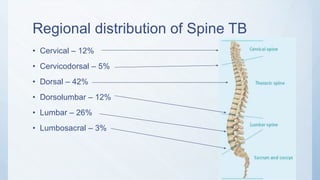
Regional distribution of Spine TB
• Cervical – 12%
• Cervicodorsal – 5%
• Dorsal – 42%
• Dorsolumbar – 12%
• Lumbar – 26%
• Lumbosacral – 3%
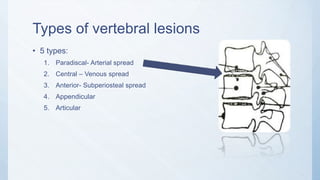
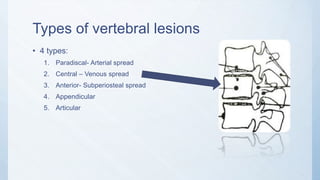
Types of vertebral lesions
• 5 types:
1. Paradiscal- Arterial spread
2. Central – Venous spread
3. Anterior- Subperiosteal spread
4. Appendicular
5. Articular
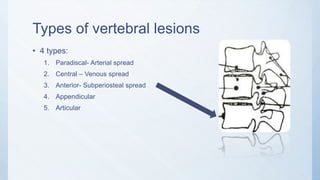
Types of vertebral lesions
• 4 types:
1. Paradiscal- Arterial spread
2. Central – Venous spread
3. Anterior- Subperiosteal spread
4. Appendicular
5. Articular
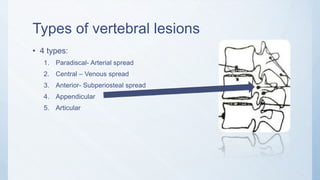
Types of vertebral lesions
• 4 types:
1. Paradiscal- Arterial spread
2. Central – Venous spread
3. Anterior- Subperiosteal spread
4. Appendicular
5. Articular
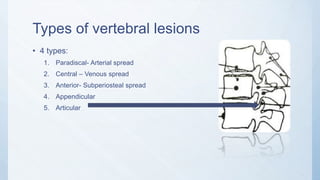
Types of vertebral lesions
• 4 types:
1. Paradiscal- Arterial spread
2. Central – Venous spread
3. Anterior- Subperiosteal spread
4. Appendicular
5. Articular
Types of vertebral lesions
• 4 types:
1. Paradiscal- Arterial spread
2. Central – Venous spread
3. Anterior- Subperiosteal spread
4. Appendicular
5. Articular
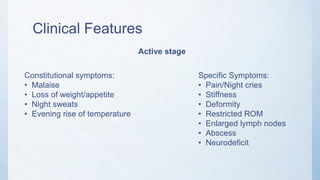
Clinical Features
Active stage
Constitutional symptoms:
• Malaise
• Loss of weight/appetite
• Night sweats
• Evening rise of temperature
Specific Symptoms:
• Pain/Night cries
• Stiffness
• Deformity
• Restricted ROM
• Enlarged lymph nodes
• Abscess
• Neurodeficit
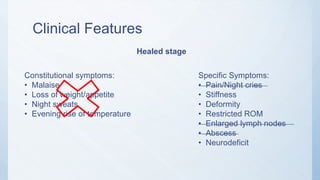
Clinical Features
Healed stage
Constitutional symptoms:
• Malaise
• Loss of weight/appetite
• Night sweats
• Evening rise of temperature
Specific Symptoms:
• Pain/Night cries
• Stiffness
• Deformity
• Restricted ROM
• Enlarged lymph nodes
• Abscess
• Neurodeficit
Neurological deficit
• 10-30% cases – Neurological deficit
• Age: 1 3 decadesst
• Disease below L1 vertebrae rarely causes Paraplegia
• Highest Incidence of paraplegia seen in TB of lower thoracic vertebrae
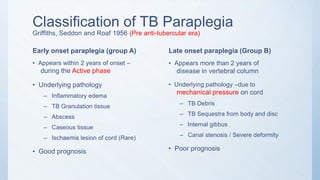
Classification of TB Paraplegia
Griffiths, Seddon and Roaf 1956 (Pre anti-tubercular era)
Early onset paraplegia (group A)
• Appears within 2 years of onset –
during the Active phase
• Underlying pathology
– Inflammatory edema
– TB Granulation tissue
– Abscess
– Caseous tissue
– Ischaemis lesion of cord (Rare)
• Good prognosis
Late onset paraplegia (Group B)
• Appears more than 2 years of
disease in vertebral column
• Underlying pathology –due to
mechanical pressure on cord
– TB Debris
– TB Sequestra from body and disc
– Internal gibbus
– Canal stenosis / Severe deformity
• Poor prognosis
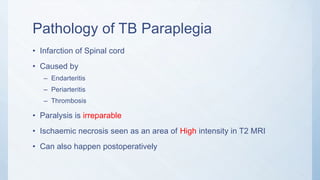
Pathology of TB Paraplegia
• Infarction of Spinal cord
• Caused by
– Endarteritis
– Periarteritis
– Thrombosis
• Paralysis is irreparable
• Ischaemic necrosis seen as an area of High intensity in T2 MRI
• Can also happen postoperatively
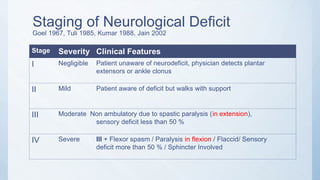
Staging of Neurological Deficit
Goel 1967, Tuli 1985, Kumar 1988, Jain 2002
Stage Severity Clinical Features
I Negligible Patient unaware of neurodeficit, physician detects plantar
extensors or ankle clonus
II Mild Patient aware of deficit but walks with support
III Moderate Non ambulatory due to spastic paralysis (in extension),
sensory deficit less than 50 %
IV Severe III + Flexor spasm / Paralysis in flexion / Flaccid/ Sensory
deficit more than 50 % / Sphincter Involved
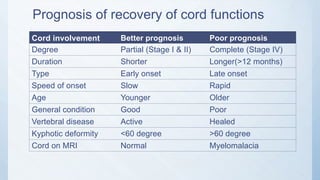
Prognosis of recovery of cord functions
Cord involvement Better prognosis Poor prognosis
Degree Partial (Stage I & II) Complete (Stage IV)
Duration Shorter Longer(>12 months)
Type Early onset Late onset
Speed of onset Slow Rapid
Age Younger Older
General condition Good Poor
Vertebral disease Active Healed
Kyphotic deformity <60 degree >60 degree
Cord on MRI Normal Myelomalacia
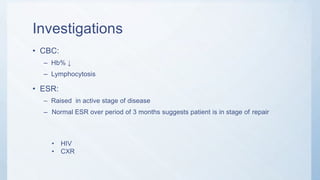
Investigations
• CBC:
– Hb% ↓
– Lymphocytosis
• ESR:
– Raised in active stage of disease
– Normal ESR over period of 3 months suggests patient is in stage of repair
• HIV
• CXR
Investigations
• Mantoux test
– Erythema of more than 20 mm at 72 hours – Positive
– Negative test, in general, rules out the disease
Investigations
• Biopsy
– In case of doubt, it is mandatory to prove the diagnosis by obtai
diseased tissue
Investigations
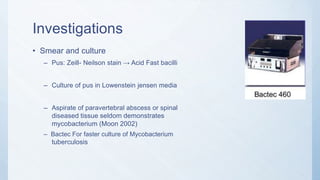
• Smear and culture
– Pus: Zeill- Neilson stain → Acid Fast bacilli
– Culture of pus in Lowenstein jensen media
– Aspirate of paravertebral abscess or spinal
diseased tissue seldom demonstrates
mycobacterium (Moon 2002)
– Bactec For faster culture of Mycobacterium
tuberculosis
Investigation
• Serological Investigations
– ELISPOT (Enzyme- linked immunospot)
– T-cell based assay from blood
– IgM & IgG antibodies : High sensitivity, low specificity
– PCR: Tissue /Pus PCR more sensitive
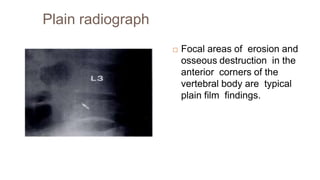
Plain radiograph
 Focal areas of erosion and
osseous destruction in the
anterior corners of the
vertebral body are typical
plain film findings.
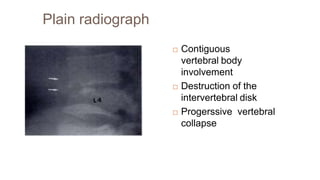
Plain radiograph
 Contiguous
vertebral body
involvement
 Destruction of the
intervertebral disk
 Progerssive vertebral
collapse
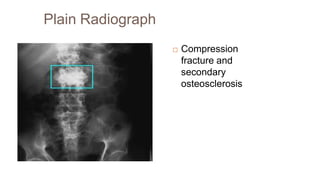
Plain Radiograph
 Compression
fracture and
secondary
osteosclerosis
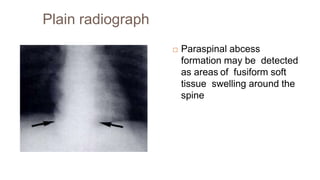
Plain radiograph
 Paraspinal abcess
formation may be detected
as areas of fusiform soft
tissue swelling around the
spine
Plain radiograph
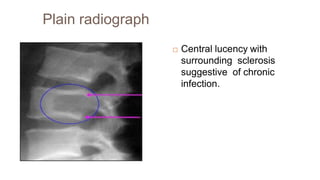
 Central lucency with
surrounding sclerosis
suggestive of chronic
infection.
Radiological Investigations
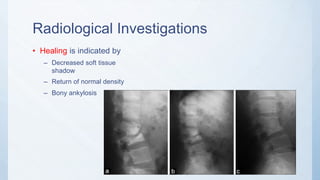
• Healing is indicated by
– Decreased soft tissue
shadow
– Return of normal density
– Bony ankylosis
Scintigraphy
 Initially bone scans and gallium studies can be negative despite
active disease.
 Later on increased bony metabolism manifests as increased
radionuclide uptake.
 Useful in determining the number of active sites of the disease.
 Helpful in determining the involvement of posterior elements of the
spine.
 Also useful in chronic infection in monitor the response to
therapy.
scintigraphy
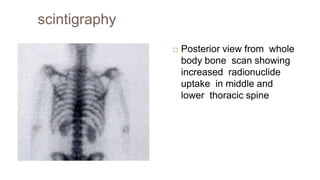
 Posterior view from whole
body bone scan showing
increased radionuclide
uptake in middle and
lower thoracic spine
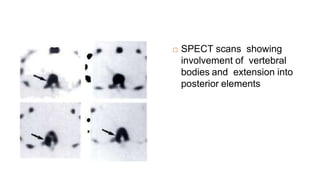
 SPECT scans showing
involvement of vertebral
bodies and extension into
posterior elements
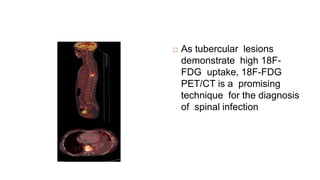
 As tubercular lesions
demonstrate high 18F-
FDG uptake, 18F-FDG
PET/CT is a promising
technique for the diagnosis
of spinal infection
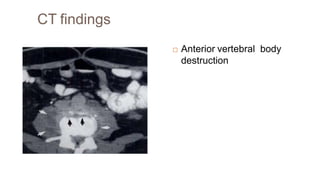
CT findings
 Anterior vertebral body
destruction
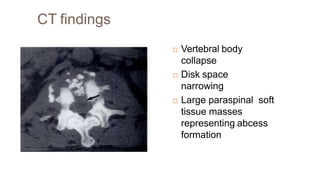
CT findings
 Vertebral body
collapse
 Disk space
narrowing
 Large paraspinal soft
tissue masses
representing abcess
formation
CT findings
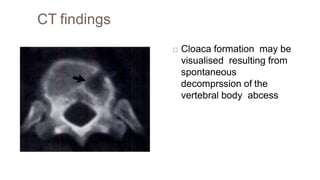
 Cloaca formation may be
visualised resulting from
spontaneous
decomprssion of the
vertebral body abcess
CT findings
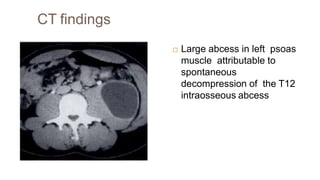
 Large abcess in left psoas
muscle attributable to
spontaneous
decompression of the T12
intraosseous abcess
CT findings
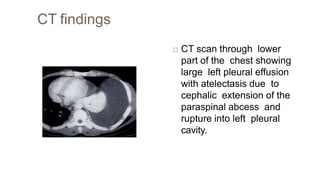
 CT scan through lower
part of the chest showing
large left pleural effusion
with atelectasis due to
cephalic extension of the
paraspinal abcess and
rupture into left pleural
cavity.
CT findings
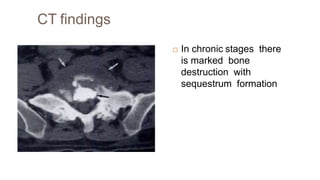
 In chronic stages there
is marked bone
destruction with
sequestrum formation
MR findings
 Highly sensitive and specific for spinal tuberculosis
 Provides early detection
 Best to know extent of soft tissue and spinal involvement
 CT is superior to MRI in the evaluation of the degree of
bony destruction, deformity and calcification.
MR findings
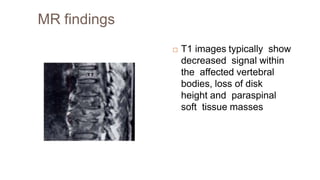
 T1 images typically show
decreased signal within
the affected vertebral
bodies, loss of disk
height and paraspinal
soft tissue masses
MR findings
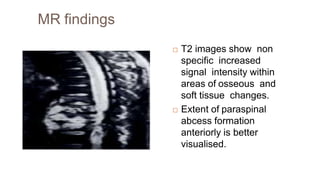
 T2 images show non
specific increased
signal intensity within
areas of osseous and
soft tissue changes.
 Extent of paraspinal
abcess formation
anteriorly is better
visualised.
MR findings
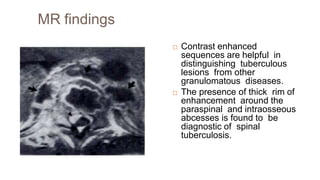
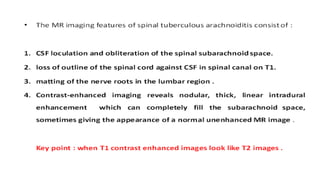
 Contrast enhanced
sequences are helpful in
distinguishing tuberculous
lesions from other
granulomatous diseases.
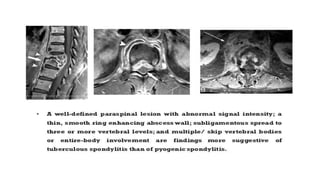
 The presence of thick rim of
enhancement around the
paraspinal and intraosseous
abcesses is found to be
diagnostic of spinal
tuberculosis.
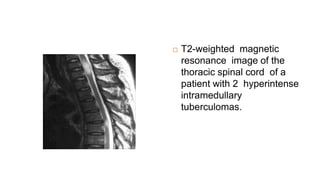
 T2-weighted magnetic
resonance image of the
thoracic spinal cord of a
patient with 2 hyperintense
intramedullary
tuberculomas.
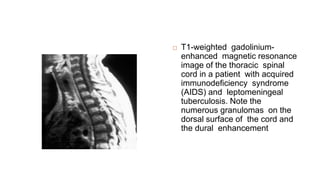
 T1-weighted gadolinium-
enhanced magnetic resonance
image of the thoracic spinal
cord in a patient with acquired
immunodeficiency syndrome
(AIDS) and leptomeningeal
tuberculosis. Note the
numerous granulomas on the
dorsal surface of the cord and
the dural enhancement
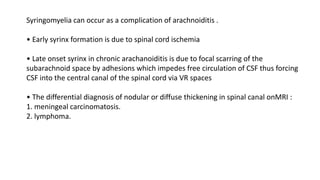
Syringomyelia can occur as a complication of arachnoiditis .
• Early syrinx formation is due to spinal cord ischemia
• Late onset syrinx in chronic arachanoiditis is due to focal scarring of the
subarachnoid space by adhesions which impedes free circulation of CSF thus forcing
CSF into the central canal of the spinal cord via VR spaces
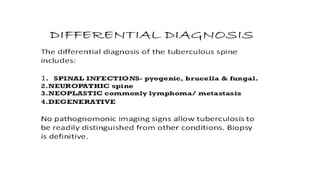
• The differential diagnosis of nodular or diffuse thickening in spinal canal onMRI :
1. meningeal carcinomatosis.
2. lymphoma.
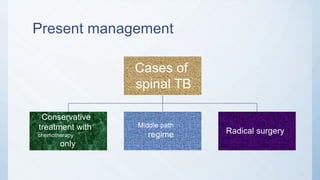
Present management
Cases of
spinal TB
Conservative
treatment with
chemotherapy
only
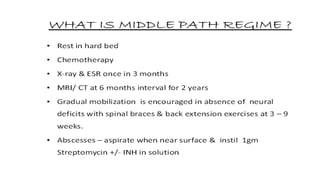
Middle path
regime Radical surgery
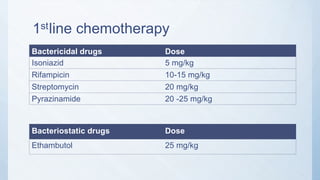
1 line chemotherapyst
Bactericidal drugs Dose
Isoniazid 5 mg/kg
Rifampicin 10-15 mg/kg
Streptomycin 20 mg/kg
Pyrazinamide 20 -25 mg/kg
Bacteriostatic drugs Dose
Ethambutol 25 mg/kg
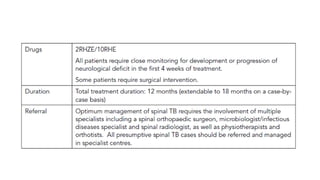
• Sinus heals 6-12 weeks after treatment.
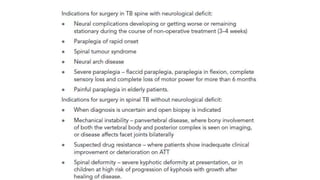
• Neural complications if showing progressive recovery on ATT b/w 3-4 weeks :-
surgery unnecessary
• Excisional surgery for posterior spinal disease associated with abscess / sinus
formation +/- neural involvement.
• Operative debridement–if no arrest after 3-6 months of ATT / with recurrence of
disease .
• Post op spinal brace→18 months-2 years
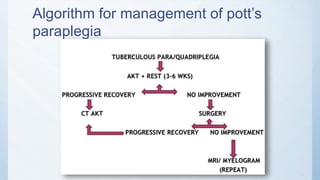
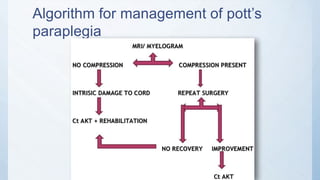
Algorithm for management of pott’s
paraplegia
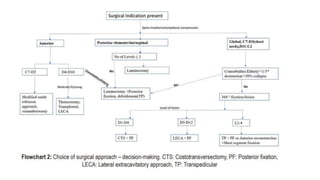
Algorithm for management of pott’s
paraplegia
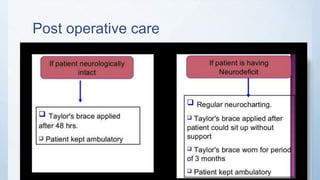
Post operative care
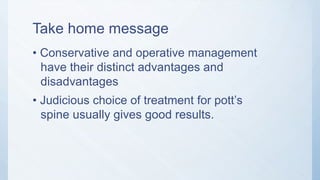
Take home message
• Conservative and operative management
have their distinct advantages and
disadvantages
• Judicious choice of treatment for pott’s
spine usually gives good results.
Spinal tb

  • 1.
  • 3.
    Regional distribution ofSpine TB • Cervical – 12% • Cervicodorsal – 5% • Dorsal – 42% • Dorsolumbar – 12% • Lumbar – 26% • Lumbosacral – 3%
  • 4.
    Types of vertebrallesions • 5 types: 1. Paradiscal- Arterial spread 2. Central – Venous spread 3. Anterior- Subperiosteal spread 4. Appendicular 5. Articular
  • 5.
    Types of vertebrallesions • 4 types: 1. Paradiscal- Arterial spread 2. Central – Venous spread 3. Anterior- Subperiosteal spread 4. Appendicular 5. Articular
  • 6.
    Types of vertebrallesions • 4 types: 1. Paradiscal- Arterial spread 2. Central – Venous spread 3. Anterior- Subperiosteal spread 4. Appendicular 5. Articular
  • 7.
    Types of vertebrallesions • 4 types: 1. Paradiscal- Arterial spread 2. Central – Venous spread 3. Anterior- Subperiosteal spread 4. Appendicular 5. Articular
  • 8.
    Types of vertebrallesions • 4 types: 1. Paradiscal- Arterial spread 2. Central – Venous spread 3. Anterior- Subperiosteal spread 4. Appendicular 5. Articular
  • 9.
    Clinical Features Active stage Constitutionalsymptoms: • Malaise • Loss of weight/appetite • Night sweats • Evening rise of temperature Specific Symptoms: • Pain/Night cries • Stiffness • Deformity • Restricted ROM • Enlarged lymph nodes • Abscess • Neurodeficit
  • 10.
    Clinical Features Healed stage Constitutionalsymptoms: • Malaise • Loss of weight/appetite • Night sweats • Evening rise of temperature Specific Symptoms: • Pain/Night cries • Stiffness • Deformity • Restricted ROM • Enlarged lymph nodes • Abscess • Neurodeficit
  • 11.
    Neurological deficit • 10-30%cases – Neurological deficit • Age: 1 3 decadesst • Disease below L1 vertebrae rarely causes Paraplegia • Highest Incidence of paraplegia seen in TB of lower thoracic vertebrae
  • 12.
    Classification of TBParaplegia Griffiths, Seddon and Roaf 1956 (Pre anti-tubercular era) Early onset paraplegia (group A) • Appears within 2 years of onset – during the Active phase • Underlying pathology – Inflammatory edema – TB Granulation tissue – Abscess – Caseous tissue – Ischaemis lesion of cord (Rare) • Good prognosis Late onset paraplegia (Group B) • Appears more than 2 years of disease in vertebral column • Underlying pathology –due to mechanical pressure on cord – TB Debris – TB Sequestra from body and disc – Internal gibbus – Canal stenosis / Severe deformity • Poor prognosis
  • 13.
    Pathology of TBParaplegia • Infarction of Spinal cord • Caused by – Endarteritis – Periarteritis – Thrombosis • Paralysis is irreparable • Ischaemic necrosis seen as an area of High intensity in T2 MRI • Can also happen postoperatively
  • 14.
    Staging of NeurologicalDeficit Goel 1967, Tuli 1985, Kumar 1988, Jain 2002 Stage Severity Clinical Features I Negligible Patient unaware of neurodeficit, physician detects plantar extensors or ankle clonus II Mild Patient aware of deficit but walks with support III Moderate Non ambulatory due to spastic paralysis (in extension), sensory deficit less than 50 % IV Severe III + Flexor spasm / Paralysis in flexion / Flaccid/ Sensory deficit more than 50 % / Sphincter Involved
  • 15.
    Prognosis of recoveryof cord functions Cord involvement Better prognosis Poor prognosis Degree Partial (Stage I & II) Complete (Stage IV) Duration Shorter Longer(>12 months) Type Early onset Late onset Speed of onset Slow Rapid Age Younger Older General condition Good Poor Vertebral disease Active Healed Kyphotic deformity <60 degree >60 degree Cord on MRI Normal Myelomalacia
  • 16.
    Investigations • CBC: – Hb%↓ – Lymphocytosis • ESR: – Raised in active stage of disease – Normal ESR over period of 3 months suggests patient is in stage of repair • HIV • CXR
  • 17.
    Investigations • Mantoux test –Erythema of more than 20 mm at 72 hours – Positive – Negative test, in general, rules out the disease
  • 18.
    Investigations • Biopsy – Incase of doubt, it is mandatory to prove the diagnosis by obtai diseased tissue
  • 19.
    Investigations • Smear andculture – Pus: Zeill- Neilson stain → Acid Fast bacilli – Culture of pus in Lowenstein jensen media – Aspirate of paravertebral abscess or spinal diseased tissue seldom demonstrates mycobacterium (Moon 2002) – Bactec For faster culture of Mycobacterium tuberculosis
  • 20.
    Investigation • Serological Investigations –ELISPOT (Enzyme- linked immunospot) – T-cell based assay from blood – IgM & IgG antibodies : High sensitivity, low specificity – PCR: Tissue /Pus PCR more sensitive
  • 21.
    Plain radiograph  Focalareas of erosion and osseous destruction in the anterior corners of the vertebral body are typical plain film findings.
  • 22.
    Plain radiograph  Contiguous vertebralbody involvement  Destruction of the intervertebral disk  Progerssive vertebral collapse
  • 23.
    Plain Radiograph  Compression fractureand secondary osteosclerosis
  • 24.
    Plain radiograph  Paraspinalabcess formation may be detected as areas of fusiform soft tissue swelling around the spine
  • 25.
    Plain radiograph  Centrallucency with surrounding sclerosis suggestive of chronic infection.
  • 26.
    Radiological Investigations • Healingis indicated by – Decreased soft tissue shadow – Return of normal density – Bony ankylosis
  • 27.
    Scintigraphy  Initially bonescans and gallium studies can be negative despite active disease.  Later on increased bony metabolism manifests as increased radionuclide uptake.  Useful in determining the number of active sites of the disease.  Helpful in determining the involvement of posterior elements of the spine.  Also useful in chronic infection in monitor the response to therapy.
  • 28.
    scintigraphy  Posterior viewfrom whole body bone scan showing increased radionuclide uptake in middle and lower thoracic spine
  • 29.
     SPECT scansshowing involvement of vertebral bodies and extension into posterior elements
  • 30.
     As tubercularlesions demonstrate high 18F- FDG uptake, 18F-FDG PET/CT is a promising technique for the diagnosis of spinal infection
  • 31.
    CT findings  Anteriorvertebral body destruction
  • 32.
    CT findings  Vertebralbody collapse  Disk space narrowing  Large paraspinal soft tissue masses representing abcess formation
  • 33.
    CT findings  Cloacaformation may be visualised resulting from spontaneous decomprssion of the vertebral body abcess
  • 34.
    CT findings  Largeabcess in left psoas muscle attributable to spontaneous decompression of the T12 intraosseous abcess
  • 35.
    CT findings  CTscan through lower part of the chest showing large left pleural effusion with atelectasis due to cephalic extension of the paraspinal abcess and rupture into left pleural cavity.
  • 36.
    CT findings  Inchronic stages there is marked bone destruction with sequestrum formation
  • 37.
    MR findings  Highlysensitive and specific for spinal tuberculosis  Provides early detection  Best to know extent of soft tissue and spinal involvement  CT is superior to MRI in the evaluation of the degree of bony destruction, deformity and calcification.
  • 38.
    MR findings  T1images typically show decreased signal within the affected vertebral bodies, loss of disk height and paraspinal soft tissue masses
  • 39.
    MR findings  T2images show non specific increased signal intensity within areas of osseous and soft tissue changes.  Extent of paraspinal abcess formation anteriorly is better visualised.
  • 40.
    MR findings  Contrastenhanced sequences are helpful in distinguishing tuberculous lesions from other granulomatous diseases.  The presence of thick rim of enhancement around the paraspinal and intraosseous abcesses is found to be diagnostic of spinal tuberculosis.
  • 41.
     T2-weighted magnetic resonanceimage of the thoracic spinal cord of a patient with 2 hyperintense intramedullary tuberculomas.
  • 42.
     T1-weighted gadolinium- enhancedmagnetic resonance image of the thoracic spinal cord in a patient with acquired immunodeficiency syndrome (AIDS) and leptomeningeal tuberculosis. Note the numerous granulomas on the dorsal surface of the cord and the dural enhancement
  • 51.
    Syringomyelia can occuras a complication of arachnoiditis . • Early syrinx formation is due to spinal cord ischemia • Late onset syrinx in chronic arachanoiditis is due to focal scarring of the subarachnoid space by adhesions which impedes free circulation of CSF thus forcing CSF into the central canal of the spinal cord via VR spaces • The differential diagnosis of nodular or diffuse thickening in spinal canal onMRI : 1. meningeal carcinomatosis. 2. lymphoma.
  • 52.
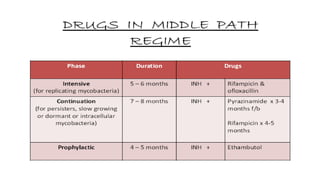
    Present management Cases of spinalTB Conservative treatment with chemotherapy only Middle path regime Radical surgery
  • 53.
    1 line chemotherapyst Bactericidaldrugs Dose Isoniazid 5 mg/kg Rifampicin 10-15 mg/kg Streptomycin 20 mg/kg Pyrazinamide 20 -25 mg/kg Bacteriostatic drugs Dose Ethambutol 25 mg/kg
  • 57.
    • Sinus heals6-12 weeks after treatment. • Neural complications if showing progressive recovery on ATT b/w 3-4 weeks :- surgery unnecessary • Excisional surgery for posterior spinal disease associated with abscess / sinus formation +/- neural involvement. • Operative debridement–if no arrest after 3-6 months of ATT / with recurrence of disease . • Post op spinal brace→18 months-2 years
  • 60.
    Algorithm for managementof pott’s paraplegia
  • 61.
    Algorithm for managementof pott’s paraplegia
  • 63.
  • 64.
    Take home message •Conservative and operative management have their distinct advantages and disadvantages • Judicious choice of treatment for pott’s spine usually gives good results.