Paralanguage
Paralanguage: what is it
When we speak, we produce sounds.
These sounds act as information to our listeners.
If the listener understands our language, he will
catch the word-meanings. Word-meanings
comprise the verbal message in speech.
If the listener does not understand our language, he
will totally have to depend on the other things
that we do while speaking: high volume; high
pitch; rising and falling tones; speed of speaking
etc. These are called paralanguage features.
Definition
• Paralanguage consists of all the activities
happening inside our oral cavity, from the
vocal chords to the mouth, while we speak.
• Paralanguage acts as a support to the verbal
message we speak, and conveys our emotions
and intensions to the audience.
• Paralanguage consists of 8 parts:
Volume; Pitch; Tone; Rate of Speech per minute;
Stress; Articulation; Pronunciation; Silence
Volume
• This indicates your sense of adjusting the right
volume for a particular occasion, while
delivering a speech.
• The norm is to keep it neither too high or low.
Eg.: When we are doing a formal group
discussion.
Volume
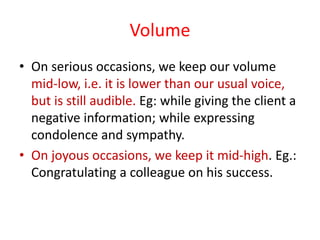
• On serious occasions, we keep our volume
mid-low, i.e. it is lower than our usual voice,
but is still audible. Eg: while giving the client a
negative information; while expressing
condolence and sympathy.
• On joyous occasions, we keep it mid-high. Eg.:
Congratulating a colleague on his success.
Pitch
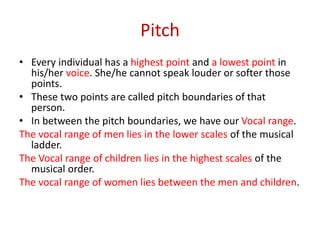
• Every individual has a highest point and a lowest point in
his/her voice. She/he cannot speak louder or softer those
points.
• These two points are called pitch boundaries of that
person.
• In between the pitch boundaries, we have our Vocal range.
The vocal range of men lies in the lower scales of the musical
ladder.
The Vocal range of children lies in the highest scales of the
musical order.
The vocal range of women lies between the men and children.
Pitch
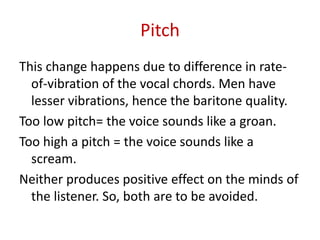
This change happens due to difference in rate-
of-vibration of the vocal chords. Men have
lesser vibrations, hence the baritone quality.
Too low pitch= the voice sounds like a groan.
Too high a pitch = the voice sounds like a
scream.
Neither produces positive effect on the minds of
the listener. So, both are to be avoided.
Tones
Tone means voice-movement from high-to-low, or
low-to-high in the pitch ladder. When a person
speaks, she/he moves the voice across her/his
vocal range, to convey emotions, intentions, etc.
Tone is of 4 types:
1. Falling Tone
2. Rising Tone
3. Falling-Rising tone
4. Rising-Falling tone.
Falling tone
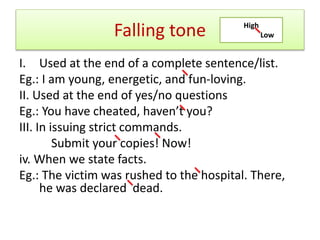
I. Used at the end of a complete sentence/list.
Eg.: I am young, energetic, and fun-loving.
II. Used at the end of yes/no questions
Eg.: You have cheated, haven’t you?
III. In issuing strict commands.
Submit your copies! Now!
iv. When we state facts.
Eg.: The victim was rushed to the hospital. There,
he was declared dead.
High
Low
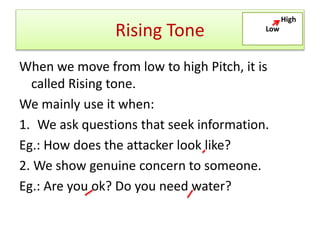
Rising Tone
When we move from low to high Pitch, it is
called Rising tone.
We mainly use it when:
1. We ask questions that seek information.
Eg.: How does the attacker look like?
2. We show genuine concern to someone.
Eg.: Are you ok? Do you need water?
High
Low
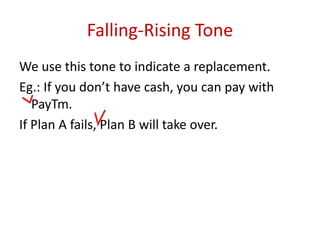
Falling-Rising Tone
We use this tone to indicate a replacement.
Eg.: If you don’t have cash, you can pay with
PayTm.
If Plan A fails, Plan B will take over.
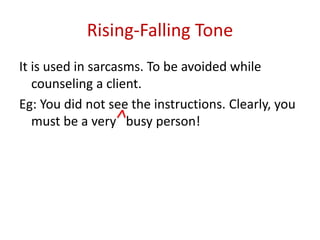
Rising-Falling Tone
It is used in sarcasms. To be avoided while
counseling a client.
Eg: You did not see the instructions. Clearly, you
must be a very busy person!
Stress
• Stress means word-highlight.
• When we speak a sentence, we give more
emphasis to the important words. This is
called stress. It gives accurate information of
what the speaker wants to highlight.
Eg.: I went to Bombay last week. [Not Delhi]
I went to Bombay last week. [Not this week].
I went to Bombay last week. [Not my Dad].
Rate of Words Per Minute
• The general rate is 120-150 words per minute. It
varies from person to person.
• Talking too slowly makes one a dull presenter.
• Talking too fast will leave your audience
frustrated, as they can’t grasp ideas.
• However, pace can be adjusted according to
occasion. Inspirational speeches are spoken faster
than academic speeches.
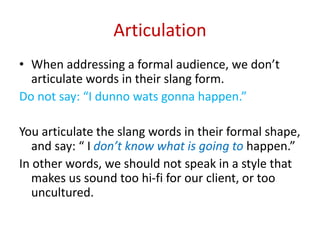
Articulation
• When addressing a formal audience, we don’t
articulate words in their slang form.
Do not say: “I dunno wats gonna happen.”
You articulate the slang words in their formal shape,
and say: “ I don’t know what is going to happen.”
In other words, we should not speak in a style that
makes us sound too hi-fi for our client, or too
uncultured.
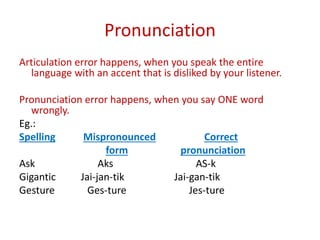
Pronunciation
Articulation error happens, when you speak the entire
language with an accent that is disliked by your listener.
Pronunciation error happens, when you say ONE word
wrongly.
Eg.:
Spelling Mispronounced Correct
form pronunciation
Ask Aks AS-k
Gigantic Jai-jan-tik Jai-gan-tik
Gesture Ges-ture Jes-ture
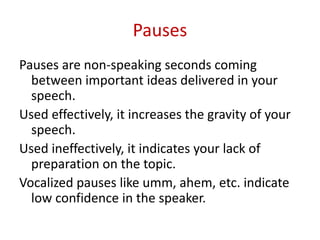
Pauses
Pauses are non-speaking seconds coming
between important ideas delivered in your
speech.
Used effectively, it increases the gravity of your
speech.
Used ineffectively, it indicates your lack of
preparation on the topic.
Vocalized pauses like umm, ahem, etc. indicate
low confidence in the speaker.
Analyze the voice of Amitabh Bacchan.
Can you identify the paralanguage factors that
make him sound so good?

Paralanguage

  • 1.
  • 2.
    Paralanguage: what isit When we speak, we produce sounds. These sounds act as information to our listeners. If the listener understands our language, he will catch the word-meanings. Word-meanings comprise the verbal message in speech. If the listener does not understand our language, he will totally have to depend on the other things that we do while speaking: high volume; high pitch; rising and falling tones; speed of speaking etc. These are called paralanguage features.
  • 3.
    Definition • Paralanguage consistsof all the activities happening inside our oral cavity, from the vocal chords to the mouth, while we speak. • Paralanguage acts as a support to the verbal message we speak, and conveys our emotions and intensions to the audience. • Paralanguage consists of 8 parts: Volume; Pitch; Tone; Rate of Speech per minute; Stress; Articulation; Pronunciation; Silence
  • 4.
    Volume • This indicatesyour sense of adjusting the right volume for a particular occasion, while delivering a speech. • The norm is to keep it neither too high or low. Eg.: When we are doing a formal group discussion.
  • 5.
    Volume • On seriousoccasions, we keep our volume mid-low, i.e. it is lower than our usual voice, but is still audible. Eg: while giving the client a negative information; while expressing condolence and sympathy. • On joyous occasions, we keep it mid-high. Eg.: Congratulating a colleague on his success.
  • 6.
    Pitch • Every individualhas a highest point and a lowest point in his/her voice. She/he cannot speak louder or softer those points. • These two points are called pitch boundaries of that person. • In between the pitch boundaries, we have our Vocal range. The vocal range of men lies in the lower scales of the musical ladder. The Vocal range of children lies in the highest scales of the musical order. The vocal range of women lies between the men and children.
  • 7.
    Pitch This change happensdue to difference in rate- of-vibration of the vocal chords. Men have lesser vibrations, hence the baritone quality. Too low pitch= the voice sounds like a groan. Too high a pitch = the voice sounds like a scream. Neither produces positive effect on the minds of the listener. So, both are to be avoided.
  • 8.
    Tones Tone means voice-movementfrom high-to-low, or low-to-high in the pitch ladder. When a person speaks, she/he moves the voice across her/his vocal range, to convey emotions, intentions, etc. Tone is of 4 types: 1. Falling Tone 2. Rising Tone 3. Falling-Rising tone 4. Rising-Falling tone.
  • 9.
    Falling tone I. Usedat the end of a complete sentence/list. Eg.: I am young, energetic, and fun-loving. II. Used at the end of yes/no questions Eg.: You have cheated, haven’t you? III. In issuing strict commands. Submit your copies! Now! iv. When we state facts. Eg.: The victim was rushed to the hospital. There, he was declared dead. High Low
  • 10.
    Rising Tone When wemove from low to high Pitch, it is called Rising tone. We mainly use it when: 1. We ask questions that seek information. Eg.: How does the attacker look like? 2. We show genuine concern to someone. Eg.: Are you ok? Do you need water? High Low
  • 11.
    Falling-Rising Tone We usethis tone to indicate a replacement. Eg.: If you don’t have cash, you can pay with PayTm. If Plan A fails, Plan B will take over.
  • 12.
    Rising-Falling Tone It isused in sarcasms. To be avoided while counseling a client. Eg: You did not see the instructions. Clearly, you must be a very busy person!
  • 13.
    Stress • Stress meansword-highlight. • When we speak a sentence, we give more emphasis to the important words. This is called stress. It gives accurate information of what the speaker wants to highlight. Eg.: I went to Bombay last week. [Not Delhi] I went to Bombay last week. [Not this week]. I went to Bombay last week. [Not my Dad].
  • 14.
    Rate of WordsPer Minute • The general rate is 120-150 words per minute. It varies from person to person. • Talking too slowly makes one a dull presenter. • Talking too fast will leave your audience frustrated, as they can’t grasp ideas. • However, pace can be adjusted according to occasion. Inspirational speeches are spoken faster than academic speeches.
  • 15.
    Articulation • When addressinga formal audience, we don’t articulate words in their slang form. Do not say: “I dunno wats gonna happen.” You articulate the slang words in their formal shape, and say: “ I don’t know what is going to happen.” In other words, we should not speak in a style that makes us sound too hi-fi for our client, or too uncultured.
  • 16.
    Pronunciation Articulation error happens,when you speak the entire language with an accent that is disliked by your listener. Pronunciation error happens, when you say ONE word wrongly. Eg.: Spelling Mispronounced Correct form pronunciation Ask Aks AS-k Gigantic Jai-jan-tik Jai-gan-tik Gesture Ges-ture Jes-ture
  • 17.
    Pauses Pauses are non-speakingseconds coming between important ideas delivered in your speech. Used effectively, it increases the gravity of your speech. Used ineffectively, it indicates your lack of preparation on the topic. Vocalized pauses like umm, ahem, etc. indicate low confidence in the speaker.
  • 18.
    Analyze the voiceof Amitabh Bacchan. Can you identify the paralanguage factors that make him sound so good?