The Voice in
Delivery
The Voice- Your Instrument
u Your voice is a powerful instrument of
expression that should express who you are
and convey your message in a way that
engages listeners.
uIndicates your confidence and whether the
audience perceives you to be in control of the
situation.
uVocal elements include: volume, pitch, rate,
pauses, vocal variety, and pronunciation and
articulation.
Volume
u Volume, is the relative loudness of a speaker’s
voice while giving a speech.
u Proper volume when delivering a speech is somewhat
louder than a normal conversation.
u How much louder depends on: 1) size of the room &
number of people in the audience; 2) whether or not you
use a microphone; 3) level of background noise.
u Volume affects credibility
Pitch
u Pitch is the range of sounds from high to low (or vice versa).
u Determined by the number of vibrations per unit of time; the more
vibrations per unit, the higher the pitch.
u Vary your intonation
u Intonation is the rising and falling of vocal pitch across phrases and
sentences.
u Pitch conveys your mood, reveals your level of enthusiasm,
expresses your concern for the audience, and signals your
overall commitment to the occasion.
u Avoid the monotone voice!
Do, Re, Mi, Fa, So, La, Ti
Do, a deer, a female deer
Re, a drop of golden sun
Mi, a name I call myself
Fa, a long, long way to run
So, a needle pulling thread
La, a note to follow Sol
Ti, a drink with jam and bread
That will bring us back to do (oh-oh-oh)
https://www.youtube.com/watch?v=bJJUG_Elt5g
Rate
u The speaking rate is the pace at which you convey
the speech.
u Normal rate of speech for adults is estimated to be between
120-150 words per minute.
u Typical speech occurs at a rate slightly below 120 words per
minute.
u Varying your speaking rate is the most effective way
to hold your audience’s attention.
u A slow rate indicates thoughtfulness, seriousness, concern, etc.
u A fast pace indicates excitement, happiness, adventure.
Pauses
u Pauses enhance meaning by providing a type of
punctuation, emphasizing a point, drawing attention
to a thought, or allowing listeners a moment to
contemplate what is said.
u Many novice speakers are uncomfortable with pauses.
u Pauses can make a speech effective; not always a social
stigma.
u It is a tendency to cover pauses with vocal fillers.
u “Uh,” “hmm,” “you know,” “I mean,” “it’s like,” and “anyways”
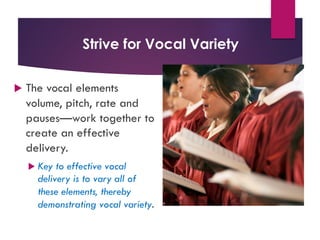
Strive for Vocal Variety
u The vocal elements
volume, pitch, rate and
pauses—work together to
create an effective
delivery.
u Key to effective vocal
delivery is to vary all of
these elements, thereby
demonstrating vocal variety.
Pronunciation and Articulation
u Few things distract an audience more than improper
pronunciation or unclear articulation of words.
1. Pronunciation is the correct formation of word sounds.
2. Articulation is the clarity or forcefulness with which the
sounds are made, regardless of whether they are
pronounced correctly.
u You can articulate clearly but pronounce incorrectly
u Good articulation betrays poor pronunciation
u Articulation problems can be a matter of habit (wearing orthodontics,
tongue twist)
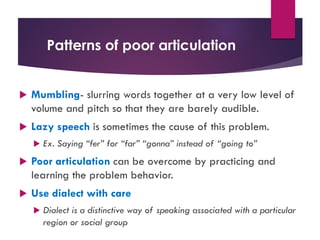
Patterns of poor articulation
u Mumbling- slurring words together at a very low level of
volume and pitch so that they are barely audible.
u Lazy speech is sometimes the cause of this problem.
u Ex. Saying “fer” for “far” “gonna” instead of “going to”
u Poor articulation can be overcome by practicing and
learning the problem behavior.
u Use dialect with care
u Dialect is a distinctive way of speaking associated with a particular
region or social group
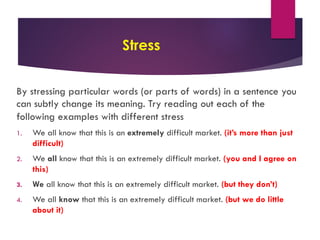
Stress
By stressing particular words (or parts of words) in a sentence you
can subtly change its meaning. Try reading out each of the
following examples with different stress
1. We all know that this is an extremely difficult market. (it’s more than just
difficult)
2. We all know that this is an extremely difficult market. (you and I agree on
this)
3. We all know that this is an extremely difficult market. (but they don’t)
4. We all know that this is an extremely difficult market. (but we do little
about it)
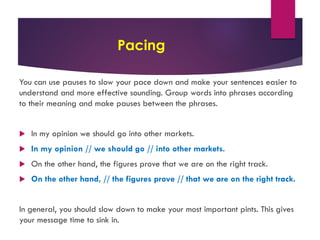
Pacing
You can use pauses to slow your pace down and make your sentences easier to
understand and more effective sounding. Group words into phrases according
to their meaning and make pauses between the phrases.
u In my opinion we should go into other markets.
u In my opinion // we should go // into other markets.
u On the other hand, the figures prove that we are on the right track.
u On the other hand, // the figures prove // that we are on the right track.
In general, you should slow down to make your most important pints. This gives
your message time to sink in.
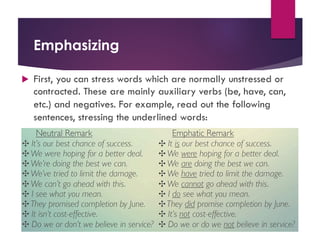
Emphasizing
u First, you can stress words which are normally unstressed or
contracted. These are mainly auxiliary verbs (be, have, can,
etc.) and negatives. For example, read out the following
sentences, stressing the underlined words:
Emphasizing
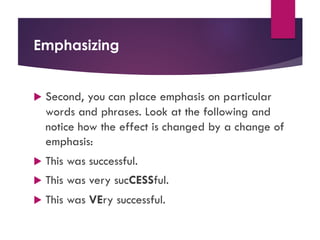
u Second, you can place emphasis on particular
words and phrases. Look at the following and
notice how the effect is changed by a change of
emphasis:
u This was successful.
u This was very sucCESSful.
u This was VEry successful.
Emphasizing
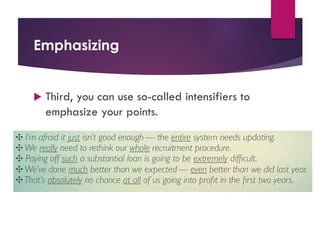
u Third, you can use so-called intensifiers to
emphasize your points.
Emphasizing
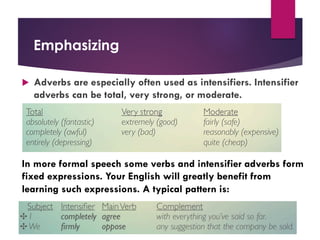
u Adverbs are especially often used as intensifiers. Intensifier
adverbs can be total, very strong, or moderate.
In more formal speech some verbs and intensifier adverbs form
fixed expressions. Your English will greatly benefit from
learning such expressions. A typical pattern is:
Emphasizing
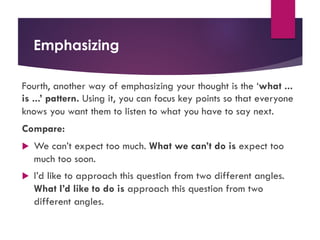
Fourth, another way of emphasizing your thought is the ‘what ...
is ...’ pattern. Using it, you can focus key points so that everyone
knows you want them to listen to what you have to say next.
Compare:
u We can’t expect too much. What we can’t do is expect too
much too soon.
u I’d like to approach this question from two different angles.
What I’d like to do is approach this question from two
different angles.
Emphasizing
And finally, you can actually use the verbs to stress,
emphasize, etc.
u I’d like to stress the following point.
u I’d like to draw your attention to the latest figures.
u I’d like to emphasize that our market position is
excellent.
General Advice
1. Articulate.
2. Keep your sentences short.
3. Check the spelling of difficult words.
To create rich delivery:
1. Vary the speed, volume, and intonation
2. Use various Stress, Pacing and Emphasis
techniques.
And above all,
Sound natural. Be eloquent and vivid
Practice
Go back to Week 4 Assignment
- Watch your video recordings.
- Comment on your group members’ voice/delivery (pace, speed,
articulation, pronunciation, etc.)
- Share your comments to your group.
- Practice
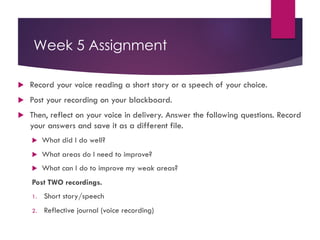
Week 5 Assignment
u Record your voice reading a short story or a speech of your choice.
u Post your recording on your blackboard.
u Then, reflect on your voice in delivery. Answer the following questions. Record
your answers and save it as a different file.
u What did I do well?
u What areas do I need to improve?
u What can I do to improve my weak areas?
Post TWO recordings.
1. Short story/speech
2. Reflective journal (voice recording)

Week 5 ENG366

  • 1.
  • 2.
    The Voice- YourInstrument u Your voice is a powerful instrument of expression that should express who you are and convey your message in a way that engages listeners. uIndicates your confidence and whether the audience perceives you to be in control of the situation. uVocal elements include: volume, pitch, rate, pauses, vocal variety, and pronunciation and articulation.
  • 3.
    Volume u Volume, isthe relative loudness of a speaker’s voice while giving a speech. u Proper volume when delivering a speech is somewhat louder than a normal conversation. u How much louder depends on: 1) size of the room & number of people in the audience; 2) whether or not you use a microphone; 3) level of background noise. u Volume affects credibility
  • 4.
    Pitch u Pitch isthe range of sounds from high to low (or vice versa). u Determined by the number of vibrations per unit of time; the more vibrations per unit, the higher the pitch. u Vary your intonation u Intonation is the rising and falling of vocal pitch across phrases and sentences. u Pitch conveys your mood, reveals your level of enthusiasm, expresses your concern for the audience, and signals your overall commitment to the occasion. u Avoid the monotone voice!
  • 5.
    Do, Re, Mi,Fa, So, La, Ti Do, a deer, a female deer Re, a drop of golden sun Mi, a name I call myself Fa, a long, long way to run So, a needle pulling thread La, a note to follow Sol Ti, a drink with jam and bread That will bring us back to do (oh-oh-oh) https://www.youtube.com/watch?v=bJJUG_Elt5g
  • 6.
    Rate u The speakingrate is the pace at which you convey the speech. u Normal rate of speech for adults is estimated to be between 120-150 words per minute. u Typical speech occurs at a rate slightly below 120 words per minute. u Varying your speaking rate is the most effective way to hold your audience’s attention. u A slow rate indicates thoughtfulness, seriousness, concern, etc. u A fast pace indicates excitement, happiness, adventure.
  • 7.
    Pauses u Pauses enhancemeaning by providing a type of punctuation, emphasizing a point, drawing attention to a thought, or allowing listeners a moment to contemplate what is said. u Many novice speakers are uncomfortable with pauses. u Pauses can make a speech effective; not always a social stigma. u It is a tendency to cover pauses with vocal fillers. u “Uh,” “hmm,” “you know,” “I mean,” “it’s like,” and “anyways”
  • 8.
    Strive for VocalVariety u The vocal elements volume, pitch, rate and pauses—work together to create an effective delivery. u Key to effective vocal delivery is to vary all of these elements, thereby demonstrating vocal variety.
  • 9.
    Pronunciation and Articulation uFew things distract an audience more than improper pronunciation or unclear articulation of words. 1. Pronunciation is the correct formation of word sounds. 2. Articulation is the clarity or forcefulness with which the sounds are made, regardless of whether they are pronounced correctly. u You can articulate clearly but pronounce incorrectly u Good articulation betrays poor pronunciation u Articulation problems can be a matter of habit (wearing orthodontics, tongue twist)
  • 10.
    Patterns of poorarticulation u Mumbling- slurring words together at a very low level of volume and pitch so that they are barely audible. u Lazy speech is sometimes the cause of this problem. u Ex. Saying “fer” for “far” “gonna” instead of “going to” u Poor articulation can be overcome by practicing and learning the problem behavior. u Use dialect with care u Dialect is a distinctive way of speaking associated with a particular region or social group
  • 11.
    Stress By stressing particularwords (or parts of words) in a sentence you can subtly change its meaning. Try reading out each of the following examples with different stress 1. We all know that this is an extremely difficult market. (it’s more than just difficult) 2. We all know that this is an extremely difficult market. (you and I agree on this) 3. We all know that this is an extremely difficult market. (but they don’t) 4. We all know that this is an extremely difficult market. (but we do little about it)
  • 12.
    Pacing You can usepauses to slow your pace down and make your sentences easier to understand and more effective sounding. Group words into phrases according to their meaning and make pauses between the phrases. u In my opinion we should go into other markets. u In my opinion // we should go // into other markets. u On the other hand, the figures prove that we are on the right track. u On the other hand, // the figures prove // that we are on the right track. In general, you should slow down to make your most important pints. This gives your message time to sink in.
  • 13.
    Emphasizing u First, youcan stress words which are normally unstressed or contracted. These are mainly auxiliary verbs (be, have, can, etc.) and negatives. For example, read out the following sentences, stressing the underlined words:
  • 14.
    Emphasizing u Second, youcan place emphasis on particular words and phrases. Look at the following and notice how the effect is changed by a change of emphasis: u This was successful. u This was very sucCESSful. u This was VEry successful.
  • 15.
    Emphasizing u Third, youcan use so-called intensifiers to emphasize your points.
  • 16.
    Emphasizing u Adverbs areespecially often used as intensifiers. Intensifier adverbs can be total, very strong, or moderate. In more formal speech some verbs and intensifier adverbs form fixed expressions. Your English will greatly benefit from learning such expressions. A typical pattern is:
  • 17.
    Emphasizing Fourth, another wayof emphasizing your thought is the ‘what ... is ...’ pattern. Using it, you can focus key points so that everyone knows you want them to listen to what you have to say next. Compare: u We can’t expect too much. What we can’t do is expect too much too soon. u I’d like to approach this question from two different angles. What I’d like to do is approach this question from two different angles.
  • 18.
    Emphasizing And finally, youcan actually use the verbs to stress, emphasize, etc. u I’d like to stress the following point. u I’d like to draw your attention to the latest figures. u I’d like to emphasize that our market position is excellent.
  • 19.
    General Advice 1. Articulate. 2.Keep your sentences short. 3. Check the spelling of difficult words.
  • 20.
    To create richdelivery: 1. Vary the speed, volume, and intonation 2. Use various Stress, Pacing and Emphasis techniques. And above all, Sound natural. Be eloquent and vivid
  • 21.
    Practice Go back toWeek 4 Assignment - Watch your video recordings. - Comment on your group members’ voice/delivery (pace, speed, articulation, pronunciation, etc.) - Share your comments to your group. - Practice
  • 22.
    Week 5 Assignment uRecord your voice reading a short story or a speech of your choice. u Post your recording on your blackboard. u Then, reflect on your voice in delivery. Answer the following questions. Record your answers and save it as a different file. u What did I do well? u What areas do I need to improve? u What can I do to improve my weak areas? Post TWO recordings. 1. Short story/speech 2. Reflective journal (voice recording)