Miscommunication

By
Ananthram N S (1321006)
Bikramadithya
Baruah
(1321011)
Dhruva (1321013)
Bhavana (1321047)
Ranjini (1321060)
Introduction

Miscommunication happens when the listener obtains an
interpretation that is not in line with the speaker’s intentions.
Types of Miscommunication
Asynchronous communication: Where Communication doesn’t happen in real time.
•Misperception
•Misinterpretation
•Misconception

Synchronous communication: Communication happens in real time. Eg. telephone,
meetings, etc.

No communication: Where there is no verbal communication.
•Fear
•Assumption
Reasons for
Miscommunication
 Sometimes people do not listen because they think the subject

is not relevant to them.

 One of the most frequent types of miscommunication are

those based on slips of the tongue or slips of the ear.

 When people do not understand words, sentences or whole

passages, the brain tries to fill the gap with known structures.
Why communication fails??
Misperception
 Misperception It occurs when a person

perceived something wrongly or
incorrectly.

 Ex: When a doctor prescribed a medicine

dose for a person and he misperceived
that the dose is same for infants and
adults.
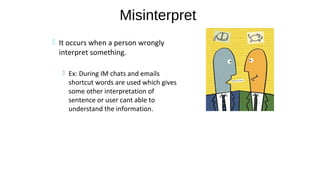
Misinterpret
 It occurs when a person wrongly

interpret something.

 Ex: During IM chats and emails

shortcut words are used which gives
some other interpretation of
sentence or user cant able to
understand the information.
Misconception
It occurs when there is mistaken view or
opinion about some fact.
 Miscommunication due to ineffective use of nonverbal

communication :
When the communication is nonverbal there is a chance that it
can be interpreted and represented wrongly.
A person has to keep in mind the body language(individual facial
expression, eye contact, body movement etc.) & voice
tone(pitch etc.).

 Due to inadequate information while communicating.
 Physical hindrance.
Avoiding miscommunication
 Communicator: Communicator  should be chosen according to their 

efficiency, position or the kind of audience they are going to speak 
to. 

 Message: Message being conveyed should be clear and concise.
 Channel: A right channel should be selected. If possible feedback 

should be given to the communicator that the message are 
understandable or not.

 Culture: The communicator should be aware of the existing culture 

to avoid the misunderstandings caused by the cultural differences.
How can “We” avoid
Miscommunication??
Follow these 5 basic steps:
 Think before you speak.
 Clarity in speech.
 Grabbing attention.
 Don’t assume
 Re-confirm
References
 http://www.wikihow.com/Avoid-Miscommunication

 http://en.wikipedia.org/wiki/Miscommunication

Miscommunication

  • 1.
    Miscommunication By Ananthram N S(1321006) Bikramadithya Baruah (1321011) Dhruva (1321013) Bhavana (1321047) Ranjini (1321060)
  • 2.
    Introduction Miscommunication happens whenthe listener obtains an interpretation that is not in line with the speaker’s intentions.
  • 3.
    Types of Miscommunication Asynchronouscommunication: Where Communication doesn’t happen in real time. •Misperception •Misinterpretation •Misconception Synchronous communication: Communication happens in real time. Eg. telephone, meetings, etc. No communication: Where there is no verbal communication. •Fear •Assumption
  • 4.
    Reasons for Miscommunication  Sometimespeople do not listen because they think the subject is not relevant to them.  One of the most frequent types of miscommunication are those based on slips of the tongue or slips of the ear.  When people do not understand words, sentences or whole passages, the brain tries to fill the gap with known structures.
  • 5.
  • 6.
    Misperception  Misperception Itoccurs when a person perceived something wrongly or incorrectly.  Ex: When a doctor prescribed a medicine dose for a person and he misperceived that the dose is same for infants and adults.
  • 7.
    Misinterpret  It occurswhen a person wrongly interpret something.  Ex: During IM chats and emails shortcut words are used which gives some other interpretation of sentence or user cant able to understand the information.
  • 8.
    Misconception It occurs whenthere is mistaken view or opinion about some fact.
  • 9.
     Miscommunication dueto ineffective use of nonverbal communication : When the communication is nonverbal there is a chance that it can be interpreted and represented wrongly. A person has to keep in mind the body language(individual facial expression, eye contact, body movement etc.) & voice tone(pitch etc.).  Due to inadequate information while communicating.  Physical hindrance.
  • 10.
    Avoiding miscommunication  Communicator:Communicator  should be chosen according to their  efficiency, position or the kind of audience they are going to speak  to.   Message: Message being conveyed should be clear and concise.  Channel: A right channel should be selected. If possible feedback  should be given to the communicator that the message are  understandable or not.  Culture: The communicator should be aware of the existing culture  to avoid the misunderstandings caused by the cultural differences.
  • 11.
    How can “We”avoid Miscommunication?? Follow these 5 basic steps:  Think before you speak.  Clarity in speech.  Grabbing attention.  Don’t assume  Re-confirm
  • 12.