Common Errors
Most common errors
1. Error in using Modifiers
2. Adverb Errors
3. Error in Pronoun cases
4. Commonly confused words
What are Modifiers?
Modifiers are a group of words that add
information about a noun or verb.
Eg.:
1. The patients with cough and fever, are placed in isolation.
The phrase, “with cough and fever” specifies the noun “The
patients.” It is a modifier, pin-pointing a certain type of patients.
2. People get infected when they come in contact with a Covid-19 patient.
“Get infected” is a verb. “when…patient” is a modifier, adding
time-information to the verb.
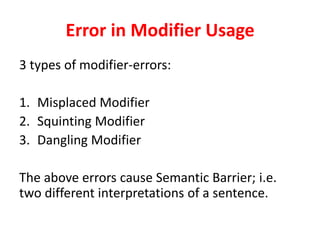
Error in Modifier Usage
3 types of modifier-errors:
1. Misplaced Modifier
2. Squinting Modifier
3. Dangling Modifier
The above errors cause Semantic Barrier; i.e.
two different interpretations of a sentence.
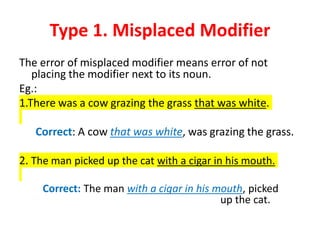
Type 1. Misplaced Modifier
The error of misplaced modifier means error of not
placing the modifier next to its noun.
Eg.:
1.There was a cow grazing the grass that was white.
Correct: A cow that was white, was grazing the grass.
2. The man picked up the cat with a cigar in his mouth.
Correct: The man with a cigar in his mouth, picked
up the cat.
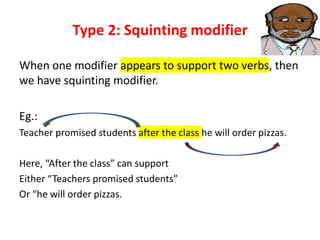
Type 2: Squinting modifier
When one modifier appears to support two verbs, then
we have squinting modifier.
Eg.:
Teacher promised students after the class he will order pizzas.
Here, “After the class” can support
Either “Teachers promised students”
Or “he will order pizzas.
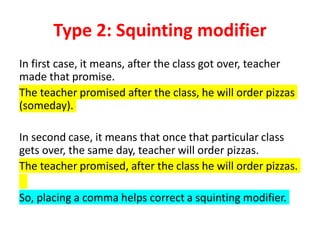
Type 2: Squinting modifier
In first case, it means, after the class got over, teacher
made that promise.
The teacher promised after the class, he will order pizzas
(someday).
In second case, it means that once that particular class
gets over, the same day, teacher will order pizzas.
The teacher promised, after the class he will order pizzas.
So, placing a comma helps correct a squinting modifier.
Type 3: Dangling Modifier
Sometimes, modifiers are just awkward. They
support no word.
Eg.: When 6 years old, Grandma taught me to paint.
“When 6 years old”—who? Grandma? Me? Not clear.
Correct form:
When I was 6 years old, Grandma taught me to paint.
Modifiers starting with WH- questions, V3 and –ing verbs, are
generally Dangling Modifiers.
Dangling modifiers: More Examples
a. While talking to my friend, the cat ran away.
Correct: While I was talking to my friend, the cat ran away.
b. While taking a bath, an idea struck me.
Correct: While I was taking a bath, an idea struck me.
c. Sold all over the country, the ladies became famous for
Lijjat Papad.
Correct: The ladies became famous for Lijjat Papad which was
sold all over the country.
d. Charged of murder, the police arrested the man.
Correct: The police arrested the man who was charged of
murder.
Error in Adverbs
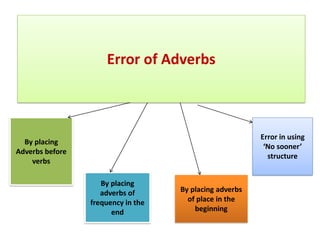
Error of Adverbs
By placing
Adverbs before
verbs
By placing
adverbs of
frequency in the
end
By placing adverbs
of place in the
beginning
Error in using
‘No sooner’
structure
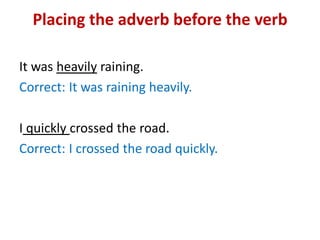
Placing the adverb before the verb
It was heavily raining.
Correct: It was raining heavily.
I quickly crossed the road.
Correct: I crossed the road quickly.
ii. Error of placing
Frequency-Adverbs at the end.
Frequency-adverbs answer ‘how often a thing
happens’, like ‘hardly’, ‘never’, ‘often’, etc.]
I miss my home hardly.
I hardly miss my home.
I visit my home frequently.
I frequently visit my home.
Time-Frequency:
Before verb
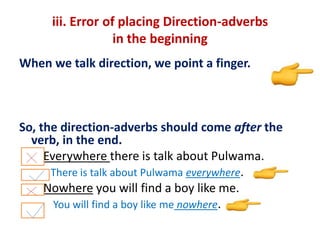
iii. Error of placing Direction-adverbs
in the beginning
When we talk direction, we point a finger.
So, the direction-adverbs should come after the
verb, in the end.
Everywhere there is talk about Pulwama.
There is talk about Pulwama everywhere.
Nowhere you will find a boy like me.
You will find a boy like me nowhere.
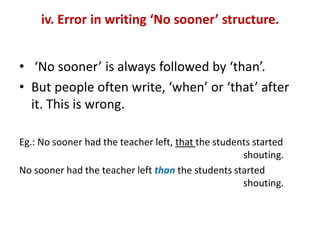
iv. Error in writing ‘No sooner’ structure.
• ‘No sooner’ is always followed by ‘than’.
• But people often write, ‘when’ or ‘that’ after
it. This is wrong.
Eg.: No sooner had the teacher left, that the students started
shouting.
No sooner had the teacher left than the students started
shouting.
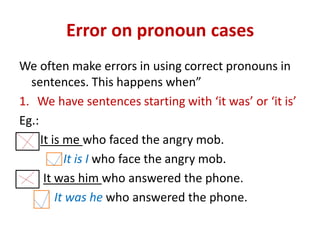
Error in Pronoun Cases
Error on pronoun cases
We often make errors in using correct pronouns in
sentences. This happens when”
1. We have sentences starting with ‘it was’ or ‘it is’
Eg.:
It is me who faced the angry mob.
It is I who face the angry mob.
It was him who answered the phone.
It was he who answered the phone.
2. There is ‘I’ in the list of people, and we put ‘I’ in the
beginning.
Eg.:
A. I and you make a wonderful couple.
Correct: You and I make a wonderful couple.
[First You, Last I]
B. I, you and Dad will go for the party.
Correct: You, Dad, and I will go for the party
tonight. [first, You, last I]
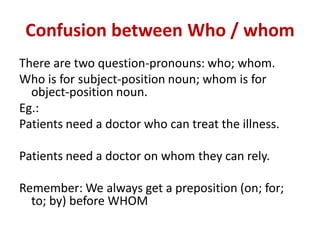
Confusion between Who / whom
There are two question-pronouns: who; whom.
Who is for subject-position noun; whom is for
object-position noun.
Eg.:
Patients need a doctor who can treat the illness.
Patients need a doctor on whom they can rely.
Remember: We always get a preposition (on; for;
to; by) before WHOM
Commonly Confused Words
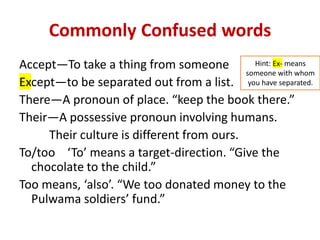
Commonly Confused words
Accept—To take a thing from someone
Except—to be separated out from a list.
There—A pronoun of place. “keep the book there.”
Their—A possessive pronoun involving humans.
Their culture is different from ours.
To/too ‘To’ means a target-direction. “Give the
chocolate to the child.”
Too means, ‘also’. “We too donated money to the
Pulwama soldiers’ fund.”
Hint: Ex- means
someone with whom
you have separated.
Commonly confused words
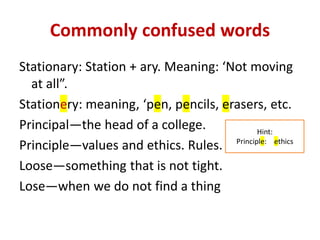
Stationary: Station + ary. Meaning: ‘Not moving
at all”.
Stationery: meaning, ‘pen, pencils, erasers, etc.
Principal—the head of a college.
Principle—values and ethics. Rules.
Loose—something that is not tight.
Lose—when we do not find a thing
Hint:
Principle: ethics
Commonly confused words
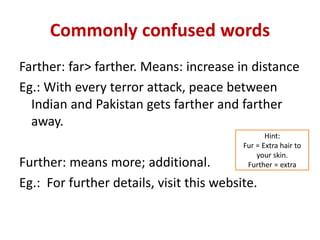
Farther: far> farther. Means: increase in distance
Eg.: With every terror attack, peace between
Indian and Pakistan gets farther and farther
away.
Further: means more; additional.
Eg.: For further details, visit this website.
Hint:
Fur = Extra hair to
your skin.
Further = extra
Commonly confused words
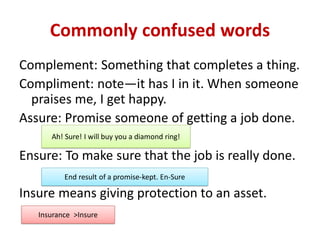
Complement: Something that completes a thing.
Compliment: note—it has I in it. When someone
praises me, I get happy.
Assure: Promise someone of getting a job done.
Ensure: To make sure that the job is really done.
Insure means giving protection to an asset.
Ah! Sure! I will buy you a diamond ring!
End result of a promise-kept. En-Sure
Insurance >Insure
Commonly confused words
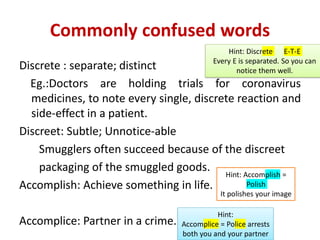
Discrete : separate; distinct
Eg.:Doctors are holding trials for coronavirus
medicines, to note every single, discrete reaction and
side-effect in a patient.
Discreet: Subtle; Unnotice-able
Smugglers often succeed because of the discreet
packaging of the smuggled goods.
Accomplish: Achieve something in life.
Accomplice: Partner in a crime.
Hint: Accomplish =
Polish
It polishes your image
Hint:
Accomplice = Police arrests
both you and your partner
Hint: Discrete E-T-E
Every E is separated. So you can
notice them well.
Commonly Confused words
Disinterested: Un-biased in view. Judges have a
disinterested view towards a case.
Uninterested: Bored. A student uninterested in
maths cannot study science.
Hint: Dis – interested
Dis-tance yourself from other’s emotions
Commonly Confused words
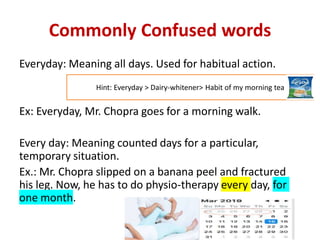
Everyday: Meaning all days. Used for habitual action.
Ex: Everyday, Mr. Chopra goes for a morning walk.
Every day: Meaning counted days for a particular,
temporary situation.
Ex.: Mr. Chopra slipped on a banana peel and fractured
his leg. Now, he has to do physio-therapy every day, for
one month.
Hint: Everyday > Dairy-whitener> Habit of my morning tea
Commonly Confused words
Everyone: Means ALL. General reference to
people.
Ex. Everyone needs a family.
Every one: Specific people in a specific place and
time.
Ex. Every one of the students were checked for
admit card in the exam hall.
Hint: EVERY; One. [two times One]
MEANING—ONE-BY ONE, every student is checked.
Commonly Confused Words
Affect: Negatively influence someone /
something.
Eg.: Old age affected the survival chance of
coronavirus victims in Italy.
Effect: Result.
Eg.: The effect of this lockdown is control is
disease transmission.
Hint:
Affect = Ahh!!! Painful effect.

Common errors

  • 1.
  • 2.
    Most common errors 1.Error in using Modifiers 2. Adverb Errors 3. Error in Pronoun cases 4. Commonly confused words
  • 3.
    What are Modifiers? Modifiersare a group of words that add information about a noun or verb. Eg.: 1. The patients with cough and fever, are placed in isolation. The phrase, “with cough and fever” specifies the noun “The patients.” It is a modifier, pin-pointing a certain type of patients. 2. People get infected when they come in contact with a Covid-19 patient. “Get infected” is a verb. “when…patient” is a modifier, adding time-information to the verb.
  • 4.
    Error in ModifierUsage 3 types of modifier-errors: 1. Misplaced Modifier 2. Squinting Modifier 3. Dangling Modifier The above errors cause Semantic Barrier; i.e. two different interpretations of a sentence.
  • 5.
    Type 1. MisplacedModifier The error of misplaced modifier means error of not placing the modifier next to its noun. Eg.: 1.There was a cow grazing the grass that was white. Correct: A cow that was white, was grazing the grass. 2. The man picked up the cat with a cigar in his mouth. Correct: The man with a cigar in his mouth, picked up the cat.
  • 6.
    Type 2: Squintingmodifier When one modifier appears to support two verbs, then we have squinting modifier. Eg.: Teacher promised students after the class he will order pizzas. Here, “After the class” can support Either “Teachers promised students” Or “he will order pizzas.
  • 7.
    Type 2: Squintingmodifier In first case, it means, after the class got over, teacher made that promise. The teacher promised after the class, he will order pizzas (someday). In second case, it means that once that particular class gets over, the same day, teacher will order pizzas. The teacher promised, after the class he will order pizzas. So, placing a comma helps correct a squinting modifier.
  • 8.
    Type 3: DanglingModifier Sometimes, modifiers are just awkward. They support no word. Eg.: When 6 years old, Grandma taught me to paint. “When 6 years old”—who? Grandma? Me? Not clear. Correct form: When I was 6 years old, Grandma taught me to paint. Modifiers starting with WH- questions, V3 and –ing verbs, are generally Dangling Modifiers.
  • 9.
    Dangling modifiers: MoreExamples a. While talking to my friend, the cat ran away. Correct: While I was talking to my friend, the cat ran away. b. While taking a bath, an idea struck me. Correct: While I was taking a bath, an idea struck me. c. Sold all over the country, the ladies became famous for Lijjat Papad. Correct: The ladies became famous for Lijjat Papad which was sold all over the country. d. Charged of murder, the police arrested the man. Correct: The police arrested the man who was charged of murder.
  • 10.
  • 11.
    Error of Adverbs Byplacing Adverbs before verbs By placing adverbs of frequency in the end By placing adverbs of place in the beginning Error in using ‘No sooner’ structure
  • 12.
    Placing the adverbbefore the verb It was heavily raining. Correct: It was raining heavily. I quickly crossed the road. Correct: I crossed the road quickly.
  • 13.
    ii. Error ofplacing Frequency-Adverbs at the end. Frequency-adverbs answer ‘how often a thing happens’, like ‘hardly’, ‘never’, ‘often’, etc.] I miss my home hardly. I hardly miss my home. I visit my home frequently. I frequently visit my home. Time-Frequency: Before verb
  • 14.
    iii. Error ofplacing Direction-adverbs in the beginning When we talk direction, we point a finger. So, the direction-adverbs should come after the verb, in the end. Everywhere there is talk about Pulwama. There is talk about Pulwama everywhere. Nowhere you will find a boy like me. You will find a boy like me nowhere.
  • 15.
    iv. Error inwriting ‘No sooner’ structure. • ‘No sooner’ is always followed by ‘than’. • But people often write, ‘when’ or ‘that’ after it. This is wrong. Eg.: No sooner had the teacher left, that the students started shouting. No sooner had the teacher left than the students started shouting.
  • 16.
  • 17.
    Error on pronouncases We often make errors in using correct pronouns in sentences. This happens when” 1. We have sentences starting with ‘it was’ or ‘it is’ Eg.: It is me who faced the angry mob. It is I who face the angry mob. It was him who answered the phone. It was he who answered the phone.
  • 18.
    2. There is‘I’ in the list of people, and we put ‘I’ in the beginning. Eg.: A. I and you make a wonderful couple. Correct: You and I make a wonderful couple. [First You, Last I] B. I, you and Dad will go for the party. Correct: You, Dad, and I will go for the party tonight. [first, You, last I]
  • 19.
    Confusion between Who/ whom There are two question-pronouns: who; whom. Who is for subject-position noun; whom is for object-position noun. Eg.: Patients need a doctor who can treat the illness. Patients need a doctor on whom they can rely. Remember: We always get a preposition (on; for; to; by) before WHOM
  • 20.
  • 21.
    Commonly Confused words Accept—Totake a thing from someone Except—to be separated out from a list. There—A pronoun of place. “keep the book there.” Their—A possessive pronoun involving humans. Their culture is different from ours. To/too ‘To’ means a target-direction. “Give the chocolate to the child.” Too means, ‘also’. “We too donated money to the Pulwama soldiers’ fund.” Hint: Ex- means someone with whom you have separated.
  • 22.
    Commonly confused words Stationary:Station + ary. Meaning: ‘Not moving at all”. Stationery: meaning, ‘pen, pencils, erasers, etc. Principal—the head of a college. Principle—values and ethics. Rules. Loose—something that is not tight. Lose—when we do not find a thing Hint: Principle: ethics
  • 23.
    Commonly confused words Farther:far> farther. Means: increase in distance Eg.: With every terror attack, peace between Indian and Pakistan gets farther and farther away. Further: means more; additional. Eg.: For further details, visit this website. Hint: Fur = Extra hair to your skin. Further = extra
  • 24.
    Commonly confused words Complement:Something that completes a thing. Compliment: note—it has I in it. When someone praises me, I get happy. Assure: Promise someone of getting a job done. Ensure: To make sure that the job is really done. Insure means giving protection to an asset. Ah! Sure! I will buy you a diamond ring! End result of a promise-kept. En-Sure Insurance >Insure
  • 25.
    Commonly confused words Discrete: separate; distinct Eg.:Doctors are holding trials for coronavirus medicines, to note every single, discrete reaction and side-effect in a patient. Discreet: Subtle; Unnotice-able Smugglers often succeed because of the discreet packaging of the smuggled goods. Accomplish: Achieve something in life. Accomplice: Partner in a crime. Hint: Accomplish = Polish It polishes your image Hint: Accomplice = Police arrests both you and your partner Hint: Discrete E-T-E Every E is separated. So you can notice them well.
  • 26.
    Commonly Confused words Disinterested:Un-biased in view. Judges have a disinterested view towards a case. Uninterested: Bored. A student uninterested in maths cannot study science. Hint: Dis – interested Dis-tance yourself from other’s emotions
  • 27.
    Commonly Confused words Everyday:Meaning all days. Used for habitual action. Ex: Everyday, Mr. Chopra goes for a morning walk. Every day: Meaning counted days for a particular, temporary situation. Ex.: Mr. Chopra slipped on a banana peel and fractured his leg. Now, he has to do physio-therapy every day, for one month. Hint: Everyday > Dairy-whitener> Habit of my morning tea
  • 28.
    Commonly Confused words Everyone:Means ALL. General reference to people. Ex. Everyone needs a family. Every one: Specific people in a specific place and time. Ex. Every one of the students were checked for admit card in the exam hall. Hint: EVERY; One. [two times One] MEANING—ONE-BY ONE, every student is checked.
  • 29.
    Commonly Confused Words Affect:Negatively influence someone / something. Eg.: Old age affected the survival chance of coronavirus victims in Italy. Effect: Result. Eg.: The effect of this lockdown is control is disease transmission. Hint: Affect = Ahh!!! Painful effect.