Principles of Legal Drafting
Definition of Legal Draft
• Any written document that one prepares in
the course of his/her legal career, is known as
a draft.
Definition of Legal Draft
• Draft takes a lot of skill, care and revision to be
prepared.
• One has to ensure that the message is clear,
short, and does not contain any error.
Principles / Steps to follow
Active Voice
No Lengthy
phrases
Avoid over-use of
‘Shall’
Concrete words
No Redundancy
No errors
Courtesy
Use Citations
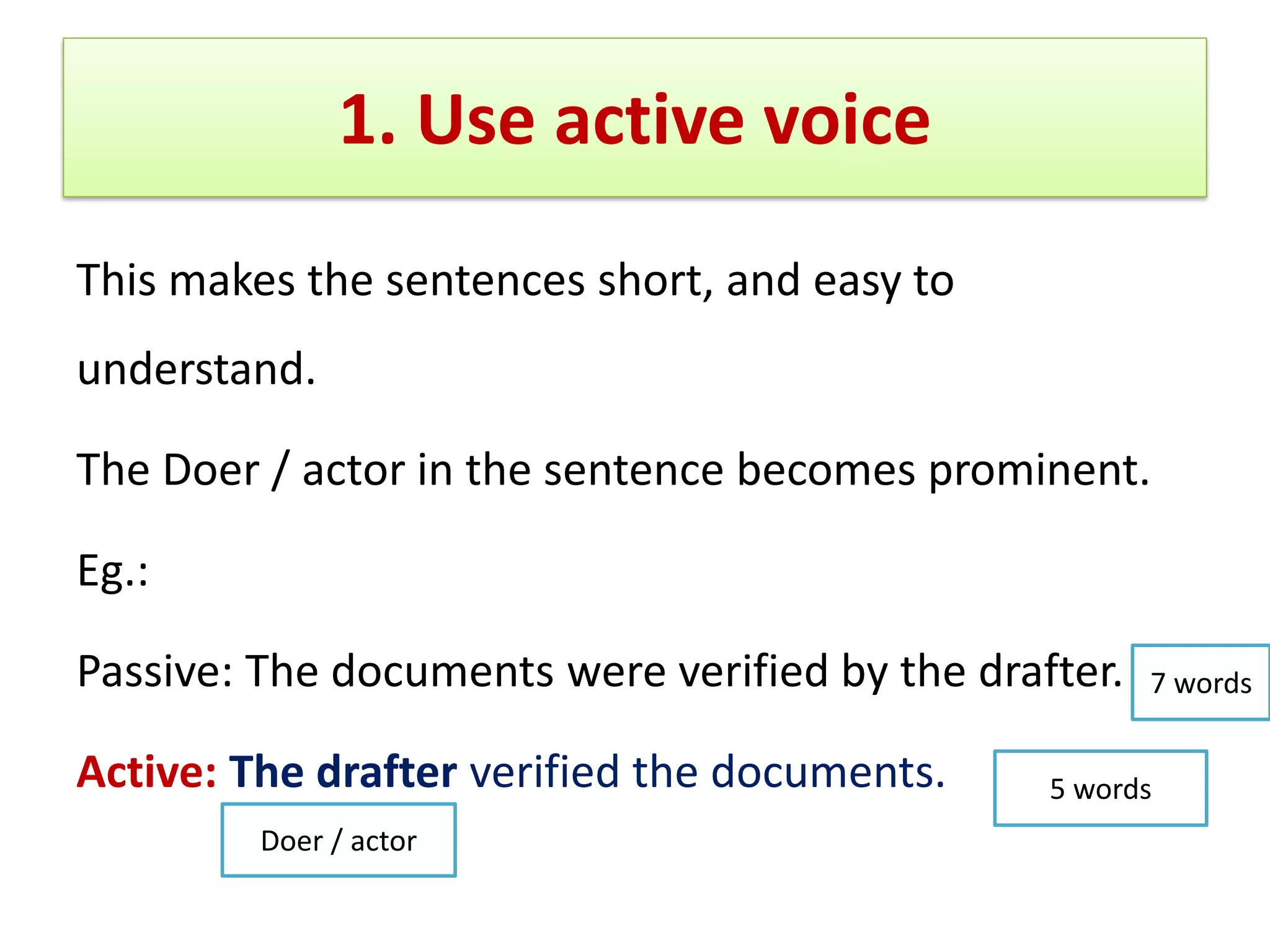
1. Use active voice
This makes the sentences short, and easy to
understand.
The Doer / actor in the sentence becomes prominent.
Eg.:
Passive: The documents were verified by the drafter.
Active: The drafter verified the documents. 5 words
7 words
Doer / actor
Active Voice
Another good point about active voice is that, it
clearly fixes responsibility of the action.
Eg.:
Passive: The facts must be verified. [by whom?]
Active: The police must verify the facts.
Passive Voice Situations
When we need to highlight the receiver of the action.
Eg.:
Every 8 seconds, a kid is trafficked somewhere in India.
By whom? Unimportant.Receiver of
‘kidnapping’ = Kid
This data is Important
2. No lengthy phrases
Eg.: I have given consideration to your proposal.
Correct: I have given consideration to your
proposal.
Workplaces must give recognition to the rights of transgender
people.
Workplaces must give recognition to the rights of transgender
people.
considered
recognize
3. Use concrete words
Avoid vague adjectives and use concrete words.
Eg.: My client has suffered horrible injuries from
this event.
Correct: My client has suffered a fracture in his
ribs and deep wound in his shoulders because of
this event.
4. No over-use of “Shall”
“Shall” creates confusion. Are we talking of a
future action, or an obligation?
Eg.:
We shall obey the law. [Moral Obligation]
If we try hard, we shall succeed. [Future event]
But if one interprets obeying law as ‘just any other, probable event of
future, then trouble will arise!!
4. No over-use of “Shall”
In order to avoid that confusion, we use:
✓ “must” for legal obligation
✓ “will” for future action.
Eg.:
The governor shall leave the residential quarters provided to
him, after his service tenure.
The Governor shall invite the leader of the winning party to form
government. [future action]
must
will
5. Avoid redundancies
Redundancies are same words used two-times.
In a legal document, presence of redundancy
makes you sound unprofessional.
Eg.: This notice is the last and final chance
given to you, to settle the dispute with my
client.
6. Avoid errors
• Errors in grammar and spelling make a
negative impact on the mind of the reader.
They think you to be either careless, or
untrained.
• Errors in punctuation / usage of modifiers
create double-meaning in sentences. So, they
are to be avoided.
7. Show courtesy:
Be diplomatic with words
• Legal drafting is required for any business: for
agreements; disclaimers; warranty; etc.
• We should not refer to our reader in terms of
specific age, gender, physical / mental condition,
economic status, etc.
• This proves that our stance is neutral towards any
client / consumer.
1. There are separate reservation quotas for old people
and the physically handicapped.
2. Every MNREGA worker must show his ID card.
3.
7. Show courtesy:
Be diplomatic with words
Senior Citizens
Differently abled
His / her
Fireman Firefighter
Manhours Hours worked
Manpower Personnel, workforce
8. Always give citation
• Citations help our reader to refer to the facts
presented in the document.
• This makes our writing a sincere work of
research.
Assignment Questions
1. Discuss the principles of Legal Drafting.
2. Discuss the uses of Legal brief.
3. Discuss the Format of a Legal brief /
summary.

Principles of legal drafting

  • 1.
  • 2.
    Definition of LegalDraft • Any written document that one prepares in the course of his/her legal career, is known as a draft.
  • 3.
    Definition of LegalDraft • Draft takes a lot of skill, care and revision to be prepared. • One has to ensure that the message is clear, short, and does not contain any error.
  • 4.
    Principles / Stepsto follow Active Voice No Lengthy phrases Avoid over-use of ‘Shall’ Concrete words No Redundancy No errors Courtesy Use Citations
  • 5.
    1. Use activevoice This makes the sentences short, and easy to understand. The Doer / actor in the sentence becomes prominent. Eg.: Passive: The documents were verified by the drafter. Active: The drafter verified the documents. 5 words 7 words Doer / actor
  • 6.
    Active Voice Another goodpoint about active voice is that, it clearly fixes responsibility of the action. Eg.: Passive: The facts must be verified. [by whom?] Active: The police must verify the facts.
  • 7.
    Passive Voice Situations Whenwe need to highlight the receiver of the action. Eg.: Every 8 seconds, a kid is trafficked somewhere in India. By whom? Unimportant.Receiver of ‘kidnapping’ = Kid This data is Important
  • 8.
    2. No lengthyphrases Eg.: I have given consideration to your proposal. Correct: I have given consideration to your proposal. Workplaces must give recognition to the rights of transgender people. Workplaces must give recognition to the rights of transgender people. considered recognize
  • 9.
    3. Use concretewords Avoid vague adjectives and use concrete words. Eg.: My client has suffered horrible injuries from this event. Correct: My client has suffered a fracture in his ribs and deep wound in his shoulders because of this event.
  • 10.
    4. No over-useof “Shall” “Shall” creates confusion. Are we talking of a future action, or an obligation? Eg.: We shall obey the law. [Moral Obligation] If we try hard, we shall succeed. [Future event] But if one interprets obeying law as ‘just any other, probable event of future, then trouble will arise!!
  • 11.
    4. No over-useof “Shall” In order to avoid that confusion, we use: ✓ “must” for legal obligation ✓ “will” for future action. Eg.: The governor shall leave the residential quarters provided to him, after his service tenure. The Governor shall invite the leader of the winning party to form government. [future action] must will
  • 12.
    5. Avoid redundancies Redundanciesare same words used two-times. In a legal document, presence of redundancy makes you sound unprofessional. Eg.: This notice is the last and final chance given to you, to settle the dispute with my client.
  • 13.
    6. Avoid errors •Errors in grammar and spelling make a negative impact on the mind of the reader. They think you to be either careless, or untrained. • Errors in punctuation / usage of modifiers create double-meaning in sentences. So, they are to be avoided.
  • 14.
    7. Show courtesy: Bediplomatic with words • Legal drafting is required for any business: for agreements; disclaimers; warranty; etc. • We should not refer to our reader in terms of specific age, gender, physical / mental condition, economic status, etc. • This proves that our stance is neutral towards any client / consumer.
  • 15.
    1. There areseparate reservation quotas for old people and the physically handicapped. 2. Every MNREGA worker must show his ID card. 3. 7. Show courtesy: Be diplomatic with words Senior Citizens Differently abled His / her Fireman Firefighter Manhours Hours worked Manpower Personnel, workforce
  • 16.
    8. Always givecitation • Citations help our reader to refer to the facts presented in the document. • This makes our writing a sincere work of research.
  • 17.
    Assignment Questions 1. Discussthe principles of Legal Drafting. 2. Discuss the uses of Legal brief. 3. Discuss the Format of a Legal brief / summary.