Subject Verb Agreement
Subject–Verb Agreement
• singular subject singular verb
• Plural subject plural verb
.
Note: we cannot have TWO S-s together.
Bird flies.
Birds fly.
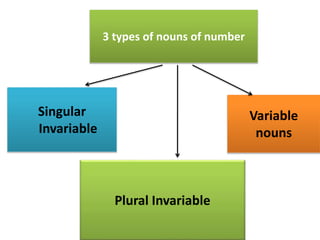
Singular
Invariable
Plural Invariable
Variable
nouns
3 types of nouns of number
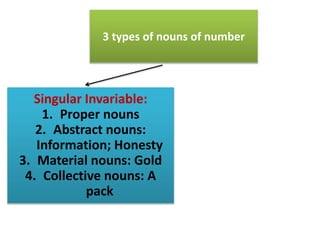
Singular Invariable:
1. Proper nouns
2. Abstract nouns:
Information; Honesty
3. Material nouns: Gold
4. Collective nouns: A
pack
3 types of nouns of number
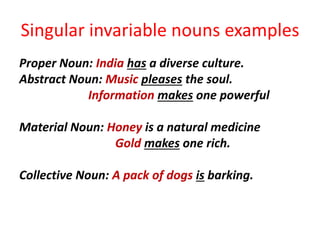
Singular invariable nouns examples
Proper Noun: India has a diverse culture.
Abstract Noun: Music pleases the soul.
Information makes one powerful
Material Noun: Honey is a natural medicine
Gold makes one rich.
Collective Noun: A pack of dogs is barking.
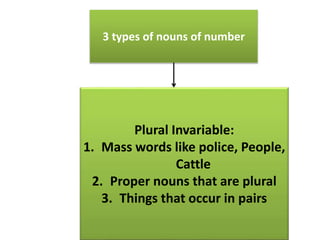
Plural Invariable:
1. Mass words like police, People,
Cattle
2. Proper nouns that are plural
3. Things that occur in pairs
3 types of nouns of number
Plural Invariable
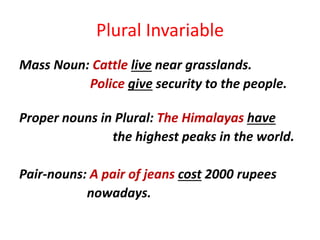
Mass Noun: Cattle live near grasslands.
Police give security to the people.
Proper nouns in Plural: The Himalayas have
the highest peaks in the world.
Pair-nouns: A pair of jeans cost 2000 rupees
nowadays.
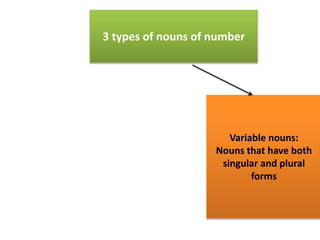
Variable nouns:
Nouns that have both
singular and plural
forms
3 types of nouns of number
Variable Nouns
Variable nouns are easy to recognize. They have
singular forms [taking singular], and plural
forms (taking plural verbs)
• A village gives you a closer life to nature.
• Villages are the worst victims of epidemic.
Solve
1. Homework ___ [is/are] boring.
2. The police ___ completed the investigation.
3. The Alps ___ in Italy.
4. A pair of Rayban sunglasses ___ around 8K.
5. Someone ___ left a bunch of flowers.
6. None of you __ going to the party.
7. Is there anyone who ___ not written
the notes?
Now, Subject-Verb Agreement follows
3 rules
Grammatical
Rules
Notional
Rules
Proximity
Rules
Grammatical Rules: All you have
learnt so far
Grammatical Rules: Special cases
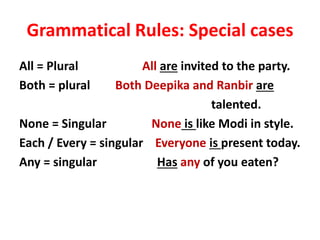
All = Plural All are invited to the party.
Both = plural Both Deepika and Ranbir are
talented.
None = Singular None is like Modi in style.
Each / Every = singular Everyone is present today.
Any = singular Has any of you eaten?
Grammatical Rules: Special Cases
Some = Can be Singular or plural, depending on the context
Eg.:
1. Someone is standing over there.
[Some = Someone; Used for particular individuals]
2. Some never learn to behave.
[Some = some people; used in general statements]
Notional Rules
Notional Rules
Notion means idea, intellect.
Sometimes we have to use our brains to
understand whether the Noun is singular or
plural.
There are 5 situations where we use Notional
Rules:
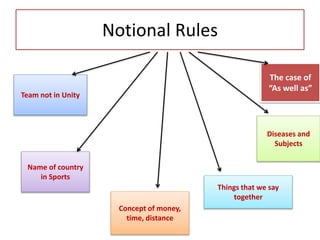
Notional Rules
Team not in Unity
Name of country
in Sports
Concept of money,
time, distance
Things that we say
together
Diseases and
Subjects
The case of
“As well as”
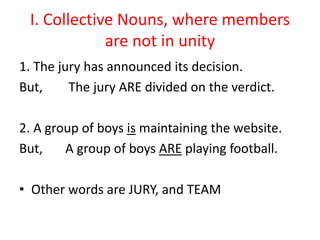
I. Collective Nouns, where members
are not in unity
1. The jury has announced its decision.
But, The jury ARE divided on the verdict.
2. A group of boys is maintaining the website.
But, A group of boys ARE playing football.
• Other words are JURY, and TEAM
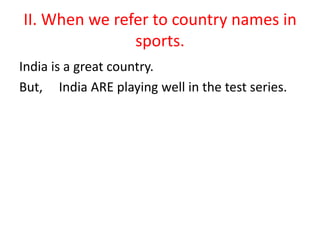
II. When we refer to country names in
sports.
India is a great country.
But, India ARE playing well in the test series.
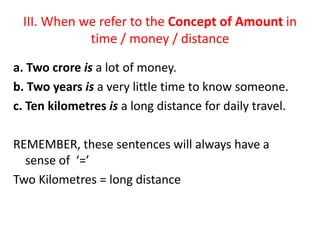
III. When we refer to the Concept of Amount in
time / money / distance
a. Two crore is a lot of money.
b. Two years is a very little time to know someone.
c. Ten kilometres is a long distance for daily travel.
REMEMBER, these sentences will always have a
sense of ‘=’
Two Kilometres = long distance
IV.
Some things come together to form a concept. Take
for example: a dish.
Eg.: Cornflakes and milk is his favourite
breakfast.
Here, cornflakes + milk = a dish.
• Peace and harmony is important for domestic
life. [ peace and harmony = same thing]
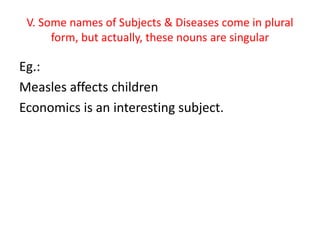
V. Some names of Subjects & Diseases come in plural
form, but actually, these nouns are singular
Eg.:
Measles affects children
Economics is an interesting subject.
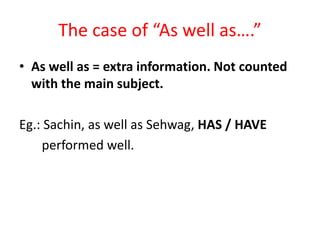
The case of “As well as….”
• As well as = extra information. Not counted
with the main subject.
Eg.: Sachin, as well as Sehwag, HAS / HAVE
performed well.
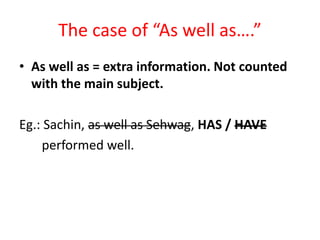
The case of “As well as….”
• As well as = extra information. Not counted
with the main subject.
Eg.: Sachin, as well as Sehwag, HAS / HAVE
performed well.
The case of “As well as….”
• As well as = extra information. Not counted
with the main subject.
Sony and Samsung, as well as Redmi, IS /ARE in
good demand.
Ans.: _________________________________
Solve
8. A band of robbers ___ terrorizing the place.
9. The team of doctors ___ divided on the question
whether 4 weeks ___ sufficient to heal pox.
10. Thousand crore notes ___ printed after
demonetization.
11. Economics ___ interesting to study.
12. 4 years ___ a long time to wait for someone.
13. Pizza and chowmein ____ ordered from
Zomato.
14. Pizza and coke ___ my all-time favorite menu.
15. The Police, as well as the Media, ___ after Nirav Modi.
Rules of Proximity
The noun that is near the verb, controls the
verb.
Used in:
Either..or
Neither..nor
Or
Not only..but also
Examples
• Either He or his friends are responsible for this.
[Friends> plural >near verb > Are]
• Either his friends or he is responsible.
Not only a criminal, but also the police get
beaten by mob.
A special note on “OF”
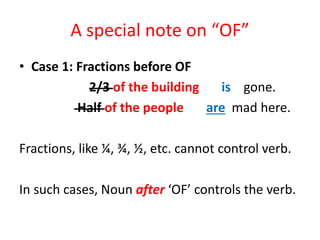
• Case 1: Fractions before OF
2/3 of the building is gone.
Half of the people are mad here.
Fractions, like ¼, ¾, ½, etc. cannot control verb.
In such cases, Noun after ‘OF’ controls the verb.
A special note on “OF”
• Case 1: Fractions before OF
2/3 of the building is gone.
Half of the people are mad here.
Fractions, like ¼, ¾, ½, etc. cannot control verb.
In such cases, Noun after ‘OF’ controls the verb.
“OF” contd.
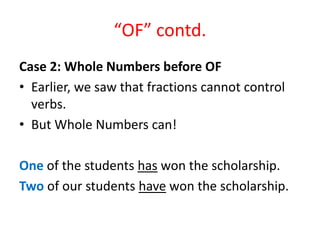
Case 2: Whole Numbers before OF
• Earlier, we saw that fractions cannot control
verbs.
• But Whole Numbers can!
One of the students has won the scholarship.
Two of our students have won the scholarship.
“OF” contd.
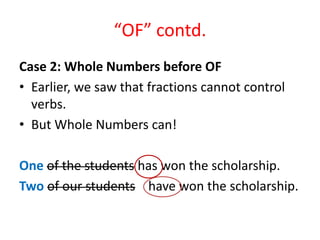
Case 2: Whole Numbers before OF
• Earlier, we saw that fractions cannot control
verbs.
• But Whole Numbers can!
One of the students has won the scholarship.
Two of our students have won the scholarship.
“Of” Continued
Case 3: Percentages [Most; Some] before OF
In case of Most / Some, what we mean is %
percentage.
Most = 80%
Some = maybe 20 %
Percentage is like fraction. 20% = 1/5th
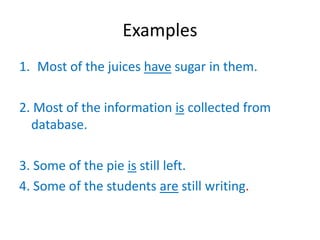
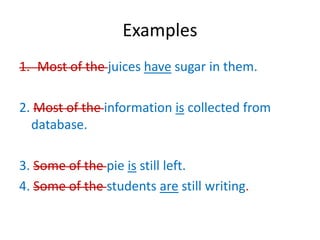
Examples
1. Most of the juices have sugar in them.
2. Most of the information is collected from
database.
3. Some of the pie is still left.
4. Some of the students are still writing.
Examples
1. Most of the juices have sugar in them.
2. Most of the information is collected from
database.
3. Some of the pie is still left.
4. Some of the students are still writing.
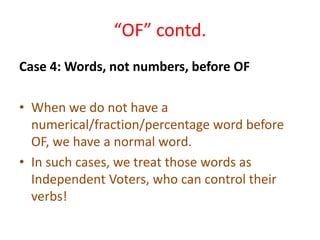
“OF” contd.
Case 4: Words, not numbers, before OF
• When we do not have a
numerical/fraction/percentage word before
OF, we have a normal word.
• In such cases, we treat those words as
Independent Voters, who can control their
verbs!
A special note on “OF” contd.
Example:
1. Colours of the rainbow ARE beautiful.
[colours> plural]
2. The view of the rainbow IS beautiful.
[View> singular]

Subject verb agreement

  • 1.
  • 2.
    Subject–Verb Agreement • singularsubject singular verb • Plural subject plural verb . Note: we cannot have TWO S-s together. Bird flies. Birds fly.
  • 3.
  • 4.
    Singular Invariable: 1. Propernouns 2. Abstract nouns: Information; Honesty 3. Material nouns: Gold 4. Collective nouns: A pack 3 types of nouns of number
  • 5.
    Singular invariable nounsexamples Proper Noun: India has a diverse culture. Abstract Noun: Music pleases the soul. Information makes one powerful Material Noun: Honey is a natural medicine Gold makes one rich. Collective Noun: A pack of dogs is barking.
  • 6.
    Plural Invariable: 1. Masswords like police, People, Cattle 2. Proper nouns that are plural 3. Things that occur in pairs 3 types of nouns of number
  • 7.
    Plural Invariable Mass Noun:Cattle live near grasslands. Police give security to the people. Proper nouns in Plural: The Himalayas have the highest peaks in the world. Pair-nouns: A pair of jeans cost 2000 rupees nowadays.
  • 8.
    Variable nouns: Nouns thathave both singular and plural forms 3 types of nouns of number
  • 9.
    Variable Nouns Variable nounsare easy to recognize. They have singular forms [taking singular], and plural forms (taking plural verbs) • A village gives you a closer life to nature. • Villages are the worst victims of epidemic.
  • 10.
    Solve 1. Homework ___[is/are] boring. 2. The police ___ completed the investigation. 3. The Alps ___ in Italy. 4. A pair of Rayban sunglasses ___ around 8K. 5. Someone ___ left a bunch of flowers. 6. None of you __ going to the party. 7. Is there anyone who ___ not written the notes?
  • 11.
    Now, Subject-Verb Agreementfollows 3 rules Grammatical Rules Notional Rules Proximity Rules
  • 12.
    Grammatical Rules: Allyou have learnt so far
  • 13.
    Grammatical Rules: Specialcases All = Plural All are invited to the party. Both = plural Both Deepika and Ranbir are talented. None = Singular None is like Modi in style. Each / Every = singular Everyone is present today. Any = singular Has any of you eaten?
  • 14.
    Grammatical Rules: SpecialCases Some = Can be Singular or plural, depending on the context Eg.: 1. Someone is standing over there. [Some = Someone; Used for particular individuals] 2. Some never learn to behave. [Some = some people; used in general statements]
  • 15.
  • 16.
    Notional Rules Notion meansidea, intellect. Sometimes we have to use our brains to understand whether the Noun is singular or plural. There are 5 situations where we use Notional Rules:
  • 17.
    Notional Rules Team notin Unity Name of country in Sports Concept of money, time, distance Things that we say together Diseases and Subjects The case of “As well as”
  • 18.
    I. Collective Nouns,where members are not in unity 1. The jury has announced its decision. But, The jury ARE divided on the verdict. 2. A group of boys is maintaining the website. But, A group of boys ARE playing football. • Other words are JURY, and TEAM
  • 19.
    II. When werefer to country names in sports. India is a great country. But, India ARE playing well in the test series.
  • 20.
    III. When werefer to the Concept of Amount in time / money / distance a. Two crore is a lot of money. b. Two years is a very little time to know someone. c. Ten kilometres is a long distance for daily travel. REMEMBER, these sentences will always have a sense of ‘=’ Two Kilometres = long distance
  • 21.
    IV. Some things cometogether to form a concept. Take for example: a dish. Eg.: Cornflakes and milk is his favourite breakfast. Here, cornflakes + milk = a dish. • Peace and harmony is important for domestic life. [ peace and harmony = same thing]
  • 22.
    V. Some namesof Subjects & Diseases come in plural form, but actually, these nouns are singular Eg.: Measles affects children Economics is an interesting subject.
  • 23.
    The case of“As well as….” • As well as = extra information. Not counted with the main subject. Eg.: Sachin, as well as Sehwag, HAS / HAVE performed well.
  • 24.
    The case of“As well as….” • As well as = extra information. Not counted with the main subject. Eg.: Sachin, as well as Sehwag, HAS / HAVE performed well.
  • 25.
    The case of“As well as….” • As well as = extra information. Not counted with the main subject. Sony and Samsung, as well as Redmi, IS /ARE in good demand. Ans.: _________________________________
  • 26.
    Solve 8. A bandof robbers ___ terrorizing the place. 9. The team of doctors ___ divided on the question whether 4 weeks ___ sufficient to heal pox. 10. Thousand crore notes ___ printed after demonetization. 11. Economics ___ interesting to study. 12. 4 years ___ a long time to wait for someone. 13. Pizza and chowmein ____ ordered from Zomato. 14. Pizza and coke ___ my all-time favorite menu. 15. The Police, as well as the Media, ___ after Nirav Modi.
  • 27.
    Rules of Proximity Thenoun that is near the verb, controls the verb. Used in: Either..or Neither..nor Or Not only..but also
  • 28.
    Examples • Either Heor his friends are responsible for this. [Friends> plural >near verb > Are] • Either his friends or he is responsible. Not only a criminal, but also the police get beaten by mob.
  • 29.
    A special noteon “OF” • Case 1: Fractions before OF 2/3 of the building is gone. Half of the people are mad here. Fractions, like ¼, ¾, ½, etc. cannot control verb. In such cases, Noun after ‘OF’ controls the verb.
  • 30.
    A special noteon “OF” • Case 1: Fractions before OF 2/3 of the building is gone. Half of the people are mad here. Fractions, like ¼, ¾, ½, etc. cannot control verb. In such cases, Noun after ‘OF’ controls the verb.
  • 31.
    “OF” contd. Case 2:Whole Numbers before OF • Earlier, we saw that fractions cannot control verbs. • But Whole Numbers can! One of the students has won the scholarship. Two of our students have won the scholarship.
  • 32.
    “OF” contd. Case 2:Whole Numbers before OF • Earlier, we saw that fractions cannot control verbs. • But Whole Numbers can! One of the students has won the scholarship. Two of our students have won the scholarship.
  • 33.
    “Of” Continued Case 3:Percentages [Most; Some] before OF In case of Most / Some, what we mean is % percentage. Most = 80% Some = maybe 20 % Percentage is like fraction. 20% = 1/5th
  • 34.
    Examples 1. Most ofthe juices have sugar in them. 2. Most of the information is collected from database. 3. Some of the pie is still left. 4. Some of the students are still writing.
  • 35.
    Examples 1. Most ofthe juices have sugar in them. 2. Most of the information is collected from database. 3. Some of the pie is still left. 4. Some of the students are still writing.
  • 36.
    “OF” contd. Case 4:Words, not numbers, before OF • When we do not have a numerical/fraction/percentage word before OF, we have a normal word. • In such cases, we treat those words as Independent Voters, who can control their verbs!
  • 37.
    A special noteon “OF” contd. Example: 1. Colours of the rainbow ARE beautiful. [colours> plural] 2. The view of the rainbow IS beautiful. [View> singular]