Para-language
By: Huba Akhtar Khan
Para-Language:
The term para-language is combination of two words :
PARA means “Like”
And
LANGUAGE means “Mode of language”
Thus, Para-language literally means “Like language”.
Para-Language:
“Not only what you
say, but how you
say is also matters”
Para-Language:
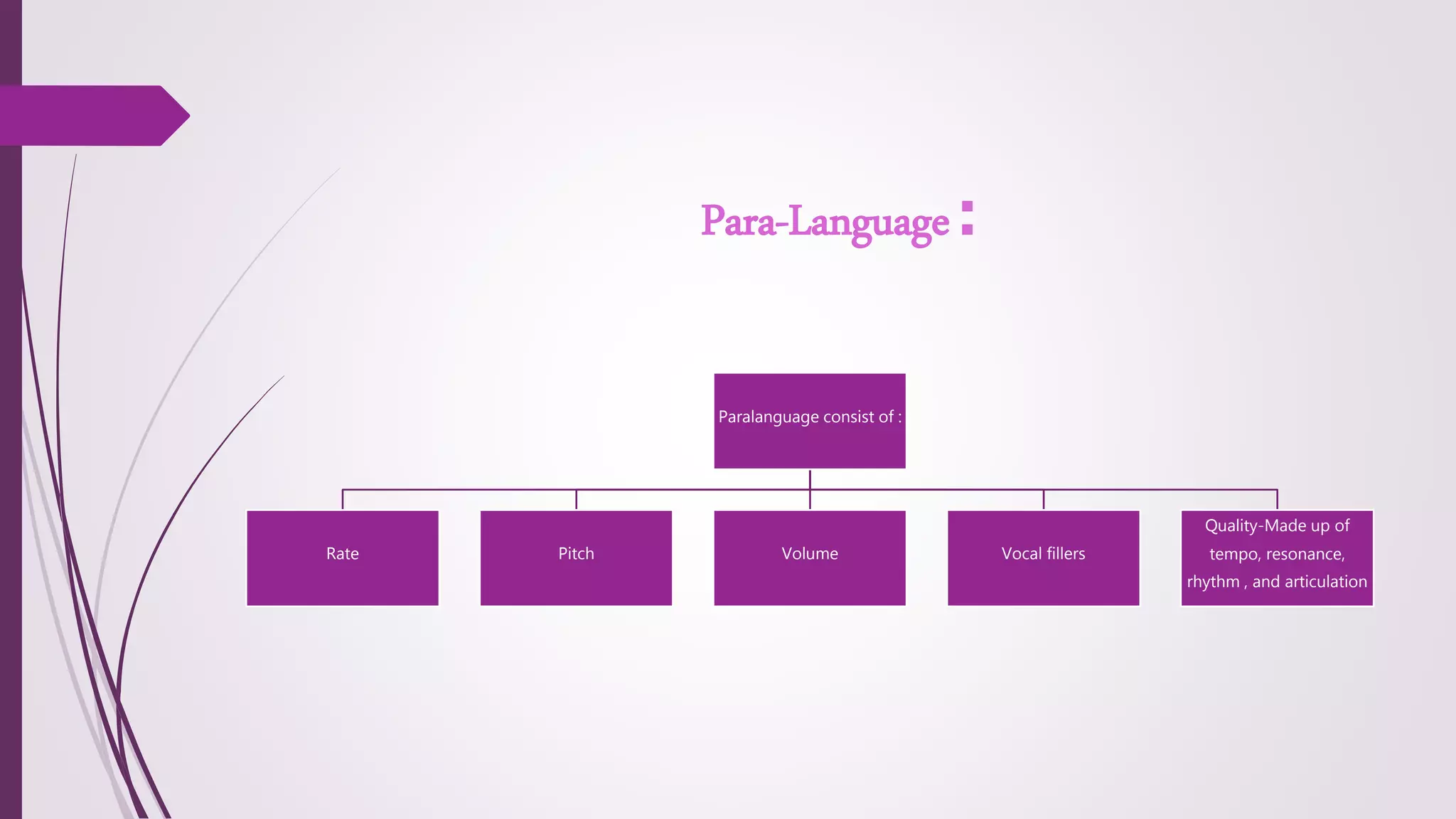
Paralanguage consist of :
Rate Pitch Volume Vocal fillers
Quality-Made up of
tempo, resonance,
rhythm , and articulation
Definition:
“Paralanguage is the voice intonation that accompanies speech,
including voice pitch, voice tone and the rhythm of speech.”
Paralanguage is most similar to verbal communication; however
it sends non-verbal messages in all phases of communication
process. Paralanguage refers to not what is said, but how it is said
Paralanguage can alter meaning. When the voice rises at the
end of a sentences in English, it means the sentence is a
question.
Paralanguage can give emotional context for the content of
speech. A loud, high pitched, voice tone can express
excitement, anger on face.
Paralanguage can show membership in a linguistic
subgroup. Accents are partially caused by paralanguage. The
cadence or rhythm of a southern accent in the U.S. is slow and
lazy sounding.
Para-Language:
Advantages:
 No oral communication is complete without paralanguage.
 Speaker`s education background can be known.
 Indicates person`s place in hierarchical structure.
 Knowledge of paralanguage helps in dealings with others.
 Paralanguage can be improved by listening to good speaker.
Para-Language:
Disadvantages:
 Paralanguage is like a language but not a Language. Can`t be
relied fully.
 Unless the listener is open minded, it may prejudice him.
 As speakers belong to different speech communities, uniformity
becomes difficult.
Examples of Para-Language:
Crossing one`s finger is an example
of paralanguage that can have
different meanings based on the
situation..
Examples of Para-Language:
Thank You..

Para-Language

  • 1.
  • 2.
    Para-Language: The term para-languageis combination of two words : PARA means “Like” And LANGUAGE means “Mode of language” Thus, Para-language literally means “Like language”.
  • 3.
    Para-Language: “Not only whatyou say, but how you say is also matters”
  • 4.
    Para-Language: Paralanguage consist of: Rate Pitch Volume Vocal fillers Quality-Made up of tempo, resonance, rhythm , and articulation
  • 5.
    Definition: “Paralanguage is thevoice intonation that accompanies speech, including voice pitch, voice tone and the rhythm of speech.” Paralanguage is most similar to verbal communication; however it sends non-verbal messages in all phases of communication process. Paralanguage refers to not what is said, but how it is said
  • 6.
    Paralanguage can altermeaning. When the voice rises at the end of a sentences in English, it means the sentence is a question. Paralanguage can give emotional context for the content of speech. A loud, high pitched, voice tone can express excitement, anger on face. Paralanguage can show membership in a linguistic subgroup. Accents are partially caused by paralanguage. The cadence or rhythm of a southern accent in the U.S. is slow and lazy sounding.
  • 7.
    Para-Language: Advantages:  No oralcommunication is complete without paralanguage.  Speaker`s education background can be known.  Indicates person`s place in hierarchical structure.  Knowledge of paralanguage helps in dealings with others.  Paralanguage can be improved by listening to good speaker.
  • 8.
    Para-Language: Disadvantages:  Paralanguage islike a language but not a Language. Can`t be relied fully.  Unless the listener is open minded, it may prejudice him.  As speakers belong to different speech communities, uniformity becomes difficult.
  • 9.
    Examples of Para-Language: Crossingone`s finger is an example of paralanguage that can have different meanings based on the situation..
  • 10.
  • 11.
  • 12.