
MICROTEACHING
ON
TEACHING AND
SYMPOSIUM
SUBMITTED TO: SUBMITTED BY:
DR. PALLAVI PATHANIA MS. MINAKSHI RANA
ASSOCIATE PROFESSOR M.SC. (N) 1ST YEAR
SHIMLA NURSING COLLEGE SHIMLA NURSING COLLEGE
INDEX:
SR. NO. CONTENT
1) TEACHING
2) SYMPOSIUM
INTRODUCTION:
 Teaching is science as well as art. For
effective teaching, teacher has to follow
some specific principles based on certain
precise knowledge.
 In this sense, teaching is science. In order
to teach effectively, teacher has to adopt
varied circumstances by using different
techniques.
DEFINITION:
BURTON: “Teaching is the stimulation,
guidance, direction and encouragement for
learning.”
FLANDER: “ Teaching is an interaction
process. Interaction means participation of both
teacher and student and both get benefit by this.
The interaction takes place for achieving desired
objectives.”
CHARACTERISTICS:
1.Imparting knowledge in an efficient manner.
2. Inculcates desirable values and proper attitude and
habits of work in the student.
3. Create a genuine attachment to work and desire to
its efficiently, honestly and thoroughly as possible.
Contd..
4. Provide opportunities for student to learn actively
and to apply partially the knowledge that they have
acquired in the class room.
5. Clear thinking and clear expression both in speech
and writing has to take place.
Contd..
6.Train the learner in the technique of the study
methods of acquiring knowledge through personal
efforts and initiatives.
7. Opportunity of the student should be provided to
work in groups and to carry out project and
activities to develop in them the qualities
necessary for group life and for cooperation work.
PRINCIPLES OF TEACHING:
a) Principle of
motivation
b) Principles of activity
c) Principle of individual
difference
contd..
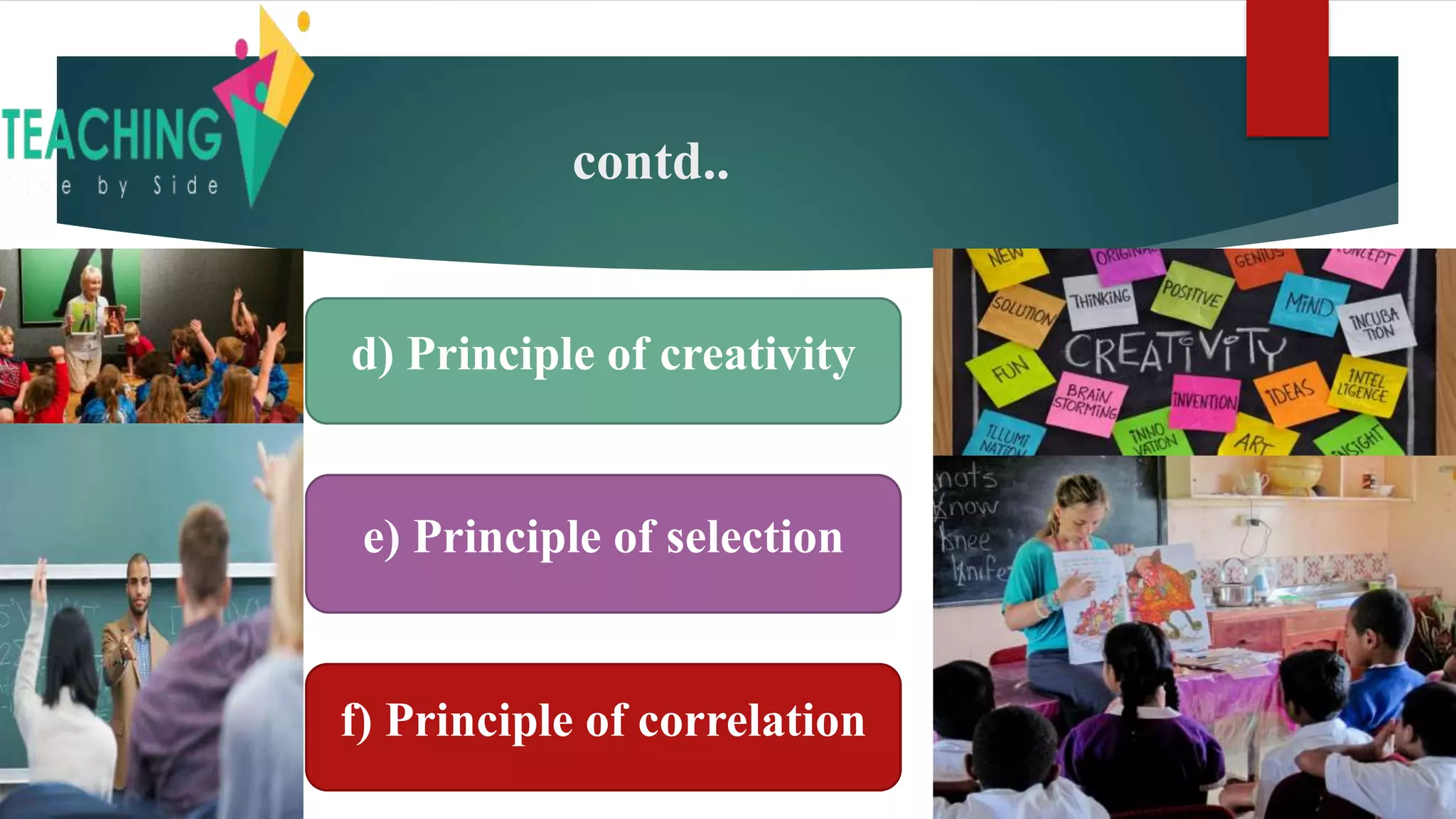
d) Principle of creativity
e) Principle of selection
f) Principle of correlation
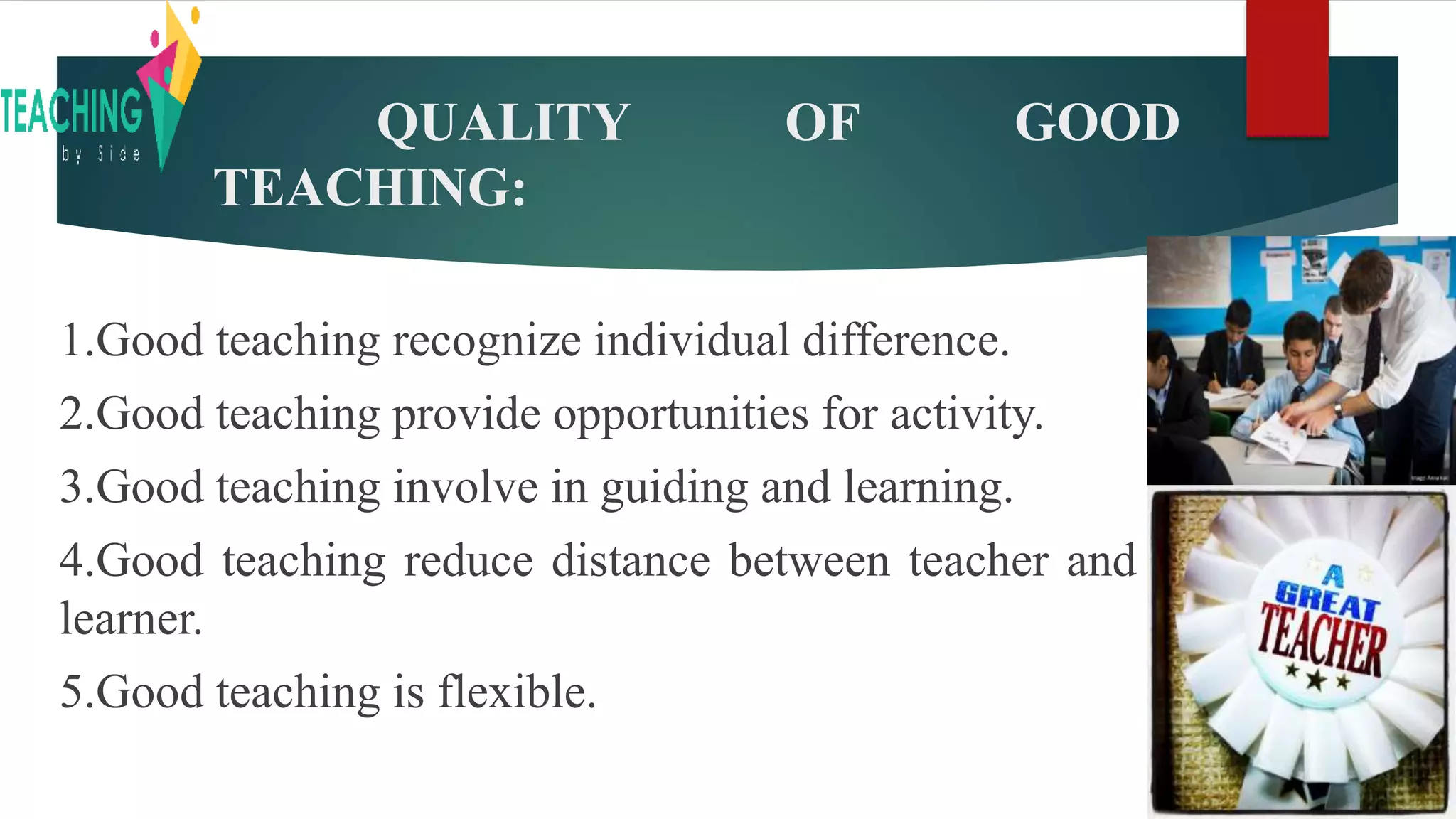
QUALITY OF GOOD
TEACHING:
1.Good teaching recognize individual difference.
2.Good teaching provide opportunities for activity.
3.Good teaching involve in guiding and learning.
4.Good teaching reduce distance between teacher and
learner.
5.Good teaching is flexible.
Contd..
6.Good teaching provide desirable and
selective information.
7.Good teaching helps the client to adjust
himself in the environment.
8.Good teaching should be on the basis of
previous knowledge of the student.
QUALITIES OF GOOD TEACHER:
a) Friendliness and
congeniality
b) A good personality
c) Deep knowledge and a
great education
Contd..
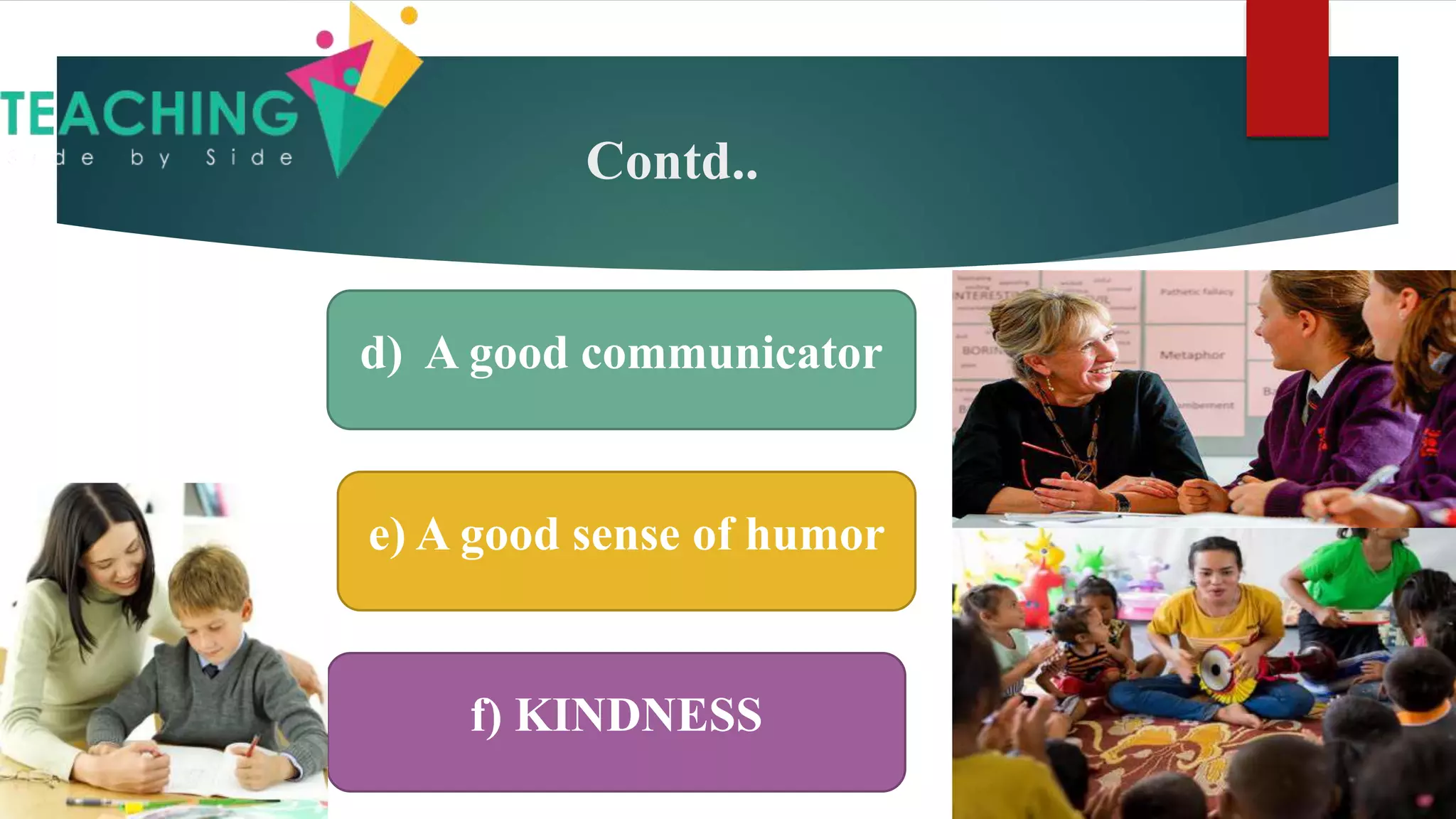
d) A good communicator
e) A good sense of humor
f) KINDNESS
INTRODUCTION OF SYMPOSIUM:
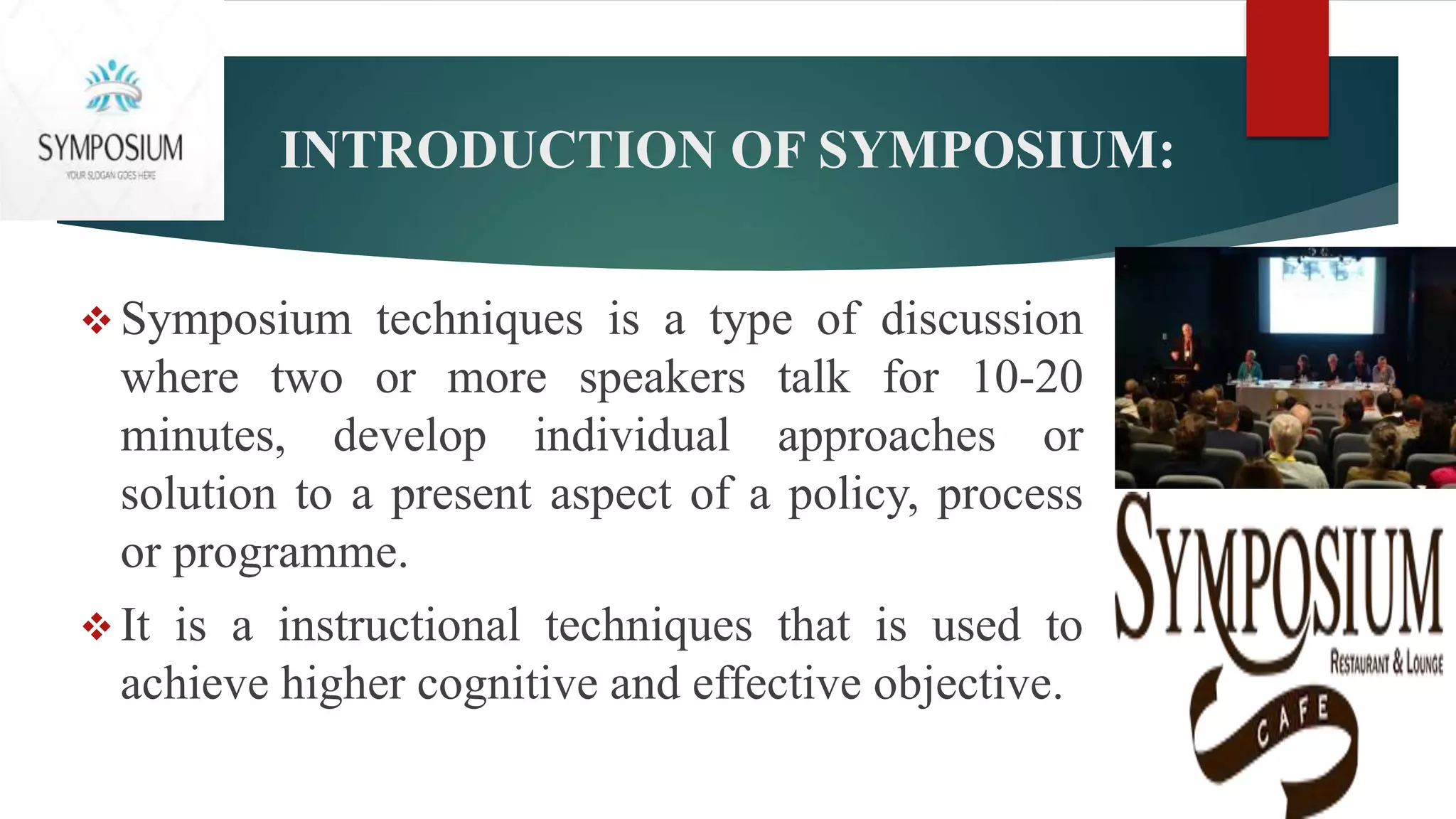
 Symposium techniques is a type of discussion
where two or more speakers talk for 10-20
minutes, develop individual approaches or
solution to a present aspect of a policy, process
or programme.
 It is a instructional techniques that is used to
achieve higher cognitive and effective objective.
MEANING OF SYMPOSIUM:
 The word symposium has several
dictionary meanings.
 Plato used this term for good dialogue to
present views towards god.
 Another meaning of the intellectual
recreation or enjoyment.
DEFINITION OF SYMPOSIUM:
 Symposium is defined as a teaching
technique that serves as an excellent ,
crystallizing their opinion and preparing
them for arriving at decision regarding a
particular issue or a topic.
OBJECTIVE OF SYMPOSIUM:
 To identify and understand various aspect of the
theme and problem.
 To develop the ability to come to a decision and
provide judgement regarding a problem.
 To develop values and feelings regarding a
problem.
Contd..
 To enables the listeners form policies
regarding a theme problem.
 To boost students abilities to speak in the
group.
LIMITATIONS OF SYMPOSIUM
TECHNIQUE:
 The chairmen has no control over the speakers as they
have full freedom to prepare the theme for discussion.
They can present any aspect of the theme or problem.
 There is a probability of repetition of the content
because every speakers theme as a whole.
 The different aspects of a theme are presented
simultaneously. Therefore the listeners are not able to
understand the theme correctly.
CHARACTERISTICS OF SYMPOSIUM:
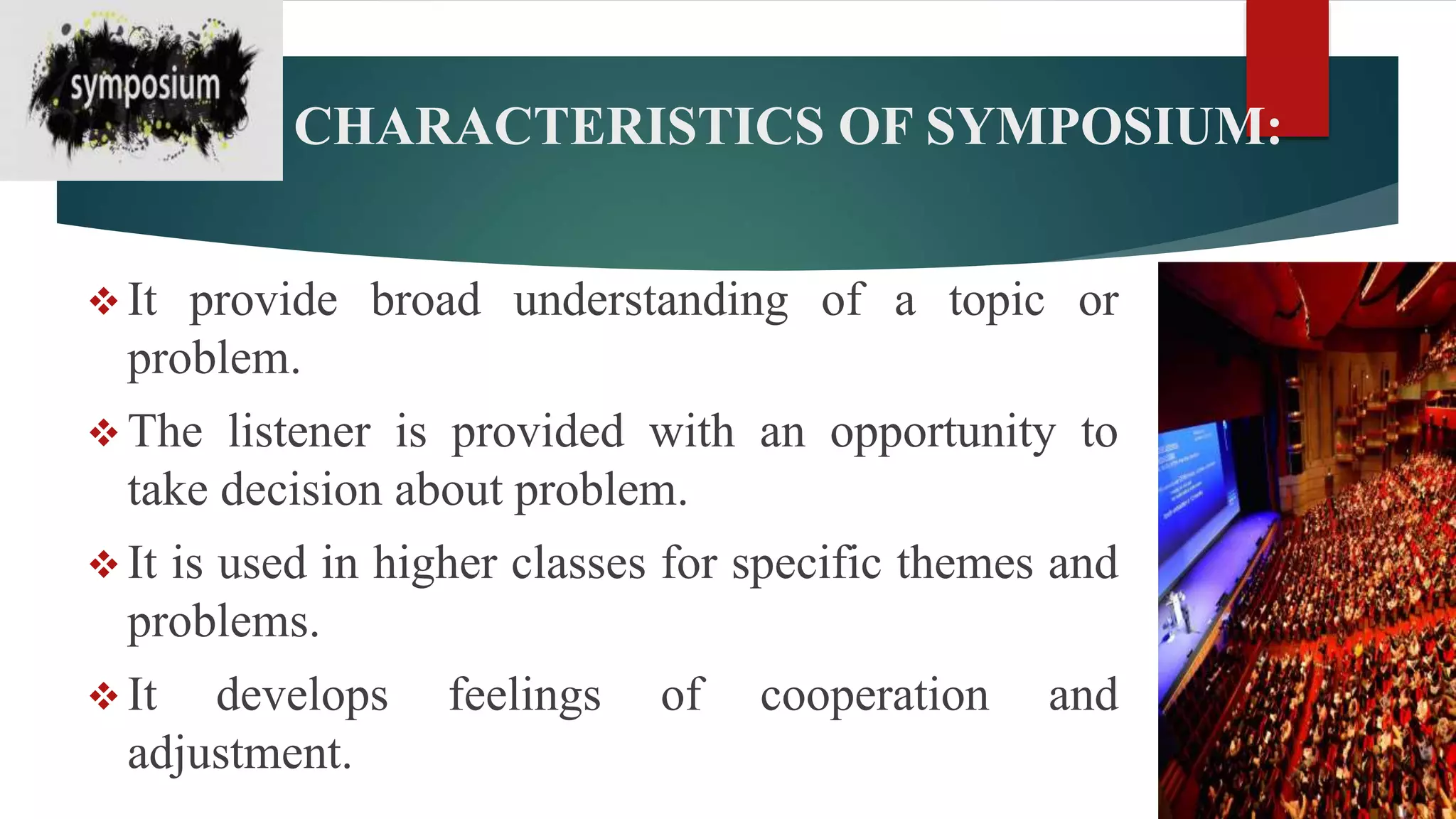
 It provide broad understanding of a topic or
problem.
 The listener is provided with an opportunity to
take decision about problem.
 It is used in higher classes for specific themes and
problems.
 It develops feelings of cooperation and
adjustment.
PRINCIPLES OF SYMPOSIUM:
 The speech may be persuasive, argumentative and
informative.
 Original presentation is objective and accurate.
 Always include a summary at conclusion.
 Each speech without interruption.
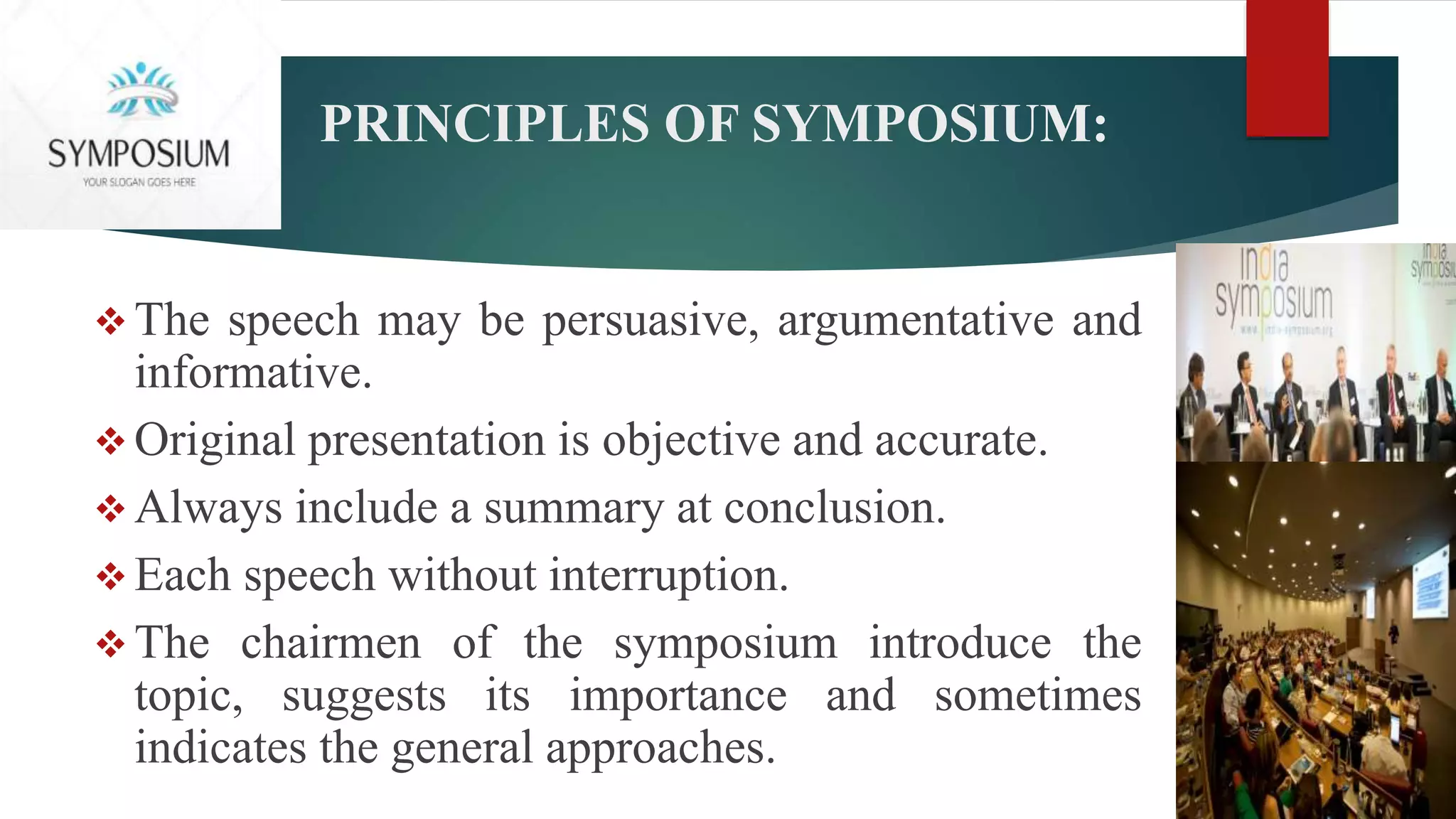
 The chairmen of the symposium introduce the
topic, suggests its importance and sometimes
indicates the general approaches.
GUIDELINES FOR CONDUCTING
SYMPOSIUM:
1. All members of the performing group can sit in
straight line behind a table or in adjoining chairs
with the chairmen in the middle or to one side of
the speakers.
2. The chairmen of the symposium introduce the
topic and suggest something of its performance.
Contd..
3. Two or more speakers talk for 10 to 20
minutes.
4. The speech are followed by questions or
comments from the audiences as in the panel
form.
PRECAUTIONS FOR SYMPOSIUM:
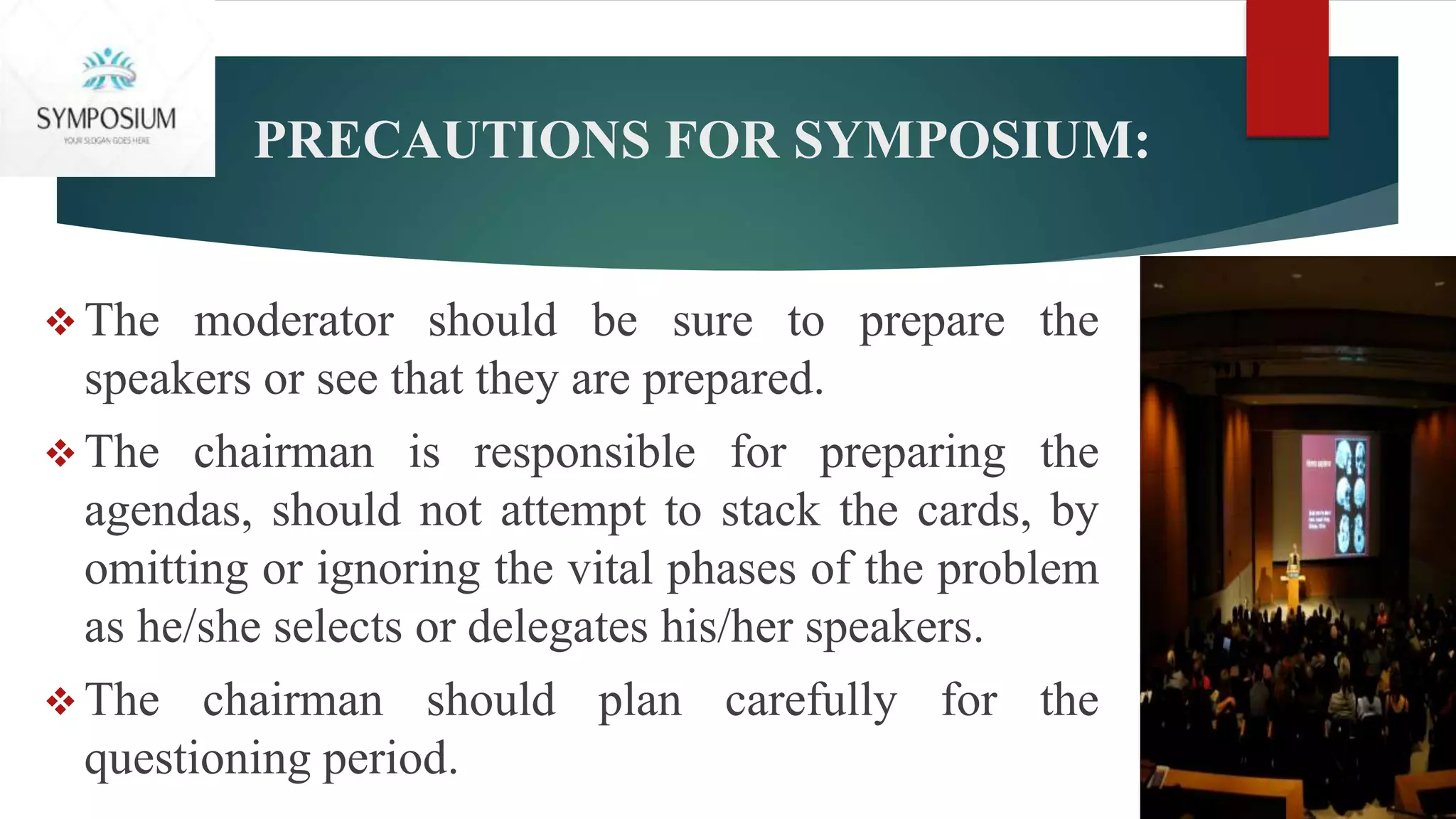
 The moderator should be sure to prepare the
speakers or see that they are prepared.
 The chairman is responsible for preparing the
agendas, should not attempt to stack the cards, by
omitting or ignoring the vital phases of the problem
as he/she selects or delegates his/her speakers.
 The chairman should plan carefully for the
questioning period.
ADVANTAGES OF SYMPOSIUM:
 It is suited to a large group or classes.
 Used to present broad topics for discussions at
conventions and organization meetings.
 Organization is a good because of the set speeches
before hand.
 Gives deeper insight to the topic.
DISADVANTAGE OF
SYMPOSIUM:
 Inadequate opportunity for all the students to
participate actively.
 The speech is limited to 15-20 minutes.
 Limited audience participation.
 Question and answer limited to 3-4 minutes.
 Possibility of overlapping of subjects.
CONCLUSION:
 Teaching is an interaction process. Interaction means
participation of both teacher and student and both are
benefit by this. The interaction takes place for achieving
desired objective.
 Symposium is a meeting or conference for the
discussion of some subject, especially a meeting at
which several speakers talk on or discuss a topic before
an audience.
SUMMARIZATION:
RECAPITALIZATION:
 Enlist the principle of teaching?
 What are the advantages of symposium?
 What are the quality of good teaching?
BIBLIOGRAPHY:
 Krishan Murali Rama. Textbook of nursing
education first edition: Jaypee publishers. Page no.
90,96,294.
 www.slideshare.com. On viewed> 17-8-2020
Vivek Jamnik.
 Teaching METHOD symposium

Teaching METHOD symposium

  • 1.
    MICROTEACHING ON TEACHING AND SYMPOSIUM SUBMITTED TO:SUBMITTED BY: DR. PALLAVI PATHANIA MS. MINAKSHI RANA ASSOCIATE PROFESSOR M.SC. (N) 1ST YEAR SHIMLA NURSING COLLEGE SHIMLA NURSING COLLEGE
  • 2.
    INDEX: SR. NO. CONTENT 1)TEACHING 2) SYMPOSIUM
  • 4.
    INTRODUCTION:  Teaching isscience as well as art. For effective teaching, teacher has to follow some specific principles based on certain precise knowledge.  In this sense, teaching is science. In order to teach effectively, teacher has to adopt varied circumstances by using different techniques.
  • 5.
    DEFINITION: BURTON: “Teaching isthe stimulation, guidance, direction and encouragement for learning.” FLANDER: “ Teaching is an interaction process. Interaction means participation of both teacher and student and both get benefit by this. The interaction takes place for achieving desired objectives.”
  • 6.
    CHARACTERISTICS: 1.Imparting knowledge inan efficient manner. 2. Inculcates desirable values and proper attitude and habits of work in the student. 3. Create a genuine attachment to work and desire to its efficiently, honestly and thoroughly as possible.
  • 7.
    Contd.. 4. Provide opportunitiesfor student to learn actively and to apply partially the knowledge that they have acquired in the class room. 5. Clear thinking and clear expression both in speech and writing has to take place.
  • 8.
    Contd.. 6.Train the learnerin the technique of the study methods of acquiring knowledge through personal efforts and initiatives. 7. Opportunity of the student should be provided to work in groups and to carry out project and activities to develop in them the qualities necessary for group life and for cooperation work.
  • 9.
    PRINCIPLES OF TEACHING: a)Principle of motivation b) Principles of activity c) Principle of individual difference
  • 10.
    contd.. d) Principle ofcreativity e) Principle of selection f) Principle of correlation
  • 11.
    QUALITY OF GOOD TEACHING: 1.Goodteaching recognize individual difference. 2.Good teaching provide opportunities for activity. 3.Good teaching involve in guiding and learning. 4.Good teaching reduce distance between teacher and learner. 5.Good teaching is flexible.
  • 12.
    Contd.. 6.Good teaching providedesirable and selective information. 7.Good teaching helps the client to adjust himself in the environment. 8.Good teaching should be on the basis of previous knowledge of the student.
  • 13.
    QUALITIES OF GOODTEACHER: a) Friendliness and congeniality b) A good personality c) Deep knowledge and a great education
  • 14.
    Contd.. d) A goodcommunicator e) A good sense of humor f) KINDNESS
  • 16.
    INTRODUCTION OF SYMPOSIUM: Symposium techniques is a type of discussion where two or more speakers talk for 10-20 minutes, develop individual approaches or solution to a present aspect of a policy, process or programme.  It is a instructional techniques that is used to achieve higher cognitive and effective objective.
  • 17.
    MEANING OF SYMPOSIUM: The word symposium has several dictionary meanings.  Plato used this term for good dialogue to present views towards god.  Another meaning of the intellectual recreation or enjoyment.
  • 18.
    DEFINITION OF SYMPOSIUM: Symposium is defined as a teaching technique that serves as an excellent , crystallizing their opinion and preparing them for arriving at decision regarding a particular issue or a topic.
  • 19.
    OBJECTIVE OF SYMPOSIUM: To identify and understand various aspect of the theme and problem.  To develop the ability to come to a decision and provide judgement regarding a problem.  To develop values and feelings regarding a problem.
  • 20.
    Contd..  To enablesthe listeners form policies regarding a theme problem.  To boost students abilities to speak in the group.
  • 21.
    LIMITATIONS OF SYMPOSIUM TECHNIQUE: The chairmen has no control over the speakers as they have full freedom to prepare the theme for discussion. They can present any aspect of the theme or problem.  There is a probability of repetition of the content because every speakers theme as a whole.  The different aspects of a theme are presented simultaneously. Therefore the listeners are not able to understand the theme correctly.
  • 22.
    CHARACTERISTICS OF SYMPOSIUM: It provide broad understanding of a topic or problem.  The listener is provided with an opportunity to take decision about problem.  It is used in higher classes for specific themes and problems.  It develops feelings of cooperation and adjustment.
  • 23.
    PRINCIPLES OF SYMPOSIUM: The speech may be persuasive, argumentative and informative.  Original presentation is objective and accurate.  Always include a summary at conclusion.  Each speech without interruption.  The chairmen of the symposium introduce the topic, suggests its importance and sometimes indicates the general approaches.
  • 24.
    GUIDELINES FOR CONDUCTING SYMPOSIUM: 1.All members of the performing group can sit in straight line behind a table or in adjoining chairs with the chairmen in the middle or to one side of the speakers. 2. The chairmen of the symposium introduce the topic and suggest something of its performance.
  • 25.
    Contd.. 3. Two ormore speakers talk for 10 to 20 minutes. 4. The speech are followed by questions or comments from the audiences as in the panel form.
  • 26.
    PRECAUTIONS FOR SYMPOSIUM: The moderator should be sure to prepare the speakers or see that they are prepared.  The chairman is responsible for preparing the agendas, should not attempt to stack the cards, by omitting or ignoring the vital phases of the problem as he/she selects or delegates his/her speakers.  The chairman should plan carefully for the questioning period.
  • 27.
    ADVANTAGES OF SYMPOSIUM: It is suited to a large group or classes.  Used to present broad topics for discussions at conventions and organization meetings.  Organization is a good because of the set speeches before hand.  Gives deeper insight to the topic.
  • 28.
    DISADVANTAGE OF SYMPOSIUM:  Inadequateopportunity for all the students to participate actively.  The speech is limited to 15-20 minutes.  Limited audience participation.  Question and answer limited to 3-4 minutes.  Possibility of overlapping of subjects.
  • 29.
    CONCLUSION:  Teaching isan interaction process. Interaction means participation of both teacher and student and both are benefit by this. The interaction takes place for achieving desired objective.  Symposium is a meeting or conference for the discussion of some subject, especially a meeting at which several speakers talk on or discuss a topic before an audience.
  • 30.
  • 32.
    RECAPITALIZATION:  Enlist theprinciple of teaching?  What are the advantages of symposium?  What are the quality of good teaching?
  • 33.
    BIBLIOGRAPHY:  Krishan MuraliRama. Textbook of nursing education first edition: Jaypee publishers. Page no. 90,96,294.  www.slideshare.com. On viewed> 17-8-2020 Vivek Jamnik.