GROUP MEMBERS
MUHAMMAD ALYAN
ANWERZAIB
ARMAN ULLAH
ABID
JAVID RAZA
TEACHING METHODS AND
SETTINGS
Objectives…..
• Introduction to teaching..
• Definition of methods of teaching…
• Domains of teaching…
• Lecture method…
• Demonstration ..
• Group discussion…
• Seminar…
• Symposium..
• Panel discussion.. Role play...project method
• Field trip… work shop…
•
Introduction to teaching
• Good teaching is the main criterion of an effective teacher
.
• Every individual is unique and so different teacher adopt
different methods and strategies of teaching.
• The selection of teaching method depend upon the
nature of a task ,learning objectives learners abilities and
students entering behaviour.
• The main objective of teaching is to bring about desires
changes in the attitude and behaviour of learners .
Methods of learning
• The way or style of the presentation of content
in a class room is called teaching method.
• According to burton teachings method is the
stimulation guidance direction and
encouragement of learning.
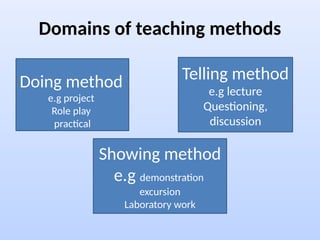
Domains of teaching methods
Doing method
e.g project
Role play
practical
Telling method
e.g lecture
Questioning,
discussion
Showing method
e.g demonstration
excursion
Laboratory work
Demonstration
• Demonstration can be define as visualised
explanation of facts concepts and procedure’s.
• It trains explains the students in the art of
careful observation.
• To show the leaner how to perform certain
psychomotor skill.the leaner must reproduce
the behaviour of demonstration exactly
Characteristics of
demonstration
• The demonstrator should understand the-entire
procedure before attempting to perform.
• A positive approach should be used .
• Knowledge about the procedure should be given
to student.
• The sitting for a demonstration should be real to
life as possible .
components /steps to demonstration
• Before demonstration
• Formulate behavioural objectives.
• Perform skill analysis and determine the
sequences.
• Assess enter behaviour of learners and
determine pre requisite’s.
• Formulate lesson plan for demonstration
Conti…
• During demonstration
• State the objective to the learners.
• Motivate the learner by explaining why the skills
required.
• Demonstrate the complete skill at normal speed.
• Avoid the use of negative example and variation in
the technique.
Conti…
• After demonstration
• Provide immediate supervised practice with
adequate time allowance.
• Make the environment psychologically safe by
providing a friendly atmosphere and
constructive criticism
Group discussion
• Group discussion is an effective method of
teaching and considered a learner centric
approach of the teaching learning process.
• In group discussion a number of learners
interact face to face-to achieve specific
educational objectives.
• Group discussion is a corporative problem
solving activity which seeks a consensus
regarding the solution of a problem.
Conti….
• Group discussion can defined as three or more
participant who have an agreed topic to
discuss and share their views in all the aspects
and submit/present their views in the form of
report to bigger gathering.
• A variety of information may be learned in a
short time when a number of people in a
group share their own experience and
knowledge with others.
SEMINAR
• Seminar is one of the technique of discussion
for small groups ,a small group is one in which
face to face relationship among participants is
there.
• Seminar are simply a group of people coming
together for the discussion and learning of
specific techniques and topics .
Conti….
• Seminar is a form of class organisation that utilises
a scientific approach for the analysis of a problem
chosen for discussion.
• The objective of seminar is to give students the
opportunity to the participate in methods of
scientific analysis and research procedures.
• It is a discussion method of teaching where an
informal group of 10-15 participate to solve
problem in a scientific approach .generally the
duration of seminar is not more than 1-2 hours.
Characteristics of the seminar
• Teacher is the leader(student can also function
as a leader in certain selected situation).
• The topic is initially presented by the presenter
followed by group discussion.
• The leader should keep the discussion within
limits so the focus of discussion can be
mentioned..
SYMPOSIUM
• Is a teaching technique that serves as an
excellent method for informing the audience
crystallising their opinion and preparing them
for arriving at discussion regarding a particular
issue or a topic.
Conti…..
• Symposium techniques is type of discussion
where two or more speakers talk for 10-20
minutes, develop individual approach or
solution to a problem or present aspect of
policy ,process or programme.
• This is the techniques of higher learning.
• It is an instructional techniques that is used to
achieve higher cognitive and effective
objectives.
Purpose of symposium
• To identify and understand various aspects of
the theme and problems
• To develop the ability to come to a discussion
and provide judgement regarding a problem.
• To provide understanding to the students or
listeners on the theme or problem to
specifically develop certain values and feelings.
PANEL DISCUSSION
• This technique was first used by harry A over
street for the first time in 1929.
• The purpose of panel is to make use of small
group discussion for the benefit of a large
group.
• The discussion provide equal opportunity in
the instructional situation to every participant.
Purpose of panel discussion
• to provide new information and new facts .
• To analyse the current problem from different
angles
• To identify the values.
• To influence the audience to an open minded
attitude and respect for other opinion.
• To organise for the mental recreations.
ROLE PLAY
• Role playing is a teaching method where a group of
participant act out the assigned role to deliver the
content of topic to be thought to the participant.
• In a role playing group the member play the
assigned role the way they think the character
would act in reality which help in arousing feeling
and elicit emotional responses in learner where
cognitive and affective domaine may be achieved.
Purpose of role play
• To present interpersonal problems.
• To provide emotional and affective stimulus for
solving problem.
• To develop a situation for an analysis.
• To prevent alternative courses of action.
• To prepare for meeting future situations.
• To develop understanding of other point of
views.
PROJECT METHOD
• This method is a teaching method where
students learn to work individually or in a
group to achieve preplanned learning
objectives.
• According to Williams kilo art Rick’’ project
method is a whole hearted purposeful
activates proceedings in a social environment.
• The project method want to reset the whole
curriculum and break all barriers of the subject
matter.
FIELD TRIP
• An educational trip is defined as an
educational procedure by which the student
obtain first hand information by observing
places objects phenomena and process in their
natural setting to future learning.
PURPOSE OF FIELD TRIP
• To provide real life situation for first hand
information.
• To supplement classroom instruction to secure
definite information for a specific lesson.
• To serve as a preview of a lesson and gather
instructional material .
• To verify previous information class discussion and
conclusion of individual experiment.
• To create situational teaching for cultivating
observation keenness and discovery.
WORKSHOP
• Work shop is a meeting during which
experienced people in responsible position
come together with expert and consultants to
find solution to the problem that cropped up in
the courses of there work and they have had
difficulty in dealing with on their own .
• It is a large discussion method.
Conti…
• The word workshop is related to any area that
provides both space and tools required for the
manufacture and repair of goods.
• Similarly in educational workshops experts
provide knowledge and skills to deal with
problem .
Teaching and learning presentation by Muhammad Alyan

Teaching and learning presentation by Muhammad Alyan

  • 1.
    GROUP MEMBERS MUHAMMAD ALYAN ANWERZAIB ARMANULLAH ABID JAVID RAZA TEACHING METHODS AND SETTINGS
  • 2.
    Objectives….. • Introduction toteaching.. • Definition of methods of teaching… • Domains of teaching… • Lecture method… • Demonstration .. • Group discussion… • Seminar… • Symposium.. • Panel discussion.. Role play...project method • Field trip… work shop… •
  • 3.
    Introduction to teaching •Good teaching is the main criterion of an effective teacher . • Every individual is unique and so different teacher adopt different methods and strategies of teaching. • The selection of teaching method depend upon the nature of a task ,learning objectives learners abilities and students entering behaviour. • The main objective of teaching is to bring about desires changes in the attitude and behaviour of learners .
  • 4.
    Methods of learning •The way or style of the presentation of content in a class room is called teaching method. • According to burton teachings method is the stimulation guidance direction and encouragement of learning.
  • 5.
    Domains of teachingmethods Doing method e.g project Role play practical Telling method e.g lecture Questioning, discussion Showing method e.g demonstration excursion Laboratory work
  • 6.
    Demonstration • Demonstration canbe define as visualised explanation of facts concepts and procedure’s. • It trains explains the students in the art of careful observation. • To show the leaner how to perform certain psychomotor skill.the leaner must reproduce the behaviour of demonstration exactly
  • 7.
    Characteristics of demonstration • Thedemonstrator should understand the-entire procedure before attempting to perform. • A positive approach should be used . • Knowledge about the procedure should be given to student. • The sitting for a demonstration should be real to life as possible .
  • 8.
    components /steps todemonstration • Before demonstration • Formulate behavioural objectives. • Perform skill analysis and determine the sequences. • Assess enter behaviour of learners and determine pre requisite’s. • Formulate lesson plan for demonstration
  • 9.
    Conti… • During demonstration •State the objective to the learners. • Motivate the learner by explaining why the skills required. • Demonstrate the complete skill at normal speed. • Avoid the use of negative example and variation in the technique.
  • 10.
    Conti… • After demonstration •Provide immediate supervised practice with adequate time allowance. • Make the environment psychologically safe by providing a friendly atmosphere and constructive criticism
  • 11.
    Group discussion • Groupdiscussion is an effective method of teaching and considered a learner centric approach of the teaching learning process. • In group discussion a number of learners interact face to face-to achieve specific educational objectives. • Group discussion is a corporative problem solving activity which seeks a consensus regarding the solution of a problem.
  • 12.
    Conti…. • Group discussioncan defined as three or more participant who have an agreed topic to discuss and share their views in all the aspects and submit/present their views in the form of report to bigger gathering. • A variety of information may be learned in a short time when a number of people in a group share their own experience and knowledge with others.
  • 13.
    SEMINAR • Seminar isone of the technique of discussion for small groups ,a small group is one in which face to face relationship among participants is there. • Seminar are simply a group of people coming together for the discussion and learning of specific techniques and topics .
  • 14.
    Conti…. • Seminar isa form of class organisation that utilises a scientific approach for the analysis of a problem chosen for discussion. • The objective of seminar is to give students the opportunity to the participate in methods of scientific analysis and research procedures. • It is a discussion method of teaching where an informal group of 10-15 participate to solve problem in a scientific approach .generally the duration of seminar is not more than 1-2 hours.
  • 15.
    Characteristics of theseminar • Teacher is the leader(student can also function as a leader in certain selected situation). • The topic is initially presented by the presenter followed by group discussion. • The leader should keep the discussion within limits so the focus of discussion can be mentioned..
  • 16.
    SYMPOSIUM • Is ateaching technique that serves as an excellent method for informing the audience crystallising their opinion and preparing them for arriving at discussion regarding a particular issue or a topic.
  • 17.
    Conti….. • Symposium techniquesis type of discussion where two or more speakers talk for 10-20 minutes, develop individual approach or solution to a problem or present aspect of policy ,process or programme. • This is the techniques of higher learning. • It is an instructional techniques that is used to achieve higher cognitive and effective objectives.
  • 18.
    Purpose of symposium •To identify and understand various aspects of the theme and problems • To develop the ability to come to a discussion and provide judgement regarding a problem. • To provide understanding to the students or listeners on the theme or problem to specifically develop certain values and feelings.
  • 19.
    PANEL DISCUSSION • Thistechnique was first used by harry A over street for the first time in 1929. • The purpose of panel is to make use of small group discussion for the benefit of a large group. • The discussion provide equal opportunity in the instructional situation to every participant.
  • 20.
    Purpose of paneldiscussion • to provide new information and new facts . • To analyse the current problem from different angles • To identify the values. • To influence the audience to an open minded attitude and respect for other opinion. • To organise for the mental recreations.
  • 21.
    ROLE PLAY • Roleplaying is a teaching method where a group of participant act out the assigned role to deliver the content of topic to be thought to the participant. • In a role playing group the member play the assigned role the way they think the character would act in reality which help in arousing feeling and elicit emotional responses in learner where cognitive and affective domaine may be achieved.
  • 22.
    Purpose of roleplay • To present interpersonal problems. • To provide emotional and affective stimulus for solving problem. • To develop a situation for an analysis. • To prevent alternative courses of action. • To prepare for meeting future situations. • To develop understanding of other point of views.
  • 23.
    PROJECT METHOD • Thismethod is a teaching method where students learn to work individually or in a group to achieve preplanned learning objectives. • According to Williams kilo art Rick’’ project method is a whole hearted purposeful activates proceedings in a social environment. • The project method want to reset the whole curriculum and break all barriers of the subject matter.
  • 24.
    FIELD TRIP • Aneducational trip is defined as an educational procedure by which the student obtain first hand information by observing places objects phenomena and process in their natural setting to future learning.
  • 25.
    PURPOSE OF FIELDTRIP • To provide real life situation for first hand information. • To supplement classroom instruction to secure definite information for a specific lesson. • To serve as a preview of a lesson and gather instructional material . • To verify previous information class discussion and conclusion of individual experiment. • To create situational teaching for cultivating observation keenness and discovery.
  • 26.
    WORKSHOP • Work shopis a meeting during which experienced people in responsible position come together with expert and consultants to find solution to the problem that cropped up in the courses of there work and they have had difficulty in dealing with on their own . • It is a large discussion method.
  • 27.
    Conti… • The wordworkshop is related to any area that provides both space and tools required for the manufacture and repair of goods. • Similarly in educational workshops experts provide knowledge and skills to deal with problem .