Seminars,TrainingsSeminars,Trainings
and Workshopand Workshop
Presented By –MR. DARWIN D. SUPERIO,MBA
The term "seminar" can be applied to a
variety of sessions. On the whole it is used to
describe an activity involving a smaller number
of students than one might find in a lecture,
during which the students are more actively
involved. It may be structured as a task which
has been set in advance, and agreed between
students and lecturers, it may involve a
student or students taking a pro-active lead in
the session, or it may be a "hands on"
workshop or case study activity.
SEMINAR DEFINITIONSEMINAR DEFINITION
INTRODUCTIONINTRODUCTION
A seminar is an instructional
technique which involves generating a
situation for a group to have guided
interaction among themselves on a theme
which is generally presented to the group
by one or more members.
DEFINITIONDEFINITION
Seminar is an instructional technique of
higher learning which involves paper
reading on a theme and followed by the
group discussion to clarify the complex
aspects of the theme
is a lecture or presentation delivered to
an audience on a particular topic or set of
topics that are educational in nature. It is
usually held for groups of 10-50
individuals.
is frequently held at a hotel meeting
space or within an office conference
room.
SEMINAR DEFINITIONSEMINAR DEFINITION
• How presentation will benefit
audience: Adult learners are more
interested in a subject if they know how or
why it is important to them.
• Presenter’s level of expertise in the
subject: Briefly state your credentials in
this area, or explain why participants
should listen to you.
OBJECTIVESOBJECTIVES
Objectives are mainly divided into two
types:-
Cognitive objectives
Affective objectives
Cognitive objectivesCognitive objectives
To develops the higher cognitive abilities
that is analysis , synthesis and evaluation.
To develop the ability of responding that
is valuing, organizing etc.
To develop the ability of keen
observation, experience ,feeling and to
present them effectively.
To develop the ability to seek
clarification and defend the ideas of other
effectively.
Affective ObjectivesAffective Objectives
To develop the feeling to tolerate the
opposite ideas of other.
To develop the feeling of cooperation.
To develop the emotional stability among
the participants of seminar.
To acquire a good manner of putting
questions and to answer the questions of
other effectives.
Roles of Seminar TechniqueRoles of Seminar Technique
In organizing a seminar the following roles
are performed:-
ORGANIZER
PRESEDENT OR CHAIRMEN
PARTICIPANT
OBSERVERS
ROLE OF ORGANIZERROLE OF ORGANIZER
Responsibility of an organizer is to
Plan and prepare the whole program of
the seminar.
To decide the theme
Assign the parts of theme to different
person
He decides that who will be the speaker
ROLE OF PRESIDENTROLE OF PRESIDENT
Direct the whole program and keeps the
discussion on the theme of seminar
ROLE OF SPEAKERROLE OF SPEAKER
They prepare the topic thoroughly and
photocopy of papers are prepared and
distributed among the participants before
the commencement of the topic so the
participants should also prepare
themselves for the topic.
The speaker should be ready to define
the questions
ROLE OF PARTICIPANTSROLE OF PARTICIPANTS
participants should be well acquainted
with theme.
They should appreciate the performance
of the speaker.
They should be able to put questions and
seek clarification
There are 25 -30 participants in seminar.
ROLE OF OBSERVERROLE OF OBSERVER
Some guest and observers are also
invited to observe the activity.
PROCEDURE OF SEMINARPROCEDURE OF SEMINAR
Organizer select the theme and organize
the seminar
Chairman conduct the activities of
seminar and direct the seminar on theme.
Speaker speaks about the theme.
Group discussion
Participants seeks clarification and put
questions.
Observers observe the activity of
seminar.
To get the students to present material orally
To get the students to present material visually
To get the students to lead a discussion
To expand on material introduced in large
lectures, but to reach more depth
To provide a forum for students to ask questions
To encourage the students to partake in a
discussion and express their own points of view
PURPOSE OF A SEMINARPURPOSE OF A SEMINAR
To engage in a more formal debate
Set the students problems to be solved
Ask the students to undertake case study
work
Involve the students in group or team
work
Ask the students to undertake peer
assessment of each others' work (oral
presentation or written work)
Use a role play exercise
Sometimes seminars do not achieve as much as
one hope. The difficulties are most likely to be with
discussion sessions rather than workshops which
ask the students to undertake much defined tasks.
Students do not speak out in a seminar, so the
session is dominated by the lecturer
Only one or two students speak and dominate
the session
The discussion drifts a long way "off the point"
and the major topic is not covered adequately
Students have been involved in the session, but
leave with a rather hazy view of the outcomes
PROBLEMS THAT MAYPROBLEMS THAT MAY
ARISE IN SEMINARSARISE IN SEMINARS
Students in different seminar groups (in the same
module) complain of different learning
experiences
A group of staff providing the same seminars,
within a module, on the same topic can deliver a
very different experience if the purposes,
outcomes and approaches are not clear
Students who prepare work to be marked by
their seminar teacher collude with another
student in a different group and assume this
"cheating" will not be spotted 
Students arrive at the seminar unprepared for
the discussion
PROBLEMS THAT MAYPROBLEMS THAT MAY
ARISE IN SEMINARSARISE IN SEMINARS
Conducting a seminar is a great way
to communicate your ideas or
introduce new technologies. It is
useful to know some guidelines when
you have to conduct a seminar. I
understood the importance of this
both as an attendee and a presenter
myself.
How to conduct seminar?How to conduct seminar?
PREPARED BY:
MR. DARWIN D. SUPERIO, MBA
HOW TO ORGANIZE AHOW TO ORGANIZE A
SEMINARS,TRAININGS ORSEMINARS,TRAININGS OR
WORKSHOPWORKSHOP
GUIDELINESGUIDELINES
1. Choose your topic. If you're a
consultant or speaker, it's likely that
you've been asked to speak to a group
about a certain topic. If you're a business
owner organizing a seminar to promote
your business, you should select a topic
that will appeal to your target customer.
For example, an attorney might organize
a free seminar for the public on estate
planning.
GUIDELINESGUIDELINES
2. Select your venue. Try to estimate the
number of participants you'll have and choose a
venue that will have ample space for everyone
to sit comfortably. You'll also have to take price
into consideration when selecting a venue.
Some venues can have room rental fees of
several hundred or even thousands while
others are much more reasonable. Hotels often
have banquet rooms where businesses
frequently hold conventions, so that may be a
good place to start in your search for a
location.
GUIDELINESGUIDELINES
3. Create an invitations. Depending on the size
and formality of your event, your invitations can
range from a simple document created in
Microsoft Word to a fancy design created by a
professional designer. Distribute your
invitations several weeks in advance to allow
participants time to plan to attend. Don't
distribute the invitations so far in advance that
they may forget before the actual seminar date
arrives, however. You can also email your
invitations, but keep in mind that they may end
up in several recipients' spam folders.
GUIDELINESGUIDELINES
4. Decide whether you'll offer lunch or light
refreshments. If your seminar runs for several
hours, it's a nice touch to have light
refreshments available. If your seminar starts
early in the morning or runs over the lunch
hour, providing lunch is recommended. Some
venues have a requirement that you utilize the
services of their in-house caterer when holding
an event at the facility. Be sure you know the
rules of your contract before you order
refreshments.
GUIDELINESGUIDELINES
5. Create your presentation materials. Make
copies of handouts, or have them printed at a
professional printer. You'll probably want to
create a PowerPoint presentation so you have a
visual reference when you or your speaker are
presenting material. You can easily create a
handout for your participants by selecting
"handouts" under print options. Make sure you
select three per page, and your participants will
be able to take notes directly on their
handouts.
GUIDELINESGUIDELINES
6. A few days before the event, finalize your
number of attendees based on your RSVPs. If
you choose, you can call other people that
you've invited to remind them of your event
and give them one last chance to register. Leave
a message for anyone you don't reach, if
possible, and instruct them to call you as soon
as possible if they plan to attend.
GUIDELINESGUIDELINES7. Create a sign-in sheet and nametags. It's nice for
seminar participants to be able to meet other people and
immediately see their name and where they are from. It
eliminates some of the uncomfortable feelings people
have when introducing themselves to new people. A
sign-in sheet will prove useful if you plan to offer any
type of continuing education credits to your participants,
or if you simply wish to keep in contact with your
participants after the seminar. You can ask for their
names, addresses, phone numbers and email addresses.
It's wise to offer a box they can check if they don't wish
to receive further communication from you.
GUIDELINESGUIDELINES
8. Create packets for each table setting. You
may want to include brochures and other
promotional material about your business.
You'll also want to provide something for your
participants to write on and a pen for them to
write with. If you don't have these items with
your business logo on, the venue where you're
holding your event may have pens and pads that
they'd be happy to provide.
GUIDELINESGUIDELINES
9. Confirm details with your contact person at
your venue a few days prior to your event. You
should also confirm a final head count with your
caterer if you're having food catered. Be sure to
let your caterer know if you'll need them to
supply paper products, such as plates, napkins
or cups. Make any payment arrangements
necessary. Some venues and caterers require
upfront payment, while others are happy to
collect money the day of your event.
GUIDELINESGUIDELINES
10.Set up your venue the day before or
morning of your event. You'll want to be sure
that your venue staff have the room set up the
way you asked. You'll also want to place your
packets and other materials at each place
setting before your guests arrive. Walk around
the room and make sure everyone will have a
clear view of you or your speaker at the front
of the room.
GUIDELINESGUIDELINES
11. Plan for yourself or a representative from
your company to be present when the first
guests will begin arriving the day of your event.
You'll want to greet people and direct them to
the sign-in sheet, the location of restrooms and
the refreshments.
After the event: compile the evaluation
results and plan a follow-up. Discuss the
evaluation outcome with the trainers and
within the institute.
Preparing the presentation
Include a presentation. Presentations help the
audience to understand the underlying points that
the speaker has to say especially if the subject is
rather vague.
The presentation should have an Introduction and a
conclusion. The introduction can include a
summary of the topic and a brief overview of what
the speaker will be saying for the rest of the
duration of the seminar.
I. Preparing your presentationI. Preparing your presentation
Discussion in pairs
Brainstorms
"Buzz" groups
Rounds
Circular interviewing
Pyramids
Cross-overs
Skills-based Groups
Fishbowls
Techniques for promotingTechniques for promoting
student discussion in seminarsstudent discussion in seminars
TYPES OF SEMINARTYPES OF SEMINAR
Mini seminar
Main seminar
National seminar
International seminar
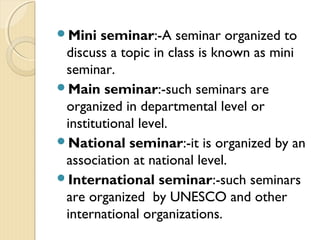
Mini seminar:-A seminar organized to
discuss a topic in class is known as mini
seminar.
Main seminar:-such seminars are
organized in departmental level or
institutional level.
National seminar:-it is organized by an
association at national level.
International seminar:-such seminars
are organized by UNESCO and other
international organizations.
ADVANTAGES OF SEMINARADVANTAGES OF SEMINAR
METHODMETHOD
Stimulation of thinking.
Tolerance of other views develops.
Cooperation with others develops.
Openness of ideas occurs.
Represents the norms of behaviours.
It has great instructional values .
Natural way of learning
LIMITATION OF SEMINARLIMITATION OF SEMINAR
Seminar cannot be organized on all the
content of subject matter.
Technique cannot be used in all levels of
education
Conclusion:Conclusion:
Seminar is a method of teaching
mostly used for higher education. It is an
instructional technique which involves
paper reading on a theme. It includes the
group discussion to clarify the complex
aspect of theme. The students’ learns to
develop the ability of keen observation of
experience and feelings of tolerance to the
opposite ideas of others.
BIBLIOGRAPHY:BIBLIOGRAPHY:
1.)Basvanthappa.BT,Nursing Education,2nd :2009,Jaypee
Brothers Medical Publisher Ltd,New Delhi,572-575
2.)Neerja.KP,Text Book of Nursing Education,1st :2003,
Jaypee Brothers Medical Publisher Ltd,New Delhi,
3.)Kumar.N, Educational Technology Theory and Practice,
1st:2009, AITBS Publisher, Delhi,
ASK YOUR DOUBTSASK YOUR DOUBTS
Seminar intro

Seminar intro

  • 1.
  • 2.
    The term "seminar"can be applied to a variety of sessions. On the whole it is used to describe an activity involving a smaller number of students than one might find in a lecture, during which the students are more actively involved. It may be structured as a task which has been set in advance, and agreed between students and lecturers, it may involve a student or students taking a pro-active lead in the session, or it may be a "hands on" workshop or case study activity. SEMINAR DEFINITIONSEMINAR DEFINITION
  • 3.
    INTRODUCTIONINTRODUCTION A seminar isan instructional technique which involves generating a situation for a group to have guided interaction among themselves on a theme which is generally presented to the group by one or more members.
  • 4.
    DEFINITIONDEFINITION Seminar is aninstructional technique of higher learning which involves paper reading on a theme and followed by the group discussion to clarify the complex aspects of the theme
  • 5.
    is a lectureor presentation delivered to an audience on a particular topic or set of topics that are educational in nature. It is usually held for groups of 10-50 individuals. is frequently held at a hotel meeting space or within an office conference room. SEMINAR DEFINITIONSEMINAR DEFINITION
  • 6.
    • How presentationwill benefit audience: Adult learners are more interested in a subject if they know how or why it is important to them. • Presenter’s level of expertise in the subject: Briefly state your credentials in this area, or explain why participants should listen to you.
  • 7.
    OBJECTIVESOBJECTIVES Objectives are mainlydivided into two types:- Cognitive objectives Affective objectives
  • 8.
    Cognitive objectivesCognitive objectives Todevelops the higher cognitive abilities that is analysis , synthesis and evaluation. To develop the ability of responding that is valuing, organizing etc. To develop the ability of keen observation, experience ,feeling and to present them effectively. To develop the ability to seek clarification and defend the ideas of other effectively.
  • 9.
    Affective ObjectivesAffective Objectives Todevelop the feeling to tolerate the opposite ideas of other. To develop the feeling of cooperation. To develop the emotional stability among the participants of seminar. To acquire a good manner of putting questions and to answer the questions of other effectives.
  • 10.
    Roles of SeminarTechniqueRoles of Seminar Technique In organizing a seminar the following roles are performed:- ORGANIZER PRESEDENT OR CHAIRMEN PARTICIPANT OBSERVERS
  • 11.
    ROLE OF ORGANIZERROLEOF ORGANIZER Responsibility of an organizer is to Plan and prepare the whole program of the seminar. To decide the theme Assign the parts of theme to different person He decides that who will be the speaker
  • 12.
    ROLE OF PRESIDENTROLEOF PRESIDENT Direct the whole program and keeps the discussion on the theme of seminar
  • 13.
    ROLE OF SPEAKERROLEOF SPEAKER They prepare the topic thoroughly and photocopy of papers are prepared and distributed among the participants before the commencement of the topic so the participants should also prepare themselves for the topic. The speaker should be ready to define the questions
  • 14.
    ROLE OF PARTICIPANTSROLEOF PARTICIPANTS participants should be well acquainted with theme. They should appreciate the performance of the speaker. They should be able to put questions and seek clarification There are 25 -30 participants in seminar.
  • 15.
    ROLE OF OBSERVERROLEOF OBSERVER Some guest and observers are also invited to observe the activity.
  • 16.
    PROCEDURE OF SEMINARPROCEDUREOF SEMINAR Organizer select the theme and organize the seminar Chairman conduct the activities of seminar and direct the seminar on theme. Speaker speaks about the theme. Group discussion Participants seeks clarification and put questions. Observers observe the activity of seminar.
  • 17.
    To get thestudents to present material orally To get the students to present material visually To get the students to lead a discussion To expand on material introduced in large lectures, but to reach more depth To provide a forum for students to ask questions To encourage the students to partake in a discussion and express their own points of view PURPOSE OF A SEMINARPURPOSE OF A SEMINAR
  • 18.
    PURPOSE OF ASEMINARPURPOSE OF A SEMINAR To engage in a more formal debate Set the students problems to be solved Ask the students to undertake case study work Involve the students in group or team work Ask the students to undertake peer assessment of each others' work (oral presentation or written work) Use a role play exercise
  • 19.
    Sometimes seminars donot achieve as much as one hope. The difficulties are most likely to be with discussion sessions rather than workshops which ask the students to undertake much defined tasks. Students do not speak out in a seminar, so the session is dominated by the lecturer Only one or two students speak and dominate the session The discussion drifts a long way "off the point" and the major topic is not covered adequately Students have been involved in the session, but leave with a rather hazy view of the outcomes PROBLEMS THAT MAYPROBLEMS THAT MAY ARISE IN SEMINARSARISE IN SEMINARS
  • 20.
    Students in differentseminar groups (in the same module) complain of different learning experiences A group of staff providing the same seminars, within a module, on the same topic can deliver a very different experience if the purposes, outcomes and approaches are not clear Students who prepare work to be marked by their seminar teacher collude with another student in a different group and assume this "cheating" will not be spotted  Students arrive at the seminar unprepared for the discussion PROBLEMS THAT MAYPROBLEMS THAT MAY ARISE IN SEMINARSARISE IN SEMINARS
  • 21.
    Conducting a seminaris a great way to communicate your ideas or introduce new technologies. It is useful to know some guidelines when you have to conduct a seminar. I understood the importance of this both as an attendee and a presenter myself. How to conduct seminar?How to conduct seminar?
  • 22.
    PREPARED BY: MR. DARWIND. SUPERIO, MBA HOW TO ORGANIZE AHOW TO ORGANIZE A SEMINARS,TRAININGS ORSEMINARS,TRAININGS OR WORKSHOPWORKSHOP
  • 23.
    GUIDELINESGUIDELINES 1. Choose yourtopic. If you're a consultant or speaker, it's likely that you've been asked to speak to a group about a certain topic. If you're a business owner organizing a seminar to promote your business, you should select a topic that will appeal to your target customer. For example, an attorney might organize a free seminar for the public on estate planning.
  • 24.
    GUIDELINESGUIDELINES 2. Select yourvenue. Try to estimate the number of participants you'll have and choose a venue that will have ample space for everyone to sit comfortably. You'll also have to take price into consideration when selecting a venue. Some venues can have room rental fees of several hundred or even thousands while others are much more reasonable. Hotels often have banquet rooms where businesses frequently hold conventions, so that may be a good place to start in your search for a location.
  • 25.
    GUIDELINESGUIDELINES 3. Create aninvitations. Depending on the size and formality of your event, your invitations can range from a simple document created in Microsoft Word to a fancy design created by a professional designer. Distribute your invitations several weeks in advance to allow participants time to plan to attend. Don't distribute the invitations so far in advance that they may forget before the actual seminar date arrives, however. You can also email your invitations, but keep in mind that they may end up in several recipients' spam folders.
  • 26.
    GUIDELINESGUIDELINES 4. Decide whetheryou'll offer lunch or light refreshments. If your seminar runs for several hours, it's a nice touch to have light refreshments available. If your seminar starts early in the morning or runs over the lunch hour, providing lunch is recommended. Some venues have a requirement that you utilize the services of their in-house caterer when holding an event at the facility. Be sure you know the rules of your contract before you order refreshments.
  • 27.
    GUIDELINESGUIDELINES 5. Create yourpresentation materials. Make copies of handouts, or have them printed at a professional printer. You'll probably want to create a PowerPoint presentation so you have a visual reference when you or your speaker are presenting material. You can easily create a handout for your participants by selecting "handouts" under print options. Make sure you select three per page, and your participants will be able to take notes directly on their handouts.
  • 28.
    GUIDELINESGUIDELINES 6. A fewdays before the event, finalize your number of attendees based on your RSVPs. If you choose, you can call other people that you've invited to remind them of your event and give them one last chance to register. Leave a message for anyone you don't reach, if possible, and instruct them to call you as soon as possible if they plan to attend.
  • 29.
    GUIDELINESGUIDELINES7. Create asign-in sheet and nametags. It's nice for seminar participants to be able to meet other people and immediately see their name and where they are from. It eliminates some of the uncomfortable feelings people have when introducing themselves to new people. A sign-in sheet will prove useful if you plan to offer any type of continuing education credits to your participants, or if you simply wish to keep in contact with your participants after the seminar. You can ask for their names, addresses, phone numbers and email addresses. It's wise to offer a box they can check if they don't wish to receive further communication from you.
  • 30.
    GUIDELINESGUIDELINES 8. Create packetsfor each table setting. You may want to include brochures and other promotional material about your business. You'll also want to provide something for your participants to write on and a pen for them to write with. If you don't have these items with your business logo on, the venue where you're holding your event may have pens and pads that they'd be happy to provide.
  • 31.
    GUIDELINESGUIDELINES 9. Confirm detailswith your contact person at your venue a few days prior to your event. You should also confirm a final head count with your caterer if you're having food catered. Be sure to let your caterer know if you'll need them to supply paper products, such as plates, napkins or cups. Make any payment arrangements necessary. Some venues and caterers require upfront payment, while others are happy to collect money the day of your event.
  • 32.
    GUIDELINESGUIDELINES 10.Set up yourvenue the day before or morning of your event. You'll want to be sure that your venue staff have the room set up the way you asked. You'll also want to place your packets and other materials at each place setting before your guests arrive. Walk around the room and make sure everyone will have a clear view of you or your speaker at the front of the room.
  • 33.
    GUIDELINESGUIDELINES 11. Plan foryourself or a representative from your company to be present when the first guests will begin arriving the day of your event. You'll want to greet people and direct them to the sign-in sheet, the location of restrooms and the refreshments. After the event: compile the evaluation results and plan a follow-up. Discuss the evaluation outcome with the trainers and within the institute.
  • 34.
    Preparing the presentation Includea presentation. Presentations help the audience to understand the underlying points that the speaker has to say especially if the subject is rather vague. The presentation should have an Introduction and a conclusion. The introduction can include a summary of the topic and a brief overview of what the speaker will be saying for the rest of the duration of the seminar. I. Preparing your presentationI. Preparing your presentation
  • 35.
    Discussion in pairs Brainstorms "Buzz"groups Rounds Circular interviewing Pyramids Cross-overs Skills-based Groups Fishbowls Techniques for promotingTechniques for promoting student discussion in seminarsstudent discussion in seminars
  • 36.
    TYPES OF SEMINARTYPESOF SEMINAR Mini seminar Main seminar National seminar International seminar
  • 37.
    Mini seminar:-A seminarorganized to discuss a topic in class is known as mini seminar. Main seminar:-such seminars are organized in departmental level or institutional level. National seminar:-it is organized by an association at national level. International seminar:-such seminars are organized by UNESCO and other international organizations.
  • 38.
    ADVANTAGES OF SEMINARADVANTAGESOF SEMINAR METHODMETHOD Stimulation of thinking. Tolerance of other views develops. Cooperation with others develops. Openness of ideas occurs. Represents the norms of behaviours. It has great instructional values . Natural way of learning
  • 39.
    LIMITATION OF SEMINARLIMITATIONOF SEMINAR Seminar cannot be organized on all the content of subject matter. Technique cannot be used in all levels of education
  • 40.
    Conclusion:Conclusion: Seminar is amethod of teaching mostly used for higher education. It is an instructional technique which involves paper reading on a theme. It includes the group discussion to clarify the complex aspect of theme. The students’ learns to develop the ability of keen observation of experience and feelings of tolerance to the opposite ideas of others.
  • 41.
    BIBLIOGRAPHY:BIBLIOGRAPHY: 1.)Basvanthappa.BT,Nursing Education,2nd :2009,Jaypee BrothersMedical Publisher Ltd,New Delhi,572-575 2.)Neerja.KP,Text Book of Nursing Education,1st :2003, Jaypee Brothers Medical Publisher Ltd,New Delhi, 3.)Kumar.N, Educational Technology Theory and Practice, 1st:2009, AITBS Publisher, Delhi,
  • 42.
    ASK YOUR DOUBTSASKYOUR DOUBTS

Editor's Notes

  • #6 How presentation will benefit audience: Adult learners are more interested in a subject if they know how or why it is important to them. Presenter’s level of expertise in the subject: Briefly state your credentials in this area, or explain why participants should listen to you.
  • #18 How presentation will benefit audience: Adult learners are more interested in a subject if they know how or why it is important to them. Presenter’s level of expertise in the subject: Briefly state your credentials in this area, or explain why participants should listen to you.
  • #20 Lesson descriptions should be brief.
  • #21 Lesson descriptions should be brief.
  • #22 Example objectives At the end of this lesson, you will be able to: Save files to the team Web server. Move files to different locations on the team Web server. Share files on the team Web server.