EXTRA ORAL Radiographic
TECHNIQUES PART I
By
Dr. Hassan M. Abouelkheir
BDS, MSC, PHD.
Extra oral Radiography:
• All extra oral radiographic projections should
be performed using screen film.
• Medium or high speed (rare-earth) screenfilm combination are recommended to reduce
pt’s exposure.
• Metallic letters (L) &(R) are used to determine
left & right sides of pt as well as grids to
reduce the fog.
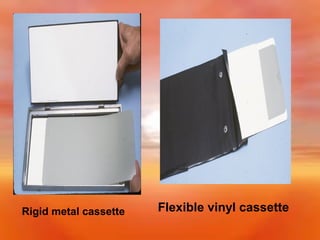
Rigid metal cassette

Flexible vinyl cassette
Intensifying Screen Function
 One of the properties of x-rays is that
they cause certain materials to
fluoresce (emit light); the phosphor
crystals found in intensifying screens
are one of these materials.
The light emission is usually green or
blue, depending on the type of
phosphor crystal used.
Intensifying Screen Function
 The composition of the films used
with these screens is adjusted by
the manufacturer to be sensitive to
either blue light or green light.
 correct film should be used with
corresponding screen type. (Bluesensitive film with blue lightemitting screen, etc.)
Screen Film
• Screen film is sensitive to the effects of light
from an intensifying screen. When these
screens, on either side of the film in a cassette,
are exposed to x-rays, they emit light which in
turn exposes the film.
• Using the screen-film combination allows a
very large reduction in the amount of radiation
needed to expose the film (30-60 times less
radiation than that required by direct exposure
film).
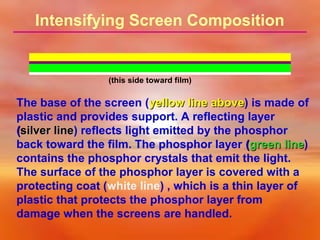
Intensifying Screen Composition

(this side toward film)

The base of the screen (yellow line above) is made of
above
plastic and provides support. A reflecting layer
(silver line) reflects light emitted by the phosphor
line
back toward the film. The phosphor layer (green line)
line
contains the phosphor crystals that emit the light.
The surface of the phosphor layer is covered with a
protecting coat (white line) , which is a thin layer of
plastic that protects the phosphor layer from
damage when the screens are handled.
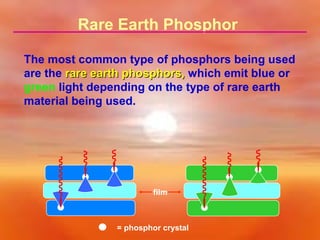
Rare Earth Phosphor
The most common type of phosphors being used
are the rare earth phosphors, which emit blue or
green light depending on the type of rare earth
material being used.

film

= phosphor crystal
Intensifying Screen Speed
The speed of the screen depends on crystal size and
the thickness of the phosphor layer (larger crystals
and thicker layer increase speed). Image quality
decreases as the screen speed increases. The three
speeds are:
• Fast (Rapid): requires the least exposure but the
images are less sharp
• Medium (Par): medium speed, medium sharpness
• Detail (Slow): produces the sharpest images but
requires the most exposure
Screen Film
The two types of screen film used with rare earth
screens are T-Mat and Ektavision. These films are
available in three styles: G, which is used to
provide the best contrast; L, which has the widest
latitude (long-scale contrast) and is good for soft
tissue visualization and H, which is used to provide
an extra film for referral purposes (two films are
placed in the cassette at the same time).
The advantage of Ektavision film over T-Mat film is
that it has anti-crossover layers incorporated into
the film. This prevents light from one screen
affecting both emulsion layers; this produces a
sharper image on the film.
T-Mat (crossover)
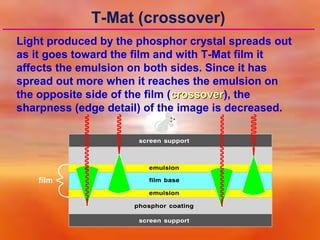
Light produced by the phosphor crystal spreads out
as it goes toward the film and with T-Mat film it
affects the emulsion on both sides. Since it has
spread out more when it reaches the emulsion on
the opposite side of the film (crossover), the
crossover
sharpness (edge detail) of the image is decreased.

film
Ektavision (anti-crossover)
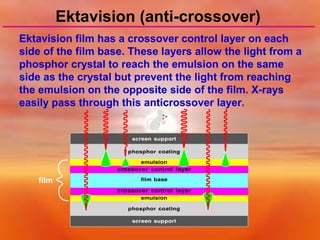
Ektavision film has a crossover control layer on each
side of the film base. These layers allow the light from a
phosphor crystal to reach the emulsion on the same
side as the crystal but prevent the light from reaching
the emulsion on the opposite side of the film. X-rays
easily pass through this anticrossover layer.

film
Types of Extra-Oral Radiographic
Examination:
• 1- Mandibular oblique lateral (Ramus,
Body).
• 2- True Lateral (Cephalometric).
• 3-Submento-Vertex view.
• 4- Water’s projection (Occipito-Mental).
• 5- Postero-Anterior projection.
• 6- Reverse Town’s projection.
1] Lateral oblique projection:
• 2 views for mandibular projection;
• a) body projection:
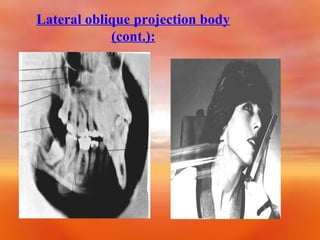
• For demonstration premolar-molar region
and inferior border of the body of the
mandible.
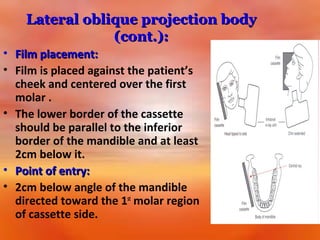
• Head position: Head tilted to the side to
be examined with the mandible
protruded.
Lateral oblique projection body
(cont.):
• Film placement:
• Film is placed against the patient’s
cheek and centered over the first
molar .
• The lower border of the cassette
should be parallel to the inferior
border of the mandible and at least
2cm below it.
• Point of entry:
• 2cm below angle of the mandible
directed toward the 1st molar region
of cassette side.
Lateral oblique projection body
(cont.):
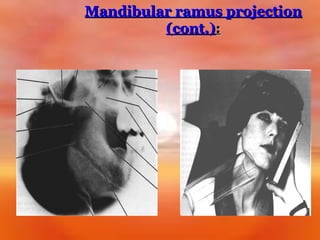
B) Mandibular Ramus projection:

• To view the ramus from the mandibular
angle to the condyle for examining the 3rd
molar region of both the maxilla and
mandible.
• Head position: head tilted towards the
projected mandible where the mandibular
angle of tube side and condyle of cassette
side parallel to the floor.
Mandibular ramus projection (cont.):
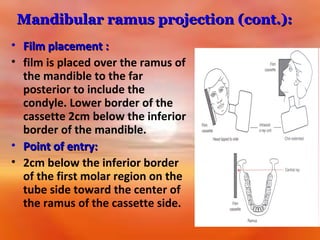
• Film placement :
• film is placed over the ramus of
the mandible to the far
posterior to include the
condyle. Lower border of the
cassette 2cm below the inferior
border of the mandible.
• Point of entry:
• 2cm below the inferior border
of the first molar region on the
tube side toward the center of
the ramus of the cassette side.
Mandibular ramus projection
(cont.):
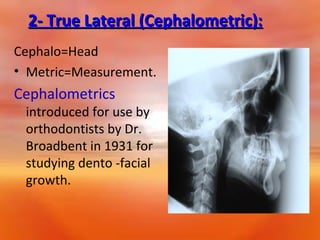
2- True Lateral (Cephalometric):
Cephalo=Head
• Metric=Measurement.

Cephalometrics

introduced for use by
orthodontists by Dr.
Broadbent in 1931 for
studying dento -facial
growth.
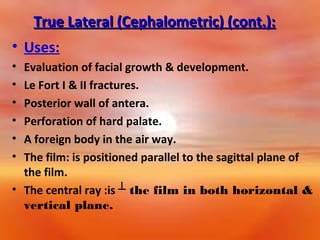
True Lateral (Cephalometric) (cont.):
• Uses:
•
•
•
•
•
•

Evaluation of facial growth & development.
Le Fort I & II fractures.
Posterior wall of antera.
Perforation of hard palate.
A foreign body in the air way.
The film: is positioned parallel to the sagittal plane of
the film.
• The central ray :is ┴ the film in both horizontal &
vertical plane.
True Lateral (Cephalometric) (cont.):
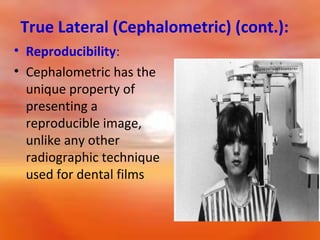
• Reproducibility:
• Cephalometric has the
unique property of
presenting a
reproducible image,
unlike any other
radiographic technique
used for dental films
True Lateral (Cephalometric) (cont.):
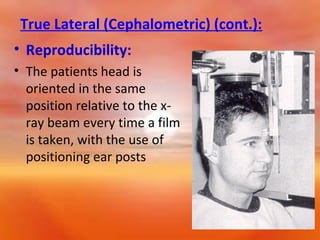
• Reproducibility:
• The patients head is
oriented in the same
position relative to the xray beam every time a film
is taken, with the use of
positioning ear posts
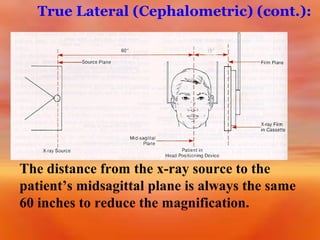
True Lateral (Cephalometric) (cont.):

The distance from the x-ray source to the
patient’s midsagittal plane is always the same
60 inches to reduce the magnification.
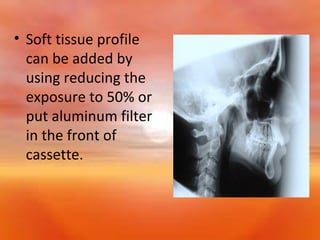
• Soft tissue profile
can be added by
using reducing the
exposure to 50% or
put aluminum filter
in the front of
cassette.
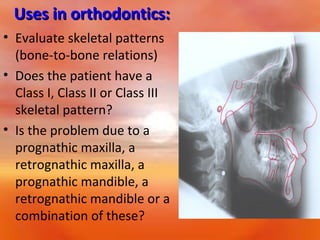
Uses in orthodontics:
• Evaluate skeletal patterns
(bone-to-bone relations)
• Does the patient have a
Class I, Class II or Class III
skeletal pattern?
• Is the problem due to a
prognathic maxilla, a
retrognathic maxilla, a
prognathic mandible, a
retrognathic mandible or a
combination of these?
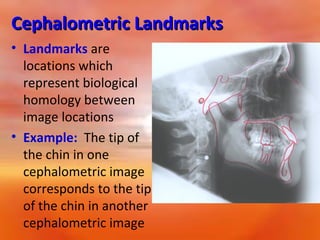
Cephalometric Landmarks
• Landmarks are
locations which
represent biological
homology between
image locations
• Example: The tip of
the chin in one
cephalometric image
corresponds to the tip
of the chin in another
cephalometric image
Cephalometric Landmarks
• Landmarks need to have 3 properties:
1.Landmarks should not remodel over time
(neither be created nor destroyed)
2.Landmarks need to capture biological form,
including the shape, size and position of the
tissue component of which it represents
3.Landmarks have to be reliably located on
cephalometric radiographs
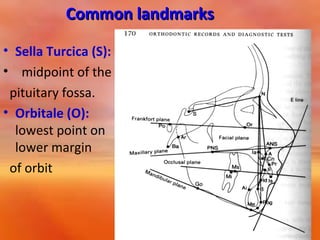
Common landmarks
• Sella Turcica (S):
• midpoint of the
pituitary fossa.
• Orbitale (O):
lowest point on
lower margin
of orbit
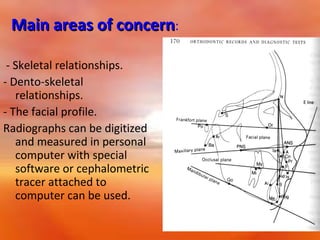
Orthodontic tracing
• To the fixed anatomical points is applied to assess the
nature and extent of any malocclusion which may be
present.
• Tracing of anatomical landmarks should be drown
with sharp , hard (6H) pencil on good quality tracing
paper or acetate drafting sheet not on the film and
done on film viewer.
Main areas of concern:
- Skeletal relationships.
- Dento-skeletal
relationships.
- The facial profile.
Radiographs can be digitized
and measured in personal
computer with special
software or cephalometric
tracer attached to
computer can be used.
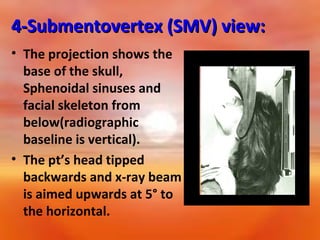
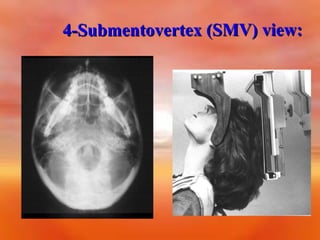
4-Submentovertex (SMV) view:
• The projection shows the
base of the skull,
Sphenoidal sinuses and
facial skeleton from
below(radiographic
baseline is vertical).
• The pt’s head tipped
backwards and x-ray beam
is aimed upwards at 5° to
the horizontal.
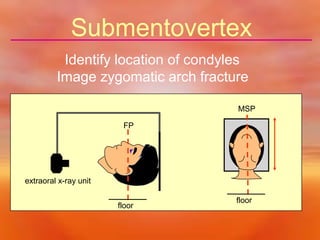
Submentovertex
Identify location of condyles
Image zygomatic arch fracture
MSP
FP

extraoral x-ray unit
floor

floor
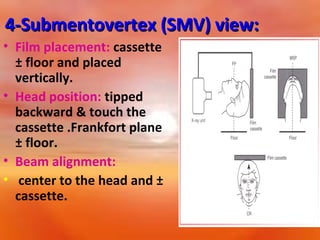
4-Submentovertex (SMV) view:
• Film placement: cassette
± floor and placed
vertically.
• Head position: tipped
backward & touch the
cassette .Frankfort plane
± floor.
• Beam alignment:
• center to the head and ±
cassette.
4-Submentovertex (SMV) view:
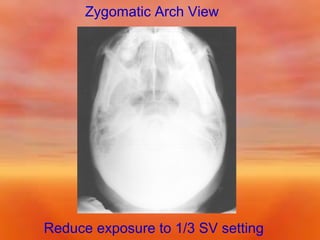
Zygomatic Arch View

Reduce exposure to 1/3 SV setting
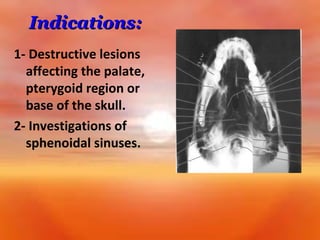
Indications:
1- Destructive lesions
affecting the palate,
pterygoid region or
base of the skull.
2- Investigations of
sphenoidal sinuses.
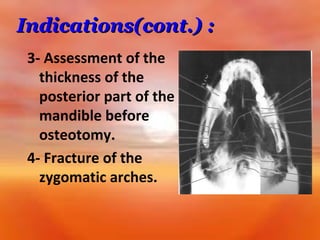
Indications(cont.) :
3- Assessment of the
thickness of the
posterior part of the
mandible before
osteotomy.
4- Fracture of the
zygomatic arches.
The End

Extra-oral Radiology Techniques I

  • 1.
    EXTRA ORAL Radiographic TECHNIQUESPART I By Dr. Hassan M. Abouelkheir BDS, MSC, PHD.
  • 2.
    Extra oral Radiography: •All extra oral radiographic projections should be performed using screen film. • Medium or high speed (rare-earth) screenfilm combination are recommended to reduce pt’s exposure. • Metallic letters (L) &(R) are used to determine left & right sides of pt as well as grids to reduce the fog.
  • 3.
  • 4.
    Intensifying Screen Function One of the properties of x-rays is that they cause certain materials to fluoresce (emit light); the phosphor crystals found in intensifying screens are one of these materials. The light emission is usually green or blue, depending on the type of phosphor crystal used.
  • 5.
    Intensifying Screen Function The composition of the films used with these screens is adjusted by the manufacturer to be sensitive to either blue light or green light.  correct film should be used with corresponding screen type. (Bluesensitive film with blue lightemitting screen, etc.)
  • 6.
    Screen Film • Screenfilm is sensitive to the effects of light from an intensifying screen. When these screens, on either side of the film in a cassette, are exposed to x-rays, they emit light which in turn exposes the film. • Using the screen-film combination allows a very large reduction in the amount of radiation needed to expose the film (30-60 times less radiation than that required by direct exposure film).
  • 7.
    Intensifying Screen Composition (thisside toward film) The base of the screen (yellow line above) is made of above plastic and provides support. A reflecting layer (silver line) reflects light emitted by the phosphor line back toward the film. The phosphor layer (green line) line contains the phosphor crystals that emit the light. The surface of the phosphor layer is covered with a protecting coat (white line) , which is a thin layer of plastic that protects the phosphor layer from damage when the screens are handled.
  • 8.
    Rare Earth Phosphor Themost common type of phosphors being used are the rare earth phosphors, which emit blue or green light depending on the type of rare earth material being used. film = phosphor crystal
  • 9.
    Intensifying Screen Speed Thespeed of the screen depends on crystal size and the thickness of the phosphor layer (larger crystals and thicker layer increase speed). Image quality decreases as the screen speed increases. The three speeds are: • Fast (Rapid): requires the least exposure but the images are less sharp • Medium (Par): medium speed, medium sharpness • Detail (Slow): produces the sharpest images but requires the most exposure
  • 10.
    Screen Film The twotypes of screen film used with rare earth screens are T-Mat and Ektavision. These films are available in three styles: G, which is used to provide the best contrast; L, which has the widest latitude (long-scale contrast) and is good for soft tissue visualization and H, which is used to provide an extra film for referral purposes (two films are placed in the cassette at the same time). The advantage of Ektavision film over T-Mat film is that it has anti-crossover layers incorporated into the film. This prevents light from one screen affecting both emulsion layers; this produces a sharper image on the film.
  • 11.
    T-Mat (crossover) Light producedby the phosphor crystal spreads out as it goes toward the film and with T-Mat film it affects the emulsion on both sides. Since it has spread out more when it reaches the emulsion on the opposite side of the film (crossover), the crossover sharpness (edge detail) of the image is decreased. film
  • 12.
    Ektavision (anti-crossover) Ektavision filmhas a crossover control layer on each side of the film base. These layers allow the light from a phosphor crystal to reach the emulsion on the same side as the crystal but prevent the light from reaching the emulsion on the opposite side of the film. X-rays easily pass through this anticrossover layer. film
  • 13.
    Types of Extra-OralRadiographic Examination: • 1- Mandibular oblique lateral (Ramus, Body). • 2- True Lateral (Cephalometric). • 3-Submento-Vertex view. • 4- Water’s projection (Occipito-Mental). • 5- Postero-Anterior projection. • 6- Reverse Town’s projection.
  • 14.
    1] Lateral obliqueprojection: • 2 views for mandibular projection; • a) body projection: • For demonstration premolar-molar region and inferior border of the body of the mandible. • Head position: Head tilted to the side to be examined with the mandible protruded.
  • 15.
    Lateral oblique projectionbody (cont.): • Film placement: • Film is placed against the patient’s cheek and centered over the first molar . • The lower border of the cassette should be parallel to the inferior border of the mandible and at least 2cm below it. • Point of entry: • 2cm below angle of the mandible directed toward the 1st molar region of cassette side.
  • 16.
  • 17.
    B) Mandibular Ramusprojection: • To view the ramus from the mandibular angle to the condyle for examining the 3rd molar region of both the maxilla and mandible. • Head position: head tilted towards the projected mandible where the mandibular angle of tube side and condyle of cassette side parallel to the floor.
  • 18.
    Mandibular ramus projection(cont.): • Film placement : • film is placed over the ramus of the mandible to the far posterior to include the condyle. Lower border of the cassette 2cm below the inferior border of the mandible. • Point of entry: • 2cm below the inferior border of the first molar region on the tube side toward the center of the ramus of the cassette side.
  • 19.
  • 20.
    2- True Lateral(Cephalometric): Cephalo=Head • Metric=Measurement. Cephalometrics introduced for use by orthodontists by Dr. Broadbent in 1931 for studying dento -facial growth.
  • 21.
    True Lateral (Cephalometric)(cont.): • Uses: • • • • • • Evaluation of facial growth & development. Le Fort I & II fractures. Posterior wall of antera. Perforation of hard palate. A foreign body in the air way. The film: is positioned parallel to the sagittal plane of the film. • The central ray :is ┴ the film in both horizontal & vertical plane.
  • 22.
    True Lateral (Cephalometric)(cont.): • Reproducibility: • Cephalometric has the unique property of presenting a reproducible image, unlike any other radiographic technique used for dental films
  • 23.
    True Lateral (Cephalometric)(cont.): • Reproducibility: • The patients head is oriented in the same position relative to the xray beam every time a film is taken, with the use of positioning ear posts
  • 24.
    True Lateral (Cephalometric)(cont.): The distance from the x-ray source to the patient’s midsagittal plane is always the same 60 inches to reduce the magnification.
  • 25.
    • Soft tissueprofile can be added by using reducing the exposure to 50% or put aluminum filter in the front of cassette.
  • 26.
    Uses in orthodontics: •Evaluate skeletal patterns (bone-to-bone relations) • Does the patient have a Class I, Class II or Class III skeletal pattern? • Is the problem due to a prognathic maxilla, a retrognathic maxilla, a prognathic mandible, a retrognathic mandible or a combination of these?
  • 27.
    Cephalometric Landmarks • Landmarksare locations which represent biological homology between image locations • Example: The tip of the chin in one cephalometric image corresponds to the tip of the chin in another cephalometric image
  • 28.
    Cephalometric Landmarks • Landmarksneed to have 3 properties: 1.Landmarks should not remodel over time (neither be created nor destroyed) 2.Landmarks need to capture biological form, including the shape, size and position of the tissue component of which it represents 3.Landmarks have to be reliably located on cephalometric radiographs
  • 29.
    Common landmarks • SellaTurcica (S): • midpoint of the pituitary fossa. • Orbitale (O): lowest point on lower margin of orbit
  • 30.
    Orthodontic tracing • Tothe fixed anatomical points is applied to assess the nature and extent of any malocclusion which may be present. • Tracing of anatomical landmarks should be drown with sharp , hard (6H) pencil on good quality tracing paper or acetate drafting sheet not on the film and done on film viewer.
  • 31.
    Main areas ofconcern: - Skeletal relationships. - Dento-skeletal relationships. - The facial profile. Radiographs can be digitized and measured in personal computer with special software or cephalometric tracer attached to computer can be used.
  • 32.
    4-Submentovertex (SMV) view: •The projection shows the base of the skull, Sphenoidal sinuses and facial skeleton from below(radiographic baseline is vertical). • The pt’s head tipped backwards and x-ray beam is aimed upwards at 5° to the horizontal.
  • 33.
    Submentovertex Identify location ofcondyles Image zygomatic arch fracture MSP FP extraoral x-ray unit floor floor
  • 34.
    4-Submentovertex (SMV) view: •Film placement: cassette ± floor and placed vertically. • Head position: tipped backward & touch the cassette .Frankfort plane ± floor. • Beam alignment: • center to the head and ± cassette.
  • 35.
  • 36.
    Zygomatic Arch View Reduceexposure to 1/3 SV setting
  • 37.
    Indications: 1- Destructive lesions affectingthe palate, pterygoid region or base of the skull. 2- Investigations of sphenoidal sinuses.
  • 38.
    Indications(cont.) : 3- Assessmentof the thickness of the posterior part of the mandible before osteotomy. 4- Fracture of the zygomatic arches.
  • 39.