ORTHOPANTOMOGRAM
S.SHIFAYA NASRIN
FINAL YEAR BDS
54094033
CONTENTS
 Introduction
 Principles of panoramic imaging
 Image layer
 Panoramic machines
 Panoramic film
 Patient positioning
 Interpreting the panoramic imaging
i. The mandible
ii. Midfacial region
iii.Soft tissues
iv.Dentition
 Indication
 Advantages
 Disadvantages
 Conclusion
 References
INTRODUCTION
Panoramic imaging also called pantomography is a technique for producing a single tomographic
image of facial structures that includes both the maxillary and mandibular dental arches and their
supporting structures .
This is a curvilinear variant of conventional tomography.
PRINCIPLES OF PANORAMIC IMAGE FORMATION
Patero and Numata was first to describe the principles of panoramic radiography
It is based on the principle of reciprocal movement of x-ray source and an image receptor around
a central point or plane called the image layer, in which the object of image is located. Object in
front or behind this image are not clearly captured because of their movement relative to the
centre of rotation of the receptor and the x-ray source.
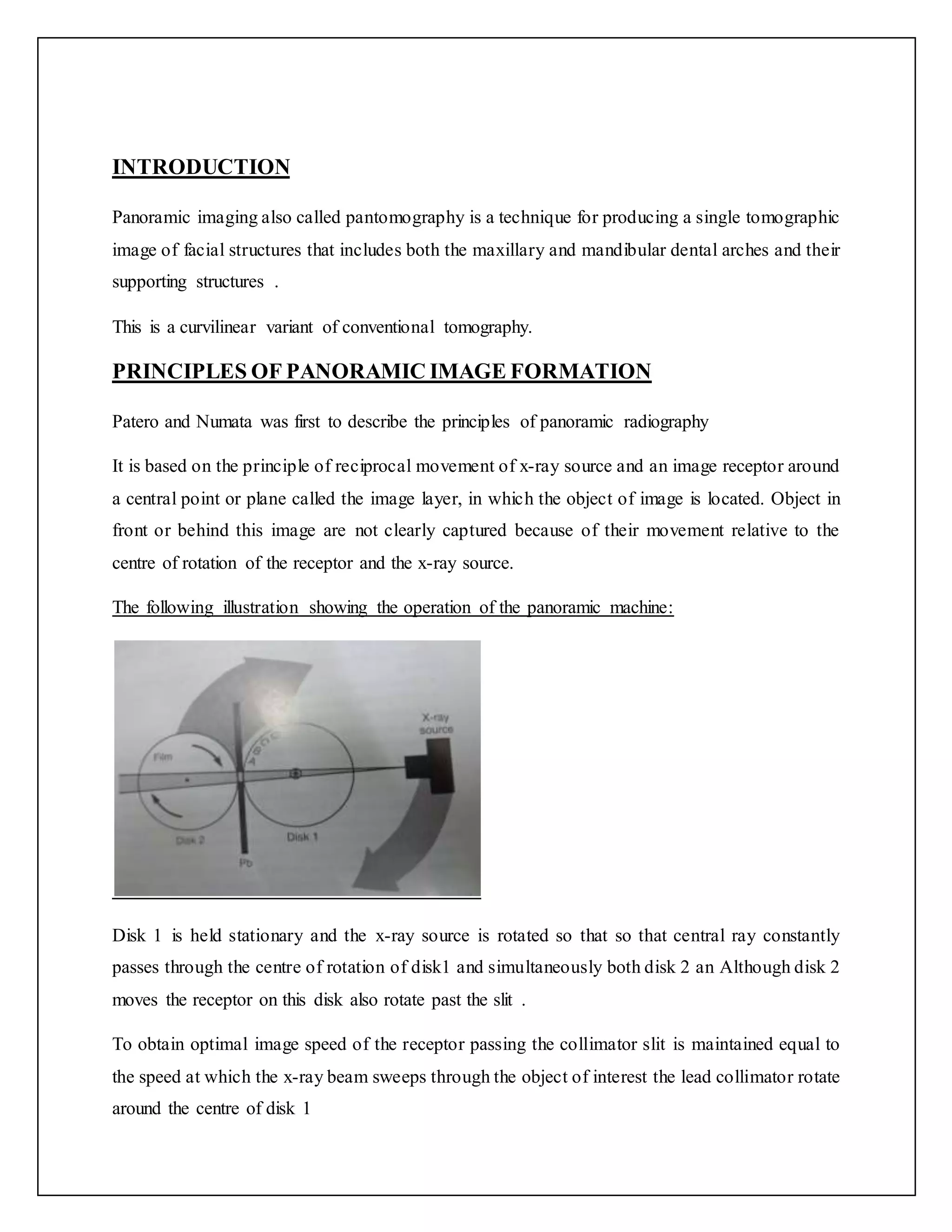
The following illustration showing the operation of the panoramic machine:
Disk 1 is held stationary and the x-ray source is rotated so that so that central ray constantly
passes through the centre of rotation of disk1 and simultaneously both disk 2 an Although disk 2
moves the receptor on this disk also rotate past the slit .
To obtain optimal image speed of the receptor passing the collimator slit is maintained equal to
the speed at which the x-ray beam sweeps through the object of interest the lead collimator rotate
around the centre of disk 1
A patient may replace disk 1 and that object A through D represent teeth and surrounding bone.
Structures on the opposite side of the patient are distorted and appear out of focus.
Structures near the x-ray source are so magnified.
Rotationcenter
The pivotal point or axis around which the cassette carrier and tube head rotate is termed rotation
center
Three basic rotation center used in panoramic radiography
 Double centre rotation
 Triple centre rotation
 moving centre rotation
The location and number of rotational centers influence size and shape of focal trough
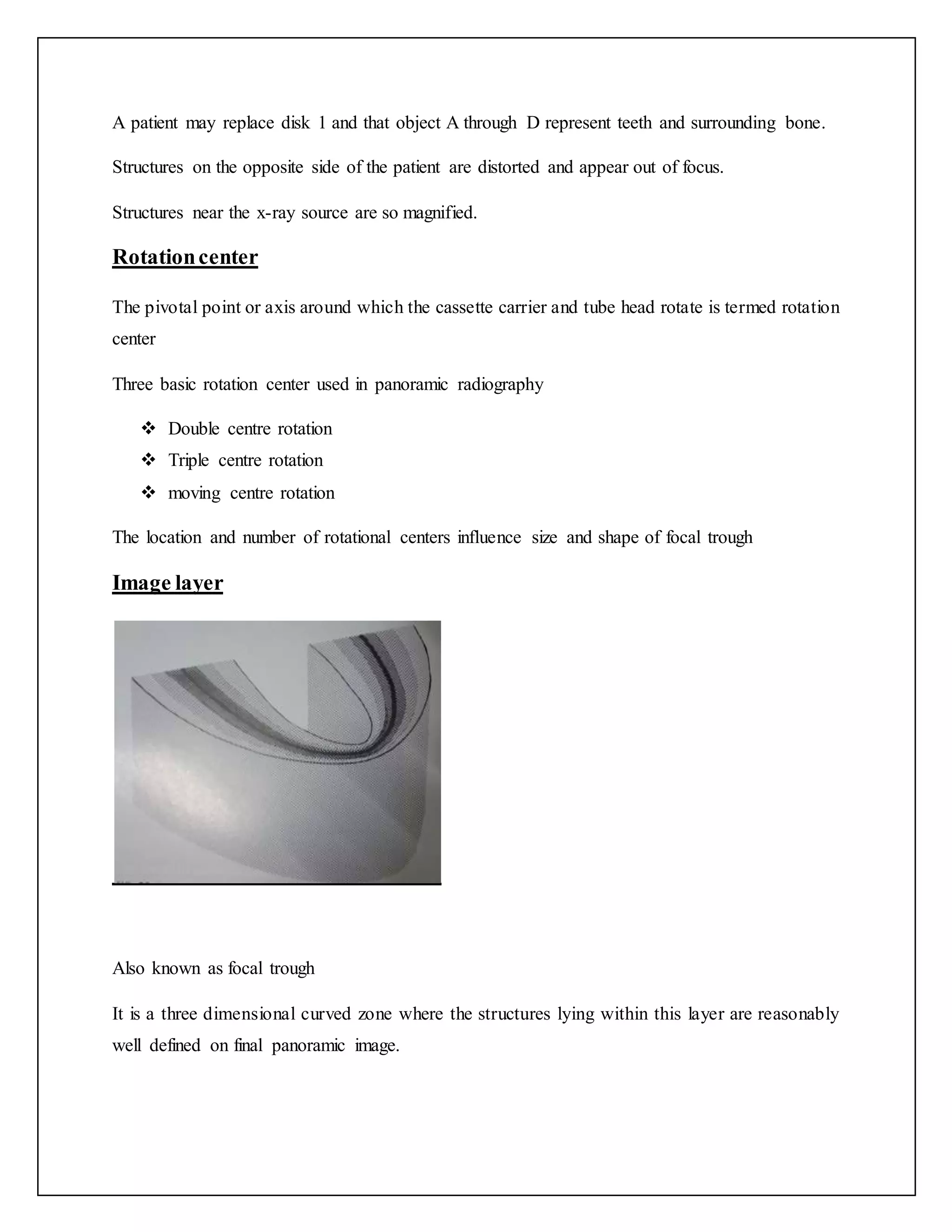
Image layer
Also known as focal trough
It is a three dimensional curved zone where the structures lying within this layer are reasonably
well defined on final panoramic image.
The structures seen on a panoramic image are primarily those located within image layer.
Objects outside the image layer are blurred magnified are reduced in size. Even distorted to the
extent of not being recognizable. This shape of image layer varies with the brand of equipment
used.
Factors affecting size of image layer:
 Arc path
 Velocity of receptor and X-ray tube head
 Alignment of x-ray beam
 Collimator width
 The location of image layer change with extensive machine used so recalibration may be
necessary if consistently suboptimal images are produced.
 As a position of object is moved within the image layer size and shape of image layer
change.
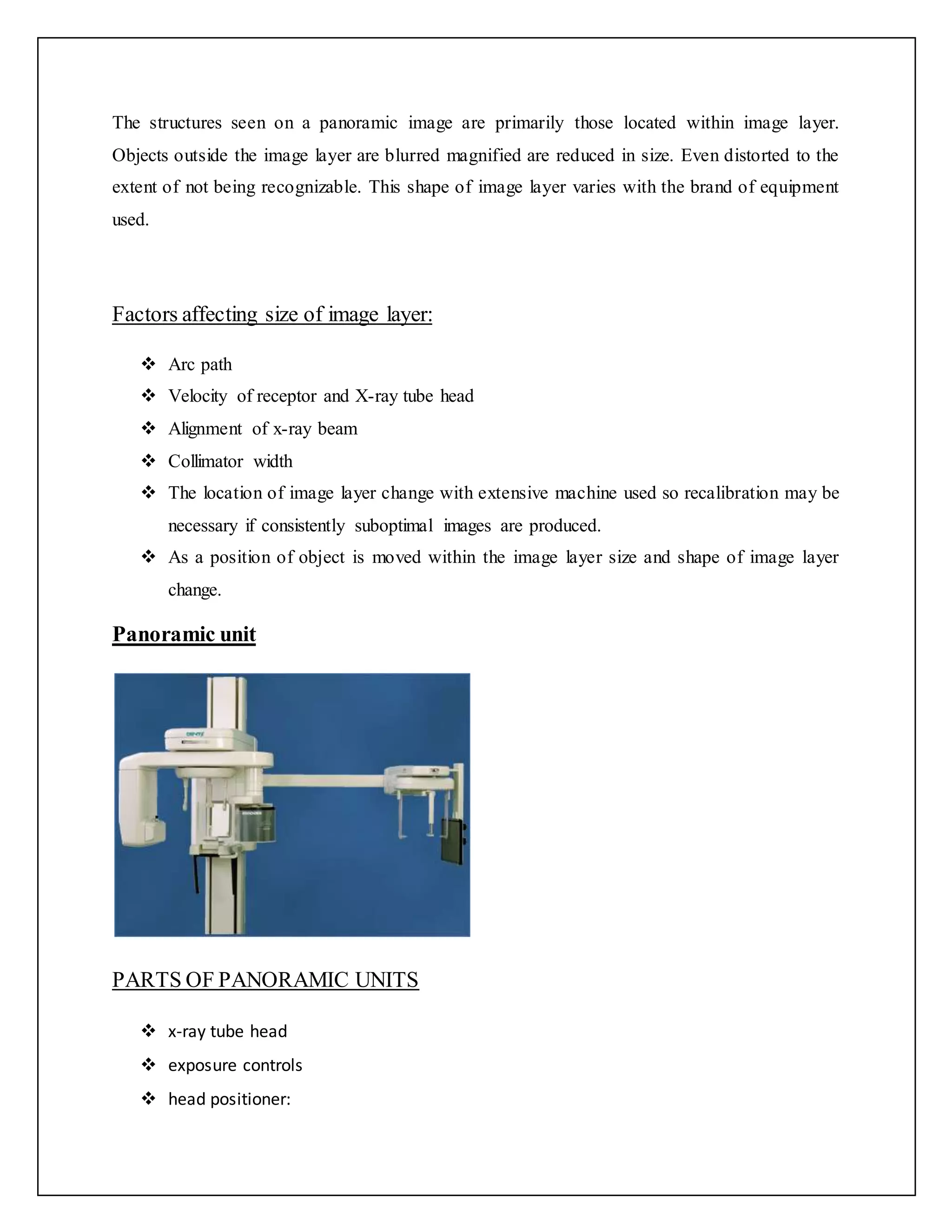
Panoramic unit
PARTS OF PANORAMIC UNITS
 x-ray tube head
 exposure controls
 head positioner:
 chin rest
 notched bite block
 forehead rest
 lateral head support
x-ray tube head:
Similar to intraoral x-ray tube head
Each has a filament to produce electrons and a target to produce x-rays
Collimator is a lead plate with narrow vertical slit
Narrow x-ray beam emerges from collimator minimize patient exposure to radiation
Tube head is fixed in position and rotates behind the patient head
Film positioner is used to align the patients teeth accurately in focal trough
Exposure parameter
 Power Supply 230V 50 Hz.
 Kvp 50-90 KVp
 Tube Current 10mA
 Focal Spot 0.5mm X 0.5mm
 Target Angle 5 Degree
 Total Filtration
2.8 mm Al
 Focus Distance 51cm
 Exposure Time 19 sec
 Film Size 15 X 30 cm
 Weight Supply Approx. 220 Kg.
Panoramic film
Screen film is used available in two sizes:
 5x12 inch
 6x12 inch
Placed between two intensifying screen in a cassette holder
Sensitive to light emitted from intensifying screens
When exposed to x-ray, screen convert x-ray energy into light
Intensifying screens
Two types
 Calcium tungstate –emit blue light
 Rare earth –emit green light, less x-ray exposure
Cassette
 It is a device used to hold the extra oral film and intensifying screens
 Light tight to protect the film from exposure
Two types
 Rigid
 Flexible
Patient positioning and head alignment
 Dental appliance earrings ,necklace,hairpins,and any other metallic objects should be
removed
 Instruct the patient to stand as tall as possible with back straight and stand erect .Vertical
column must be straight
 Instruct the patient to bite on the plastic bite block tooth must be positioned in edge to
edge position in the groove present in the bite block it is used to align the teeth in the
focal trough
 Midsagittal plane perpendicular to floor
 Frankfort horizontal plane parallel to the floor
 Tongue must be positioned on the roof of the mouth
 Instruct the patient to remain still while machine is rotating
Interpreting panoramic image
The mandible
1. Condylar process and TMJ: a bony rounded radioopaque projection extending from
ramus of mandible
2. Coronoid process: triangular radio opacity posterior to tuberosity region
3. Ramus: shadow of other structure may superimposed over the ramus such as
 Pharyngeal airway shadow
 Posterior wall of pharynx
 Cervical vertebra
 Ear lobe
 Nasal cartilage
 Soft palate and uvula
 Dorsum of tongue
 Ghost shadow
4. Body and angle : radiopaque bony structure where the ramus join the body of the
mandible
5. Anterior sextant mandibular dentition and alveolus
Midfacialregion
 Individual bones such as
1. Temporal
2. zygoma
3. mandible
4. frontal
5. Maxilla
6. Sphenoid
7. Ethmoid
8. Vomer
1. articular tubercle 8.anterior nasal spine
2. zygomatic arch 9.floor of maxillary sinus
3. zygomatic process of maxilla 10.developing third molar
4. pterygomaxillary fissure 11.ear lobe
5. orbital rim 12.cervical vertebra
6. inferior nasal choncha
7. nasal septum
8. 7
9. nasal septun
9. Nasal
10. Palate
 Cortical boundary of maxilla including posterior border and alveolar ridge
 Pterygomaxillary fissure : radiolucent area between the lateral pterygoid plate and
maxilla
 Maxillary sinuses: paired radiolucencies located above the apices of premolars and
molars
 Zygomatic complex or buttresses of midface: includeslateral and inferior orbital rims
zygomatic process of maxilla zygomatic arch
 Nasal cavity and conchae: radiolucent area above the maxillary incissors
 TMJ
 Maxillary dentition and alveolus
Soft tissues
 Tongue under the hard palate: radiopaque area superimposed over the maxillary posterior
teeth
 Lip line: seen in the region of anterior teeth
 Soft palate: extending posteriorly from hard palate
 Posterior wall of pharynx
 Nasal septum
 Ear lobes
 Nose and nasolabial fold
Dentition
Teeth and supporting alveolar bone are evaluated
Teeth examined for
 Gross anomalies of number ,position, and anatomy
 Impacted third molars
 Endodontic obturations, crowns, fixed restoration
Indication
 To evaluate impacted teeth
 To evaluate eruption patterns, growth and development
 To detect diseases ,lesions and conditions of the jaw
 To examine extent of large lesions
 To evaluate trauma periodontal bone loss and periapical involvement.
 Finding the source of dental pain
 Assessment for the placement of dental implants
 Orthodontic assessment. pre and post operative
 Caries detection especially in the inter-dental region.
 Diagnosis of developmental anomalies such as Cherubism, Cleido cranial dysplasia
 Carcinoma in relation to the jaws
 Tempero mandibular joint dysfunctions and ankylosis
Advantages
 Broad coverage of facial bones and teeth
 Low patient radiation dose
 Convenience of the examination of the patient
 Use in patients unable to open their mouth
 Short time required
 In patient education and case presentation
Disadvantage
 Image quality are not sharp
 Focal trough limitations
 Distortion
 Expensive equipment cost
Conclusion
As OPG has several advantages in the field of dentistry and its inevitable role in diagnosis every
dentist should know about it.
Compared with the conventional radiographic technique involving atleast 16 intraoral exposures
OPG has several advantage it takes fairly easy; takes one minute and shows entire oral cavity in
one minute however resulting image produce less detail than IOPA
References
 Freny R.Karjodkar :Text book of Dental and maxillofacial radiology 2nd edition page
number :236-255
 Laura Jansen ,Joen M.Ianucci Harring :Dental radiography Principles and techniques of
Oral radiology: 3rd edition page number:305-319
 white and pharaoh : Oral radiology principles and interpretation 6th edition; page
number: 175-189
Orthopantomogram
Orthopantomogram

Orthopantomogram

  • 1.
  • 2.
    CONTENTS  Introduction  Principlesof panoramic imaging  Image layer  Panoramic machines  Panoramic film  Patient positioning  Interpreting the panoramic imaging i. The mandible ii. Midfacial region iii.Soft tissues iv.Dentition  Indication  Advantages  Disadvantages  Conclusion  References
  • 3.
    INTRODUCTION Panoramic imaging alsocalled pantomography is a technique for producing a single tomographic image of facial structures that includes both the maxillary and mandibular dental arches and their supporting structures . This is a curvilinear variant of conventional tomography. PRINCIPLES OF PANORAMIC IMAGE FORMATION Patero and Numata was first to describe the principles of panoramic radiography It is based on the principle of reciprocal movement of x-ray source and an image receptor around a central point or plane called the image layer, in which the object of image is located. Object in front or behind this image are not clearly captured because of their movement relative to the centre of rotation of the receptor and the x-ray source. The following illustration showing the operation of the panoramic machine: Disk 1 is held stationary and the x-ray source is rotated so that so that central ray constantly passes through the centre of rotation of disk1 and simultaneously both disk 2 an Although disk 2 moves the receptor on this disk also rotate past the slit . To obtain optimal image speed of the receptor passing the collimator slit is maintained equal to the speed at which the x-ray beam sweeps through the object of interest the lead collimator rotate around the centre of disk 1
  • 4.
    A patient mayreplace disk 1 and that object A through D represent teeth and surrounding bone. Structures on the opposite side of the patient are distorted and appear out of focus. Structures near the x-ray source are so magnified. Rotationcenter The pivotal point or axis around which the cassette carrier and tube head rotate is termed rotation center Three basic rotation center used in panoramic radiography  Double centre rotation  Triple centre rotation  moving centre rotation The location and number of rotational centers influence size and shape of focal trough Image layer Also known as focal trough It is a three dimensional curved zone where the structures lying within this layer are reasonably well defined on final panoramic image.
  • 5.
    The structures seenon a panoramic image are primarily those located within image layer. Objects outside the image layer are blurred magnified are reduced in size. Even distorted to the extent of not being recognizable. This shape of image layer varies with the brand of equipment used. Factors affecting size of image layer:  Arc path  Velocity of receptor and X-ray tube head  Alignment of x-ray beam  Collimator width  The location of image layer change with extensive machine used so recalibration may be necessary if consistently suboptimal images are produced.  As a position of object is moved within the image layer size and shape of image layer change. Panoramic unit PARTS OF PANORAMIC UNITS  x-ray tube head  exposure controls  head positioner:
  • 6.
     chin rest notched bite block  forehead rest  lateral head support x-ray tube head: Similar to intraoral x-ray tube head Each has a filament to produce electrons and a target to produce x-rays Collimator is a lead plate with narrow vertical slit Narrow x-ray beam emerges from collimator minimize patient exposure to radiation Tube head is fixed in position and rotates behind the patient head Film positioner is used to align the patients teeth accurately in focal trough Exposure parameter  Power Supply 230V 50 Hz.  Kvp 50-90 KVp  Tube Current 10mA  Focal Spot 0.5mm X 0.5mm  Target Angle 5 Degree  Total Filtration 2.8 mm Al  Focus Distance 51cm  Exposure Time 19 sec  Film Size 15 X 30 cm  Weight Supply Approx. 220 Kg.
  • 7.
    Panoramic film Screen filmis used available in two sizes:  5x12 inch  6x12 inch Placed between two intensifying screen in a cassette holder Sensitive to light emitted from intensifying screens When exposed to x-ray, screen convert x-ray energy into light Intensifying screens Two types  Calcium tungstate –emit blue light  Rare earth –emit green light, less x-ray exposure Cassette  It is a device used to hold the extra oral film and intensifying screens  Light tight to protect the film from exposure Two types  Rigid  Flexible
  • 8.
    Patient positioning andhead alignment  Dental appliance earrings ,necklace,hairpins,and any other metallic objects should be removed  Instruct the patient to stand as tall as possible with back straight and stand erect .Vertical column must be straight  Instruct the patient to bite on the plastic bite block tooth must be positioned in edge to edge position in the groove present in the bite block it is used to align the teeth in the focal trough  Midsagittal plane perpendicular to floor  Frankfort horizontal plane parallel to the floor  Tongue must be positioned on the roof of the mouth  Instruct the patient to remain still while machine is rotating
  • 9.
    Interpreting panoramic image Themandible 1. Condylar process and TMJ: a bony rounded radioopaque projection extending from ramus of mandible 2. Coronoid process: triangular radio opacity posterior to tuberosity region 3. Ramus: shadow of other structure may superimposed over the ramus such as  Pharyngeal airway shadow  Posterior wall of pharynx  Cervical vertebra  Ear lobe  Nasal cartilage  Soft palate and uvula  Dorsum of tongue  Ghost shadow 4. Body and angle : radiopaque bony structure where the ramus join the body of the mandible 5. Anterior sextant mandibular dentition and alveolus
  • 10.
    Midfacialregion  Individual bonessuch as 1. Temporal 2. zygoma 3. mandible 4. frontal 5. Maxilla 6. Sphenoid 7. Ethmoid 8. Vomer 1. articular tubercle 8.anterior nasal spine 2. zygomatic arch 9.floor of maxillary sinus 3. zygomatic process of maxilla 10.developing third molar 4. pterygomaxillary fissure 11.ear lobe 5. orbital rim 12.cervical vertebra 6. inferior nasal choncha 7. nasal septum 8. 7 9. nasal septun
  • 11.
    9. Nasal 10. Palate Cortical boundary of maxilla including posterior border and alveolar ridge  Pterygomaxillary fissure : radiolucent area between the lateral pterygoid plate and maxilla  Maxillary sinuses: paired radiolucencies located above the apices of premolars and molars  Zygomatic complex or buttresses of midface: includeslateral and inferior orbital rims zygomatic process of maxilla zygomatic arch  Nasal cavity and conchae: radiolucent area above the maxillary incissors  TMJ  Maxillary dentition and alveolus
  • 12.
    Soft tissues  Tongueunder the hard palate: radiopaque area superimposed over the maxillary posterior teeth  Lip line: seen in the region of anterior teeth  Soft palate: extending posteriorly from hard palate  Posterior wall of pharynx  Nasal septum  Ear lobes  Nose and nasolabial fold
  • 13.
    Dentition Teeth and supportingalveolar bone are evaluated Teeth examined for  Gross anomalies of number ,position, and anatomy  Impacted third molars  Endodontic obturations, crowns, fixed restoration Indication  To evaluate impacted teeth  To evaluate eruption patterns, growth and development  To detect diseases ,lesions and conditions of the jaw  To examine extent of large lesions  To evaluate trauma periodontal bone loss and periapical involvement.  Finding the source of dental pain  Assessment for the placement of dental implants  Orthodontic assessment. pre and post operative  Caries detection especially in the inter-dental region.  Diagnosis of developmental anomalies such as Cherubism, Cleido cranial dysplasia  Carcinoma in relation to the jaws  Tempero mandibular joint dysfunctions and ankylosis Advantages  Broad coverage of facial bones and teeth  Low patient radiation dose  Convenience of the examination of the patient  Use in patients unable to open their mouth  Short time required  In patient education and case presentation
  • 14.
    Disadvantage  Image qualityare not sharp  Focal trough limitations  Distortion  Expensive equipment cost Conclusion As OPG has several advantages in the field of dentistry and its inevitable role in diagnosis every dentist should know about it. Compared with the conventional radiographic technique involving atleast 16 intraoral exposures OPG has several advantage it takes fairly easy; takes one minute and shows entire oral cavity in one minute however resulting image produce less detail than IOPA
  • 15.
    References  Freny R.Karjodkar:Text book of Dental and maxillofacial radiology 2nd edition page number :236-255  Laura Jansen ,Joen M.Ianucci Harring :Dental radiography Principles and techniques of Oral radiology: 3rd edition page number:305-319  white and pharaoh : Oral radiology principles and interpretation 6th edition; page number: 175-189