ORTHOPANTOMAGRAM
CONTENTS
 Introduction
 Principle
 Equipment
 Patient Positioning
DENTAL PANORAMIC TOMOGRAPH (DPT) OR
PANORAMIC RADIOGRAPH
 A technique for producing a single tomographic image of the facial
structures that includes both the maxillary and mandibular dental
arches and their supporting structures
4
PAN – WIDE
TOMO- SLICE
GRAPHY – TO WRITE
5
Panoramic radiography also known as,
Pantomography
Rotational panoramic Radiography
6
To produce the required elliptical, horseshoe-shaped focal trough, panoramic
tomographic equipment employs the principle of narrow-beam rotational
tomography and uses two or more centres of rotation.
PRINCIPLES OF PANORAMIC IMAGE FORMATION
7
Conventional tomography is a specialized radiographic technique developed
originally for producing radiographs that showed only a section or slice of a patient.
CONVENTIONAL TOMOGRAPHY
8
A technique that enables the patient to be imaged in slices – like a loaf of sliced
bread
9
 Each individual tomographic image (or slice) shows the tissues within that section
sharply defined and in focus. The section is thus referred to as the focal plane or
focal trough.
 Tissues and structures outside the tomographic section are not visible because
they are very blurred and out of focus.
10
TOMOGRAPHIC THEORY
The theory of tomographic movement and three methods for producing linear and curved
tomographic slices include:
1. Linear tomography using a wide or broad X-ray beam
2. Linear tomography using a narrow or slit X-ray Beam
3. Rotational curved tomography using a narrow slit X-ray beam.
11
• The synchronized movement of the tube
head and film, in the vertical plane,
results in a straight linear focal trough.
• The broad x-ray beam exposes the entire
film throughout the exposure.
12
SLIT OR NARROW-BEAM LINEAR TOMOGRAPHY
• The equipment is designed so that the narrow beam traverses the film.
• Only by the end of the tomographic movement has the entire film been exposed.
• The film cassette has to be placed behind a protective metal shield with narrow
opening is required to allow a small part of the film to be exposed to the X-ray
beam at any one instant.
• The tomographic movement is produced by the
synchronized movement of the X-ray tubehead and the
cassette carrier, in the vertical plane.
• The film, placed behind the metal protective front of the
cassette carrier, also moves during the exposure, in the
same direction as the X-ray tubehead.
• The narrow X-ray beam traverses the patient and film,
exposing a different part of the film throughout the cycle.
NARROW-BEAM ROTATIONAL TOMOGRAPHY
In this type of tomography:
narrow-beam equipment is used, but the synchronized movement of the X-ray tube
head and the cassette carrier are designed to rotate in the horizontal plane, in a
circular path around the head, with a single centre of rotation. The resultant focal
trough is curved and forms the arc of a circle.
15
* The tomographic movement is by the circular synchronized
movement of the X-ray tubehead in one direction and the
cassette carrier in the opposite direction, in horizontal plane.
* The equipment has a single centre of rotation.
* The film also moves inside the cassette carrier so that a
different part of the film is exposed to the narrow beam during
the cycle, thus by the end the entire film has been exposed.
* The focal plane or trough (shaded) is curved and forms the arc
of a circle. 16
PRINCIPLE OF TOMOGRAPHIC MOVEMENT
18
Important points to note
● The X-ray tubehead orbits around the back of the head while the cassette
carrier with the film orbits around the front of the face.
● The X-ray tubehead and the cassette carrier appear to move in opposite
directions to one another.
19
● The film moves in the same direction as the X-ray tubehead, behind the
protective metal shield of the cassette carrier.
● A different part of the film is exposed to the X-ray beam at any one instant, as
the equipment orbits the head.
● The simple circular rotational movement with a single centre of rotation
produces a curved circular focal trough.
20
TYPES OF TOMOGRAPHIC MOVEMENT
֎ Linear
֎ Elliptical
֎ Circular
֎ Spiral
֎ Hypocycloidal
By varying the size of the X-ray beam and the type of equipment movement employed
it proved possible to change the shape of the tomographic layer from a straight (linear)
line to a curve, and ultimately to the approximate horseshoe shape of the dental arch,
providing an overall panoramic image of all the teeth and their supporting structures .
22
The several dental panoramic units available work on the same principle but differ in how the
rotational movement is modified to image the elliptical dental arch.
Four main methods have been used including:
● Two stationary centres of rotation, using two separate circular arcs
● Three stationary centres of rotation, using three separate circular arcs
● A continually moving centre of rotation using multiple circular arcs combined to form a final
elliptical shape
● A combination of three stationary centres of rotation and a moving centre of rotation.
23
ROTATION CENTRE
• The film and tube head are connected and rotate simultaneously around a patient
during exposure.
• The axis around which the film and x-ray tube rotate is termed as center of rotation.
• Arches are not true arcs.
• Several centers of rotation are necessary to maintain the dental arches in the focal
trough as the machine turns around the patient.
Movement of the film and x-ray source about one fixed center of rotation.
25
* This technique used the stationary rotation center of the
beam, placed at one side of the jaws.
* The rotation center is then shifted symmetrically by
moving the patient.
* This projection technique produced the split image.
SINGLE ROTATION CENTRE
Movement of the film and objects ( A, B, C, and D ) about two fixed centers of rotation
27
* The individual left and right sides of the arc
formed by the teeth and jaws closely form a part of
a circle.
* The center of rotation was positioned anteriorly to
the location of the third molar opposite the side
being examined.
DOUBLE CENTER OF ROTATION
THREE CENTER ROTATION
This system divided the arc of jaws into three areas:
1. A condyle to first premolar posterior segment
2. A canine to canine anterior segment
3. A contralateral opposite segment
These three curved segments have three different centers
1. Two are bilaterally situated slightly posterior
2. Lateral to the third molars
3. In the midline posterior to the incisors.
The x-ray beam can be shifted from one
center to the other without any interruption
and a continuous image can be made from
condyle to condyle.
CONTINUALLY MOVING CENTER OF ROTATION
31
33
IMAGE LAYER
* The image layer is a three-dimensional curved zone, or “ focal trough, ” where the
structures lying within this layer are reasonably well defined on final panoramic image.
* The structures seen on a panoramic image are primarily those located within the image
layer.
* Objects outside the image layer are blurred, magnified, or reduced in size and are
sometimes distorted to the extent of not being recognizable
34
Objects
closest to
film will be
narrowed
Objects
closest or
toward the
source will
be widened
Buccal
objects
projected
lower
Lingual
objects
projected
higher
Objects in the
center of the
layer are
magnified
20-30%
35
IMAGES OF STRUCTURES SHARPEST WITHIN FOCAL TROUGH
A different part of the focal trough is imaged throughout the
exposure.
The final radiograph is thus built up of sections , each created
separately, as the equipment orbits around the patient’s head.
37
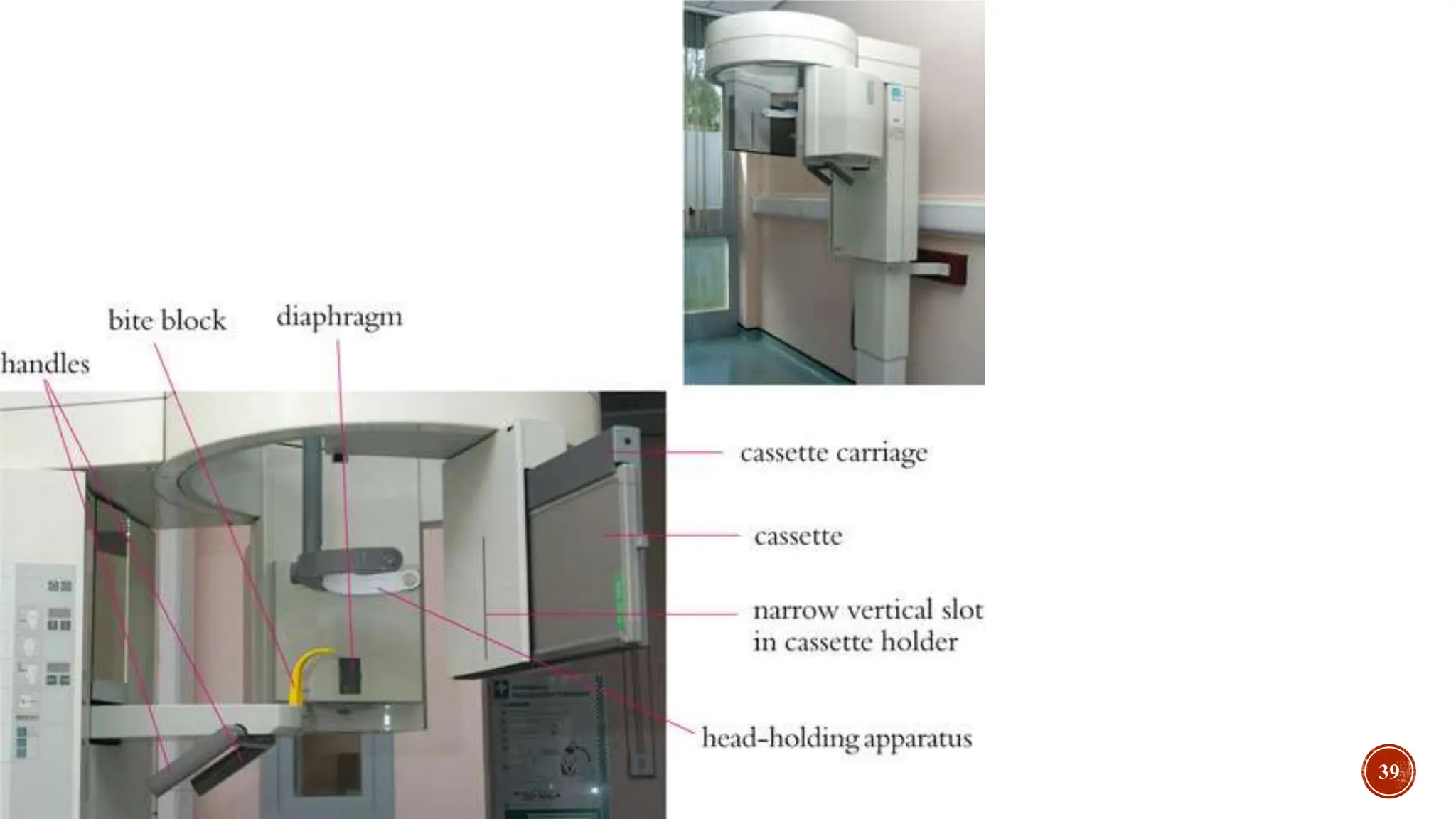
 X ray tube head
 Head positioner
 Exposure controls
 Screen film
 Intensifying screens
 Cassette
38
39
• Similar to intraoral x-ray tube head
• The panoramic tube head always rotates behind the patients head as the film
rotates in front of the patient
• Vertical angulation: fixed
40
• Collimator used is a lead plate with an opening in the shape of vertical narrow slit
• Restrict the size & shape of the x-ray beam - reduce exposure to the patient.
• Fits directly over the opening of metal housing where the x rays exit.
• Restrict size and shape of x ray beam – reduce exposure to the patient
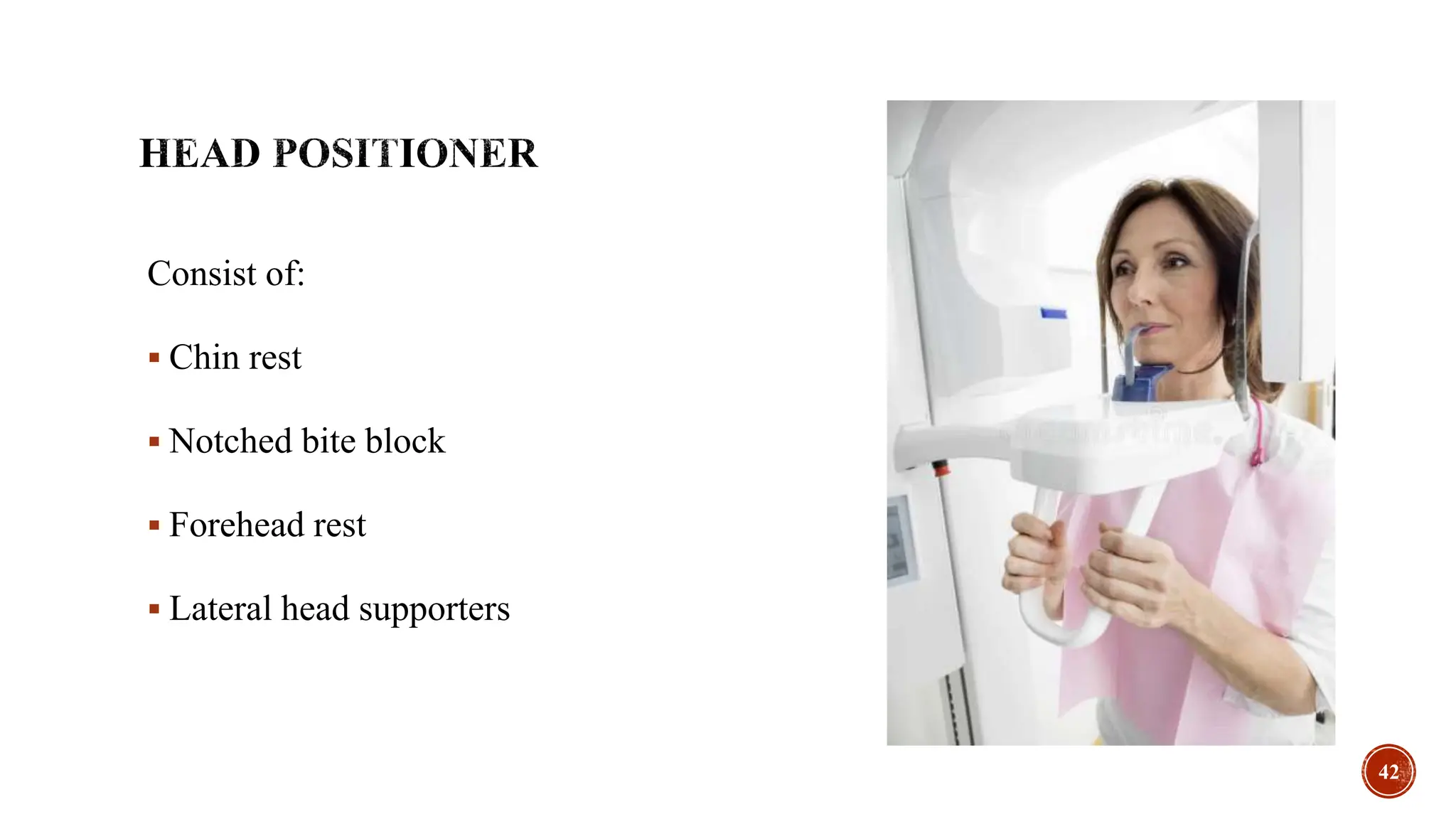
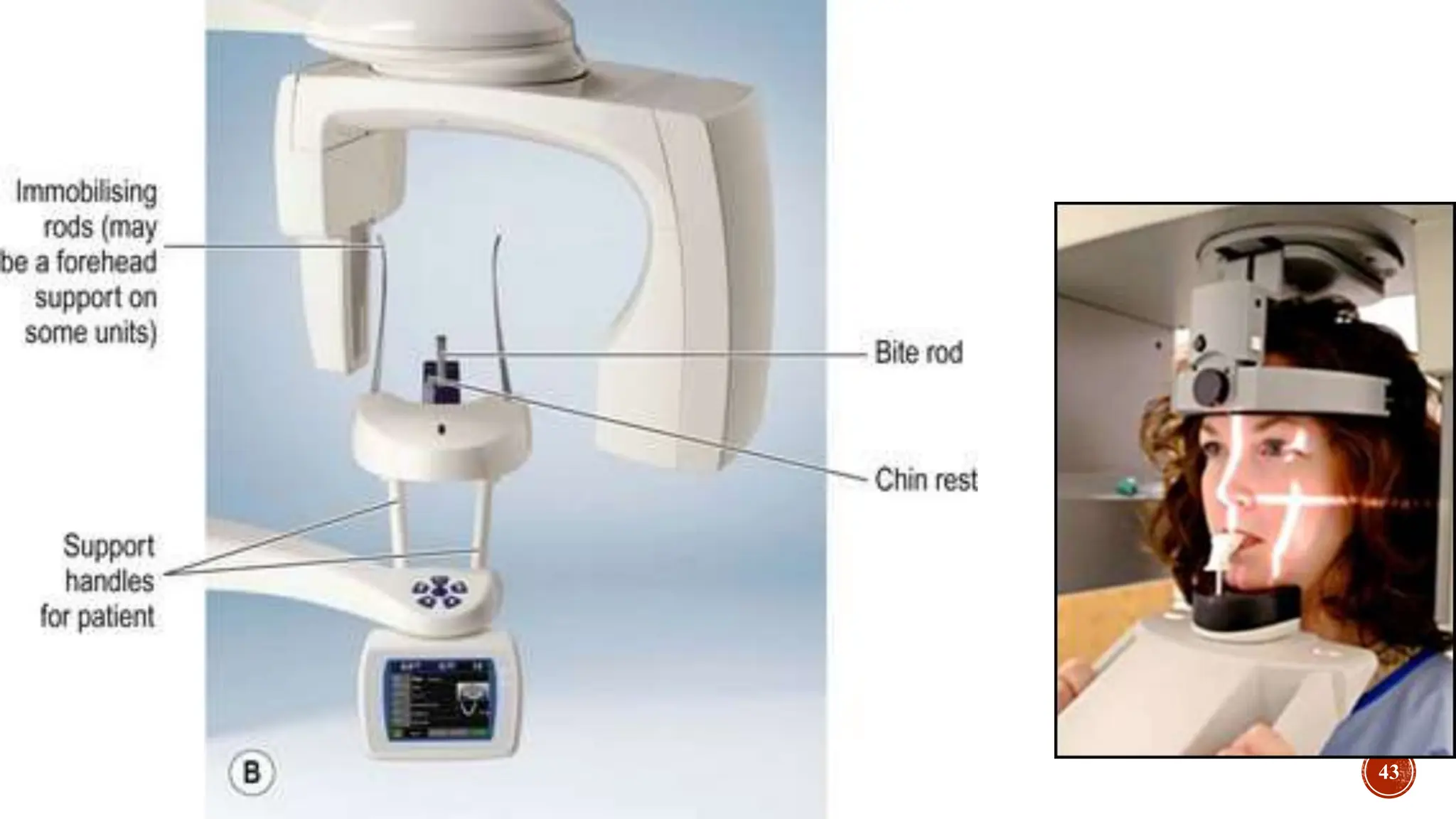
Consist of:
 Chin rest
 Notched bite block
 Forehead rest
 Lateral head supporters
42
43
 Milliamperage and kilovoltage are adjustable
 Exposure time is fixed and cannot be changed
44
 kV76 mA :15 Time :15 sec
 kV 80 mA :15 Time: 15 sec
45
 Films that are placed outside the mouth during x ray exposure.
 Used to examine large areas of skull and jaws
 Two types:
• Non screen films
• Screen films
46
Extra oral films are boxed in quantities of 50 or 100 films
Some manufacturers separate each piece of film with protective paper
Boxes of extraoral film are labelled with:
 Type of film
 Film size
 Total number of films enclosed
 Expiration date
High contrast medium speed films – used for panoramic and skull radiography
47
 Used without intensifying screens
 The emulsion is sensitive to direct x ray exposure rather than fluorescent light
 Slower – require longer exposure time – but image obtained is much sharper.
 These films not recommended for dental use
48
 These films are used in combination with intensifying screens, that
emit visible light
 Screens placed in the film cassette on either side of the film and are
held under pressure in a rigid manner – so fluorescent layers of the
screen and the emulsion of the film are pressed together closely.
 When cassette is exposed to x rays – screens convert x ray energy
into light -> exposes the screen film
 Screen film is sensitive to fluorescent light rather than direct x ray 49
Sizes: 5x12 inches
6x12 inches
2 types :
Screen film –sensitive to light emitted from intensifying screens.
Green light sensitive
Blue light sensitive
Green light sensitive
 Kodak ortho & T-Mat films
 Two or more times faster and provide sufficient clarity for most diagnostic tasks.
 These films have tubular shaped silver halide grains
 Green sensitizing dyes are also added to increase the light gathering capability
and to reduce the cross over of light from phosphorus layer of one side to other
side. 51
Blue light sensitive
Kodak X-Omat & Ektamat films
52
 Device that transfers X ray energy into visible light Visible light inturn
exposes the screen film
 These screens intensify the effect of x rays on film – less radiation is required to
expose a screen film ( less exposure to patient)
 An intensifying screen is a smooth plastic sheet coated with minute fluorescent
crystals – known as phosphorus
53
Two types
• Calcium tungstate,lanthanum oxybromide: emits blue light (faster)
• Terbium, Activated Gadolinium Oxysulphide: emits green light
 It holds the Extra-oral film and intensifying film.
 It must be light –tight to protect the film from exposure.
 It may be-rigid or flexible, curved or straight
 Book like container consisting of two aluminium or bakelite leaves which open and close
on hinges.
 Cassette is loaded and unloaded in the darkroom
 A metal letter L or R is attached to the front cover of cassette – indicates Rt and Lt side. 55
56
• These transmits an electric signal to the controlling computer,which displays the image
on computer screen.
• Post processing modifications on the image - linear contrast and density adjustments,
black/white reversal, magnification, edge enhancement and color rendering.
• Software used – dicom(digital imaging and communication in medicine)
57
TECHNIQUE AND POSITIONING
Patient preparation
● Patients should be asked to remove any earrings, jewellery, hair pins,
spectacles, dentures or orthodontic appliances.
● The procedure and equipment movements should be explained, to reassure
patients and if necessary use a test exposure to show them the machine’s
movements.
Patient positioning
● The patient should be positioned in the unit so that their spine is straight and instructed to
hold any stabilizing supports or handles provided.
● The patient should be instructed to bite their upper and lower incisors edge-to-edge on the
bite-peg with their chin in good contact with the chin support.
● The head should be immobilized using the temple supports.
● The light beam markers should be used so that the mid-sagittal plane is vertical, the
Frankfort plane is horizontal and the canine light lies between the upper lateral incisor and
canine.
● The patient should be instructed to close their lips and press their tongue on the roof of
their mouth so that it is in contact with their hard palate and not to move throughout the
exposure cycle (approximately 15–18 seconds).
EDENTULOUS PATIENT POSITIONING
The chin support is used instead of the bite-peg and the canine positioning light beam is
centered on the corner of the mouth.
CLINICAL INDICATIONS
1. As a substitute for full mouth intraoral periapical radiographs.
2. For evaluation of tooth development for children, the mixed dentition and also the aged.
3. To assist and assess the patient for and during orthodontic treatment.
4. To establish the site and size of lesions such as cysts, tumors and developmental anomalies in
the body and rami of the mandible.
5. Prior to any surgical procedures such as extraction of impacted teeth, enucleation of a cyst, etc.
6. For detection of fractures of the middle third face and the mandible after facial trauma.
62
63
7. For follow-up of treatment, progress of pathology or postoperative bony healing.
8. Investigation of TM joint dysfunction.
9. To study the antrum, especially to study the floor, posterior and anterior walls of the
antrum.
10. Periodontal disease—as an overall view of the alveolar bone levels.
11. Assessment for underlying bone disease before constructing complete or partial dentures.
12. Evaluation of developmental anomalies.
13. Evaluation of the vertical height of the alveolar bone before inserting osseointegrated
implants.
64
ADVANTAGES
1. Simple procedure requiring very little patient compliance.
2. Convenient for the patient.
3. Useful in patients with trismus and gagging problems.
4. Time required is minimal compared to a full mouth intraoral periapical radiographs.
5. That portion of the maxilla and the mandible lying within the focal trough can be
visualized on a single film.
6. The patient dose is relatively low.
65
7. Panoramic radiographs taken for diagnostic purpose are valuable visual aid in patient
education.
8. A broad anatomic region is imaged.
9. The anatomical structures are most identifiable and the teeth are oriented in their
correct relationship to the adjacent structures and to each other.
10. It allows for the assessment of the presence and position of unerupted teeth in
orthodontic treatment.
66
11. It demonstrates periodontal disease in a general way. Manifesting a generalized bone
loss.
12. All the parameters are standardized and repetitive images can be taken, on recall visits for
comparative and research purposes.
13. Useful for mass screening.
14. This view helps in localization of objects/ pathology in conjunction with a topographic
view or an intraoral periapical radiograph.
15. The radiation dose (effective dose equivalent) of app. 0.08 mSv is about one-third of the
dose from a full mouth survey of intraoral films.
67
Disadvantages or Limitations
1. Areas of diagnostic interest outside the focal trough may be poorly visualized, e.g. swelling
on the palate, floor of the mouth.
2. Comparatively this radiograph is of a poor diagnostic quality, in terms of magnification,
geometric distortion, poor definition and loss of detail.
3. There is an overlapping of the teeth in the bicuspid area of the maxilla and the mandible.
4. In cases of pronounced inclination, the anterior teeth are poorly registered.
5. The density of the spine, especially in short necked people can cause lack of clarity in the
central portion of the film.
68
6. Number of radiopaque and radiolucent areas may be present due to the superimposition of
real/double or ghost images and because of soft tissue shadows and air spaces.
7. Due to prescribed rotation, patient with facial asymmetry or patients who do not conform to
the rotation curvature, cannot be X-rayed with any degree of satisfaction.
8. If the patient positioning is improper, the amount of vertical and horizontal distortion will
var from one part of the film to another part of the
film.
9. The ease and convenience of obtaining an OPG may encourage careless evaluation of a
patient’s specific radiographic needs.
69
10. Artifacts are easily misinterpreted and are more commonly seen, e.g. nose ring as a
periapical radiopaque lesion, earring as a calcification in the maxillary sinus.
11. OPG shows an oblique, rather than true lateral view of the condylar heads and hence,
the joint space cannot be accurately assessed.
12. Some patients donot conform to the shape of the focal trough and some structures
will be out of focus.
13. The cost of the machine is very high.
a seminar on panoramic radiography- first part.pptx

a seminar on panoramic radiography- first part.pptx

  • 2.
  • 3.
    CONTENTS  Introduction  Principle Equipment  Patient Positioning
  • 4.
    DENTAL PANORAMIC TOMOGRAPH(DPT) OR PANORAMIC RADIOGRAPH  A technique for producing a single tomographic image of the facial structures that includes both the maxillary and mandibular dental arches and their supporting structures 4
  • 5.
    PAN – WIDE TOMO-SLICE GRAPHY – TO WRITE 5
  • 6.
    Panoramic radiography alsoknown as, Pantomography Rotational panoramic Radiography 6
  • 7.
    To produce therequired elliptical, horseshoe-shaped focal trough, panoramic tomographic equipment employs the principle of narrow-beam rotational tomography and uses two or more centres of rotation. PRINCIPLES OF PANORAMIC IMAGE FORMATION 7
  • 8.
    Conventional tomography isa specialized radiographic technique developed originally for producing radiographs that showed only a section or slice of a patient. CONVENTIONAL TOMOGRAPHY 8
  • 9.
    A technique thatenables the patient to be imaged in slices – like a loaf of sliced bread 9
  • 10.
     Each individualtomographic image (or slice) shows the tissues within that section sharply defined and in focus. The section is thus referred to as the focal plane or focal trough.  Tissues and structures outside the tomographic section are not visible because they are very blurred and out of focus. 10
  • 11.
    TOMOGRAPHIC THEORY The theoryof tomographic movement and three methods for producing linear and curved tomographic slices include: 1. Linear tomography using a wide or broad X-ray beam 2. Linear tomography using a narrow or slit X-ray Beam 3. Rotational curved tomography using a narrow slit X-ray beam. 11
  • 12.
    • The synchronizedmovement of the tube head and film, in the vertical plane, results in a straight linear focal trough. • The broad x-ray beam exposes the entire film throughout the exposure. 12
  • 13.
    SLIT OR NARROW-BEAMLINEAR TOMOGRAPHY • The equipment is designed so that the narrow beam traverses the film. • Only by the end of the tomographic movement has the entire film been exposed. • The film cassette has to be placed behind a protective metal shield with narrow opening is required to allow a small part of the film to be exposed to the X-ray beam at any one instant.
  • 14.
    • The tomographicmovement is produced by the synchronized movement of the X-ray tubehead and the cassette carrier, in the vertical plane. • The film, placed behind the metal protective front of the cassette carrier, also moves during the exposure, in the same direction as the X-ray tubehead. • The narrow X-ray beam traverses the patient and film, exposing a different part of the film throughout the cycle.
  • 15.
    NARROW-BEAM ROTATIONAL TOMOGRAPHY Inthis type of tomography: narrow-beam equipment is used, but the synchronized movement of the X-ray tube head and the cassette carrier are designed to rotate in the horizontal plane, in a circular path around the head, with a single centre of rotation. The resultant focal trough is curved and forms the arc of a circle. 15
  • 16.
    * The tomographicmovement is by the circular synchronized movement of the X-ray tubehead in one direction and the cassette carrier in the opposite direction, in horizontal plane. * The equipment has a single centre of rotation. * The film also moves inside the cassette carrier so that a different part of the film is exposed to the narrow beam during the cycle, thus by the end the entire film has been exposed. * The focal plane or trough (shaded) is curved and forms the arc of a circle. 16
  • 18.
  • 19.
    Important points tonote ● The X-ray tubehead orbits around the back of the head while the cassette carrier with the film orbits around the front of the face. ● The X-ray tubehead and the cassette carrier appear to move in opposite directions to one another. 19
  • 20.
    ● The filmmoves in the same direction as the X-ray tubehead, behind the protective metal shield of the cassette carrier. ● A different part of the film is exposed to the X-ray beam at any one instant, as the equipment orbits the head. ● The simple circular rotational movement with a single centre of rotation produces a curved circular focal trough. 20
  • 21.
    TYPES OF TOMOGRAPHICMOVEMENT ֎ Linear ֎ Elliptical ֎ Circular ֎ Spiral ֎ Hypocycloidal
  • 22.
    By varying thesize of the X-ray beam and the type of equipment movement employed it proved possible to change the shape of the tomographic layer from a straight (linear) line to a curve, and ultimately to the approximate horseshoe shape of the dental arch, providing an overall panoramic image of all the teeth and their supporting structures . 22
  • 23.
    The several dentalpanoramic units available work on the same principle but differ in how the rotational movement is modified to image the elliptical dental arch. Four main methods have been used including: ● Two stationary centres of rotation, using two separate circular arcs ● Three stationary centres of rotation, using three separate circular arcs ● A continually moving centre of rotation using multiple circular arcs combined to form a final elliptical shape ● A combination of three stationary centres of rotation and a moving centre of rotation. 23
  • 24.
    ROTATION CENTRE • Thefilm and tube head are connected and rotate simultaneously around a patient during exposure. • The axis around which the film and x-ray tube rotate is termed as center of rotation. • Arches are not true arcs. • Several centers of rotation are necessary to maintain the dental arches in the focal trough as the machine turns around the patient.
  • 25.
    Movement of thefilm and x-ray source about one fixed center of rotation. 25
  • 26.
    * This techniqueused the stationary rotation center of the beam, placed at one side of the jaws. * The rotation center is then shifted symmetrically by moving the patient. * This projection technique produced the split image. SINGLE ROTATION CENTRE
  • 27.
    Movement of thefilm and objects ( A, B, C, and D ) about two fixed centers of rotation 27
  • 28.
    * The individualleft and right sides of the arc formed by the teeth and jaws closely form a part of a circle. * The center of rotation was positioned anteriorly to the location of the third molar opposite the side being examined. DOUBLE CENTER OF ROTATION
  • 29.
    THREE CENTER ROTATION Thissystem divided the arc of jaws into three areas: 1. A condyle to first premolar posterior segment 2. A canine to canine anterior segment 3. A contralateral opposite segment These three curved segments have three different centers 1. Two are bilaterally situated slightly posterior 2. Lateral to the third molars 3. In the midline posterior to the incisors.
  • 30.
    The x-ray beamcan be shifted from one center to the other without any interruption and a continuous image can be made from condyle to condyle.
  • 31.
  • 33.
  • 34.
    IMAGE LAYER * Theimage layer is a three-dimensional curved zone, or “ focal trough, ” where the structures lying within this layer are reasonably well defined on final panoramic image. * The structures seen on a panoramic image are primarily those located within the image layer. * Objects outside the image layer are blurred, magnified, or reduced in size and are sometimes distorted to the extent of not being recognizable 34
  • 35.
    Objects closest to film willbe narrowed Objects closest or toward the source will be widened Buccal objects projected lower Lingual objects projected higher Objects in the center of the layer are magnified 20-30% 35
  • 36.
    IMAGES OF STRUCTURESSHARPEST WITHIN FOCAL TROUGH
  • 37.
    A different partof the focal trough is imaged throughout the exposure. The final radiograph is thus built up of sections , each created separately, as the equipment orbits around the patient’s head. 37
  • 38.
     X raytube head  Head positioner  Exposure controls  Screen film  Intensifying screens  Cassette 38
  • 39.
  • 40.
    • Similar tointraoral x-ray tube head • The panoramic tube head always rotates behind the patients head as the film rotates in front of the patient • Vertical angulation: fixed 40
  • 41.
    • Collimator usedis a lead plate with an opening in the shape of vertical narrow slit • Restrict the size & shape of the x-ray beam - reduce exposure to the patient. • Fits directly over the opening of metal housing where the x rays exit. • Restrict size and shape of x ray beam – reduce exposure to the patient
  • 42.
    Consist of:  Chinrest  Notched bite block  Forehead rest  Lateral head supporters 42
  • 43.
  • 44.
     Milliamperage andkilovoltage are adjustable  Exposure time is fixed and cannot be changed 44
  • 45.
     kV76 mA:15 Time :15 sec  kV 80 mA :15 Time: 15 sec 45
  • 46.
     Films thatare placed outside the mouth during x ray exposure.  Used to examine large areas of skull and jaws  Two types: • Non screen films • Screen films 46
  • 47.
    Extra oral filmsare boxed in quantities of 50 or 100 films Some manufacturers separate each piece of film with protective paper Boxes of extraoral film are labelled with:  Type of film  Film size  Total number of films enclosed  Expiration date High contrast medium speed films – used for panoramic and skull radiography 47
  • 48.
     Used withoutintensifying screens  The emulsion is sensitive to direct x ray exposure rather than fluorescent light  Slower – require longer exposure time – but image obtained is much sharper.  These films not recommended for dental use 48
  • 49.
     These filmsare used in combination with intensifying screens, that emit visible light  Screens placed in the film cassette on either side of the film and are held under pressure in a rigid manner – so fluorescent layers of the screen and the emulsion of the film are pressed together closely.  When cassette is exposed to x rays – screens convert x ray energy into light -> exposes the screen film  Screen film is sensitive to fluorescent light rather than direct x ray 49
  • 50.
    Sizes: 5x12 inches 6x12inches 2 types : Screen film –sensitive to light emitted from intensifying screens. Green light sensitive Blue light sensitive
  • 51.
    Green light sensitive Kodak ortho & T-Mat films  Two or more times faster and provide sufficient clarity for most diagnostic tasks.  These films have tubular shaped silver halide grains  Green sensitizing dyes are also added to increase the light gathering capability and to reduce the cross over of light from phosphorus layer of one side to other side. 51
  • 52.
    Blue light sensitive KodakX-Omat & Ektamat films 52
  • 53.
     Device thattransfers X ray energy into visible light Visible light inturn exposes the screen film  These screens intensify the effect of x rays on film – less radiation is required to expose a screen film ( less exposure to patient)  An intensifying screen is a smooth plastic sheet coated with minute fluorescent crystals – known as phosphorus 53
  • 54.
    Two types • Calciumtungstate,lanthanum oxybromide: emits blue light (faster) • Terbium, Activated Gadolinium Oxysulphide: emits green light
  • 55.
     It holdsthe Extra-oral film and intensifying film.  It must be light –tight to protect the film from exposure.  It may be-rigid or flexible, curved or straight  Book like container consisting of two aluminium or bakelite leaves which open and close on hinges.  Cassette is loaded and unloaded in the darkroom  A metal letter L or R is attached to the front cover of cassette – indicates Rt and Lt side. 55
  • 56.
  • 57.
    • These transmitsan electric signal to the controlling computer,which displays the image on computer screen. • Post processing modifications on the image - linear contrast and density adjustments, black/white reversal, magnification, edge enhancement and color rendering. • Software used – dicom(digital imaging and communication in medicine) 57
  • 58.
    TECHNIQUE AND POSITIONING Patientpreparation ● Patients should be asked to remove any earrings, jewellery, hair pins, spectacles, dentures or orthodontic appliances. ● The procedure and equipment movements should be explained, to reassure patients and if necessary use a test exposure to show them the machine’s movements.
  • 59.
    Patient positioning ● Thepatient should be positioned in the unit so that their spine is straight and instructed to hold any stabilizing supports or handles provided. ● The patient should be instructed to bite their upper and lower incisors edge-to-edge on the bite-peg with their chin in good contact with the chin support. ● The head should be immobilized using the temple supports.
  • 60.
    ● The lightbeam markers should be used so that the mid-sagittal plane is vertical, the Frankfort plane is horizontal and the canine light lies between the upper lateral incisor and canine. ● The patient should be instructed to close their lips and press their tongue on the roof of their mouth so that it is in contact with their hard palate and not to move throughout the exposure cycle (approximately 15–18 seconds).
  • 61.
    EDENTULOUS PATIENT POSITIONING Thechin support is used instead of the bite-peg and the canine positioning light beam is centered on the corner of the mouth.
  • 62.
    CLINICAL INDICATIONS 1. Asa substitute for full mouth intraoral periapical radiographs. 2. For evaluation of tooth development for children, the mixed dentition and also the aged. 3. To assist and assess the patient for and during orthodontic treatment. 4. To establish the site and size of lesions such as cysts, tumors and developmental anomalies in the body and rami of the mandible. 5. Prior to any surgical procedures such as extraction of impacted teeth, enucleation of a cyst, etc. 6. For detection of fractures of the middle third face and the mandible after facial trauma. 62
  • 63.
    63 7. For follow-upof treatment, progress of pathology or postoperative bony healing. 8. Investigation of TM joint dysfunction. 9. To study the antrum, especially to study the floor, posterior and anterior walls of the antrum. 10. Periodontal disease—as an overall view of the alveolar bone levels. 11. Assessment for underlying bone disease before constructing complete or partial dentures. 12. Evaluation of developmental anomalies. 13. Evaluation of the vertical height of the alveolar bone before inserting osseointegrated implants.
  • 64.
    64 ADVANTAGES 1. Simple procedurerequiring very little patient compliance. 2. Convenient for the patient. 3. Useful in patients with trismus and gagging problems. 4. Time required is minimal compared to a full mouth intraoral periapical radiographs. 5. That portion of the maxilla and the mandible lying within the focal trough can be visualized on a single film. 6. The patient dose is relatively low.
  • 65.
    65 7. Panoramic radiographstaken for diagnostic purpose are valuable visual aid in patient education. 8. A broad anatomic region is imaged. 9. The anatomical structures are most identifiable and the teeth are oriented in their correct relationship to the adjacent structures and to each other. 10. It allows for the assessment of the presence and position of unerupted teeth in orthodontic treatment.
  • 66.
    66 11. It demonstratesperiodontal disease in a general way. Manifesting a generalized bone loss. 12. All the parameters are standardized and repetitive images can be taken, on recall visits for comparative and research purposes. 13. Useful for mass screening. 14. This view helps in localization of objects/ pathology in conjunction with a topographic view or an intraoral periapical radiograph. 15. The radiation dose (effective dose equivalent) of app. 0.08 mSv is about one-third of the dose from a full mouth survey of intraoral films.
  • 67.
    67 Disadvantages or Limitations 1.Areas of diagnostic interest outside the focal trough may be poorly visualized, e.g. swelling on the palate, floor of the mouth. 2. Comparatively this radiograph is of a poor diagnostic quality, in terms of magnification, geometric distortion, poor definition and loss of detail. 3. There is an overlapping of the teeth in the bicuspid area of the maxilla and the mandible. 4. In cases of pronounced inclination, the anterior teeth are poorly registered. 5. The density of the spine, especially in short necked people can cause lack of clarity in the central portion of the film.
  • 68.
    68 6. Number ofradiopaque and radiolucent areas may be present due to the superimposition of real/double or ghost images and because of soft tissue shadows and air spaces. 7. Due to prescribed rotation, patient with facial asymmetry or patients who do not conform to the rotation curvature, cannot be X-rayed with any degree of satisfaction. 8. If the patient positioning is improper, the amount of vertical and horizontal distortion will var from one part of the film to another part of the film. 9. The ease and convenience of obtaining an OPG may encourage careless evaluation of a patient’s specific radiographic needs.
  • 69.
    69 10. Artifacts areeasily misinterpreted and are more commonly seen, e.g. nose ring as a periapical radiopaque lesion, earring as a calcification in the maxillary sinus. 11. OPG shows an oblique, rather than true lateral view of the condylar heads and hence, the joint space cannot be accurately assessed. 12. Some patients donot conform to the shape of the focal trough and some structures will be out of focus. 13. The cost of the machine is very high.

Editor's Notes

  • #13 Diagram showing the theory of broad-beam linear tomography to produce a vertical coronal section with the synchronized movement of the X-ray tubehead and the film in the vertical plane. the broad X-ray beam exposes the entire film throughout the exposure
  • #19 The X-ray tubehead moves in one direction while the film moves in the opposite direction. Points A, B, C, D, E and F will all appear on different parts of the film and thus will be blurred out, while point O, the centre of rotation, will appear in the same place on the film throughout the exposure and will therefore be sharply defined.
  • #26 if disk 1 is held stationary and the x-ray source is rotated so that the central ray constantly passes through the center of rotation of disk 1 and, simultaneously, both disk 2 and the lead collimator (Pb) rotate around the center of disk 1. Note that, although disk 2 moves, the receptor on this disk also rotates past the slit. In this situation, as before, the objects A through D move through the x-ray beam in the same direction and at the same rate as the receptor. To obtain optimal image definition, it is crucial that the speed of the receptor passing the collimator slit (Pb) be maintained equal to the speed at which the x-ray beam sweeps through the objects of interest.
  • #28 Two adjacent disks are rotating at the same speed in opposite directions as an x-ray beam passes through their centers of rotation Lead collimators in the shape of a slit, located at the x-ray source and at the image receptor, limit the central ray to a narrow vertical beam. Radiopaque objects A, B, C, and D stand upright on disk 1 and rotate past the slit. Their images are recorded on the receptor, which also moves past the slit at the same time. The objects are displayed sharply on the receptor because they are moving past the slit at the same rate and in the same direction as the receptor. This causes their moving shadows to appear stationary in relation to the moving receptor. Other objects between the letters and the center of rotation of disk 1 rotate with a slower velocity and are blurred on the receptor. Any objects between the x-ray source and the center of rotation of disk 1 move in the opposite direction of the receptor, and their shadows are also blurred on the receptor.
  • #32 continually moving center of rotation. This feature optimizes the shape of the image layer to reveal the teeth and supporting bone. This center of rotation is initially near the lingual surface of the right body of the mandible when the left TMJ is imaged. The rotation center moves forward along an arc that ends just lingual to the symphysis of the mandible when the midline is imaged. The arc is reversed as the opposite side of the face is imaged.
  • #34 the relative movements of the X-ray tubehead, carriage assembly and image receptor (film or phosphor plate) during the first half of the panoramic cycle when the left side of the jaw is imaged. As the X-ray tubehead moves behind the patient’s head to image the anterior teeth, the carriage assembly moves in front of the patient’s face and the centre of rotation moves forward along the dark arc (arrowed) towards the midline. Note that the X-ray beam has to pass through the cervical spine. the relative movements during the second half of the panoramic cycle when the right side of the jaw is imaged. The X-ray tubehead and carriage assembly continue to move around the patient’s head to image the opposite side, and the centre of rotation moves backwards along the dark arc (arrowed) a way from the midline. Throughout the cycle the film or phosphor plate is also continuously moving as illustrated, so that a different part of the image receptor is exposed at any one time.
  • #50 Extra oral film equipment includes film,cassette,inten. Screen
  • #52 495–570 nm
  • #53 Blue light has shorter waves, with wavelengths between about 450 and 495 nanometers.
  • #54 2 types – blue light sensitive, green light sensitive
  • #56 Rigid cassette More expensive, lasts longer Protects screens from damage