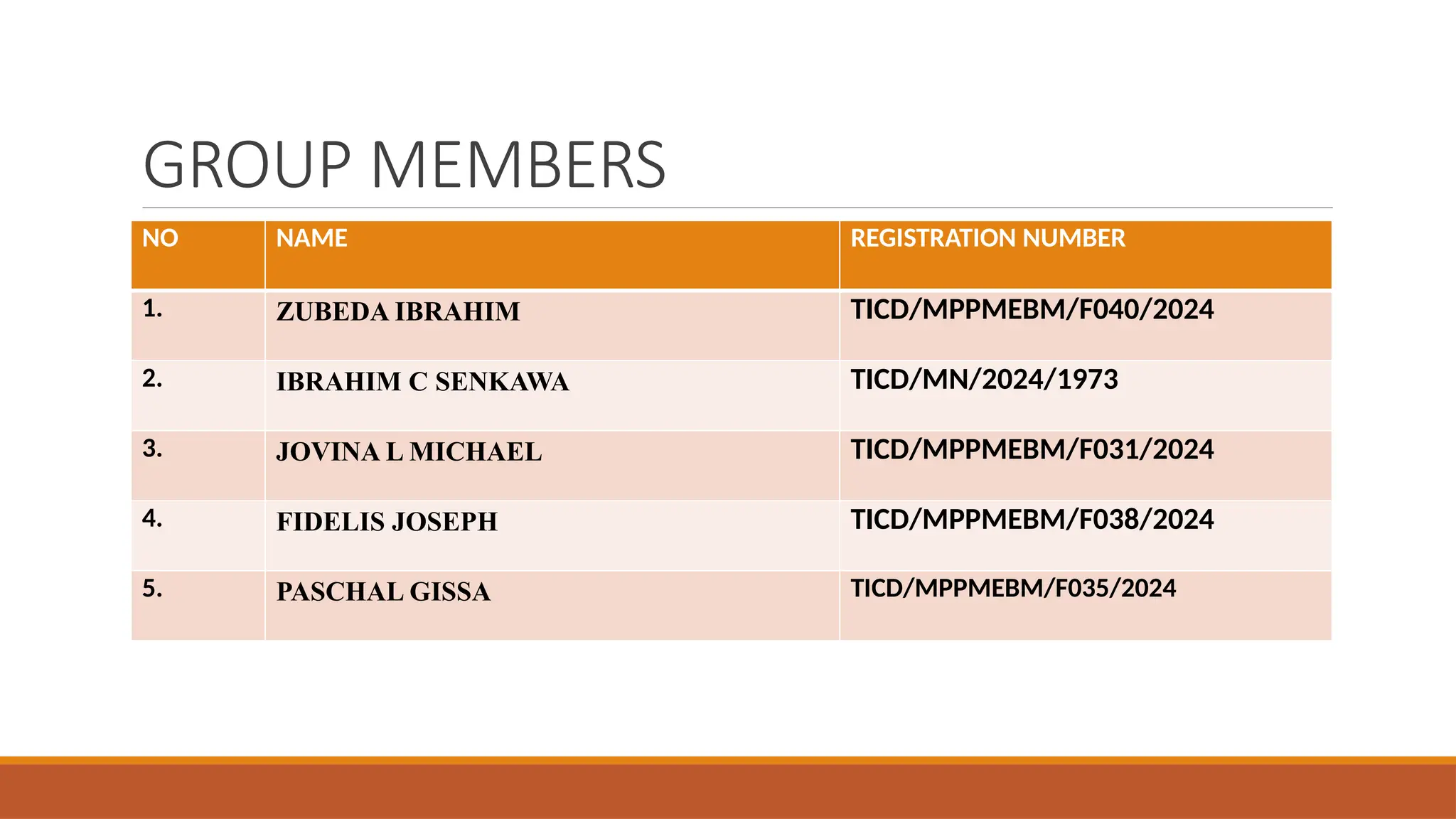
GROUP MEMBERS
NO NAMEREGISTRATION NUMBER
1. ZUBEDA IBRAHIM TICD/MPPMEBM/F040/2024
2. IBRAHIM C SENKAWA TICD/MN/2024/1973
3. JOVINA L MICHAEL TICD/MPPMEBM/F031/2024
4. FIDELIS JOSEPH TICD/MPPMEBM/F038/2024
5. PASCHAL GISSA TICD/MPPMEBM/F035/2024
3.
INTRODUCTION
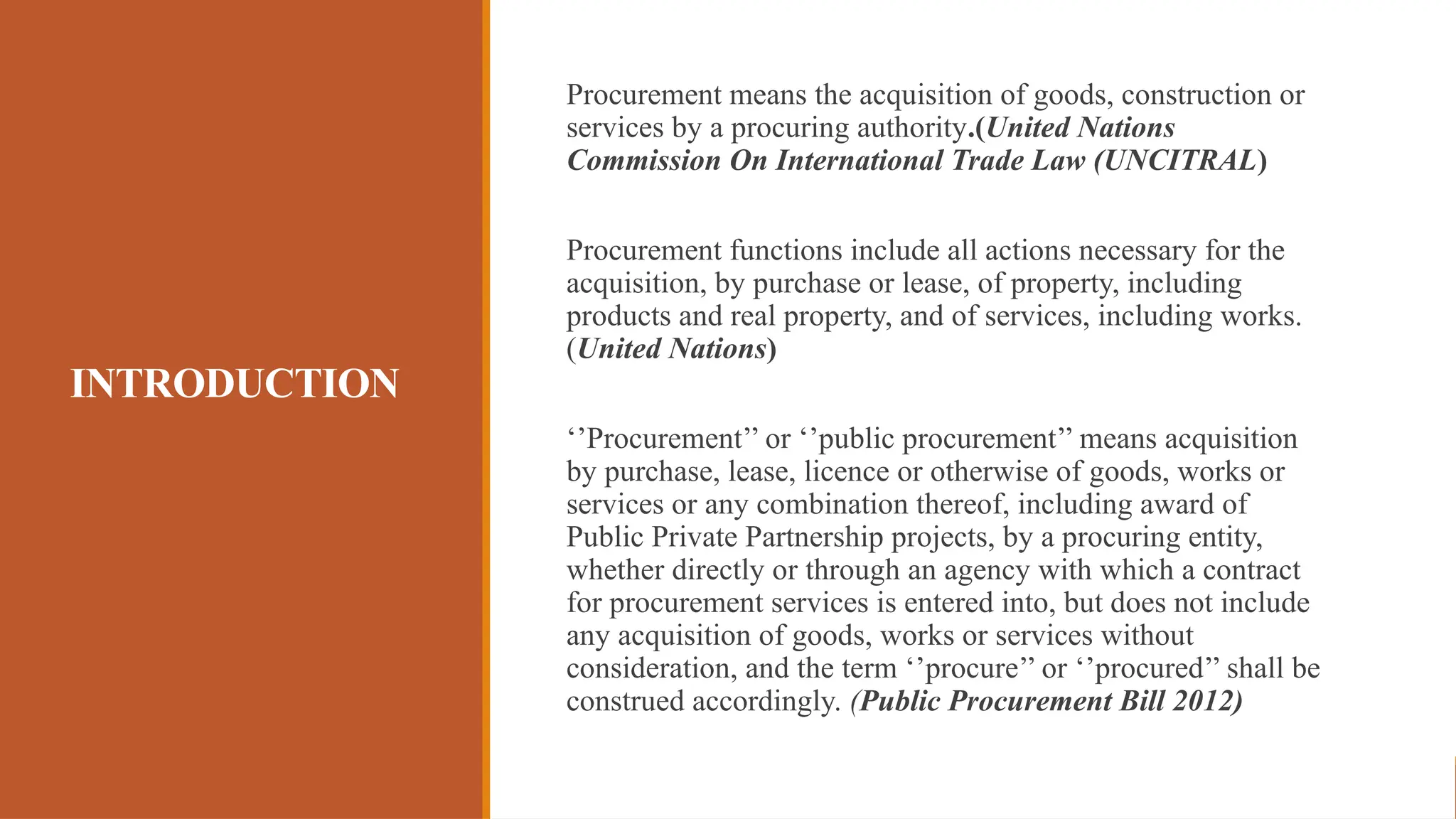
Procurement means theacquisition of goods, construction or
services by a procuring authority.(United Nations
Commission On International Trade Law (UNCITRAL)
Procurement functions include all actions necessary for the
acquisition, by purchase or lease, of property, including
products and real property, and of services, including works.
(United Nations)
‘’Procurement’’ or ‘’public procurement’’ means acquisition
by purchase, lease, licence or otherwise of goods, works or
services or any combination thereof, including award of
Public Private Partnership projects, by a procuring entity,
whether directly or through an agency with which a contract
for procurement services is entered into, but does not include
any acquisition of goods, works or services without
consideration, and the term ‘’procure’’ or ‘’procured’’ shall be
construed accordingly. (Public Procurement Bill 2012)
4.
INTRODUCTION
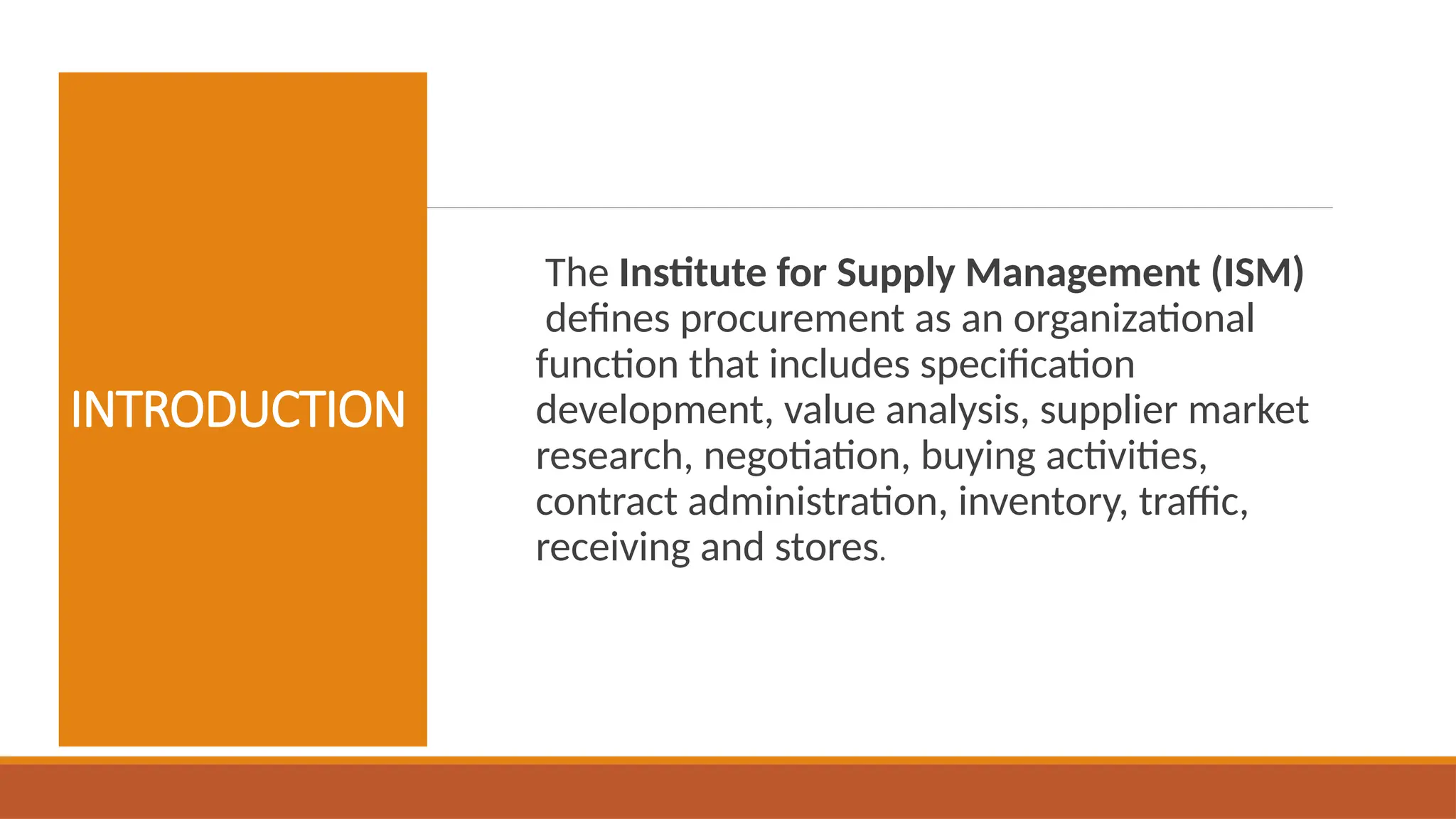
The Institute forSupply Management (ISM)
defines procurement as an organizational
function that includes specification
development, value analysis, supplier market
research, negotiation, buying activities,
contract administration, inventory, traffic,
receiving and stores.
5.
TYPES OF
PROCUREMENT
Procurement canbe categorized in several ways. It can be
classified as direct or indirect procurement, depending on how
the company will use the items being procured. It can also be
categorized as goods or services procurement depending on
the items that are being procured. It is as follows,
1. Direct procurement refers to obtaining anything that’s
required to produce an end-product. For a manufacturing
company, this includes raw materials and components. For a
retailer, it includes any items purchased from a wholesaler for
resale to customers.
2. Indirect procurement typically involves purchases of items
that are essential for day-to-day operations but don’t directly
contribute to the company’s bottom line. This can include
anything from office supplies and furniture to advertising
campaigns, consulting services and equipment maintenance.
6.
CONT..
3. Goods procurementlargely refers to the
procurement of physical items, but it can also
include items like software subscriptions.
Effective goods procurement generally relies on
good supply chain management practices. It may
include both direct and indirect procurement.
4. Services procurement focuses on procuring
people-based services. Depending on the
company, this may include hiring individual
contractors, contingent labor, law firms or on-
site security services. It may include both direct
and indirect procurement. Example Hiring
Technologist
7.
Steps in theProcurement Process
1. Identify which goods and services the company needs.
First, a business/public institution must identify its requirements for a specific item
or a service. This may be a new item that an institution hasn’t previously
purchased, a restock of existing goods or a subscription renewal. At this stage, it’s
a good idea to consult all business departments affected by the purchasing decision
to ensure the items procured accurately reflect the needs of each department.
8.
Steps in theProcurement Process
2. Submit purchase request.
When a public institution needs to procure a significant quantity of new supplies or
services, they make a formal purchase request. A purchase request notifies the
institution that a need exists, usually via department managers, purchasing staff or
the financial team, as well as specifications such as price, time frame needed,
quantity and other important things for the purchasing team to keep in mind. The
department overseeing the purchase can then approve or deny the purchase request.
If approved, the procurement team can proceed with selecting a vendor and making
the purchase. In Tanzania we use NEST.
9.
Steps in theProcurement Process
3. Assess and select vendors.
With a clear list of requirements and an approved purchase request,
now is the time to find the best vendor and submit a request for
quote (RFQ) .Vendor assessment should focus not only on cost but
also on reputation, speed, quality and reliability. Many companies
consider ethics and social responsibility as well, since procurement
is often intertwined with corporate identity.
10.
Steps in theProcurement Process
4. Negotiate price and terms.
A common best practice is to get at least three quotes from
suppliers before making a decision. Examine each quote carefully
and negotiate where possible. If you need to walk away from a
deal, be sure that you have concrete alternative options. Once
you’ve agreed on final terms, be sure to get them in writing.
11.
Steps in theProcurement Process
5. Create a purchase order.
Fill out a purchase order (PO) and send it to the supplier.
The PO should be sufficiently detailed to identify the
exact services or goods needed and to enable the supplier
to fill the order.
12.
Steps in theProcurement Process
6. Receive and inspect the delivered goods.
Carefully examine deliveries for any errors or damage.
Make sure everything is delivered as specified in the PO
and that the quality meets or exceeds expectations.
13.
Steps in theProcurement Process
7. Conduct three-way matching.
Accounts payable should conduct three-way matching by
comparing the purchase order, order receipt or packing list and
invoice. The goal is to ensure the goods or services received match
the purchase order and to prevent payment for unauthorized or
inaccurate invoices. Highlight any discrepancies between the three
documents and resolve issues before arranging payment.
14.
Steps in theProcurement Process
8. Approve the invoice and arrange payment.
If the three-way match is accurate, approve and pay the invoice. Businesses
should strive to have a consistent invoice payment process through the
accounts payable that checks that payments match the invoice amount and
due date. A standardized process can help make sure invoices are always paid
on time, which can prevent late fees and build good relationships with
suppliers.
15.
Steps in theProcurement Process
9. Keep Records.
It’s important to maintain records for the entire procurement process, from
purchase requests to price negotiations, invoices, receipts and everything in
between. These records may be useful for multiple reasons. They help the
company reorder goods at the right price in the future, as well as assist with
auditing processes and calculating taxes. Clear, accurate records can also help
resolve any potential disputes.
16.
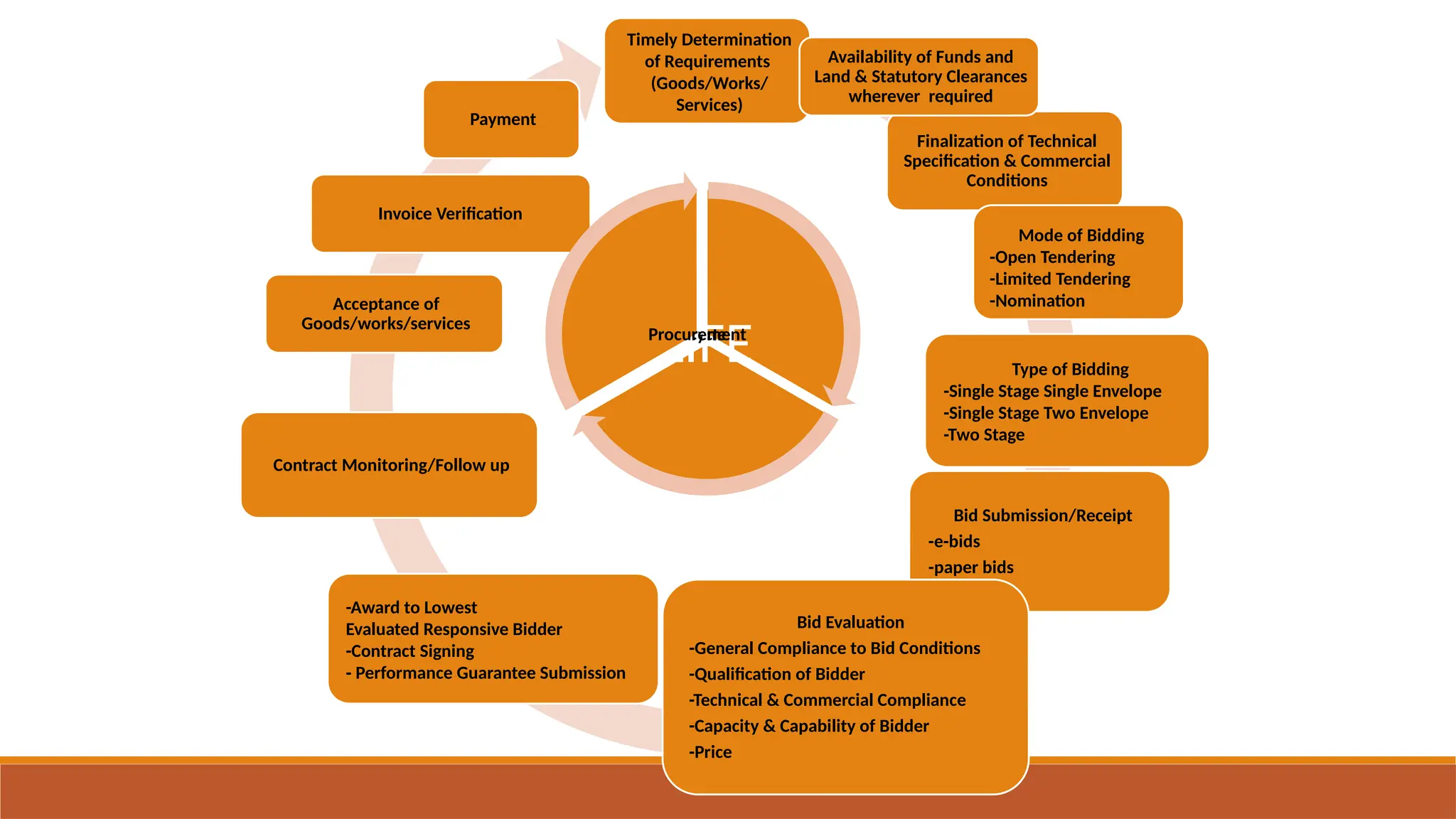
Procurement
life Cycle
Organizations commonlythink of steps in the
procurement process as a life cycle. This
perspective provides a reminder that all the tasks
and stages in the procurement process overlap
and rely on each other and that the process is
continuous. A carefully thought-out procurement
life cycle also recognizes the integration between
the process and the business as a whole, including
the need to align with existing company rules and
procedures covering areas such as budgeting. The
process is not always linear, and sometimes
adjustments need to be made to account for a
dynamic digital supply chain with shifting
suppliers, availabilities and costs.
17.
Timely Determination
of Requirements
(Goods/Works/
Services)
Finalizationof Technical
Specification & Commercial
Conditions
Mode of Bidding
-Open Tendering
-Limited Tendering
-Nomination
Type of Bidding
-Single Stage Single Envelope
-Single Stage Two Envelope
-Two Stage
Bid Submission/Receipt
-e-bids
-paper bids
Bid Evaluation
-General Compliance to Bid Conditions
-Qualification of Bidder
-Technical & Commercial Compliance
-Capacity & Capability of Bidder
-Price
-Award to Lowest
Evaluated Responsive Bidder
-Contract Signing
- Performance Guarantee Submission
Contract Monitoring/Follow up
Availability of Funds and
Land & Statutory Clearances
wherever required
Acceptance of
Goods/works/services
Invoice Verification
Payment
Cycle
LIFE
Procurement
20.
Procurement, Purchasing andSupply Chain: What’s the Difference?
The terms procurement, purchasing,
sourcing and supply chain are often used
interchangeably. However, there are
important distinctions between them
21.
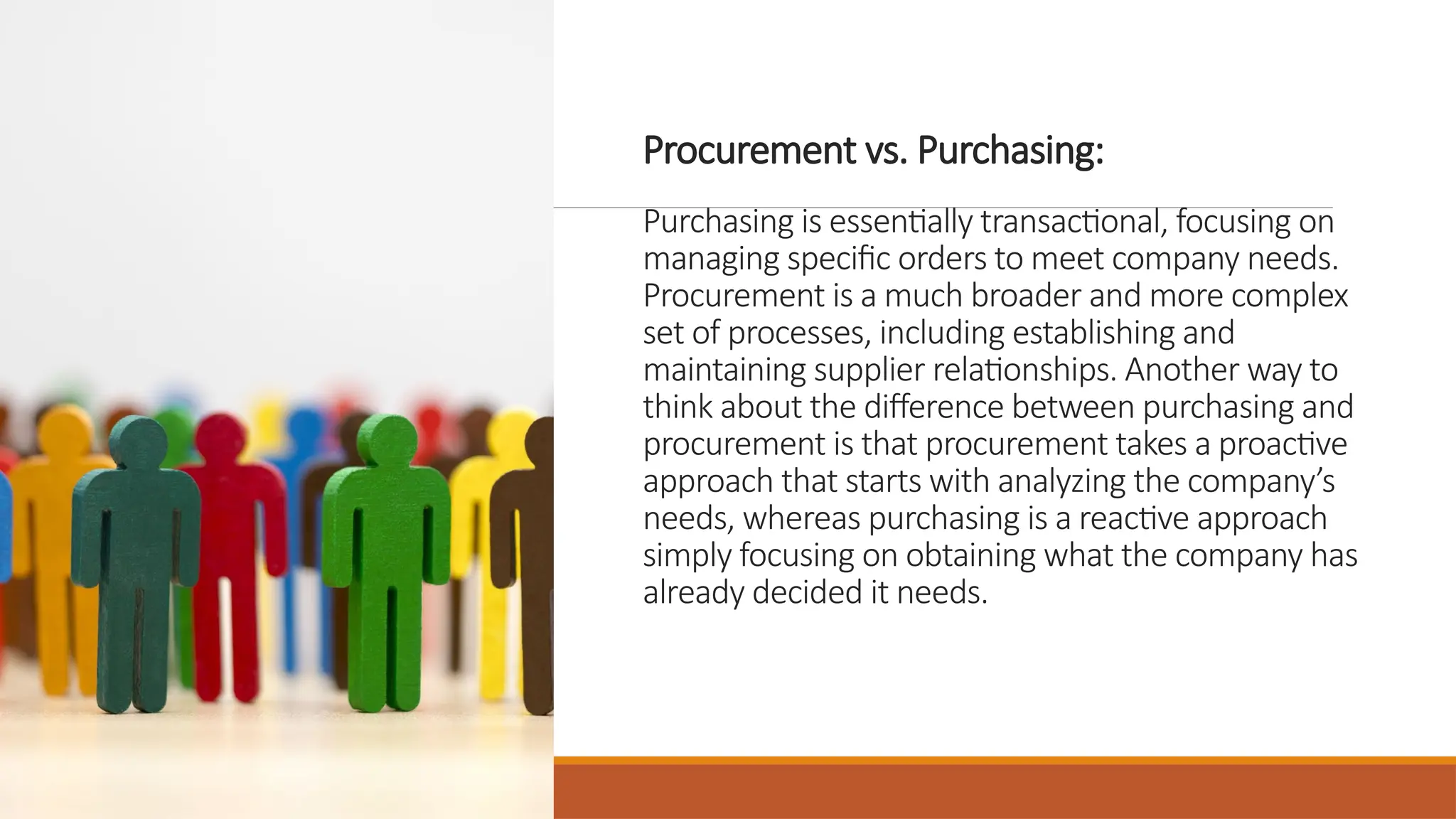
Procurement vs. Purchasing:
Purchasingis essentially transactional, focusing on
managing specific orders to meet company needs.
Procurement is a much broader and more complex
set of processes, including establishing and
maintaining supplier relationships. Another way to
think about the difference between purchasing and
procurement is that procurement takes a proactive
approach that starts with analyzing the company’s
needs, whereas purchasing is a reactive approach
simply focusing on obtaining what the company has
already decided it needs.
22.
CONT…
Procurement vs. sourcing:Sourcing, like purchasing, is
only part of the overall procurement process. Sourcing is an
early stage of the procurement cycle. It encompasses activities
such as identifying and assessing potential suppliers of goods
or services, negotiating terms and selecting the vendors that
best meet the company’s needs.
23.
CONT….
Procurement vs. Supplychain: Procurement covers one aspect of
supply chain management Procurement includes sourcing,
obtaining and paying for goods and services. Supply chain
management also covers the logistics involved in obtaining goods,
such as shipping and warehouse management, as well as
transforming the procured goods into products and distributing
them to customers.
24.
PRINCIPLES OF PROCUREMENT
PUBLICPROCUREMENT ACT CAP 410 AND ITS
REGULATION PROVIDE THE LEGAL FRAMEWORK
FOR PUBLIC PROCUREMENT.
THE ACT AND REGULATIONS OUTLINE THE RULES
AND PROCEDURES THAT MUST BE FOLLOWED BY
PUBLIC ENTITIES WHEN PRODUCING GOODS ,
WORKS AD SERVICES.
PROCURING ENTITIES ARE REQUIRED TO FOLLOW
PROCUREMENT PROCEDURES WHEN PRODUCING
GOODS OR SERVICES INCLUDING INVITATION TO
TENDER, RECEIVING AND EVALUATING BIDS
OBTAINING NECESSARY APPROVALS AND
AWARDING THE CONTRACT TO THE SUCCESSFUL
MANUFACTURER, SERVICE PROVIDER OR
AUTHORISED DEALER.
25.
PROCUREMENT
PRINCIPLES
1. Integrity
Intergrity canbe defined as the use of funds, resources, assets
and authority according to the intended official purposes, to be
used in line with public interest. In the context of public
procurement, it implies that procurement procedures are
transparent and promote fair and equal treatment of
suppliers/bidders.
Integrity is essentially reliability.
Bidders should be able to rely on any information given by
the procuring entity, formally or informally. When bidding
documents are made publicly available, the information they
contain must be dependable and free of ambiguities or bias.
26.
PRINCIPLES OF
PROCUREMENT
2. Transparency
Informationof public procurement
should be available to all stake
holders-contractors , suppliers,
service providers and public at large
unless there are valid and legal
reasons for not revealing certain
information.
Example: Military and Defense
related procurements.
27.
PRINCIPLES OF PROCUREMENT
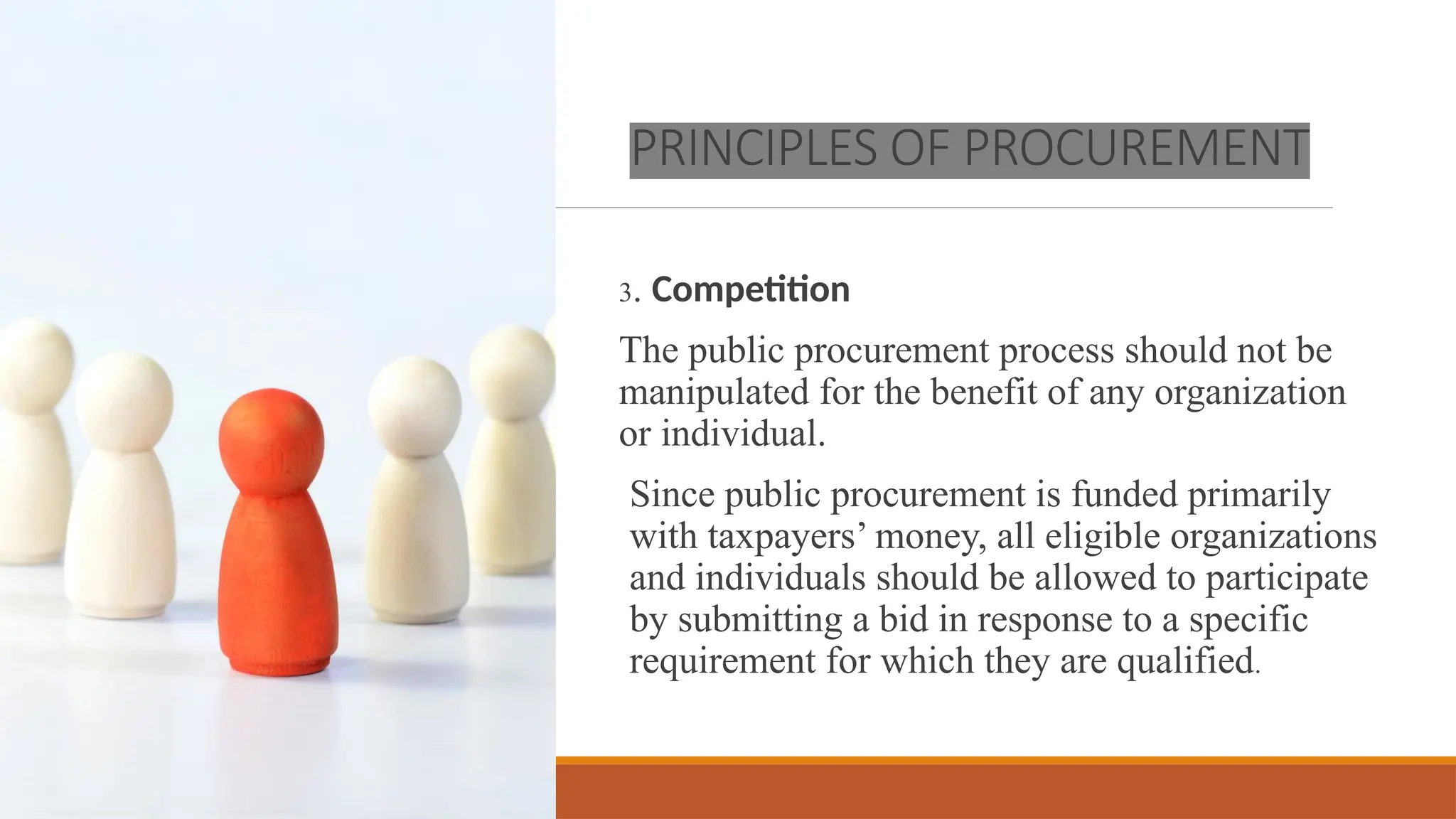
3.Competition
The public procurement process should not be
manipulated for the benefit of any organization
or individual.
Since public procurement is funded primarily
with taxpayers’ money, all eligible organizations
and individuals should be allowed to participate
by submitting a bid in response to a specific
requirement for which they are qualified.
28.
PRINCIPLES OF
PROCUREMENT
4. Accountability
Accountabilityin public procurement
should be understood to mean that anyone
involved in the procurement process is
responsible for their actions and decisions.
As public servants, procurement
practitioners, and others involved directly
and indirectly in the public procurement
process, are accountable and exposed to
sanctions for any behavior that violates the
public procurement rules
29.
PRINCIPLES OF
PROCUREMENT
5. Fairness
Fairnesshas different meanings depending on how it is used.
In public procurement, we could simply say that fairness is to treat all
bidders equally, but it’s not that simple. Below are some. examples of the
application of fairness in public procurement.
To achieve fairness in the public procurement process:
The decision-making and actions must be unbiased, and no preferential
treatment should be extended to individuals or organizations, given that
public procurement activities are undertaken with public funds. All bids
must be considered based on their compliance with the stipulations of the
bidding documents, and bids should not be rejected for reasons other than
those specifically stated.
30.
PRINCIPLES OF
PROCUREMENT
6. Economy
Synonymouswith efficiency, value for
money, and commercially reasonable
price, the principle of economy
emphasizes the need to manage public
funds with care and due diligence so
that prices paid for goods, services and
works are acceptable and represent
good value for the public funds
expended on them.
PRINCIPLES OF
PROCUREMENT
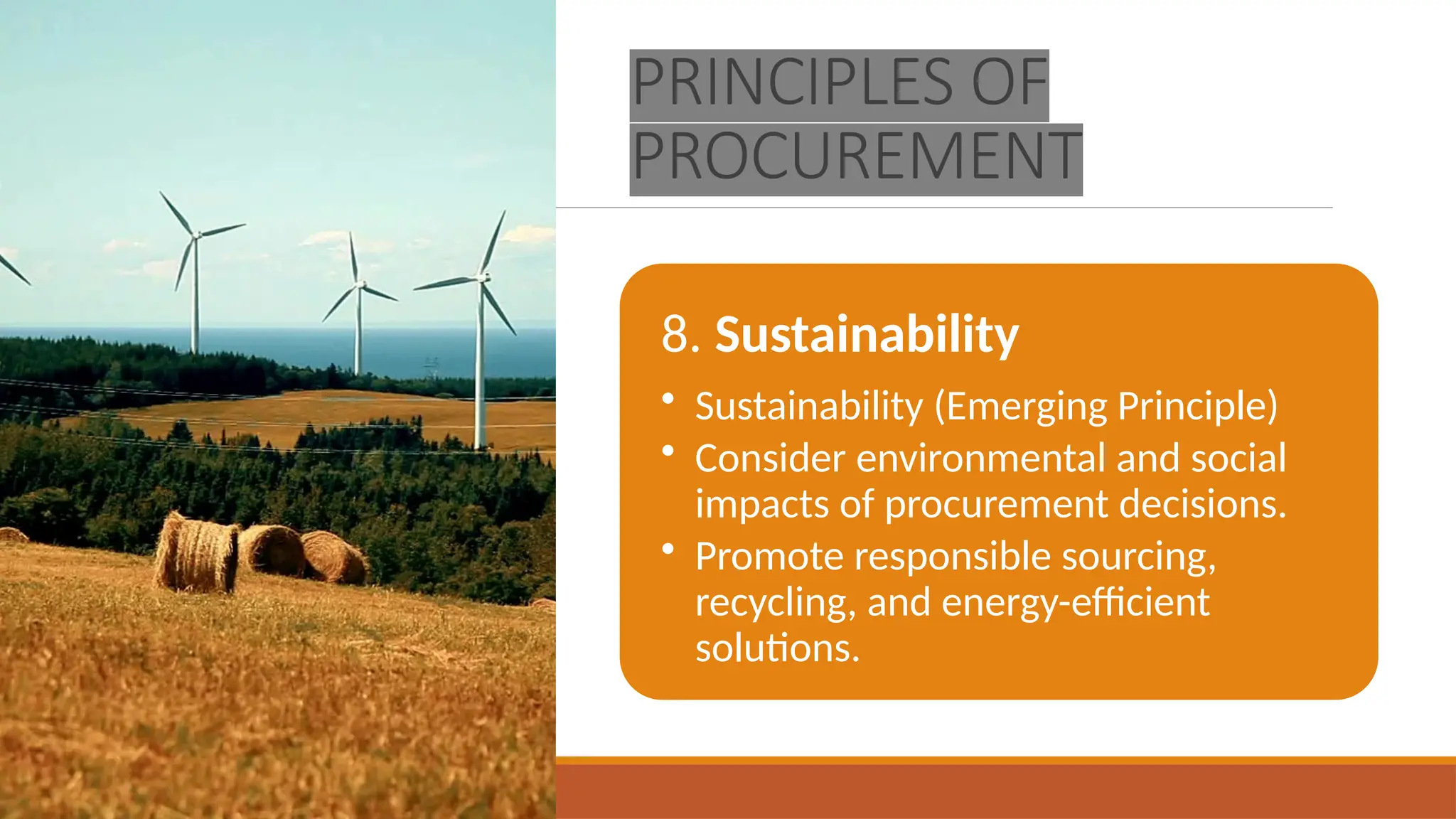
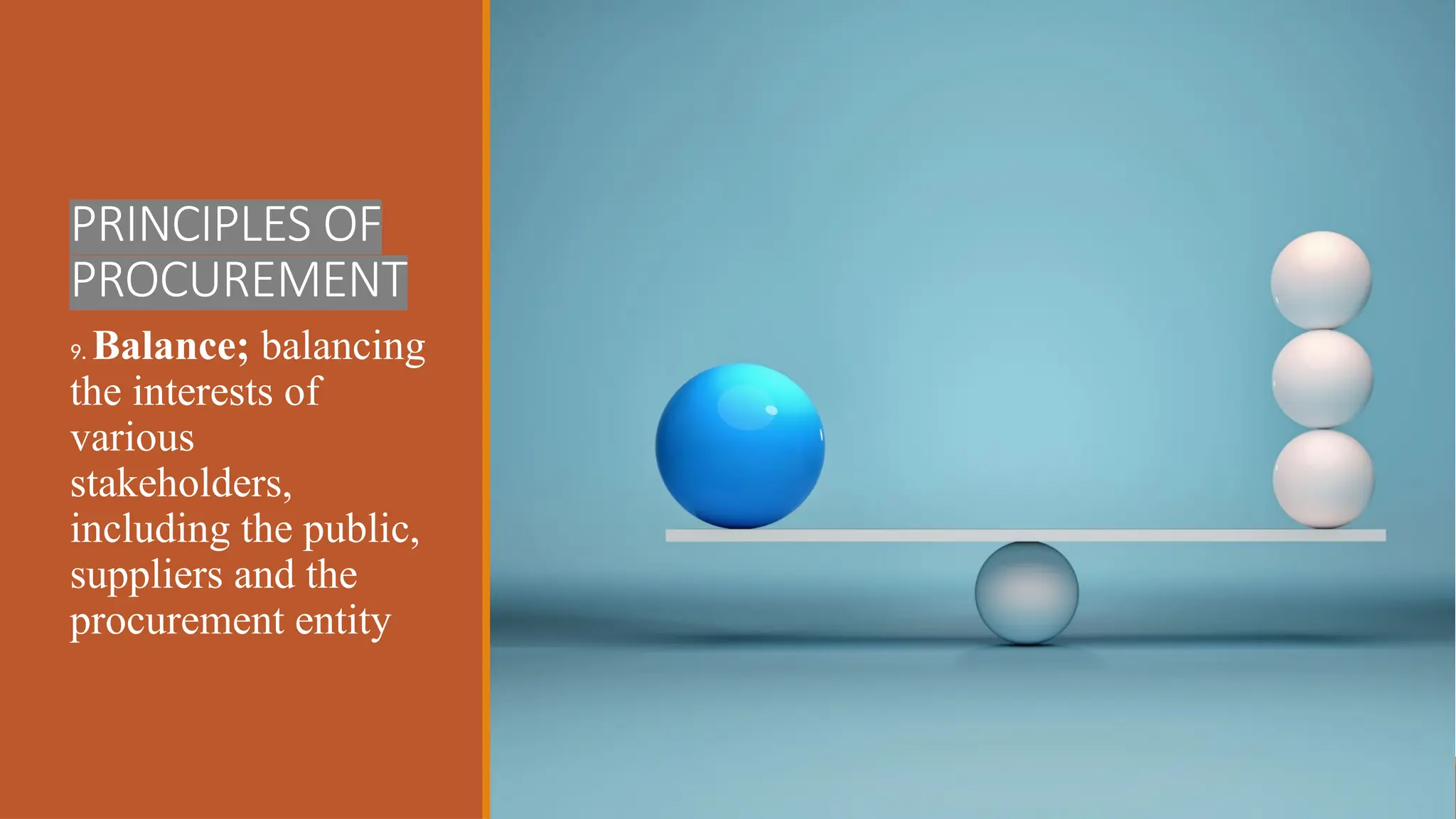
8. Sustainability
•Sustainability (Emerging Principle)
• Consider environmental and social
impacts of procurement decisions.
• Promote responsible sourcing,
recycling, and energy-efficient
solutions.