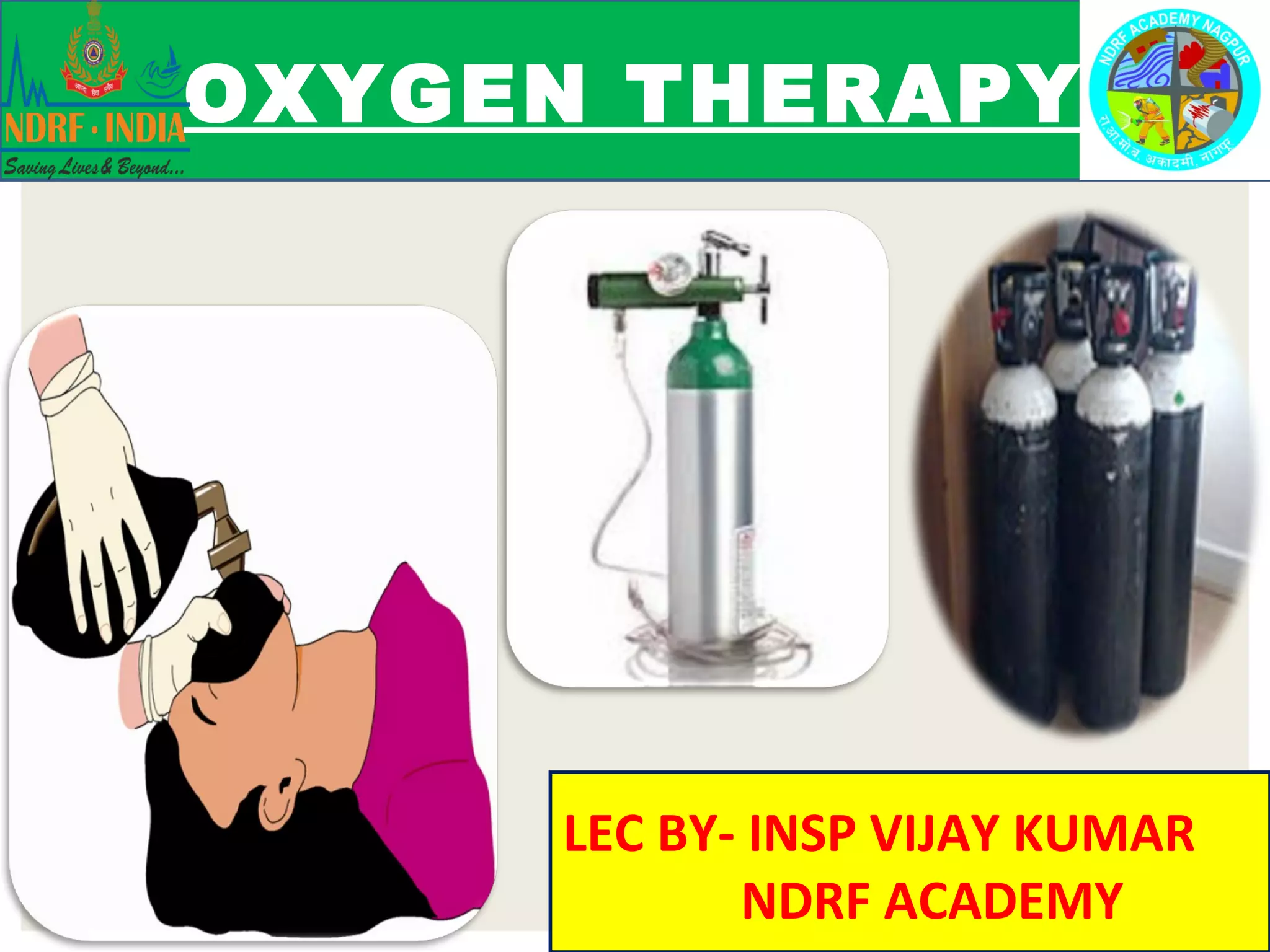
LEC BY- INSP VIJAY KUMAR
NDRF ACADEMY
OXYGEN THERAPY
OBJECTIVES
Upon completion of this lesson you will be able
to define …
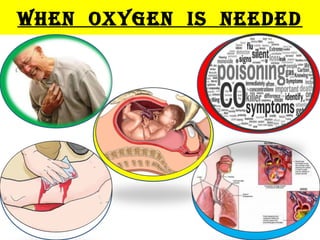
• Five situations in which the use of Oxygen is needed.
• About an Oropharyngeal airway, Nasal cannula, a CPR mask,
a Bag valve mask, Non rebreather mask, Simple and Venturi
mask.
• Four key pieces of equipment used in an Oxygen delivery
system
• Humidifier, Mechanical suction and suction equipment
INTRODUCTION
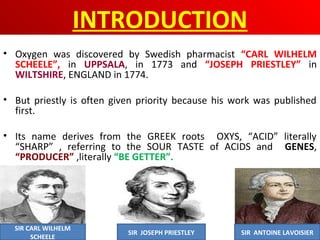
• Oxygen was discovered by Swedish pharmacist “CARL WILHELM
SCHEELE”, in UPPSALA, in 1773 and “JOSEPH PRIESTLEY” in
WILTSHIRE, ENGLAND in 1774.
• But priestly is often given priority because his work was published
first.
• Its name derives from the GREEK roots OXYS, “ACID” literally
“SHARP” , referring to the SOUR TASTE of ACIDS and GENES,
“PRODUCER” ,literally “BE GETTER”.
SIR CARL WILHELM
SCHEELE
SIR JOSEPH PRIESTLEY SIR ANTOINE LAVOISIER
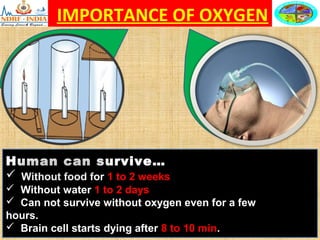
IMPORTANCE OF OXYGEN
Human can survive…
 Without food for 1 to 2 weeks
 Without water 1 to 2 days
 Can not survive without oxygen even for a few
hours.
 Brain cell starts dying after 8 to 10 min.
WHEN OXYGEN IS NEEDED
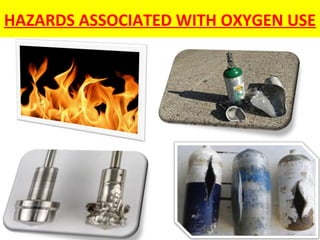
HAZARDS ASSOCIATED WITH OXYGEN USE
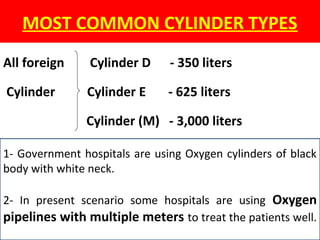
MOST COMMON CYLINDER TYPES
All foreign Cylinder D - 350 liters
Cylinder Cylinder E - 625 liters
Cylinder (M) - 3,000 liters
1- Government hospitals are using Oxygen cylinders of black
body with white neck.
2- In present scenario some hospitals are using Oxygen
pipelines with multiple meters to treat the patients well.
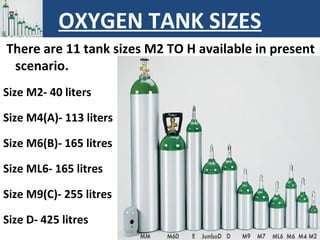
OXYGEN TANK SIZES
There are 11 tank sizes M2 TO H available in present
scenario.
Size M2- 40 liters
Size M4(A)- 113 liters
Size M6(B)- 165 litres
Size ML6- 165 litres
Size M9(C)- 255 litres
Size D- 425 litres
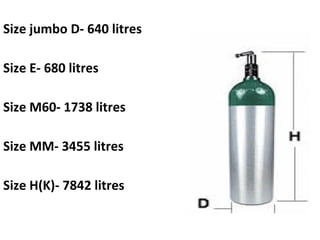
Size jumbo D- 640 litres
Size E- 680 litres
Size M60- 1738 litres
Size MM- 3455 litres
Size H(K)- 7842 litres
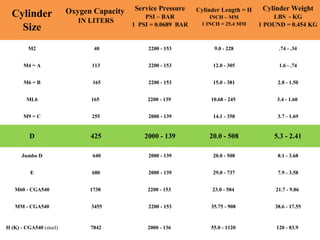
Cylinder
Size
Oxygen Capacity
IN LITERS
Service Pressure
PSI – BAR
1 PSI = 0.0689 BAR
Cylinder Length = H
INCH – MM
1 INCH = 25.4 MM
Cylinder Weight
LBS - KG
1 POUND = 0.454 KG
M2 40 2200 - 153 9.0 - 228 .74 - .34
M4 = A 113 2200 - 153 12.0 - 305 1.6 - .74
M6 = B 165 2200 - 153 15.0 - 381 2.8 - 1.50
ML6 165 2200 - 139 10.68 - 245 3.4 - 1.60
M9 = C 255 2000 - 139 14.1 - 358 3.7 - 1.69
D 425 2000 - 139 20.0 - 508 5.3 - 2.41
Jumbo D 640 2000 - 139 20.0 - 508 8.1 - 3.68
E 680 2000 - 139 29.0 - 737 7.9 - 3.58
M60 - CGA540 1738 2200 - 153 23.0 - 584 21.7 - 9.86
MM - CGA540 3455 2200 - 153 35.75 - 908 38.6 - 17.55
H (K) - CGA540 (steel) 7842 2000 - 136 55.0 - 1120 120 - 83.9
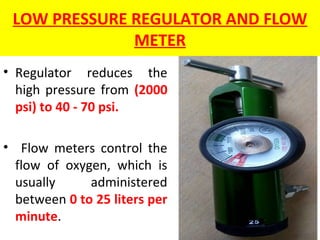
LOW PRESSURE REGULATOR AND FLOW
METER
• Regulator reduces the
high pressure from (2000
psi) to 40 - 70 psi.
• Flow meters control the
flow of oxygen, which is
usually administered
between 0 to 25 liters per
minute.
PRECAUTION WHEN GIVING
OXYGEN
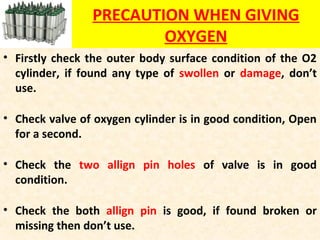
• Firstly check the outer body surface condition of the O2
cylinder, if found any type of swollen or damage, don’t
use.
• Check valve of oxygen cylinder is in good condition, Open
for a second.
• Check the two allign pin holes of valve is in good
condition.
• Check the both allign pin is good, if found broken or
missing then don’t use.
• Apply the regulator and check ,needle is working properly
or not.
• Check flow meter is working properly or not.
• Check present pressure in the cylinder.
• Install low pressure regulator, flow meter, oxygen
delivery pipe(3m), nasal cannula(2.20m), non rebreather
mask(2m), bag valve mask to the cylinder, as required.
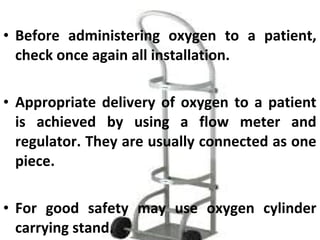
• Before administering oxygen to a patient,
check once again all installation.
• Appropriate delivery of oxygen to a patient
is achieved by using a flow meter and
regulator. They are usually connected as one
piece.
• For good safety may use oxygen cylinder
carrying stand.
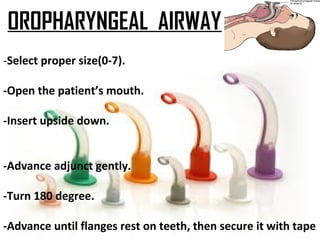
OROPHARYNGEAL AIRWAY
-Select proper size(0-7).
-Open the patient’s mouth.
-Insert upside down.
-Advance adjunct gently.
-Turn 180 degree.
-Advance until flanges rest on teeth, then secure it with tape
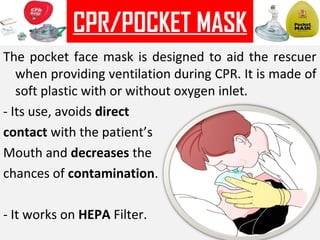
CPR/POCKET MASK
The pocket face mask is designed to aid the rescuer
when providing ventilation during CPR. It is made of
soft plastic with or without oxygen inlet.
- Its use, avoids direct
contact with the patient’s
Mouth and decreases the
chances of contamination.
- It works on HEPA Filter.
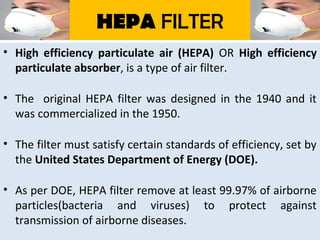
HEPA FILTER
• High efficiency particulate air (HEPA) OR High efficiency
particulate absorber, is a type of air filter.
• The original HEPA filter was designed in the 1940 and it
was commercialized in the 1950.
• The filter must satisfy certain standards of efficiency, set by
the United States Department of Energy (DOE).
• As per DOE, HEPA filter remove at least 99.97% of airborne
particles(bacteria and viruses) to protect against
transmission of airborne diseases.
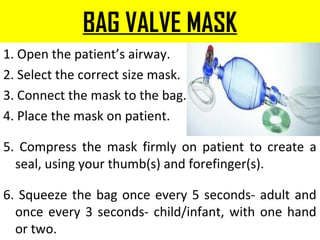
BAG VALVE MASK
1. Open the patient’s airway.
2. Select the correct size mask.
3. Connect the mask to the bag.
4. Place the mask on patient.
5. Compress the mask firmly on patient to create a
seal, using your thumb(s) and forefinger(s).
6. Squeeze the bag once every 5 seconds- adult and
once every 3 seconds- child/infant, with one hand
or two.
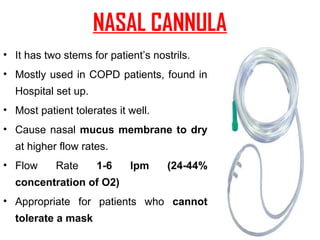
NASAL CANNULA
• It has two stems for patient’s nostrils.
• Mostly used in COPD patients, found in
Hospital set up.
• Most patient tolerates it well.
• Cause nasal mucus membrane to dry
at higher flow rates.
• Flow Rate 1-6 lpm (24-44%
concentration of O2)
• Appropriate for patients who cannot
tolerate a mask
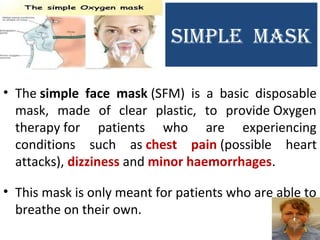
SIMPLE MASK
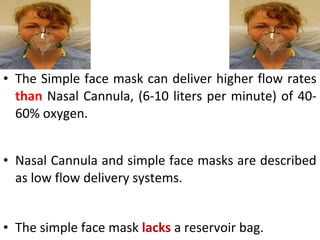
• The simple face mask (SFM) is a basic disposable
mask, made of clear plastic, to provide Oxygen
therapy for patients who are experiencing
conditions such as chest pain (possible heart
attacks), dizziness and minor haemorrhages.
• This mask is only meant for patients who are able to
breathe on their own.
• The Simple face mask can deliver higher flow rates
than Nasal Cannula, (6-10 liters per minute) of 40-
60% oxygen.
• Nasal Cannula and simple face masks are described
as low flow delivery systems.
• The simple face mask lacks a reservoir bag.
NON-REBREATHER MASK/HUDSON MASK
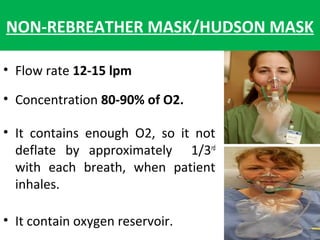
• Flow rate 12-15 lpm
• Concentration 80-90% of O2.
• It contains enough O2, so it not
deflate by approximately 1/3rd
with each breath, when patient
inhales.
• It contain oxygen reservoir.
VENTURI MASK
• The venturi mask, also known as an air-
entrainment mask, is a medical device to deliver a
known oxygen concentration to patients on
controlled oxygen therapy.
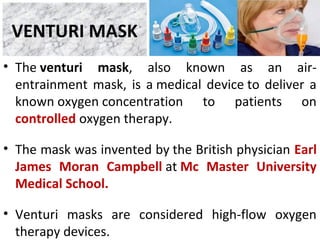
• The mask was invented by the British physician Earl
James Moran Campbell at Mc Master University
Medical School.
• Venturi masks are considered high-flow oxygen
therapy devices.
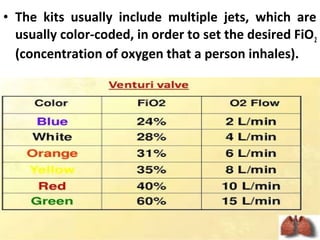
• The kits usually include multiple jets, which are
usually color-coded, in order to set the desired FiO2
(concentration of oxygen that a person inhales).
HUMIDIFIER
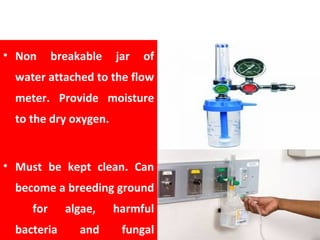
• Non breakable jar of
water attached to the flow
meter. Provide moisture
to the dry oxygen.
• Must be kept clean. Can
become a breeding ground
for algae, harmful
bacteria and fungal
SUCTION EQUIPMENT
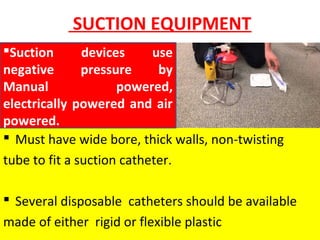
 Must have wide bore, thick walls, non-twisting
tube to fit a suction catheter.
 Several disposable catheters should be available
made of either rigid or flexible plastic
Suction devices use
negative pressure by
Manual powered,
electrically powered and air
powered.
• Suction should be performed rapidly to decrease
the chance of blood or other foreign object/matter
from moving into the lungs, which may cause
pneumonia or complete airway obstruction.
• Solid objects as food, teeth etc always not be
removed by suction, may use alternate like finger
sweep or etc.
?
POST EVALUATION
1. In what situation oxygen needed?
2. What is the flow rate of nasal cannula?
3. Which equipment develop negative pressure?
4. O2 was discovered by……
THANK YOU

Oxygen therapy

  • 1.
    LEC BY- INSPVIJAY KUMAR NDRF ACADEMY OXYGEN THERAPY
  • 2.
    OBJECTIVES Upon completion ofthis lesson you will be able to define … • Five situations in which the use of Oxygen is needed. • About an Oropharyngeal airway, Nasal cannula, a CPR mask, a Bag valve mask, Non rebreather mask, Simple and Venturi mask. • Four key pieces of equipment used in an Oxygen delivery system • Humidifier, Mechanical suction and suction equipment
  • 3.
    INTRODUCTION • Oxygen wasdiscovered by Swedish pharmacist “CARL WILHELM SCHEELE”, in UPPSALA, in 1773 and “JOSEPH PRIESTLEY” in WILTSHIRE, ENGLAND in 1774. • But priestly is often given priority because his work was published first. • Its name derives from the GREEK roots OXYS, “ACID” literally “SHARP” , referring to the SOUR TASTE of ACIDS and GENES, “PRODUCER” ,literally “BE GETTER”. SIR CARL WILHELM SCHEELE SIR JOSEPH PRIESTLEY SIR ANTOINE LAVOISIER
  • 4.
    IMPORTANCE OF OXYGEN Humancan survive…  Without food for 1 to 2 weeks  Without water 1 to 2 days  Can not survive without oxygen even for a few hours.  Brain cell starts dying after 8 to 10 min.
  • 5.
  • 6.
  • 7.
    MOST COMMON CYLINDERTYPES All foreign Cylinder D - 350 liters Cylinder Cylinder E - 625 liters Cylinder (M) - 3,000 liters 1- Government hospitals are using Oxygen cylinders of black body with white neck. 2- In present scenario some hospitals are using Oxygen pipelines with multiple meters to treat the patients well.
  • 8.
    OXYGEN TANK SIZES Thereare 11 tank sizes M2 TO H available in present scenario. Size M2- 40 liters Size M4(A)- 113 liters Size M6(B)- 165 litres Size ML6- 165 litres Size M9(C)- 255 litres Size D- 425 litres
  • 9.
    Size jumbo D-640 litres Size E- 680 litres Size M60- 1738 litres Size MM- 3455 litres Size H(K)- 7842 litres
  • 10.
    Cylinder Size Oxygen Capacity IN LITERS ServicePressure PSI – BAR 1 PSI = 0.0689 BAR Cylinder Length = H INCH – MM 1 INCH = 25.4 MM Cylinder Weight LBS - KG 1 POUND = 0.454 KG M2 40 2200 - 153 9.0 - 228 .74 - .34 M4 = A 113 2200 - 153 12.0 - 305 1.6 - .74 M6 = B 165 2200 - 153 15.0 - 381 2.8 - 1.50 ML6 165 2200 - 139 10.68 - 245 3.4 - 1.60 M9 = C 255 2000 - 139 14.1 - 358 3.7 - 1.69 D 425 2000 - 139 20.0 - 508 5.3 - 2.41 Jumbo D 640 2000 - 139 20.0 - 508 8.1 - 3.68 E 680 2000 - 139 29.0 - 737 7.9 - 3.58 M60 - CGA540 1738 2200 - 153 23.0 - 584 21.7 - 9.86 MM - CGA540 3455 2200 - 153 35.75 - 908 38.6 - 17.55 H (K) - CGA540 (steel) 7842 2000 - 136 55.0 - 1120 120 - 83.9
  • 11.
    LOW PRESSURE REGULATORAND FLOW METER • Regulator reduces the high pressure from (2000 psi) to 40 - 70 psi. • Flow meters control the flow of oxygen, which is usually administered between 0 to 25 liters per minute.
  • 12.
    PRECAUTION WHEN GIVING OXYGEN •Firstly check the outer body surface condition of the O2 cylinder, if found any type of swollen or damage, don’t use. • Check valve of oxygen cylinder is in good condition, Open for a second. • Check the two allign pin holes of valve is in good condition. • Check the both allign pin is good, if found broken or missing then don’t use.
  • 13.
    • Apply theregulator and check ,needle is working properly or not. • Check flow meter is working properly or not. • Check present pressure in the cylinder. • Install low pressure regulator, flow meter, oxygen delivery pipe(3m), nasal cannula(2.20m), non rebreather mask(2m), bag valve mask to the cylinder, as required.
  • 14.
    • Before administeringoxygen to a patient, check once again all installation. • Appropriate delivery of oxygen to a patient is achieved by using a flow meter and regulator. They are usually connected as one piece. • For good safety may use oxygen cylinder carrying stand.
  • 15.
    OROPHARYNGEAL AIRWAY -Select propersize(0-7). -Open the patient’s mouth. -Insert upside down. -Advance adjunct gently. -Turn 180 degree. -Advance until flanges rest on teeth, then secure it with tape
  • 16.
    CPR/POCKET MASK The pocketface mask is designed to aid the rescuer when providing ventilation during CPR. It is made of soft plastic with or without oxygen inlet. - Its use, avoids direct contact with the patient’s Mouth and decreases the chances of contamination. - It works on HEPA Filter.
  • 17.
    HEPA FILTER • Highefficiency particulate air (HEPA) OR High efficiency particulate absorber, is a type of air filter. • The original HEPA filter was designed in the 1940 and it was commercialized in the 1950. • The filter must satisfy certain standards of efficiency, set by the United States Department of Energy (DOE). • As per DOE, HEPA filter remove at least 99.97% of airborne particles(bacteria and viruses) to protect against transmission of airborne diseases.
  • 18.
    BAG VALVE MASK 1.Open the patient’s airway. 2. Select the correct size mask. 3. Connect the mask to the bag. 4. Place the mask on patient. 5. Compress the mask firmly on patient to create a seal, using your thumb(s) and forefinger(s). 6. Squeeze the bag once every 5 seconds- adult and once every 3 seconds- child/infant, with one hand or two.
  • 19.
    NASAL CANNULA • Ithas two stems for patient’s nostrils. • Mostly used in COPD patients, found in Hospital set up. • Most patient tolerates it well. • Cause nasal mucus membrane to dry at higher flow rates. • Flow Rate 1-6 lpm (24-44% concentration of O2) • Appropriate for patients who cannot tolerate a mask
  • 20.
    SIMPLE MASK • Thesimple face mask (SFM) is a basic disposable mask, made of clear plastic, to provide Oxygen therapy for patients who are experiencing conditions such as chest pain (possible heart attacks), dizziness and minor haemorrhages. • This mask is only meant for patients who are able to breathe on their own.
  • 21.
    • The Simpleface mask can deliver higher flow rates than Nasal Cannula, (6-10 liters per minute) of 40- 60% oxygen. • Nasal Cannula and simple face masks are described as low flow delivery systems. • The simple face mask lacks a reservoir bag.
  • 22.
    NON-REBREATHER MASK/HUDSON MASK •Flow rate 12-15 lpm • Concentration 80-90% of O2. • It contains enough O2, so it not deflate by approximately 1/3rd with each breath, when patient inhales. • It contain oxygen reservoir.
  • 23.
    VENTURI MASK • Theventuri mask, also known as an air- entrainment mask, is a medical device to deliver a known oxygen concentration to patients on controlled oxygen therapy. • The mask was invented by the British physician Earl James Moran Campbell at Mc Master University Medical School. • Venturi masks are considered high-flow oxygen therapy devices.
  • 24.
    • The kitsusually include multiple jets, which are usually color-coded, in order to set the desired FiO2 (concentration of oxygen that a person inhales).
  • 25.
    HUMIDIFIER • Non breakablejar of water attached to the flow meter. Provide moisture to the dry oxygen. • Must be kept clean. Can become a breeding ground for algae, harmful bacteria and fungal
  • 26.
    SUCTION EQUIPMENT  Musthave wide bore, thick walls, non-twisting tube to fit a suction catheter.  Several disposable catheters should be available made of either rigid or flexible plastic Suction devices use negative pressure by Manual powered, electrically powered and air powered.
  • 27.
    • Suction shouldbe performed rapidly to decrease the chance of blood or other foreign object/matter from moving into the lungs, which may cause pneumonia or complete airway obstruction. • Solid objects as food, teeth etc always not be removed by suction, may use alternate like finger sweep or etc.
  • 28.
  • 30.
  • 31.
    1. In whatsituation oxygen needed? 2. What is the flow rate of nasal cannula? 3. Which equipment develop negative pressure? 4. O2 was discovered by……
  • 34.