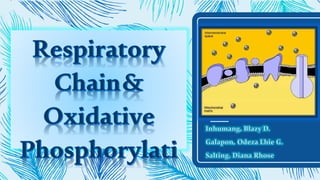
Inhumang, Blazy D.
Galapon, Odeza Lhie G.
Salting, Diana Rhose
– also known as the electron transport chain
– A series of biochemical reactions in which electrons and
hydrogen ions form NADH (nicotinamide adenine
dinucleotide) and FADH2 (flavin adenine dinucleotide)
both of which get oxidized in the electron transport
chain
– passed on from complex to complex and finally to
oxygen, creating a proton gradient that will be used to
make ATP from ADP (oxidative phosphorylation)
– The enzymes and electron carriers needed for the ETC
are located along the inner mitochondrial membrane.
– These four protein complexes, which are tightly bound
to the membrane are:
– Complex I : NADH-coenzyme Q reductase
– Complex II : Succinate-coenzyme Q reductase
– Complex III: Coenzyme Q-cytochrome c reductase
– Complex IV : Cytochrome c oxidase
– In ETC coenzyme Q and cytochrome c serves as
mobile electron carriers that shuttle electrons
between the various complexes.
– Largest of the 4 protein complexes
– Complex I containing 40 subunits including flavin
mononucleotide (FMN)- a derivative of
riboflavin or Vitamin B2 - and iron-sulfur
proteins called FeS.
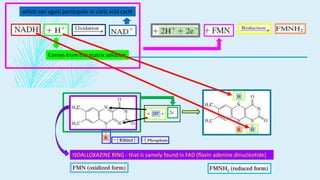
• The first electron transfer step is NADH gives
its electron to flavin mononucleotide
Comes from the matrix solution
which can again participate in citric acid cycle
ISOALLOXAZINE RING - that is samely found in FAD (flavin adenine dinucleotide)
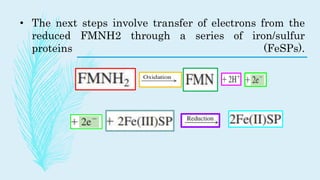
• The next steps involve transfer of electrons from the
reduced FMNH2 through a series of iron/sulfur
proteins (FeSPs).
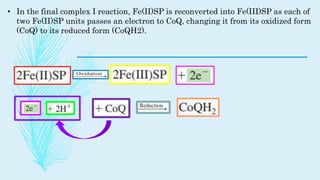
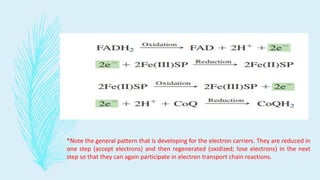
• In the final complex I reaction, Fe(II)SP is reconverted into Fe(III)SP as each of
two Fe(II)SP units passes an electron to CoQ, changing it from its oxidized form
(CoQ) to its reduced form (CoQH2).
Structural characteristics of the coenzyme Q.
• Coenzyme Q, in both its oxidized and reduced forms, is lipid soluble and can move laterally within
the mitochondrial membrane.
• Its function is to shuttle its newly acquired electrons to complex III, where it becomes the initial
substrate for reactions at this complex.
• The Q in the designation coenzyme Q comes from the molecule quinone. Structurally, coenzyme Q
is a quinone derivative.
• In its most common form, coenzyme Q has a long carbon chain containing 10 isoprene units
attached to its quinone unit.
• The actual changes that occur within the structure of CoQ as it accepts the two electrons and the
two H ions involve the quinone part of its structure, as shown.
• The two H ions that CoQ picks up in forming CoQH2 come from solution
– contains only 4 subunits, including two FeSPs.
– FADH2 gives its electron to Complex II - This
complex is used to process the FADH2 that is
generated in the citric acid cycle when succinate
is converted to fumarate.
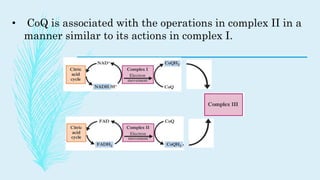
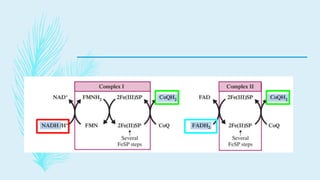
• CoQ is associated with the operations in complex II in a
manner similar to its actions in complex I.
*Note the general pattern that is developing for the electron carriers. They are reduced in
one step (accept electrons) and then regenerated (oxidized; lose electrons) in the next
step so that they can again participate in electron transport chain reactions.
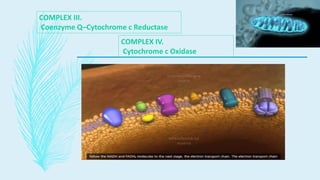
COMPLEX III.
Coenzyme Q–Cytochrome c Reductase
COMPLEX IV.
Cytochrome c Oxidase
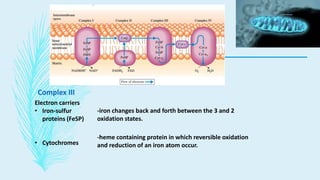
Complex III
Electron carriers
• Iron-sulfur
proteins (FeSP)
• Cytochromes
-iron changes back and forth between the 3 and 2
oxidation states.
-heme containing protein in which reversible oxidation
and reduction of an iron atom occur.
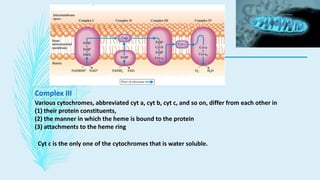
Complex III
Various cytochromes, abbreviated cyt a, cyt b, cyt c, and so on, differ from each other in
(1) their protein constituents,
(2) the manner in which the heme is bound to the protein
(3) attachments to the heme ring
Cyt c is the only one of the cytochromes that is water soluble.
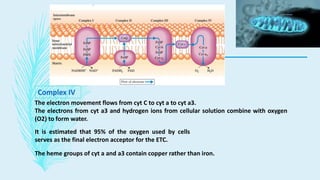
Complex IV
The electron movement flows from cyt C to cyt a to cyt a3.
The electrons from cyt a3 and hydrogen ions from cellular solution combine with oxygen
(O2) to form water.
It is estimated that 95% of the oxygen used by cells
serves as the final electron acceptor for the ETC.
The heme groups of cyt a and a3 contain copper rather than iron.
– The synthesis of ATP from ADP (phosphorylation), that occurs
when NADH and FADH2 are oxidized through electron transport
chain (respiratory chain).
– Mitochondria are the site of oxidative phosphorylation in
eukaryotes Oxidative Phosphorylation
– During transfer of electrons through the ETC energy is produced.
– This energy is coupled to the formation of ATP from ADP.
– By an enzyme F0F1 ATPase.
Two ways to synthesize ATP
– Oxidative phosphorylation is the phosphorylation of ADP to ATP
coupled to electron transfer.
– Substrate level phosphorylation is the direct transfer the
phosphate from chemical intermediate (also called substrate ) to
ADP or GDP forming ATP or GTP, independent of electron transfer
chain. Examples are the removal of inorganic phosphates from 1,3-
biphosphoglycerate or phosphoenolpyruvate to form 3-
phosphoglycerate or pyruvate, respectively, as well as ATP .
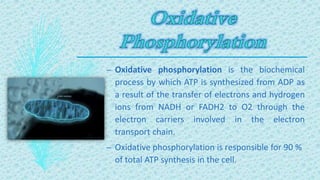
– Oxidative phosphorylation is the biochemical
process by which ATP is synthesized from ADP as
a result of the transfer of electrons and hydrogen
ions from NADH or FADH2 to O2 through the
electron carriers involved in the electron
transport chain.
– Oxidative phosphorylation is responsible for 90 %
of total ATP synthesis in the cell.
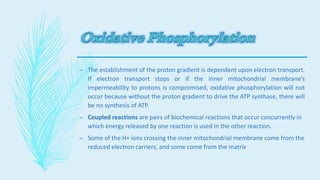
– The establishment of the proton gradient is dependent upon electron transport.
If electron transport stops or if the inner mitochondrial membrane’s
impermeability to protons is compromised, oxidative phosphorylation will not
occur because without the proton gradient to drive the ATP synthase, there will
be no synthesis of ATP.
– Coupled reactions are pairs of biochemical reactions that occur concurrently in
which energy released by one reaction is used in the other reaction.
– Some of the H+ ions crossing the inner mitochondrial membrane come from the
reduced electron carriers, and some come from the matrix
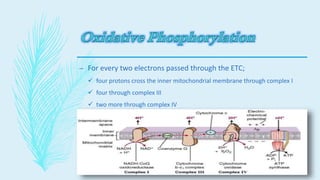
– For every two electrons passed through the ETC;
 four protons cross the inner mitochondrial membrane through complex I
 four through complex III
 two more through complex IV
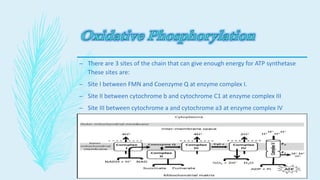
– There are 3 sites of the chain that can give enough energy for ATP synthetase
These sites are:
– Site I between FMN and Coenzyme Q at enzyme complex I.
– Site II between cytochrome b and cytochrome C1 at enzyme complex III
– Site III between cytochrome a and cytochrome a3 at enzyme complex IV
– Chemiosmotic coupling is the coupling of ATP synthesis with
electron transport chain reactions that requires a proton gradient
across the inner mitochondrial membrane. The main concepts in
this explanation for coupling follow.
1. Pumping of protons via electron carrier proteins
2. Generation of electrochemical potential.
i. Membrane potential
ii. Proton gradient (chemical potential)
3. Electron transport flow back to matrix through ATPase.
– A greater number of protons in the intermembrane space than in
the matrix is the result of the pumping of protons from the
mitochondrial matrix across the inner mitochondrial membrane.
– The transport of electrons through ETC is coupled with the
translocation of protons (H+) across the inner mitochondrial
membrane from the matrix to the intermembrane space.
– This results in an electrochemical or proton gradient.
 Generation of electrochemical potential
– A spontaneous flow of protons from the region of high
concentration to the region of low concentration occurs because
of the electrochemical gradient
 Electron transport flow back to matrix through ATPase
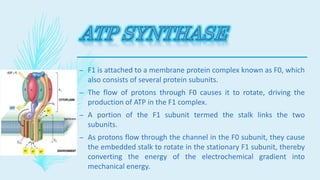
– ATP synthase has two subunits, the F0 and F1 subunits. The F0 part
of the synthase is the channel for proton flow, whereas the
formation of ATP takes place in the F1 subunit.
– ADP + Pi ATP synthase ATP + H2O
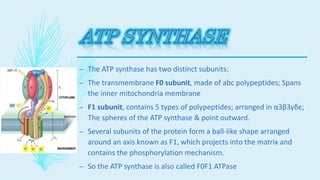
– The ATP synthase has two distinct subunits:
– The transmembrane F0 subunit, made of abc polypeptides; Spans
the inner mitochondria membrane
– F1 subunit, contains 5 types of polypeptides; arranged in α3β3γδε;
The spheres of the ATP synthase & point outward.
– Several subunits of the protein form a ball-like shape arranged
around an axis known as F1, which projects into the matrix and
contains the phosphorylation mechanism.
– So the ATP synthase is also called F0F1 ATPase
– F1 is attached to a membrane protein complex known as F0, which
also consists of several protein subunits.
– The flow of protons through F0 causes it to rotate, driving the
production of ATP in the F1 complex.
– A portion of the F1 subunit termed the stalk links the two
subunits.
– As protons flow through the channel in the F0 subunit, they cause
the embedded stalk to rotate in the stationary F1 subunit, thereby
converting the energy of the electrochemical gradient into
mechanical energy.
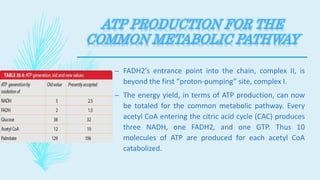
– FADH2’s entrance point into the chain, complex II, is
beyond the first “proton-pumping” site, complex I.
– The energy yield, in terms of ATP production, can now
be totaled for the common metabolic pathway. Every
acetyl CoA entering the citric acid cycle (CAC) produces
three NADH, one FADH2, and one GTP. Thus 10
molecules of ATP are produced for each acetyl CoA
catabolized.
– The cycling of ATP and ADP in metabolic processes is the
principal medium for energy exchange in biochemical processes.
– The conversion ATP ADP + Pi, powers life processes.
– The conversion Pi + ADP ATP, regenerates the ATP
expended in cell operation.
– ATP is a high-energy phosphate compound. Its hydrolysis to ADP
produces an intermediate amount of free energy (7.5 kcal/mole)
compared with hydrolysis energies for other organophosphate
compounds.
– more than 90% of the oxygen taken into the human body via
respiration.
– converted into several highly reactive oxygen species (ROS)
– hydrogen peroxide (H2O2), superoxide ion (O2 ), and hydroxyl
radical (OH).
– White blood cells have a significant concentration of superoxide
free radicals; aid in the destruction of invading bacteria and viruses.
– 2O2 + NADPH 2O2- + NADP+ + H+
– (NADP is a phosphorylated version of the coenzyme NADH)
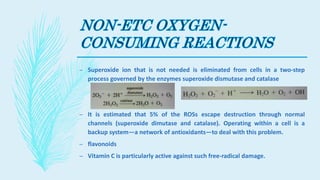
– Superoxide ion that is not needed is eliminated from cells in a two-step
process governed by the enzymes superoxide dismutase and catalase
– It is estimated that 5% of the ROSs escape destruction through normal
channels (superoxide dimutase and catalase). Operating within a cell is a
backup system—a network of antioxidants—to deal with this problem.
– flavonoids
– Vitamin C is particularly active against such free-radical damage.
– The oxidative phosphorylation process is as follow Electron
transport down the respiratory chain from NADH or FADH2
Complex Ⅰ,Ⅲ,Ⅳ Cause protons be pumped out of the
mitochondrial matrix into the intermembrane space The
pumping out of H + generates a higher conc. of H+ and an
electrical potential , thus an electrochemical proton gradient is
formed.
– The H + flow back into the mitochondrial matrix through ATP
synthase and the electrochemical proton gradient drives ATP
synthesis
References:
– https://microbenotes.com/oxidative-phosphorylation/
– https://chem.libretexts.org/Courses/Brevard_College/CHE_301_Biochemistry/08%3A_Metab
olism_of_carbohydrates/8.06%3A_Oxidative_Phosphorylation
– https://www.slideshare.net/ashokktt/biological-oxidation-part-iii-oxidative-phosphorylation
– https://themedicalbiochemistrypage.org/oxidative-phosphorylation-related-mitochondrial-
functions/
– https://www.khanacademy.org/science/ap-biology/cellular-energetics/cellular-respiration-
ap/a/oxidative-phosphorylation-etc
– https://www.slideshare.net/sadaffarooq395/oxidative-phosphorylation-29905346
– https://bio.libretexts.org/Bookshelves/Biochemistry/Book%3A_Biochemistry_Free_For_All_(A
hern_Rajagopal_and_Tan)/05%3A_Energy/5.2%3A_Electron_Transport_and_Oxidative_Phosp
horylation
Biochem Respiratory chain and Oxidative phosphorylation

Biochem Respiratory chain and Oxidative phosphorylation

  • 2.
    Inhumang, Blazy D. Galapon,Odeza Lhie G. Salting, Diana Rhose
  • 4.
    – also knownas the electron transport chain – A series of biochemical reactions in which electrons and hydrogen ions form NADH (nicotinamide adenine dinucleotide) and FADH2 (flavin adenine dinucleotide) both of which get oxidized in the electron transport chain – passed on from complex to complex and finally to oxygen, creating a proton gradient that will be used to make ATP from ADP (oxidative phosphorylation)
  • 5.
    – The enzymesand electron carriers needed for the ETC are located along the inner mitochondrial membrane. – These four protein complexes, which are tightly bound to the membrane are: – Complex I : NADH-coenzyme Q reductase – Complex II : Succinate-coenzyme Q reductase – Complex III: Coenzyme Q-cytochrome c reductase – Complex IV : Cytochrome c oxidase – In ETC coenzyme Q and cytochrome c serves as mobile electron carriers that shuttle electrons between the various complexes.
  • 6.
    – Largest ofthe 4 protein complexes – Complex I containing 40 subunits including flavin mononucleotide (FMN)- a derivative of riboflavin or Vitamin B2 - and iron-sulfur proteins called FeS.
  • 7.
    • The firstelectron transfer step is NADH gives its electron to flavin mononucleotide
  • 8.
    Comes from thematrix solution which can again participate in citric acid cycle ISOALLOXAZINE RING - that is samely found in FAD (flavin adenine dinucleotide)
  • 9.
    • The nextsteps involve transfer of electrons from the reduced FMNH2 through a series of iron/sulfur proteins (FeSPs).
  • 10.
    • In thefinal complex I reaction, Fe(II)SP is reconverted into Fe(III)SP as each of two Fe(II)SP units passes an electron to CoQ, changing it from its oxidized form (CoQ) to its reduced form (CoQH2).
  • 11.
    Structural characteristics ofthe coenzyme Q. • Coenzyme Q, in both its oxidized and reduced forms, is lipid soluble and can move laterally within the mitochondrial membrane. • Its function is to shuttle its newly acquired electrons to complex III, where it becomes the initial substrate for reactions at this complex. • The Q in the designation coenzyme Q comes from the molecule quinone. Structurally, coenzyme Q is a quinone derivative. • In its most common form, coenzyme Q has a long carbon chain containing 10 isoprene units attached to its quinone unit. • The actual changes that occur within the structure of CoQ as it accepts the two electrons and the two H ions involve the quinone part of its structure, as shown. • The two H ions that CoQ picks up in forming CoQH2 come from solution
  • 12.
    – contains only4 subunits, including two FeSPs. – FADH2 gives its electron to Complex II - This complex is used to process the FADH2 that is generated in the citric acid cycle when succinate is converted to fumarate.
  • 13.
    • CoQ isassociated with the operations in complex II in a manner similar to its actions in complex I.
  • 15.
    *Note the generalpattern that is developing for the electron carriers. They are reduced in one step (accept electrons) and then regenerated (oxidized; lose electrons) in the next step so that they can again participate in electron transport chain reactions.
  • 16.
    COMPLEX III. Coenzyme Q–Cytochromec Reductase COMPLEX IV. Cytochrome c Oxidase
  • 17.
    Complex III Electron carriers •Iron-sulfur proteins (FeSP) • Cytochromes -iron changes back and forth between the 3 and 2 oxidation states. -heme containing protein in which reversible oxidation and reduction of an iron atom occur.

  • 18.
    Complex III Various cytochromes,abbreviated cyt a, cyt b, cyt c, and so on, differ from each other in (1) their protein constituents, (2) the manner in which the heme is bound to the protein (3) attachments to the heme ring Cyt c is the only one of the cytochromes that is water soluble.
  • 19.
    Complex IV The electronmovement flows from cyt C to cyt a to cyt a3. The electrons from cyt a3 and hydrogen ions from cellular solution combine with oxygen (O2) to form water. It is estimated that 95% of the oxygen used by cells serves as the final electron acceptor for the ETC. The heme groups of cyt a and a3 contain copper rather than iron.
  • 21.
    – The synthesisof ATP from ADP (phosphorylation), that occurs when NADH and FADH2 are oxidized through electron transport chain (respiratory chain). – Mitochondria are the site of oxidative phosphorylation in eukaryotes Oxidative Phosphorylation – During transfer of electrons through the ETC energy is produced. – This energy is coupled to the formation of ATP from ADP. – By an enzyme F0F1 ATPase.
  • 22.
    Two ways tosynthesize ATP – Oxidative phosphorylation is the phosphorylation of ADP to ATP coupled to electron transfer. – Substrate level phosphorylation is the direct transfer the phosphate from chemical intermediate (also called substrate ) to ADP or GDP forming ATP or GTP, independent of electron transfer chain. Examples are the removal of inorganic phosphates from 1,3- biphosphoglycerate or phosphoenolpyruvate to form 3- phosphoglycerate or pyruvate, respectively, as well as ATP .
  • 23.
    – Oxidative phosphorylationis the biochemical process by which ATP is synthesized from ADP as a result of the transfer of electrons and hydrogen ions from NADH or FADH2 to O2 through the electron carriers involved in the electron transport chain. – Oxidative phosphorylation is responsible for 90 % of total ATP synthesis in the cell.
  • 24.
    – The establishmentof the proton gradient is dependent upon electron transport. If electron transport stops or if the inner mitochondrial membrane’s impermeability to protons is compromised, oxidative phosphorylation will not occur because without the proton gradient to drive the ATP synthase, there will be no synthesis of ATP. – Coupled reactions are pairs of biochemical reactions that occur concurrently in which energy released by one reaction is used in the other reaction. – Some of the H+ ions crossing the inner mitochondrial membrane come from the reduced electron carriers, and some come from the matrix
  • 25.
    – For everytwo electrons passed through the ETC;  four protons cross the inner mitochondrial membrane through complex I  four through complex III  two more through complex IV
  • 26.
    – There are3 sites of the chain that can give enough energy for ATP synthetase These sites are: – Site I between FMN and Coenzyme Q at enzyme complex I. – Site II between cytochrome b and cytochrome C1 at enzyme complex III – Site III between cytochrome a and cytochrome a3 at enzyme complex IV
  • 27.
    – Chemiosmotic couplingis the coupling of ATP synthesis with electron transport chain reactions that requires a proton gradient across the inner mitochondrial membrane. The main concepts in this explanation for coupling follow. 1. Pumping of protons via electron carrier proteins 2. Generation of electrochemical potential. i. Membrane potential ii. Proton gradient (chemical potential) 3. Electron transport flow back to matrix through ATPase.
  • 28.
    – A greaternumber of protons in the intermembrane space than in the matrix is the result of the pumping of protons from the mitochondrial matrix across the inner mitochondrial membrane. – The transport of electrons through ETC is coupled with the translocation of protons (H+) across the inner mitochondrial membrane from the matrix to the intermembrane space. – This results in an electrochemical or proton gradient.
  • 29.
     Generation ofelectrochemical potential – A spontaneous flow of protons from the region of high concentration to the region of low concentration occurs because of the electrochemical gradient  Electron transport flow back to matrix through ATPase – ATP synthase has two subunits, the F0 and F1 subunits. The F0 part of the synthase is the channel for proton flow, whereas the formation of ATP takes place in the F1 subunit. – ADP + Pi ATP synthase ATP + H2O
  • 30.
    – The ATPsynthase has two distinct subunits: – The transmembrane F0 subunit, made of abc polypeptides; Spans the inner mitochondria membrane – F1 subunit, contains 5 types of polypeptides; arranged in α3β3γδε; The spheres of the ATP synthase & point outward. – Several subunits of the protein form a ball-like shape arranged around an axis known as F1, which projects into the matrix and contains the phosphorylation mechanism. – So the ATP synthase is also called F0F1 ATPase
  • 31.
    – F1 isattached to a membrane protein complex known as F0, which also consists of several protein subunits. – The flow of protons through F0 causes it to rotate, driving the production of ATP in the F1 complex. – A portion of the F1 subunit termed the stalk links the two subunits. – As protons flow through the channel in the F0 subunit, they cause the embedded stalk to rotate in the stationary F1 subunit, thereby converting the energy of the electrochemical gradient into mechanical energy.
  • 32.
    – FADH2’s entrancepoint into the chain, complex II, is beyond the first “proton-pumping” site, complex I. – The energy yield, in terms of ATP production, can now be totaled for the common metabolic pathway. Every acetyl CoA entering the citric acid cycle (CAC) produces three NADH, one FADH2, and one GTP. Thus 10 molecules of ATP are produced for each acetyl CoA catabolized.
  • 33.
    – The cyclingof ATP and ADP in metabolic processes is the principal medium for energy exchange in biochemical processes. – The conversion ATP ADP + Pi, powers life processes. – The conversion Pi + ADP ATP, regenerates the ATP expended in cell operation. – ATP is a high-energy phosphate compound. Its hydrolysis to ADP produces an intermediate amount of free energy (7.5 kcal/mole) compared with hydrolysis energies for other organophosphate compounds.
  • 34.
    – more than90% of the oxygen taken into the human body via respiration. – converted into several highly reactive oxygen species (ROS) – hydrogen peroxide (H2O2), superoxide ion (O2 ), and hydroxyl radical (OH). – White blood cells have a significant concentration of superoxide free radicals; aid in the destruction of invading bacteria and viruses. – 2O2 + NADPH 2O2- + NADP+ + H+ – (NADP is a phosphorylated version of the coenzyme NADH)
  • 35.
    – Superoxide ionthat is not needed is eliminated from cells in a two-step process governed by the enzymes superoxide dismutase and catalase – It is estimated that 5% of the ROSs escape destruction through normal channels (superoxide dimutase and catalase). Operating within a cell is a backup system—a network of antioxidants—to deal with this problem. – flavonoids – Vitamin C is particularly active against such free-radical damage.
  • 36.
    – The oxidativephosphorylation process is as follow Electron transport down the respiratory chain from NADH or FADH2 Complex Ⅰ,Ⅲ,Ⅳ Cause protons be pumped out of the mitochondrial matrix into the intermembrane space The pumping out of H + generates a higher conc. of H+ and an electrical potential , thus an electrochemical proton gradient is formed. – The H + flow back into the mitochondrial matrix through ATP synthase and the electrochemical proton gradient drives ATP synthesis
  • 37.
    References: – https://microbenotes.com/oxidative-phosphorylation/ – https://chem.libretexts.org/Courses/Brevard_College/CHE_301_Biochemistry/08%3A_Metab olism_of_carbohydrates/8.06%3A_Oxidative_Phosphorylation –https://www.slideshare.net/ashokktt/biological-oxidation-part-iii-oxidative-phosphorylation – https://themedicalbiochemistrypage.org/oxidative-phosphorylation-related-mitochondrial- functions/ – https://www.khanacademy.org/science/ap-biology/cellular-energetics/cellular-respiration- ap/a/oxidative-phosphorylation-etc – https://www.slideshare.net/sadaffarooq395/oxidative-phosphorylation-29905346 – https://bio.libretexts.org/Bookshelves/Biochemistry/Book%3A_Biochemistry_Free_For_All_(A hern_Rajagopal_and_Tan)/05%3A_Energy/5.2%3A_Electron_Transport_and_Oxidative_Phosp horylation