IC’S AND INSTRUMENTATION
Prof K.Manikantan
Government Arts College
Udhagamandalam
Epitaxial Growth
• The word epitaxy is derived from Greek word epi meaning 'upon' and the past tense of the
word teinon meaning 'arranged'. So, one could describe epitaxy as, arranging atoms in single
crystal fashion upon a single crystal substrate, so that the resulting layer is an extension of the
substrate crystal structure. The basic chemical reaction used for the epitaxial growth of pure
silicon is the hydrogen reduction of silicon tetrachloride.
 Epitaxial films with specific impurity concentration are required. This is
accomplished by introducing phosphine <PH3> for the n-type and bi.borane
B2H6 for p.type doping into the silicon.
 Tetrachloride hydrogen gas stream. The process is carried out in a reaction
chamber consisting of a long cylindrical quarto tube encircled by an RF
induction coil. Figure shows the diagrammatic representation of the system
used. The silicon wafers are placed on a rectangular graphite rod called a boat.
 This boat is then placed in the reaction chamber where the graphite is heated
inductively to a temperature 1200'C. The various gases required for the growth
of desired epitaxial layers are introduced into the system through a control
console.
 Oxidation
 SiO2 has the property of preventing the diffusion of almost all impurities through it. It
serves two very important purposes.
 1. SiO2 is an extremely hard protective coating and is unaffected by almost all reagents
except hydrofluoric acid. Thus it stands against any contamination.
 2. By selective etching of SiO2, diffusion of impurities through carefully defined windows
in the SiO2 can be accomplished to fabricate various components.
 The silicon wafers are stacked up in a quartz boat and then inserted into quartz furnace
tube. The Si-wafers are raised to a high temperature in the range of 950 to 1150C and at the
same time, exposed to a gas containing O. or H.O or both.
 The chemical reaction is Si + 2H20 SiO2 + 2H2 This oxidation process is called thermal
oxidation because high temperature is used to grow the oxide layer.
 The thickness of the film is governed by time, temperature and the moisture content. The
thickness of oxide layer is usually in the order of 0.02 to 2μm.
 Photolithography
 With the help of photolithography, it has become possible to produce microscopically small
circuit and device patterns on Si-wafers.
 As many as 10,000 transistors can be fabricated on a 1 cm x 1 cm chip. The conventional
photolithographic process uses ultraviolet light exposure and device dimension or line width
as small as 2 I1IIl can be obtained.
 However, with the advent of latest technology using X.ray or electron beam lithographic
techniques, it has become possible to produce de. vice dimension 7
 down to submicron range (<1 μm).Photolithography involves two processes, namely: Making
of a photographic mask.
 Photo etching
 The making of a photographic mask involves the following sequence of operations-first the
preparation of initial artwork and secondly, its reduction.
 The initial layout or artwork of an IC is normally done at a scale several hundred times larger
than the final dimensions of the finished monolithic circuit. This is because, for a tiny chip,
larger the artwork, more accurate is the final mask. For example, it is often required to make
an opening of width about 1 mil (25 11m).
 This initial layout is then decomposed into several mask layers, each corresponding to a
process step in the fabrication schedule, e.g., a mask for base diffusion, another for collector
diffusion, another for metallization and so on.
 For photographic purpose, artwork should not contain any line drawings but must be of
alternate clear and opaque regions. This is accomplished by the use of clear Mylar coated with
a sheet of red photographically opaque mylar (trade name-Rubylith).
 Photoetching is used for the removal of Si02 from desired regions so that the desired
impurities can be diffused. The wafer is coated with 1 film of photosensitive emulsion
(Kodak Photoresist KPR).
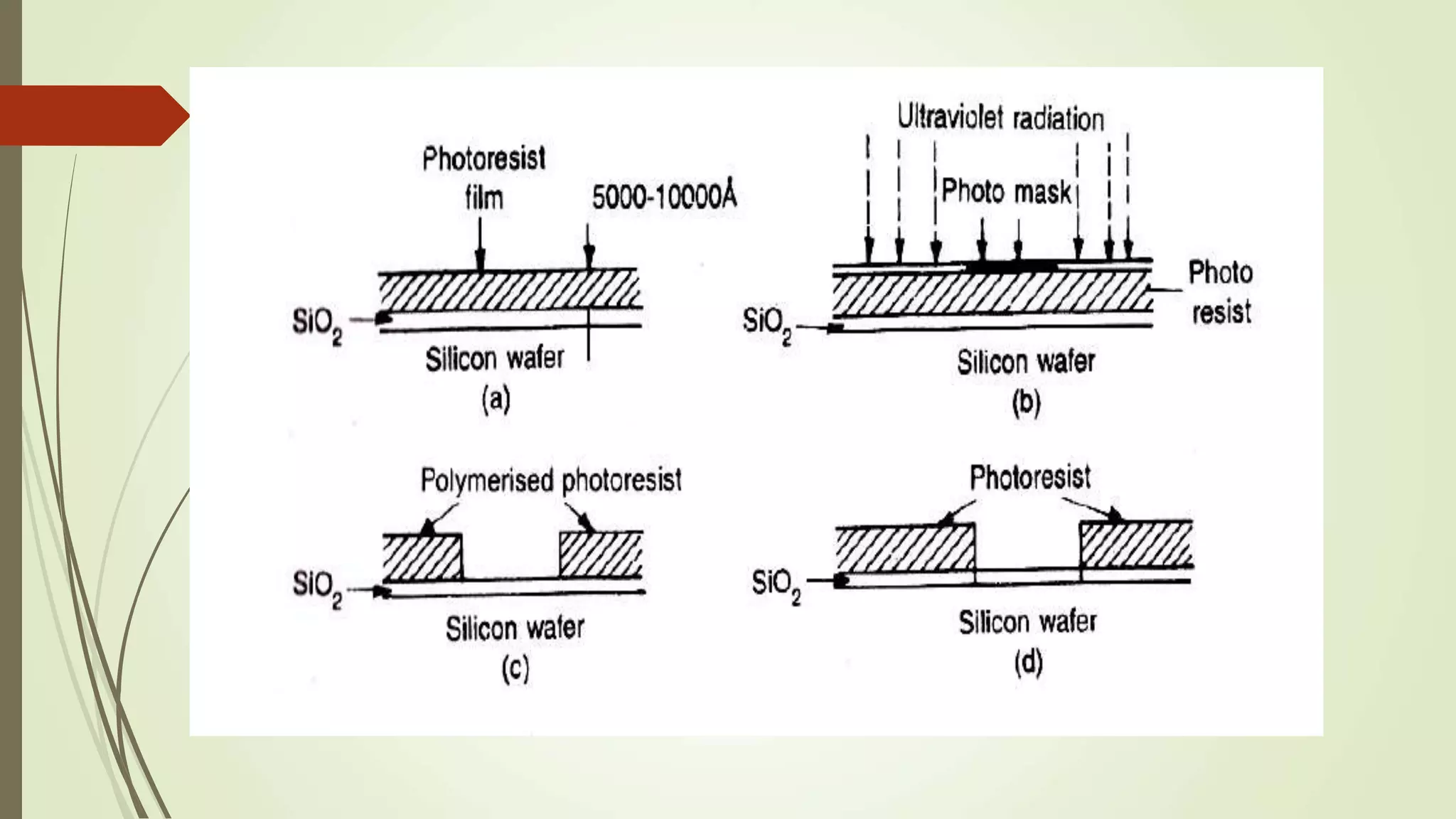
 The thickness of the film is in the range of 5000-10000 A as shown in Fig (a). The mask
negative of the desired pattern) as prepared by steps described earlier is placed over the
photoresist coated wafer as shown in Fig (b). This is now exposed to ultraviolet light. so that
KPR becomes polymerized beneath the transparent regions of the mask.
 The mask is then removed and the wafer is developed using 1 chemical
(trichloroethylene) which dissolves the unexposed unpolymerized regions on the
photoresist and leaves the pattern as shown in Fig (c).
 The polymerized photoresist is next fixed or ,,"red. so that it becomes immune to
certain chemicals called etchants used in subsequent processing steps. The chip is
immersed in the etching solution of hydrofluoric acid, which removes the Si02 from
the areas which are not protected by KPR as shown in Fig (d) after diffusion of
impurities the photoresist is removed with a chemical solvent (hot H2SO4) and
mechanical abrasion.
 Diffusion
 Another important process in the fabrication of monolithic ICs is the diffusion of impurities in
the Silicon chip. This uses a high temperature furnace having a flat temperature profile over a
useful length (about 20" length).
 A quartz boat containing about 20 cleaned wafers is pushed into the hot zone with temperature
maintained at about a 1000°C. I impurities to be diffused are rarely used in their elemental
forms. Normally, compounds such as ~03 (Boron oxide), BCl3 (Boron chloride)are used for
Boron and P20S (Phosphorous pentaoxide) and POCl3 (Phosphorous oxychloride) are used as
sources of Phosphorous.
 A carrier goes, such as dry oxygen or nitrogen is normally used for sweeping the impurity to
the high temperature zone. The depth of diffusion depends upon the time of diffusion which
normally extends to 2 hours.
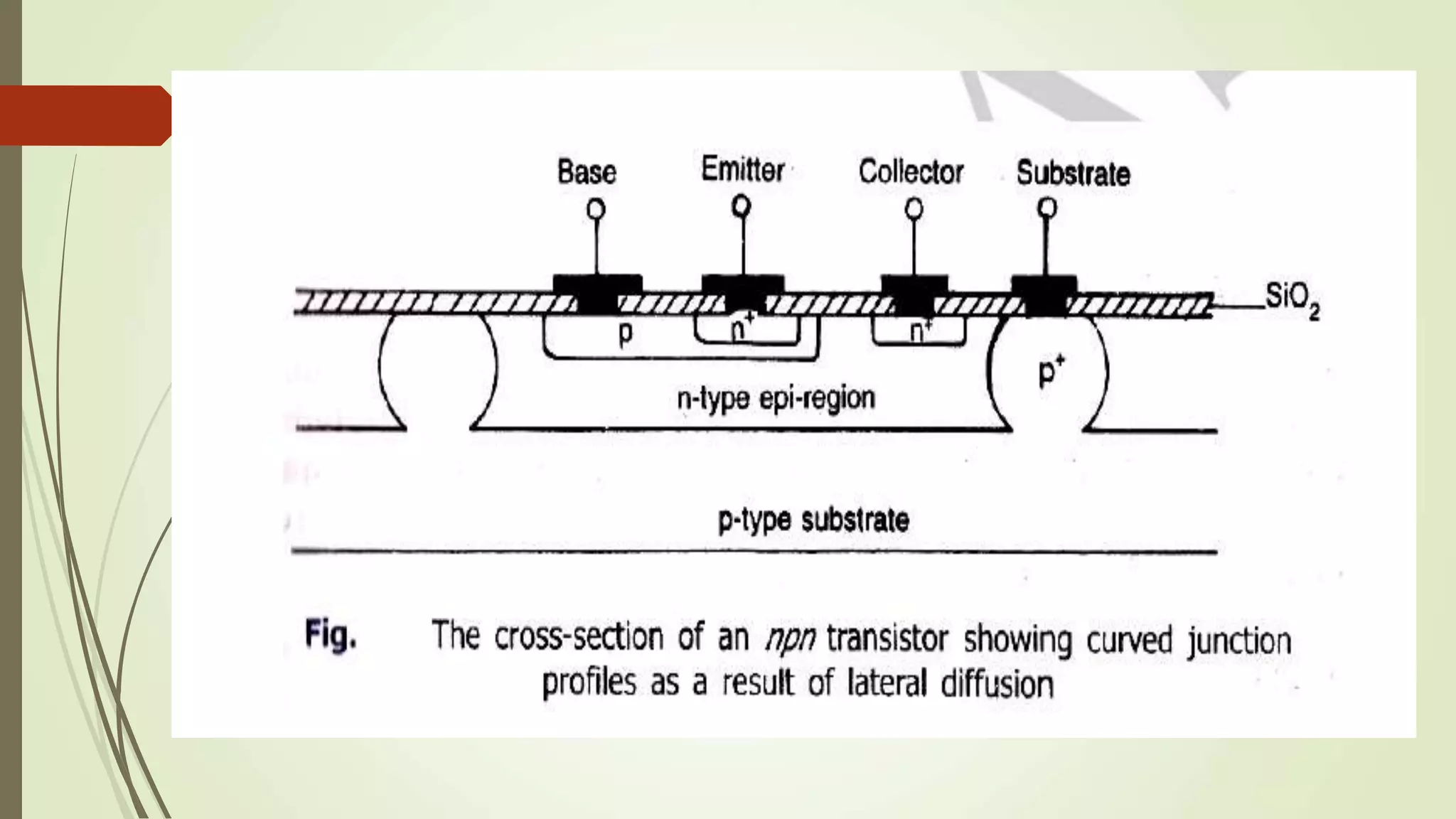
 The diffusion of impurities normally takes place both laterally as well us vertically. Therefore,
the actual junction profiles will be curved 110 shown in Fig. However, for the sake of
simplicity, lateral diffusion will be omitted in all the drawings.
 Ion Implantation
 lon implantation is the other technique used to introduce impurities in a silicon wafer. In this
process, silicon wafers are placed in a vacuum chamber and are scanned by a beam of high-
energy dopant in" (borons for p-type and phosphorus for n-type) as shown in Fig..
 These ions are accelerated by energies between 20 kV to 250 kV. As the ions strike the silicon
wafers, they penetrate some small distance into the wafer.
 The depth of penetration of any particular type of Ion increases with increasing accelerating
voltage. Ion implantation technique has two important advantages.
 1. It is performed at low temperatures. Therefore, previously diffused regions have a lesser
tendency for lateral spreading.
 2. In diffusion process, temperature has to be controlled over a large area inside the oven,
whereas in ion implantation technique, accelerating potential and the beam current are
electrically controlled from outside.
 Isolation Techniques
 Since a number of components are fabricated on the same IC chip, it becomes necessary to
provide electrical isolation between different components and interconnections. Various types
of isolation techniques have been developed. However, we shaJl discuss here only two
commonly used techniques namely:
 PN junction isolation.
 Dielectric isolation
 P-N Junction Isolation
 In this isolation technique, p+ type impurities are selectively diffused Into the n.type epitaxial
layer so as to reach p-type substrate as Shown in Fig (a).
 This produces islands surrounded by p.type moats. It can be seen that these regions are
separated by two back to. back p.n junction diodes. If the p-type substrate material is held at
the most negative potential in the circuit, the diodes will be reverse biased providing electric
isolation between these islands.
 The different components are fabricated in these isolation islands. The concentration of the
acceptor atoms in the region between isolation islands is usually kept much higher (p+) than
the p-type substrate. This prevents the depletion region of the reverse biased diode from
penetrating more into p+ region and possibly connecting the isolation islands.
 Dielectric Isolation
 Here a layer of solid dielectric such as silicon dioxide or ruby completely surrounds each
component, thereby producing isolation, both electrical and physical.
 This isolating dielectric layer is thick enough so that its associated capacitance is negligible.
Also, it is possible to fabricate both pnp and npn transistor within the same silicon substrate.
 Since this method requires additional fabrication steps, it becomes more expensive. The
technique is mostly used for fabricating professional grade ICs required for specialized
applications viz, aerospace and military, where higher cost is justified by superior
performance. Figure (b) shows such a structure.
 Metallization
 The purpose of this process is to produce a thin metal film layer that will serve to make
interconnections of the various components on the chip. Aluminium is usually used for the
metallization of most ICs as it offers several advantages.
 1. It is relatively a good conductor.
 2. It is easy to deposit aluminium films using vacuum deposition.
 3. Aluminium makes good mechanical bonds with silicon.
 4. Aluminium forms low resistance, non-rectifying (i.e. ohmic) contact with p-type silicon and
the heavily doped n-type silicon
 The film thickness of about 1 μm and conduction width of about 2 to 25 μm is commonly used.
The process takes place in a vacuum evaporation chamber as shown in Fig..
 The pressure in the chamber is reduced to the range of about 10-6 to 10-7 torr (l - atmosphere .
760 torr = 760 mm Hg). The material to be evaporated is placed in a resistance heated tungsten
coil or basket. A very high power density electron beam is focused at the surface of the material
to be evaporated.
 This heats up the material to very high temperature and It starts vaporizing. These vapors travel
in straight line paths. The evaporated molecules hit the substrate and condense there to form a
thin film coating.
 After the thin film metallization is done, the film is patterned to produce the required
interconnections and bonding pad configuration. This is done by photolithographic process and
aluminium is etched away from unwanted places by using etchants like phosphoric acid
(H3PO4).

Epitaxial growth

  • 1.
    IC’S AND INSTRUMENTATION ProfK.Manikantan Government Arts College Udhagamandalam
  • 2.
    Epitaxial Growth • Theword epitaxy is derived from Greek word epi meaning 'upon' and the past tense of the word teinon meaning 'arranged'. So, one could describe epitaxy as, arranging atoms in single crystal fashion upon a single crystal substrate, so that the resulting layer is an extension of the substrate crystal structure. The basic chemical reaction used for the epitaxial growth of pure silicon is the hydrogen reduction of silicon tetrachloride.
  • 3.
     Epitaxial filmswith specific impurity concentration are required. This is accomplished by introducing phosphine <PH3> for the n-type and bi.borane B2H6 for p.type doping into the silicon.  Tetrachloride hydrogen gas stream. The process is carried out in a reaction chamber consisting of a long cylindrical quarto tube encircled by an RF induction coil. Figure shows the diagrammatic representation of the system used. The silicon wafers are placed on a rectangular graphite rod called a boat.  This boat is then placed in the reaction chamber where the graphite is heated inductively to a temperature 1200'C. The various gases required for the growth of desired epitaxial layers are introduced into the system through a control console.
  • 5.
     Oxidation  SiO2has the property of preventing the diffusion of almost all impurities through it. It serves two very important purposes.  1. SiO2 is an extremely hard protective coating and is unaffected by almost all reagents except hydrofluoric acid. Thus it stands against any contamination.  2. By selective etching of SiO2, diffusion of impurities through carefully defined windows in the SiO2 can be accomplished to fabricate various components.  The silicon wafers are stacked up in a quartz boat and then inserted into quartz furnace tube. The Si-wafers are raised to a high temperature in the range of 950 to 1150C and at the same time, exposed to a gas containing O. or H.O or both.  The chemical reaction is Si + 2H20 SiO2 + 2H2 This oxidation process is called thermal oxidation because high temperature is used to grow the oxide layer.  The thickness of the film is governed by time, temperature and the moisture content. The thickness of oxide layer is usually in the order of 0.02 to 2μm.
  • 6.
     Photolithography  Withthe help of photolithography, it has become possible to produce microscopically small circuit and device patterns on Si-wafers.  As many as 10,000 transistors can be fabricated on a 1 cm x 1 cm chip. The conventional photolithographic process uses ultraviolet light exposure and device dimension or line width as small as 2 I1IIl can be obtained.  However, with the advent of latest technology using X.ray or electron beam lithographic techniques, it has become possible to produce de. vice dimension 7  down to submicron range (<1 μm).Photolithography involves two processes, namely: Making of a photographic mask.  Photo etching  The making of a photographic mask involves the following sequence of operations-first the preparation of initial artwork and secondly, its reduction.  The initial layout or artwork of an IC is normally done at a scale several hundred times larger than the final dimensions of the finished monolithic circuit. This is because, for a tiny chip, larger the artwork, more accurate is the final mask. For example, it is often required to make an opening of width about 1 mil (25 11m).
  • 8.
     This initiallayout is then decomposed into several mask layers, each corresponding to a process step in the fabrication schedule, e.g., a mask for base diffusion, another for collector diffusion, another for metallization and so on.  For photographic purpose, artwork should not contain any line drawings but must be of alternate clear and opaque regions. This is accomplished by the use of clear Mylar coated with a sheet of red photographically opaque mylar (trade name-Rubylith).  Photoetching is used for the removal of Si02 from desired regions so that the desired impurities can be diffused. The wafer is coated with 1 film of photosensitive emulsion (Kodak Photoresist KPR).  The thickness of the film is in the range of 5000-10000 A as shown in Fig (a). The mask negative of the desired pattern) as prepared by steps described earlier is placed over the photoresist coated wafer as shown in Fig (b). This is now exposed to ultraviolet light. so that KPR becomes polymerized beneath the transparent regions of the mask.
  • 9.
     The maskis then removed and the wafer is developed using 1 chemical (trichloroethylene) which dissolves the unexposed unpolymerized regions on the photoresist and leaves the pattern as shown in Fig (c).  The polymerized photoresist is next fixed or ,,"red. so that it becomes immune to certain chemicals called etchants used in subsequent processing steps. The chip is immersed in the etching solution of hydrofluoric acid, which removes the Si02 from the areas which are not protected by KPR as shown in Fig (d) after diffusion of impurities the photoresist is removed with a chemical solvent (hot H2SO4) and mechanical abrasion.
  • 10.
     Diffusion  Anotherimportant process in the fabrication of monolithic ICs is the diffusion of impurities in the Silicon chip. This uses a high temperature furnace having a flat temperature profile over a useful length (about 20" length).  A quartz boat containing about 20 cleaned wafers is pushed into the hot zone with temperature maintained at about a 1000°C. I impurities to be diffused are rarely used in their elemental forms. Normally, compounds such as ~03 (Boron oxide), BCl3 (Boron chloride)are used for Boron and P20S (Phosphorous pentaoxide) and POCl3 (Phosphorous oxychloride) are used as sources of Phosphorous.  A carrier goes, such as dry oxygen or nitrogen is normally used for sweeping the impurity to the high temperature zone. The depth of diffusion depends upon the time of diffusion which normally extends to 2 hours.  The diffusion of impurities normally takes place both laterally as well us vertically. Therefore, the actual junction profiles will be curved 110 shown in Fig. However, for the sake of simplicity, lateral diffusion will be omitted in all the drawings.
  • 12.
     Ion Implantation lon implantation is the other technique used to introduce impurities in a silicon wafer. In this process, silicon wafers are placed in a vacuum chamber and are scanned by a beam of high- energy dopant in" (borons for p-type and phosphorus for n-type) as shown in Fig..  These ions are accelerated by energies between 20 kV to 250 kV. As the ions strike the silicon wafers, they penetrate some small distance into the wafer.  The depth of penetration of any particular type of Ion increases with increasing accelerating voltage. Ion implantation technique has two important advantages.  1. It is performed at low temperatures. Therefore, previously diffused regions have a lesser tendency for lateral spreading.  2. In diffusion process, temperature has to be controlled over a large area inside the oven, whereas in ion implantation technique, accelerating potential and the beam current are electrically controlled from outside.
  • 14.
     Isolation Techniques Since a number of components are fabricated on the same IC chip, it becomes necessary to provide electrical isolation between different components and interconnections. Various types of isolation techniques have been developed. However, we shaJl discuss here only two commonly used techniques namely:  PN junction isolation.  Dielectric isolation  P-N Junction Isolation  In this isolation technique, p+ type impurities are selectively diffused Into the n.type epitaxial layer so as to reach p-type substrate as Shown in Fig (a).  This produces islands surrounded by p.type moats. It can be seen that these regions are separated by two back to. back p.n junction diodes. If the p-type substrate material is held at the most negative potential in the circuit, the diodes will be reverse biased providing electric isolation between these islands.  The different components are fabricated in these isolation islands. The concentration of the acceptor atoms in the region between isolation islands is usually kept much higher (p+) than the p-type substrate. This prevents the depletion region of the reverse biased diode from penetrating more into p+ region and possibly connecting the isolation islands.
  • 16.
     Dielectric Isolation Here a layer of solid dielectric such as silicon dioxide or ruby completely surrounds each component, thereby producing isolation, both electrical and physical.  This isolating dielectric layer is thick enough so that its associated capacitance is negligible. Also, it is possible to fabricate both pnp and npn transistor within the same silicon substrate.  Since this method requires additional fabrication steps, it becomes more expensive. The technique is mostly used for fabricating professional grade ICs required for specialized applications viz, aerospace and military, where higher cost is justified by superior performance. Figure (b) shows such a structure.
  • 17.
     Metallization  Thepurpose of this process is to produce a thin metal film layer that will serve to make interconnections of the various components on the chip. Aluminium is usually used for the metallization of most ICs as it offers several advantages.  1. It is relatively a good conductor.  2. It is easy to deposit aluminium films using vacuum deposition.  3. Aluminium makes good mechanical bonds with silicon.  4. Aluminium forms low resistance, non-rectifying (i.e. ohmic) contact with p-type silicon and the heavily doped n-type silicon  The film thickness of about 1 μm and conduction width of about 2 to 25 μm is commonly used. The process takes place in a vacuum evaporation chamber as shown in Fig..  The pressure in the chamber is reduced to the range of about 10-6 to 10-7 torr (l - atmosphere . 760 torr = 760 mm Hg). The material to be evaporated is placed in a resistance heated tungsten coil or basket. A very high power density electron beam is focused at the surface of the material to be evaporated.
  • 18.
     This heatsup the material to very high temperature and It starts vaporizing. These vapors travel in straight line paths. The evaporated molecules hit the substrate and condense there to form a thin film coating.  After the thin film metallization is done, the film is patterned to produce the required interconnections and bonding pad configuration. This is done by photolithographic process and aluminium is etched away from unwanted places by using etchants like phosphoric acid (H3PO4).