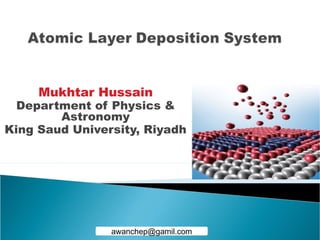
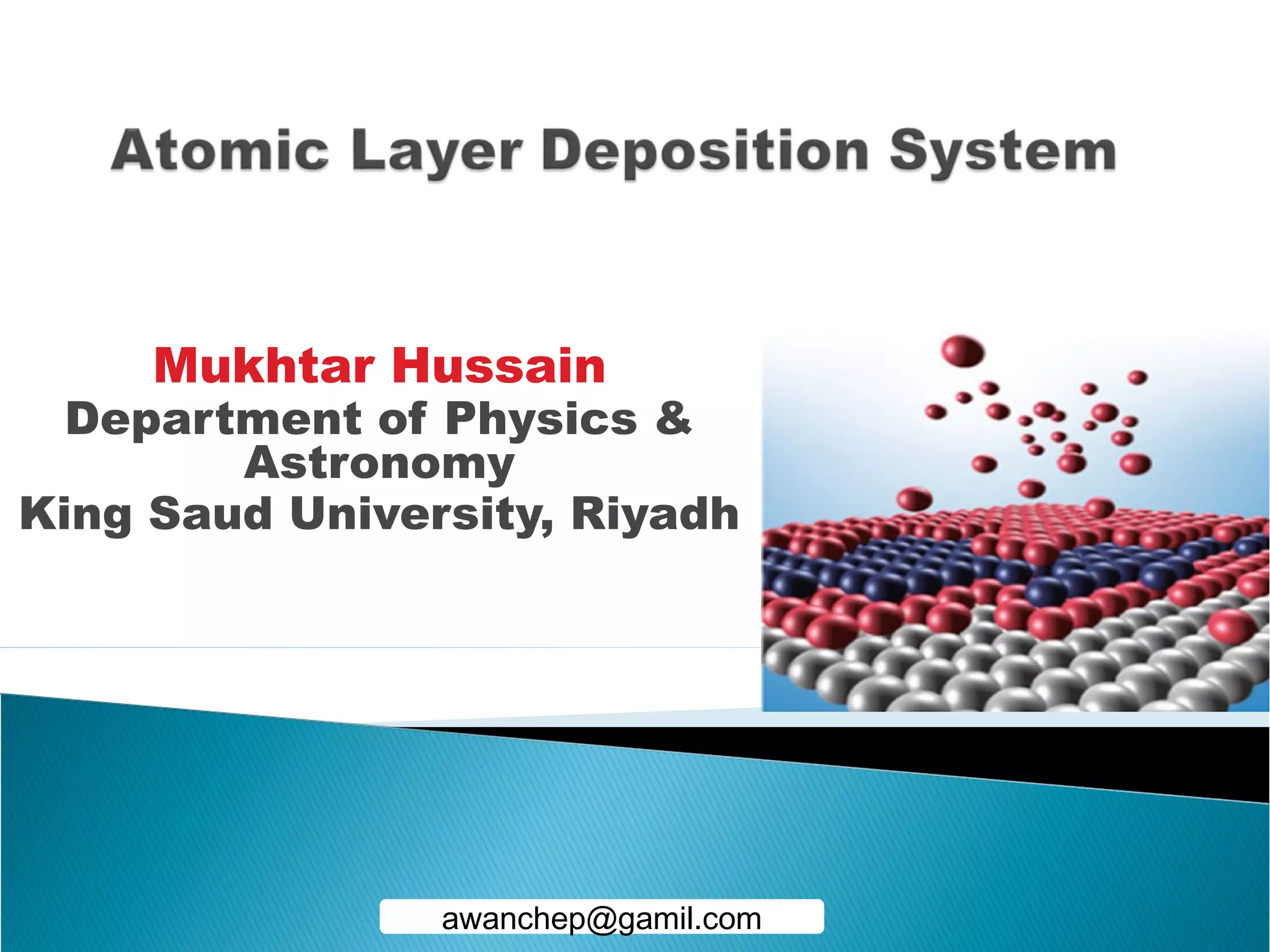
Mukhtar Hussain
Department of Physics &
Astronomy
King Saud University, Riyadh
awanchep@gamil.com
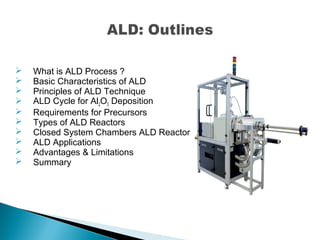
 What is ALD Process ?
 Basic Characteristics of ALD
 Principles of ALD Technique
 ALD Cycle for Al2O3 Deposition
 Requirements for Precursors
 Types of ALD Reactors
 Closed System Chambers ALD Reactor
 ALD Applications
 Advantages & Limitations
 Summary
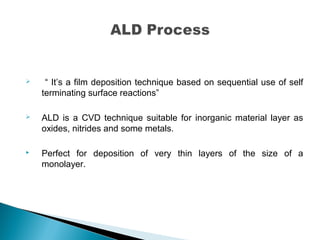
 “ It’s a film deposition technique based on sequential use of self
terminating surface reactions”
 ALD is a CVD technique suitable for inorganic material layer as
oxides, nitrides and some metals.
 Perfect for deposition of very thin layers of the size of a
monolayer.
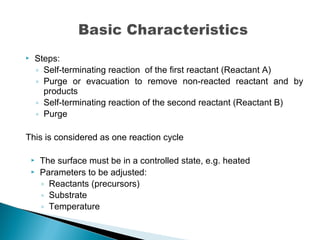
 Steps:
◦ Self-terminating reaction of the first reactant (Reactant A)
◦ Purge or evacuation to remove non-reacted reactant and by
products
◦ Self-terminating reaction of the second reactant (Reactant B)
◦ Purge
This is considered as one reaction cycle
 The surface must be in a controlled state, e.g. heated
 Parameters to be adjusted:
◦ Reactants (precursors)
◦ Substrate
◦ Temperature
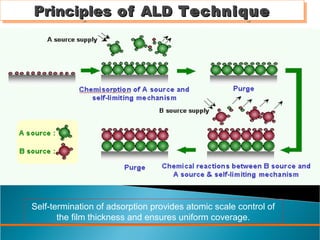
Self-termination of adsorption provides atomic scale control of
the film thickness and ensures uniform coverage.
PrinciplesPrinciples ofof ALDALD TechniqueTechniquePrinciplesPrinciples ofof ALDALD TechniqueTechnique
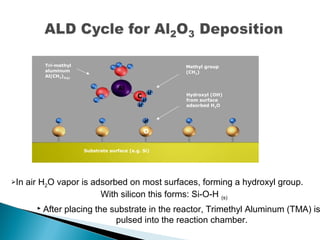
In air H2O vapor is adsorbed on most surfaces, forming a hydroxyl group.
With silicon this forms: Si-O-H (s)
 After placing the substrate in the reactor, Trimethyl Aluminum (TMA) is
pulsed into the reaction chamber.
Tri-methyl
aluminum
Al(CH3)3(g)
C
H
H
H
H
Al
O
Hydroxyl (OH)
from surface
adsorbed H2O
Methyl group
(CH3)
Substrate surface (e.g. Si)
Al(CH3)3 (g) + : Si-O-H (s) :Si-O-Al(CH3)2 (s) + CH4
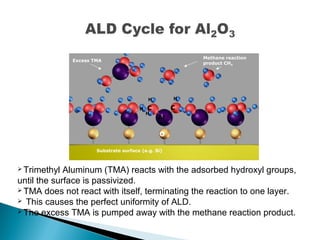
 Trimethyl Aluminum (TMA) reacts with the adsorbed hydroxyl groups,
producing methane as the reaction product
C
H
H
H
H
Al
O
Reaction of
TMA with OH
Methane reaction
product CH4
H
H
H
H
H C
C
Substrate surface (e.g. Si)
C
HH
Al
O
Excess TMA
Methane reaction
product CH4
H
H C
 Trimethyl Aluminum (TMA) reacts with the adsorbed hydroxyl groups,
until the surface is passivized.
 TMA does not react with itself, terminating the reaction to one layer.
 This causes the perfect uniformity of ALD.
 The excess TMA is pumped away with the methane reaction product.
Substrate surface (e.g. Si)
C
HH
Al
O
H2O
H
H C
O
HH
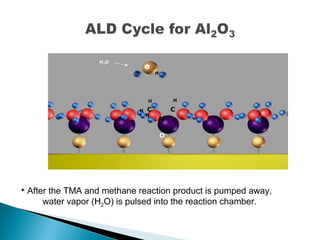
 After the TMA and methane reaction product is pumped away,
water vapor (H2O) is pulsed into the reaction chamber.
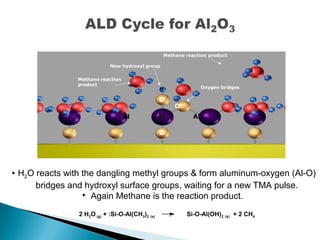
2 H2O (g) + :Si-O-Al(CH3)2 (s) : Si-O-Al(OH)2 (s) + 2 CH4
H
Al
O
O
 H2O reacts with the dangling methyl groups & form aluminum-oxygen (Al-O)
bridges and hydroxyl surface groups, waiting for a new TMA pulse.
 Again Methane is the reaction product.
O
Al Al
New hydroxyl group
Oxygen bridges
Methane reaction product
Methane reaction
product
H
Al
O
O
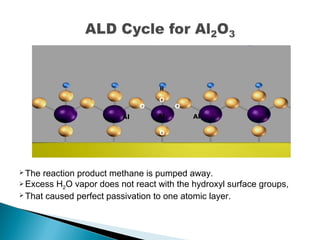
 The reaction product methane is pumped away.
 Excess H2O vapor does not react with the hydroxyl surface groups,
 That caused perfect passivation to one atomic layer.
O O
Al Al
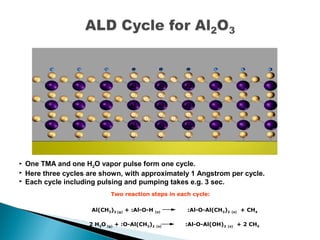
 One TMA and one H2O vapor pulse form one cycle.
 Here three cycles are shown, with approximately 1 Angstrom per cycle.
 Each cycle including pulsing and pumping takes e.g. 3 sec.
O
H
Al Al Al
HH
OO
O O
O OO
Al Al Al
O O
O OO
Al Al Al
O O
O OO
Al(CH3)3 (g) + :Al-O-H (s) :Al-O-Al(CH3)2 (s) + CH4
2 H2O (g) + :O-Al(CH3)2 (s) :Al-O-Al(OH)2 (s) + 2 CH4
Two reaction steps in each cycle:
 Ligand Precursor
◦ To prepare the surface for next layer, and define the kind of
material to growth i.e. H2O for oxides, N2 or NH3 for nitrides, etc.
 Main Precursor (metallic precursor)
◦ Highly reactive (usually this means volatile precursors)
◦ Thermally stable
◦ Full-fill the requirement for self terminating reaction
◦ No self-decomposition
◦ No etching of the film or substrate material
◦ No dissolution into the film or substrate
◦ Sufficient purity
14
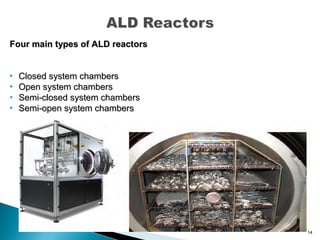
Four main types of ALD reactorsFour main types of ALD reactors
 Closed system chambersClosed system chambers
 Open system chambersOpen system chambers
 Semi-closed system chambersSemi-closed system chambers
 Semi-open system chambersSemi-open system chambers
15
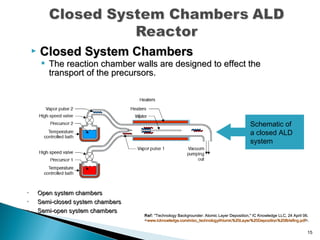
 Closed System ChambersClosed System Chambers
 The reaction chamber walls are designed to effect theThe reaction chamber walls are designed to effect the
transport of the precursors.transport of the precursors.
• Open system chambersOpen system chambers
• Semi-closed system chambersSemi-closed system chambers
• Semi-open system chambersSemi-open system chambers
Schematic of
a closed ALD
system
Ref:Ref: "Technology Backgrounder: Atomic Layer Deposition," IC Knowledge LLC, 24 April 06."Technology Backgrounder: Atomic Layer Deposition," IC Knowledge LLC, 24 April 06.
<<www.icknowledge.com/misc_technology/Atomic%20Layer%20Deposition%20Briefing.pdfwww.icknowledge.com/misc_technology/Atomic%20Layer%20Deposition%20Briefing.pdf>.>.
16
The Verano 5500™
A 300-mm ALD system by
Aviza Technology, Inc [2].
Process Temperature [1]
[1] [1]
11
"Technology Backgrounder: Atomic Layer Deposition," IC Knowledge LLC, 24 April 06. <"Technology Backgrounder: Atomic Layer Deposition," IC Knowledge LLC, 24 April 06. <
www.icknowledge.com/misc_technology/Atomic%20Layer%20Deposition%20Briefing.pdfwww.icknowledge.com/misc_technology/Atomic%20Layer%20Deposition%20Briefing.pdf>>
22
”Atomic Layer Deposition," Aviza Technology. 26 April 06. <”Atomic Layer Deposition," Aviza Technology. 26 April 06. <
http://www.avizatechnology.com/products/verano.shtmlhttp://www.avizatechnology.com/products/verano.shtml>.>.
 Semi & Nanoelectronics
 Coatings on Polymers
 Protective Coatings
 Magnetic Heads
 Thin Film Electroluminescent Displays (TFELs)
 MEMS
 Nanostructures
 Chemical
 Solar Cell
18
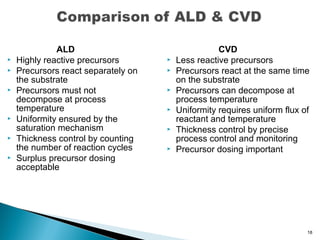
ALD
 Highly reactive precursors
 Precursors react separately on
the substrate
 Precursors must not
decompose at process
temperature
 Uniformity ensured by the
saturation mechanism
 Thickness control by counting
the number of reaction cycles
 Surplus precursor dosing
acceptable
CVD
 Less reactive precursors
 Precursors react at the same time
on the substrate
 Precursors can decompose at
process temperature
 Uniformity requires uniform flux of
reactant and temperature
 Thickness control by precise
process control and monitoring
 Precursor dosing important
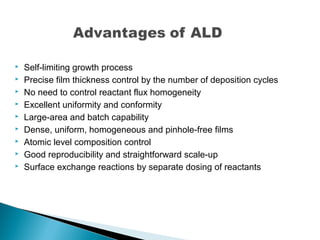
 Self-limiting growth process
 Precise film thickness control by the number of deposition cycles
 No need to control reactant flux homogeneity
 Excellent uniformity and conformity
 Large-area and batch capability
 Dense, uniform, homogeneous and pinhole-free films
 Atomic level composition control
 Good reproducibility and straightforward scale-up
 Surface exchange reactions by separate dosing of reactants
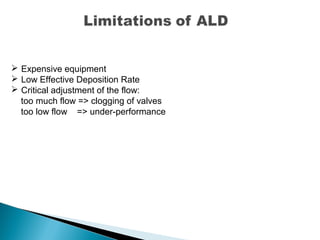
 Expensive equipment
 Low Effective Deposition Rate
 Critical adjustment of the flow:
too much flow => clogging of valves
too low flow => under-performance
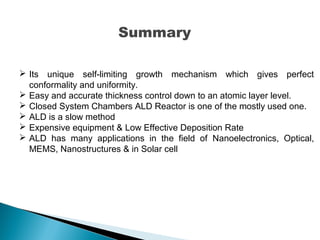
Summary
 Its unique self-limiting growth mechanism which gives perfect
conformality and uniformity.
 Easy and accurate thickness control down to an atomic layer level.
 Closed System Chambers ALD Reactor is one of the mostly used one.
 ALD is a slow method
 Expensive equipment & Low Effective Deposition Rate
 ALD has many applications in the field of Nanoelectronics, Optical,
MEMS, Nanostructures & in Solar cell

Atomic layer Deposition _Mukhtar Hussain awan

  • 1.
    Mukhtar Hussain Department ofPhysics & Astronomy King Saud University, Riyadh awanchep@gamil.com
  • 2.
     What isALD Process ?  Basic Characteristics of ALD  Principles of ALD Technique  ALD Cycle for Al2O3 Deposition  Requirements for Precursors  Types of ALD Reactors  Closed System Chambers ALD Reactor  ALD Applications  Advantages & Limitations  Summary
  • 3.
     “ It’sa film deposition technique based on sequential use of self terminating surface reactions”  ALD is a CVD technique suitable for inorganic material layer as oxides, nitrides and some metals.  Perfect for deposition of very thin layers of the size of a monolayer.
  • 4.
     Steps: ◦ Self-terminatingreaction of the first reactant (Reactant A) ◦ Purge or evacuation to remove non-reacted reactant and by products ◦ Self-terminating reaction of the second reactant (Reactant B) ◦ Purge This is considered as one reaction cycle  The surface must be in a controlled state, e.g. heated  Parameters to be adjusted: ◦ Reactants (precursors) ◦ Substrate ◦ Temperature
  • 5.
    Self-termination of adsorptionprovides atomic scale control of the film thickness and ensures uniform coverage. PrinciplesPrinciples ofof ALDALD TechniqueTechniquePrinciplesPrinciples ofof ALDALD TechniqueTechnique
  • 6.
    In air H2Ovapor is adsorbed on most surfaces, forming a hydroxyl group. With silicon this forms: Si-O-H (s)  After placing the substrate in the reactor, Trimethyl Aluminum (TMA) is pulsed into the reaction chamber. Tri-methyl aluminum Al(CH3)3(g) C H H H H Al O Hydroxyl (OH) from surface adsorbed H2O Methyl group (CH3) Substrate surface (e.g. Si)
  • 7.
    Al(CH3)3 (g) +: Si-O-H (s) :Si-O-Al(CH3)2 (s) + CH4  Trimethyl Aluminum (TMA) reacts with the adsorbed hydroxyl groups, producing methane as the reaction product C H H H H Al O Reaction of TMA with OH Methane reaction product CH4 H H H H H C C Substrate surface (e.g. Si)
  • 8.
    C HH Al O Excess TMA Methane reaction productCH4 H H C  Trimethyl Aluminum (TMA) reacts with the adsorbed hydroxyl groups, until the surface is passivized.  TMA does not react with itself, terminating the reaction to one layer.  This causes the perfect uniformity of ALD.  The excess TMA is pumped away with the methane reaction product. Substrate surface (e.g. Si)
  • 9.
    C HH Al O H2O H H C O HH  Afterthe TMA and methane reaction product is pumped away, water vapor (H2O) is pulsed into the reaction chamber.
  • 10.
    2 H2O (g)+ :Si-O-Al(CH3)2 (s) : Si-O-Al(OH)2 (s) + 2 CH4 H Al O O  H2O reacts with the dangling methyl groups & form aluminum-oxygen (Al-O) bridges and hydroxyl surface groups, waiting for a new TMA pulse.  Again Methane is the reaction product. O Al Al New hydroxyl group Oxygen bridges Methane reaction product Methane reaction product
  • 11.
    H Al O O  The reactionproduct methane is pumped away.  Excess H2O vapor does not react with the hydroxyl surface groups,  That caused perfect passivation to one atomic layer. O O Al Al
  • 12.
     One TMAand one H2O vapor pulse form one cycle.  Here three cycles are shown, with approximately 1 Angstrom per cycle.  Each cycle including pulsing and pumping takes e.g. 3 sec. O H Al Al Al HH OO O O O OO Al Al Al O O O OO Al Al Al O O O OO Al(CH3)3 (g) + :Al-O-H (s) :Al-O-Al(CH3)2 (s) + CH4 2 H2O (g) + :O-Al(CH3)2 (s) :Al-O-Al(OH)2 (s) + 2 CH4 Two reaction steps in each cycle:
  • 13.
     Ligand Precursor ◦To prepare the surface for next layer, and define the kind of material to growth i.e. H2O for oxides, N2 or NH3 for nitrides, etc.  Main Precursor (metallic precursor) ◦ Highly reactive (usually this means volatile precursors) ◦ Thermally stable ◦ Full-fill the requirement for self terminating reaction ◦ No self-decomposition ◦ No etching of the film or substrate material ◦ No dissolution into the film or substrate ◦ Sufficient purity
  • 14.
    14 Four main typesof ALD reactorsFour main types of ALD reactors  Closed system chambersClosed system chambers  Open system chambersOpen system chambers  Semi-closed system chambersSemi-closed system chambers  Semi-open system chambersSemi-open system chambers
  • 15.
    15  Closed SystemChambersClosed System Chambers  The reaction chamber walls are designed to effect theThe reaction chamber walls are designed to effect the transport of the precursors.transport of the precursors. • Open system chambersOpen system chambers • Semi-closed system chambersSemi-closed system chambers • Semi-open system chambersSemi-open system chambers Schematic of a closed ALD system Ref:Ref: "Technology Backgrounder: Atomic Layer Deposition," IC Knowledge LLC, 24 April 06."Technology Backgrounder: Atomic Layer Deposition," IC Knowledge LLC, 24 April 06. <<www.icknowledge.com/misc_technology/Atomic%20Layer%20Deposition%20Briefing.pdfwww.icknowledge.com/misc_technology/Atomic%20Layer%20Deposition%20Briefing.pdf>.>.
  • 16.
    16 The Verano 5500™ A300-mm ALD system by Aviza Technology, Inc [2]. Process Temperature [1] [1] [1] 11 "Technology Backgrounder: Atomic Layer Deposition," IC Knowledge LLC, 24 April 06. <"Technology Backgrounder: Atomic Layer Deposition," IC Knowledge LLC, 24 April 06. < www.icknowledge.com/misc_technology/Atomic%20Layer%20Deposition%20Briefing.pdfwww.icknowledge.com/misc_technology/Atomic%20Layer%20Deposition%20Briefing.pdf>> 22 ”Atomic Layer Deposition," Aviza Technology. 26 April 06. <”Atomic Layer Deposition," Aviza Technology. 26 April 06. < http://www.avizatechnology.com/products/verano.shtmlhttp://www.avizatechnology.com/products/verano.shtml>.>.
  • 17.
     Semi &Nanoelectronics  Coatings on Polymers  Protective Coatings  Magnetic Heads  Thin Film Electroluminescent Displays (TFELs)  MEMS  Nanostructures  Chemical  Solar Cell
  • 18.
    18 ALD  Highly reactiveprecursors  Precursors react separately on the substrate  Precursors must not decompose at process temperature  Uniformity ensured by the saturation mechanism  Thickness control by counting the number of reaction cycles  Surplus precursor dosing acceptable CVD  Less reactive precursors  Precursors react at the same time on the substrate  Precursors can decompose at process temperature  Uniformity requires uniform flux of reactant and temperature  Thickness control by precise process control and monitoring  Precursor dosing important
  • 19.
     Self-limiting growthprocess  Precise film thickness control by the number of deposition cycles  No need to control reactant flux homogeneity  Excellent uniformity and conformity  Large-area and batch capability  Dense, uniform, homogeneous and pinhole-free films  Atomic level composition control  Good reproducibility and straightforward scale-up  Surface exchange reactions by separate dosing of reactants
  • 20.
     Expensive equipment Low Effective Deposition Rate  Critical adjustment of the flow: too much flow => clogging of valves too low flow => under-performance
  • 21.
    Summary  Its uniqueself-limiting growth mechanism which gives perfect conformality and uniformity.  Easy and accurate thickness control down to an atomic layer level.  Closed System Chambers ALD Reactor is one of the mostly used one.  ALD is a slow method  Expensive equipment & Low Effective Deposition Rate  ALD has many applications in the field of Nanoelectronics, Optical, MEMS, Nanostructures & in Solar cell