Download to read offline
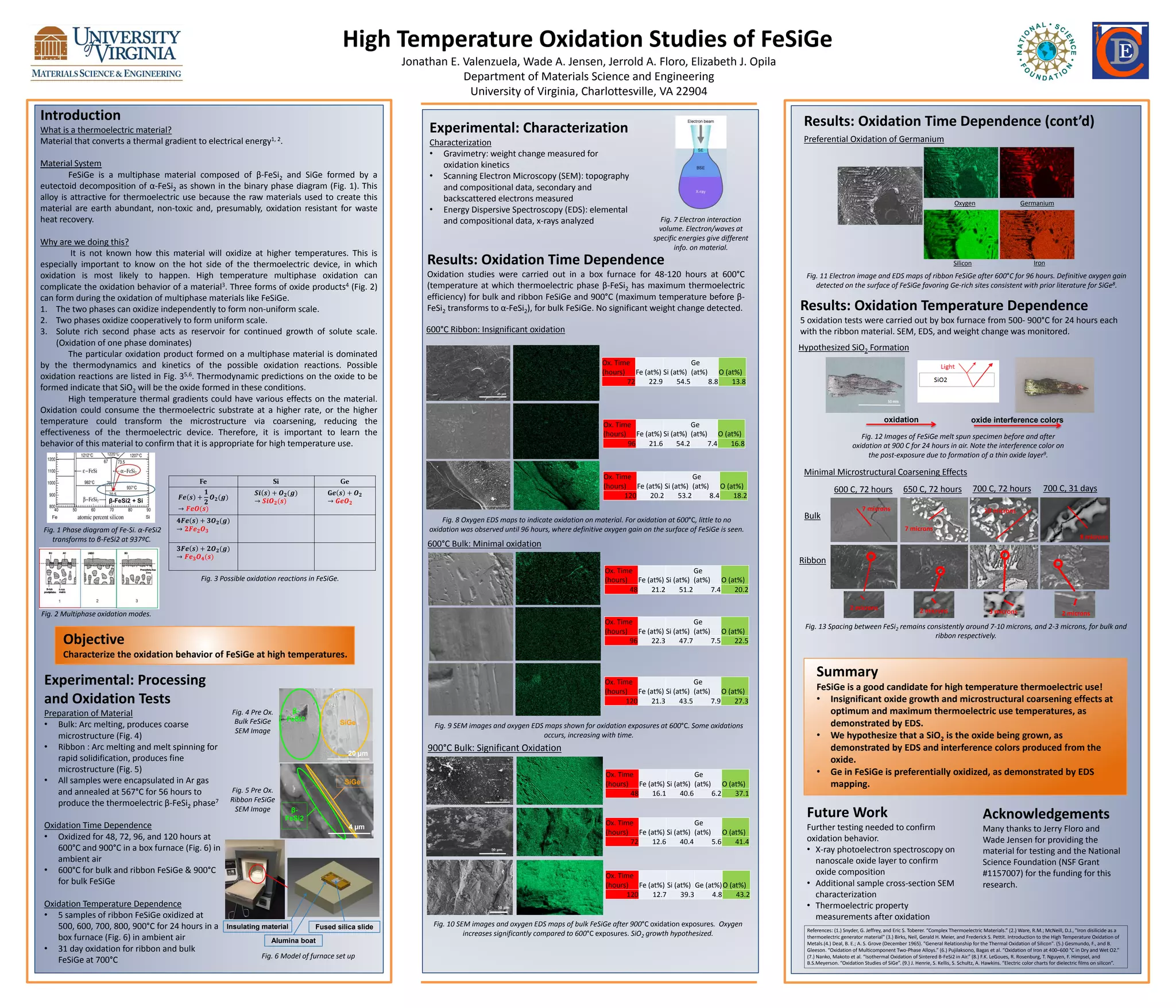

- FeSiGe exhibits insignificant oxide growth and microstructural changes at temperatures up to 900°C, as shown by oxidation studies using SEM, EDS, and weight measurements. - Germanium in FeSiGe is preferentially oxidized, forming a thin SiO2 oxide layer, as demonstrated by EDS mapping. - Oxidation is minimal for ribbon FeSiGe at 600°C but increases slightly for bulk FeSiGe at the same temperature, indicating Germanium oxidation. Significant oxidation occurs for bulk FeSiGe at 900°C. - The findings suggest FeSiGe is suitable for high-temperature thermoelectric applications due to its oxidation resistance at operating temperatures.


