Prepared By:
MD.AZMERI LATIF BEG
ID: 142-32-257
Course Title: Apparel Wash, Dyeing & Finishing.
Course Code: AWF-514
M. Sc in Textile Engineering
Department of Textile Engineering
The dyeing of the garments requires more care
than the dyeing of the fabric, though there is very
little difference in the dyeing procedures. This is
due to the fact that processing of garments
involves value added goods. Garment dyeing is
the cost effectiveness of mass producing identical
garments of particular colors.
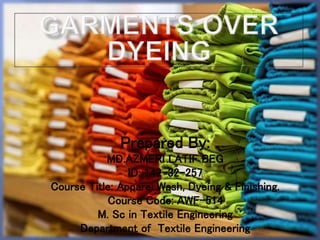
In general sense garment dyeing is the process
of dyeing fully fashioned garments (such as
pants, shirts, pullovers, t-shirts, jeans,
sweaters, dresses, bathrobes, casual jackets,
skirts, hosieries) subsequent to manufacturing,
as opposed to the conventional method of
manufacturing garments from pre-dyed
fabrics.
(Over Dyeing) to dye for a second or third time with
a different color. Over dyeing is such a rewarding way of
rescuing an ugly or unsatisfactory colored cloth. It gives
uneven look. sometimes over dyeing doesn’t mean all-
time dyeing the garment which is previously dyed. Over
dyeing may be normal dyeing or piece dyeing process.
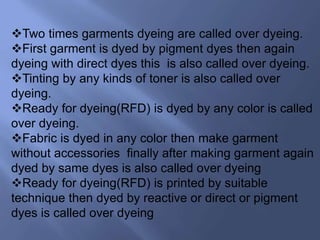
Two times garments dyeing are called over dyeing.
First garment is dyed by pigment dyes then again
dyeing with direct dyes this is also called over dyeing.
Tinting by any kinds of toner is also called over
dyeing.
Ready for dyeing(RFD) is dyed by any color is called
over dyeing.
Fabric is dyed in any color then make garment
without accessories finally after making garment again
dyed by same dyes is also called over dyeing
Ready for dyeing(RFD) is printed by suitable
technique then dyed by reactive or direct or pigment
dyes is called over dyeing
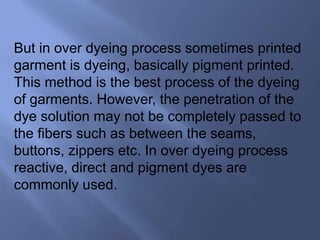
But in over dyeing process sometimes printed
garment is dyeing, basically pigment printed.
This method is the best process of the dyeing
of garments. However, the penetration of the
dye solution may not be completely passed to
the fibers such as between the seams,
buttons, zippers etc. In over dyeing process
reactive, direct and pigment dyes are
commonly used.
Factor consider for over dyeing of a garment
Garment accessories like zips, buttons, etc impose
restrictions. The garments produced from woven fabrics
create many problems and it has been found that the existing
textile treatment styles as developed for piece dyed fabric
cannot be just assembled for garment wet processing
operation such as garment dyeing, unless they have been
engineered from the original design stage for garment
dyeing.
The factors governing processing of ready-made garments
are
• Sewing Thread
• Metal Components. Shrink behavior
• Accessories
• Foreign substances
• Interlining
• Care labeling.
Selection of Fabric
For heavily swelling fibres such as cotton, the elasticized areas,
waist bands and cuffs, must be fairly slack, and seams should not
be too tight or bulky.
•Shrinking behavior of the fabric must be uniform before garment
dyeing.
•Articles which are prone to Crease marks or Pilling effects should
be turned inside out and dyed with the addition of a non-foaming
lubricant while adopting the shortest possible dyeing process.
•Fabrics should be free from foreign materials (Contamination)
•The interlinings used are to be checked for their performance to
satisfy the requirement.
- Dyes to be taken as same as the outer fabric.
- The gum should not be removed off from the surface
- The resin in the interlinings should not make adverse
effect on the dyeing color.
Selection of Accessories
Buttons, Studs and Zippers:
Free from Nickel
Polyester buttons for pre determined colors.
Nylon preferred
Wooden to be verified before usage.
Brass, antiq brass, silver, gun metal, golden zippers can be
used and to be checked before the bulk process.
Studs and Buttons may be used after dyeing of the garment
most of the cases to avoid breakages and damages to the
fabric and Care Labels& Embroideries
Care labels to be used are to be good in fastness properties.
It should not absorb the dyes from the bath.
Polyester care labels are mostly used.
A pouch may be used to avoid dye penetration on the care
labels. Embroidery threads are used as polyester threads for
pre confirmed colors.
Selection of Sewing Thread
Cotton thread is preferred in most of the garment
dyeing.
They should be of same lot.
Polyester threads can be used only in pre
determined colors.
Selection of Sewing
Sewing Recommendations:
Stitch density
Thread Tension
Stitch and Seam type
Needle size
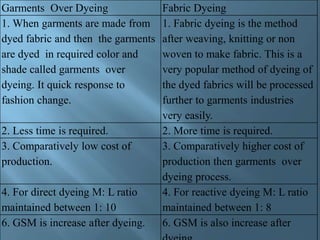
Garments Over Dyeing Fabric Dyeing
1. When garments are made from
dyed fabric and then the garments
are dyed in required color and
shade called garments over
dyeing. It quick response to
fashion change.
1. Fabric dyeing is the method
after weaving, knitting or non
woven to make fabric. This is a
very popular method of dyeing of
the dyed fabrics will be processed
further to garments industries
very easily.
2. Less time is required. 2. More time is required.
3. Comparatively low cost of
production.
3. Comparatively higher cost of
production then garments over
dyeing process.
4. For direct dyeing M: L ratio
maintained between 1: 10
4. For reactive dyeing M: L ratio
maintained between 1: 8
6. GSM is increase after dyeing. 6. GSM is also increase after
7. Generally Belly machine is used
for garments dyeing.
7. Generally Jet/Jigger/Pad/ Winch
dyeing machine are used
8. Less production than Fabric
Dyeing.
8. Higher production than Garments
over Dyeing.
9. Comparatively lower space is
needed.
9. Comparatively higher space is
needed.
10. Less possibility of shade
variation.
10. It has possibility of shade
variation.
11. For direct dye pH is needed 4-7. For reactive dye pH is needed 9-11.
12. Sewing thread used for making
the garments should be of same fiber
like the garments fabric, otherwise
color difference may occur between
garments fabric and sewing thread.
12. No need of sewing thread.
13. After dyed garments no need
processed further to garments
industries.
13. After dyed fabrics must be
processed further to garments
industries.
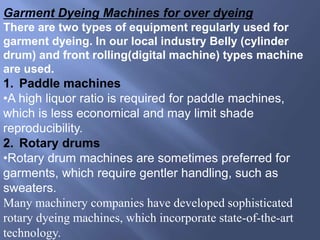
Garment Dyeing Machines for over dyeing
There are two types of equipment regularly used for
garment dyeing. In our local industry Belly (cylinder
drum) and front rolling(digital machine) types machine
are used.
1. Paddle machines
•A high liquor ratio is required for paddle machines,
which is less economical and may limit shade
reproducibility.
2. Rotary drums
•Rotary drum machines are sometimes preferred for
garments, which require gentler handling, such as
sweaters.
Many machinery companies have developed sophisticated
rotary dyeing machines, which incorporate state-of-the-art
technology.
Over dyeing
Apparel wash, dyeing and Finishing
1. Paddle machines:
A. Horizontal Paddle Machine
B. Lateral / oval paddle
C. HT Paddle Machines
2. Rotary drums
A. Rotary Drum Dyeing Machine
B. Tumbler Dyeing Machine
3. Toroid Dyeing Machine
4. Modified Pegg Toroid Whiteley garment dyeing machine
5. The Gyrobox
GARMENT DYEING MACHINES
Over dyeing
M. Sc in Textile Engineering
Working Principle:
A process of dyeing textiles in a machine that gently
move the goods using paddles similar to a paddle
wheel on a boat.
This is a slow process, but there is extremely little
abrasion on the goods.
1. PADDLE DYEING MACHINE
GARMENT DYEING
MACHINES
Over dyeing
Apparel wash, dyeing and Finishing
1A. Horizontal Paddle Machines
 (over head paddle machine) consist of a
curved beck like lower suction to
contain the materials and the dye
liquor.
 The goods are moved by a rotating
paddle, which extends across the width
of the machine.
 Half immersed paddles cause the
material to move upwards and
downwards through out the liquor.
 The temperature can be raised to 98o C
in such system.
Drain
Paddle
Wheel
GARMENT DYEING
MACHINES
Over dyeing
M. Sc in Textile Engineering
1B. Lateral / oval paddle
 This machines consist of oval
tank to enhance the fluid flow
and the processing the goods.
 In the middle of this tank is a
closed oval island.
 The paddle moves in a lateral
direction and is not half
submerged in the liquor.
 The temperature can be increased
up to 98o C.
Circulation
Island
Peddle
Dye Bath
GARMENT DYEING
MACHINES
Over dyeing
Apparel wash, dyeing and Finishing
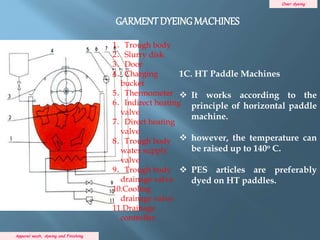
1C. HT Paddle Machines
 It works according to the
principle of horizontal paddle
machine.
 however, the temperature can
be raised up to 140o C.
 PES articles are preferably
dyed on HT paddles.
1.Trough body
2.Slurry disk
3.Door
4.Charging
bucket
5.Thermometer
6.Indirect heating
valve
7.Direct heating
valve
8.Trough body
water supply
valve
9.Trough body
drainage valve
10.Cooling
drainage valve
11.Drainage
controller
GARMENTDYEINGMACHINES
Over dyeing
M. Sc in Textile Engineering
In paddle machines,
 The dyeing can be carried out with 30:1 to 40:1 Liquor to Material Ratio.
 Lower ratios reduces optimum movement of the goods, lead to unleveled dyeing,
crease formation.
 For gentleness, the blades of the paddle are either curved or have rounded edges.
 The rotating speed of the paddle can be regulated from 1.5 to 40 rpm.
 Circulation of the liquor should be strong enough to prevent goods from sinking
to the bottom.
 Paddle machines are suitable for dyeing articles of all substrates in all forms of
make ups.
 The goods are normally dyed using PP/PET bags.
General Parameters & Features
GARMENT DYEING
MACHINES
Over dyeing
Apparel wash, dyeing and Finishing
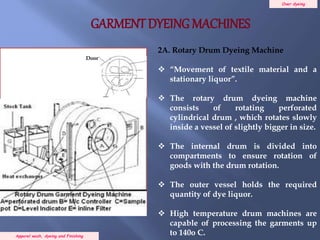
2A. Rotary Drum Dyeing Machine
 “Movement of textile material and a
stationary liquor”.
 The rotary drum dyeing machine
consists of rotating perforated
cylindrical drum , which rotates slowly
inside a vessel of slightly bigger in size.
 The internal drum is divided into
compartments to ensure rotation of
goods with the drum rotation.
 The outer vessel holds the required
quantity of dye liquor.
 High temperature drum machines are
capable of processing the garments up
to 140o C.
Door
Steam Pipe
GARMENT DYEING MACHINES
Over dyeing
M. Sc in Textile Engineering
Features of modern rotary-dyeing Machine
1. Lower liquor ratio
2. Gentle movement of goods and liquor (minimizes surface abrasion)
3. Rapid heating and cooling
4. Centrifugal extraction
5. Variable drum speed with reversal capability
(adaptable to a wide variety of goods)
6. Continuous circulation of goods (improves migration control)
7. Ease of sampling
8. Variable water levels with overflow rinsing capabilities
9. Large diameter feed and discharge lines
(minimizes filling and draining time)
10. Microprocessor controls
11. Lint filters
12. Pressure dyeing
13. Auto-balancing drums
GARMENT DYEING
MACHINES
Over dyeing
Apparel wash, dyeing and Finishing
One feature that can be used to reduce abrasion on delicate garments or
to minimize tangling is a compartmental chamber, sometimes
referred to as a "Y" pocket.
 The rotary drum machines are very simple to operate and are quite
compact in size.
 The cost of unit is also not high .
Drum dyeing-centrifuging machines are also called
- “multipurpose drum machines” or
- “multi-rapid dyeing centrifuging machines”
 since these machines can perform scouring, dyeing, centrifuging and
conditioning successively with automated controls.
General Parameters & Features of Rotary Machine
GARMENT DYEING
MACHINES
Over dyeing
M. Sc in Textile Engineering
 The goods are treated in a perforated inner drum housed within an
outer drum (dyeing tank).
 Inner drums without dividing walls are provided with ribs that carry
the goods along for a certain time, partially lifting them up out of the
liquor.
 These machines can operate at very low liquor ratios and can dye the
goods up to 98 -140o C.

 This is suitable for knits as well as other garments.
 Liquor circulation can be intensified using additional jets.
 Drums can be rotated in both the directions.
Working Features of Rotary Machine
GARMENT DYEING MACHINES
Over dyeing
Apparel wash, dyeing and Finishing
2B. Tumbler Dyeing Machine
 These machines are being used for
small garments either in loose form or
in open mesh bags.
 Design wise the tumbler dyeing
machines are similar to the
commercial laundering machines.
 The principle of operation is to load
the material into perforated inner SS
tanks , which rotates round a
horizontal shaft fixed at the back of
the drum.
 The drum is divided into
compartments for moving the goods
with rotation of drum.
GARMENT DYEING MACHINES
Over dyeing
M. Sc in Textile Engineering
 A variety of tumbling machines have higher rotation speeds and can spin
dry at the end of the cycle.
 These are similar to dry-cleaning machines.
Rotating drum machines are more efficient and cleaner to operate than
paddle machines.
 The more vigorous mechanical action often promotes more shrinkage
and bulking, which may be desirable for some articles.
 In order to handle higher quantities and large production of similar
pieces the latest machines are provided with several automatic features
and sophistications.
General Parameters & Features of Tumbler Dyeing Machine
GARMENT DYEING MACHINES
Over dyeing
Apparel wash, dyeing and Finishing
3. Toroid Dyeing Machine
 In these machines the garments
circulate in the liquor in a toroidal
path with the aid of an impeller
situated below the perforated false
bottom of the vessel.
 Movement of the goods depends
completely on the pumped action of
the liquor.
 High-temperature versions of this
machine operating at 120 to 130°C
were developed in the 1970s for
dyeing fully-fashioned polyester or
triacetate garments.
 The liquor ratio of such machines is
about 30:1.
GARMENT DYEING MACHINES
Over dyeing
M. Sc in Textile Engineering
4. Modified Pegg Toroid Whiteley garment dyeing machine
 This is an improved version of Toroid machines , the
additional features are:
 The machine is suitable for both atmospheric and pressure
dyeing.
 Full automation upto hydroextraction.
 The design features, speed and performance is simplified to
make the machine more versatile and free from operating
problems.
GARMENT DYEING MACHINES
Over dyeing
Apparel wash, dyeing and Finishing
5.The Gyrobox
 The machine has support in the form of a large wheel, which is
divided into 12 independent non radial compartments.
 The goods are placed in these compartments .
 The wheel runs at a moderate speed of 2-6 rpm.
 The main advantage of this machine are,
1.Reduced M:L
2.Different types of garments can be dyed simulteneously .
3.Flexible loading
4.Fully automatic operation.
GARMENT DYEING
MACHINES
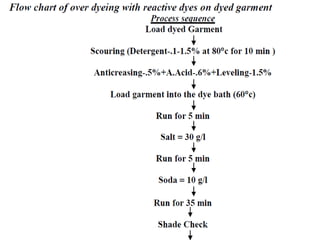
Over dyeing process for a dyed garment
For over dyeing of a dyed garment select the dye
which is previously used for dyeing the fabric that
form the garment. In the below I shown a standard
recipe and flow chart which is previously dyed with
reactive dye during fabric form. Now over dyeing is
done by reactive dyes. It gives uneven look. When
buyer said it will over dyeing we try to dyeing light
during fabric dyeing. We may use extra toner to give
effective tone. In market different types of toner is
available.
Over dyeing of a garment with reactive dyes
Dyeing recipe: (for a standard shade)
Reactive black dyes = 0.8 %
Reactive red dyes = 1.0 %
Reactive yellow dyes = 0.05 %
Salt = 30 g/l
Soda = 10 g/l
Over dyeing of a garment with direct dyes on
dyed garment
Dyeing recipe: (for a standard shade)
Direct black dyes = 0.7 %
Direct red dyes = 1.0 %
Direct yellow dyes = 0.06 %
Salt = 30 g/l
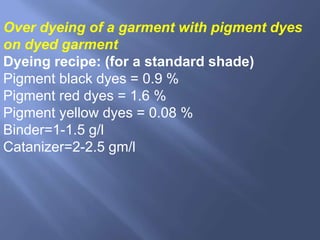
Over dyeing of a garment with pigment dyes
on dyed garment
Dyeing recipe: (for a standard shade)
Pigment black dyes = 0.9 %
Pigment red dyes = 1.6 %
Pigment yellow dyes = 0.08 %
Binder=1-1.5 g/l
Catanizer=2-2.5 gm/l
*Pigment dyes is not suitable for deep shade because dyeing cost is not meet, so
when deep shade is required garment is tint by direct dyes.
Reference:
•http://www.slideshare.net/prabukrishnaa/garment-dyeing-
techniques?qid=ea2993db-0989-4751-9417-
00bff5cc322d&v=qf1&b=&from_search=1
•http://www.slideshare.net/sheshir/garments-dying-machine
•http://www.dyehouseltd.com/garmentdye.html
•http://www.coatsindustrial.com/en/information-hub/apparel-
expertise/sewing-post-dyed-garments
•Md. Mahamudul Hasan(Wash Technician) of Ayesha Washing
Ltd.(A Sister Concern of Palmal Group) in Jamgora, Ashulia,
Savar,Dhaka., Cell: +8801747284925, +8801672130171, Email:
mahamudul.hs@gmail.com, awl.pdn@palmalgarments.com
•Md Sohel Rana(Wash technician) of Hamim Washing in
Nisadnagor, Tongi, Dhaka. Cell: +8801736571160
Over dyeing on Apparel

Over dyeing on Apparel

  • 1.
    Prepared By: MD.AZMERI LATIFBEG ID: 142-32-257 Course Title: Apparel Wash, Dyeing & Finishing. Course Code: AWF-514 M. Sc in Textile Engineering Department of Textile Engineering
  • 2.
    The dyeing ofthe garments requires more care than the dyeing of the fabric, though there is very little difference in the dyeing procedures. This is due to the fact that processing of garments involves value added goods. Garment dyeing is the cost effectiveness of mass producing identical garments of particular colors.
  • 3.
    In general sensegarment dyeing is the process of dyeing fully fashioned garments (such as pants, shirts, pullovers, t-shirts, jeans, sweaters, dresses, bathrobes, casual jackets, skirts, hosieries) subsequent to manufacturing, as opposed to the conventional method of manufacturing garments from pre-dyed fabrics.
  • 5.
    (Over Dyeing) todye for a second or third time with a different color. Over dyeing is such a rewarding way of rescuing an ugly or unsatisfactory colored cloth. It gives uneven look. sometimes over dyeing doesn’t mean all- time dyeing the garment which is previously dyed. Over dyeing may be normal dyeing or piece dyeing process.
  • 6.
    Two times garmentsdyeing are called over dyeing. First garment is dyed by pigment dyes then again dyeing with direct dyes this is also called over dyeing. Tinting by any kinds of toner is also called over dyeing. Ready for dyeing(RFD) is dyed by any color is called over dyeing. Fabric is dyed in any color then make garment without accessories finally after making garment again dyed by same dyes is also called over dyeing Ready for dyeing(RFD) is printed by suitable technique then dyed by reactive or direct or pigment dyes is called over dyeing
  • 7.
    But in overdyeing process sometimes printed garment is dyeing, basically pigment printed. This method is the best process of the dyeing of garments. However, the penetration of the dye solution may not be completely passed to the fibers such as between the seams, buttons, zippers etc. In over dyeing process reactive, direct and pigment dyes are commonly used.
  • 8.
    Factor consider forover dyeing of a garment Garment accessories like zips, buttons, etc impose restrictions. The garments produced from woven fabrics create many problems and it has been found that the existing textile treatment styles as developed for piece dyed fabric cannot be just assembled for garment wet processing operation such as garment dyeing, unless they have been engineered from the original design stage for garment dyeing. The factors governing processing of ready-made garments are • Sewing Thread • Metal Components. Shrink behavior • Accessories • Foreign substances • Interlining • Care labeling.
  • 9.
    Selection of Fabric Forheavily swelling fibres such as cotton, the elasticized areas, waist bands and cuffs, must be fairly slack, and seams should not be too tight or bulky. •Shrinking behavior of the fabric must be uniform before garment dyeing. •Articles which are prone to Crease marks or Pilling effects should be turned inside out and dyed with the addition of a non-foaming lubricant while adopting the shortest possible dyeing process. •Fabrics should be free from foreign materials (Contamination) •The interlinings used are to be checked for their performance to satisfy the requirement. - Dyes to be taken as same as the outer fabric. - The gum should not be removed off from the surface - The resin in the interlinings should not make adverse effect on the dyeing color.
  • 10.
    Selection of Accessories Buttons,Studs and Zippers: Free from Nickel Polyester buttons for pre determined colors. Nylon preferred Wooden to be verified before usage. Brass, antiq brass, silver, gun metal, golden zippers can be used and to be checked before the bulk process. Studs and Buttons may be used after dyeing of the garment most of the cases to avoid breakages and damages to the fabric and Care Labels& Embroideries Care labels to be used are to be good in fastness properties. It should not absorb the dyes from the bath. Polyester care labels are mostly used. A pouch may be used to avoid dye penetration on the care labels. Embroidery threads are used as polyester threads for pre confirmed colors.
  • 11.
    Selection of SewingThread Cotton thread is preferred in most of the garment dyeing. They should be of same lot. Polyester threads can be used only in pre determined colors. Selection of Sewing Sewing Recommendations: Stitch density Thread Tension Stitch and Seam type Needle size
  • 12.
    Garments Over DyeingFabric Dyeing 1. When garments are made from dyed fabric and then the garments are dyed in required color and shade called garments over dyeing. It quick response to fashion change. 1. Fabric dyeing is the method after weaving, knitting or non woven to make fabric. This is a very popular method of dyeing of the dyed fabrics will be processed further to garments industries very easily. 2. Less time is required. 2. More time is required. 3. Comparatively low cost of production. 3. Comparatively higher cost of production then garments over dyeing process. 4. For direct dyeing M: L ratio maintained between 1: 10 4. For reactive dyeing M: L ratio maintained between 1: 8 6. GSM is increase after dyeing. 6. GSM is also increase after
  • 13.
    7. Generally Bellymachine is used for garments dyeing. 7. Generally Jet/Jigger/Pad/ Winch dyeing machine are used 8. Less production than Fabric Dyeing. 8. Higher production than Garments over Dyeing. 9. Comparatively lower space is needed. 9. Comparatively higher space is needed. 10. Less possibility of shade variation. 10. It has possibility of shade variation. 11. For direct dye pH is needed 4-7. For reactive dye pH is needed 9-11. 12. Sewing thread used for making the garments should be of same fiber like the garments fabric, otherwise color difference may occur between garments fabric and sewing thread. 12. No need of sewing thread. 13. After dyed garments no need processed further to garments industries. 13. After dyed fabrics must be processed further to garments industries.
  • 14.
    Garment Dyeing Machinesfor over dyeing There are two types of equipment regularly used for garment dyeing. In our local industry Belly (cylinder drum) and front rolling(digital machine) types machine are used. 1. Paddle machines •A high liquor ratio is required for paddle machines, which is less economical and may limit shade reproducibility. 2. Rotary drums •Rotary drum machines are sometimes preferred for garments, which require gentler handling, such as sweaters. Many machinery companies have developed sophisticated rotary dyeing machines, which incorporate state-of-the-art technology.
  • 15.
    Over dyeing Apparel wash,dyeing and Finishing 1. Paddle machines: A. Horizontal Paddle Machine B. Lateral / oval paddle C. HT Paddle Machines 2. Rotary drums A. Rotary Drum Dyeing Machine B. Tumbler Dyeing Machine 3. Toroid Dyeing Machine 4. Modified Pegg Toroid Whiteley garment dyeing machine 5. The Gyrobox GARMENT DYEING MACHINES
  • 16.
    Over dyeing M. Scin Textile Engineering Working Principle: A process of dyeing textiles in a machine that gently move the goods using paddles similar to a paddle wheel on a boat. This is a slow process, but there is extremely little abrasion on the goods. 1. PADDLE DYEING MACHINE GARMENT DYEING MACHINES
  • 17.
    Over dyeing Apparel wash,dyeing and Finishing 1A. Horizontal Paddle Machines  (over head paddle machine) consist of a curved beck like lower suction to contain the materials and the dye liquor.  The goods are moved by a rotating paddle, which extends across the width of the machine.  Half immersed paddles cause the material to move upwards and downwards through out the liquor.  The temperature can be raised to 98o C in such system. Drain Paddle Wheel GARMENT DYEING MACHINES
  • 18.
    Over dyeing M. Scin Textile Engineering 1B. Lateral / oval paddle  This machines consist of oval tank to enhance the fluid flow and the processing the goods.  In the middle of this tank is a closed oval island.  The paddle moves in a lateral direction and is not half submerged in the liquor.  The temperature can be increased up to 98o C. Circulation Island Peddle Dye Bath GARMENT DYEING MACHINES
  • 19.
    Over dyeing Apparel wash,dyeing and Finishing 1C. HT Paddle Machines  It works according to the principle of horizontal paddle machine.  however, the temperature can be raised up to 140o C.  PES articles are preferably dyed on HT paddles. 1.Trough body 2.Slurry disk 3.Door 4.Charging bucket 5.Thermometer 6.Indirect heating valve 7.Direct heating valve 8.Trough body water supply valve 9.Trough body drainage valve 10.Cooling drainage valve 11.Drainage controller GARMENTDYEINGMACHINES
  • 20.
    Over dyeing M. Scin Textile Engineering In paddle machines,  The dyeing can be carried out with 30:1 to 40:1 Liquor to Material Ratio.  Lower ratios reduces optimum movement of the goods, lead to unleveled dyeing, crease formation.  For gentleness, the blades of the paddle are either curved or have rounded edges.  The rotating speed of the paddle can be regulated from 1.5 to 40 rpm.  Circulation of the liquor should be strong enough to prevent goods from sinking to the bottom.  Paddle machines are suitable for dyeing articles of all substrates in all forms of make ups.  The goods are normally dyed using PP/PET bags. General Parameters & Features GARMENT DYEING MACHINES
  • 21.
    Over dyeing Apparel wash,dyeing and Finishing 2A. Rotary Drum Dyeing Machine  “Movement of textile material and a stationary liquor”.  The rotary drum dyeing machine consists of rotating perforated cylindrical drum , which rotates slowly inside a vessel of slightly bigger in size.  The internal drum is divided into compartments to ensure rotation of goods with the drum rotation.  The outer vessel holds the required quantity of dye liquor.  High temperature drum machines are capable of processing the garments up to 140o C. Door Steam Pipe GARMENT DYEING MACHINES
  • 22.
    Over dyeing M. Scin Textile Engineering Features of modern rotary-dyeing Machine 1. Lower liquor ratio 2. Gentle movement of goods and liquor (minimizes surface abrasion) 3. Rapid heating and cooling 4. Centrifugal extraction 5. Variable drum speed with reversal capability (adaptable to a wide variety of goods) 6. Continuous circulation of goods (improves migration control) 7. Ease of sampling 8. Variable water levels with overflow rinsing capabilities 9. Large diameter feed and discharge lines (minimizes filling and draining time) 10. Microprocessor controls 11. Lint filters 12. Pressure dyeing 13. Auto-balancing drums GARMENT DYEING MACHINES
  • 23.
    Over dyeing Apparel wash,dyeing and Finishing One feature that can be used to reduce abrasion on delicate garments or to minimize tangling is a compartmental chamber, sometimes referred to as a "Y" pocket.  The rotary drum machines are very simple to operate and are quite compact in size.  The cost of unit is also not high . Drum dyeing-centrifuging machines are also called - “multipurpose drum machines” or - “multi-rapid dyeing centrifuging machines”  since these machines can perform scouring, dyeing, centrifuging and conditioning successively with automated controls. General Parameters & Features of Rotary Machine GARMENT DYEING MACHINES
  • 24.
    Over dyeing M. Scin Textile Engineering  The goods are treated in a perforated inner drum housed within an outer drum (dyeing tank).  Inner drums without dividing walls are provided with ribs that carry the goods along for a certain time, partially lifting them up out of the liquor.  These machines can operate at very low liquor ratios and can dye the goods up to 98 -140o C.   This is suitable for knits as well as other garments.  Liquor circulation can be intensified using additional jets.  Drums can be rotated in both the directions. Working Features of Rotary Machine GARMENT DYEING MACHINES
  • 25.
    Over dyeing Apparel wash,dyeing and Finishing 2B. Tumbler Dyeing Machine  These machines are being used for small garments either in loose form or in open mesh bags.  Design wise the tumbler dyeing machines are similar to the commercial laundering machines.  The principle of operation is to load the material into perforated inner SS tanks , which rotates round a horizontal shaft fixed at the back of the drum.  The drum is divided into compartments for moving the goods with rotation of drum. GARMENT DYEING MACHINES
  • 26.
    Over dyeing M. Scin Textile Engineering  A variety of tumbling machines have higher rotation speeds and can spin dry at the end of the cycle.  These are similar to dry-cleaning machines. Rotating drum machines are more efficient and cleaner to operate than paddle machines.  The more vigorous mechanical action often promotes more shrinkage and bulking, which may be desirable for some articles.  In order to handle higher quantities and large production of similar pieces the latest machines are provided with several automatic features and sophistications. General Parameters & Features of Tumbler Dyeing Machine GARMENT DYEING MACHINES
  • 27.
    Over dyeing Apparel wash,dyeing and Finishing 3. Toroid Dyeing Machine  In these machines the garments circulate in the liquor in a toroidal path with the aid of an impeller situated below the perforated false bottom of the vessel.  Movement of the goods depends completely on the pumped action of the liquor.  High-temperature versions of this machine operating at 120 to 130°C were developed in the 1970s for dyeing fully-fashioned polyester or triacetate garments.  The liquor ratio of such machines is about 30:1. GARMENT DYEING MACHINES
  • 28.
    Over dyeing M. Scin Textile Engineering 4. Modified Pegg Toroid Whiteley garment dyeing machine  This is an improved version of Toroid machines , the additional features are:  The machine is suitable for both atmospheric and pressure dyeing.  Full automation upto hydroextraction.  The design features, speed and performance is simplified to make the machine more versatile and free from operating problems. GARMENT DYEING MACHINES
  • 29.
    Over dyeing Apparel wash,dyeing and Finishing 5.The Gyrobox  The machine has support in the form of a large wheel, which is divided into 12 independent non radial compartments.  The goods are placed in these compartments .  The wheel runs at a moderate speed of 2-6 rpm.  The main advantage of this machine are, 1.Reduced M:L 2.Different types of garments can be dyed simulteneously . 3.Flexible loading 4.Fully automatic operation. GARMENT DYEING MACHINES
  • 32.
    Over dyeing processfor a dyed garment For over dyeing of a dyed garment select the dye which is previously used for dyeing the fabric that form the garment. In the below I shown a standard recipe and flow chart which is previously dyed with reactive dye during fabric form. Now over dyeing is done by reactive dyes. It gives uneven look. When buyer said it will over dyeing we try to dyeing light during fabric dyeing. We may use extra toner to give effective tone. In market different types of toner is available.
  • 33.
    Over dyeing ofa garment with reactive dyes Dyeing recipe: (for a standard shade) Reactive black dyes = 0.8 % Reactive red dyes = 1.0 % Reactive yellow dyes = 0.05 % Salt = 30 g/l Soda = 10 g/l
  • 36.
    Over dyeing ofa garment with direct dyes on dyed garment Dyeing recipe: (for a standard shade) Direct black dyes = 0.7 % Direct red dyes = 1.0 % Direct yellow dyes = 0.06 % Salt = 30 g/l
  • 39.
    Over dyeing ofa garment with pigment dyes on dyed garment Dyeing recipe: (for a standard shade) Pigment black dyes = 0.9 % Pigment red dyes = 1.6 % Pigment yellow dyes = 0.08 % Binder=1-1.5 g/l Catanizer=2-2.5 gm/l
  • 41.
    *Pigment dyes isnot suitable for deep shade because dyeing cost is not meet, so when deep shade is required garment is tint by direct dyes.
  • 44.
    Reference: •http://www.slideshare.net/prabukrishnaa/garment-dyeing- techniques?qid=ea2993db-0989-4751-9417- 00bff5cc322d&v=qf1&b=&from_search=1 •http://www.slideshare.net/sheshir/garments-dying-machine •http://www.dyehouseltd.com/garmentdye.html •http://www.coatsindustrial.com/en/information-hub/apparel- expertise/sewing-post-dyed-garments •Md. Mahamudul Hasan(WashTechnician) of Ayesha Washing Ltd.(A Sister Concern of Palmal Group) in Jamgora, Ashulia, Savar,Dhaka., Cell: +8801747284925, +8801672130171, Email: mahamudul.hs@gmail.com, awl.pdn@palmalgarments.com •Md Sohel Rana(Wash technician) of Hamim Washing in Nisadnagor, Tongi, Dhaka. Cell: +8801736571160