Department of Textile EngineeringDepartment of Textile Engineering
Presented by …
GARMENT DYEINGGARMENT DYEING
Garment dyeing may be defined as the ―application ofGarment dyeing may be defined as the ―application of
color to fully fashioned apparel articles, may be in thecolor to fully fashioned apparel articles, may be in the
form of garments cut and sewn either prepared orform of garments cut and sewn either prepared or
unprepared knitted fabrics and then dyed, garmentsunprepared knitted fabrics and then dyed, garments
and / or components knitted from either prepared orand / or components knitted from either prepared or
unprepared yarn and then dyed, garments manufacturedunprepared yarn and then dyed, garments manufactured
from either prepared or unprepared woven fabric andfrom either prepared or unprepared woven fabric and
then dyed and mixed fabric garments i.e. woven andthen dyed and mixed fabric garments i.e. woven and
knitted fabrics manufactured from prepared fabrics andknitted fabrics manufactured from prepared fabrics and
then dyedthen dyed
Reason for Garment dyeingReason for Garment dyeing
a)a) The advantage of this process isThe advantage of this process is
the cost effectiveness of massthe cost effectiveness of mass
producing identical garments ofproducing identical garments of
particular colors.particular colors.
b)b) Quick response to the market ..Quick response to the market ..
c)c) Ability to supply a wide range ofAbility to supply a wide range of
colorations to the retailer, but onlycolorations to the retailer, but only
in the shades that are selling.in the shades that are selling.
d)d) Reduced discounted sales atReduced discounted sales at
inventoryinventory
Reason for Garment dyeingReason for Garment dyeing
e)e) Best way to achieved relaxed,Best way to achieved relaxed,
casual look.casual look.
f)f) Ability to create special effectsAbility to create special effects
such as tie dyed, pigmentsuch as tie dyed, pigment
dyed and washed down in adyed and washed down in a
single process etc.single process etc.
g) A major drawback with thisA major drawback with this
approach is the riskapproach is the risk
associated with carrying aassociated with carrying a
large inventory of a particularlarge inventory of a particular
style or color in today'sstyle or color in today's
dynamic market.dynamic market.
Categories of Garment DyeingCategories of Garment Dyeing
The entire garment dyeing activities may be
broken down in to four categories::
a)a) Fully fashioned garment dyeing carried out by majorFully fashioned garment dyeing carried out by major
dyers and finishersdyers and finishers
b)b) Cut and sewn garment covering woven and knittedCut and sewn garment covering woven and knitted
fabrics.fabrics.
c)c) Dyeing of 100% cotton goods for boutique trade suitableDyeing of 100% cotton goods for boutique trade suitable
for hand washing. Andfor hand washing. And
d)d) Washing, desizing, bleaching denim goods, leading toWashing, desizing, bleaching denim goods, leading to
stone wash, snow wash, over dyeing and highlightingstone wash, snow wash, over dyeing and highlighting
effects.effects.
Advantages of Garment Dyeing
 Flexibility towards fast changing market trendsFlexibility towards fast changing market trends
 Quick response and rapid turnaroundQuick response and rapid turnaround
 Flexibility towards dye shades and finishesFlexibility towards dye shades and finishes
 Flexibility of lot sizeFlexibility of lot size
 Flexibility of items to be dyedFlexibility of items to be dyed
 Comparatively less rejectionComparatively less rejection
 Low inventoryLow inventory
 Less capital investmentsLess capital investments
 Fancy effectsFancy effects
 Handling of smaller lots economically.Handling of smaller lots economically.
 Enables various special effects to achieveEnables various special effects to achieve
Disadvantages of Garment Dyeing
 Labor intensive process and requiresLabor intensive process and requires
thorough checking of every piecethorough checking of every piece
 Higher “seconds” rateHigher “seconds” rate
 Poor appearancePoor appearance
 Poor reproducibility of shadesPoor reproducibility of shades
 Special care in the selection of fittingsSpecial care in the selection of fittings
 More material handling  High cost ofMore material handling  High cost of
processingprocessing
Technique used for GarmentTechnique used for Garment
dyeingdyeing
1.1. Tie dyeingTie dyeing
2.2. Dip dyeingDip dyeing
3.3. Spray dyeingSpray dyeing
4.4. Over dyeingOver dyeing
5.5. Cold dyeingCold dyeing
6.6. High white dyeingHigh white dyeing
7.7. Washable dyeingWashable dyeing
8.8. Reverse dyeingReverse dyeing
9.9. Top dyeingTop dyeing
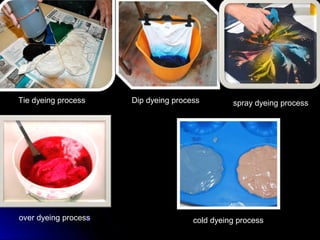
Tie dyeing process Dip dyeing process spray dyeing process
over dyeing process cold dyeing process
Tying techniqueTying technique
1.Knot Tying1.Knot Tying 2. Spirals Tying2. Spirals Tying
Tying techniqueTying technique
3. Electric Bunching3. Electric Bunching 4. Rosettes4. Rosettes
Tying techniqueTying technique
5. Stripes5. Stripes 6. Circles6. Circles
Tying techniqueTying technique
7. Pleats7. Pleats
Thank You

Study on garments dyeing

  • 1.
    Department of TextileEngineeringDepartment of Textile Engineering Presented by …
  • 2.
    GARMENT DYEINGGARMENT DYEING Garmentdyeing may be defined as the ―application ofGarment dyeing may be defined as the ―application of color to fully fashioned apparel articles, may be in thecolor to fully fashioned apparel articles, may be in the form of garments cut and sewn either prepared orform of garments cut and sewn either prepared or unprepared knitted fabrics and then dyed, garmentsunprepared knitted fabrics and then dyed, garments and / or components knitted from either prepared orand / or components knitted from either prepared or unprepared yarn and then dyed, garments manufacturedunprepared yarn and then dyed, garments manufactured from either prepared or unprepared woven fabric andfrom either prepared or unprepared woven fabric and then dyed and mixed fabric garments i.e. woven andthen dyed and mixed fabric garments i.e. woven and knitted fabrics manufactured from prepared fabrics andknitted fabrics manufactured from prepared fabrics and then dyedthen dyed
  • 3.
    Reason for GarmentdyeingReason for Garment dyeing a)a) The advantage of this process isThe advantage of this process is the cost effectiveness of massthe cost effectiveness of mass producing identical garments ofproducing identical garments of particular colors.particular colors. b)b) Quick response to the market ..Quick response to the market .. c)c) Ability to supply a wide range ofAbility to supply a wide range of colorations to the retailer, but onlycolorations to the retailer, but only in the shades that are selling.in the shades that are selling. d)d) Reduced discounted sales atReduced discounted sales at inventoryinventory
  • 4.
    Reason for GarmentdyeingReason for Garment dyeing e)e) Best way to achieved relaxed,Best way to achieved relaxed, casual look.casual look. f)f) Ability to create special effectsAbility to create special effects such as tie dyed, pigmentsuch as tie dyed, pigment dyed and washed down in adyed and washed down in a single process etc.single process etc. g) A major drawback with thisA major drawback with this approach is the riskapproach is the risk associated with carrying aassociated with carrying a large inventory of a particularlarge inventory of a particular style or color in today'sstyle or color in today's dynamic market.dynamic market.
  • 5.
    Categories of GarmentDyeingCategories of Garment Dyeing The entire garment dyeing activities may be broken down in to four categories:: a)a) Fully fashioned garment dyeing carried out by majorFully fashioned garment dyeing carried out by major dyers and finishersdyers and finishers b)b) Cut and sewn garment covering woven and knittedCut and sewn garment covering woven and knitted fabrics.fabrics. c)c) Dyeing of 100% cotton goods for boutique trade suitableDyeing of 100% cotton goods for boutique trade suitable for hand washing. Andfor hand washing. And d)d) Washing, desizing, bleaching denim goods, leading toWashing, desizing, bleaching denim goods, leading to stone wash, snow wash, over dyeing and highlightingstone wash, snow wash, over dyeing and highlighting effects.effects.
  • 7.
    Advantages of GarmentDyeing  Flexibility towards fast changing market trendsFlexibility towards fast changing market trends  Quick response and rapid turnaroundQuick response and rapid turnaround  Flexibility towards dye shades and finishesFlexibility towards dye shades and finishes  Flexibility of lot sizeFlexibility of lot size  Flexibility of items to be dyedFlexibility of items to be dyed  Comparatively less rejectionComparatively less rejection  Low inventoryLow inventory  Less capital investmentsLess capital investments  Fancy effectsFancy effects  Handling of smaller lots economically.Handling of smaller lots economically.  Enables various special effects to achieveEnables various special effects to achieve
  • 8.
    Disadvantages of GarmentDyeing  Labor intensive process and requiresLabor intensive process and requires thorough checking of every piecethorough checking of every piece  Higher “seconds” rateHigher “seconds” rate  Poor appearancePoor appearance  Poor reproducibility of shadesPoor reproducibility of shades  Special care in the selection of fittingsSpecial care in the selection of fittings  More material handling  High cost ofMore material handling  High cost of processingprocessing
  • 10.
    Technique used forGarmentTechnique used for Garment dyeingdyeing 1.1. Tie dyeingTie dyeing 2.2. Dip dyeingDip dyeing 3.3. Spray dyeingSpray dyeing 4.4. Over dyeingOver dyeing 5.5. Cold dyeingCold dyeing 6.6. High white dyeingHigh white dyeing 7.7. Washable dyeingWashable dyeing 8.8. Reverse dyeingReverse dyeing 9.9. Top dyeingTop dyeing
  • 11.
    Tie dyeing processDip dyeing process spray dyeing process over dyeing process cold dyeing process
  • 12.
    Tying techniqueTying technique 1.KnotTying1.Knot Tying 2. Spirals Tying2. Spirals Tying
  • 13.
    Tying techniqueTying technique 3.Electric Bunching3. Electric Bunching 4. Rosettes4. Rosettes
  • 14.
    Tying techniqueTying technique 5.Stripes5. Stripes 6. Circles6. Circles
  • 15.
  • 16.