KCT, Dept.of
Fashion Tech
PRESENTED BY
SYED All-e-ahmed 15-ntu -199
Muhammad shoaib 15-ntu-116
Waseem shahzad 15-ntu-201
Salman Hassan 15-ntu-143
GARMENT DYEING
 GARMENT DYEING
 FABRIC SELECTION
 SEWING THREAD SELECTION
 ACCESSORIES SELECTION
 DYE SELECTION
 GARMENT DYEING MACHINERY
KCT, Dept.of
Fashion Tech
Apparel Finish and Care
National textile university faisalabad
What is garment dyeing?
 Garment dyeing is the process of dyeing fully
fashioned garments. (such as pants,
pullovers, t-shirts, jeans, sweaters, dresses,
bathrobes, casual jackets, shirts, skirts,
hosieries)
Apparel Finish and Care
National textile university faisalabad
.
The dyeing of the garments requires more care than the dyeing of the
fabric, though there is very little difference in the dyeing procedures.
This is due to the fact that processing of garments involves value
added goods.
 Fully fashioned garment dyeing carried out by major dyers and
finishers
 Cut and sewn garment covering woven and knitted fabrics.
 Dyeing of 100% cotton goods for boutique trade suitable for
hand washing. and
 Washing, desizing, bleaching denim goods, leading to stone
wash, snow wash, over dyeing and highlighting effects.
Categories of Garment Dyeing
Apparel Finish and Care
National textile university faisalabad
.
Traditionally, garments are constructed from fabrics that are
pre dyed (piece dyed) before the actual cutting and sewing.
 The advantage of this process is the cost effectiveness of
mass producing identical garments of particular colors.
 Ability to supply a wide range of colorations to the
retailer.
 Best way to achieved relaxed, casual look
 Ability to create special effects such as tie dyed, pigment
dyed and washed down in a single process etc.
 Dimensionally stability and shrinkage control.
Need of Garment Dyeing
KCT, Dept.of
Fashion Tech
SELECTION OF FABRIC
 Lots or batches of grey fabric must be selected that will dye up
identical in shade.
 Loom state fabric must be converted into RFD (ready for Dyeing)
Stage.
- Desized, Scoured for dark colours,
- Desized, Scoured and bleached for light colours
 To get the best-looking garments.
 - Desized, Scoured, bleached and Mercerized
 For heavily swelling fibres such as cotton, the elasticized areas,
waist bands and cuffs, must be fairly slack, and seams should
not be too tight or bulky.
.
SELECTION OF FABRIC
 Shrinking behavior of the fabric must be uniform
before garment dyeing.
 Fabrics should be free from foreign materials
(Contamination)
 The interlinings used are to be checked for their
performance to satisfy the requirement.
 - Dyes to be taken as same as the outer fabric.
 - The resin in the interlinings should not make
adverse effect on the dyeing color.
SELECTION OF SEWING THREAD
Cotton thread is preferred in most of the
garment dyeing.
Polyester threads can be used only in pre
determined colors.
Should be free from hairiness.
Threads with low tension to be applied while
sewing to balance the shrinkage of threads.
Core spun yarn also be used for better
performance of seams.
 Paddle machines:
A. Horizontal Paddle Machine
B. Lateral / oval paddle
C. HT Paddle Machines
 Rotary drums
A. Rotary Drum Dyeing Machine
B. Tumbler Dyeing Machine
GARMENT DYEING MACHINES
1. Paddle machines
 A high liquor ratio is required for paddle machines, which
is less economical and may limit shade reproducibility.
2. Rotary drums
 Rotary drum machines are sometimes preferred for
garments, which require gentler handling, such as
sweaters.
 Many machinery companies have developed
sophisticated rotary dyeing machines, which incorporate
state-of-the-art technology.
Technique used for Garment
dyeing1. Tie dyeing
2. Dip dyeing
3. Spray dyeing
4. Over dyeing
5. Cold dyeing
6. High white dyeing
7. Washable dyeing
8. Reverse dyeing
9. Top dyeing
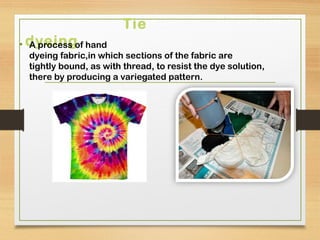
Tie
dyeing• A process of hand
dyeing fabric,in which sections of the fabric are
tightly bound, as with thread, to resist the dye solution, 
there by producing a variegated pattern.
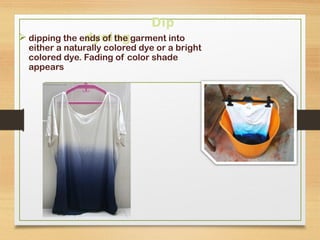
Dip
dyeing dipping the ends of the garment into
either a naturally colored dye or a bright
colored dye. Fading of color shade
appears
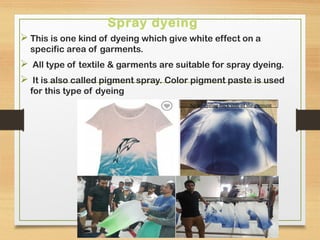
Spray dyeing
 This is one kind of dyeing which give white effect on a
specific area of garments.
 All type of textile & garments are suitable for spray dyeing.
 It is also called pigment spray. Color pigment paste is used
for this type of dyeing
KCT, Dept.of
Fashion Tech
Spray dyeing back side of the garment
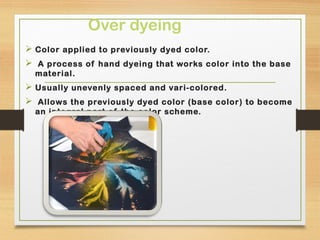
Over dyeing
 Color applied to previously dyed color.
 A process of hand dyeing that works color into the base
material.
 Usually unevenly spaced and vari-colored.
 Allows the previously dyed color (base color) to become
an integral part of the color scheme.
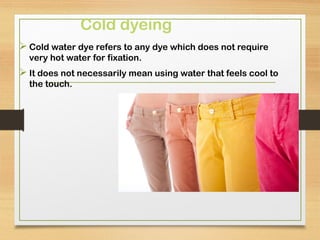
Cold dyeing
 Cold water dye refers to any dye which does not require
very hot water for fixation.
 It does not necessarily mean using water that feels cool to
the touch.
High white dye.
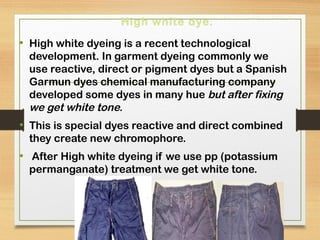
• High white dyeing is a recent technological
development. In garment dyeing commonly we
use reactive, direct or pigment dyes but a Spanish
Garmun dyes chemical manufacturing company
developed some dyes in many hue but after fixing
we get white tone.
• This is special dyes reactive and direct combined
they create new chromophore.
• After High white dyeing if we use pp (potassium
permanganate) treatment we get white tone.
KCT, Dept.of
Fashion Tech
Washable dyeing
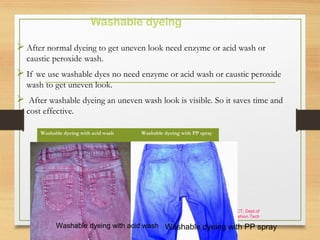
 After normal dyeing to get uneven look need enzyme or acid wash or
caustic peroxide wash.
 If we use washable dyes no need enzyme or acid wash or caustic peroxide
wash to get uneven look.
 After washable dyeing an uneven wash look is visible. So it saves time and
cost effective.
KCT, Dept.of
Fashion Tech
Washable dyeing with acid wash   Washable dyeing with PP spray
Washable dyeing with acid wash Washable dyeing with PP spray
Top dyeing
 Top dyeing is also called garment top dyeing.
 In top dyeing process only top side of garment is dyeing with reactive or
direct dyes.
 Top dyeing is carried out in varying sized vessels as dictated by the order
weight of garments.
 This is a manual process.
Apparel Finish and Care
GARMENT DYEING
Advantages of Garment Dyeing
 Flexibility towards fast changing
market trends
 Quick response and rapid
turnaround
 Flexibility towards dye shades
and finishes
 Flexibility of lot size
 Flexibility of items to be dyed
 Comparatively less rejectioen
 Low inventory
 Less capital investments
 Fancy effects
Disadvantages of Garment Dyeing
 Labour intensive process and
requires thorough checking of
every pice
 Higher “seconds” rate
 Poor appearance
 Poor reproducibility of shades
 Special care in the selection of
fittings
 More material handling
 A major drawback with this
approach is the risk
associated with carrying a
large inventory of a
particular style or color in
today's dynamic market.

garment dyeing

garment dyeing

  • 1.
  • 2.
    PRESENTED BY SYED All-e-ahmed15-ntu -199 Muhammad shoaib 15-ntu-116 Waseem shahzad 15-ntu-201 Salman Hassan 15-ntu-143
  • 3.
    GARMENT DYEING  GARMENTDYEING  FABRIC SELECTION  SEWING THREAD SELECTION  ACCESSORIES SELECTION  DYE SELECTION  GARMENT DYEING MACHINERY
  • 4.
    KCT, Dept.of Fashion Tech ApparelFinish and Care National textile university faisalabad What is garment dyeing?  Garment dyeing is the process of dyeing fully fashioned garments. (such as pants, pullovers, t-shirts, jeans, sweaters, dresses, bathrobes, casual jackets, shirts, skirts, hosieries)
  • 5.
    Apparel Finish andCare National textile university faisalabad . The dyeing of the garments requires more care than the dyeing of the fabric, though there is very little difference in the dyeing procedures. This is due to the fact that processing of garments involves value added goods.  Fully fashioned garment dyeing carried out by major dyers and finishers  Cut and sewn garment covering woven and knitted fabrics.  Dyeing of 100% cotton goods for boutique trade suitable for hand washing. and  Washing, desizing, bleaching denim goods, leading to stone wash, snow wash, over dyeing and highlighting effects. Categories of Garment Dyeing
  • 6.
    Apparel Finish andCare National textile university faisalabad . Traditionally, garments are constructed from fabrics that are pre dyed (piece dyed) before the actual cutting and sewing.  The advantage of this process is the cost effectiveness of mass producing identical garments of particular colors.  Ability to supply a wide range of colorations to the retailer.  Best way to achieved relaxed, casual look  Ability to create special effects such as tie dyed, pigment dyed and washed down in a single process etc.  Dimensionally stability and shrinkage control. Need of Garment Dyeing
  • 7.
    KCT, Dept.of Fashion Tech SELECTIONOF FABRIC  Lots or batches of grey fabric must be selected that will dye up identical in shade.  Loom state fabric must be converted into RFD (ready for Dyeing) Stage. - Desized, Scoured for dark colours, - Desized, Scoured and bleached for light colours  To get the best-looking garments.  - Desized, Scoured, bleached and Mercerized  For heavily swelling fibres such as cotton, the elasticized areas, waist bands and cuffs, must be fairly slack, and seams should not be too tight or bulky.
  • 8.
    . SELECTION OF FABRIC Shrinking behavior of the fabric must be uniform before garment dyeing.  Fabrics should be free from foreign materials (Contamination)  The interlinings used are to be checked for their performance to satisfy the requirement.  - Dyes to be taken as same as the outer fabric.  - The resin in the interlinings should not make adverse effect on the dyeing color.
  • 9.
    SELECTION OF SEWINGTHREAD Cotton thread is preferred in most of the garment dyeing. Polyester threads can be used only in pre determined colors. Should be free from hairiness. Threads with low tension to be applied while sewing to balance the shrinkage of threads. Core spun yarn also be used for better performance of seams.
  • 10.
     Paddle machines: A.Horizontal Paddle Machine B. Lateral / oval paddle C. HT Paddle Machines  Rotary drums A. Rotary Drum Dyeing Machine B. Tumbler Dyeing Machine GARMENT DYEING MACHINES
  • 11.
    GARMENT DYEING MACHINES 1.Paddle machines  A high liquor ratio is required for paddle machines, which is less economical and may limit shade reproducibility. 2. Rotary drums  Rotary drum machines are sometimes preferred for garments, which require gentler handling, such as sweaters.  Many machinery companies have developed sophisticated rotary dyeing machines, which incorporate state-of-the-art technology.
  • 12.
    Technique used forGarment dyeing1. Tie dyeing 2. Dip dyeing 3. Spray dyeing 4. Over dyeing 5. Cold dyeing 6. High white dyeing 7. Washable dyeing 8. Reverse dyeing 9. Top dyeing
  • 13.
  • 14.
    Dip dyeing dipping theends of the garment into either a naturally colored dye or a bright colored dye. Fading of color shade appears
  • 15.
    Spray dyeing  Thisis one kind of dyeing which give white effect on a specific area of garments.  All type of textile & garments are suitable for spray dyeing.  It is also called pigment spray. Color pigment paste is used for this type of dyeing KCT, Dept.of Fashion Tech Spray dyeing back side of the garment
  • 16.
    Over dyeing  Colorapplied to previously dyed color.  A process of hand dyeing that works color into the base material.  Usually unevenly spaced and vari-colored.  Allows the previously dyed color (base color) to become an integral part of the color scheme.
  • 17.
    Cold dyeing  Coldwater dye refers to any dye which does not require very hot water for fixation.  It does not necessarily mean using water that feels cool to the touch.
  • 18.
    High white dye. •High white dyeing is a recent technological development. In garment dyeing commonly we use reactive, direct or pigment dyes but a Spanish Garmun dyes chemical manufacturing company developed some dyes in many hue but after fixing we get white tone. • This is special dyes reactive and direct combined they create new chromophore. • After High white dyeing if we use pp (potassium permanganate) treatment we get white tone. KCT, Dept.of Fashion Tech
  • 19.
    Washable dyeing  Afternormal dyeing to get uneven look need enzyme or acid wash or caustic peroxide wash.  If we use washable dyes no need enzyme or acid wash or caustic peroxide wash to get uneven look.  After washable dyeing an uneven wash look is visible. So it saves time and cost effective. KCT, Dept.of Fashion Tech Washable dyeing with acid wash   Washable dyeing with PP spray Washable dyeing with acid wash Washable dyeing with PP spray
  • 20.
    Top dyeing  Topdyeing is also called garment top dyeing.  In top dyeing process only top side of garment is dyeing with reactive or direct dyes.  Top dyeing is carried out in varying sized vessels as dictated by the order weight of garments.  This is a manual process.
  • 21.
    Apparel Finish andCare GARMENT DYEING Advantages of Garment Dyeing  Flexibility towards fast changing market trends  Quick response and rapid turnaround  Flexibility towards dye shades and finishes  Flexibility of lot size  Flexibility of items to be dyed  Comparatively less rejectioen  Low inventory  Less capital investments  Fancy effects Disadvantages of Garment Dyeing  Labour intensive process and requires thorough checking of every pice  Higher “seconds” rate  Poor appearance  Poor reproducibility of shades  Special care in the selection of fittings  More material handling  A major drawback with this approach is the risk associated with carrying a large inventory of a particular style or color in today's dynamic market. 