Spectrum Analyzers
By:
Mohammed AbouHaggar
What is a Spectrum Analyzer?
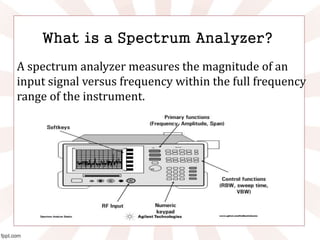
A spectrum analyzer measures the magnitude of an
input signal versus frequency within the full frequency
range of the instrument.
Measurement Categories
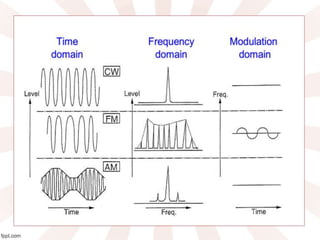
Analysis Domains
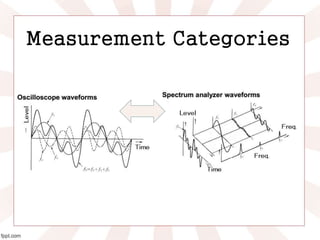
Time Domain (Oscilloscope)
• See what changes in time.
• If signal has many frequencies ,analysis
become difficult.
Frequency Domain (Spectrum analyzer)
• Each element of a complex signal can be
separated easily.
• Low-level distortion signals can be
detected.
Analysis Domains
Modulation Domain (Modulation analyzer)
• See how frequency changes.
• Measures modulation accuracy
Different Types of Analyzers
1] Fourier Transform Analyzer
2] Swept-Tuned Analyzer
Parallel filters measured
simultaneously
CRT shows full
spectral display
A
ff1
f2
Fourier Analyzer
Fourier Analyzer
• The Fourier analyzer basically takes a
time-domain signal, digitizes it using digital
sampling, and then performs the
mathematics required to convert it to the
frequency domain, and display the
resulting spectrum.
Fourier Analyzer
• It is as if the analyzer is looking at the
entire frequency range at the same time
using parallel filters measuring
simultaneously.
• The Fourier analyzer is able to capture
periodic as well as random and transient
events.
Fourier Analyzer
• However it does have its limitations,
particularly in the areas of frequency
range, sensitivity, and dynamic range.
• Fourier analyzers are becoming more
prevalent, as ADC converters and DSP
technologies advance.
• These analyzers can offer significant
performance improvements over
conventional spectrum analyzers, but
often with a price premium.
A
ff1
f2
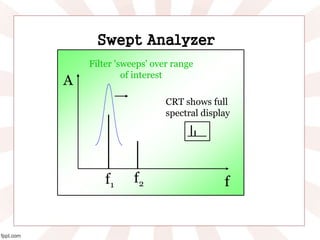
Filter 'sweeps' over range
of interest
CRT shows full
spectral display
Swept Analyzer
Swept Analyzer
• The most common type of spectrum
analyzer is the swept-tuned receiver,
displaying all the frequency components
present.
• The swept-tuned analyzer works just like
the AM radio in your home except that on
your radio, the dial controls the tuning and
instead of a display, your radio has a
speaker.
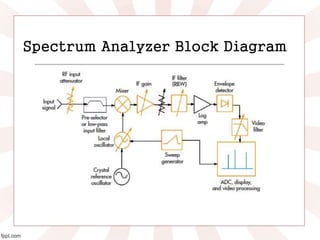
Spectrum Analyzer Block Diagram
Mixer
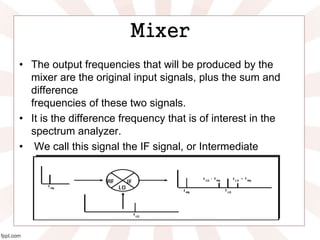
• The output frequencies that will be produced by the
mixer are the original input signals, plus the sum and
difference
frequencies of these two signals.
• It is the difference frequency that is of interest in the
spectrum analyzer.
• We call this signal the IF signal, or Intermediate
Frequency signal.
IF Filter
• The IF filter is a band pass filter which is used as
the "window" for detecting signals. It's bandwidth
is also called the resolution bandwidth (RBW) of
the analyzer and can be changed via the front
panel of the analyzer.
Envelope Detector
• The analyzer must covert the IF signal to a baseband or
video signal so it can be digitized and then viewed on the
analyzer display. This is accomplished with an envelope
detector whose video output is then digitized with an
ADC.
• The digitized output of the ADC is then represented as
the signal’s amplitude on the Y-axis of the display. This
allows for several different detector modes of how the
signal is displayed.
Video Filter
• The video filter is a low-pass filter that is
located after the envelope detector and
before the ADC. This filter determines the
bandwidth of the video amplifier, and is
used to average or smooth the trace seen
on the screen.
Other Components
• The local oscillator (LO) s a Voltage Controlled
Oscillator (VCO) which in effect tunes the
analyzer. The sweep generator actually tunes
the LO so that its frequency changes in
proportion to the ramp voltage.
• The RF attenuator attenuates the input signal to
a suitable mixer input level.
• The IF gain is used to adjust the vertical position
of signals on the display without affecting the
signal level at the input mixer.
Theory of Operation
Theory of Operation
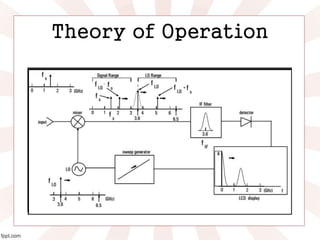
• The signal to be analyzed is connected to
the input of the analyzer.
• This signal is then combined with the LO
through the mixer to convert it to an IF.
• These signals are then sent to the IF filter,
whose output is detected, indicating the
presence of a signal at the analyzer's
tuned frequency.
Theory of Operation
• The output voltage of the detector drives
the vertical axis (amplitude) of the LCD
display.
The sweep generator provides
synchronization between the horizontal
axis (frequency) and tuning of the LO.
• The resulting display shows amplitude
versus frequency of the spectral
components of each incoming signal.
Specifications
1) what's the frequency range?
2) what's the amplitude range (maximum
input and sensitivity)?
3) to what level can I measure the
difference
between two signals, both in amplitude
(dynamic range) and frequency
(resolution)?
4) how accurate are my measurements once
I've made them?
Frequency Range-
Resolution
• The range of frequencies that device
works on.
• Resolution is an important specification
when you are trying to measure signals
that are close together and want to be able
to distinguish them from each other.
Sensitivity
• One of the primary uses of a spectrum analyzer is to
search out and measure low-level signals.
• The sensitivity of any receiver is an indication of how
well it can measure small signals.
• A perfect receiver would add no additional noise to the
natural amount of thermal noise present in all electronic
systems.
• In practice, all receivers, including spectrum analyzers,
add some amount of internally generated noise.
Dynamic Range
• Dynamic Range is defined as the maximum ratio of two
signal levels simultaneously present at the input which
can be measured to a specified accuracy. You can
imagine connecting two signals to the analyzer input -
one which is the maximum allowable level for the
analyzer's input range and the other which is much
smaller. The smaller one is
reduced in amplitude until it is no longer detectable by
the analyzer. When the smaller signal is just
measurable, the
ratio of the two signal levels (in dB) defines the dynamic
range of the analyzer.

Spectrum analyzer

  • 1.
  • 2.
    What is aSpectrum Analyzer? A spectrum analyzer measures the magnitude of an input signal versus frequency within the full frequency range of the instrument.
  • 3.
  • 5.
    Analysis Domains Time Domain(Oscilloscope) • See what changes in time. • If signal has many frequencies ,analysis become difficult. Frequency Domain (Spectrum analyzer) • Each element of a complex signal can be separated easily. • Low-level distortion signals can be detected.
  • 6.
    Analysis Domains Modulation Domain(Modulation analyzer) • See how frequency changes. • Measures modulation accuracy
  • 8.
    Different Types ofAnalyzers 1] Fourier Transform Analyzer 2] Swept-Tuned Analyzer
  • 9.
    Parallel filters measured simultaneously CRTshows full spectral display A ff1 f2 Fourier Analyzer
  • 10.
    Fourier Analyzer • TheFourier analyzer basically takes a time-domain signal, digitizes it using digital sampling, and then performs the mathematics required to convert it to the frequency domain, and display the resulting spectrum.
  • 11.
    Fourier Analyzer • Itis as if the analyzer is looking at the entire frequency range at the same time using parallel filters measuring simultaneously. • The Fourier analyzer is able to capture periodic as well as random and transient events.
  • 12.
    Fourier Analyzer • Howeverit does have its limitations, particularly in the areas of frequency range, sensitivity, and dynamic range. • Fourier analyzers are becoming more prevalent, as ADC converters and DSP technologies advance. • These analyzers can offer significant performance improvements over conventional spectrum analyzers, but often with a price premium.
  • 13.
    A ff1 f2 Filter 'sweeps' overrange of interest CRT shows full spectral display Swept Analyzer
  • 14.
    Swept Analyzer • Themost common type of spectrum analyzer is the swept-tuned receiver, displaying all the frequency components present. • The swept-tuned analyzer works just like the AM radio in your home except that on your radio, the dial controls the tuning and instead of a display, your radio has a speaker.
  • 15.
  • 16.
    Mixer • The outputfrequencies that will be produced by the mixer are the original input signals, plus the sum and difference frequencies of these two signals. • It is the difference frequency that is of interest in the spectrum analyzer. • We call this signal the IF signal, or Intermediate Frequency signal.
  • 17.
    IF Filter • TheIF filter is a band pass filter which is used as the "window" for detecting signals. It's bandwidth is also called the resolution bandwidth (RBW) of the analyzer and can be changed via the front panel of the analyzer.
  • 18.
    Envelope Detector • Theanalyzer must covert the IF signal to a baseband or video signal so it can be digitized and then viewed on the analyzer display. This is accomplished with an envelope detector whose video output is then digitized with an ADC. • The digitized output of the ADC is then represented as the signal’s amplitude on the Y-axis of the display. This allows for several different detector modes of how the signal is displayed.
  • 19.
    Video Filter • Thevideo filter is a low-pass filter that is located after the envelope detector and before the ADC. This filter determines the bandwidth of the video amplifier, and is used to average or smooth the trace seen on the screen.
  • 20.
    Other Components • Thelocal oscillator (LO) s a Voltage Controlled Oscillator (VCO) which in effect tunes the analyzer. The sweep generator actually tunes the LO so that its frequency changes in proportion to the ramp voltage. • The RF attenuator attenuates the input signal to a suitable mixer input level. • The IF gain is used to adjust the vertical position of signals on the display without affecting the signal level at the input mixer.
  • 21.
  • 22.
    Theory of Operation •The signal to be analyzed is connected to the input of the analyzer. • This signal is then combined with the LO through the mixer to convert it to an IF. • These signals are then sent to the IF filter, whose output is detected, indicating the presence of a signal at the analyzer's tuned frequency.
  • 23.
    Theory of Operation •The output voltage of the detector drives the vertical axis (amplitude) of the LCD display. The sweep generator provides synchronization between the horizontal axis (frequency) and tuning of the LO. • The resulting display shows amplitude versus frequency of the spectral components of each incoming signal.
  • 24.
    Specifications 1) what's thefrequency range? 2) what's the amplitude range (maximum input and sensitivity)? 3) to what level can I measure the difference between two signals, both in amplitude (dynamic range) and frequency (resolution)? 4) how accurate are my measurements once I've made them?
  • 25.
    Frequency Range- Resolution • Therange of frequencies that device works on. • Resolution is an important specification when you are trying to measure signals that are close together and want to be able to distinguish them from each other.
  • 26.
    Sensitivity • One ofthe primary uses of a spectrum analyzer is to search out and measure low-level signals. • The sensitivity of any receiver is an indication of how well it can measure small signals. • A perfect receiver would add no additional noise to the natural amount of thermal noise present in all electronic systems. • In practice, all receivers, including spectrum analyzers, add some amount of internally generated noise.
  • 28.
    Dynamic Range • DynamicRange is defined as the maximum ratio of two signal levels simultaneously present at the input which can be measured to a specified accuracy. You can imagine connecting two signals to the analyzer input - one which is the maximum allowable level for the analyzer's input range and the other which is much smaller. The smaller one is reduced in amplitude until it is no longer detectable by the analyzer. When the smaller signal is just measurable, the ratio of the two signal levels (in dB) defines the dynamic range of the analyzer.

Editor's Notes

  • #13 DSP chips get smaller , faster and low-power consumption every year
  • #27 It is important to know the sensitivity capability of your analyzer in order to determine if it will adequately measure your low-level signals