Data Analysis Lab
ME 288
L7 abc
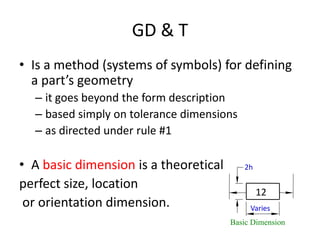
GD & T
• Is a method (systems of symbols) for defining
a part’s geometry
– it goes beyond the form description
– based simply on tolerance dimensions
– as directed under rule #1

• A basic dimension is a theoretical
perfect size, location
or orientation dimension.

2h

12
Varies
Basic Dimension
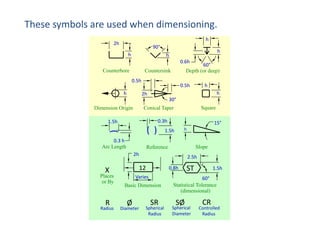
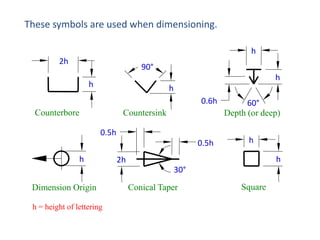
These symbols are used when dimensioning.
h

2h

90°
h

h

h
0.6h

Counterbore

60°
Depth (or deep)

Countersink
0.5h

h

h

0.5h

h

2h
30°
Square

Conical Taper

Dimension Origin

0.3h

1.5h

(

( )

0.3 h
Arc Length

15°
h

1.5h

Slope

Reference
2h

12

X

Places
or By

R

Radius

2.5h
0.8h

Varies

Basic Dimension

Ø

Diameter

SR

Spherical
Radius

ST

1.5h

60°
Statistical Tolerance
(dimensional)

SØ

Spherical
Diameter

CR

Controlled
Radius
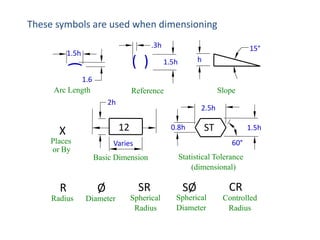
These symbols are used when dimensioning.
h
2h

90°
h

h

h
0.6h

Counterbore

Countersink
0.5h
0.5h

h

60°
Depth (or deep)
h
h

2h

30°
Dimension Origin
h = height of lettering

Conical Taper

Square
These symbols are used when dimensioning
.3h

1.5h

(

( )

1.6
Arc Length

15°

h

1.5h

Slope

Reference
2h

2.5h

X

12

Places
or By

Varies

0.8h

ST

1.5h
60°

Basic Dimension

Statistical Tolerance
(dimensional)

R

Ø

SR

SØ

Radius

Diameter

Spherical
Radius

Spherical
Diameter

CR
Controlled
Radius
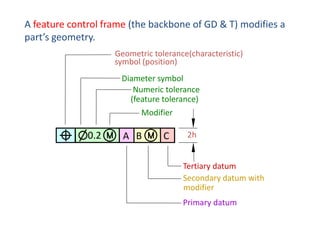
A feature control frame (the backbone of GD & T) modifies a
part’s geometry.
Geometric tolerance(characteristic)
symbol (position)

Diameter symbol
Numeric tolerance
(feature tolerance)
Modifier

0.2

A B

C

2h

Tertiary datum
Secondary datum with
modifier
Primary datum
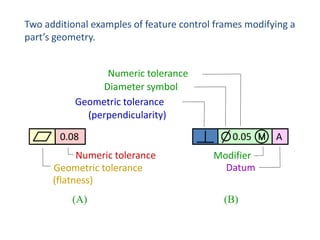
Two additional examples of feature control frames modifying a
part’s geometry.
Numeric tolerance
Diameter symbol
Geometric tolerance
(perpendicularity)
0.08
Numeric tolerance
Geometric tolerance
(flatness)
(A)

0.05

Modifier
Datum
(B)

A
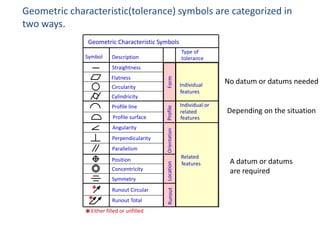
Geometric characteristic(tolerance) symbols are categorized in
two ways.
Geometric Characteristic Symbols
Symbol

Type of
tolerance

Description

Flatness

Circularity

Form

Straightness

Perpendicularity
Parallelism
Position
Concentricity
Symmetry

*
*

Runout Circular
Runout Total

*Either filled or unfilled

Individual or
related
features

No datum or datums needed

Depending on the situation

Orientation

Angularity

Location

Profile surface

Runout

Profile line

Profile

Cylindricity

Individual
features

Related
features

A datum or datums
are required
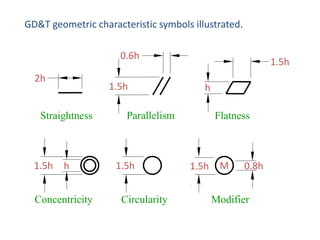
GD&T geometric characteristic symbols illustrated.
0.6h
2h

1.5h

Straightness

1.5h

h

Concentricity

1.5h
h

Parallelism

1.5h

Circularity

Flatness

1.5h

M

0.8h

Modifier
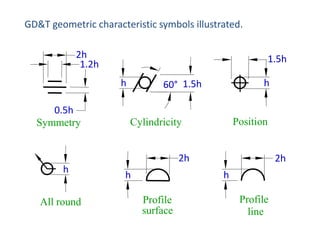
GD&T geometric characteristic symbols illustrated.
2h
1.2h

1.5h
h

0.5h
Symmetry

h

60° 1.5h

Position

Cylindricity
2h

h

All round

h

2h
h

Profile
surface

Profile
line
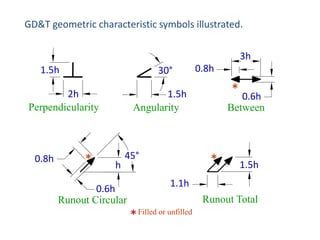
GD&T geometric characteristic symbols illustrated.
3h
1.5h

30°

2h
Perpendicularity

0.8h

*

0.8h

* 0.6h

1.5h
Angularity

h

45°

0.6h
Runout Circular

Between

*

1.5h

1.1h
Runout Total

* Filled or unfilled
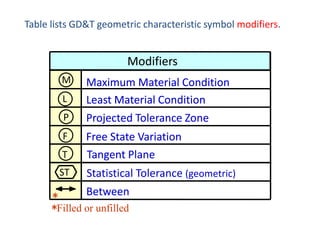
Table lists GD&T geometric characteristic symbol modifiers.

Modifiers
M
L

Maximum Material Condition
Least Material Condition

P

Projected Tolerance Zone

F
T

Free State Variation
Tangent Plane

ST

Statistical Tolerance (geometric)
Between

*
*Filled or unfilled
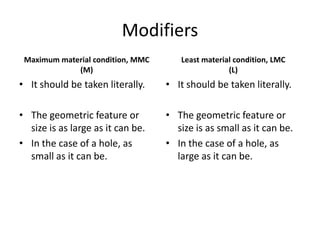
Modifiers
Maximum material condition, MMC
(M)

Least material condition, LMC
(L)

• It should be taken literally.

• It should be taken literally.

• The geometric feature or
size is as large as it can be.
• In the case of a hole, as
small as it can be.

• The geometric feature or
size is as small as it can be.
• In the case of a hole, as
large as it can be.
7B
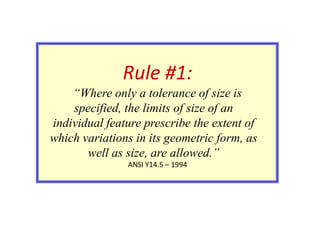
Rule #1:
“Where only a tolerance of size is
specified, the limits of size of an
individual feature prescribe the extent of
which variations in its geometric form, as
well as size, are allowed.”
ANSI Y14.5 – 1994
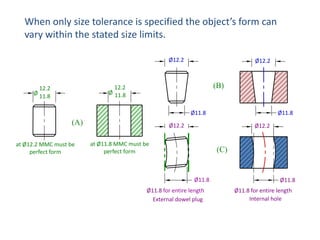
When only size tolerance is specified the object’s form can
vary within the stated size limits.
Ø12.2

Ø12.2

(B)

12.2
Ø 11.8

12.2
Ø 11.8

Ø11.8

(A)
at Ø12.2 MMC must be
perfect form

Ø11.8

Ø12.2

Ø12.2

at Ø11.8 MMC must be
perfect form

(C)

Ø11.8
Ø11.8 for entire length
External dowel plug

Ø11.8
Ø11.8 for entire length
Internal hole
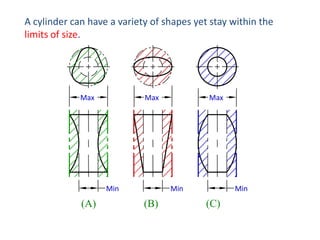
A cylinder can have a variety of shapes yet stay within the
limits of size.

Max

Max

Min

(A)

Max

Min

(B)

Min

(C)
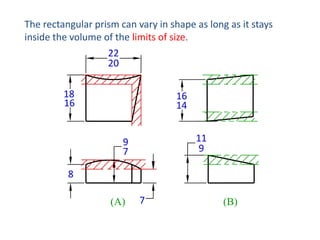
The rectangular prism can vary in shape as long as it stays
inside the volume of the limits of size.
22
20
18
16

16
14

11
9

9
7
8
(A)

7

(B)
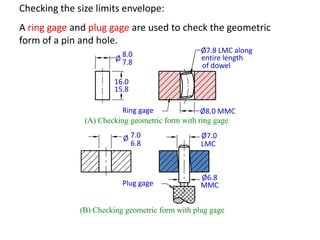
Checking the size limits envelope:
A ring gage and plug gage are used to check the geometric
form of a pin and hole.
8.0
Ø 7.8

Ø7.8 LMC along
entire length
of dowel

16.0
15.8
Ring gage
Ø8.0 MMC
(A) Checking geometric form with ring gage
Ø 7.0
6.8

Ø7.0
LMC

Plug gage

Ø6.8
MMC

(B) Checking geometric form with plug gage
Standard Stock Item
• Items whose geometry are already controlled
by established industrial or government
standards
– bars, sheet stock, tubing or structural shapes
Datums
• A datum is an exact surface, line, point ,axis or
cylinder from which measurements are taken.
• Ex. A surface plate or a polished slab of granite
(simulated datum).
• 3 points define a plane.
• Datum feature – is the surface of the part in contact
with the simulated datum.
A height gage measures the height of an object from the
simulated datum surface of a surface plate.
Dial face
Probe

Up

Down
Measured
height

Simulated
datum
(surface plate)

Datum
feature
Note:

the datum feature rests on the simulated datum.
the height is measured from the simulated datum and not from the datum feature.
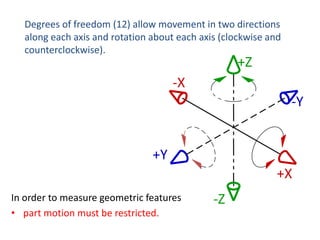
Degrees of freedom (12) allow movement in two directions
along each axis and rotation about each axis (clockwise and
counterclockwise).

+Z

-X
-Y

+Y

+X
In order to measure geometric features
• part motion must be restricted.

-Z
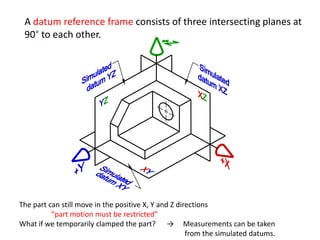
A datum reference frame consists of three intersecting planes at
90° to each other.

The part can still move in the positive X, Y and Z directions
“part motion must be restricted”
What if we temporarily clamped the part? → Measurements can be taken
from the simulated datums.
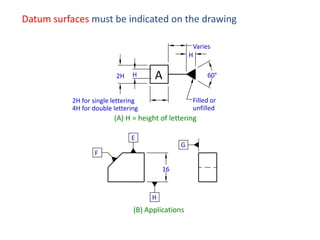
Datum surfaces must be indicated on the drawing
Varies
H
2H

H

A

60°

Filled or
unfilled

2H for single lettering
4H for double lettering

(A) H = height of lettering
E

G

F
16

H

(B) Applications
7C
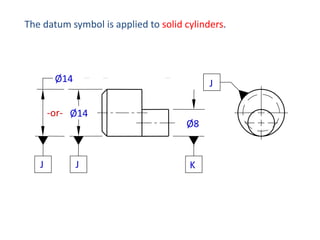
The datum symbol is applied to solid cylinders.

Ø14

J

-or- Ø14

J

J

Ø8

K
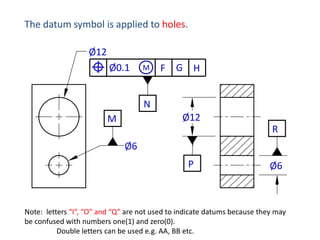
The datum symbol is applied to holes.
Ø12
Ø0.1

M

F

G H

N
Ø12

M

R
Ø6
P

Ø6

Note: letters “I”, “O” and “Q” are not used to indicate datums because they may
be confused with numbers one(1) and zero(0).
Double letters can be used e.g. AA, BB etc.
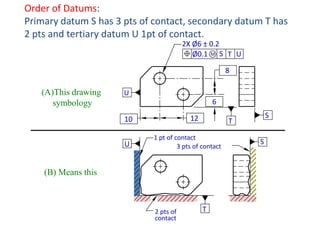
Order of Datums:
Primary datum S has 3 pts of contact, secondary datum T has
2 pts and tertiary datum U 1pt of contact.
2X Ø6 ± 0.2
Ø0.1 M S T U

8

(A)This drawing
symbology

U
6
12

10

U

1 pt of contact
3 pts of contact

(B) Means this

2 pts of
contact

S

T

T

S
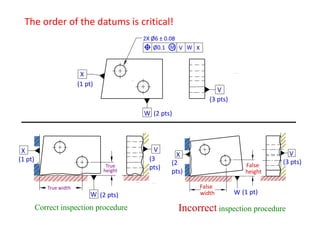
The order of the datums is critical!
2X Ø6 ± 0.08
Ø0.1 M V W X

X
(1 pt)

V
(3 pts)
W (2 pts)

X
(1 pt)
True
height
True width

W (2 pts)

Correct inspection procedure

V
(3
pts)

X
(2
pts)

False
height
False
width

V
(3 pts)

W (1 pt)

Incorrect inspection procedure
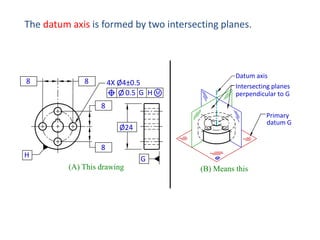
The datum axis is formed by two intersecting planes.

8

8

4X Ø4±0.5
0.5 G H

Datum axis
Intersecting planes
perpendicular to G

8
Primary
datum G

Ø24
H

8
G
(A) This drawing

(B) Means this
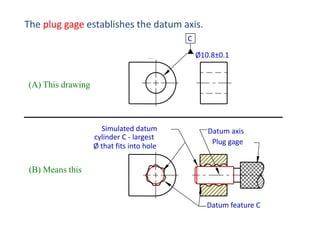
The plug gage establishes the datum axis.
C
Ø10.8±0.1

(A) This drawing

Simulated datum
cylinder C - largest
Ø that fits into hole

Datum axis
Plug gage

(B) Means this

Datum feature C
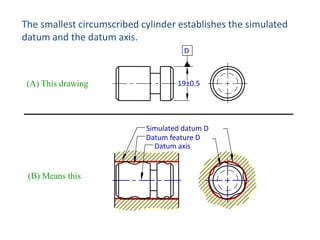
The smallest circumscribed cylinder establishes the simulated
datum and the datum axis.
D

(A) This drawing

19±0.5

Simulated datum D
Datum feature D
Datum axis

(B) Means this
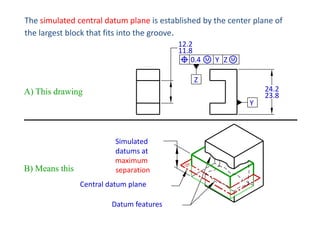
The simulated central datum plane is established by the center plane of
the largest block that fits into the groove.
12.2
11.8
0.4

Y Z

Z

A) This drawing
Y

B) Means this

Simulated
datums at
maximum
separation
Central datum plane
Datum features

24.2
23.8
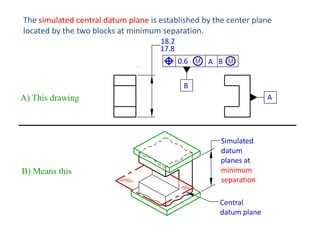
The simulated central datum plane is established by the center plane
located by the two blocks at minimum separation.
18.2
17.8
0.6

A B

B
A

A) This drawing

B) Means this

Simulated
datum
planes at
minimum
separation
Central
datum plane

Basic gd&t datums

  • 1.
  • 2.
    GD & T •Is a method (systems of symbols) for defining a part’s geometry – it goes beyond the form description – based simply on tolerance dimensions – as directed under rule #1 • A basic dimension is a theoretical perfect size, location or orientation dimension. 2h 12 Varies Basic Dimension
  • 3.
    These symbols areused when dimensioning. h 2h 90° h h h 0.6h Counterbore 60° Depth (or deep) Countersink 0.5h h h 0.5h h 2h 30° Square Conical Taper Dimension Origin 0.3h 1.5h ( ( ) 0.3 h Arc Length 15° h 1.5h Slope Reference 2h 12 X Places or By R Radius 2.5h 0.8h Varies Basic Dimension Ø Diameter SR Spherical Radius ST 1.5h 60° Statistical Tolerance (dimensional) SØ Spherical Diameter CR Controlled Radius
  • 4.
    These symbols areused when dimensioning. h 2h 90° h h h 0.6h Counterbore Countersink 0.5h 0.5h h 60° Depth (or deep) h h 2h 30° Dimension Origin h = height of lettering Conical Taper Square
  • 5.
    These symbols areused when dimensioning .3h 1.5h ( ( ) 1.6 Arc Length 15° h 1.5h Slope Reference 2h 2.5h X 12 Places or By Varies 0.8h ST 1.5h 60° Basic Dimension Statistical Tolerance (dimensional) R Ø SR SØ Radius Diameter Spherical Radius Spherical Diameter CR Controlled Radius
  • 6.
    A feature controlframe (the backbone of GD & T) modifies a part’s geometry. Geometric tolerance(characteristic) symbol (position) Diameter symbol Numeric tolerance (feature tolerance) Modifier 0.2 A B C 2h Tertiary datum Secondary datum with modifier Primary datum
  • 7.
    Two additional examplesof feature control frames modifying a part’s geometry. Numeric tolerance Diameter symbol Geometric tolerance (perpendicularity) 0.08 Numeric tolerance Geometric tolerance (flatness) (A) 0.05 Modifier Datum (B) A
  • 8.
    Geometric characteristic(tolerance) symbolsare categorized in two ways. Geometric Characteristic Symbols Symbol Type of tolerance Description Flatness Circularity Form Straightness Perpendicularity Parallelism Position Concentricity Symmetry * * Runout Circular Runout Total *Either filled or unfilled Individual or related features No datum or datums needed Depending on the situation Orientation Angularity Location Profile surface Runout Profile line Profile Cylindricity Individual features Related features A datum or datums are required
  • 9.
    GD&T geometric characteristicsymbols illustrated. 0.6h 2h 1.5h Straightness 1.5h h Concentricity 1.5h h Parallelism 1.5h Circularity Flatness 1.5h M 0.8h Modifier
  • 10.
    GD&T geometric characteristicsymbols illustrated. 2h 1.2h 1.5h h 0.5h Symmetry h 60° 1.5h Position Cylindricity 2h h All round h 2h h Profile surface Profile line
  • 11.
    GD&T geometric characteristicsymbols illustrated. 3h 1.5h 30° 2h Perpendicularity 0.8h * 0.8h * 0.6h 1.5h Angularity h 45° 0.6h Runout Circular Between * 1.5h 1.1h Runout Total * Filled or unfilled
  • 12.
    Table lists GD&Tgeometric characteristic symbol modifiers. Modifiers M L Maximum Material Condition Least Material Condition P Projected Tolerance Zone F T Free State Variation Tangent Plane ST Statistical Tolerance (geometric) Between * *Filled or unfilled
  • 13.
    Modifiers Maximum material condition,MMC (M) Least material condition, LMC (L) • It should be taken literally. • It should be taken literally. • The geometric feature or size is as large as it can be. • In the case of a hole, as small as it can be. • The geometric feature or size is as small as it can be. • In the case of a hole, as large as it can be.
  • 14.
  • 15.
    Rule #1: “Where onlya tolerance of size is specified, the limits of size of an individual feature prescribe the extent of which variations in its geometric form, as well as size, are allowed.” ANSI Y14.5 – 1994
  • 16.
    When only sizetolerance is specified the object’s form can vary within the stated size limits. Ø12.2 Ø12.2 (B) 12.2 Ø 11.8 12.2 Ø 11.8 Ø11.8 (A) at Ø12.2 MMC must be perfect form Ø11.8 Ø12.2 Ø12.2 at Ø11.8 MMC must be perfect form (C) Ø11.8 Ø11.8 for entire length External dowel plug Ø11.8 Ø11.8 for entire length Internal hole
  • 17.
    A cylinder canhave a variety of shapes yet stay within the limits of size. Max Max Min (A) Max Min (B) Min (C)
  • 18.
    The rectangular prismcan vary in shape as long as it stays inside the volume of the limits of size. 22 20 18 16 16 14 11 9 9 7 8 (A) 7 (B)
  • 19.
    Checking the sizelimits envelope: A ring gage and plug gage are used to check the geometric form of a pin and hole. 8.0 Ø 7.8 Ø7.8 LMC along entire length of dowel 16.0 15.8 Ring gage Ø8.0 MMC (A) Checking geometric form with ring gage Ø 7.0 6.8 Ø7.0 LMC Plug gage Ø6.8 MMC (B) Checking geometric form with plug gage
  • 20.
    Standard Stock Item •Items whose geometry are already controlled by established industrial or government standards – bars, sheet stock, tubing or structural shapes
  • 21.
    Datums • A datumis an exact surface, line, point ,axis or cylinder from which measurements are taken. • Ex. A surface plate or a polished slab of granite (simulated datum). • 3 points define a plane. • Datum feature – is the surface of the part in contact with the simulated datum.
  • 22.
    A height gagemeasures the height of an object from the simulated datum surface of a surface plate. Dial face Probe Up Down Measured height Simulated datum (surface plate) Datum feature Note: the datum feature rests on the simulated datum. the height is measured from the simulated datum and not from the datum feature.
  • 23.
    Degrees of freedom(12) allow movement in two directions along each axis and rotation about each axis (clockwise and counterclockwise). +Z -X -Y +Y +X In order to measure geometric features • part motion must be restricted. -Z
  • 24.
    A datum referenceframe consists of three intersecting planes at 90° to each other. The part can still move in the positive X, Y and Z directions “part motion must be restricted” What if we temporarily clamped the part? → Measurements can be taken from the simulated datums.
  • 25.
    Datum surfaces mustbe indicated on the drawing Varies H 2H H A 60° Filled or unfilled 2H for single lettering 4H for double lettering (A) H = height of lettering E G F 16 H (B) Applications
  • 26.
  • 27.
    The datum symbolis applied to solid cylinders. Ø14 J -or- Ø14 J J Ø8 K
  • 28.
    The datum symbolis applied to holes. Ø12 Ø0.1 M F G H N Ø12 M R Ø6 P Ø6 Note: letters “I”, “O” and “Q” are not used to indicate datums because they may be confused with numbers one(1) and zero(0). Double letters can be used e.g. AA, BB etc.
  • 29.
    Order of Datums: Primarydatum S has 3 pts of contact, secondary datum T has 2 pts and tertiary datum U 1pt of contact. 2X Ø6 ± 0.2 Ø0.1 M S T U 8 (A)This drawing symbology U 6 12 10 U 1 pt of contact 3 pts of contact (B) Means this 2 pts of contact S T T S
  • 30.
    The order ofthe datums is critical! 2X Ø6 ± 0.08 Ø0.1 M V W X X (1 pt) V (3 pts) W (2 pts) X (1 pt) True height True width W (2 pts) Correct inspection procedure V (3 pts) X (2 pts) False height False width V (3 pts) W (1 pt) Incorrect inspection procedure
  • 31.
    The datum axisis formed by two intersecting planes. 8 8 4X Ø4±0.5 0.5 G H Datum axis Intersecting planes perpendicular to G 8 Primary datum G Ø24 H 8 G (A) This drawing (B) Means this
  • 32.
    The plug gageestablishes the datum axis. C Ø10.8±0.1 (A) This drawing Simulated datum cylinder C - largest Ø that fits into hole Datum axis Plug gage (B) Means this Datum feature C
  • 33.
    The smallest circumscribedcylinder establishes the simulated datum and the datum axis. D (A) This drawing 19±0.5 Simulated datum D Datum feature D Datum axis (B) Means this
  • 34.
    The simulated centraldatum plane is established by the center plane of the largest block that fits into the groove. 12.2 11.8 0.4 Y Z Z A) This drawing Y B) Means this Simulated datums at maximum separation Central datum plane Datum features 24.2 23.8
  • 35.
    The simulated centraldatum plane is established by the center plane located by the two blocks at minimum separation. 18.2 17.8 0.6 A B B A A) This drawing B) Means this Simulated datum planes at minimum separation Central datum plane