
Prepared By
Manthan Dhavne
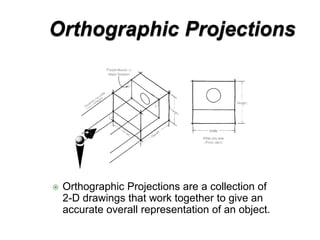
 Orthographic Projections are a collection of
2-D drawings that work together to give an
accurate overall representation of an object.
Basically, there are 2 types of orthographic
projection. They are:
1) 1st angle projection
And
2)3rd angle projection
They are explained below.
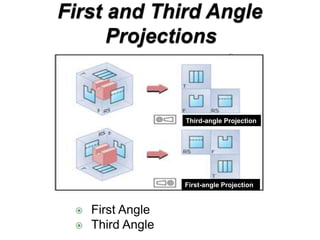
 The one and only difference between 1st angle &
3rd angle projection is that only the
representation positions of plan (top view),
bottom view and side view.
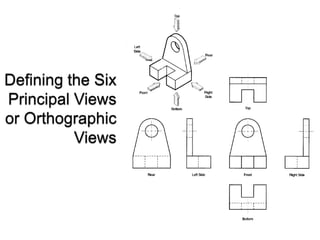
 In 1st angle projection, the front view is in center,
top view is below front view, bottom view is
above front view, RHSV(right hand side view) is
to the left of front view and LHSV(left hand side
view) is to the right of front view.
Third-angle Projection
First-angle Projection
 First Angle
 Third Angle
General Guidelines
Pick a Front View that is most descriptive
of object
Normally the longest dimension is chosen
as the width (or depth)
Most common combination of views is to
use:
• Front, Top, and Side View
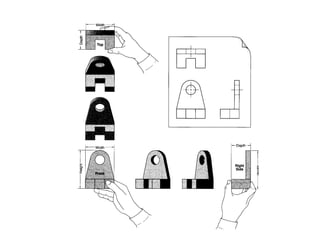
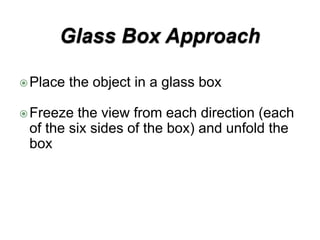
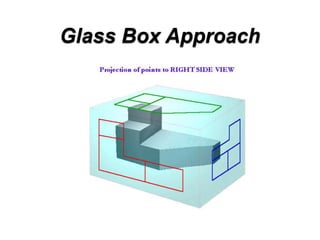
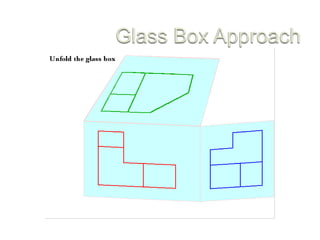
Place the object in a glass box
Freeze the view from each direction (each
of the six sides of the box) and unfold the
box
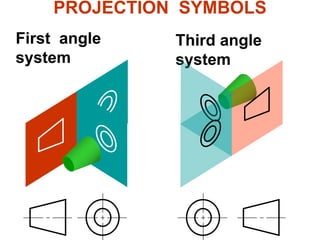
First angle
system
Third angle
system
PROJECTION SYMBOLS
Orthographic Projection

Orthographic Projection

  • 1.
  • 2.
     Orthographic Projectionsare a collection of 2-D drawings that work together to give an accurate overall representation of an object.
  • 4.
    Basically, there are2 types of orthographic projection. They are: 1) 1st angle projection And 2)3rd angle projection They are explained below.
  • 5.
     The oneand only difference between 1st angle & 3rd angle projection is that only the representation positions of plan (top view), bottom view and side view.  In 1st angle projection, the front view is in center, top view is below front view, bottom view is above front view, RHSV(right hand side view) is to the left of front view and LHSV(left hand side view) is to the right of front view.
  • 6.
  • 7.
    General Guidelines Pick aFront View that is most descriptive of object Normally the longest dimension is chosen as the width (or depth) Most common combination of views is to use: • Front, Top, and Side View
  • 9.
    Place the objectin a glass box Freeze the view from each direction (each of the six sides of the box) and unfold the box
  • 12.