ORIENTEERING
A SPORT FOR ALL
THE MAP
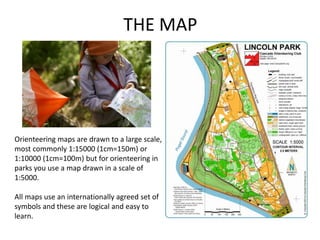
Orienteering maps are drawn to a large scale,
most commonly 1:15000 (1cm=150m) or
1:10000 (1cm=100m) but for orienteering in
parks you use a map drawn in a scale of
1:5000.
All maps use an internationally agreed set of
symbols and these are logical and easy to
learn.
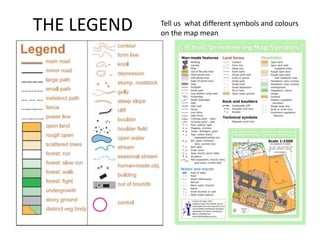
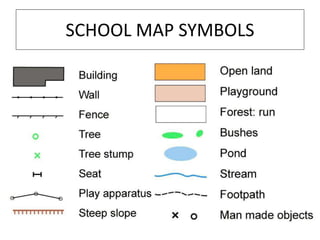
THE LEGEND Tell us what different symbols and colours
on the map mean
THE SCALE Is used to show the relationship between a measurement on
the map and the actual distance it represents
Orienteering maps are very detailed topographical maps (they show hills and valleys). Their scales
are 1:15,000 or 1:10,000, wich means every cm in the map equals 15.000 or 10.000 cms (150 or 100m)
on the terrain. Map symbols are standardized by the IOF, and designed to be readable by any competitor.
For example: A 1:1 scale means that 1 cm on the map = 1 cm in real life. However this
would be a very small map so scales are often much larger:
1:15.000 means 1cm on map = 15.000 cm on the ground
If you measured from point A to B on the map and it was 2 cm. the actual ground
distance between them would be 30.000 cm (300 m).
THE COLOURS
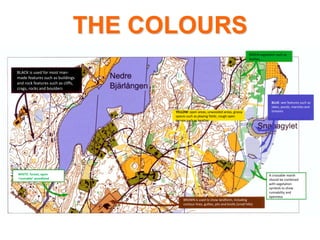
BLACK is used for most man-
made features such as buildings
and rock features such as cliffs,
crags, rocks and boulders
BROWN is used to show landform, including
contour lines, gullies, pits and knolls (small hills)
BLUE: wet features such as
lakes, ponds, marshes and
streams
WHITE: forest, open
‘runnable’ woodland
GREEN vegetation such as
bushes,..,
YELLOW: open areas, unwooded areas, grassy
spaces such as playing fields ,rough open
terrain such as heather
A crossable marsh
should be combined
with vegetation
symbols to show
runnability and
openness
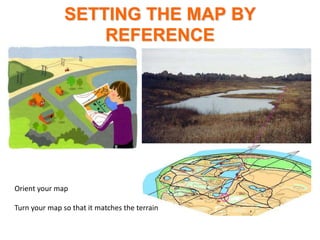
SETTING THE MAP BY
REFERENCE
Orient your map
Turn your map so that it matches the terrain
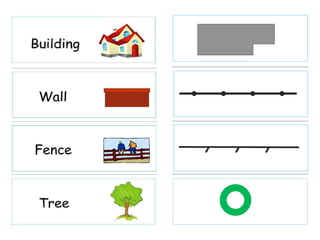
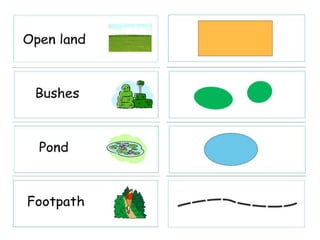
WHAT IS RIGHT?
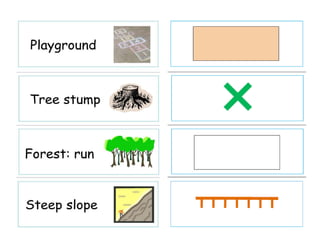
SCHOOL MAP SYMBOLS
Orienteering 1ESO
Orienteering 1ESO
Orienteering 1ESO
Orienteering 1ESO

Orienteering 1ESO

  • 1.
  • 2.
    THE MAP Orienteering mapsare drawn to a large scale, most commonly 1:15000 (1cm=150m) or 1:10000 (1cm=100m) but for orienteering in parks you use a map drawn in a scale of 1:5000. All maps use an internationally agreed set of symbols and these are logical and easy to learn.
  • 3.
    THE LEGEND Tellus what different symbols and colours on the map mean
  • 4.
    THE SCALE Isused to show the relationship between a measurement on the map and the actual distance it represents Orienteering maps are very detailed topographical maps (they show hills and valleys). Their scales are 1:15,000 or 1:10,000, wich means every cm in the map equals 15.000 or 10.000 cms (150 or 100m) on the terrain. Map symbols are standardized by the IOF, and designed to be readable by any competitor. For example: A 1:1 scale means that 1 cm on the map = 1 cm in real life. However this would be a very small map so scales are often much larger: 1:15.000 means 1cm on map = 15.000 cm on the ground If you measured from point A to B on the map and it was 2 cm. the actual ground distance between them would be 30.000 cm (300 m).
  • 5.
    THE COLOURS BLACK isused for most man- made features such as buildings and rock features such as cliffs, crags, rocks and boulders BROWN is used to show landform, including contour lines, gullies, pits and knolls (small hills) BLUE: wet features such as lakes, ponds, marshes and streams WHITE: forest, open ‘runnable’ woodland GREEN vegetation such as bushes,.., YELLOW: open areas, unwooded areas, grassy spaces such as playing fields ,rough open terrain such as heather A crossable marsh should be combined with vegetation symbols to show runnability and openness
  • 12.
    SETTING THE MAPBY REFERENCE Orient your map Turn your map so that it matches the terrain
  • 13.
  • 14.