Erbil Polytechnic University
Technical Engineering College
Civil Engineering Department
Surveying Engineering
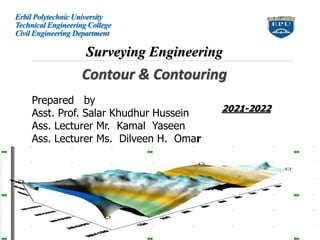
Contour & Contouring
1
Prepared by
Asst. Prof. Salar Khudhur Hussein
Ass. Lecturer Mr. Kamal Yaseen
Ass. Lecturer Ms. Dilveen H. Omar
2021-2022
In this lecture we will cover
 definitions.
Characteristics of contour lines.
Contours used by Engineers .
Methods of locating contour.
Method of Interpolation Contours.
2
Contour & Contouring
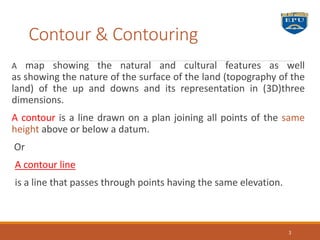
A map showing the natural and cultural features as well
as showing the nature of the surface of the land (topography of the
land) of the up and downs and its representation in (3D)three
dimensions.
A contour is a line drawn on a plan joining all points of the same
height above or below a datum.
Or
A contour line
is a line that passes through points having the same elevation.
3
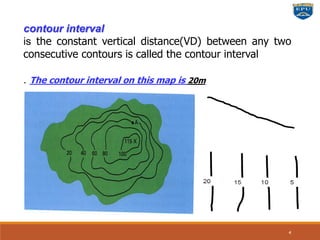
contour interval
is the constant vertical distance(VD) between any two
consecutive contours is called the contour interval
. The contour interval on this map is 20m
4
5
The choice of suitable contour interval depends on several
factors:
1- The nature of the ground surface.
2- The scale of the map.
3- The purpose of the map.
4- The area of the ground.
5- The time and cost.
6
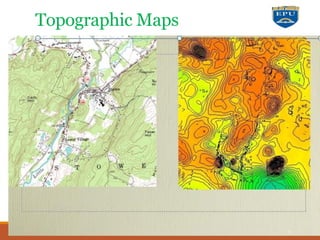
Topographic Maps
7
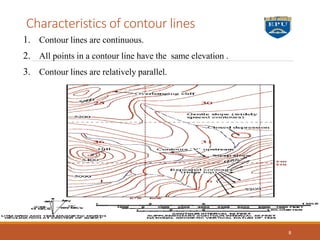
1. Contour lines are continuous.
2. All points in a contour line have the same elevation .
3. Contour lines are relatively parallel.
Characteristics of contour lines
8
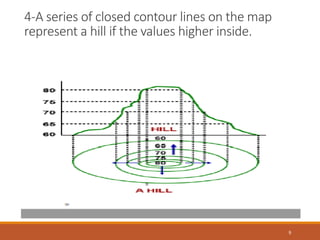
4-A series of closed contour lines on the map
represent a hill if the values higher inside.
9
5
10
15
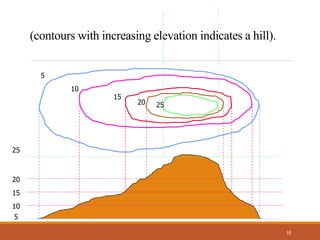
(contours with increasing elevation indicates a hill).
20
25
5
10
15
20 25
10
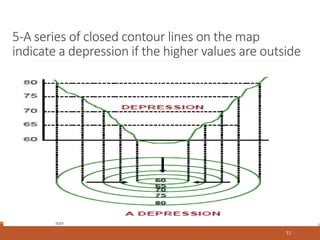
5-A series of closed contour lines on the map
indicate a depression if the higher values are outside
11
Characteristics of contour lines continued
6-Evenly(Equal) spaced lines indicate an area of uniform slope.
7. The distance between contour lines indicates the steepness of
the slope. The greater distance between two contours indicates
less slope. The opposite is also true.
12
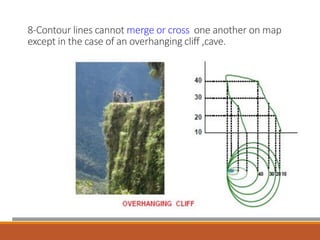
8-Contour lines cannot merge or cross one another on map
except in the case of an overhanging cliff ,cave.
Contours are used by Engineers to:
1- Construct longitudinal sections and cross-sections for initial investigation.
2- Compute volumes.
3- Construct route lines of constant gradient.
4- Draw the limits of constructed dams, roads, railways, & tunnels, etc.
5- Draw and measure drainage areas.
 IF the ground is reasonably flat, the optical level can be used for contouring
using either the direct or indirect methods.
14
Methods of locating contour:-
A- The direct methods
1- Level and staff method.
2- Plan table and alidade method.
Direct method procedure:
In this method the actual contour is pegged out on the ground and its
planimetric position located. A back-sight is taken to an appropriate BM and
the HPC of the instrument is obtained, say( 34.800m.) A staff reading of
0.800m would then place the foot of the staff at the( 34m )contour level. The
staff is then moved throughout the terrain area, with its position pegged at
every 0.800m reading. In this way the 34m contour is located. Similarly a
staff reading of (1.800m) gives the 33m contour and so on. The planimetric
position of the contour needs to be located using an appropriate survey
technique
15
16
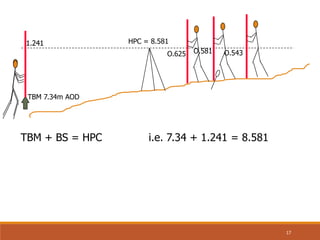
TBM 7.34m AOD
1.241
TBM + BS = HPC i.e. 7.34 + 1.241 = 8.581
1.241 HPC = 8.581
O.625 O.543
O.581
17
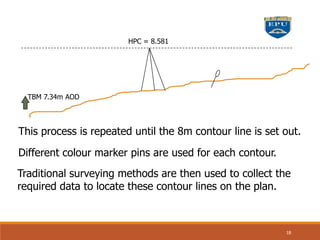
TBM 7.34m AOD
HPC = 8.581
This process is repeated until the 8m contour line is set out.
Different colour marker pins are used for each contour.
Traditional surveying methods are then used to collect the
required data to locate these contour lines on the plan.
18
B- The indirect methods:-
1- Grid method (Square method). Use Level instrument
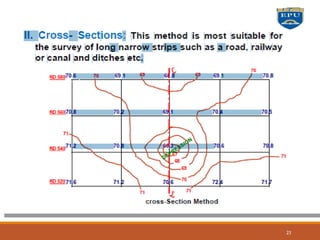
2- Profile and Cross-section method. Use Level instrument
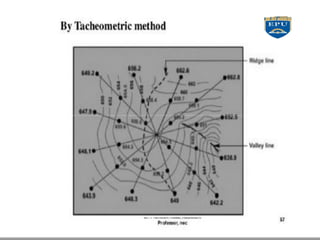
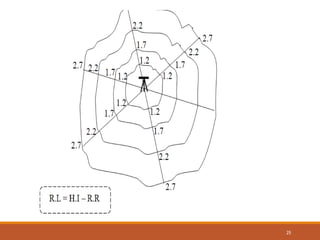
3- Tachometric method (Radial line method).
Use either theodolite or tachometry instrument
4- Plan table method. Use Alidade instrument
5- Total Station .(TS)
6-Global Navigation Satellite System (GNSS)
19
1- Grid method:-
It is used when the area to be surveyed is small and the ground
is not very slope
Steps
1- The area is divided into squares. The size of the squares
may vary from (5 – 20) m depending upon the nature of the
ground and contour interval.
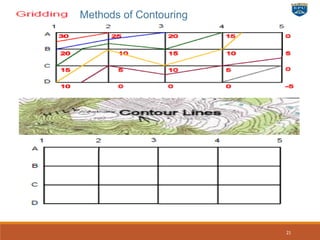
2- The elevation of the corners of the squares are determined
using a level and staff, starting from a (B.M).
3- The contours are drawn by (interpolation).
20
Methods of Contouring
21
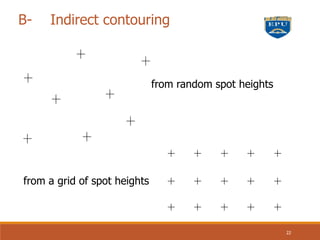
B- Indirect contouring
from random spot heights
from a grid of spot heights
22
23
24
25
26
27
28
7.45 8.23
8m
R.L.(C)
R.L.(L) R.L.(H)
[ R.L.(C)
- R.L.(L) ]
[ R.L.(H)
- R.L.(L) ]
[ R.L.(H) - R.L.(C) ]
L
x
From large triangle :
[ R.L.(H) - R.L.(L) ]
L
From small triangle :
[ R.L.(H) - R.L.(C) ]
x
=
Hence : [ R.L.(H) - R.L.(C) ]
x =
[ R.L.(H) - R.L.(L) ]
L . This is a
calculation
method 29
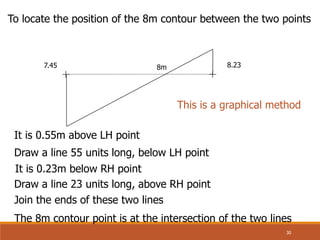
To locate the position of the 8m contour between the two points
7.45 8.23
It is 0.55m above LH point
Draw a line 55 units long, below LH point
It is 0.23m below RH point
Draw a line 23 units long, above RH point
Join the ends of these two lines
The 8m contour point is at the intersection of the two lines
8m
This is a graphical method
30
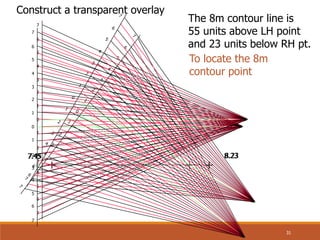
7.45 8.23
To locate the 8m
contour point
Construct a transparent overlay
7
6
5
4
3
2
1
0
1
2
3
4
5
6
7
7.45 8.23
The 8m contour line is
55 units above LH point
and 23 units below RH pt.
7
6
5
4
3
2
1
0
1
2
3
4
5
6
7
31
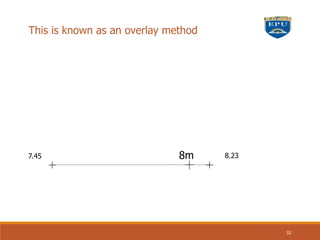
7.45 8.23
8m
This is known as an overlay method
32
33
34
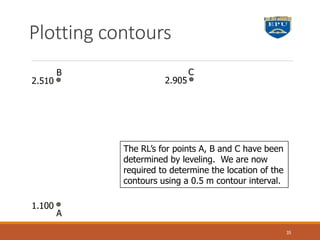
1.100
2.905
2.510
A
B C
Plotting contours
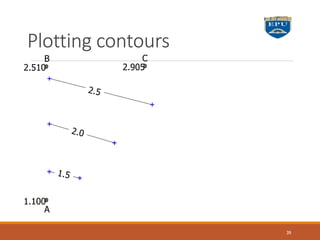
The RL’s for points A, B and C have been
determined by leveling. We are now
required to determine the location of the
contours using a 0.5 m contour interval.
35
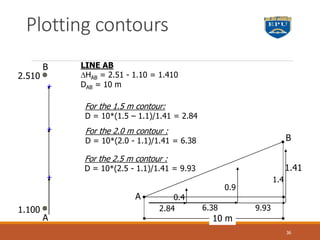
Plotting contours
LINE AB
HAB = 2.51 - 1.10 = 1.410
DAB = 10 m
1.100
2.510
A
B
A
B
1.41
10 m
1.4
9.93
For the 2.5 m contour :
D = 10*(2.5 - 1.1)/1.41 = 9.93
0.9
6.38
For the 2.0 m contour :
D = 10*(2.0 - 1.1)/1.41 = 6.38
0.4
2.84
For the 1.5 m contour:
D = 10*(1.5 – 1.1)/1.41 = 2.84
36
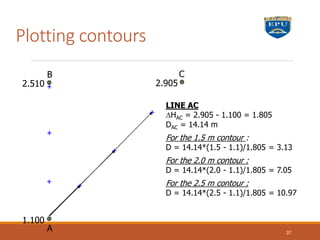
Plotting contours
LINE AC
HAC = 2.905 - 1.100 = 1.805
DAC = 14.14 m
For the 1.5 m contour :
D = 14.14*(1.5 - 1.1)/1.805 = 3.13
For the 2.0 m contour :
D = 14.14*(2.0 - 1.1)/1.805 = 7.05
For the 2.5 m contour :
D = 14.14*(2.5 - 1.1)/1.805 = 10.97
1.100
2.905
2.510
A
B C
37
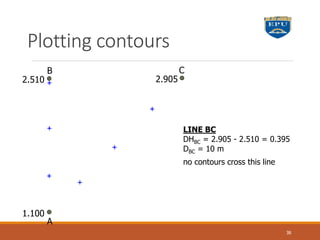
Plotting contours
LINE BC
DHBC = 2.905 - 2.510 = 0.395
DBC = 10 m
no contours cross this line
1.100
2.905
2.510
A
B C
38
1.100
2.905
2.510
A
B C
Plotting contours
39

Contour & Contouring Surveying

  • 1.
    Erbil Polytechnic University TechnicalEngineering College Civil Engineering Department Surveying Engineering Contour & Contouring 1 Prepared by Asst. Prof. Salar Khudhur Hussein Ass. Lecturer Mr. Kamal Yaseen Ass. Lecturer Ms. Dilveen H. Omar 2021-2022
  • 2.
    In this lecturewe will cover  definitions. Characteristics of contour lines. Contours used by Engineers . Methods of locating contour. Method of Interpolation Contours. 2
  • 3.
    Contour & Contouring Amap showing the natural and cultural features as well as showing the nature of the surface of the land (topography of the land) of the up and downs and its representation in (3D)three dimensions. A contour is a line drawn on a plan joining all points of the same height above or below a datum. Or A contour line is a line that passes through points having the same elevation. 3
  • 4.
    contour interval is theconstant vertical distance(VD) between any two consecutive contours is called the contour interval . The contour interval on this map is 20m 4
  • 5.
  • 6.
    The choice ofsuitable contour interval depends on several factors: 1- The nature of the ground surface. 2- The scale of the map. 3- The purpose of the map. 4- The area of the ground. 5- The time and cost. 6
  • 7.
  • 8.
    1. Contour linesare continuous. 2. All points in a contour line have the same elevation . 3. Contour lines are relatively parallel. Characteristics of contour lines 8
  • 9.
    4-A series ofclosed contour lines on the map represent a hill if the values higher inside. 9
  • 10.
    5 10 15 (contours with increasingelevation indicates a hill). 20 25 5 10 15 20 25 10
  • 11.
    5-A series ofclosed contour lines on the map indicate a depression if the higher values are outside 11
  • 12.
    Characteristics of contourlines continued 6-Evenly(Equal) spaced lines indicate an area of uniform slope. 7. The distance between contour lines indicates the steepness of the slope. The greater distance between two contours indicates less slope. The opposite is also true. 12
  • 13.
    8-Contour lines cannotmerge or cross one another on map except in the case of an overhanging cliff ,cave.
  • 14.
    Contours are usedby Engineers to: 1- Construct longitudinal sections and cross-sections for initial investigation. 2- Compute volumes. 3- Construct route lines of constant gradient. 4- Draw the limits of constructed dams, roads, railways, & tunnels, etc. 5- Draw and measure drainage areas.  IF the ground is reasonably flat, the optical level can be used for contouring using either the direct or indirect methods. 14
  • 15.
    Methods of locatingcontour:- A- The direct methods 1- Level and staff method. 2- Plan table and alidade method. Direct method procedure: In this method the actual contour is pegged out on the ground and its planimetric position located. A back-sight is taken to an appropriate BM and the HPC of the instrument is obtained, say( 34.800m.) A staff reading of 0.800m would then place the foot of the staff at the( 34m )contour level. The staff is then moved throughout the terrain area, with its position pegged at every 0.800m reading. In this way the 34m contour is located. Similarly a staff reading of (1.800m) gives the 33m contour and so on. The planimetric position of the contour needs to be located using an appropriate survey technique 15
  • 16.
  • 17.
    TBM 7.34m AOD 1.241 TBM+ BS = HPC i.e. 7.34 + 1.241 = 8.581 1.241 HPC = 8.581 O.625 O.543 O.581 17
  • 18.
    TBM 7.34m AOD HPC= 8.581 This process is repeated until the 8m contour line is set out. Different colour marker pins are used for each contour. Traditional surveying methods are then used to collect the required data to locate these contour lines on the plan. 18
  • 19.
    B- The indirectmethods:- 1- Grid method (Square method). Use Level instrument 2- Profile and Cross-section method. Use Level instrument 3- Tachometric method (Radial line method). Use either theodolite or tachometry instrument 4- Plan table method. Use Alidade instrument 5- Total Station .(TS) 6-Global Navigation Satellite System (GNSS) 19
  • 20.
    1- Grid method:- Itis used when the area to be surveyed is small and the ground is not very slope Steps 1- The area is divided into squares. The size of the squares may vary from (5 – 20) m depending upon the nature of the ground and contour interval. 2- The elevation of the corners of the squares are determined using a level and staff, starting from a (B.M). 3- The contours are drawn by (interpolation). 20
  • 21.
  • 22.
    B- Indirect contouring fromrandom spot heights from a grid of spot heights 22
  • 23.
  • 24.
  • 25.
  • 26.
  • 27.
  • 28.
  • 29.
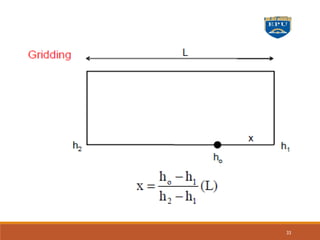
    7.45 8.23 8m R.L.(C) R.L.(L) R.L.(H) [R.L.(C) - R.L.(L) ] [ R.L.(H) - R.L.(L) ] [ R.L.(H) - R.L.(C) ] L x From large triangle : [ R.L.(H) - R.L.(L) ] L From small triangle : [ R.L.(H) - R.L.(C) ] x = Hence : [ R.L.(H) - R.L.(C) ] x = [ R.L.(H) - R.L.(L) ] L . This is a calculation method 29
  • 30.
    To locate theposition of the 8m contour between the two points 7.45 8.23 It is 0.55m above LH point Draw a line 55 units long, below LH point It is 0.23m below RH point Draw a line 23 units long, above RH point Join the ends of these two lines The 8m contour point is at the intersection of the two lines 8m This is a graphical method 30
  • 31.
    7.45 8.23 To locatethe 8m contour point Construct a transparent overlay 7 6 5 4 3 2 1 0 1 2 3 4 5 6 7 7.45 8.23 The 8m contour line is 55 units above LH point and 23 units below RH pt. 7 6 5 4 3 2 1 0 1 2 3 4 5 6 7 31
  • 32.
    7.45 8.23 8m This isknown as an overlay method 32
  • 33.
  • 34.
  • 35.
    1.100 2.905 2.510 A B C Plotting contours TheRL’s for points A, B and C have been determined by leveling. We are now required to determine the location of the contours using a 0.5 m contour interval. 35
  • 36.
    Plotting contours LINE AB HAB= 2.51 - 1.10 = 1.410 DAB = 10 m 1.100 2.510 A B A B 1.41 10 m 1.4 9.93 For the 2.5 m contour : D = 10*(2.5 - 1.1)/1.41 = 9.93 0.9 6.38 For the 2.0 m contour : D = 10*(2.0 - 1.1)/1.41 = 6.38 0.4 2.84 For the 1.5 m contour: D = 10*(1.5 – 1.1)/1.41 = 2.84 36
  • 37.
    Plotting contours LINE AC HAC= 2.905 - 1.100 = 1.805 DAC = 14.14 m For the 1.5 m contour : D = 14.14*(1.5 - 1.1)/1.805 = 3.13 For the 2.0 m contour : D = 14.14*(2.0 - 1.1)/1.805 = 7.05 For the 2.5 m contour : D = 14.14*(2.5 - 1.1)/1.805 = 10.97 1.100 2.905 2.510 A B C 37
  • 38.
    Plotting contours LINE BC DHBC= 2.905 - 2.510 = 0.395 DBC = 10 m no contours cross this line 1.100 2.905 2.510 A B C 38
  • 39.