FOOTBALL

History and Rules

DONE BY
VISHNUSHANKAR.P
Soccer’s Beginnings






The origin of soccer can be found in every
corner of geography and history.
The Chinese, Japanese, Italian, Ancient
Greek, Persian, Viking, and many more
played a ball game long before our era.
The Chinese played "football" games date
as far back as 3000 years ago.
The Ancient Greeks and the Roman used
football games to sharpen warriors for
battle. In South and Central America a
game called "Tlatchi" once flourished.
Ancient Civilizations
and Soccer






Mesoamerican civilizations also
devised a game played with rubber
balls, which resembled a combination
between soccer, basketball and
volleyball.
The game involved two teams, playing
in a sort of basin dug below ground
level, with baskets strapped in several
locations on the side walls.
The teams would then have to kick
the ball towards these baskets, and
score a goal.
Soccer in Europe






As we go forward on the history of
soccer timeline, we notice that the
game has gradually entered European
territory, Europe being the place
where modern day soccer will start in
several centuries.
Middle age soccer is covered in a
combination of myth and historical
facts.
One popular form of the game (Mob
soccer) involved entire villages or
towns and was rather chaotic.
Soccer in Europe (cont.)






The teams could have unlimited players,
as long as they were from the same
village or town. Both teams had to kick
the ball towards specific landmarks, and
defend their own.
To add more chaos, the ball was made out
of inflated pigs' bladders, or leather skins
stuffed with all sorts of materials.
Picture two masses of people running
towards a poor pig bladder ball, kicking,
stomping, punching and pushing each
other in the attempt to kick the object to
some area.
Soccer in Europe (cont.)






In medieval France, a game called "La
Choule" was usually played in town
gatherings, such as just after Sunday
church, or on special occasions or
holidays.
The game itself looked like a
combination of soccer, handball,
hockey, baseball and kickboxing, since
the players of each team had to strike
the ball into the opponent's goal, using
whatever means necessary and
whatever accessories necessary.
For example, one record shows that
players were allowed to use sticks or
clubs to hit the ball around, although it
wasn't always the ball that got hit.
History Continued




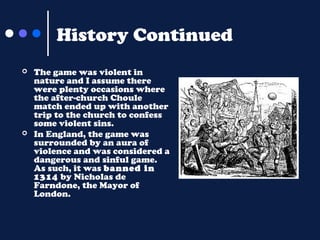
The game was violent in
nature and I assume there
were plenty occasions where
the after-church Choule
match ended up with another
trip to the church to confess
some violent sins.
In England, the game was
surrounded by an aura of
violence and was considered a
dangerous and sinful game.
As such, it was banned in
1314 by Nicholas de
Farndone, the Mayor of
London.
Soccer Grows Popular




Despite this ban, soccer became to
grow in medieval England and it was
not long that it was introduced in
English public schools in order to
keep young boys fit.
Since soccer was growing strong in
English public schools, the idea of
having an organized tournament
sparked in the 19th century.






In 1862, a solicitor by the name of Cobb
Morley, formed a semi-professional soccer
club in Barnes, called the Barnes Club.
Cobb Morley is rightfully considered the
father of soccer, but that's not just
because he was the one to spark the idea
of the Soccer Association.
He also drew up the Laws of the Game,
probably the most important document
in the history of soccer, since it held all
the official rules around which the game
would be played.
Soccer
It is a team sport played between
two teams of eleven players each.
 Players use a spherical ball which is
a round, leather covered, inflated
rubber bladder 27-28 inches in
circumference and 397-454 grams in
weight.
 The game is played within a clearly
defined area on a rectangular grass
or artificial turf with a goal in the
centre of each of the short ends.

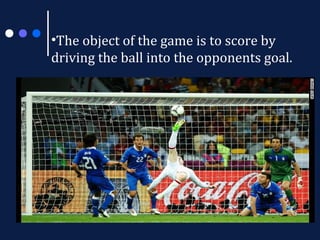
•The object of the game is to score by
driving the ball into the opponents goal.
The Rules of Soccer
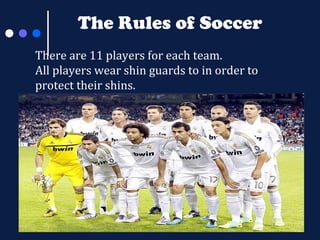
There are 11 players for each team.
All players wear shin guards to in order to
protect their shins.
The goalkeeper isthe only player who can get
the ball with his hands.
Soccer Rules
A goal is scored when the whole of the ball
passes over the goal line, between the goalposts and
under the crossbar, provided that no faults has been
committed previously by the team scoring the goal.




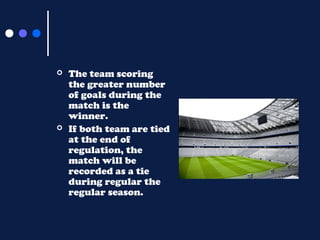
The team scoring
the greater number
of goals during the
match is the
winner.
If both team are tied
at the end of
regulation, the
match will be
recorded as a tie
during regular the
regular season.
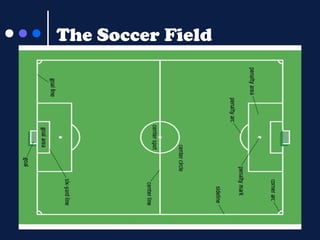
The Soccer Field
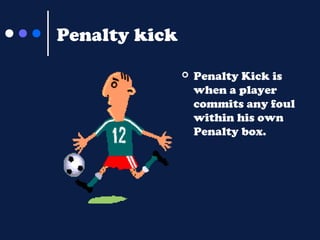
Penalty kick


Penalty Kick is
when a player
commits any foul
within his own
Penalty box.
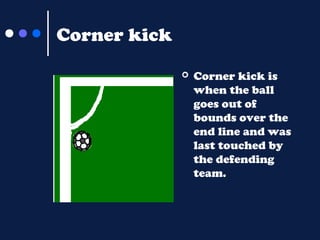
Corner kick


Corner kick is
when the ball
goes out of
bounds over the
end line and was
last touched by
the defending
team.
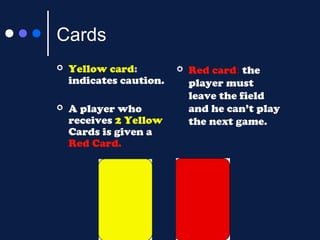
Cards


Yellow card:
indicates caution.



A player who
receives 2 Yellow
Cards is given a
Red Card.



Red card: the
player must
leave the field
and he can’t play
the next game.
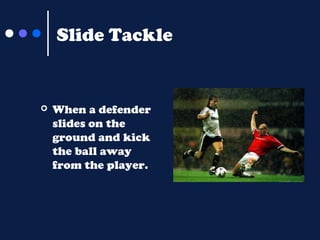
Slide Tackle



When a defender
slides on the
ground and kick
the ball away
from the player.
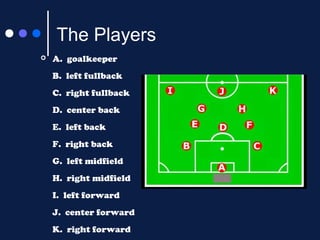
The Players


A. goalkeeper
B. left fullback
C. right fullback
D. center back
E. left back
F. right back
G. left midfield
H. right midfield
I. left forward
J. center forward
K. right forward
Spanish Words for Playing
Soccer









Fuera de lugar –
offsides
tiro de esquina corner kick
tiro libre - free kick
falta - foul
penal - penalty
lateral - throw in
saque del arco - goal
kick
delantero - forward











portero - goalkeeper
se fue - the ball went out
mano - handball (literally
means "hand")
empujon - push
pelota - ball
mediocampista - midfielder
defensor - defender
cruze - cross
cabezazo - header













Toque - pass it back
Hay que bajar or baja - guys we need to get downfield and
defend more or specifically you need to go help out
downfield.
Dos - when two teamates are running towards a loose ball
and one needs to ease off so as to avoid a mishaps.
Centro - cross it in
Solo - no pressure is on you so go ahead and shoot it or
dribble it upfield
¡Te llegan! - man on!
Calmado - don't rush your passing or dribbling
Tiro- shoot it
Marca - defend your nearest or assigned oppenent
Entrale - tackle your opponent now or apply pressure
Pásame la pelota – pass me the ball
Soccer ppt

Soccer ppt

  • 1.
  • 2.
    Soccer’s Beginnings     The originof soccer can be found in every corner of geography and history. The Chinese, Japanese, Italian, Ancient Greek, Persian, Viking, and many more played a ball game long before our era. The Chinese played "football" games date as far back as 3000 years ago. The Ancient Greeks and the Roman used football games to sharpen warriors for battle. In South and Central America a game called "Tlatchi" once flourished.
  • 3.
    Ancient Civilizations and Soccer    Mesoamericancivilizations also devised a game played with rubber balls, which resembled a combination between soccer, basketball and volleyball. The game involved two teams, playing in a sort of basin dug below ground level, with baskets strapped in several locations on the side walls. The teams would then have to kick the ball towards these baskets, and score a goal.
  • 4.
    Soccer in Europe    Aswe go forward on the history of soccer timeline, we notice that the game has gradually entered European territory, Europe being the place where modern day soccer will start in several centuries. Middle age soccer is covered in a combination of myth and historical facts. One popular form of the game (Mob soccer) involved entire villages or towns and was rather chaotic.
  • 5.
    Soccer in Europe(cont.)    The teams could have unlimited players, as long as they were from the same village or town. Both teams had to kick the ball towards specific landmarks, and defend their own. To add more chaos, the ball was made out of inflated pigs' bladders, or leather skins stuffed with all sorts of materials. Picture two masses of people running towards a poor pig bladder ball, kicking, stomping, punching and pushing each other in the attempt to kick the object to some area.
  • 6.
    Soccer in Europe(cont.)    In medieval France, a game called "La Choule" was usually played in town gatherings, such as just after Sunday church, or on special occasions or holidays. The game itself looked like a combination of soccer, handball, hockey, baseball and kickboxing, since the players of each team had to strike the ball into the opponent's goal, using whatever means necessary and whatever accessories necessary. For example, one record shows that players were allowed to use sticks or clubs to hit the ball around, although it wasn't always the ball that got hit.
  • 7.
    History Continued   The gamewas violent in nature and I assume there were plenty occasions where the after-church Choule match ended up with another trip to the church to confess some violent sins. In England, the game was surrounded by an aura of violence and was considered a dangerous and sinful game. As such, it was banned in 1314 by Nicholas de Farndone, the Mayor of London.
  • 8.
    Soccer Grows Popular   Despitethis ban, soccer became to grow in medieval England and it was not long that it was introduced in English public schools in order to keep young boys fit. Since soccer was growing strong in English public schools, the idea of having an organized tournament sparked in the 19th century.
  • 9.
       In 1862, asolicitor by the name of Cobb Morley, formed a semi-professional soccer club in Barnes, called the Barnes Club. Cobb Morley is rightfully considered the father of soccer, but that's not just because he was the one to spark the idea of the Soccer Association. He also drew up the Laws of the Game, probably the most important document in the history of soccer, since it held all the official rules around which the game would be played.
  • 10.
    Soccer It is ateam sport played between two teams of eleven players each.  Players use a spherical ball which is a round, leather covered, inflated rubber bladder 27-28 inches in circumference and 397-454 grams in weight.  The game is played within a clearly defined area on a rectangular grass or artificial turf with a goal in the centre of each of the short ends. 
  • 11.
    •The object ofthe game is to score by driving the ball into the opponents goal.
  • 12.
    The Rules ofSoccer There are 11 players for each team. All players wear shin guards to in order to protect their shins.
  • 13.
    The goalkeeper istheonly player who can get the ball with his hands.
  • 14.
    Soccer Rules A goalis scored when the whole of the ball passes over the goal line, between the goalposts and under the crossbar, provided that no faults has been committed previously by the team scoring the goal.
  • 15.
      The team scoring thegreater number of goals during the match is the winner. If both team are tied at the end of regulation, the match will be recorded as a tie during regular the regular season.
  • 16.
  • 17.
    Penalty kick  Penalty Kickis when a player commits any foul within his own Penalty box.
  • 18.
    Corner kick  Corner kickis when the ball goes out of bounds over the end line and was last touched by the defending team.
  • 19.
    Cards  Yellow card: indicates caution.  Aplayer who receives 2 Yellow Cards is given a Red Card.  Red card: the player must leave the field and he can’t play the next game.
  • 20.
    Slide Tackle  When adefender slides on the ground and kick the ball away from the player.
  • 21.
    The Players  A. goalkeeper B.left fullback C. right fullback D. center back E. left back F. right back G. left midfield H. right midfield I. left forward J. center forward K. right forward
  • 22.
    Spanish Words forPlaying Soccer         Fuera de lugar – offsides tiro de esquina corner kick tiro libre - free kick falta - foul penal - penalty lateral - throw in saque del arco - goal kick delantero - forward          portero - goalkeeper se fue - the ball went out mano - handball (literally means "hand") empujon - push pelota - ball mediocampista - midfielder defensor - defender cruze - cross cabezazo - header
  • 23.
               Toque - passit back Hay que bajar or baja - guys we need to get downfield and defend more or specifically you need to go help out downfield. Dos - when two teamates are running towards a loose ball and one needs to ease off so as to avoid a mishaps. Centro - cross it in Solo - no pressure is on you so go ahead and shoot it or dribble it upfield ¡Te llegan! - man on! Calmado - don't rush your passing or dribbling Tiro- shoot it Marca - defend your nearest or assigned oppenent Entrale - tackle your opponent now or apply pressure Pásame la pelota – pass me the ball