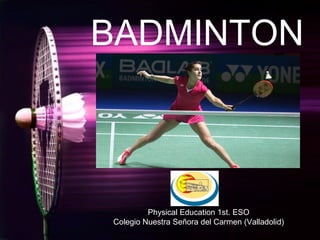
BADMINTON
Physical Education 1st. ESO
Colegio Nuestra Señora del Carmen (Valladolid)
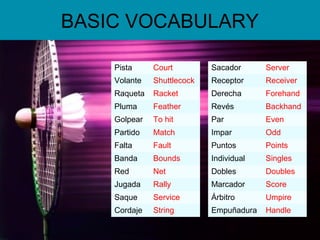
BASIC VOCABULARY
Pista Court
Volante Shuttlecock
Raqueta Racket
Pluma Feather
Golpear To hit
Partido Match
Falta Fault
Banda Bounds
Red Net
Jugada Rally
Saque Service
Cordaje String
Sacador Server
Receptor Receiver
Derecha Forehand
Revés Backhand
Par Even
Impar Odd
Puntos Points
Individual Singles
Dobles Doubles
Marcador Score
Árbitro Umpire
Empuñadura Handle
The Game
 To hit the shuttle over the net so that it lands
in your opponent's court before it can be
returned.
 A rally is started when the shuttle is returned.
 Each rally begins with a stroke known as the
serve.
 You can win the rally when:
- You hit the shuttle on to the ground in
your opponent's court.
- Your opponent makes a mistake and hits
the shuttle out of court.
History of the Game
• Badminton was started in India with
the name of “Poona” (1850 ).
• English officials in service in this
country liked the game and they
brought it to Europe.
• In 1870, a new version of the sport
was played in the property of
Badminton, belonging to the Duke of
Beaufort, in Gloucestershire, England.
• The first rules were printed in 1876.
This is how Badminton was
played during the early years
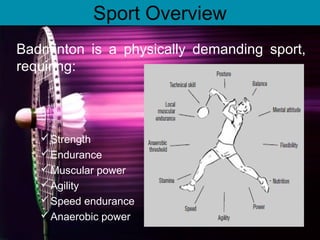
Sport Overview
Strength
Endurance
Muscular power
Agility
Speed endurance
Anaerobic power
Badminton is a physically demanding sport,
requiring:
Equipment
The Net
Racket and shuttlecock
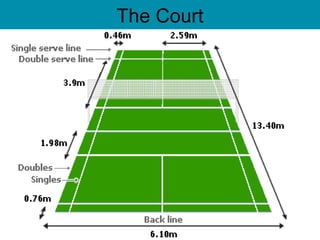
The Court
The Court
The Net
1,55 m height1,52 m height on the middle
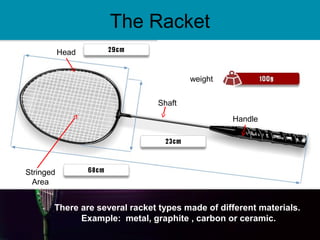
The Racket
Handle
Shaft
Head
weight
Stringed
Area
There are several racket types made of different materials.
Example: metal, graphite , carbon or ceramic.
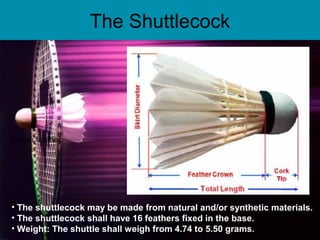
The Shuttlecock
• The shuttlecock may be made from natural and/or synthetic materials.
• The shuttlecock shall have 16 feathers fixed in the base.
• Weight: The shuttle shall weigh from 4.74 to 5.50 grams.
Goose feather
Players
Doubles:
Feminine or
Masculine
There are tournaments of :
Doubles Mix:
Feminine and
Masculine
Singles:
Feminine or
Masculine
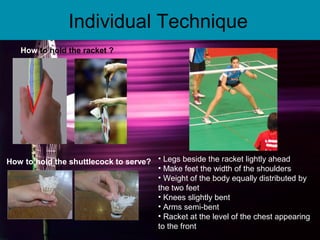
Individual Technique
How to hold the racket ?
How to hold the shuttlecock to serve? • Legs beside the racket lightly ahead
• Make feet the width of the shoulders
• Weight of the body equally distributed by
the two feet
• Knees slightly bent
• Arms semi-bent
• Racket at the level of the chest appearing
to the front
The Grip
You need to apply correct grip for each shot being played.
There are 2 basic types of grip:
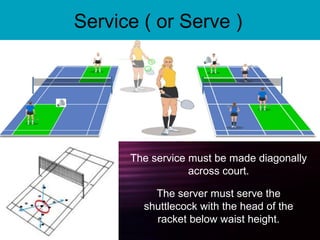
Service ( or Serve )
The service must be made diagonally
across court.
The server must serve the
shuttlecock with the head of the
racket below waist height.
Service ( or Serve )
Deciding who gets to serve first:
In more casual games, you usually just throw the
shuttle up in the air or let it land from the net, and
see which side it points towards: that side serves
first.
Which side to serve from?
When the server’s score is an even number, he
serves from the right service court. When his score is
an odd number, he serves from the left service court.
Always say the server’s score first.
When you’re saying the score, always say the server’s
score first. So if you are serving and have 10 points to your
opponent’s 15 points, then the score is 10–15 (not 15–10).
The Service or Serve
FOREHAND SERVICE
BACKHAND SERVICE
Low Serve
High Serve
This choice of serve can be used to
push them to the back of the court.
Can be used to Outwit an Opponent
by varying the depth of the shot.
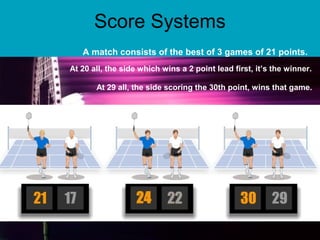
Score Systems
A match consists of the best of 3 games of 21 points.
At 29 all, the side scoring the 30th point, wins that game.
At 20 all, the side which wins a 2 point lead first, it’s the winner.
Faults and rules
• One touch of the shuttle on your own side.Two touches are fault.
• Transport, to carry the shuttlecock with
the racket.
• To be out of the service area, in service is fault.
• To hit with the racket over the waist in the service is fault, as well.
• A shuttle landing on the line is in.
• A player may not make contact with the
net with either the racket or their body.
• The shuttle must be contacted on the
player’s own side of the net.

Badminton 1st.ESO

  • 1.
    BADMINTON Physical Education 1st.ESO Colegio Nuestra Señora del Carmen (Valladolid)
  • 2.
    BASIC VOCABULARY Pista Court VolanteShuttlecock Raqueta Racket Pluma Feather Golpear To hit Partido Match Falta Fault Banda Bounds Red Net Jugada Rally Saque Service Cordaje String Sacador Server Receptor Receiver Derecha Forehand Revés Backhand Par Even Impar Odd Puntos Points Individual Singles Dobles Doubles Marcador Score Árbitro Umpire Empuñadura Handle
  • 3.
    The Game  Tohit the shuttle over the net so that it lands in your opponent's court before it can be returned.  A rally is started when the shuttle is returned.  Each rally begins with a stroke known as the serve.  You can win the rally when: - You hit the shuttle on to the ground in your opponent's court. - Your opponent makes a mistake and hits the shuttle out of court.
  • 4.
    History of theGame • Badminton was started in India with the name of “Poona” (1850 ). • English officials in service in this country liked the game and they brought it to Europe. • In 1870, a new version of the sport was played in the property of Badminton, belonging to the Duke of Beaufort, in Gloucestershire, England. • The first rules were printed in 1876. This is how Badminton was played during the early years
  • 5.
    Sport Overview Strength Endurance Muscular power Agility Speedendurance Anaerobic power Badminton is a physically demanding sport, requiring:
  • 6.
    Equipment The Net Racket andshuttlecock The Court
  • 7.
  • 8.
    The Net 1,55 mheight1,52 m height on the middle
  • 9.
    The Racket Handle Shaft Head weight Stringed Area There areseveral racket types made of different materials. Example: metal, graphite , carbon or ceramic.
  • 10.
    The Shuttlecock • Theshuttlecock may be made from natural and/or synthetic materials. • The shuttlecock shall have 16 feathers fixed in the base. • Weight: The shuttle shall weigh from 4.74 to 5.50 grams. Goose feather
  • 11.
    Players Doubles: Feminine or Masculine There aretournaments of : Doubles Mix: Feminine and Masculine Singles: Feminine or Masculine
  • 12.
    Individual Technique How tohold the racket ? How to hold the shuttlecock to serve? • Legs beside the racket lightly ahead • Make feet the width of the shoulders • Weight of the body equally distributed by the two feet • Knees slightly bent • Arms semi-bent • Racket at the level of the chest appearing to the front
  • 13.
    The Grip You needto apply correct grip for each shot being played. There are 2 basic types of grip:
  • 14.
    Service ( orServe ) The service must be made diagonally across court. The server must serve the shuttlecock with the head of the racket below waist height.
  • 15.
    Service ( orServe ) Deciding who gets to serve first: In more casual games, you usually just throw the shuttle up in the air or let it land from the net, and see which side it points towards: that side serves first. Which side to serve from? When the server’s score is an even number, he serves from the right service court. When his score is an odd number, he serves from the left service court. Always say the server’s score first. When you’re saying the score, always say the server’s score first. So if you are serving and have 10 points to your opponent’s 15 points, then the score is 10–15 (not 15–10).
  • 16.
    The Service orServe FOREHAND SERVICE BACKHAND SERVICE Low Serve High Serve This choice of serve can be used to push them to the back of the court. Can be used to Outwit an Opponent by varying the depth of the shot.
  • 17.
    Score Systems A matchconsists of the best of 3 games of 21 points. At 29 all, the side scoring the 30th point, wins that game. At 20 all, the side which wins a 2 point lead first, it’s the winner.
  • 18.
    Faults and rules •One touch of the shuttle on your own side.Two touches are fault. • Transport, to carry the shuttlecock with the racket. • To be out of the service area, in service is fault. • To hit with the racket over the waist in the service is fault, as well. • A shuttle landing on the line is in. • A player may not make contact with the net with either the racket or their body. • The shuttle must be contacted on the player’s own side of the net.