Prepared By
Dr. Krishnaswamy. G
Faculty
DOS & R in Organic Chemistry
Tumkur University
Tumakuru
Organo sulphur
Compounds
Introduction
Sulphur containing organic compounds are known as organosulphur
compounds.
Cystein and Methionine are the naturally occuring Organosulphur
compounds containing amino acids.
Thioethers as well as thiols and their derivatives are the most important
organosulphur compounds
H3N
COO
SH
H3N
COO
S
From alkyl halides
Reaction of alkyl halide with sodium hydrosulfide
From alcohols
Reaction of alcohols with hydrogen sulfide in presence of thorium oxide
Preparation
R X NaSH R SH NaX

R OH H2S R SH H2O

ThO2
Thiols
From alkyl halides
Reaction of two equivalents of alkyl halide with potassium sulphide yields
thioethers.
From alkyl halides and sodium salts of thiols
Reaction of alkyl halide with sodium salts of thiols yields thioethers.
R X K2S
R
S
2KX

2 R
R X
R
S
NaX
 RR SNa
Thioethers
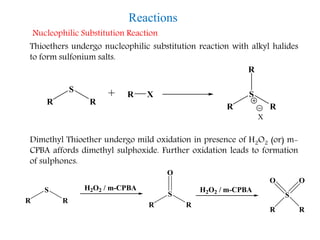
Thioethers undergo nucleophilic substitution reaction with alkyl halides
to form sulfonium salts.
Dimethyl Thioether undergo mild oxidation in presence of H2O2 (or) m-
CPBA affords dimethyl sulphoxide. Further oxidation leads to formation
of sulphones.
Nucleophilic Substitution Reaction
R
S
R
R X
R
S
R
R
X
R
S
R
R
S
R
O
H2O2 / m-CPBA H2O2 / m-CPBA
R
S
R
O O
Reactions
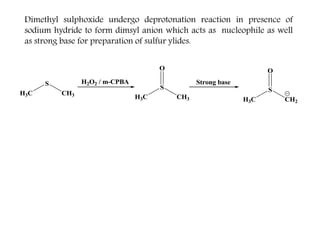
Dimethyl sulphoxide undergo deprotonation reaction in presence of
sodium hydride to form dimsyl anion which acts as nucleophile as well
as strong base for preparation of sulfur ylides.
CH3
S
H3C
CH3
S
H3C
O
H2O2 / m-CPBA Strong base
CH2
S
H3C
O
Dimethyl sulphoxide undergo alkylation reaction with alkyl halides to
sulfoxonium salts.
CH3
S
H3C
O
CH3I
CH3
S
H3C
O
CH3
I
Addition reaction
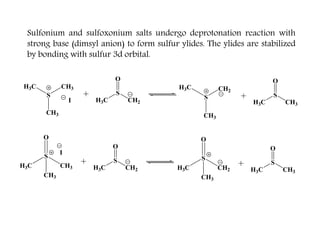
Sulfonium and sulfoxonium salts undergo deprotonation reaction with
strong base (dimsyl anion) to form sulfur ylides. The ylides are stabilized
by bonding with sulfur 3d orbital.
CH3
S
H3C
CH3
I
S
H3C
O
CH2
CH2
S
H3C
CH3
S
H3C
O
CH3
CH3
S
H3C
O
CH3
I
S
H3C
O
CH2 CH2
S
H3C
O
CH3
S
H3C
O
CH3
Sulfur ylides reacts with an aldehyde (or) ketones to form sulfur
containing adducts.
The sulfur containing adducts undergoes intramolecular nucleophilic
substitution to give an epoxide.
R R'
OCH2
S
H3C
CH3
R
R'
O
H2
C
S
H3C
CH3
R
R'
O
H2C
R
R'
O
H2
C
S
H3C
CH3
O
O
S
CH3
CH3CH2
S
H3C
O
CH3
O
O
CH2
S
H3C
CH3
O
CH2
S
H3C
O
CH3
O
O
With unsaturated carbonyl compounds unstabilized sulfur ylide gives
epoxide whereas with stabilized sulfur ylide gives cyclopropane
derivatives.
Dimethyl (or) diphenyl disulfide in the presence of base reacts with
compound containing activated C-H bond followed by oxidation results
in sulphoxide.
Finally sulfoxide undergo elimination on heating provides a method for
introducing double bond next to –M type groups.
R R
O
S
SPh
Ph
R R
O
R R
O
S
Ph
Base R R
O
S
PhO
[O]
R R
O
S
PhO
R R
O
Heat
Acid catalysed reaction between aldehyde and thiol gives dithioacetal
derivatives and this known as Umpolung synthesis (or) polarity inversion.
This reversal of polarity of carbonyl compounds and also sulfur atoms
stabilize the carbanions so making possible reaction with electrophiles.
HS SH R H
O
R H
SS
Umpolung
acid
R H
SS
Umpolung
Base
R
SS
E
R
SS
E
Umpolung synthesis
R
SS
E
H3O+
- Hg2+
R E
O
R E
Raney Ni - H2
Dithio derivative hydrolytically cleaved in presence of mercury ion to
form corresponding carbonyl derivatives. While in presence of Raney
nickel undergoes reductive desulfurization to form corresponding
hydrocarbon derivatives.
A useful synthetic method to convert aldehydes (or) ketones to olefins using
arylsulfones is known as Julia Olefination.
Julia olefination is highly stereoselective reaction gives (E)-alkenes.
S
RO
O
(1) BuLi
Na-Hg(2) R'CHO
(3) Ac2O
S
RO
O
R'
OAc
R
R'
MeOH
Julia Olefination
The reaction proceeds with addition of phenylsulfonyl carbanion to an
aldehyde or ketone to form an intermediate alcohol, which is esterfired
insitu by acetic anhydride. Finally the reductive elimination with sodium
amalgum furnish alkene.
Mechanism
S
RO
O
BuLi
S
RO
O
S
RO
O
R H / R'
O
S
RO
O
R
OH
H / R'
S
RO
O
R
O
H / R'
CH3
O
Ac2O
R
R
H / R'
Na-Hg
S
RO
O
R' H
O
R
S
R'
OAc
H
H
O
O
Ph
R
S
R'
OAcH
H
O
O
Ph
R
S
R'
OAc
H
H
O O
Ph
Ac2O
Na
R
S
R'
OAc
H
H
O ONa
Ph
-PhSO2Na
R
R'
OAc
H
H
R
R'
OAc
H
H
R
R'
Na
Diastereomers
Organosulphur compounds

Organosulphur compounds

  • 1.
    Prepared By Dr. Krishnaswamy.G Faculty DOS & R in Organic Chemistry Tumkur University Tumakuru Organo sulphur Compounds
  • 2.
    Introduction Sulphur containing organiccompounds are known as organosulphur compounds. Cystein and Methionine are the naturally occuring Organosulphur compounds containing amino acids. Thioethers as well as thiols and their derivatives are the most important organosulphur compounds H3N COO SH H3N COO S
  • 3.
    From alkyl halides Reactionof alkyl halide with sodium hydrosulfide From alcohols Reaction of alcohols with hydrogen sulfide in presence of thorium oxide Preparation R X NaSH R SH NaX  R OH H2S R SH H2O  ThO2 Thiols
  • 4.
    From alkyl halides Reactionof two equivalents of alkyl halide with potassium sulphide yields thioethers. From alkyl halides and sodium salts of thiols Reaction of alkyl halide with sodium salts of thiols yields thioethers. R X K2S R S 2KX  2 R R X R S NaX  RR SNa Thioethers
  • 5.
    Thioethers undergo nucleophilicsubstitution reaction with alkyl halides to form sulfonium salts. Dimethyl Thioether undergo mild oxidation in presence of H2O2 (or) m- CPBA affords dimethyl sulphoxide. Further oxidation leads to formation of sulphones. Nucleophilic Substitution Reaction R S R R X R S R R X R S R R S R O H2O2 / m-CPBA H2O2 / m-CPBA R S R O O Reactions
  • 6.
    Dimethyl sulphoxide undergodeprotonation reaction in presence of sodium hydride to form dimsyl anion which acts as nucleophile as well as strong base for preparation of sulfur ylides. CH3 S H3C CH3 S H3C O H2O2 / m-CPBA Strong base CH2 S H3C O
  • 7.
    Dimethyl sulphoxide undergoalkylation reaction with alkyl halides to sulfoxonium salts. CH3 S H3C O CH3I CH3 S H3C O CH3 I Addition reaction
  • 8.
    Sulfonium and sulfoxoniumsalts undergo deprotonation reaction with strong base (dimsyl anion) to form sulfur ylides. The ylides are stabilized by bonding with sulfur 3d orbital. CH3 S H3C CH3 I S H3C O CH2 CH2 S H3C CH3 S H3C O CH3 CH3 S H3C O CH3 I S H3C O CH2 CH2 S H3C O CH3 S H3C O CH3
  • 9.
    Sulfur ylides reactswith an aldehyde (or) ketones to form sulfur containing adducts. The sulfur containing adducts undergoes intramolecular nucleophilic substitution to give an epoxide. R R' OCH2 S H3C CH3 R R' O H2 C S H3C CH3 R R' O H2C R R' O H2 C S H3C CH3
  • 10.
    O O S CH3 CH3CH2 S H3C O CH3 O O CH2 S H3C CH3 O CH2 S H3C O CH3 O O With unsaturated carbonylcompounds unstabilized sulfur ylide gives epoxide whereas with stabilized sulfur ylide gives cyclopropane derivatives.
  • 11.
    Dimethyl (or) diphenyldisulfide in the presence of base reacts with compound containing activated C-H bond followed by oxidation results in sulphoxide. Finally sulfoxide undergo elimination on heating provides a method for introducing double bond next to –M type groups. R R O S SPh Ph R R O R R O S Ph Base R R O S PhO [O] R R O S PhO R R O Heat
  • 12.
    Acid catalysed reactionbetween aldehyde and thiol gives dithioacetal derivatives and this known as Umpolung synthesis (or) polarity inversion. This reversal of polarity of carbonyl compounds and also sulfur atoms stabilize the carbanions so making possible reaction with electrophiles. HS SH R H O R H SS Umpolung acid R H SS Umpolung Base R SS E R SS E Umpolung synthesis
  • 13.
    R SS E H3O+ - Hg2+ R E O RE Raney Ni - H2 Dithio derivative hydrolytically cleaved in presence of mercury ion to form corresponding carbonyl derivatives. While in presence of Raney nickel undergoes reductive desulfurization to form corresponding hydrocarbon derivatives.
  • 14.
    A useful syntheticmethod to convert aldehydes (or) ketones to olefins using arylsulfones is known as Julia Olefination. Julia olefination is highly stereoselective reaction gives (E)-alkenes. S RO O (1) BuLi Na-Hg(2) R'CHO (3) Ac2O S RO O R' OAc R R' MeOH Julia Olefination The reaction proceeds with addition of phenylsulfonyl carbanion to an aldehyde or ketone to form an intermediate alcohol, which is esterfired insitu by acetic anhydride. Finally the reductive elimination with sodium amalgum furnish alkene. Mechanism
  • 15.
    S RO O BuLi S RO O S RO O R H /R' O S RO O R OH H / R' S RO O R O H / R' CH3 O Ac2O R R H / R' Na-Hg
  • 16.