Organometallic Chemistry
Lecture Note 2
1
Group 2 Organometallic Compounds
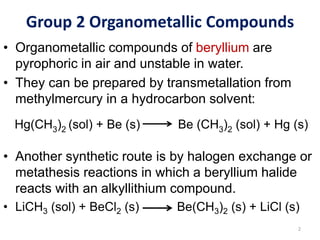
• Organometallic compounds of beryllium are
pyrophoric in air and unstable in water.
• They can be prepared by transmetallation from
methylmercury in a hydrocarbon solvent:
• Another synthetic route is by halogen exchange or
metathesis reactions in which a beryllium halide
reacts with an alkyllithium compound.
• LiCH3 (sol) + BeCl2 (s) Be(CH3)2 (s) + LiCl (s)
Hg(CH3)2 (sol) + Be (s) Be (CH3)2 (sol) + Hg (s)
2
Group 2 Organometallic Compounds
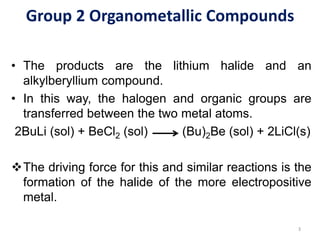
• The products are the lithium halide and an
alkylberyllium compound.
• In this way, the halogen and organic groups are
transferred between the two metal atoms.
2BuLi (sol) + BeCl2 (sol) (Bu)2Be (sol) + 2LiCl(s)
❖The driving force for this and similar reactions is the
formation of the halide of the more electropositive
metal.
3
Group 2 Organometallic Compounds
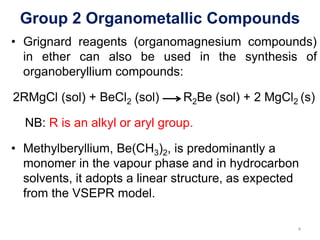
• Grignard reagents (organomagnesium compounds)
in ether can also be used in the synthesis of
organoberyllium compounds:
2RMgCl (sol) + BeCl2 (sol) R2Be (sol) + 2 MgCl2 (s)
NB: R is an alkyl or aryl group.
• Methylberyllium, Be(CH3)2, is predominantly a
monomer in the vapour phase and in hydrocarbon
solvents, it adopts a linear structure, as expected
from the VSEPR model.
4
Group 2 Organometallic Compounds
• The structure of dimethylberyllium in the solid
state is similar to that of trimethylaluminum
• Exception: methylberyllium forms chains,
whereas the trimethylaluminium forms dimers
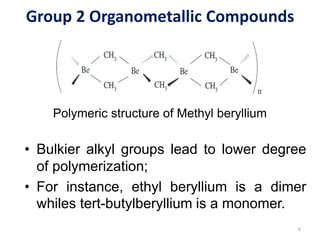
• In the solid state, Be(CH3)2 forms polymeric
chains whereby the bridging methyl groups
form 3 centre, 2 electron (3c,2e) bridging
bonds.
5
Group 2 Organometallic Compounds
Polymeric structure of Methyl beryllium
6
• Bulkier alkyl groups lead to lower degree
of polymerization;
• For instance, ethyl beryllium is a dimer
whiles tert-butylberyllium is a monomer.
Group 2 Organometallic Compounds
• An interesting organoberyllium compound is
beryllocene, (C5H5)2Be.
• This can be prepared from the reaction of
potassium cyclopentadienyl (K(C5H5) with
BCl2 in a toluene/diethyl ether mixture.
• The methyl substituted derivatives
(C5Me5)2Be are also prepared in a similar
manner.
7
Group 2 Organometallic Compounds
• The solid state structure of (C5Me5)2Be
suggests that the two rings are bound to the
Be differently such that 1 is designated η5 and
the other η1.
• Solution state 1H NMR analysis reveals that
all the protons are magnetically equivalent at
163 K.
8
Group 2 Organometallic Compounds
• Assignment: Read the following article for discussion in
our next lecture:
Synthesis, solid-state structure, and bonding analysis of
the beryllocenes [Be(C5Me4H)2], [Be(C5Me5)2], and
[Be(C5Me5)(C5Me4H)] (DOI: 10.1002/chem.200304876)
Solid state structure of
beryllocene (SC-XRD)
9
Solution state structure
of beryllocene (1H
NMR)
Group 2 Organometallic Compounds
• Alkyl- and aryl magnesium halides are very well
known as Grignard reagents and are widely used in
synthetic organic chemistry where they behave as a
source of R (alkyl or aryl groups).
• They are prepared from magnesium metal and an
organohalides.
Mg(s) + RBr (sol) RMgBr (sol)
• The reaction is carried out in ether or
tetrahydrofuran.
10
Group 2 Organometallic Compounds
• As the surface of magnesium metal is covered
by a passivating oxide film, the magnesium
must be activated before the reaction can
proceed.
• A trace of iodine is usually added to the
reactants, forming magnesium iodide.
• This compound is soluble in the solvent used
and dissolves to expose an activated
magnesium surface.
11
Group 2 Organometallic Compounds
• The structure of Grignard reagents is far from
simple.
• The metal atom has a coordination number of 2
only in solution when the alkyl group is bulky.
• Otherwise, it is solvated with a tetrahedral
arrangement of solvent molecules around the
Mg atom.
12
Group 2 Organometallic Compounds
• In addition, complex equilibria in solution known
as Schlenk equilibria, lead to the presence of
several species.
• The exact nature of which depend on
temperature, concentration and solvent.
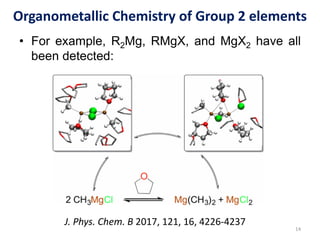
• For example, R2Mg, RMgX, and MgX2 have all
been detected:
13
Organometallic Chemistry of Group 2 elements
• For example, R2Mg, RMgX, and MgX2 have all
been detected:
14
J. Phys. Chem. B 2017, 121, 16, 4226-4237
Group 2 Organometallic Compounds
• Grignard reagents are widely used in the
synthesis of organometallic compounds of
other metals, as in the formation of
alkylberyllium compounds mentioned earlier.
• They are also widely used in organic
synthesis.
15
Group 2 Organometallic Compounds
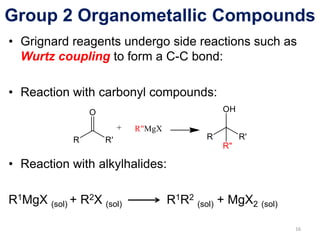
• Grignard reagents undergo side reactions such as
Wurtz coupling to form a C-C bond:
• Reaction with carbonyl compounds:
• Reaction with alkylhalides:
R1MgX (sol) + R2X (sol) R1R2
(sol) + MgX2 (sol)
16
Group 2 Organometallic Compounds
• Organometallic compounds of other group 2
metals are known.
• The organometallic compounds of calcium,
strontium, and barium are generally ionic and very
unstable.
• They all form analogues of Grignard reagents by
direct interaction of the finely divided metal with
organohalide.
17
Group 3 Organometallic Compounds
• The most important organometallic compounds
of the Group 3 elements are those of boron and
aluminium.
• Organoboron compounds are commonly
treated as organometallic compounds even
though boron is not a real metal.
18
Group 3 Organometallic Compounds
Organoboron compounds
• Organoborons of the type BR3 can be prepared by
hydroboration of an alkene with diborane.
B2H6 + 6 CH2= CH2 2 B(CH2CH3)3
• Alternatively, they can be produced from a
Grignard reagent
(C2H5)2O:BF3 + 3 RMgF BR3 + 3 MgF2 + (C2H5)2O
19
Group 3 Organometallic Compounds
Organoboron compounds
• Alkylborons are not hydrolyzed but are
pyrophoric.
• The aryl species are more stable.
• They are all monomeric and planar.
• Like other boron compounds, the organoboron
species are electron deficient and consequently
act as Lewis acids and form adducts easily.
20
Group 3 Organometallic Compounds
Organoboron compounds
• An important anion is the tetraphenylborate ion,
[B(C6H5)4]-, more commonly written BPh4
-.
• An analogous to the tetrahydroborate ion, BH4
-.
• The sodium salt can be obtained by a simple
addition reaction:
BPh3 + NaPh Na+[BPh4]-
21
Group 3 Organometallic Compounds
Organoboron compounds
• The sodium salt of [B(C6H5)4]- is used as a
counterion for cationic coordination
compounds.
• An analogue is sodium tetrakis[3,5-
bis(trifluoromethyl)phenyl]borate, popularly
known as NaBArF.
22
Group 3 Organometallic Compounds
Organoboron compounds
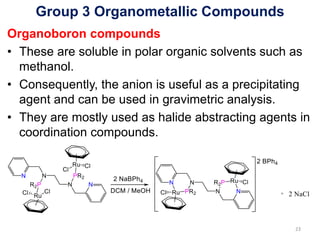
• These are soluble in polar organic solvents such as
methanol.
• Consequently, the anion is useful as a precipitating
agent and can be used in gravimetric analysis.
• They are mostly used as halide abstracting agents in
coordination compounds.
23
Group 3 Organometallic Compounds
Organoaluminium compounds
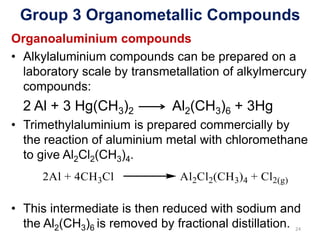
• Alkylaluminium compounds can be prepared on a
laboratory scale by transmetallation of alkylmercury
compounds:
2 Al + 3 Hg(CH3)2 Al2(CH3)6 + 3Hg
• Trimethylaluminium is prepared commercially by
the reaction of aluminium metal with chloromethane
to give Al2Cl2(CH3)4.
• This intermediate is then reduced with sodium and
the Al2(CH3)6 is removed by fractional distillation. 24
Group 3 Organometallic Compounds
Organoaluminium compounds
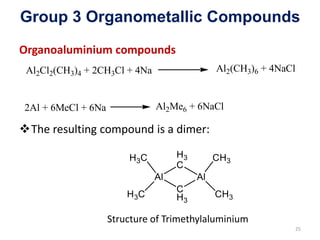
❖The resulting compound is a dimer:
2Al + 6MeCl + 6Na Al2Me6 + 6NaCl
Al2Cl2(CH3)4 + 2CH3Cl + 4Na Al2(CH3)6 + 4NaCl
25
Structure of Trimethylaluminium
Group 3 Organometallic Compounds
Organoaluminium compounds
• Alkylaluminium dimers are similar in structure to the
analogous dimeric halides but the bonding is
different. In the halides, the bridging Al-Cl-Al bonds
are 2c,2e bonds; that is, each Al-Cl bond involves
an electron pair.
• In the alkylaluminium dimers, the Al-C-Al bonds are
longer than the terminal Al-C bonds, which suggests
that they are 3c,2e bonds, with one bonding pair
shared across the Al-C-Al unit, somewhat
analogous to the bonding in diborane, B2H6.
26
Organometallic Chemistry of Group 13
elements
Organoaluminium compounds
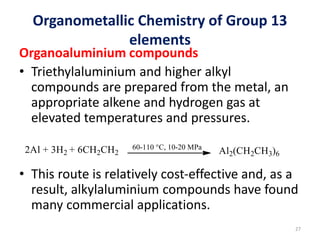
• Triethylaluminium and higher alkyl
compounds are prepared from the metal, an
appropriate alkene and hydrogen gas at
elevated temperatures and pressures.
• This route is relatively cost-effective and, as a
result, alkylaluminium compounds have found
many commercial applications.
27
Organometallic Chemistry of Group 13
elements
Organoaluminium compounds
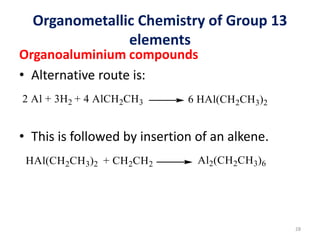
• Alternative route is:
• This is followed by insertion of an alkene.
28
Group 3 Organometallic Compounds
Organoaluminium compounds
• Triethylaluminium, often written as the
monomer, Al(C2H5)3, is an organometallic
complex of aluminium of major industrial
importance.
➢It is used as a co-catalyst in the Ziegler-Natta
ethylene polymerization.
➢It is also used as co-catalyst in ethylene
polymerization and oligomerization using
homogeneous metal catalysts.
29
Group 3 Organometallic Compounds
Organoaluminium compounds
• Steric factors have a powerful effect on the
structures of alkylaluminium compounds.
• Where dimers are formed, the long weak
bridging bonds are easily broken.
• This tendency increases with the bulkiness
of the ligand.
– Example, triphenylaluminium is a dimer but
trimesitylaluminium (where trimesityl is 2,4,6-
(CH3)3C6H2) is a monomer.
30
Group 3 Organometallic Compounds
Organoaluminium compounds
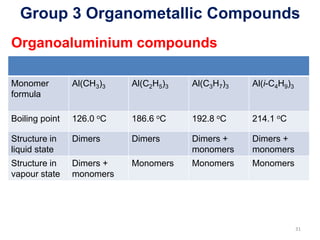
31
Monomer
formula
Al(CH3)3 Al(C2H5)3 Al(C3H7)3 Al(i-C4H9)3
Boiling point 126.0 oC 186.6 oC 192.8 oC 214.1 oC
Structure in
liquid state
Dimers Dimers Dimers +
monomers
Dimers +
monomers
Structure in
vapour state
Dimers +
monomers
Monomers Monomers Monomers

CHEM 352 -Note inorganic chemistry notes

  • 1.
  • 2.
    Group 2 OrganometallicCompounds • Organometallic compounds of beryllium are pyrophoric in air and unstable in water. • They can be prepared by transmetallation from methylmercury in a hydrocarbon solvent: • Another synthetic route is by halogen exchange or metathesis reactions in which a beryllium halide reacts with an alkyllithium compound. • LiCH3 (sol) + BeCl2 (s) Be(CH3)2 (s) + LiCl (s) Hg(CH3)2 (sol) + Be (s) Be (CH3)2 (sol) + Hg (s) 2
  • 3.
    Group 2 OrganometallicCompounds • The products are the lithium halide and an alkylberyllium compound. • In this way, the halogen and organic groups are transferred between the two metal atoms. 2BuLi (sol) + BeCl2 (sol) (Bu)2Be (sol) + 2LiCl(s) ❖The driving force for this and similar reactions is the formation of the halide of the more electropositive metal. 3
  • 4.
    Group 2 OrganometallicCompounds • Grignard reagents (organomagnesium compounds) in ether can also be used in the synthesis of organoberyllium compounds: 2RMgCl (sol) + BeCl2 (sol) R2Be (sol) + 2 MgCl2 (s) NB: R is an alkyl or aryl group. • Methylberyllium, Be(CH3)2, is predominantly a monomer in the vapour phase and in hydrocarbon solvents, it adopts a linear structure, as expected from the VSEPR model. 4
  • 5.
    Group 2 OrganometallicCompounds • The structure of dimethylberyllium in the solid state is similar to that of trimethylaluminum • Exception: methylberyllium forms chains, whereas the trimethylaluminium forms dimers • In the solid state, Be(CH3)2 forms polymeric chains whereby the bridging methyl groups form 3 centre, 2 electron (3c,2e) bridging bonds. 5
  • 6.
    Group 2 OrganometallicCompounds Polymeric structure of Methyl beryllium 6 • Bulkier alkyl groups lead to lower degree of polymerization; • For instance, ethyl beryllium is a dimer whiles tert-butylberyllium is a monomer.
  • 7.
    Group 2 OrganometallicCompounds • An interesting organoberyllium compound is beryllocene, (C5H5)2Be. • This can be prepared from the reaction of potassium cyclopentadienyl (K(C5H5) with BCl2 in a toluene/diethyl ether mixture. • The methyl substituted derivatives (C5Me5)2Be are also prepared in a similar manner. 7
  • 8.
    Group 2 OrganometallicCompounds • The solid state structure of (C5Me5)2Be suggests that the two rings are bound to the Be differently such that 1 is designated η5 and the other η1. • Solution state 1H NMR analysis reveals that all the protons are magnetically equivalent at 163 K. 8
  • 9.
    Group 2 OrganometallicCompounds • Assignment: Read the following article for discussion in our next lecture: Synthesis, solid-state structure, and bonding analysis of the beryllocenes [Be(C5Me4H)2], [Be(C5Me5)2], and [Be(C5Me5)(C5Me4H)] (DOI: 10.1002/chem.200304876) Solid state structure of beryllocene (SC-XRD) 9 Solution state structure of beryllocene (1H NMR)
  • 10.
    Group 2 OrganometallicCompounds • Alkyl- and aryl magnesium halides are very well known as Grignard reagents and are widely used in synthetic organic chemistry where they behave as a source of R (alkyl or aryl groups). • They are prepared from magnesium metal and an organohalides. Mg(s) + RBr (sol) RMgBr (sol) • The reaction is carried out in ether or tetrahydrofuran. 10
  • 11.
    Group 2 OrganometallicCompounds • As the surface of magnesium metal is covered by a passivating oxide film, the magnesium must be activated before the reaction can proceed. • A trace of iodine is usually added to the reactants, forming magnesium iodide. • This compound is soluble in the solvent used and dissolves to expose an activated magnesium surface. 11
  • 12.
    Group 2 OrganometallicCompounds • The structure of Grignard reagents is far from simple. • The metal atom has a coordination number of 2 only in solution when the alkyl group is bulky. • Otherwise, it is solvated with a tetrahedral arrangement of solvent molecules around the Mg atom. 12
  • 13.
    Group 2 OrganometallicCompounds • In addition, complex equilibria in solution known as Schlenk equilibria, lead to the presence of several species. • The exact nature of which depend on temperature, concentration and solvent. • For example, R2Mg, RMgX, and MgX2 have all been detected: 13
  • 14.
    Organometallic Chemistry ofGroup 2 elements • For example, R2Mg, RMgX, and MgX2 have all been detected: 14 J. Phys. Chem. B 2017, 121, 16, 4226-4237
  • 15.
    Group 2 OrganometallicCompounds • Grignard reagents are widely used in the synthesis of organometallic compounds of other metals, as in the formation of alkylberyllium compounds mentioned earlier. • They are also widely used in organic synthesis. 15
  • 16.
    Group 2 OrganometallicCompounds • Grignard reagents undergo side reactions such as Wurtz coupling to form a C-C bond: • Reaction with carbonyl compounds: • Reaction with alkylhalides: R1MgX (sol) + R2X (sol) R1R2 (sol) + MgX2 (sol) 16
  • 17.
    Group 2 OrganometallicCompounds • Organometallic compounds of other group 2 metals are known. • The organometallic compounds of calcium, strontium, and barium are generally ionic and very unstable. • They all form analogues of Grignard reagents by direct interaction of the finely divided metal with organohalide. 17
  • 18.
    Group 3 OrganometallicCompounds • The most important organometallic compounds of the Group 3 elements are those of boron and aluminium. • Organoboron compounds are commonly treated as organometallic compounds even though boron is not a real metal. 18
  • 19.
    Group 3 OrganometallicCompounds Organoboron compounds • Organoborons of the type BR3 can be prepared by hydroboration of an alkene with diborane. B2H6 + 6 CH2= CH2 2 B(CH2CH3)3 • Alternatively, they can be produced from a Grignard reagent (C2H5)2O:BF3 + 3 RMgF BR3 + 3 MgF2 + (C2H5)2O 19
  • 20.
    Group 3 OrganometallicCompounds Organoboron compounds • Alkylborons are not hydrolyzed but are pyrophoric. • The aryl species are more stable. • They are all monomeric and planar. • Like other boron compounds, the organoboron species are electron deficient and consequently act as Lewis acids and form adducts easily. 20
  • 21.
    Group 3 OrganometallicCompounds Organoboron compounds • An important anion is the tetraphenylborate ion, [B(C6H5)4]-, more commonly written BPh4 -. • An analogous to the tetrahydroborate ion, BH4 -. • The sodium salt can be obtained by a simple addition reaction: BPh3 + NaPh Na+[BPh4]- 21
  • 22.
    Group 3 OrganometallicCompounds Organoboron compounds • The sodium salt of [B(C6H5)4]- is used as a counterion for cationic coordination compounds. • An analogue is sodium tetrakis[3,5- bis(trifluoromethyl)phenyl]borate, popularly known as NaBArF. 22
  • 23.
    Group 3 OrganometallicCompounds Organoboron compounds • These are soluble in polar organic solvents such as methanol. • Consequently, the anion is useful as a precipitating agent and can be used in gravimetric analysis. • They are mostly used as halide abstracting agents in coordination compounds. 23
  • 24.
    Group 3 OrganometallicCompounds Organoaluminium compounds • Alkylaluminium compounds can be prepared on a laboratory scale by transmetallation of alkylmercury compounds: 2 Al + 3 Hg(CH3)2 Al2(CH3)6 + 3Hg • Trimethylaluminium is prepared commercially by the reaction of aluminium metal with chloromethane to give Al2Cl2(CH3)4. • This intermediate is then reduced with sodium and the Al2(CH3)6 is removed by fractional distillation. 24
  • 25.
    Group 3 OrganometallicCompounds Organoaluminium compounds ❖The resulting compound is a dimer: 2Al + 6MeCl + 6Na Al2Me6 + 6NaCl Al2Cl2(CH3)4 + 2CH3Cl + 4Na Al2(CH3)6 + 4NaCl 25 Structure of Trimethylaluminium
  • 26.
    Group 3 OrganometallicCompounds Organoaluminium compounds • Alkylaluminium dimers are similar in structure to the analogous dimeric halides but the bonding is different. In the halides, the bridging Al-Cl-Al bonds are 2c,2e bonds; that is, each Al-Cl bond involves an electron pair. • In the alkylaluminium dimers, the Al-C-Al bonds are longer than the terminal Al-C bonds, which suggests that they are 3c,2e bonds, with one bonding pair shared across the Al-C-Al unit, somewhat analogous to the bonding in diborane, B2H6. 26
  • 27.
    Organometallic Chemistry ofGroup 13 elements Organoaluminium compounds • Triethylaluminium and higher alkyl compounds are prepared from the metal, an appropriate alkene and hydrogen gas at elevated temperatures and pressures. • This route is relatively cost-effective and, as a result, alkylaluminium compounds have found many commercial applications. 27
  • 28.
    Organometallic Chemistry ofGroup 13 elements Organoaluminium compounds • Alternative route is: • This is followed by insertion of an alkene. 28
  • 29.
    Group 3 OrganometallicCompounds Organoaluminium compounds • Triethylaluminium, often written as the monomer, Al(C2H5)3, is an organometallic complex of aluminium of major industrial importance. ➢It is used as a co-catalyst in the Ziegler-Natta ethylene polymerization. ➢It is also used as co-catalyst in ethylene polymerization and oligomerization using homogeneous metal catalysts. 29
  • 30.
    Group 3 OrganometallicCompounds Organoaluminium compounds • Steric factors have a powerful effect on the structures of alkylaluminium compounds. • Where dimers are formed, the long weak bridging bonds are easily broken. • This tendency increases with the bulkiness of the ligand. – Example, triphenylaluminium is a dimer but trimesitylaluminium (where trimesityl is 2,4,6- (CH3)3C6H2) is a monomer. 30
  • 31.
    Group 3 OrganometallicCompounds Organoaluminium compounds 31 Monomer formula Al(CH3)3 Al(C2H5)3 Al(C3H7)3 Al(i-C4H9)3 Boiling point 126.0 oC 186.6 oC 192.8 oC 214.1 oC Structure in liquid state Dimers Dimers Dimers + monomers Dimers + monomers Structure in vapour state Dimers + monomers Monomers Monomers Monomers