

• MOHSIN MUMTAZ 
• SADDAM HUSSAIN 
• MUHAMMAD ISHFAQ 
• ABDUL QAYYUM 
• ADNAN SULEMAN
• WHY NEEDED 
• IDEA CONCEPT 
KEY CONTENTS: 
• OBJECTIVE 
• DEFINITIONS 
• REQUIRED PRACTICE 
• RECOGNITION OF CONTRACT REVENUE AND 
EXPENSES 
• DISCLOSURE 
• US GAAP 
• UK GAAP
IMPORTANT TERMS 
• [1] Contractee : Who gives the contract. 
• [2] Contractor : Who takes the contract. 
• [3] Tender Price & Deposit: Will not be shown in 
Contract A/c. 
• [4] Contract Price : Will be credited to contract a/c. 
when Contract is completed. 
• [5] Work completed : Will not be shown (Calculate on 
the basis of Contract price) in Contract Account. 
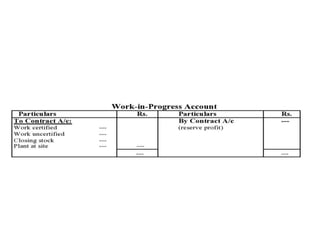
• [6] Work Certified : Will debited to WIP a/c and 
Credited to Contract a/c. 
• [work completed and also certified by the architect]
• [7] Work uncertified : Will be shown under “WIP” 
Account. 
[Work completed but not certified] 
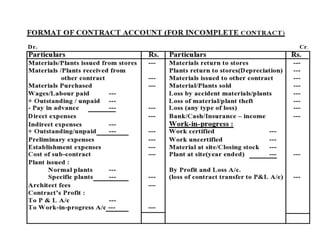
• To calculate the profit on uncompleted contract 
• 1. When contract is completed “ Whole profit or loss is 
carried to General Profit & Loss Account”. 
• 2. When contract is uncompleted : (on the basis of 
contract price) 
• A. When certified work is less than 25 % : Profit carried 
forward to WIP A/c. No profit should be transferred to 
Profit & Loss A/c. 
• B. When certified work is more than 25 % and less than 
75 %. (On the basis of 2/3 cash ) received
Contract Accounts 
• “Each Contract has a separate identity and, 
therefore it becomes essential to analyses 
and segregate costs according to each 
contract ” 
• - P. Dasgupta
• Construction projects or more generically work in 
progress (WIP) figures, are often a material 
balance sheet asset and also critical to the 
reporting of profits or losses at the correct 
amount and in the correct period. Clear definition 
of terms with clearly defined accounting is 
required. 
• The aim of the Standard is to ensure that work in 
progress is valued prudently with correct 
matching of revenue and costs.
• Work in progress values affect both the balance 
sheet asset value and the related cost of sales. If 
you wanted to manipulate profit (and assets) 
then WIP valuation would be an obvious choice. 
For a construction contract one or all of the 
following may be highly subjective: 
• • The costs to be included. 
• • The stage of completion. 
• • Realisability of the work. 
• Thus the value of WIP is very often subjective. 
There is sample scope for manipulating figures!
SADDAM HUSSAIN
• The basic concept is that costs of work done should be 
matched in an accounting period with the related income 
(or putative income), and a resultant profit or loss 
measured. Any costs of valuable work done and not 
matched by income should be carried in the balance sheet 
as WIP. 
• If you wait till the final completion and signing off of a 
contract or project then the profit or loss can be accurately 
determined. However, there is a need to calculate what 
profit (or loss) is being made as a project progresses. For 
statutory reporting purposes, it is necessary to report the 
profit earned in a year and the resultant asset/liability 
position at the balance sheet date.
• A common term used in the context of 
contract or project sales or profits is ‘earned 
value’. An issue with the Standard is that 
general principles are described but not the 
detailed assessment of profit (or margin) 
earned. The detailed definitions and 
calculations of ‘earned value’, attributable 
profit etc., vary considerably among 
companies..
• Objective 
• The objective of this Standard is to prescribe the 
accounting treatment of revenue and costs associated 
with construction contracts. Because of the nature of 
the activity undertaken in construction contracts, the 
date at which the contract activity is entered into and 
the date when the activity is completed usually fall into 
different accounting periods. Therefore, the primary 
issue in accounting for construction contracts is the 
allocation of contract revenue and contract costs to the 
accounting periods in which construction work is 
performed.
• This Standard uses the recognition criteria 
established in the Framework for the 
Preparation and Presentation of Financial 
Statements to determine when contract 
revenue and contract costs should be 
recognised as revenue and expenses in the 
statement of comprehensive income. It also 
provides practical guidance on the application 
of these criteria.
ADNAN SULEMAN
• A construction contract is a contract 
specifically negotiated for the 
• construction of an asset or a combination of 
assets that are closely interrelated or 
interdependent in terms of their design, 
technology and function or their ultimate 
purpose or use.
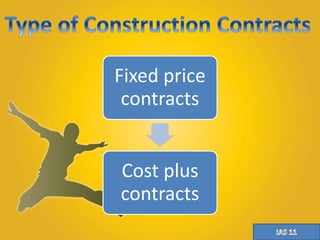
Fixed price 
contracts 
Cost plus 
contracts
• is a construction contract in which the contractor 
agrees to a fixed contract price, or a fixed rate per 
unit of output, which in some cases is subject to 
cost escalation clauses. 
• EXAMPLE: 
• K Ltd gets a contract to construct a bridge for a 
tender amount of $5 million. This $5 million is 
given by the local authority to K Ltd over a period 
of the construction. If the minimum labour wages 
increase during the construction period, a 
reimbursement to that extent is given to K Ltd.
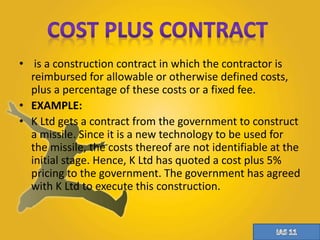
• is a construction contract in which the contractor is 
reimbursed for allowable or otherwise defined costs, 
plus a percentage of these costs or a fixed fee. 
• EXAMPLE: 
• K Ltd gets a contract from the government to construct 
a missile. Since it is a new technology to be used for 
the missile, the costs thereof are not identifiable at the 
initial stage. Hence, K Ltd has quoted a cost plus 5% 
pricing to the government. The government has agreed 
with K Ltd to execute this construction.
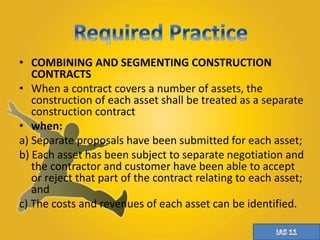
• COMBINING AND SEGMENTING CONSTRUCTION 
CONTRACTS 
• When a contract covers a number of assets, the 
construction of each asset shall be treated as a separate 
construction contract 
• when: 
a) Separate proposals have been submitted for each asset; 
b) Each asset has been subject to separate negotiation and 
the contractor and customer have been able to accept 
or reject that part of the contract relating to each asset; 
and 
c) The costs and revenues of each asset can be identified.
ABDUL QAYYUM
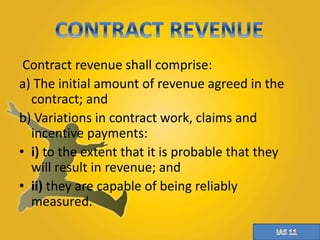
Contract revenue shall comprise: 
a) The initial amount of revenue agreed in the 
contract; and 
b) Variations in contract work, claims and 
incentive payments: 
• i) to the extent that it is probable that they 
will result in revenue; and 
• ii) they are capable of being reliably 
measured.
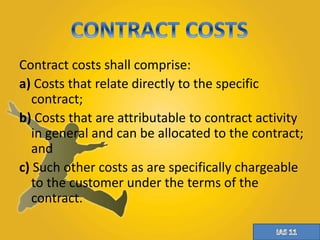
Contract costs shall comprise: 
a) Costs that relate directly to the specific 
contract; 
b) Costs that are attributable to contract activity 
in general and can be allocated to the contract; 
and 
c) Such other costs as are specifically chargeable 
to the customer under the terms of the 
contract.
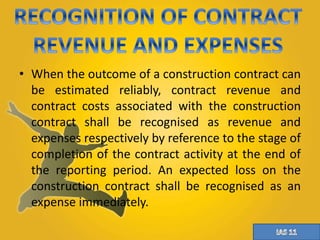
• When the outcome of a construction contract can 
be estimated reliably, contract revenue and 
contract costs associated with the construction 
contract shall be recognised as revenue and 
expenses respectively by reference to the stage of 
completion of the contract activity at the end of 
the reporting period. An expected loss on the 
construction contract shall be recognised as an 
expense immediately.
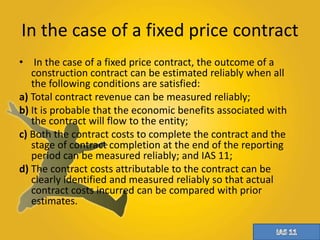
In the case of a fixed price contract 
• In the case of a fixed price contract, the outcome of a 
construction contract can be estimated reliably when all 
the following conditions are satisfied: 
a) Total contract revenue can be measured reliably; 
b) It is probable that the economic benefits associated with 
the contract will flow to the entity; 
c) Both the contract costs to complete the contract and the 
stage of contract completion at the end of the reporting 
period can be measured reliably; and IAS 11; 
d) The contract costs attributable to the contract can be 
clearly identified and measured reliably so that actual 
contract costs incurred can be compared with prior 
estimates.
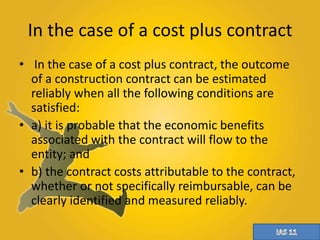
In the case of a cost plus contract 
• In the case of a cost plus contract, the outcome 
of a construction contract can be estimated 
reliably when all the following conditions are 
satisfied: 
• a) it is probable that the economic benefits 
associated with the contract will flow to the 
entity; and 
• b) the contract costs attributable to the contract, 
whether or not specifically reimbursable, can be 
clearly identified and measured reliably.
MOHSIN MUMTAZ
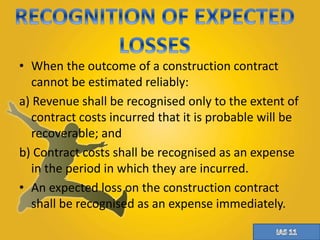
• When the outcome of a construction contract 
cannot be estimated reliably: 
a) Revenue shall be recognised only to the extent of 
contract costs incurred that it is probable will be 
recoverable; and 
b) Contract costs shall be recognised as an expense 
in the period in which they are incurred. 
• An expected loss on the construction contract 
shall be recognised as an expense immediately.
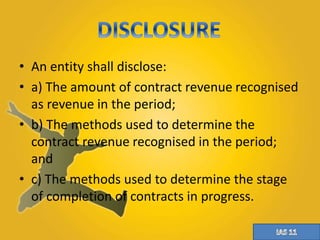
• An entity shall disclose: 
• a) The amount of contract revenue recognised 
as revenue in the period; 
• b) The methods used to determine the 
contract revenue recognised in the period; 
and 
• c) The methods used to determine the stage 
of completion of contracts in progress.
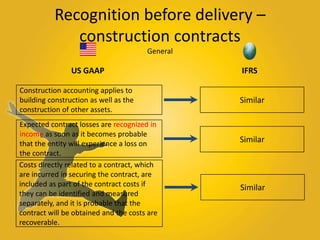
Recognition before delivery – 
construction contracts 
General 
US GAAP IFRS 
Construction accounting applies to 
building construction as well as the 
construction of other assets. 
Expected contract losses are recognized in 
income as soon as it becomes probable 
that the entity will experience a loss on 
the contract. 
Similar 
Similar 
Costs directly related to a contract, which 
are incurred in securing the contract, are 
included as part of the contract costs if 
they can be identified and measured 
separately, and it is probable that the 
contract will be obtained and the costs are 
recoverable. 
Similar
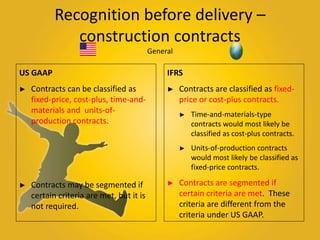
Recognition before delivery – 
construction contracts 
IFRS 
► Contracts are classified as fixed-price 
or cost-plus contracts. 
► Time-and-materials-type 
contracts would most likely be 
classified as cost-plus contracts. 
► Units-of-production contracts 
would most likely be classified as 
fixed-price contracts. 
► Contracts are segmented if 
certain criteria are met. These 
criteria are different from the 
criteria under US GAAP. 
US GAAP 
► Contracts can be classified as 
fixed-price, cost-plus, time-and-materials 
and units-of-production 
contracts. 
► Contracts may be segmented if 
certain criteria are met, but it is 
not required. 
General
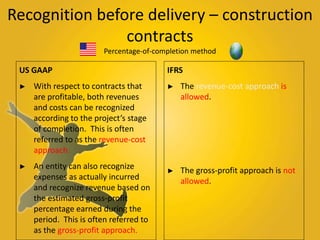
Recognition before delivery – construction 
contracts 
Percentage-of-completion method 
IFRS 
► The revenue-cost approach is 
allowed. 
► The gross-profit approach is not 
allowed. 
US GAAP 
► With respect to contracts that 
are profitable, both revenues 
and costs can be recognized 
according to the project’s stage 
of completion. This is often 
referred to as the revenue-cost 
approach. 
► An entity can also recognize 
expenses as actually incurred 
and recognize revenue based on 
the estimated gross-profit 
percentage earned during the 
period. This is often referred to 
as the gross-profit approach.
Revenue-cost and gross-profit 
approach example 
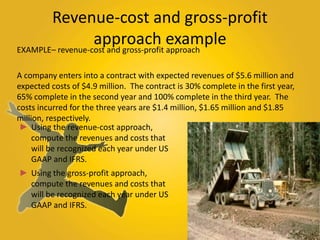
EXAMPLE– revenue-cost and gross-profit approach 
A company enters into a contract with expected revenues of $5.6 million and 
expected costs of $4.9 million. The contract is 30% complete in the first year, 
65% complete in the second year and 100% complete in the third year. The 
costs incurred for the three years are $1.4 million, $1.65 million and $1.85 
million, respectively. 
► Using the revenue-cost approach, 
compute the revenues and costs that 
will be recognized each year under US 
GAAP and IFRS. 
► Using the gross-profit approach, 
compute the revenues and costs that 
will be recognized each year under US 
GAAP and IFRS.
Revenue-cost and gross-profit 
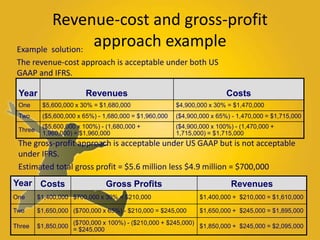
approach example Example solution: 
The revenue-cost approach is acceptable under both US 
GAAP and IFRS. 
Year Revenues Costs 
One $5,600,000 x 30% = $1,680,000 $4,900,000 x 30% = $1,470,000 
Two ($5,600,000 x 65%) - 1,680,000 = $1,960,000 ($4,900,000 x 65%) - 1,470,000 = $1,715,000 
Three 
($5,600,000 x 100%) - (1,680,000 + 
1,960,000) = $1,960,000 
($4,900,000 x 100%) - (1,470,000 + 
1,715,000) = $1,715,000 
The gross-profit approach is acceptable under US GAAP but is not acceptable 
under IFRS. 
Estimated total gross profit = $5.6 million less $4.9 million = $700,000 
Year Costs Gross Profits Revenues 
One $1,400,000 $700,000 x 30% = $210,000 $1,400,000 + $210,000 = $1,610,000 
Two $1,650,000 ($700,000 x 65%) - $210,000 = $245,000 $1,650,000 + $245,000 = $1,895,000 
Three $1,850,000 
($700,000 x 100%) - ($210,000 + $245,000) 
= $245,000 
$1,850,000 + $245,000 = $2,095,000
• IAS 11/IAS 18 – the future 
• Frankly UK GAAP and IFRS as they exist are 
pretty lax on how revenue and profit might be 
recognised – this is an area for considerable 
change – probably in 2011. 
• Significant differences in GAAP 
• US GAAP 
• Under US GAAP construction contract revenue 
recognition and balance sheet asset/liability 
amounts could be similar, but much depends on 
the entity specific detailed accounting policies.
UK GAAP 
• Both IAS 11 and SSAP 9 Stocks and long term contracts use 
the ‘percentage of completion’ method to recognise revenue 
and expense. 
• IAS 11 uses the method where the outcome of the contract 
can be estimated reliably, 
• SSAP9 implies the use of more prudence – recognising 
‘prudently calculated attributable profit. 
• Both standards require zero profit to be recognised where 
outcome is uncertain. 
• Because of UK company law presentation differs under UK 
GAAP. The amount due for WIP is shown split between 
debtors (amounts recoverable on contracts) and WIP (long 
term contact balances). IAS 11 shows one gross amount due 
from customers for contract work.
Cfr  ias 11 construction contract presentation by MOHSIN MUMTAZ

Cfr ias 11 construction contract presentation by MOHSIN MUMTAZ

  • 3.
    • MOHSIN MUMTAZ • SADDAM HUSSAIN • MUHAMMAD ISHFAQ • ABDUL QAYYUM • ADNAN SULEMAN
  • 5.
    • WHY NEEDED • IDEA CONCEPT KEY CONTENTS: • OBJECTIVE • DEFINITIONS • REQUIRED PRACTICE • RECOGNITION OF CONTRACT REVENUE AND EXPENSES • DISCLOSURE • US GAAP • UK GAAP
  • 6.
    IMPORTANT TERMS •[1] Contractee : Who gives the contract. • [2] Contractor : Who takes the contract. • [3] Tender Price & Deposit: Will not be shown in Contract A/c. • [4] Contract Price : Will be credited to contract a/c. when Contract is completed. • [5] Work completed : Will not be shown (Calculate on the basis of Contract price) in Contract Account. • [6] Work Certified : Will debited to WIP a/c and Credited to Contract a/c. • [work completed and also certified by the architect]
  • 7.
    • [7] Workuncertified : Will be shown under “WIP” Account. [Work completed but not certified] • To calculate the profit on uncompleted contract • 1. When contract is completed “ Whole profit or loss is carried to General Profit & Loss Account”. • 2. When contract is uncompleted : (on the basis of contract price) • A. When certified work is less than 25 % : Profit carried forward to WIP A/c. No profit should be transferred to Profit & Loss A/c. • B. When certified work is more than 25 % and less than 75 %. (On the basis of 2/3 cash ) received
  • 8.
    Contract Accounts •“Each Contract has a separate identity and, therefore it becomes essential to analyses and segregate costs according to each contract ” • - P. Dasgupta
  • 11.
    • Construction projectsor more generically work in progress (WIP) figures, are often a material balance sheet asset and also critical to the reporting of profits or losses at the correct amount and in the correct period. Clear definition of terms with clearly defined accounting is required. • The aim of the Standard is to ensure that work in progress is valued prudently with correct matching of revenue and costs.
  • 12.
    • Work inprogress values affect both the balance sheet asset value and the related cost of sales. If you wanted to manipulate profit (and assets) then WIP valuation would be an obvious choice. For a construction contract one or all of the following may be highly subjective: • • The costs to be included. • • The stage of completion. • • Realisability of the work. • Thus the value of WIP is very often subjective. There is sample scope for manipulating figures!
  • 13.
  • 14.
    • The basicconcept is that costs of work done should be matched in an accounting period with the related income (or putative income), and a resultant profit or loss measured. Any costs of valuable work done and not matched by income should be carried in the balance sheet as WIP. • If you wait till the final completion and signing off of a contract or project then the profit or loss can be accurately determined. However, there is a need to calculate what profit (or loss) is being made as a project progresses. For statutory reporting purposes, it is necessary to report the profit earned in a year and the resultant asset/liability position at the balance sheet date.
  • 15.
    • A commonterm used in the context of contract or project sales or profits is ‘earned value’. An issue with the Standard is that general principles are described but not the detailed assessment of profit (or margin) earned. The detailed definitions and calculations of ‘earned value’, attributable profit etc., vary considerably among companies..
  • 16.
    • Objective •The objective of this Standard is to prescribe the accounting treatment of revenue and costs associated with construction contracts. Because of the nature of the activity undertaken in construction contracts, the date at which the contract activity is entered into and the date when the activity is completed usually fall into different accounting periods. Therefore, the primary issue in accounting for construction contracts is the allocation of contract revenue and contract costs to the accounting periods in which construction work is performed.
  • 17.
    • This Standarduses the recognition criteria established in the Framework for the Preparation and Presentation of Financial Statements to determine when contract revenue and contract costs should be recognised as revenue and expenses in the statement of comprehensive income. It also provides practical guidance on the application of these criteria.
  • 18.
  • 19.
    • A constructioncontract is a contract specifically negotiated for the • construction of an asset or a combination of assets that are closely interrelated or interdependent in terms of their design, technology and function or their ultimate purpose or use.
  • 20.
    Fixed price contracts Cost plus contracts
  • 21.
    • is aconstruction contract in which the contractor agrees to a fixed contract price, or a fixed rate per unit of output, which in some cases is subject to cost escalation clauses. • EXAMPLE: • K Ltd gets a contract to construct a bridge for a tender amount of $5 million. This $5 million is given by the local authority to K Ltd over a period of the construction. If the minimum labour wages increase during the construction period, a reimbursement to that extent is given to K Ltd.
  • 22.
    • is aconstruction contract in which the contractor is reimbursed for allowable or otherwise defined costs, plus a percentage of these costs or a fixed fee. • EXAMPLE: • K Ltd gets a contract from the government to construct a missile. Since it is a new technology to be used for the missile, the costs thereof are not identifiable at the initial stage. Hence, K Ltd has quoted a cost plus 5% pricing to the government. The government has agreed with K Ltd to execute this construction.
  • 23.
    • COMBINING ANDSEGMENTING CONSTRUCTION CONTRACTS • When a contract covers a number of assets, the construction of each asset shall be treated as a separate construction contract • when: a) Separate proposals have been submitted for each asset; b) Each asset has been subject to separate negotiation and the contractor and customer have been able to accept or reject that part of the contract relating to each asset; and c) The costs and revenues of each asset can be identified.
  • 24.
  • 25.
    Contract revenue shallcomprise: a) The initial amount of revenue agreed in the contract; and b) Variations in contract work, claims and incentive payments: • i) to the extent that it is probable that they will result in revenue; and • ii) they are capable of being reliably measured.
  • 26.
    Contract costs shallcomprise: a) Costs that relate directly to the specific contract; b) Costs that are attributable to contract activity in general and can be allocated to the contract; and c) Such other costs as are specifically chargeable to the customer under the terms of the contract.
  • 27.
    • When theoutcome of a construction contract can be estimated reliably, contract revenue and contract costs associated with the construction contract shall be recognised as revenue and expenses respectively by reference to the stage of completion of the contract activity at the end of the reporting period. An expected loss on the construction contract shall be recognised as an expense immediately.
  • 28.
    In the caseof a fixed price contract • In the case of a fixed price contract, the outcome of a construction contract can be estimated reliably when all the following conditions are satisfied: a) Total contract revenue can be measured reliably; b) It is probable that the economic benefits associated with the contract will flow to the entity; c) Both the contract costs to complete the contract and the stage of contract completion at the end of the reporting period can be measured reliably; and IAS 11; d) The contract costs attributable to the contract can be clearly identified and measured reliably so that actual contract costs incurred can be compared with prior estimates.
  • 29.
    In the caseof a cost plus contract • In the case of a cost plus contract, the outcome of a construction contract can be estimated reliably when all the following conditions are satisfied: • a) it is probable that the economic benefits associated with the contract will flow to the entity; and • b) the contract costs attributable to the contract, whether or not specifically reimbursable, can be clearly identified and measured reliably.
  • 30.
  • 31.
    • When theoutcome of a construction contract cannot be estimated reliably: a) Revenue shall be recognised only to the extent of contract costs incurred that it is probable will be recoverable; and b) Contract costs shall be recognised as an expense in the period in which they are incurred. • An expected loss on the construction contract shall be recognised as an expense immediately.
  • 32.
    • An entityshall disclose: • a) The amount of contract revenue recognised as revenue in the period; • b) The methods used to determine the contract revenue recognised in the period; and • c) The methods used to determine the stage of completion of contracts in progress.
  • 33.
    Recognition before delivery– construction contracts General US GAAP IFRS Construction accounting applies to building construction as well as the construction of other assets. Expected contract losses are recognized in income as soon as it becomes probable that the entity will experience a loss on the contract. Similar Similar Costs directly related to a contract, which are incurred in securing the contract, are included as part of the contract costs if they can be identified and measured separately, and it is probable that the contract will be obtained and the costs are recoverable. Similar
  • 34.
    Recognition before delivery– construction contracts IFRS ► Contracts are classified as fixed-price or cost-plus contracts. ► Time-and-materials-type contracts would most likely be classified as cost-plus contracts. ► Units-of-production contracts would most likely be classified as fixed-price contracts. ► Contracts are segmented if certain criteria are met. These criteria are different from the criteria under US GAAP. US GAAP ► Contracts can be classified as fixed-price, cost-plus, time-and-materials and units-of-production contracts. ► Contracts may be segmented if certain criteria are met, but it is not required. General
  • 35.
    Recognition before delivery– construction contracts Percentage-of-completion method IFRS ► The revenue-cost approach is allowed. ► The gross-profit approach is not allowed. US GAAP ► With respect to contracts that are profitable, both revenues and costs can be recognized according to the project’s stage of completion. This is often referred to as the revenue-cost approach. ► An entity can also recognize expenses as actually incurred and recognize revenue based on the estimated gross-profit percentage earned during the period. This is often referred to as the gross-profit approach.
  • 36.
    Revenue-cost and gross-profit approach example EXAMPLE– revenue-cost and gross-profit approach A company enters into a contract with expected revenues of $5.6 million and expected costs of $4.9 million. The contract is 30% complete in the first year, 65% complete in the second year and 100% complete in the third year. The costs incurred for the three years are $1.4 million, $1.65 million and $1.85 million, respectively. ► Using the revenue-cost approach, compute the revenues and costs that will be recognized each year under US GAAP and IFRS. ► Using the gross-profit approach, compute the revenues and costs that will be recognized each year under US GAAP and IFRS.
  • 37.
    Revenue-cost and gross-profit approach example Example solution: The revenue-cost approach is acceptable under both US GAAP and IFRS. Year Revenues Costs One $5,600,000 x 30% = $1,680,000 $4,900,000 x 30% = $1,470,000 Two ($5,600,000 x 65%) - 1,680,000 = $1,960,000 ($4,900,000 x 65%) - 1,470,000 = $1,715,000 Three ($5,600,000 x 100%) - (1,680,000 + 1,960,000) = $1,960,000 ($4,900,000 x 100%) - (1,470,000 + 1,715,000) = $1,715,000 The gross-profit approach is acceptable under US GAAP but is not acceptable under IFRS. Estimated total gross profit = $5.6 million less $4.9 million = $700,000 Year Costs Gross Profits Revenues One $1,400,000 $700,000 x 30% = $210,000 $1,400,000 + $210,000 = $1,610,000 Two $1,650,000 ($700,000 x 65%) - $210,000 = $245,000 $1,650,000 + $245,000 = $1,895,000 Three $1,850,000 ($700,000 x 100%) - ($210,000 + $245,000) = $245,000 $1,850,000 + $245,000 = $2,095,000
  • 38.
    • IAS 11/IAS18 – the future • Frankly UK GAAP and IFRS as they exist are pretty lax on how revenue and profit might be recognised – this is an area for considerable change – probably in 2011. • Significant differences in GAAP • US GAAP • Under US GAAP construction contract revenue recognition and balance sheet asset/liability amounts could be similar, but much depends on the entity specific detailed accounting policies.
  • 39.
    UK GAAP •Both IAS 11 and SSAP 9 Stocks and long term contracts use the ‘percentage of completion’ method to recognise revenue and expense. • IAS 11 uses the method where the outcome of the contract can be estimated reliably, • SSAP9 implies the use of more prudence – recognising ‘prudently calculated attributable profit. • Both standards require zero profit to be recognised where outcome is uncertain. • Because of UK company law presentation differs under UK GAAP. The amount due for WIP is shown split between debtors (amounts recoverable on contracts) and WIP (long term contact balances). IAS 11 shows one gross amount due from customers for contract work.