Downloaded 67 times



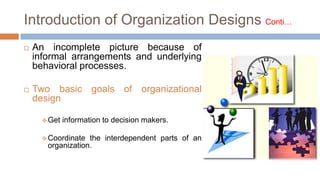




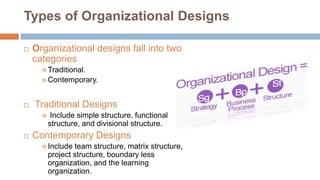


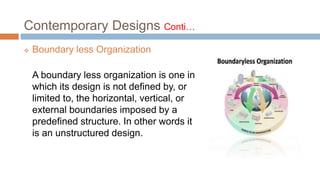


Organizational behavior and design can be summarized in 3 points: 1. Organizational design refers to how managers structure organizations to achieve goals through elements like task allocation, reporting relationships, and departmentalization. Common designs include functional, divisional, matrix, and hybrid forms. 2. Organizational behavior studies human behavior, attitudes, and performance in organizations. It draws from disciplines like psychology, sociology, and anthropology. 3. Managers perform functions like planning, organizing, leading, and controlling. Their roles can be informational, interpersonal, and decisional. Organizational behavior aims to improve outcomes like productivity, turnover, effectiveness, and job satisfaction.


![Management[1]](https://cdn.slidesharecdn.com/ss_thumbnails/management1-1213008887657795-9-thumbnail.jpg?width=640&height=640&fit=bounds)


![Final Powerpoint[1]](https://cdn.slidesharecdn.com/ss_thumbnails/finalpowerpoint1-1213130555438697-8-thumbnail.jpg?width=640&height=640&fit=bounds)


