Situational Crisis
Communication Theory (SCCT)
           Develop
          Evolution
         Application
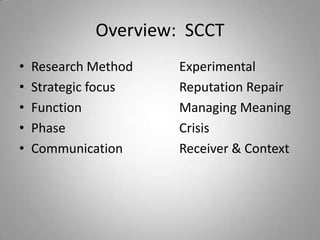
Overview: SCCT
•   Research Method   Experimental
•   Strategic focus   Reputation Repair
•   Function          Managing Meaning
•   Phase             Crisis
•   Communication     Receiver & Context
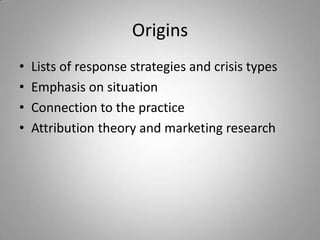
Origins
•   Lists of response strategies and crisis types
•   Emphasis on situation
•   Connection to the practice
•   Attribution theory and marketing research
Attribution Theory
• People motivated to find reasons for events
• Attributions
  – Internal
  – External
Why care about attributions?
• Attributions influence affect and behavior
Crises
• Attributions shape
  – Affect concerning organization
  – Behaviors toward organization
  – Reputations (there is damage)
Crisis and Reputation
• Reputational Capital
• Build through good work
• Crises spend some, but how much
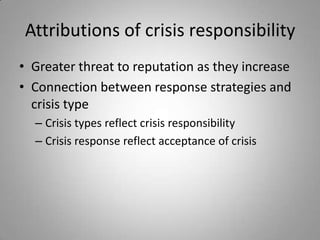
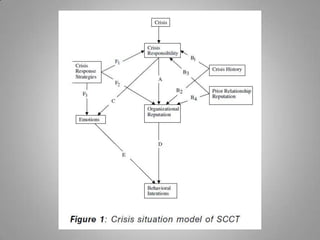
Attributions of crisis responsibility
• Greater threat to reputation as they increase
• Connection between response strategies and
  crisis type
  – Crisis types reflect crisis responsibility
  – Crisis response reflect acceptance of crisis
Crisis Type

Dominant Situational Factor
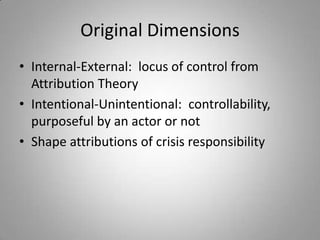
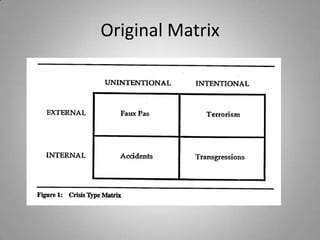
Original Dimensions
• Internal-External: locus of control from
  Attribution Theory
• Intentional-Unintentional: controllability,
  purposeful by an actor or not
• Shape attributions of crisis responsibility
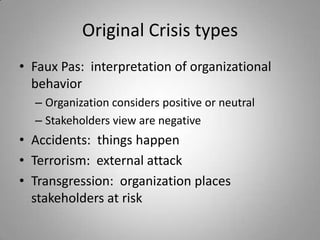
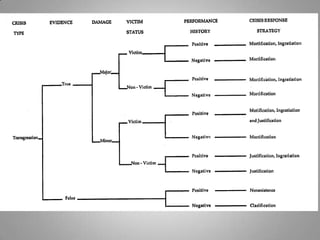
Original Crisis types
• Faux Pas: interpretation of organizational
  behavior
  – Organization considers positive or neutral
  – Stakeholders view are negative
• Accidents: things happen
• Terrorism: external attack
• Transgression: organization places
  stakeholders at risk
Original Matrix
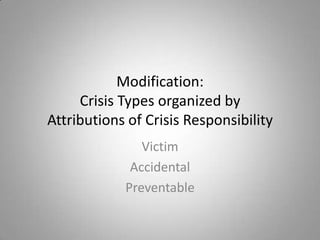
Modification:
     Crisis Types organized by
Attributions of Crisis Responsibility
               Victim
             Accidental
            Preventable
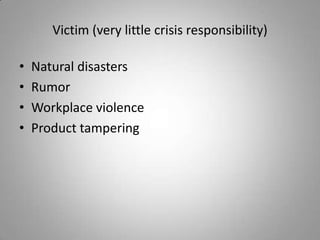
Victim (very little crisis responsibility)

•   Natural disasters
•   Rumor
•   Workplace violence
•   Product tampering
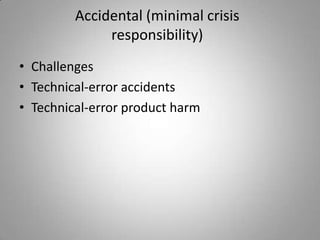
Accidental (minimal crisis
              responsibility)
• Challenges
• Technical-error accidents
• Technical-error product harm
Preventable (significant crisis
              responsibility)
• Human-error accidents
• Human-error product harm
• Organizational misdeed
  – No injuries
  – Injuries
  – Management misconduct
Change to Crisis Types
•   Shift from Grid to a Continuum
•   Dropped external control
•   Centered on crisis responsibility
•   New continuum based on survey research
Other Situational Factors
Veracity of evidence
• Proof there is a crisis
   – True
   – False
   – Ambiguous
Application Today
• Hidden factor
• Choice to use denial
• Ambiguity is key factor in accidental crises
Stakeholders
• Victim
• Non-victim
Revision Today
• Victims
• Potential victims
• Voyeurs
  – News media
  – Social media
Damage
• Harm inflicted by crisis
  – Severe
  – Minor
Current Application
• Relevant but mixed results
• Future
  – Treat as susceptibility
  – Relationship to anxiety
Performance history
• Past relationship with stakeholders
  – Positive
  – Negative
Currently an Intensifier
• Positive prior reputation
• Neutral/unknown
• Negative prior reputation—the driver
Other Intensifier: Crisis History
• No history of crises
• No knowledge of history
• Had a crisis in the past
Revision
• No longer use decision tree
• List of recommendations
Original Response Strategies

• Nonexistence
  – Denial
  – Clarification
  – Attack
  – Intimidation
• Ingratiation
  – Bolstering
  – Praise others
Original Response Strategies
• Distance
  – Excuse: deny intention and/or control
  – Justification: minimize harm done
• Mortification
• Suffering
  – Organization as victim
Revised Response Strategies
• Arranged from
  – Defensive: protect organization
  – Accommodative: help the victims
Crisis Responses
• Deny: no connection
  – Denial, Attack Accuser, and Scapegoat
• Diminish: reduce responsibility
  – Excuse and Justification
  – Reinforce existing frame
• Rebuild: attempt to improve reputation
  – Compensation and Apology
Crisis Responses
• Bolstering: draw on goodwill
  – Reminder, Ingratiation, and Victimage
  – Supporting strategies
Reputational Threat
• How people perceive the crisis.
• Strong threat requires stronger response
  (more perceived acceptance of responsibility)
Assess the Threat
• Initial Assessment: Crisis Type
• Frame used to view the crisis
• Grouped by attributions of crisis responsibility
  – Victim
  – Accidental
  – Preventable
Intensifiers
• Crisis history: similar crises in past
• Prior relational reputation: how well or poorly
  organization has treated stakeholders
Velcro Effect
• History of crises intensifies crisis responsibility
• Negative prior reputation intensifies crisis
  responsibility
Boundaries
• Financial resources are constraints
  – Afford the strategy?
• Crisis can be frame by media (includes
  Internet)
  – May need to follow and not try to reframe
Ethical Base Response
• Instructing Information: to protect selves
  – Warnings
  – Information about crisis (what happended)
• Adjusting Information: cope psychologically
  – Express regret
  – Corrective action
  – Counseling
SCCT Recommendations
1. All victims or potential victims should receive
   instructing information, including recall
   information.
  – This can be called the “public safety response.”
  – This is one-half of the base response to a crisis.
2. All victims should be provided an expression of
   sympathy, any information about corrective
   actions, and trauma counseling when needed.
  – This can be called the “care response.”
  – This is the second-half of the base response to a
    crisis.
SCCT Recommendations
3. For crises with strong attributions of crisis responsibility
  (preventable crises and accidental crises with an intensifying
  factor), add compensation and/or apology strategies to the
  instructing information and care response.
SCCT Recommendations
4. The compensation strategy is used anytime
  victims suffer serious harm
5. The reminder and ingratiation strategies can
  be used to supplement any response
6. Denial and attack the accuser strategies are
   best used only for rumor and challenge crises
7. Suffering part of response if organization is a
   victim
Beliefs
• Theory-driven (beyond description)
• Evidence-based (tested)
Research to test
• Assumptions
• Relationships between variables
  – Existence
  – Strength
Initial outcome
• Reputation
Other outcomes
• Emotion (anger)
• Purchase intention
• Negative word-of-mouth
Example of Research in Detail:
Negative Communication Dynamic
Crisis Affect
• Emotions generated by a crisis
  – Anger
  – Sympathy
  – Schadenfreude
• Anger most common (McDonald & Hartel,
  2000)
Anger
• Typical reaction to a crisis
• Can be a catalyst for behaviors
  – Negative word-of-mouth
  – Purchase intention (Jorgensen, 1996)
Anger as Energizer
• Energize people to say or write negative things
  about an organization/product/service
• We refer to as “The Negative Communication
  Dynamic”
Current Focus in Crisis Communication

•   Crisis and impact on reputation
•   Limited on purchase intention
•   Effects typically transitory—people forget
•   Any effects from crisis can dissipate quickly
    (McDonald & Hartel, 2000)
Potential Persistence of Anger
• Unhappy customers tell others (Power, 2006)
• Similarly, stakeholders unhappy about a crisis
  and crisis management may tell others
• Dissatisfaction leads to negative word-of-
  mouth
Word-of-Mouth
• A powerful force in shaping consumer
  attitudes
• Negative word-of-mouth more power than
  positive (Lacznial, DeCarlo & Ramaswami,
  2001)
Lasting Effects of Word-of-Mouth
• Negative word-of-mouth spreads beyond
  initial stakeholders
  – Initially tell 6 to 15 people
  – They in turn tell others
• Negative word-of-mouth can linger
  – Remain on blogs, web sites, and discussion boards
    after initial anger subsides.
Hypotheses
• H1: Higher attributions of crisis responsibility
  and stronger feelings of anger from a crisis are
  associated with higher levels of intended
  negative word-of-mouth.
Hypotheses
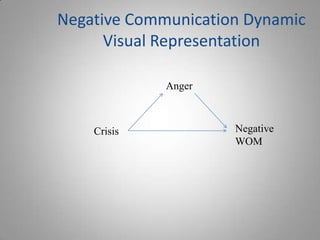
• H2: Anger mediates the relationship between
  crisis responsibility and negative word-of-
  mouth.
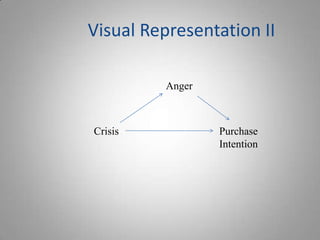
• H3: Anger mediates the relationship between
  crisis responsibility and purchase intention.
Results
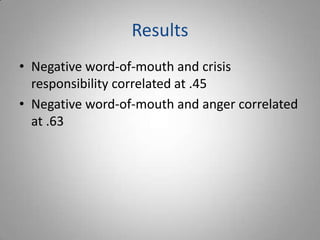
• Negative word-of-mouth and crisis
  responsibility correlated at .45
• Negative word-of-mouth and anger correlated
  at .63
Results
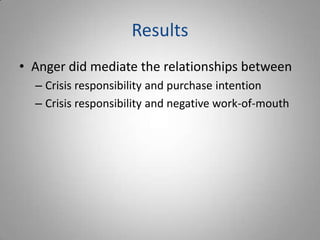
• Anger did mediate the relationships between
  – Crisis responsibility and purchase intention
  – Crisis responsibility and negative work-of-mouth
Negative Communication Dynamic
      Visual Representation

             Anger


    Crisis           Negative
                     WOM
Visual Representation II

          Anger


Crisis            Purchase
                  Intention
What does this mean
for crisis managers?
Where to Next?
•   Effects of crisis response strategies on anger
•   Crisis factors that shape anger
•   Duration of crisis anger
•   Relationship of anger and schadenfreude

Explaining Situational Crisis Communication Theory (SCCT)

  • 1.
    Situational Crisis Communication Theory(SCCT) Develop Evolution Application
  • 2.
    Overview: SCCT • Research Method Experimental • Strategic focus Reputation Repair • Function Managing Meaning • Phase Crisis • Communication Receiver & Context
  • 3.
    Origins • Lists of response strategies and crisis types • Emphasis on situation • Connection to the practice • Attribution theory and marketing research
  • 4.
    Attribution Theory • Peoplemotivated to find reasons for events • Attributions – Internal – External
  • 5.
    Why care aboutattributions? • Attributions influence affect and behavior
  • 6.
    Crises • Attributions shape – Affect concerning organization – Behaviors toward organization – Reputations (there is damage)
  • 7.
    Crisis and Reputation •Reputational Capital • Build through good work • Crises spend some, but how much
  • 8.
    Attributions of crisisresponsibility • Greater threat to reputation as they increase • Connection between response strategies and crisis type – Crisis types reflect crisis responsibility – Crisis response reflect acceptance of crisis
  • 9.
  • 10.
    Original Dimensions • Internal-External:locus of control from Attribution Theory • Intentional-Unintentional: controllability, purposeful by an actor or not • Shape attributions of crisis responsibility
  • 11.
    Original Crisis types •Faux Pas: interpretation of organizational behavior – Organization considers positive or neutral – Stakeholders view are negative • Accidents: things happen • Terrorism: external attack • Transgression: organization places stakeholders at risk
  • 12.
  • 13.
    Modification: Crisis Types organized by Attributions of Crisis Responsibility Victim Accidental Preventable
  • 14.
    Victim (very littlecrisis responsibility) • Natural disasters • Rumor • Workplace violence • Product tampering
  • 15.
    Accidental (minimal crisis responsibility) • Challenges • Technical-error accidents • Technical-error product harm
  • 16.
    Preventable (significant crisis responsibility) • Human-error accidents • Human-error product harm • Organizational misdeed – No injuries – Injuries – Management misconduct
  • 17.
    Change to CrisisTypes • Shift from Grid to a Continuum • Dropped external control • Centered on crisis responsibility • New continuum based on survey research
  • 18.
  • 19.
    Veracity of evidence •Proof there is a crisis – True – False – Ambiguous
  • 20.
    Application Today • Hiddenfactor • Choice to use denial • Ambiguity is key factor in accidental crises
  • 21.
  • 22.
    Revision Today • Victims •Potential victims • Voyeurs – News media – Social media
  • 23.
    Damage • Harm inflictedby crisis – Severe – Minor
  • 24.
    Current Application • Relevantbut mixed results • Future – Treat as susceptibility – Relationship to anxiety
  • 25.
    Performance history • Pastrelationship with stakeholders – Positive – Negative
  • 26.
    Currently an Intensifier •Positive prior reputation • Neutral/unknown • Negative prior reputation—the driver
  • 27.
    Other Intensifier: CrisisHistory • No history of crises • No knowledge of history • Had a crisis in the past
  • 29.
    Revision • No longeruse decision tree • List of recommendations
  • 30.
    Original Response Strategies •Nonexistence – Denial – Clarification – Attack – Intimidation • Ingratiation – Bolstering – Praise others
  • 31.
    Original Response Strategies •Distance – Excuse: deny intention and/or control – Justification: minimize harm done • Mortification • Suffering – Organization as victim
  • 32.
    Revised Response Strategies •Arranged from – Defensive: protect organization – Accommodative: help the victims
  • 33.
    Crisis Responses • Deny:no connection – Denial, Attack Accuser, and Scapegoat • Diminish: reduce responsibility – Excuse and Justification – Reinforce existing frame • Rebuild: attempt to improve reputation – Compensation and Apology
  • 34.
    Crisis Responses • Bolstering:draw on goodwill – Reminder, Ingratiation, and Victimage – Supporting strategies
  • 35.
    Reputational Threat • Howpeople perceive the crisis. • Strong threat requires stronger response (more perceived acceptance of responsibility)
  • 36.
    Assess the Threat •Initial Assessment: Crisis Type • Frame used to view the crisis • Grouped by attributions of crisis responsibility – Victim – Accidental – Preventable
  • 37.
    Intensifiers • Crisis history:similar crises in past • Prior relational reputation: how well or poorly organization has treated stakeholders
  • 38.
    Velcro Effect • Historyof crises intensifies crisis responsibility • Negative prior reputation intensifies crisis responsibility
  • 39.
    Boundaries • Financial resourcesare constraints – Afford the strategy? • Crisis can be frame by media (includes Internet) – May need to follow and not try to reframe
  • 40.
    Ethical Base Response •Instructing Information: to protect selves – Warnings – Information about crisis (what happended) • Adjusting Information: cope psychologically – Express regret – Corrective action – Counseling
  • 41.
    SCCT Recommendations 1. Allvictims or potential victims should receive instructing information, including recall information. – This can be called the “public safety response.” – This is one-half of the base response to a crisis. 2. All victims should be provided an expression of sympathy, any information about corrective actions, and trauma counseling when needed. – This can be called the “care response.” – This is the second-half of the base response to a crisis.
  • 42.
    SCCT Recommendations 3. Forcrises with strong attributions of crisis responsibility (preventable crises and accidental crises with an intensifying factor), add compensation and/or apology strategies to the instructing information and care response.
  • 43.
    SCCT Recommendations 4. Thecompensation strategy is used anytime victims suffer serious harm 5. The reminder and ingratiation strategies can be used to supplement any response 6. Denial and attack the accuser strategies are best used only for rumor and challenge crises 7. Suffering part of response if organization is a victim
  • 44.
    Beliefs • Theory-driven (beyonddescription) • Evidence-based (tested)
  • 45.
    Research to test •Assumptions • Relationships between variables – Existence – Strength
  • 47.
  • 48.
    Other outcomes • Emotion(anger) • Purchase intention • Negative word-of-mouth
  • 49.
    Example of Researchin Detail: Negative Communication Dynamic
  • 50.
    Crisis Affect • Emotionsgenerated by a crisis – Anger – Sympathy – Schadenfreude • Anger most common (McDonald & Hartel, 2000)
  • 51.
    Anger • Typical reactionto a crisis • Can be a catalyst for behaviors – Negative word-of-mouth – Purchase intention (Jorgensen, 1996)
  • 52.
    Anger as Energizer •Energize people to say or write negative things about an organization/product/service • We refer to as “The Negative Communication Dynamic”
  • 53.
    Current Focus inCrisis Communication • Crisis and impact on reputation • Limited on purchase intention • Effects typically transitory—people forget • Any effects from crisis can dissipate quickly (McDonald & Hartel, 2000)
  • 54.
    Potential Persistence ofAnger • Unhappy customers tell others (Power, 2006) • Similarly, stakeholders unhappy about a crisis and crisis management may tell others • Dissatisfaction leads to negative word-of- mouth
  • 55.
    Word-of-Mouth • A powerfulforce in shaping consumer attitudes • Negative word-of-mouth more power than positive (Lacznial, DeCarlo & Ramaswami, 2001)
  • 56.
    Lasting Effects ofWord-of-Mouth • Negative word-of-mouth spreads beyond initial stakeholders – Initially tell 6 to 15 people – They in turn tell others • Negative word-of-mouth can linger – Remain on blogs, web sites, and discussion boards after initial anger subsides.
  • 57.
    Hypotheses • H1: Higherattributions of crisis responsibility and stronger feelings of anger from a crisis are associated with higher levels of intended negative word-of-mouth.
  • 58.
    Hypotheses • H2: Angermediates the relationship between crisis responsibility and negative word-of- mouth. • H3: Anger mediates the relationship between crisis responsibility and purchase intention.
  • 59.
    Results • Negative word-of-mouthand crisis responsibility correlated at .45 • Negative word-of-mouth and anger correlated at .63
  • 60.
    Results • Anger didmediate the relationships between – Crisis responsibility and purchase intention – Crisis responsibility and negative work-of-mouth
  • 61.
    Negative Communication Dynamic Visual Representation Anger Crisis Negative WOM
  • 62.
    Visual Representation II Anger Crisis Purchase Intention
  • 63.
    What does thismean for crisis managers?
  • 64.
    Where to Next? • Effects of crisis response strategies on anger • Crisis factors that shape anger • Duration of crisis anger • Relationship of anger and schadenfreude

Editor's Notes

  • #47 Review assumptions and relationships
  • #54 Effects on a critical, intangible asset