Importance of Organizational
Behavior
 Globalization
 Information Technology
 Total Quality Management (TQM)
 TQ is a people-focussed technique aiming at
continuous increase in customer satisfaction at
continually lower cost. TQM is a continuous process of
improvement for individuals, groups of people and the
total organization.
 Business Process Reengineering
 The fundamental rethinking and radical redesign of
business processes to achieve dramatic improvements
is critical.
 Benchmarking
 Process of comparing work and service methods
against the best practices and outcomes for the
purpose of identifying the changes that will result in
higher-quality output.
 Diversity of Human Resources
 Competitive pressures
 Rapidly growing global business
 Desire for diverse views
 Changing workforce demographics
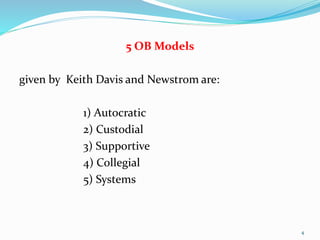
5 OB Models
given by Keith Davis and Newstrom are:
1) Autocratic
2) Custodial
3) Supportive
4) Collegial
5) Systems
4
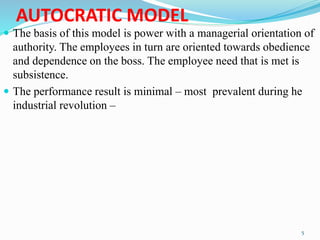
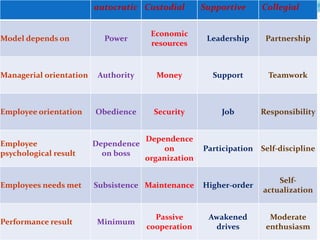
AUTOCRATIC MODEL
 The basis of this model is power with a managerial orientation of
authority. The employees in turn are oriented towards obedience
and dependence on the boss. The employee need that is met is
subsistence.
 The performance result is minimal – most prevalent during he
industrial revolution –
5
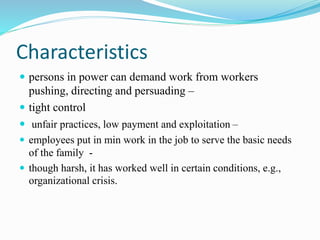
Characteristics
 persons in power can demand work from workers
pushing, directing and persuading –
 tight control
 unfair practices, low payment and exploitation –
 employees put in min work in the job to serve the basic needs
of the family -
 though harsh, it has worked well in certain conditions, e.g.,
organizational crisis.
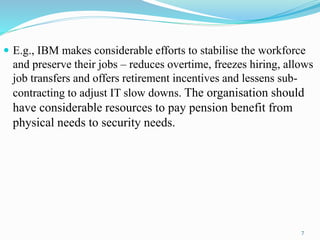
 E.g., IBM makes considerable efforts to stabilise the workforce
and preserve their jobs – reduces overtime, freezes hiring, allows
job transfers and offers retirement incentives and lessens sub-
contracting to adjust IT slow downs. The organisation should
have considerable resources to pay pension benefit from
physical needs to security needs.
7
Supportive
The basis of this model is leadership with a managerial
orientation of support. The employees in turn are oriented
towards job performance and participation. The employee
need that is met is status and recognition. The performance
result is awakened drives.
8
 The leadership and other processes of the organisation must be
such as to ensure a maximum probability that in all interactions
and all relationships within the organisation each member will,
in the light of his or her back ground, values, and expectations
view the experience as supportive and one which builds and
maintains his or her sense of personal worth and importance.”
e.g., TATAs.
Collegial
 The basis of this model is partnership with a managerial
orientation of teamwork. The employees in turn are oriented
towards responsible behavior and self-discipline. The
employee need that is met is self-actualization.
 The performance result is moderate enthusiasm.
 “Collegial” means a group of people working for a common
purpose.
 Manager is not addressed as ‘boss’ but is a facilitator.
Employees are self disciplined, self content and self
actualized. E.g., a R&D team or a project team.
10
 Although there are four separate models, almost no
organization operates exclusively in one. There will usually be
a predominate one, with one or more areas over-lapping in the
other models.
 Autocratic Custodial Supportive Collegial
 Model depends on
 PowerEconomic resourcesLeadershipPartnershipManagerial
orientationAuthorityMoneySupportTeamworkEmployee
orientationObedienceSecurityJobResponsiblityEmployee
psychological resultDependence on bossDependence on
organizationParticipationSelf-disciplineEmployees needs
metSubsistemceMaintenanceHigher-orderSelf-
actualizationPerformance resultMinimumPassive
cooperationAwakened drivesModerate enthusiasm
12
autocratic Custodial Supportive Collegial
Model depends on Power
Economic
resources
Leadership Partnership
Managerial orientation Authority Money Support Teamwork
Employee orientation Obedience Security Job Responsibility
Employee
psychological result
Dependence
on boss
Dependence
on
organization
Participation Self-discipline
Employees needs met Subsistence Maintenance Higher-order
Self-
actualization
Performance result Minimum
Passive
cooperation
Awakened
drives
Moderate
enthusiasm
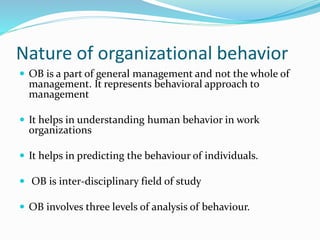
Nature of organizational behavior
 OB is a part of general management and not the whole of
management. It represents behavioral approach to
management
 It helps in understanding human behavior in work
organizations
 It helps in predicting the behaviour of individuals.
 OB is inter-disciplinary field of study
 OB involves three levels of analysis of behaviour.
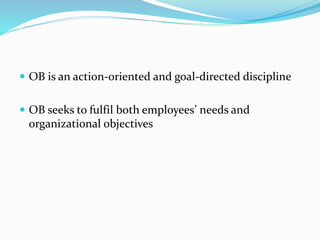
 OB is an action-oriented and goal-directed discipline
 OB seeks to fulfil both employees’ needs and
organizational objectives
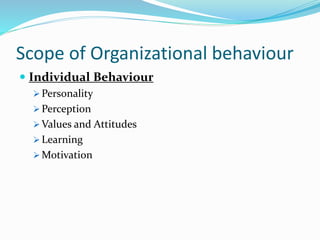
Scope of Organizational behaviour
 Individual Behaviour
 Personality
 Perception
 Values and Attitudes
 Learning
 Motivation
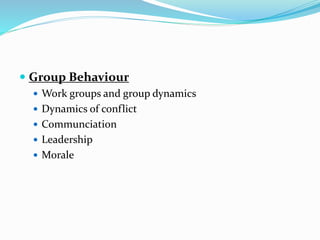
 Group Behaviour
 Work groups and group dynamics
 Dynamics of conflict
 Communciation
 Leadership
 Morale
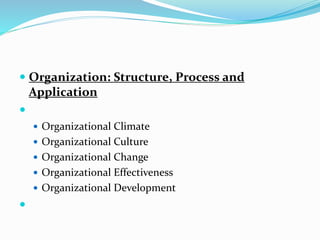
 Organization: Structure, Process and
Application

 Organizational Climate
 Organizational Culture
 Organizational Change
 Organizational Effectiveness
 Organizational Development

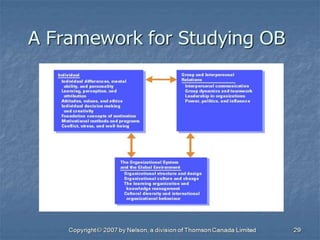
Organizational behavior framework
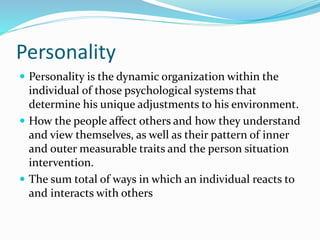
Personality
 Personality is the dynamic organization within the
individual of those psychological systems that
determine his unique adjustments to his environment.
 How the people affect others and how they understand
and view themselves, as well as their pattern of inner
and outer measurable traits and the person situation
intervention.
 The sum total of ways in which an individual reacts to
and interacts with others
Personality Traits
 The way people affect others depends on their
personality depends on their trait.
 Personality traits are enduring characteristics like
shyness, submissiveness, laziness, loyalty, dynamism,
aggressiveness, creativity etc exhibited in a large
number of situations.
 Height, weight, facial features, colour, dimentions etc
 Katherine Briggs and Isabel Briggs Myers developed
the Myers-Briggs Type Indicator (MBIT)
 A personality inventory designed to identify
individuals basic preferences for perceiving and
processing information.
 MBIT is designed to measure four dimensions relating
to how people orient themselves to the outer world
The Myers-Briggs Type Indicator
 Extroversion/introversion
 Extroversion characterizes people who are outgoing,
talkative, sociable and assertive
 Introversion which refers to those who are quiet, shy
and cautious
Sensing/intuition
 Sensing types use an organized structure to acquire
factual and preferably quantitative details. Sensers are
capable of synthesizing large amounts of seeming
random information to form quick conclusions.
 Intuitive people collect information
nonsystematically.
 They rely more on subjective evidence as well as their
intuition and sheer inspiration.
Thinking/feeling
 Thinking types rely on rational cause-effect logic and
systematic data collection to make decisions. They
weigh the evidence objectively and unemotionally.
 Feeling types on the other hand consider how their
choices affect others. They weigh the option against
their personal values more than rational logic.
Judging/perceiving
 Some people prefer order and structure in their
relationship with the outer world. These judging enjoy
the control of decision making and want to resolve
problems quickly.
 Perceiving types are more flexible. They like to
spontaneously adapt to events as they unfold and want
keep their options open.
Big Five model
 The major personality traits which influences the job
behavior and job performance are labeled as the big-
five personality traits
 Extroversion
 Sociable
 Talkative
 Assertive
 Agreeableness
 Good natured
 Corporative and trusting
 Conscientiousness
 Responsible, dependable, persistent and achievement
oriented
 Emotional stability
 Calm, self confident, secure, tense and nervous
 Openness to experience
 Imaginative, artistically sensitive
 intellectual
Personality theories
 The personality theories are grouped into the
following
 Psychoanalytic theories
 Socio-psychological theories
 Trait theories
 Holistic theories
Psychoanalytical theory
 Various psychologists contributed to the development
of psychoanalytic theory and concluded that
unconscious framework motivates the man mostly.
 There are three aspects in the unconscious framework
 Id
 The ego
 Super ego
 Id:
 The id is the primary principle of all human life. It is the
mental agency containing everything inherited.
 It seeks gratification of biological needs.
 It is unconscious part of human personality
 The biological needs include hunger, thirst, these needs
would be the driving force for thinking and behaving
throughout life
 The man removes the tension of unsatisfied biological
needs by forming a mental image of the object which
would satisfy the needs.
 The ego:
 The ego is related to the reality principle. It is
conscious and logical part of human personality.
 Ego is based on the realities of the external
environment through intellect and reasons.
 The id wants immediate pleasure through imagination
while ego wants real pleasure.
 The super ego
 Super ego represents a system of personal and societal
values, norms, ethics and ethical constraint on
behavior. This can be treated as conscience.
 Super ego acts as a norm to the ego in order to
determine which behavior is right and which behavior
is wrong.
Socio-psychological theory
 The psychological factors of the individual and the
sociological factors of the society interact with each
other.
 This theory inclusive of social factors and
psychological factors
contributions
 Fomm stressed on the importance of social context.
 These contributions include building social relations,
making the work more social relevance, making the
employee to have the feel of social sets in his work and
output
 Sullivan and Horney stressed on interpersonal
behavior. These contributions include developing
transactional abilities, viewing the people positively,
 Developing positive attitude
 Adler emphasized on different variables. These
contributions include career, networking, religious
beliefs, balancing family and work requirements
 Horney stressed on predominant interpersonal
behavior like being compliant, aggressive and
detached
Trait factor theory
 Allport and cattell contributed to the development of
trait factor theory.
 Common traits are used to compare people. He
identified six types of values
 Religious, social, economic, political , aesthetic and
theoretical
 Cattell developed similar set of threats
 Surface traits: these include wise-foolish,
affectionate-cold, honest-dishonest etc.
 Individuals keep their actual feeling inside and exhibit
the traits desirable by the situation
 Source traits: these include maturity-realism, good
nature and trustworthiness, critical-supicious ets
 Individual with sources traits possess characteristics
like maturity of mind, judgmental, analyzing and
understanding people and situations more accurately.
Holistic or self theory
 Self theory deals with the personality from all aspects
and as such it provides the holistic approach.
 It emphasizes on the totality of human behavior
 This theory is also known as organismic theory
 The contributors to this theory include Alfred maslow,
herzberg and lewin.
 Carl Rogers is the major contributor to this theory.
 According to him there are four factors
 Self image
 Ideal self
 Looking glass-self
 Real self
 Self-image:
 Self image is the way one sees himself or herself
 Self image is the set of beliefs of oneself who or what
he is
 Ideal self:
 The ideal self denotes the way one would like to be.
 The self-image is the reality of a person while the ideal
self is the ideal position expected or perceived by him
 Looking glass self:
 The looking glass self is the perception of an
individual about how others perceive his/her
characteristics and qualities.
 Real life:
 Real life is real characteristics, values and attitudes of
one self. The person adjusts and readjusts himself
based on the responses of others and the environment
influences.
Factors influencing personality
 Heredity factors
 Psychological characteristics
 Biological characteristics
 Physiological characteristics
 Environmental factors
 Culture
 Beliefs, values , norms , opinions and attitudes
 Situational factors
 Work place, employment interview, class room
Perception
 The process through which people select, organize and
interpret or attach meaning to events happening in the
environment
 A process by which individuals organize and interpret
their sensory impression in order to give meaning to
their environments
 The process of receiving, selecting, organizing,
interpreting, checking and reacting to sensory stimuli
or data
stimuli
 Stimuli is an enabling or disabling factor to act or not
to act within an individual.
 Types
 External stimuli: this include heat waves in the
summer, cold waves in the winter , light waves in the
day time
 Internal stimuli: food passing digestive system,
internal comfort or discomfort and actions and
reactions caused by physiological functioning
Perceptual process
 Perception includes all those processes by which an
individual receives information about environment-
 Seeing, hearing , feeling , tasting and smelling
 Stages:
 Receiving the perceptual inputs or stimuli from the
internal and external environment
 Selecting
 Organising
 Interpreting
 Perceptual output
 Behaviour
Perceptual inputs
 Internal environment
 Individual values
 beliefs and norms
 Psychological background
 Sociological background
 Economic background
 Physiological state
External environment
 Sensual stimulation
 Physical environment
 Factory, office, laboratory, computer, climate etc
 Socio-cultural environment
 Organization culture
 Leadership styles


Organizational Behaviour Unit 1

  • 1.
    Importance of Organizational Behavior Globalization  Information Technology  Total Quality Management (TQM)  TQ is a people-focussed technique aiming at continuous increase in customer satisfaction at continually lower cost. TQM is a continuous process of improvement for individuals, groups of people and the total organization.
  • 2.
     Business ProcessReengineering  The fundamental rethinking and radical redesign of business processes to achieve dramatic improvements is critical.  Benchmarking  Process of comparing work and service methods against the best practices and outcomes for the purpose of identifying the changes that will result in higher-quality output.
  • 3.
     Diversity ofHuman Resources  Competitive pressures  Rapidly growing global business  Desire for diverse views  Changing workforce demographics
  • 4.
    5 OB Models givenby Keith Davis and Newstrom are: 1) Autocratic 2) Custodial 3) Supportive 4) Collegial 5) Systems 4
  • 5.
    AUTOCRATIC MODEL  Thebasis of this model is power with a managerial orientation of authority. The employees in turn are oriented towards obedience and dependence on the boss. The employee need that is met is subsistence.  The performance result is minimal – most prevalent during he industrial revolution – 5
  • 6.
    Characteristics  persons inpower can demand work from workers pushing, directing and persuading –  tight control  unfair practices, low payment and exploitation –  employees put in min work in the job to serve the basic needs of the family -  though harsh, it has worked well in certain conditions, e.g., organizational crisis.
  • 7.
     E.g., IBMmakes considerable efforts to stabilise the workforce and preserve their jobs – reduces overtime, freezes hiring, allows job transfers and offers retirement incentives and lessens sub- contracting to adjust IT slow downs. The organisation should have considerable resources to pay pension benefit from physical needs to security needs. 7
  • 8.
    Supportive The basis ofthis model is leadership with a managerial orientation of support. The employees in turn are oriented towards job performance and participation. The employee need that is met is status and recognition. The performance result is awakened drives. 8
  • 9.
     The leadershipand other processes of the organisation must be such as to ensure a maximum probability that in all interactions and all relationships within the organisation each member will, in the light of his or her back ground, values, and expectations view the experience as supportive and one which builds and maintains his or her sense of personal worth and importance.” e.g., TATAs.
  • 10.
    Collegial  The basisof this model is partnership with a managerial orientation of teamwork. The employees in turn are oriented towards responsible behavior and self-discipline. The employee need that is met is self-actualization.  The performance result is moderate enthusiasm.  “Collegial” means a group of people working for a common purpose.  Manager is not addressed as ‘boss’ but is a facilitator. Employees are self disciplined, self content and self actualized. E.g., a R&D team or a project team. 10
  • 11.
     Although thereare four separate models, almost no organization operates exclusively in one. There will usually be a predominate one, with one or more areas over-lapping in the other models.
  • 12.
     Autocratic CustodialSupportive Collegial  Model depends on  PowerEconomic resourcesLeadershipPartnershipManagerial orientationAuthorityMoneySupportTeamworkEmployee orientationObedienceSecurityJobResponsiblityEmployee psychological resultDependence on bossDependence on organizationParticipationSelf-disciplineEmployees needs metSubsistemceMaintenanceHigher-orderSelf- actualizationPerformance resultMinimumPassive cooperationAwakened drivesModerate enthusiasm 12 autocratic Custodial Supportive Collegial Model depends on Power Economic resources Leadership Partnership Managerial orientation Authority Money Support Teamwork Employee orientation Obedience Security Job Responsibility Employee psychological result Dependence on boss Dependence on organization Participation Self-discipline Employees needs met Subsistence Maintenance Higher-order Self- actualization Performance result Minimum Passive cooperation Awakened drives Moderate enthusiasm
  • 13.
    Nature of organizationalbehavior  OB is a part of general management and not the whole of management. It represents behavioral approach to management  It helps in understanding human behavior in work organizations  It helps in predicting the behaviour of individuals.  OB is inter-disciplinary field of study  OB involves three levels of analysis of behaviour.
  • 14.
     OB isan action-oriented and goal-directed discipline  OB seeks to fulfil both employees’ needs and organizational objectives
  • 15.
    Scope of Organizationalbehaviour  Individual Behaviour  Personality  Perception  Values and Attitudes  Learning  Motivation
  • 16.
     Group Behaviour Work groups and group dynamics  Dynamics of conflict  Communciation  Leadership  Morale
  • 17.
     Organization: Structure,Process and Application   Organizational Climate  Organizational Culture  Organizational Change  Organizational Effectiveness  Organizational Development 
  • 18.
  • 19.
    Personality  Personality isthe dynamic organization within the individual of those psychological systems that determine his unique adjustments to his environment.  How the people affect others and how they understand and view themselves, as well as their pattern of inner and outer measurable traits and the person situation intervention.  The sum total of ways in which an individual reacts to and interacts with others
  • 20.
    Personality Traits  Theway people affect others depends on their personality depends on their trait.  Personality traits are enduring characteristics like shyness, submissiveness, laziness, loyalty, dynamism, aggressiveness, creativity etc exhibited in a large number of situations.  Height, weight, facial features, colour, dimentions etc
  • 21.
     Katherine Briggsand Isabel Briggs Myers developed the Myers-Briggs Type Indicator (MBIT)  A personality inventory designed to identify individuals basic preferences for perceiving and processing information.  MBIT is designed to measure four dimensions relating to how people orient themselves to the outer world The Myers-Briggs Type Indicator
  • 22.
     Extroversion/introversion  Extroversioncharacterizes people who are outgoing, talkative, sociable and assertive  Introversion which refers to those who are quiet, shy and cautious
  • 23.
    Sensing/intuition  Sensing typesuse an organized structure to acquire factual and preferably quantitative details. Sensers are capable of synthesizing large amounts of seeming random information to form quick conclusions.  Intuitive people collect information nonsystematically.  They rely more on subjective evidence as well as their intuition and sheer inspiration.
  • 24.
    Thinking/feeling  Thinking typesrely on rational cause-effect logic and systematic data collection to make decisions. They weigh the evidence objectively and unemotionally.  Feeling types on the other hand consider how their choices affect others. They weigh the option against their personal values more than rational logic.
  • 25.
    Judging/perceiving  Some peopleprefer order and structure in their relationship with the outer world. These judging enjoy the control of decision making and want to resolve problems quickly.  Perceiving types are more flexible. They like to spontaneously adapt to events as they unfold and want keep their options open.
  • 26.
    Big Five model The major personality traits which influences the job behavior and job performance are labeled as the big- five personality traits  Extroversion  Sociable  Talkative  Assertive  Agreeableness  Good natured  Corporative and trusting
  • 27.
     Conscientiousness  Responsible,dependable, persistent and achievement oriented  Emotional stability  Calm, self confident, secure, tense and nervous  Openness to experience  Imaginative, artistically sensitive  intellectual
  • 28.
    Personality theories  Thepersonality theories are grouped into the following  Psychoanalytic theories  Socio-psychological theories  Trait theories  Holistic theories
  • 29.
    Psychoanalytical theory  Variouspsychologists contributed to the development of psychoanalytic theory and concluded that unconscious framework motivates the man mostly.  There are three aspects in the unconscious framework  Id  The ego  Super ego
  • 30.
     Id:  Theid is the primary principle of all human life. It is the mental agency containing everything inherited.  It seeks gratification of biological needs.  It is unconscious part of human personality  The biological needs include hunger, thirst, these needs would be the driving force for thinking and behaving throughout life  The man removes the tension of unsatisfied biological needs by forming a mental image of the object which would satisfy the needs.
  • 31.
     The ego: The ego is related to the reality principle. It is conscious and logical part of human personality.  Ego is based on the realities of the external environment through intellect and reasons.  The id wants immediate pleasure through imagination while ego wants real pleasure.
  • 32.
     The superego  Super ego represents a system of personal and societal values, norms, ethics and ethical constraint on behavior. This can be treated as conscience.  Super ego acts as a norm to the ego in order to determine which behavior is right and which behavior is wrong.
  • 33.
    Socio-psychological theory  Thepsychological factors of the individual and the sociological factors of the society interact with each other.  This theory inclusive of social factors and psychological factors
  • 34.
    contributions  Fomm stressedon the importance of social context.  These contributions include building social relations, making the work more social relevance, making the employee to have the feel of social sets in his work and output  Sullivan and Horney stressed on interpersonal behavior. These contributions include developing transactional abilities, viewing the people positively,  Developing positive attitude
  • 35.
     Adler emphasizedon different variables. These contributions include career, networking, religious beliefs, balancing family and work requirements  Horney stressed on predominant interpersonal behavior like being compliant, aggressive and detached
  • 36.
    Trait factor theory Allport and cattell contributed to the development of trait factor theory.  Common traits are used to compare people. He identified six types of values  Religious, social, economic, political , aesthetic and theoretical
  • 37.
     Cattell developedsimilar set of threats  Surface traits: these include wise-foolish, affectionate-cold, honest-dishonest etc.  Individuals keep their actual feeling inside and exhibit the traits desirable by the situation  Source traits: these include maturity-realism, good nature and trustworthiness, critical-supicious ets  Individual with sources traits possess characteristics like maturity of mind, judgmental, analyzing and understanding people and situations more accurately.
  • 38.
    Holistic or selftheory  Self theory deals with the personality from all aspects and as such it provides the holistic approach.  It emphasizes on the totality of human behavior  This theory is also known as organismic theory  The contributors to this theory include Alfred maslow, herzberg and lewin.  Carl Rogers is the major contributor to this theory.
  • 39.
     According tohim there are four factors  Self image  Ideal self  Looking glass-self  Real self
  • 40.
     Self-image:  Selfimage is the way one sees himself or herself  Self image is the set of beliefs of oneself who or what he is  Ideal self:  The ideal self denotes the way one would like to be.  The self-image is the reality of a person while the ideal self is the ideal position expected or perceived by him
  • 41.
     Looking glassself:  The looking glass self is the perception of an individual about how others perceive his/her characteristics and qualities.  Real life:  Real life is real characteristics, values and attitudes of one self. The person adjusts and readjusts himself based on the responses of others and the environment influences.
  • 42.
    Factors influencing personality Heredity factors  Psychological characteristics  Biological characteristics  Physiological characteristics  Environmental factors  Culture  Beliefs, values , norms , opinions and attitudes  Situational factors  Work place, employment interview, class room
  • 43.
    Perception  The processthrough which people select, organize and interpret or attach meaning to events happening in the environment  A process by which individuals organize and interpret their sensory impression in order to give meaning to their environments  The process of receiving, selecting, organizing, interpreting, checking and reacting to sensory stimuli or data
  • 44.
    stimuli  Stimuli isan enabling or disabling factor to act or not to act within an individual.  Types  External stimuli: this include heat waves in the summer, cold waves in the winter , light waves in the day time  Internal stimuli: food passing digestive system, internal comfort or discomfort and actions and reactions caused by physiological functioning
  • 45.
    Perceptual process  Perceptionincludes all those processes by which an individual receives information about environment-  Seeing, hearing , feeling , tasting and smelling  Stages:  Receiving the perceptual inputs or stimuli from the internal and external environment  Selecting  Organising  Interpreting  Perceptual output  Behaviour
  • 46.
    Perceptual inputs  Internalenvironment  Individual values  beliefs and norms  Psychological background  Sociological background  Economic background  Physiological state
  • 47.
    External environment  Sensualstimulation  Physical environment  Factory, office, laboratory, computer, climate etc  Socio-cultural environment  Organization culture  Leadership styles 