By
J.MUNI KRISHNA
Lecturer
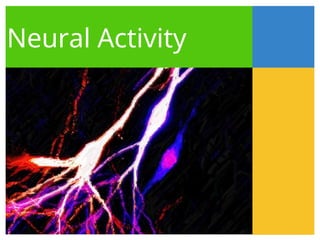
Neural Activity
The Neuron
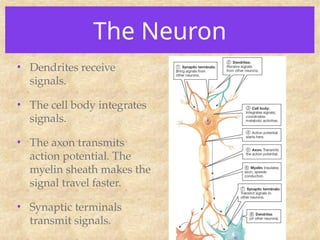
• Dendrites receive
signals.
• The cell body integrates
signals.
• The axon transmits
action potential. The
myelin sheath makes the
signal travel faster.
• Synaptic terminals
transmit signals.
Resting potential
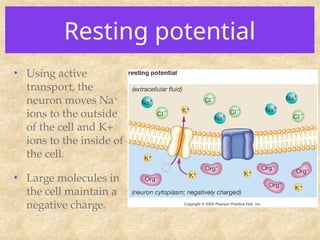
• Using active
transport, the
neuron moves Na+
ions to the outside
of the cell and K+
ions to the inside of
the cell.
• Large molecules in
the cell maintain a
negative charge.
Action potential
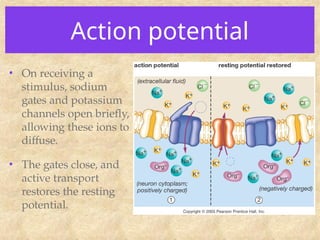
• On receiving a
stimulus, sodium
gates and potassium
channels open briefly,
allowing these ions to
diffuse.
• The gates close, and
active transport
restores the resting
potential.
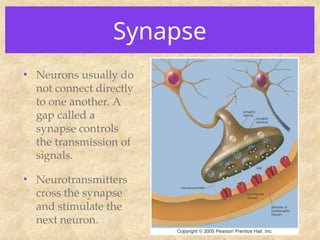
Synapse
• Neurons usually do
not connect directly
to one another. A
gap called a
synapse controls
the transmission of
signals.
• Neurotransmitters
cross the synapse
and stimulate the
next neuron.
Web Address
http://outreach.mcb.harvard.edu/animations/actionpotential.swf
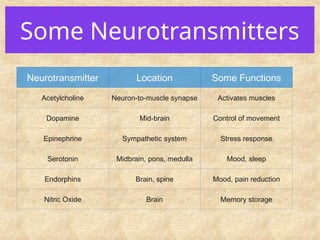
Some Neurotransmitters
Neurotransmitter Location Some Functions
Acetylcholine Neuron-to-muscle synapse Activates muscles
Dopamine Mid-brain Control of movement
Epinephrine Sympathetic system Stress response
Serotonin Midbrain, pons, medulla Mood, sleep
Endorphins Brain, spine Mood, pain reduction
Nitric Oxide Brain Memory storage
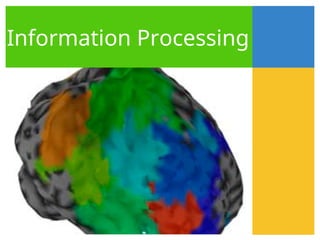
Information Processing
Four basic operations
• Determine type of stimulus
• Signal the intensity of a stimulus
• Integrate responses from many sources
• Initiate and direct operations
Type of stimulus
• Wiring patterns in the brain determine
the type of stimulus.
• Areas of the brain dedicated to specific
sensory signals are connected to nerves
that connect to specific sensory organs.
• “Cross-sensory” effects: a poke in the eye
produces stimulates the optic nerve,
producing visual effects.
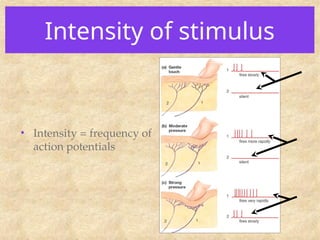
Intensity of stimulus
• Intensity = frequency of
action potentials
Integration of stimuli
• Convergence = Many signals arrive
through many neurons, but several may
pass their signal to a single connecting
neuron.
• Such cells may be “decision-making”
cells that may determine an appropriate
output.
Directing operations
• Neural pathways consist of:
• Sensory neurons
• Association neurons, which receive
signals from many sources
• Motor neurons
• Effectors: muscles, glands
Reflexes
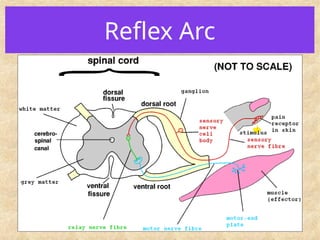
• The simplest neural pathway is the reflex arc.
• This involves one or more sensory neurons,
association neurons in the spine, and motor
neurons, which carry out the reflex entirely
before the brain is aware of the response.
Reflex Arc
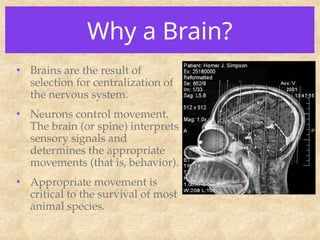
Why a Brain?
• Brains are the result of
selection for centralization of
the nervous system.
• Neurons control movement.
The brain (or spine) interprets
sensory signals and
determines the appropriate
movements (that is, behavior).
• Appropriate movement is
critical to the survival of most
animal species.
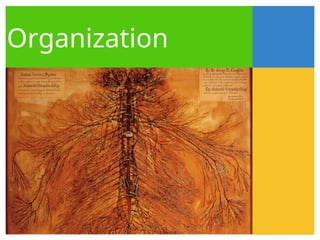
Organization
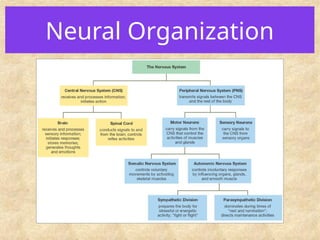
Neural Organization
Central Nervous System
• Consists of brain and spine
• Functions:
• Receives sensory signals and
determines appropriate response
• Stores memory
• Carries out thought
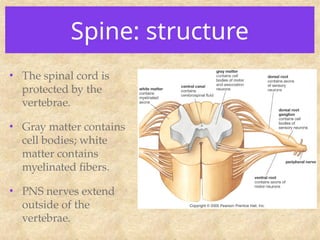
Spine: structure
• The spinal cord is
protected by the
vertebrae.
• Gray matter contains
cell bodies; white
matter contains
myelinated fibers.
• PNS nerves extend
outside of the
vertebrae.
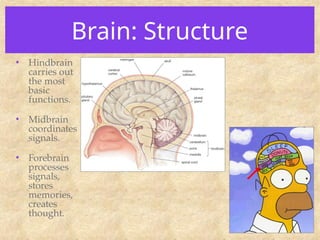
Brain: Structure
• Hindbrain
carries out
the most
basic
functions.
• Midbrain
coordinates
signals.
• Forebrain
processes
signals,
stores
memories,
creates
thought.
Peripheral Nervous System
• Nerves, neurons, and sensory organs
outside the central nervous system
• Functions:
• Sends signals to the CNS
• Receives and transmits motor signals
from the CNS
• Stimulates effectors
Somatic Nervous System
• Motor neurons that control voluntary
movements by activating skeletal
muscles.
• Also involved in what we perceive as
involuntary movements, such as reflexes
(though voluntary control of the muscles
involved, such as tensing them, can
reduce the response).
Autonomic Nervous
System
• Motor neurons that control involuntary
responses involving the organs, glands,
and smooth muscles.
• Some voluntary control over the
responses can come from relaxation,
meditation, etc., which reduce
perceptions of stress and in turn reduce
the stress response.
Sympathetic Division
• Portion of the autonomic nervous system
that produces the “fight or flight”
response:
• Dilation of pupils
• Increased heart and breathing rates
• Constriction of blood vessels
• Inhibits digestion
Parasympathetic Division
• Portion of the autonomic nervous system
that produces the “rest and ruminate”
response:
• Constricts pupils
• Dilates blood vessels
• Reduces heart and breathing rates.
• Stimulates digestion.
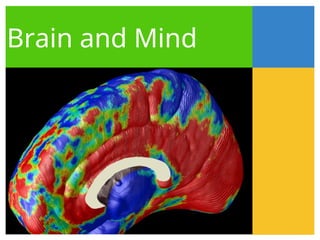
Brain and Mind
The Complex Brain
• The mammalian brain is highly complex,
containing many specialized regions that
carry out specific functions.
• Generally, the brain is divided into
hindbrain, midbrain, and forebrain.
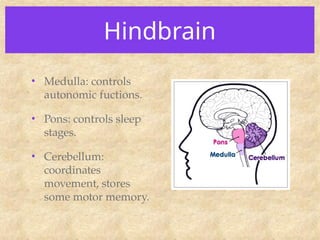
Hindbrain
• Medulla: controls
autonomic fuctions.
• Pons: controls sleep
stages.
• Cerebellum:
coordinates
movement, stores
some motor memory.
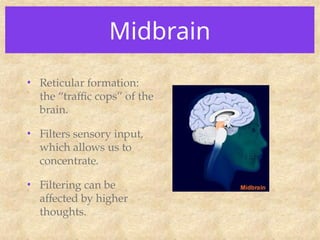
Midbrain
• Reticular formation:
the “traffic cops” of the
brain.
• Filters sensory input,
which allows us to
concentrate.
• Filtering can be
affected by higher
thoughts.
Try this:
• Stop and think: What have you been
paying attention to for the last ten
minutes?
• Pay attention to the feel of your shirt on
your arms. Had you been noticing it
during the last ten minutes? That’s the
reticular formation in action.
• What else have you not been paying
attention to?
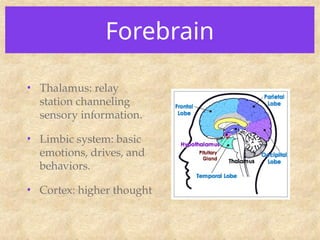
Forebrain
• Thalamus: relay
station channeling
sensory information.
• Limbic system: basic
emotions, drives, and
behaviors.
• Cortex: higher thought
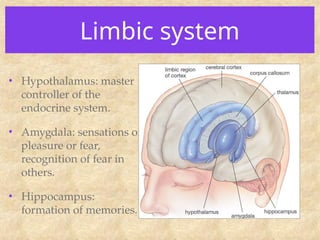
Limbic system
• Hypothalamus: master
controller of the
endocrine system.
• Amygdala: sensations of
pleasure or fear,
recognition of fear in
others.
• Hippocampus:
formation of memories.
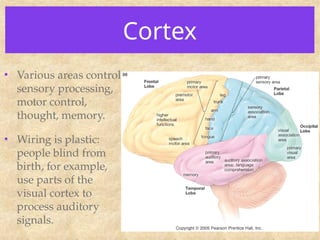
Cortex
• Various areas control
sensory processing,
motor control,
thought, memory.
• Wiring is plastic:
people blind from
birth, for example,
use parts of the
visual cortex to
process auditory
signals.
Left brain, right brain?
• While there is some specialization to each
hemisphere, the idea has been oversimplified.
• The left brain controls the right half of the body;
the right brain controls the left half of the body.
• However, “right brain” or “left brain” functions
such as math, language, etc. produce activity on
both sides of the brain, and processing of these
may be different in different people (males vs.
females, novices vs. experts, etc.).
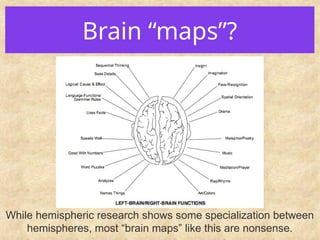
Brain “maps”?
While hemispheric research shows some specialization between
hemispheres, most “brain maps” like this are nonsense.
Memory
• How humans form memories is poorly
understood.
• “Working memory” appears to be
distinct from long-term memory. There
may be short-term memory as well,
things remembered for a few days. Is this
because the memory disappears, or
because it cannot be retrieved?
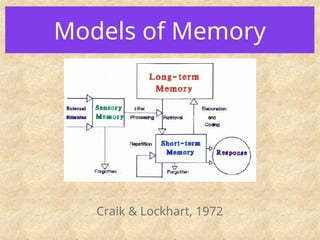
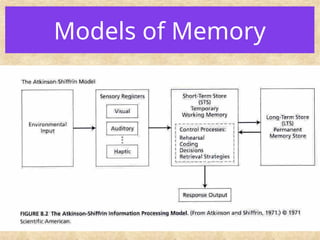
Models of Memory
Models of Memory
Craik & Lockhart, 1972
What is mind?
• Many traditions, including psychology, separate
“brain” from “mind.”
• What we perceive as “mind” (thought, will, self-
perception) does produce evidence of brain activity in
brain scans.
• That “brain” influences “mind” is well-established;
but some evidence shows “mind” can influence
“brain”; as cognitive therapy for depression can
physically change the brain.
• Neurology is a very young science, and there is still
much to learn about the brain-mind connection.
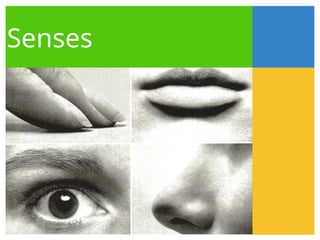
Senses
Sensory receptors
• Receptors are found in the sense organs.
They receive stimuli from the
environment and transmit stimuli to
neurons.
• Primary humans senses: photoreception,
chemoreception, mechanoreception,
thermoreception.
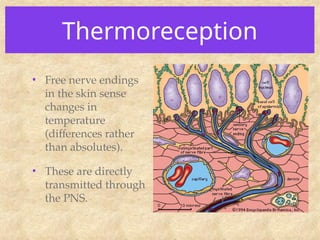
Thermoreception
• Free nerve endings
in the skin sense
changes in
temperature
(differences rather
than absolutes).
• These are directly
transmitted through
the PNS.
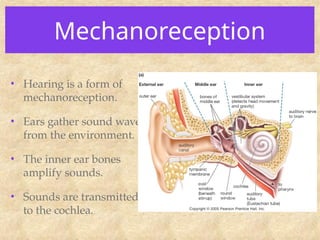
Mechanoreception
• Hearing is a form of
mechanoreception.
• Ears gather sound waves
from the environment.
• The inner ear bones
amplify sounds.
• Sounds are transmitted
to the cochlea.
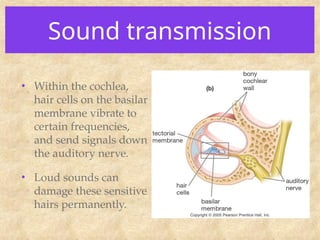
Sound transmission
• Within the cochlea,
hair cells on the basilar
membrane vibrate to
certain frequencies,
and send signals down
the auditory nerve.
• Loud sounds can
damage these sensitive
hairs permanently.
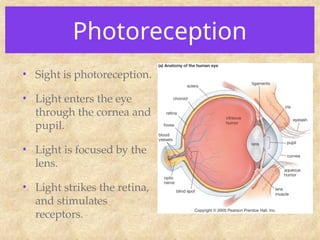
Photoreception
• Sight is photoreception.
• Light enters the eye
through the cornea and
pupil.
• Light is focused by the
lens.
• Light strikes the retina,
and stimulates
receptors.
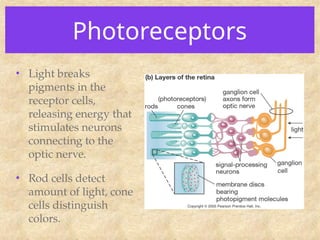
Photoreceptors
• Light breaks
pigments in the
receptor cells,
releasing energy that
stimulates neurons
connecting to the
optic nerve.
• Rod cells detect
amount of light, cone
cells distinguish
colors.
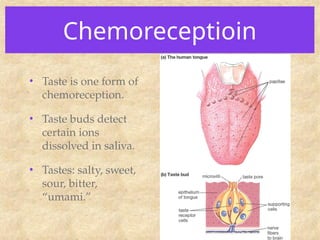
Chemoreceptioin
• Taste is one form of
chemoreception.
• Taste buds detect
certain ions
dissolved in saliva.
• Tastes: salty, sweet,
sour, bitter,
“umami.”
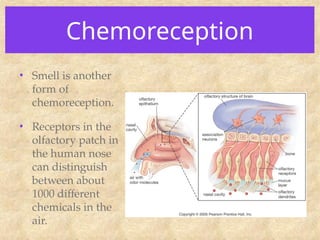
Chemoreception
• Smell is another
form of
chemoreception.
• Receptors in the
olfactory patch in
the human nose
can distinguish
between about
1000 different
chemicals in the
air.
“Flavor”
• What we sense as the “flavor” of food is
not taste alone. Smell and taste together
create the sensation of “flavor.”
• This is why things don’t “taste” good
when we have a cold; we lose the sense
of “flavor.”
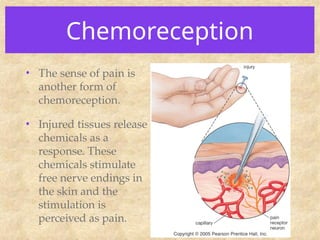
Chemoreception
• The sense of pain is
another form of
chemoreception.
• Injured tissues release
chemicals as a
response. These
chemicals stimulate
free nerve endings in
the skin and the
stimulation is
perceived as pain.
Synesthesia
• The cause of synesthesia is unknown. Some
speculate that all infants are synesthetic, and
neural “pruning” during early years separates
the senses. In some individuals, the pruning
may not be complete. The evidence on this is
mixed.
• The experiences are unique to each individual
(i.e. there is no universal association between a
certain letter or a certain color), are not made up
or learned, and usually remain the same
throughout life.
Lecture - Chapter 38 - Nervous System.ppt

Lecture - Chapter 38 - Nervous System.ppt

  • 1.
  • 2.
  • 3.
    The Neuron • Dendritesreceive signals. • The cell body integrates signals. • The axon transmits action potential. The myelin sheath makes the signal travel faster. • Synaptic terminals transmit signals.
  • 4.
    Resting potential • Usingactive transport, the neuron moves Na+ ions to the outside of the cell and K+ ions to the inside of the cell. • Large molecules in the cell maintain a negative charge.
  • 5.
    Action potential • Onreceiving a stimulus, sodium gates and potassium channels open briefly, allowing these ions to diffuse. • The gates close, and active transport restores the resting potential.
  • 6.
    Synapse • Neurons usuallydo not connect directly to one another. A gap called a synapse controls the transmission of signals. • Neurotransmitters cross the synapse and stimulate the next neuron.
  • 7.
  • 8.
    Some Neurotransmitters Neurotransmitter LocationSome Functions Acetylcholine Neuron-to-muscle synapse Activates muscles Dopamine Mid-brain Control of movement Epinephrine Sympathetic system Stress response Serotonin Midbrain, pons, medulla Mood, sleep Endorphins Brain, spine Mood, pain reduction Nitric Oxide Brain Memory storage
  • 9.
  • 10.
    Four basic operations •Determine type of stimulus • Signal the intensity of a stimulus • Integrate responses from many sources • Initiate and direct operations
  • 11.
    Type of stimulus •Wiring patterns in the brain determine the type of stimulus. • Areas of the brain dedicated to specific sensory signals are connected to nerves that connect to specific sensory organs. • “Cross-sensory” effects: a poke in the eye produces stimulates the optic nerve, producing visual effects.
  • 12.
    Intensity of stimulus •Intensity = frequency of action potentials
  • 13.
    Integration of stimuli •Convergence = Many signals arrive through many neurons, but several may pass their signal to a single connecting neuron. • Such cells may be “decision-making” cells that may determine an appropriate output.
  • 14.
    Directing operations • Neuralpathways consist of: • Sensory neurons • Association neurons, which receive signals from many sources • Motor neurons • Effectors: muscles, glands
  • 15.
    Reflexes • The simplestneural pathway is the reflex arc. • This involves one or more sensory neurons, association neurons in the spine, and motor neurons, which carry out the reflex entirely before the brain is aware of the response.
  • 16.
  • 17.
    Why a Brain? •Brains are the result of selection for centralization of the nervous system. • Neurons control movement. The brain (or spine) interprets sensory signals and determines the appropriate movements (that is, behavior). • Appropriate movement is critical to the survival of most animal species.
  • 18.
  • 19.
  • 20.
    Central Nervous System •Consists of brain and spine • Functions: • Receives sensory signals and determines appropriate response • Stores memory • Carries out thought
  • 21.
    Spine: structure • Thespinal cord is protected by the vertebrae. • Gray matter contains cell bodies; white matter contains myelinated fibers. • PNS nerves extend outside of the vertebrae.
  • 22.
    Brain: Structure • Hindbrain carriesout the most basic functions. • Midbrain coordinates signals. • Forebrain processes signals, stores memories, creates thought.
  • 23.
    Peripheral Nervous System •Nerves, neurons, and sensory organs outside the central nervous system • Functions: • Sends signals to the CNS • Receives and transmits motor signals from the CNS • Stimulates effectors
  • 24.
    Somatic Nervous System •Motor neurons that control voluntary movements by activating skeletal muscles. • Also involved in what we perceive as involuntary movements, such as reflexes (though voluntary control of the muscles involved, such as tensing them, can reduce the response).
  • 25.
    Autonomic Nervous System • Motorneurons that control involuntary responses involving the organs, glands, and smooth muscles. • Some voluntary control over the responses can come from relaxation, meditation, etc., which reduce perceptions of stress and in turn reduce the stress response.
  • 26.
    Sympathetic Division • Portionof the autonomic nervous system that produces the “fight or flight” response: • Dilation of pupils • Increased heart and breathing rates • Constriction of blood vessels • Inhibits digestion
  • 27.
    Parasympathetic Division • Portionof the autonomic nervous system that produces the “rest and ruminate” response: • Constricts pupils • Dilates blood vessels • Reduces heart and breathing rates. • Stimulates digestion.
  • 28.
  • 29.
    The Complex Brain •The mammalian brain is highly complex, containing many specialized regions that carry out specific functions. • Generally, the brain is divided into hindbrain, midbrain, and forebrain.
  • 30.
    Hindbrain • Medulla: controls autonomicfuctions. • Pons: controls sleep stages. • Cerebellum: coordinates movement, stores some motor memory.
  • 31.
    Midbrain • Reticular formation: the“traffic cops” of the brain. • Filters sensory input, which allows us to concentrate. • Filtering can be affected by higher thoughts.
  • 32.
    Try this: • Stopand think: What have you been paying attention to for the last ten minutes? • Pay attention to the feel of your shirt on your arms. Had you been noticing it during the last ten minutes? That’s the reticular formation in action. • What else have you not been paying attention to?
  • 33.
    Forebrain • Thalamus: relay stationchanneling sensory information. • Limbic system: basic emotions, drives, and behaviors. • Cortex: higher thought
  • 34.
    Limbic system • Hypothalamus:master controller of the endocrine system. • Amygdala: sensations of pleasure or fear, recognition of fear in others. • Hippocampus: formation of memories.
  • 35.
    Cortex • Various areascontrol sensory processing, motor control, thought, memory. • Wiring is plastic: people blind from birth, for example, use parts of the visual cortex to process auditory signals.
  • 36.
    Left brain, rightbrain? • While there is some specialization to each hemisphere, the idea has been oversimplified. • The left brain controls the right half of the body; the right brain controls the left half of the body. • However, “right brain” or “left brain” functions such as math, language, etc. produce activity on both sides of the brain, and processing of these may be different in different people (males vs. females, novices vs. experts, etc.).
  • 37.
    Brain “maps”? While hemisphericresearch shows some specialization between hemispheres, most “brain maps” like this are nonsense.
  • 38.
    Memory • How humansform memories is poorly understood. • “Working memory” appears to be distinct from long-term memory. There may be short-term memory as well, things remembered for a few days. Is this because the memory disappears, or because it cannot be retrieved?
  • 39.
  • 40.
    Models of Memory Craik& Lockhart, 1972
  • 41.
    What is mind? •Many traditions, including psychology, separate “brain” from “mind.” • What we perceive as “mind” (thought, will, self- perception) does produce evidence of brain activity in brain scans. • That “brain” influences “mind” is well-established; but some evidence shows “mind” can influence “brain”; as cognitive therapy for depression can physically change the brain. • Neurology is a very young science, and there is still much to learn about the brain-mind connection.
  • 42.
  • 43.
    Sensory receptors • Receptorsare found in the sense organs. They receive stimuli from the environment and transmit stimuli to neurons. • Primary humans senses: photoreception, chemoreception, mechanoreception, thermoreception.
  • 44.
    Thermoreception • Free nerveendings in the skin sense changes in temperature (differences rather than absolutes). • These are directly transmitted through the PNS.
  • 45.
    Mechanoreception • Hearing isa form of mechanoreception. • Ears gather sound waves from the environment. • The inner ear bones amplify sounds. • Sounds are transmitted to the cochlea.
  • 46.
    Sound transmission • Withinthe cochlea, hair cells on the basilar membrane vibrate to certain frequencies, and send signals down the auditory nerve. • Loud sounds can damage these sensitive hairs permanently.
  • 47.
    Photoreception • Sight isphotoreception. • Light enters the eye through the cornea and pupil. • Light is focused by the lens. • Light strikes the retina, and stimulates receptors.
  • 48.
    Photoreceptors • Light breaks pigmentsin the receptor cells, releasing energy that stimulates neurons connecting to the optic nerve. • Rod cells detect amount of light, cone cells distinguish colors.
  • 49.
    Chemoreceptioin • Taste isone form of chemoreception. • Taste buds detect certain ions dissolved in saliva. • Tastes: salty, sweet, sour, bitter, “umami.”
  • 50.
    Chemoreception • Smell isanother form of chemoreception. • Receptors in the olfactory patch in the human nose can distinguish between about 1000 different chemicals in the air.
  • 51.
    “Flavor” • What wesense as the “flavor” of food is not taste alone. Smell and taste together create the sensation of “flavor.” • This is why things don’t “taste” good when we have a cold; we lose the sense of “flavor.”
  • 52.
    Chemoreception • The senseof pain is another form of chemoreception. • Injured tissues release chemicals as a response. These chemicals stimulate free nerve endings in the skin and the stimulation is perceived as pain.
  • 53.
    Synesthesia • The causeof synesthesia is unknown. Some speculate that all infants are synesthetic, and neural “pruning” during early years separates the senses. In some individuals, the pruning may not be complete. The evidence on this is mixed. • The experiences are unique to each individual (i.e. there is no universal association between a certain letter or a certain color), are not made up or learned, and usually remain the same throughout life.