NERVOUS SYSTEM
Sympathetic
and ParasympatheticNervous
System
Autonomic Nervous System (ANS)
• It is a network of neurons connecting the CNS to our internal
muscles and organs.
• It functions continuously whether we are awake, asleep or even
under a general anesthetic.
• It regulates the activities of cardiac muscle, smooth muscle and
glands.
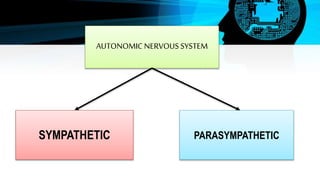
AUTONOMIC NERVOUSSYSTEM
PARASYMPATHETICSYMPATHETIC
• Group 1- You and your friends are in the
20th floor of Landco Bldg. when suddenly,
earthquake strikes.
• Group 2 – You’re quietly walking in the
park when an angry bear appear in front
of you.
• Group 3- While your doing your PE
activity, You saw your friend suddenly
stops and having a hard time to breathe.
SYMPATHETIC NERVOUS SYSTEM (sNS)
 It controls the body's responses to a perceived
threat and is responsible for the "fight or flight"
response or controls the body’s stress
response.
SYMPATHETIC NERVOUS SYSTEM (sNS)
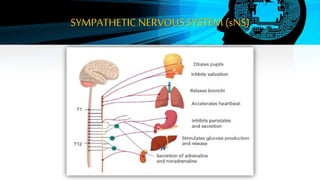
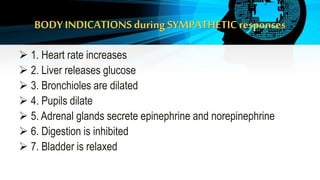
BODY INDICATIONS during SYMPATHETICresponses
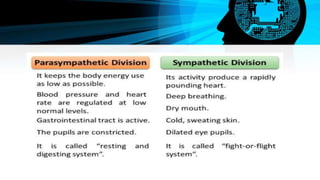
 1. Heart rate increases
 2. Liver releases glucose
 3. Bronchioles are dilated
 4. Pupils dilate
 5. Adrenal glands secrete epinephrine and norepinephrine
 6. Digestion is inhibited
 7. Bladder is relaxed
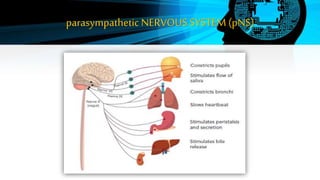
parasympathetic NERVOUS SYSTEM (pNS)
 It controls homeostasis and the body at rest
and is responsible for the body's "rest and
digest" function.
parasympathetic NERVOUS SYSTEM (pNS)
BODY INDICATIONS during paraSYMPATHETIC responses
 1. Heart rate decreases
 2. Liver produces bile
 3. Bronchioles are constricted
 4. Pupils constrict
 5. Adrenal glands stop secreting epinephrine and
norepinephrine
 6. Digestion is stimulated
 7. Bladder contracts
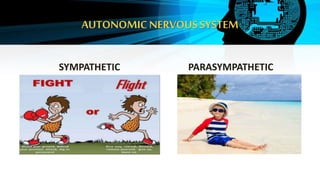
AUTONOMIC NERVOUSSYSTEM
SYMPATHETIC PARASYMPATHETIC
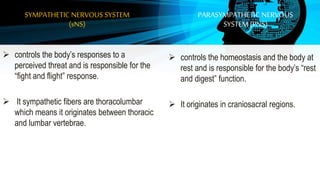
 controls the homeostasis and the body at
rest and is responsible for the body’s “rest
and digest” function.
 It originates in craniosacral regions.
 controls the body’s responses to a
perceived threat and is responsible for the
“fight and flight” response.
 It sympathetic fibers are thoracolumbar
which means it originates between thoracic
and lumbar vertebrae.
PARASYMPATHETIC NERVOUS
SYSTEM (PNS)
SYMPATHETIC NERVOUS SYSTEM
(sNS)
References:
• https://www.slideshare.net/ananthatiger/anatomy-of-autonomic-nervous-system
• https://www.slideshare.net/hermizan84/autonomic-nervous-system-50993965
• https://askabiologist.asu.edu/parts-of-nervous-system
• https://www.slideshare.net/crystaldelosa/autonomic-nervous-system-11315922
• https://slideplayer.com/slide/8134749/https://study.com/academy/lesson/the-sympathetic-and-parasympathetic-
nervous-systems.html
• http://www.softschools.com/difference/sympathetic_vs_parasympathetic/143/
• https://www.diffen.com/difference/Parasympathetic_nervous_system_vs_Sympathetic_nervous_system

Nervous system- SYMPATHETIC and PARASYMPATHETIC

  • 1.
  • 3.
    Autonomic Nervous System(ANS) • It is a network of neurons connecting the CNS to our internal muscles and organs. • It functions continuously whether we are awake, asleep or even under a general anesthetic. • It regulates the activities of cardiac muscle, smooth muscle and glands.
  • 4.
  • 5.
    • Group 1-You and your friends are in the 20th floor of Landco Bldg. when suddenly, earthquake strikes. • Group 2 – You’re quietly walking in the park when an angry bear appear in front of you. • Group 3- While your doing your PE activity, You saw your friend suddenly stops and having a hard time to breathe.
  • 6.
    SYMPATHETIC NERVOUS SYSTEM(sNS)  It controls the body's responses to a perceived threat and is responsible for the "fight or flight" response or controls the body’s stress response.
  • 7.
  • 8.
    BODY INDICATIONS duringSYMPATHETICresponses  1. Heart rate increases  2. Liver releases glucose  3. Bronchioles are dilated  4. Pupils dilate  5. Adrenal glands secrete epinephrine and norepinephrine  6. Digestion is inhibited  7. Bladder is relaxed
  • 9.
    parasympathetic NERVOUS SYSTEM(pNS)  It controls homeostasis and the body at rest and is responsible for the body's "rest and digest" function.
  • 10.
  • 11.
    BODY INDICATIONS duringparaSYMPATHETIC responses  1. Heart rate decreases  2. Liver produces bile  3. Bronchioles are constricted  4. Pupils constrict  5. Adrenal glands stop secreting epinephrine and norepinephrine  6. Digestion is stimulated  7. Bladder contracts
  • 12.
  • 13.
     controls thehomeostasis and the body at rest and is responsible for the body’s “rest and digest” function.  It originates in craniosacral regions.  controls the body’s responses to a perceived threat and is responsible for the “fight and flight” response.  It sympathetic fibers are thoracolumbar which means it originates between thoracic and lumbar vertebrae. PARASYMPATHETIC NERVOUS SYSTEM (PNS) SYMPATHETIC NERVOUS SYSTEM (sNS)
  • 16.
    References: • https://www.slideshare.net/ananthatiger/anatomy-of-autonomic-nervous-system • https://www.slideshare.net/hermizan84/autonomic-nervous-system-50993965 •https://askabiologist.asu.edu/parts-of-nervous-system • https://www.slideshare.net/crystaldelosa/autonomic-nervous-system-11315922 • https://slideplayer.com/slide/8134749/https://study.com/academy/lesson/the-sympathetic-and-parasympathetic- nervous-systems.html • http://www.softschools.com/difference/sympathetic_vs_parasympathetic/143/ • https://www.diffen.com/difference/Parasympathetic_nervous_system_vs_Sympathetic_nervous_system

Editor's Notes

  • #2 Sympathetic and Parasympathetic are both part of autonomic nervous system (ANS or Visceral nervous system) is the part of the peripheral nervous system that acts as a control system functioning largely below the level of consciousness and controls function. OR regulates the activities of cardiac muscle, smooth muscle and glands. Involuntary function: Cardiovascular , Respiratory, Digestive, Urinary, Reproductive functions, Key roles in the bodies responses to stress.
  • #7 The sympathetic nervous system (SNS) controls the body's responses to a perceived threat and is responsible for the "fight or flight" response. Sympathetic – controls the body’s stress response. **Acetylcholine in the ganglion **Norepinephrine at the effectors **Norepinephrine and Epinephrine are secreted as hormones. Receptors – ALPHA RECEPTORS cause smooth muscles to construct BETA RECEPTORS cause smooth muscles to relax.
  • #8 It’s the sympathetic nervous system that prepares our body to deal with a physical or psychological threating situation. Normally, when placed under threat, an organism will fight or flee. In either case, its bodily resources need to be maximized for survival. Therefore, instead of using energy digesting lunch, blood and its energy giving substances (oxygen, sugar, fats) are diverted to the muscles, especially those of the limbs. - The sympathetic fibers are thoracolumbar meaning that they originate from between your thoracic vertebrae where your ribs attach, and the lumbar vertebrae just inferior to your ribs. - From the greek word for "feeling together". SYMPATHETIC GANGLIA found closer to the spinal cord because of those or flight moments of high excitement or activity. They need to send a single message far and wide like the Bat Signal. -Ganglia are close to the spinal cord -It releases acetylcholine (preganglionic) and norepinephrine in final synapses (postganglionic) -has shorter preganglionic cell and longer postganglionic cell -adrenal glands releases a flood of epinephrine and norepinephrine hormones. -**NOREPINEPHRINE can be neurotransmitter or hormone -smooth muscles control your involuntary parts of the body like stocmach or blood vessels.
  • #10 The parasympathetic nervous system (PNS) controls homeostasis and the body at rest and is responsible for the body's "rest and digest" function.
  • #11 When the threat has past, the PNS returns the functions to the normal state of balance or Homeostasis. It also minimizes energy use and keeps the internal systems of the body constantly regulated.
  • #15 SYMPATHETIC NERVOUS SYTEM - The sympathetic fibers are thoracolumbar meaning that they originate from between your thoracic vertebrae where your ribs attach, and the lumbar vertebrae just inferior to your ribs. - From the greek word for "feeling together". SYMPATHETIC GANGLIA found closer to the spinal cord because of those or flight moments of high excitement or activity. They need to send a single message far and wide like the Bat Signal. -Ganglia are close to the spinal cord -It releases acetylcholine (preganglionic) and norepinephrine in final synapses (postganglionic) -has shorter preganglionic cell and longer postganglionic cell -adrenal glands releases a flood of epinephrine and norepinephrine hormones. -**NOREPINEPHRINE can be neurotransmitter or hormone -smooth muscles control your involuntary parts of the body like stocmach or blood vessels. PARASYMPATHETIC NERVOUS SYSTEM - It begins above and below where the sympathetic nerves are. - They're craniosacral, meaning they sprout from the base of your brain and also from your sacral spinal cord, just superior to the tailbone. -Literally "beside the sympathetic" - parasympathetic ganglia are found way out from the spine-near or even inside of their effector organs. -Longer preganglionic and shorter post ganglionic - Ganglia are close to the effectors.