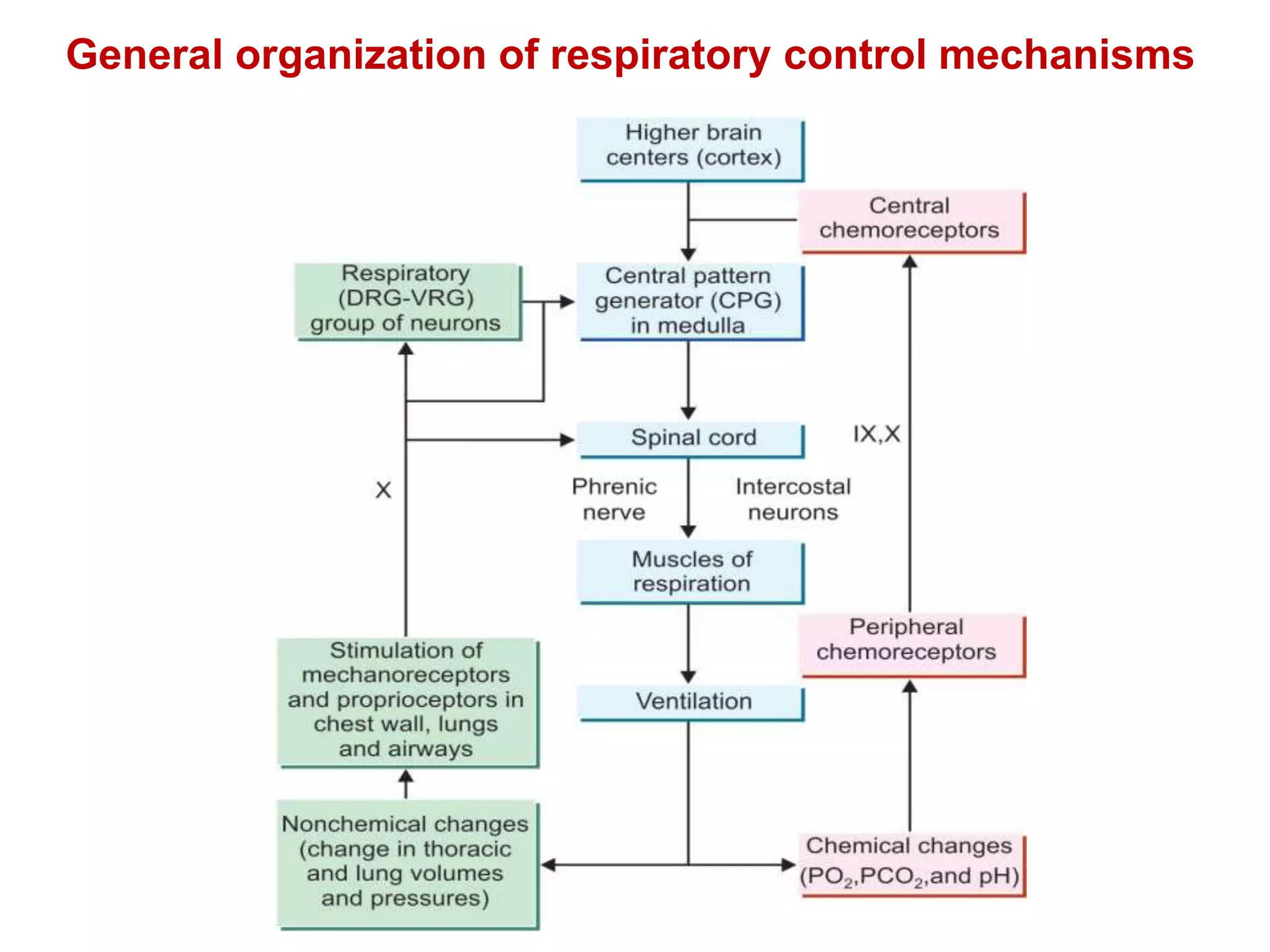
The document summarizes the neural and chemical regulation of respiration. It describes the key respiratory centers in the medulla and pons that control breathing. These include the dorsal and ventral respiratory groups in the medulla and the apneustic and pneumotaxic centers in the pons. Peripheral chemoreceptors in the carotid body and aortic body and central chemoreceptors in the medulla detect changes in blood gases like CO2 and pH to modulate breathing. Increased CO2 and H+ stimulate these chemoreceptors to enhance the activity of the respiratory centers and increase ventilation.
Specific Learning Objectives
Atthe end of class students should be able to:
1. Describe the neural regulation of respiration.
2. Describe the chemical regulation of respiration.
2
3.
Overall Control ofActivity of Respiratory Centre
A) Involuntary (Automatic) Control:
I- Neurogenic Reflexes
II- Chemoreceptor Reflexes (Chemical control)
B) Voluntary Control
3
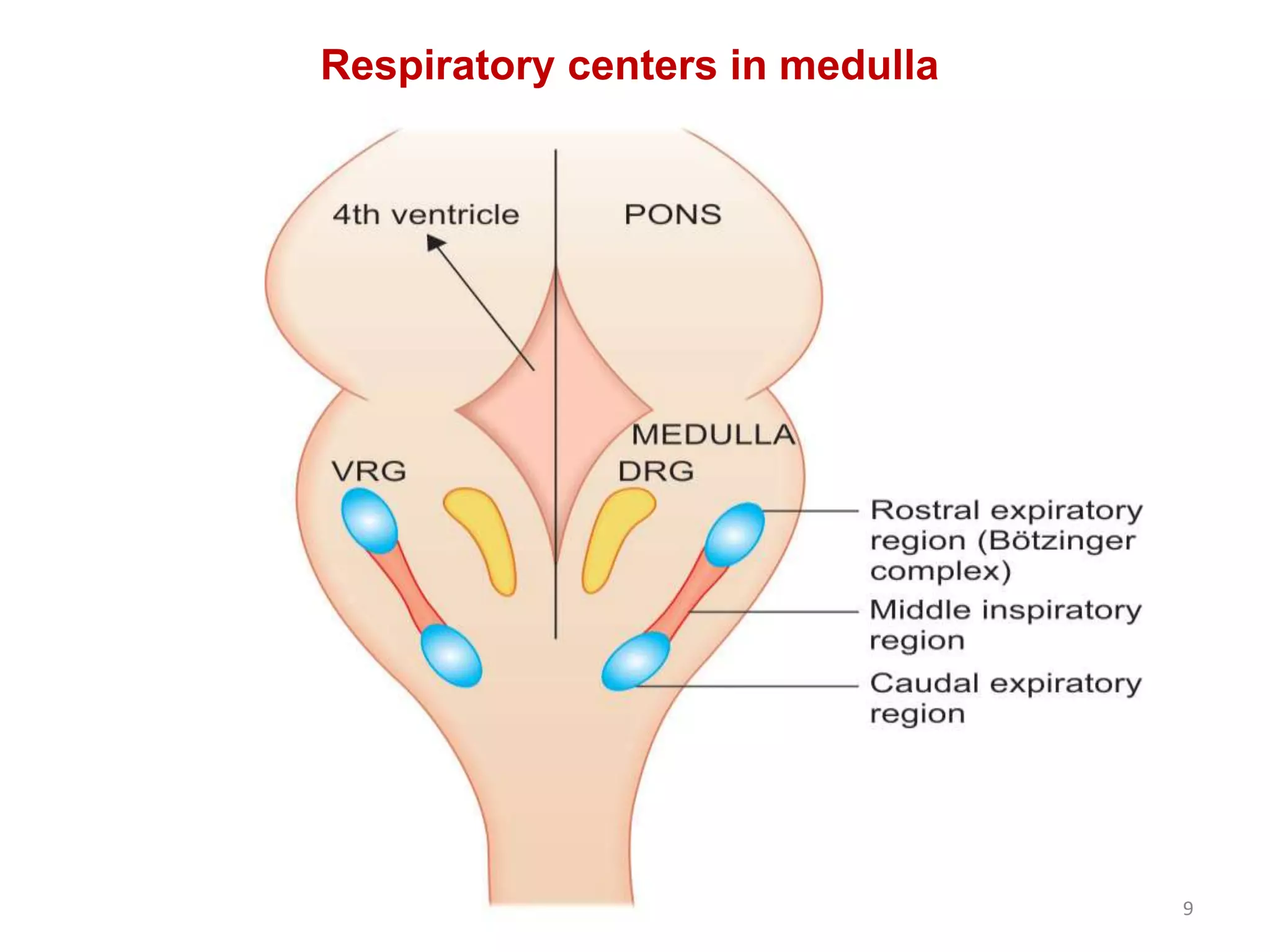
Medullary centers:
• Dorsalrespiratory group of neurons
• Ventral respiratory group of neurons
Pontine centers:
• Apneustic center
• Pneumotaxic center
6
7.
MEDULLARY CENTERS
1. DorsalRespiratory Group of Neurons (DRG):
• Diffusely situated in the nucleus of tractus solitarius (NTS),
upper part of the medulla oblongata.
• Inspiratory neurons.
- Autorhythmic property: generate inspiratory ramp.
Responsible for basic rhythm of respiration.
7
8.
2. Ventral RespiratoryGroup of Neurons (VRG):
• Situated in the medulla oblongata, anterior and lateral to the NTS.
• Ventral respiratory group has both inspiratory and expiratory
neurons.
• Normally, ventral group neurons are inactive during quiet
breathing and become active during forced breathing.
• During forced breathing, these neurons stimulate both inspiratory
and expiratory muscles.
8
PONTINE CENTERS
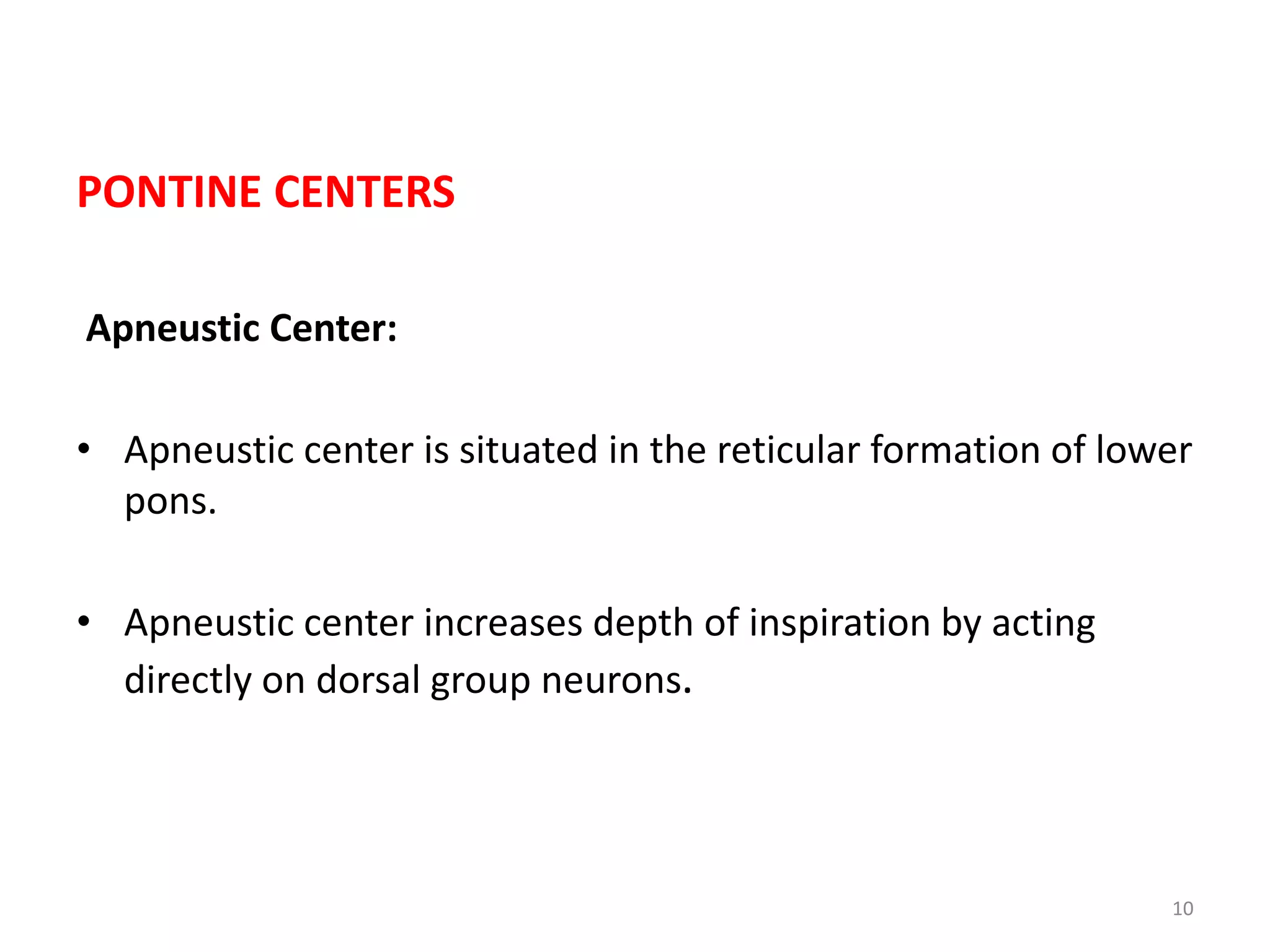
Apneustic Center:
•Apneustic center is situated in the reticular formation of lower
pons.
• Apneustic center increases depth of inspiration by acting
directly on dorsal group neurons.
10
11.
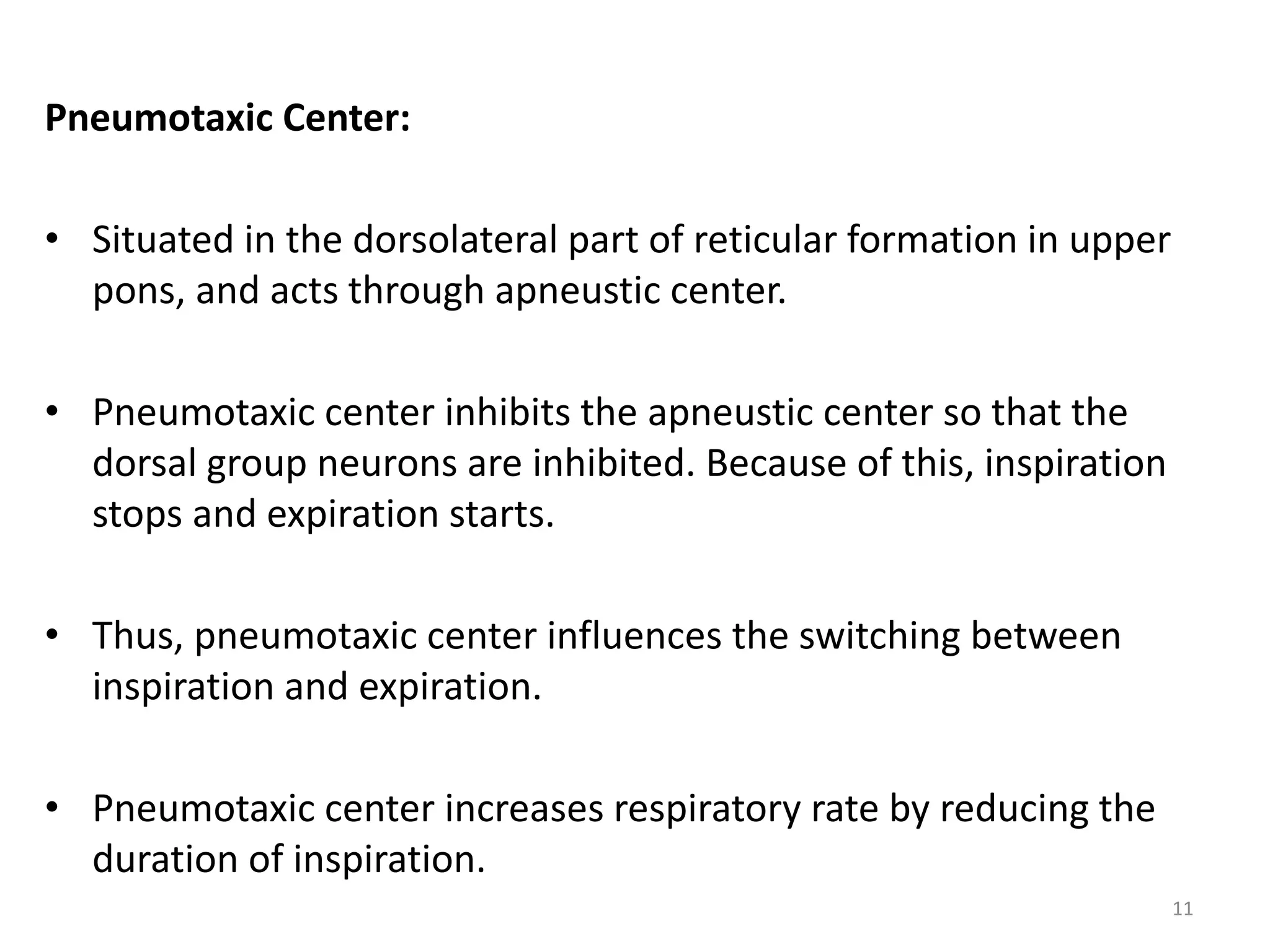
Pneumotaxic Center:
• Situatedin the dorsolateral part of reticular formation in upper
pons, and acts through apneustic center.
• Pneumotaxic center inhibits the apneustic center so that the
dorsal group neurons are inhibited. Because of this, inspiration
stops and expiration starts.
• Thus, pneumotaxic center influences the switching between
inspiration and expiration.
• Pneumotaxic center increases respiratory rate by reducing the
duration of inspiration.
11
INTEGRATION OF RESPIRATORYCENTERS
Role of Medullary Centers:
• Dorsal respiratory group of neurons are responsible for the normal
rhythm of respiration by discharging impulses rhythmically.
• These impulses are transmitted to respiratory muscles by phrenic
and intercostal nerves.
• Ramp signals are not produced continuously but only for a period
of 2 seconds, during which inspiration occurs. After 2 seconds,
ramp signals stop abruptly and do not appear for another 3
seconds. Switching off the ramp signals causes expiration.
13
14.
• Normally, duringinspiration, dorsal respiratory group neurons
inhibit expiratory neurons of ventral group.
• During expiration, the expiratory neurons inhibit the dorsal
group neurons. Thus, the medullary respiratory centers
control each other.
Significance of inspiratory ramp signals:
• Steady increase in lung volume during inspiration rather than
respiratory gasps.
14
Pre-BÖtzinger complex (pre-BÖTC)
•Central pattern generator; ‘pace-maker cells’.
• Discharges rhythmically & responsible for initiation of rhythmic
respiration
• Located between nucleus ambigus & lateral reticular formation
on either side of the medulla.
• DRG & VRG respiratory neurons project to pre-BÖTC.
• It sends rhythmic impulses to phrenic motor neurons
16
17.
Role of PontineCenters:
• Pontine respiratory centers regulate the medullary centers.
• Apneustic center accelerates the activity of dorsal group of
neurons and the stimulation of this center causes prolonged
inspiration.
• Pneumotaxic center inhibits the apneustic center and restricts
the duration of inspiration.
17
18.
Effects of transectionof brainstem at various levels on
pattern, rate, and depth of respiration.
Chemoreceptors:
• Chemoreceptors arethe sensory nerve endings, which are
sensitive to changes in pCO2, pO2 and pH of blood.
• Peripheral chemoreceptors
• Central chemoreceptors
20
21.
Peripheral chemoreceptors:
• Carotidbody is situated near bifurcation of common carotid
artery.
• Aortic body is located at arch of aorta.
• Chemoreceptors in the carotid body are supplied by Hering
nerve, branch of glossopharyngeal nerve.
• Chemoreceptors in the aortic body are supplied by aortic
nerve branch of vagus nerve.
21
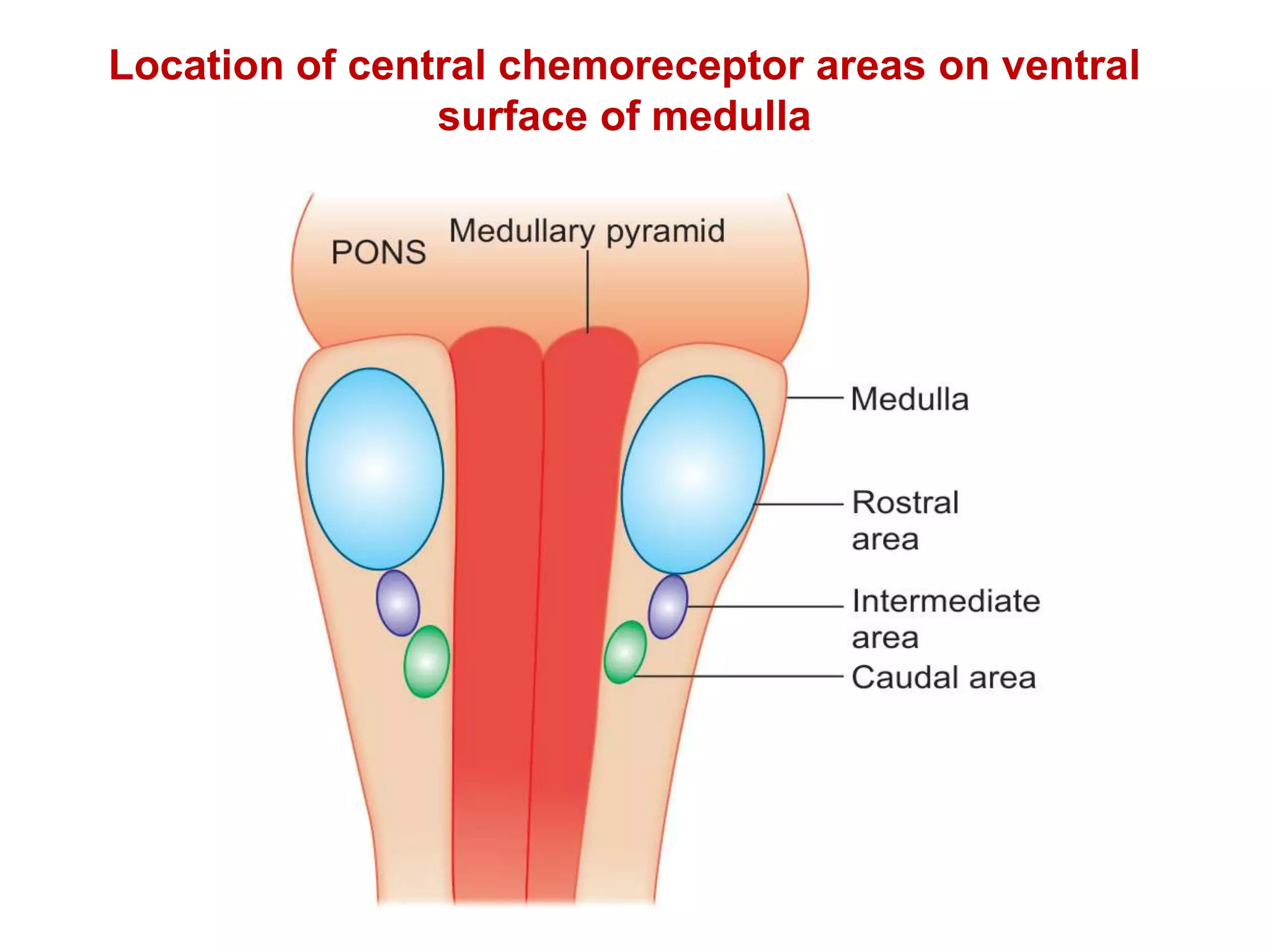
Central chemoreceptors:
• Centralchemoreceptors are situated in deeper part of
medulla oblongata, close to the dorsal respiratory group of
neurons.
• This area is known as chemosensitive area and the neurons
are called chemoreceptors.
• Chemoreceptors are in close contact with blood and
cerebrospinal fluid.
• Responsible for 70% to 80% of increased ventilation through
chemical regulatory mechanism.
24
Mechanism of action:
•Stimulant for central chemoreceptor- increased H+ ion
concentration.
• If H+ ion concentration increases in the blood, it cannot stimulate
the central chemoreceptors because, the H+ ions from blood
cannot cross the blood-brain barrier.
• If CO2 increases in the blood, it can easily cross the blood-brain
barrier and enter the interstitial fluid of brain.
• After diffusion:
CO2 + H2O → H2CO3 → H+ + HCO3
-
26
27.
• H+ ionsstimulate the central chemoreceptors.
• The excitatory impulses reach dorsal respiratory group of
neurons, resulting in increased ventilation.
• Excess CO2 is washed out and respiration is brought back to
normal.
27
References
1. Guyton andHall Textbook of Medical Physiology.
2. Ganong’s Review of Medical Physiology.
3. GK Pal, Comprehensive Textbook of Physiology- Volume 2.
4. Indu Khurana Textbook of Medical Physiology.
30