ORGANIC REAGENTS
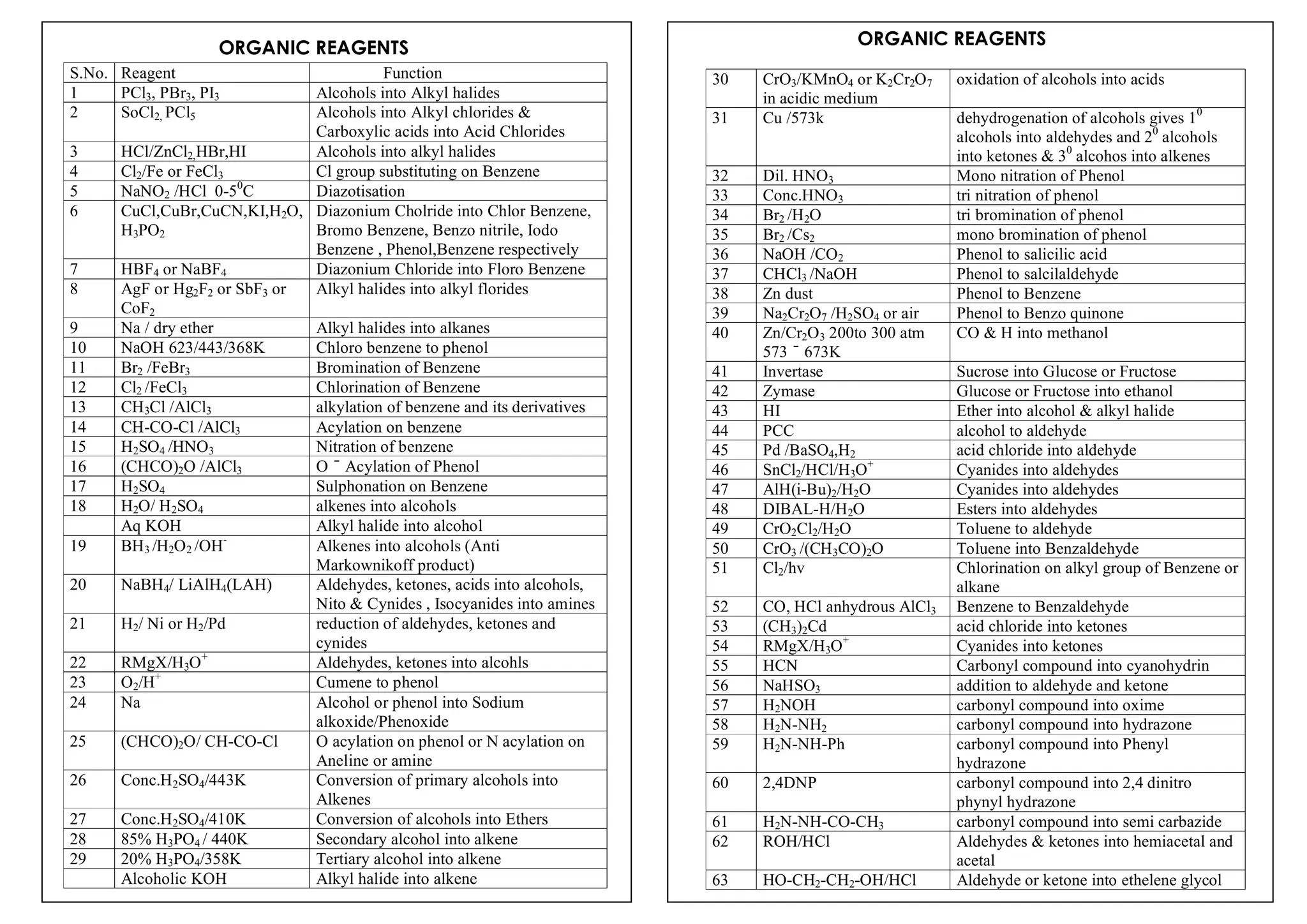
S.No. Reagent Function
1 PCl3, PBr3, PI3 Alcohols into Alkyl halides
2 SoCl2, PCl5 Alcohols into Alkyl chlorides &
Carboxylic acids into Acid Chlorides
3 HCl/ZnCl2,HBr,HI Alcohols into alkyl halides
4 Cl2/Fe or FeCl3 Cl group substituting on Benzene
5 NaNO2 /HCl 0-50
C Diazotisation
6 CuCl,CuBr,CuCN,KI,H2O,
H3PO2
Diazonium Cholride into Chlor Benzene,
Bromo Benzene, Benzo nitrile, Iodo
Benzene , Phenol,Benzene respectively
7 HBF4 or NaBF4 Diazonium Chloride into Floro Benzene
8 AgF or Hg2F2 or SbF3 or
CoF2
Alkyl halides into alkyl florides
9 Na / dry ether Alkyl halides into alkanes
10 NaOH 623/443/368K Chloro benzene to phenol
11 Br2 /FeBr3 Bromination of Benzene
12 Cl2 /FeCl3 Chlorination of Benzene
13 CH3Cl /AlCl3 alkylation of benzene and its derivatives
14 CH-CO-Cl /AlCl3 Acylation on benzene
15 H2SO4 /HNO3 Nitration of benzene
16 (CHCO)2O /AlCl3 O – Acylation of Phenol
17 H2SO4 Sulphonation on Benzene
18 H2O/ H2SO4 alkenes into alcohols
Aq KOH Alkyl halide into alcohol
19 BH3 /H2O2 /OH-
Alkenes into alcohols (Anti
Markownikoff product)
20 NaBH4/ LiAlH4(LAH) Aldehydes, ketones, acids into alcohols,
Nito & Cynides , Isocyanides into amines
21 H2/ Ni or H2/Pd reduction of aldehydes, ketones and
cynides
22 RMgX/H3O+
Aldehydes, ketones into alcohls
23 O2/H+
Cumene to phenol
24 Na Alcohol or phenol into Sodium
alkoxide/Phenoxide
25 (CHCO)2O/ CH-CO-Cl O acylation on phenol or N acylation on
Aneline or amine
26 Conc.H2SO4/443K Conversion of primary alcohols into
Alkenes
27 Conc.H2SO4/410K Conversion of alcohols into Ethers
28 85% H3PO4 / 440K Secondary alcohol into alkene
29 20% H3PO4/358K Tertiary alcohol into alkene
Alcoholic KOH Alkyl halide into alkene
ORGANIC REAGENTS
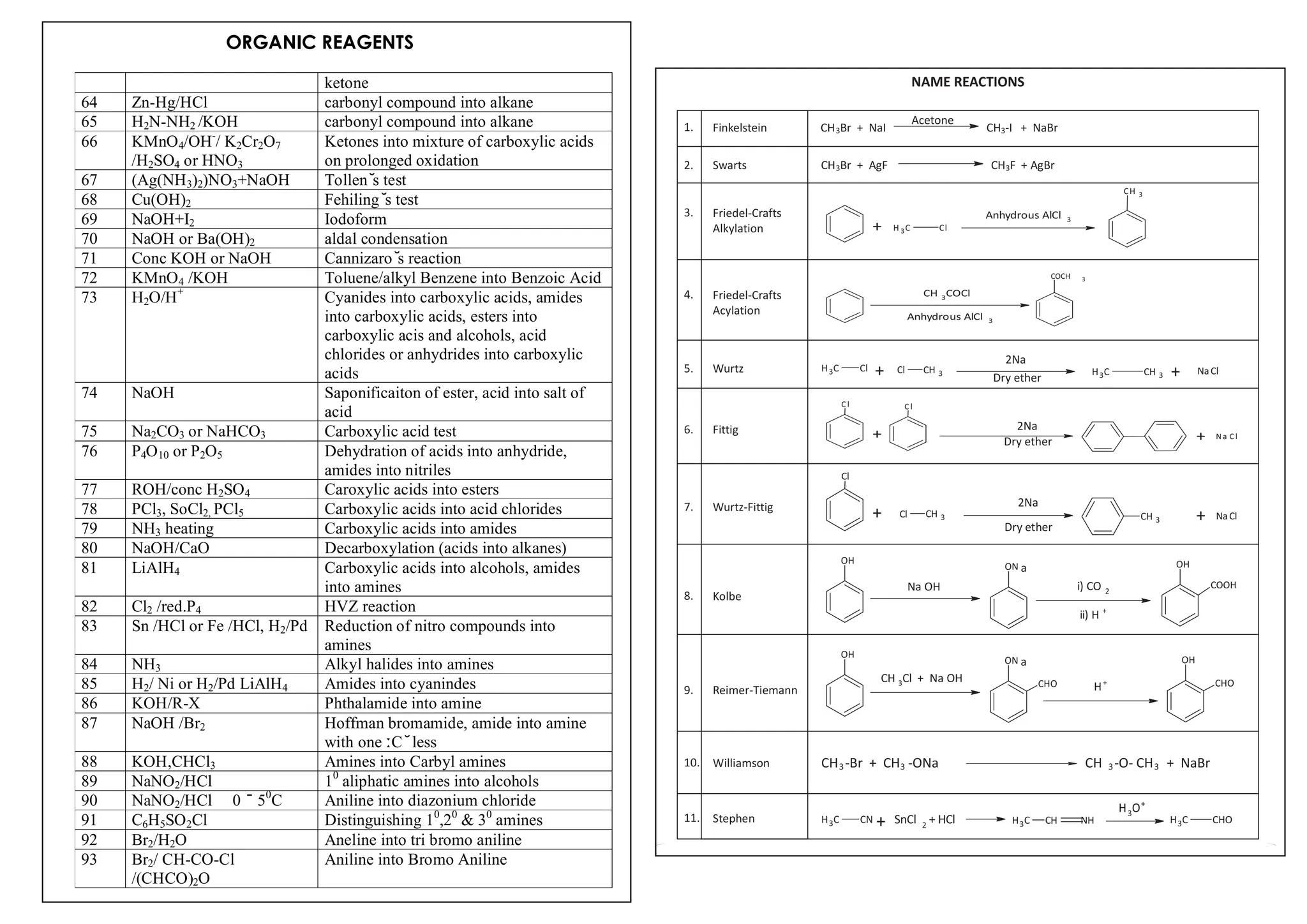
30 CrO3/KMnO4 or K2Cr2O7
in acidic medium
oxidation of alcohols into acids
31 Cu /573k dehydrogenation of alcohols gives 10
alcohols into aldehydes and 20
alcohols
into ketones & 30
alcohos into alkenes
32 Dil. HNO3 Mono nitration of Phenol
33 Conc.HNO3 tri nitration of phenol
34 Br2 /H2O tri bromination of phenol
35 Br2 /Cs2 mono bromination of phenol
36 NaOH /CO2 Phenol to salicilic acid
37 CHCl3 /NaOH Phenol to salcilaldehyde
38 Zn dust Phenol to Benzene
39 Na2Cr2O7 /H2SO4 or air Phenol to Benzo quinone
40 Zn/Cr2O3 200to 300 atm
573 – 673K
CO & H into methanol
41 Invertase Sucrose into Glucose or Fructose
42 Zymase Glucose or Fructose into ethanol
43 HI Ether into alcohol & alkyl halide
44 PCC alcohol to aldehyde
45 Pd /BaSO4,H2 acid chloride into aldehyde
46 SnCl2/HCl/H3O+
Cyanides into aldehydes
47 AlH(i-Bu)2/H2O Cyanides into aldehydes
48 DIBAL-H/H2O Esters into aldehydes
49 CrO2Cl2/H2O Toluene to aldehyde
50 CrO3 /(CH3CO)2O Toluene into Benzaldehyde
51 Cl2/hv Chlorination on alkyl group of Benzene or
alkane
52 CO, HCl anhydrous AlCl3 Benzene to Benzaldehyde
53 (CH3)2Cd acid chloride into ketones
54 RMgX/H3O+
Cyanides into ketones
55 HCN Carbonyl compound into cyanohydrin
56 NaHSO3 addition to aldehyde and ketone
57 H2NOH carbonyl compound into oxime
58 H2N-NH2 carbonyl compound into hydrazone
59 H2N-NH-Ph carbonyl compound into Phenyl
hydrazone
60 2,4DNP carbonyl compound into 2,4 dinitro
phynyl hydrazone
61 H2N-NH-CO-CH3 carbonyl compound into semi carbazide
62 ROH/HCl Aldehydes & ketones into hemiacetal and
acetal
63 HO-CH2-CH2-OH/HCl Aldehyde or ketone into ethelene glycol
ORGANIC REAGENTS
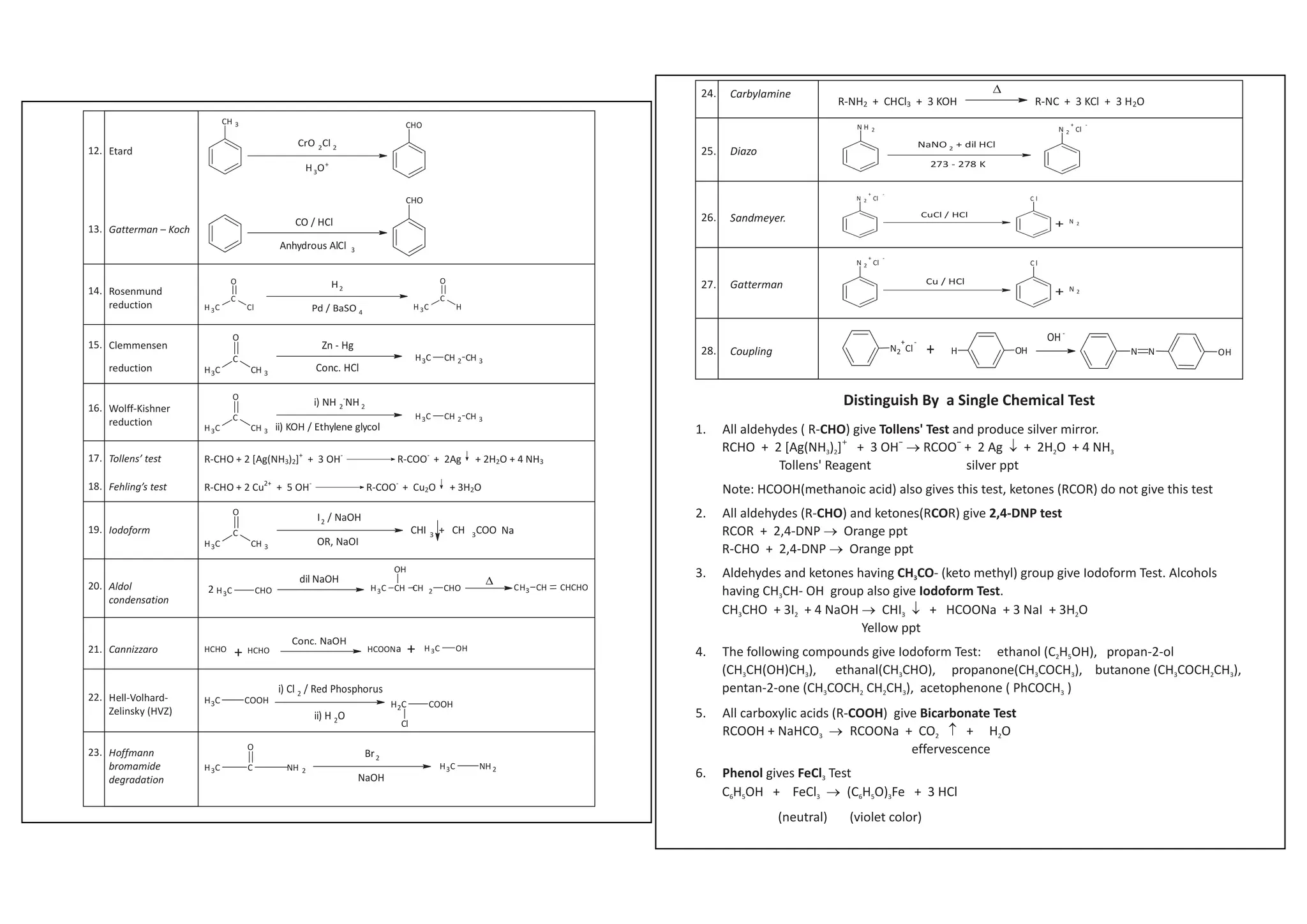
ketone
64 Zn-Hg/HCl carbonyl compound into alkane
65 H2N-NH2 /KOH carbonyl compound into alkane
66 KMnO4/OH-
/ K2Cr2O7
/H2SO4 or HNO3
Ketones into mixture of carboxylic acids
on prolonged oxidation
67 (Ag(NH3)2)NO3+NaOH Tollen’
s test
68 Cu(OH)2 Fehiling’
s test
69 NaOH+I2 Iodoform
70 NaOH or Ba(OH)2 aldal condensation
71 Conc KOH or NaOH Cannizaro’
s reaction
72 KMnO4 /KOH Toluene/alkyl Benzene into Benzoic Acid
73 H2O/H+
Cyanides into carboxylic acids, amides
into carboxylic acids, esters into
carboxylic acis and alcohols, acid
chlorides or anhydrides into carboxylic
acids
74 NaOH Saponificaiton of ester, acid into salt of
acid
75 Na2CO3 or NaHCO3 Carboxylic acid test
76 P4O10 or P2O5 Dehydration of acids into anhydride,
amides into nitriles
77 ROH/conc H2SO4 Caroxylic acids into esters
78 PCl3, SoCl2, PCl5 Carboxylic acids into acid chlorides
79 NH3 heating Carboxylic acids into amides
80 NaOH/CaO Decarboxylation (acids into alkanes)
81 LiAlH4 Carboxylic acids into alcohols, amides
into amines
82 Cl2 /red.P4 HVZ reaction
83 Sn /HCl or Fe /HCl, H2/Pd Reduction of nitro compounds into
amines
84 NH3 Alkyl halides into amines
85 H2/ Ni or H2/Pd LiAlH4 Amides into cyanindes
86 KOH/R-X Phthalamide into amine
87 NaOH /Br2 Hoffman bromamide, amide into amine
with one ‘C’less
88 KOH,CHCl3 Amines into Carbyl amines
89 NaNO2/HCl 10
aliphatic amines into alcohols
90 NaNO2/HCl 0 – 50
C Aniline into diazonium chloride
91 C6H5SO2Cl Distinguishing 10
,20
& 30
amines
92 Br2/H2O Aneline into tri bromo aniline
93 Br2/ CH-CO-Cl
/(CHCO)2O
Aniline into Bromo Aniline
I: Conversions related to alkyl halides
–
SCHEME
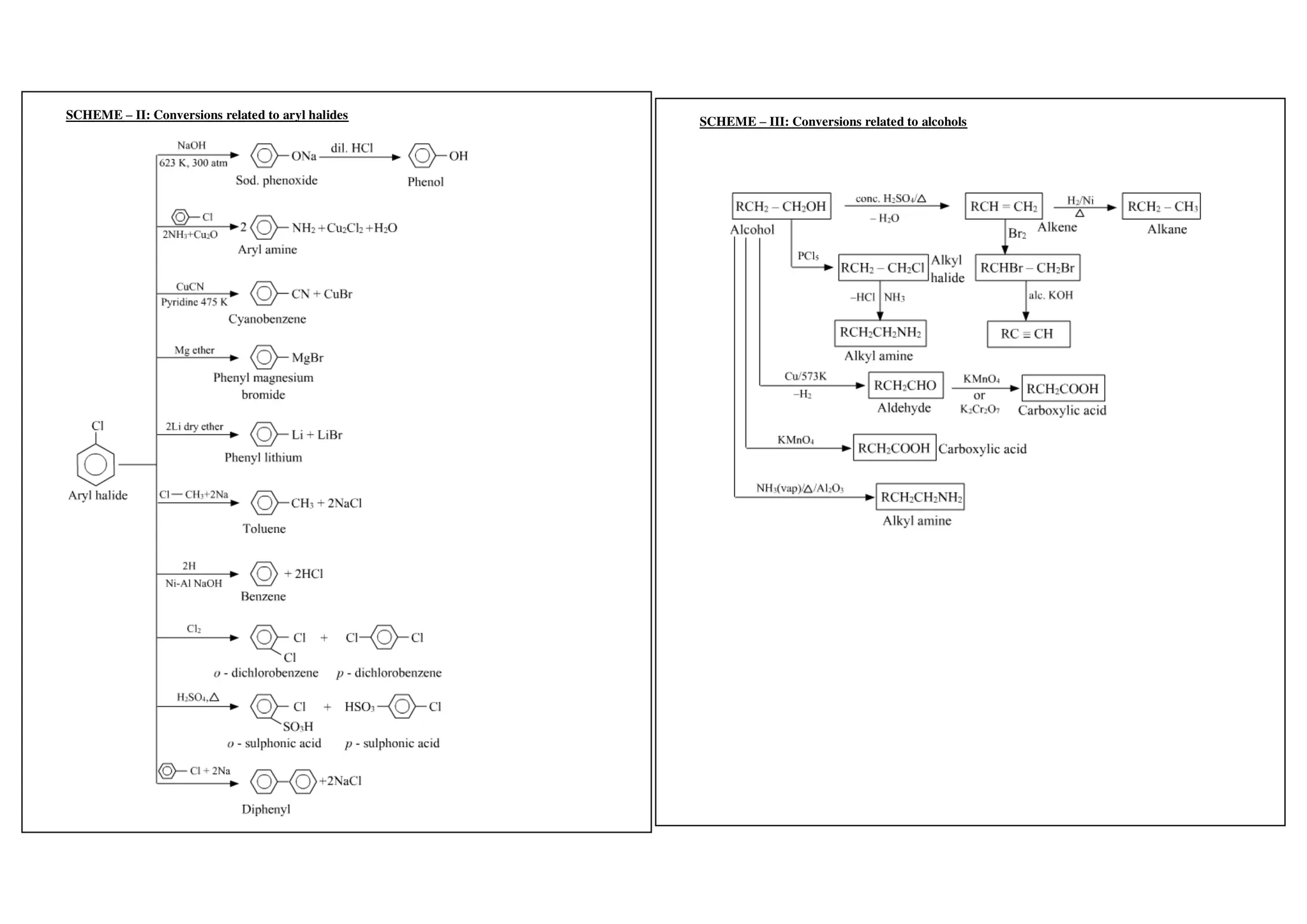
II: Conversions related to aryl halides
–
SCHEME
SCHEME – III: Conversions related to alcohols
SCHEME – IV: Conversion related to phenols – I
SCHEME – V: Conversion related to phenols – II
SCHEME – VI: Conversion related to aldehydes
SCHEME – VI: Conversion related to carboxylic acids
SCHEME – VII: Conversion related to alkyl amines SCHEME – VIII: Conversion related to aryl amines
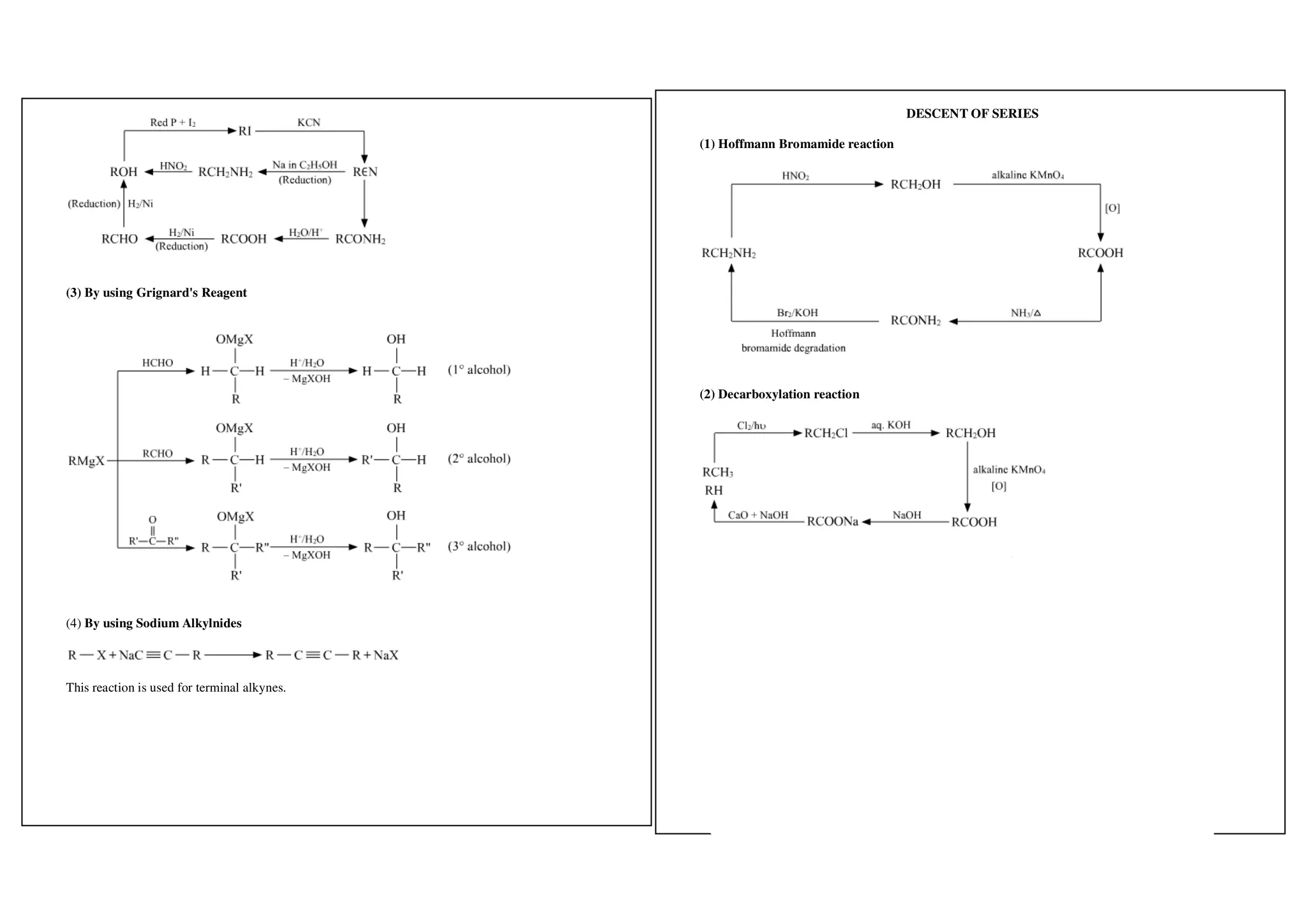
ASCENDING SERIES
(1) By Wurtz Reaction
(2) By Using Cyanide
(3) By using Grignard's Reagent
(4) By using Sodium Alkylnides
This reaction is used for terminal alkynes.
(2) Decarboxylation reaction
(1) Hoffmann Bromamide reaction
DESCENT OF SERIES
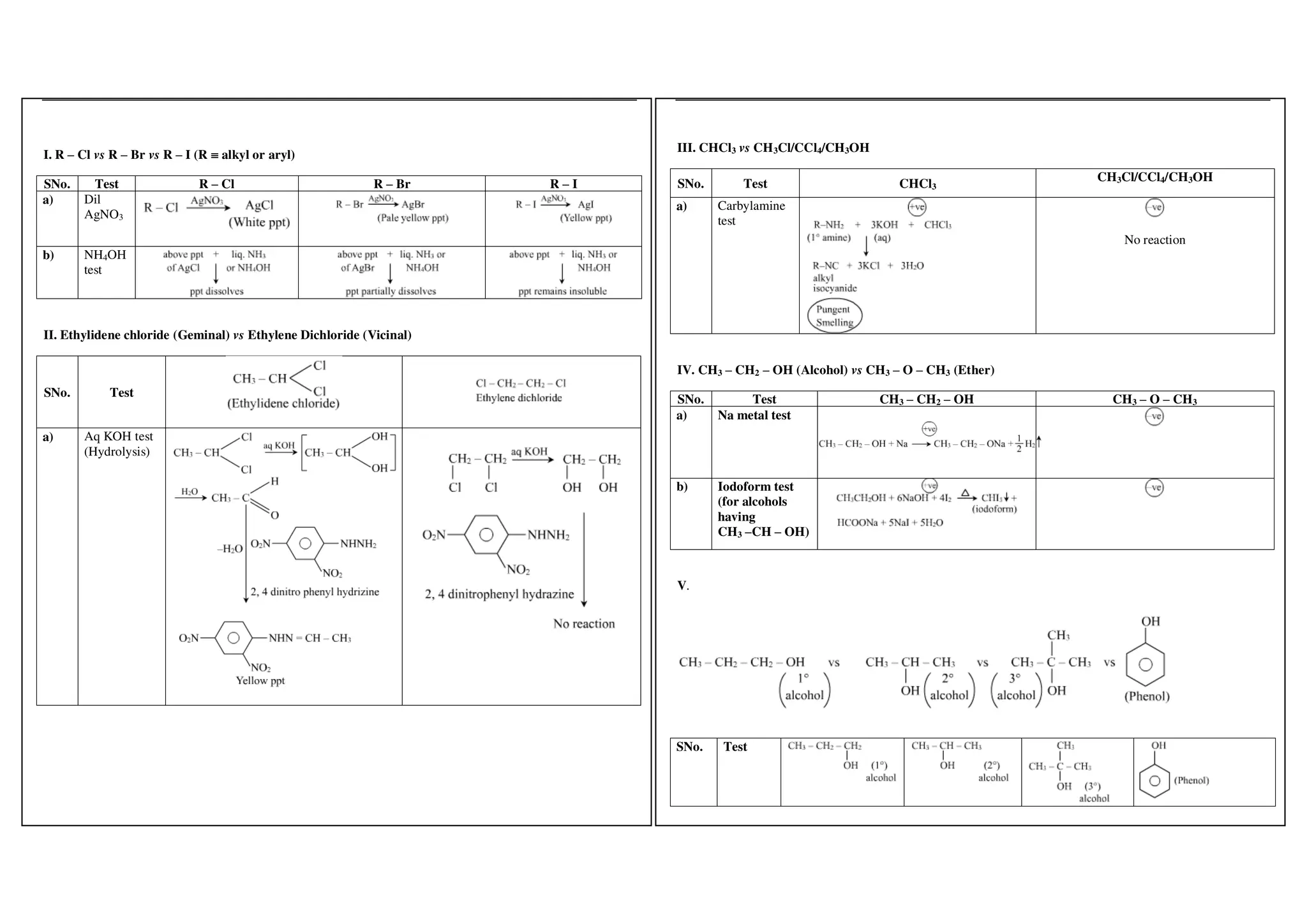
(Hydrolysis)
KOH test
Aq
a)
Test
SNo.
Ethylene Dichloride (Vicinal)
vs
II. Ethylidene chloride (Geminal)
test
OH
4
NH
b)
3
AgNO
Dil
a)
I
–
R
Br
–
R
Cl
–
R
Test
SNo.
alkyl or aryl)

R
I (
–
R
vs
Br
–
R
vs
Cl
–
I. R
Test
SNo.
.
V
OH)
–
CH
–
3
CH
having
(for alcohols
Iodoform test
b)
Na metal test
a)
3
CH
–
O
–
3
CH
OH
–
2
CH
–
3
CH
Test
SNo.
(Ether)
3
CH
–
O
–
3
CH
vs
OH (Alcohol)
–
2
CH
–
3
IV. CH
No reaction
test
Carbylamine
a)
OH
3
/CH
4
Cl/CCl
3
CH
3
CHCl
Test
SNo.
OH
3
/CH
4
Cl/CCl
3
CH
vs
3
III. CHCl
a) Lucas
Test
(Conc.
HCl +
anhyd
ZnCl2
Turbidity appears on
heating
Turbidity appears
within in 5 – 10
min.
Turbidity appears
spontaneously
No appearance of
turbidity
b) Iodofor
m test
c) Br2
water
test
d) Neutral
FeCl3
Test
e) Litmus
Test
Turns blue litmus red
f)
Victor
Meyer
Test
VI.
SNo. Test
a) Litmus Test Turns blue Litmus to red
b) Neutral FeCl3
test
c) Iodoform Test
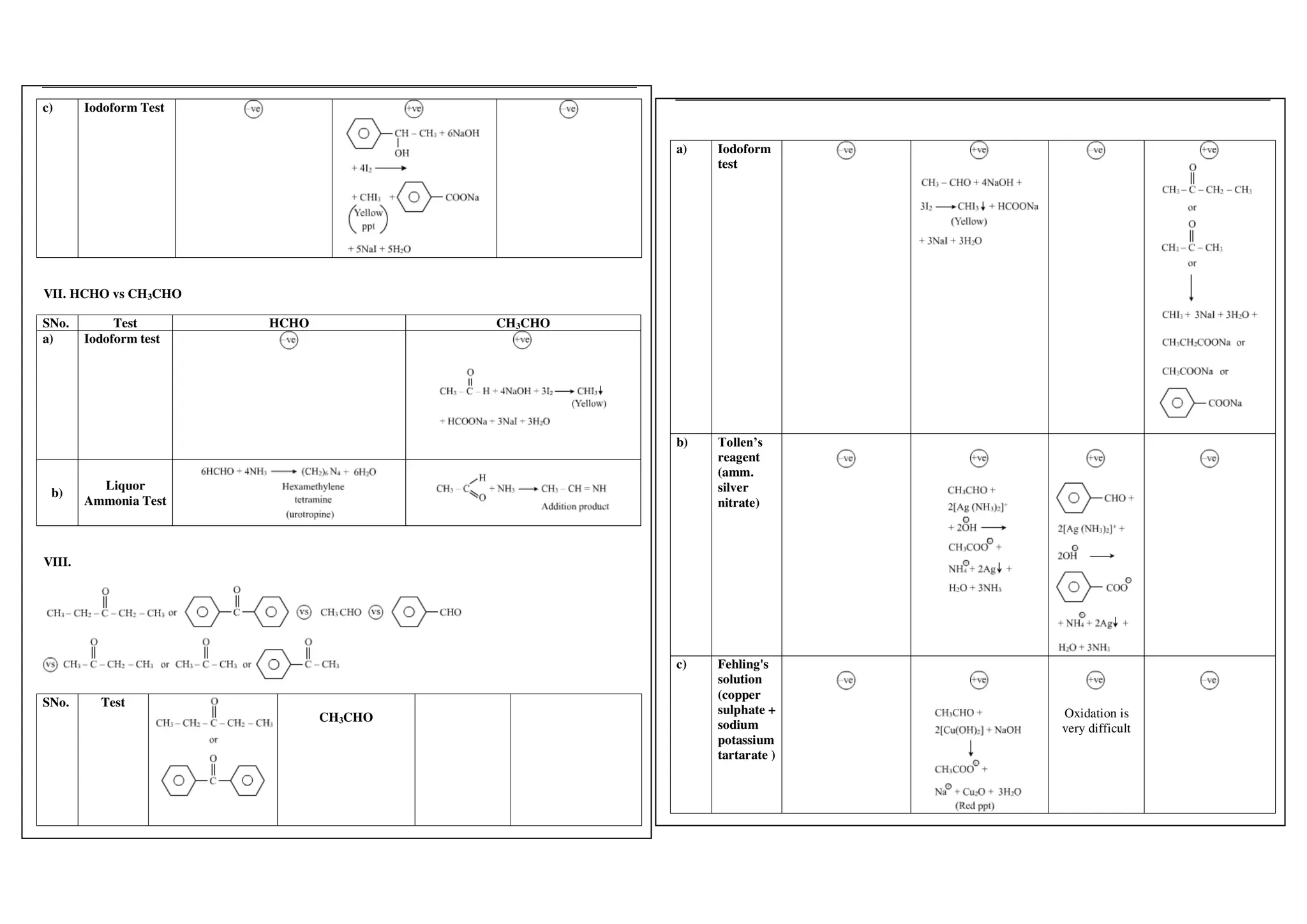
VII. HCHO vs CH3CHO
SNo. Test HCHO CH3CHO
a) Iodoform test
b)
Liquor
Ammonia Test
VIII.
SNo. Test
CH3CHO
a) Iodoform
test
b) Tollen’s
reagent
(amm.
silver
nitrate)
c) Fehling's
solution
(copper
sulphate +
sodium
potassium
tartarate )
Oxidation is
very difficult
IX.
SNo. Test
a) Tollen’s
test
b) Fehling’
s
Solution
test
c) NaHCO
3 test
d) Neutral
FeCl3
test
X.
SNo. Test R – NH2
a) Bromine
water
b) Neutral FeCl3
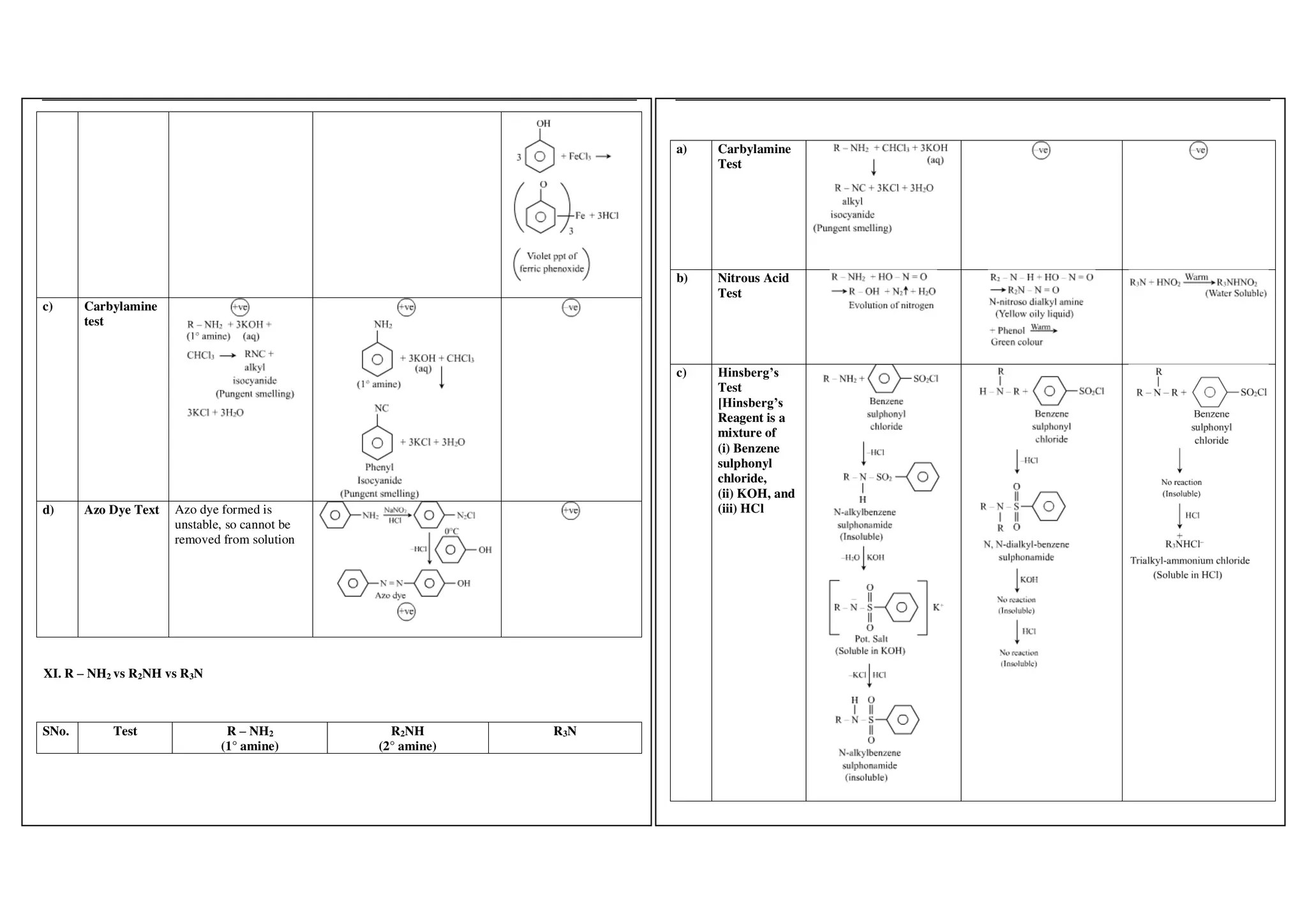
c) Carbylamine
test
d) Azo Dye Text Azo dye formed is
unstable, so cannot be
removed from solution
XI. R – NH2 vs R2NH vs R3N
SNo. Test R – NH2
(1° amine)
R2NH
(2° amine)
R3N
a) Carbylamine
Test
b) Nitrous Acid
Test
c) Hinsberg’s
Test
[Hinsberg’s
Reagent is a
mixture of
(i) Benzene
sulphonyl
chloride,
(ii) KOH, and
(iii) HCl
SNo. Test R – NH2
a) Litmus Test No response to litmus Red litmus changes to Blue
b) Carbylamine test
XIII. RNO2 vs RONO
SNo. Test R – NO2 RONO
a) Reduction
(Sn/HCl)
b) NaOH Form’s soluble sodium salt. Readily hydrolysed to give
corresponding alcohol and sodium
nitrite.
XIV. RCN vs RNC
SNo. Test R – NO2 RONO
a) Solubility in
water
Soluble Insoluble
b) Reduction
followed by
nitrous acid
treatment
c) Hydrolysis
d) Heating No effect Alkyl cyanide is formed

Organic reagents and Reaction charts.pdf

  • 1.
    ORGANIC REAGENTS S.No. ReagentFunction 1 PCl3, PBr3, PI3 Alcohols into Alkyl halides 2 SoCl2, PCl5 Alcohols into Alkyl chlorides & Carboxylic acids into Acid Chlorides 3 HCl/ZnCl2,HBr,HI Alcohols into alkyl halides 4 Cl2/Fe or FeCl3 Cl group substituting on Benzene 5 NaNO2 /HCl 0-50 C Diazotisation 6 CuCl,CuBr,CuCN,KI,H2O, H3PO2 Diazonium Cholride into Chlor Benzene, Bromo Benzene, Benzo nitrile, Iodo Benzene , Phenol,Benzene respectively 7 HBF4 or NaBF4 Diazonium Chloride into Floro Benzene 8 AgF or Hg2F2 or SbF3 or CoF2 Alkyl halides into alkyl florides 9 Na / dry ether Alkyl halides into alkanes 10 NaOH 623/443/368K Chloro benzene to phenol 11 Br2 /FeBr3 Bromination of Benzene 12 Cl2 /FeCl3 Chlorination of Benzene 13 CH3Cl /AlCl3 alkylation of benzene and its derivatives 14 CH-CO-Cl /AlCl3 Acylation on benzene 15 H2SO4 /HNO3 Nitration of benzene 16 (CHCO)2O /AlCl3 O – Acylation of Phenol 17 H2SO4 Sulphonation on Benzene 18 H2O/ H2SO4 alkenes into alcohols Aq KOH Alkyl halide into alcohol 19 BH3 /H2O2 /OH- Alkenes into alcohols (Anti Markownikoff product) 20 NaBH4/ LiAlH4(LAH) Aldehydes, ketones, acids into alcohols, Nito & Cynides , Isocyanides into amines 21 H2/ Ni or H2/Pd reduction of aldehydes, ketones and cynides 22 RMgX/H3O+ Aldehydes, ketones into alcohls 23 O2/H+ Cumene to phenol 24 Na Alcohol or phenol into Sodium alkoxide/Phenoxide 25 (CHCO)2O/ CH-CO-Cl O acylation on phenol or N acylation on Aneline or amine 26 Conc.H2SO4/443K Conversion of primary alcohols into Alkenes 27 Conc.H2SO4/410K Conversion of alcohols into Ethers 28 85% H3PO4 / 440K Secondary alcohol into alkene 29 20% H3PO4/358K Tertiary alcohol into alkene Alcoholic KOH Alkyl halide into alkene ORGANIC REAGENTS 30 CrO3/KMnO4 or K2Cr2O7 in acidic medium oxidation of alcohols into acids 31 Cu /573k dehydrogenation of alcohols gives 10 alcohols into aldehydes and 20 alcohols into ketones & 30 alcohos into alkenes 32 Dil. HNO3 Mono nitration of Phenol 33 Conc.HNO3 tri nitration of phenol 34 Br2 /H2O tri bromination of phenol 35 Br2 /Cs2 mono bromination of phenol 36 NaOH /CO2 Phenol to salicilic acid 37 CHCl3 /NaOH Phenol to salcilaldehyde 38 Zn dust Phenol to Benzene 39 Na2Cr2O7 /H2SO4 or air Phenol to Benzo quinone 40 Zn/Cr2O3 200to 300 atm 573 – 673K CO & H into methanol 41 Invertase Sucrose into Glucose or Fructose 42 Zymase Glucose or Fructose into ethanol 43 HI Ether into alcohol & alkyl halide 44 PCC alcohol to aldehyde 45 Pd /BaSO4,H2 acid chloride into aldehyde 46 SnCl2/HCl/H3O+ Cyanides into aldehydes 47 AlH(i-Bu)2/H2O Cyanides into aldehydes 48 DIBAL-H/H2O Esters into aldehydes 49 CrO2Cl2/H2O Toluene to aldehyde 50 CrO3 /(CH3CO)2O Toluene into Benzaldehyde 51 Cl2/hv Chlorination on alkyl group of Benzene or alkane 52 CO, HCl anhydrous AlCl3 Benzene to Benzaldehyde 53 (CH3)2Cd acid chloride into ketones 54 RMgX/H3O+ Cyanides into ketones 55 HCN Carbonyl compound into cyanohydrin 56 NaHSO3 addition to aldehyde and ketone 57 H2NOH carbonyl compound into oxime 58 H2N-NH2 carbonyl compound into hydrazone 59 H2N-NH-Ph carbonyl compound into Phenyl hydrazone 60 2,4DNP carbonyl compound into 2,4 dinitro phynyl hydrazone 61 H2N-NH-CO-CH3 carbonyl compound into semi carbazide 62 ROH/HCl Aldehydes & ketones into hemiacetal and acetal 63 HO-CH2-CH2-OH/HCl Aldehyde or ketone into ethelene glycol
  • 2.
    ORGANIC REAGENTS ketone 64 Zn-Hg/HClcarbonyl compound into alkane 65 H2N-NH2 /KOH carbonyl compound into alkane 66 KMnO4/OH- / K2Cr2O7 /H2SO4 or HNO3 Ketones into mixture of carboxylic acids on prolonged oxidation 67 (Ag(NH3)2)NO3+NaOH Tollen’ s test 68 Cu(OH)2 Fehiling’ s test 69 NaOH+I2 Iodoform 70 NaOH or Ba(OH)2 aldal condensation 71 Conc KOH or NaOH Cannizaro’ s reaction 72 KMnO4 /KOH Toluene/alkyl Benzene into Benzoic Acid 73 H2O/H+ Cyanides into carboxylic acids, amides into carboxylic acids, esters into carboxylic acis and alcohols, acid chlorides or anhydrides into carboxylic acids 74 NaOH Saponificaiton of ester, acid into salt of acid 75 Na2CO3 or NaHCO3 Carboxylic acid test 76 P4O10 or P2O5 Dehydration of acids into anhydride, amides into nitriles 77 ROH/conc H2SO4 Caroxylic acids into esters 78 PCl3, SoCl2, PCl5 Carboxylic acids into acid chlorides 79 NH3 heating Carboxylic acids into amides 80 NaOH/CaO Decarboxylation (acids into alkanes) 81 LiAlH4 Carboxylic acids into alcohols, amides into amines 82 Cl2 /red.P4 HVZ reaction 83 Sn /HCl or Fe /HCl, H2/Pd Reduction of nitro compounds into amines 84 NH3 Alkyl halides into amines 85 H2/ Ni or H2/Pd LiAlH4 Amides into cyanindes 86 KOH/R-X Phthalamide into amine 87 NaOH /Br2 Hoffman bromamide, amide into amine with one ‘C’less 88 KOH,CHCl3 Amines into Carbyl amines 89 NaNO2/HCl 10 aliphatic amines into alcohols 90 NaNO2/HCl 0 – 50 C Aniline into diazonium chloride 91 C6H5SO2Cl Distinguishing 10 ,20 & 30 amines 92 Br2/H2O Aneline into tri bromo aniline 93 Br2/ CH-CO-Cl /(CHCO)2O Aniline into Bromo Aniline
  • 4.
    I: Conversions relatedto alkyl halides – SCHEME
  • 5.
    II: Conversions relatedto aryl halides – SCHEME SCHEME – III: Conversions related to alcohols
  • 6.
    SCHEME – IV:Conversion related to phenols – I SCHEME – V: Conversion related to phenols – II
  • 7.
    SCHEME – VI:Conversion related to aldehydes SCHEME – VI: Conversion related to carboxylic acids
  • 8.
    SCHEME – VII:Conversion related to alkyl amines SCHEME – VIII: Conversion related to aryl amines ASCENDING SERIES (1) By Wurtz Reaction (2) By Using Cyanide
  • 9.
    (3) By usingGrignard's Reagent (4) By using Sodium Alkylnides This reaction is used for terminal alkynes. (2) Decarboxylation reaction (1) Hoffmann Bromamide reaction DESCENT OF SERIES
  • 10.
    (Hydrolysis) KOH test Aq a) Test SNo. Ethylene Dichloride(Vicinal) vs II. Ethylidene chloride (Geminal) test OH 4 NH b) 3 AgNO Dil a) I – R Br – R Cl – R Test SNo. alkyl or aryl)  R I ( – R vs Br – R vs Cl – I. R Test SNo. . V OH) – CH – 3 CH having (for alcohols Iodoform test b) Na metal test a) 3 CH – O – 3 CH OH – 2 CH – 3 CH Test SNo. (Ether) 3 CH – O – 3 CH vs OH (Alcohol) – 2 CH – 3 IV. CH No reaction test Carbylamine a) OH 3 /CH 4 Cl/CCl 3 CH 3 CHCl Test SNo. OH 3 /CH 4 Cl/CCl 3 CH vs 3 III. CHCl
  • 11.
    a) Lucas Test (Conc. HCl + anhyd ZnCl2 Turbidityappears on heating Turbidity appears within in 5 – 10 min. Turbidity appears spontaneously No appearance of turbidity b) Iodofor m test c) Br2 water test d) Neutral FeCl3 Test e) Litmus Test Turns blue litmus red f) Victor Meyer Test VI. SNo. Test a) Litmus Test Turns blue Litmus to red b) Neutral FeCl3 test
  • 12.
    c) Iodoform Test VII.HCHO vs CH3CHO SNo. Test HCHO CH3CHO a) Iodoform test b) Liquor Ammonia Test VIII. SNo. Test CH3CHO a) Iodoform test b) Tollen’s reagent (amm. silver nitrate) c) Fehling's solution (copper sulphate + sodium potassium tartarate ) Oxidation is very difficult
  • 13.
    IX. SNo. Test a) Tollen’s test b)Fehling’ s Solution test c) NaHCO 3 test d) Neutral FeCl3 test X. SNo. Test R – NH2 a) Bromine water b) Neutral FeCl3
  • 14.
    c) Carbylamine test d) AzoDye Text Azo dye formed is unstable, so cannot be removed from solution XI. R – NH2 vs R2NH vs R3N SNo. Test R – NH2 (1° amine) R2NH (2° amine) R3N a) Carbylamine Test b) Nitrous Acid Test c) Hinsberg’s Test [Hinsberg’s Reagent is a mixture of (i) Benzene sulphonyl chloride, (ii) KOH, and (iii) HCl
  • 15.
    SNo. Test R– NH2 a) Litmus Test No response to litmus Red litmus changes to Blue b) Carbylamine test XIII. RNO2 vs RONO SNo. Test R – NO2 RONO a) Reduction (Sn/HCl) b) NaOH Form’s soluble sodium salt. Readily hydrolysed to give corresponding alcohol and sodium nitrite. XIV. RCN vs RNC SNo. Test R – NO2 RONO a) Solubility in water Soluble Insoluble b) Reduction followed by nitrous acid treatment c) Hydrolysis d) Heating No effect Alkyl cyanide is formed