1
Late Ku. Durga K. Banmeru Science College,
LONAR DIST. BULDANA (Maharashtra), India.
Aldehydes and Ketones”
Mr.Shivshankar Purushottam More
Head Of Department
Department of Chemistry
Late Ku. Durga K. Banmeru Science College, Lonar
B. Sc. IInd year Sem-IIIrd Subject:- Chemistry
Chapter- III
Reactions of Aldehydes and or Ketones
1. Cannizzaro Reaction
Defn- The reaction in which aliphatic or aromatic aldehydes do not
containing -hydrogen, when heated with concentrated alkali, undergo
a disproportion reaction to form sodium salt and alcohol this reaction
is called as Cannizzaro Reaction.
 This reaction given by Italian Chemist Stanisalo Cannizzaro in
1883, hence this reaction is called as Cannizzaro Reaction
 Condition of reaction-
Aldehyde which do not have -hydrogen atom gives this reaction
50% NaOH (alkali) solution is must for this reaction.
2
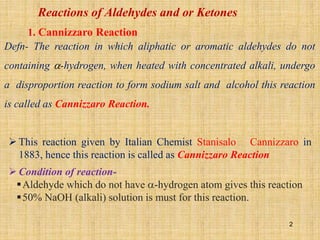
Examples- Formaldehyde and Benzaldehyde which do not have -
hydrogen atom gives this reaction
H C H
O
H C H
O
+
50% NaOH

H C O
O
Na C
H3 OH
+
Formaldehyde
SodiumFormate Methyl Alcohol
1. When formaldehyde heated with 50% NaOH solution, one molecule
is oxidized to sodium formate whereas other molecule is reduced to
methyl alcohol.
2. When bezaldehyde heated with 50% NaOH solution, one molecule
is oxidized to sodium benzoate whereas other molecule is reduced to
benzyl alcohol.
50% NaOH

+
H
O
H
O
O
O
Na
OH
O
+
Benzaldehyde SodiumBonzoate Benzoic acid
3
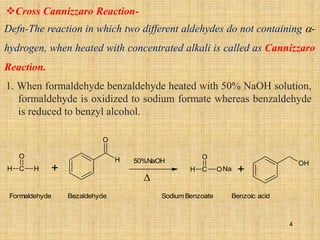
Defn-The reaction in which two different aldehydes do not containing -
hydrogen, when heated with concentrated alkali is called as Cannizzaro
Reaction.
Cross Cannizzaro Reaction-
1. When formaldehyde benzaldehyde heated with 50% NaOH solution,
formaldehyde is oxidized to sodium formate whereas benzaldehyde
is reduced to benzyl alcohol.
H
O
H C H
O
+
50%NaOH

H C O
O
Na +
OH
Formaldehyde Bezaldehyde SodiumBenzoate Benzoic acid
4
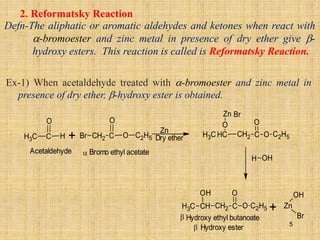
2. Reformatsky Reaction
Defn-The aliphatic or aromatic aldehydes and ketones when react with
-bromoester and zinc metal in presence of dry ether give -
hydroxy esters. This reaction is called is Reformatsky Reaction.
Ex-1) When acetaldehyde treated with -bromoester and zinc metal in
presence of dry ether, -hydroxy ester is obtained.
C
H3 C
O
H + CH2 C
O
O
Br C2H5
Zn
Dry ether C
H C
O
O
O
C2H5
C
H3 CH2
Zn Br
H OH
CH C
O
O
O
C2H5
C
H3 CH2
H
Acetaldehyde  Bromo ethyl acetate
Hydroxy ethyl butanoate
Hydroxy ester


+ Zn
OH
Br
5
+ CH2 C
O
O
Br C2H5
Zn
Dry ether
H OH
Benzaldehyde  Bromo ethyl acetate
Hydroxy phenyl ethyl butanoate
Hydroxy ester)
+ Zn
OH
Br
C
O
H C
H C
O
O
O
C2H5
CH2
Zn Br
C
H C
O
O
O
C2H5
CH2
H
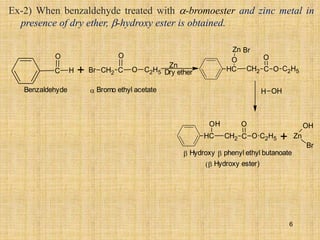
Ex-2) When benzaldehyde treated with -bromoester and zinc metal in
presence of dry ether, -hydroxy ester is obtained.
6
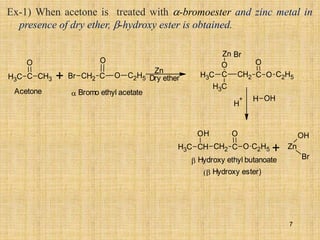
Ex-1) When acetone is treated with -bromoester and zinc metal in
presence of dry ether, -hydroxy ester is obtained.
C
H3 C
O
CH3 + CH2 C
O
O
Br C2H5
Zn
Dry ether C C
O
O
O
C2H5
C
H3 CH2
Zn Br
C
H3
H OH
CH C
O
O
O
C2H5
C
H3 CH2
H
Acetone  Bromo ethyl acetate
Hydroxy ester)
Hydroxy ethyl butanoate
+ Zn
OH
Br
H
+
7
+ CH2 C
O
O
Br C2H5
Zn
Dry ether
H OH
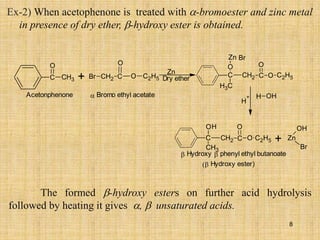
Acetonphenone  Bromo ethyl acetate
Hydroxy phenyl ethyl butanoate
Hydroxy ester)
+ Zn
OH
Br
C
O
CH3
C C
O
O
O
C2H5
CH2
Zn Br
C
H3
C C
O
O
O
C2H5
CH2
H
CH3
H
+
Ex-2) When acetophenone is treated with -bromoester and zinc metal
in presence of dry ether, -hydroxy ester is obtained.
The formed -hydroxy esters on further acid hydrolysis
followed by heating it gives ,  unsaturated acids.
8
3. Perkin Reaction
Defn-The aromatic aldehydes when heated with anhydride of aliphatic
acid (containing at least two -hydrogens) and sodium salt of
same acid (catalyst) to form ,  unsaturated acids. This
reaction is called is Perkin Reaction.
 This reaction is given by Perkin in 1868 and hence this reaction is
called is called as Perkin Reaction.
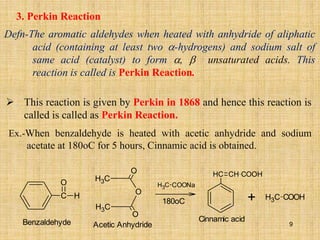
Ex.-When benzaldehyde is heated with acetic anhydride and sodium
acetate at 180oC for 5 hours, Cinnamic acid is obtained.
C
O
H
C
H3
O
C
H3
O
O
C
H3 COONa
180oC
C
H CH COOH
C
H3 COOH
+
Benzaldehyde Acetic Anhydride
Cinnamic acid
9
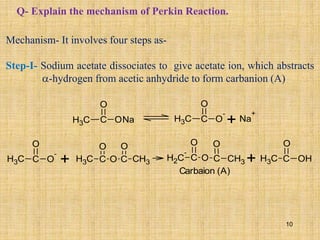
Q- Explain the mechanism of Perkin Reaction.
Mechanism- It involves four steps as-
Step-I- Sodium acetate dissociates to give acetate ion, which abstracts
-hydrogen from acetic anhydride to form carbanion (A)
C
H3 C
O
ONa C
H3 C
O
O
-
+ Na
+
C
H3 C
O
O
-
C
H3 C
O
C
O
CH3
O
+ C
H2
-
C
O
C
O
CH3
O C
H3 C
O
OH
+
Carbaion (A)
10
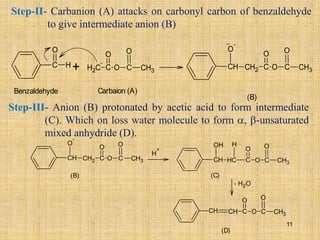
Step-II- Carbanion (A) attacks on carbonyl carbon of benzaldehyde
to give intermediate anion (B)
+
C H
O
C
H2
-
C
O
C
O
CH3
O
Carbaion (A)
CH
O
-
CH2 C
O
C
O
CH3
O
(B)
..
Benzaldehyde
Step-III- Anion (B) protonated by acetic acid to form intermediate
(C). Which on loss water molecule to form , -unsaturated
mixed anhydride (D).
(B)
CH
O
-
CH2 C
O
C
O
CH3
O
H
+
CH
OH
C
H C
O
C
O
CH3
O
H
CH CH C
O
C
O
CH3
O
(D)
- H2O
(C)
11
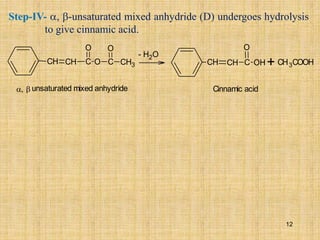
Step-IV- , -unsaturated mixed anhydride (D) undergoes hydrolysis
to give cinnamic acid.
+
 unsaturated mixed anhydride
CH CH C
O
C CH3
O
O
CH CH C
O
OH
- H2O
CH3COOH
Cinnamic acid
12
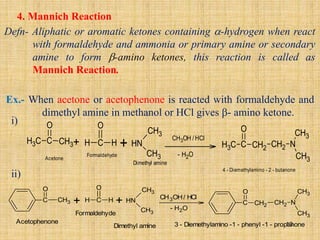
4. Mannich Reaction
Defn- Aliphatic or aromatic ketones containing -hydrogen when react
with formaldehyde and ammonia or primary amine or secondary
amine to form -amino ketones, this reaction is called as
Mannich Reaction.
Ex.- When acetone or acetophenone is reacted with formaldehyde and
dimethyl amine in methanol or HCl gives - amino ketone.
+
Acetophenone
C CH3
O
C
O
H H + N
H
CH3
CH3
CH3OH/ HCl
- H2O
C CH2
O
CH2 N
CH3
CH3
Formaldehyde
Dimethyl amine 3 - Diemethylamino -1 - phenyl -1 - propanone
i)
ii)
+
Acetone
C
H3 C CH3
O
C
O
H H + N
H
CH3
CH3
CH3OH /HCl
- H2O
C
H3 C CH2
O
CH2 N
CH3
CH3
Formaldehyde
Dimethyl amine
4 - Diemethylamino - 2 - butanone
13
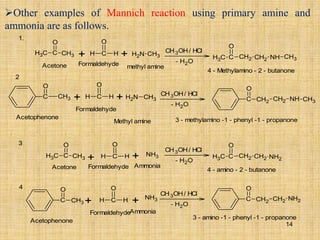
Other examples of Mannich reaction using primary amine and
ammonia are as follows.
+
Acetone
C
H3 C CH3
O
C
O
H H + N
H2 CH3
CH3OH/ HCl
- H2O
C
H3 C CH2
O
CH2 NH CH3
Formaldehyde methyl amine
4 - Methylamino - 2 - butanone
+
Acetophenone
C CH3
O
C
O
H H + N
H2 CH3
CH3OH/ HCl
- H2O
C CH2
O
CH2 NH CH3
Formaldehyde
Methyl amine 3 - methylamino -1 - phenyl -1 - propanone
+
Acetone
C
H3 C CH3
O
C
O
H H +
CH3OH/ HCl
- H2O
C
H3 C CH2
O
CH2 NH2
Formaldehyde Ammonia
4 - amino - 2 - butanone
+
Acetophenone
C CH3
O
C
O
H H +
CH3OH/ HCl
- H2O
C CH2
O
CH2 NH2
FormaldehydeAmmonia
3 - amino -1 - phenyl -1 - propanone
NH3
NH3
1.
2
3
4
14
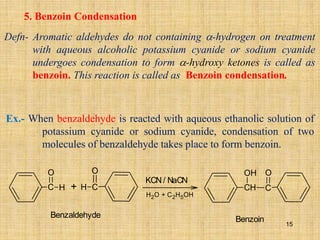
5. Benzoin Condensation
Defn- Aromatic aldehydes do not containing -hydrogen on treatment
with aqueous alcoholic potassium cyanide or sodium cyanide
undergoes condensation to form -hydroxy ketones is called as
benzoin. This reaction is called as Benzoin condensation.
Ex.- When benzaldehyde is reacted with aqueous ethanolic solution of
potassium cyanide or sodium cyanide, condensation of two
molecules of benzaldehyde takes place to form benzoin.
+
C H
O
C
O
H
KCN/ NaCN
H2O + C2H5OH
Benzaldehyde
CH C
OH O
Benzoin
15
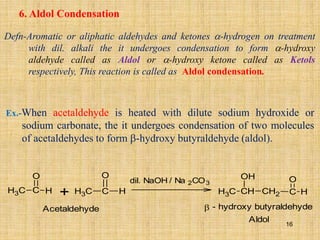
6. Aldol Condensation
Defn-Aromatic or aliphatic aldehydes and ketones -hydrogen on treatment
with dil. alkali the it undergoes condensation to form -hydroxy
aldehyde called as Aldol or -hydroxy ketone called as Ketols
respectively, This reaction is called as Aldol condensation.
Ex.-When acetaldehyde is heated with dilute sodium hydroxide or
sodium carbonate, the it undergoes condensation of two molecules
of acetaldehydes to form -hydroxy butyraldehyde (aldol).
+
C
H3 C H
O
C
O
C
H3 H C
H3 CH CH2
OH
C
O
H
Acetaldehyde  - hydroxy butyraldehyde
dil. NaOH / Na 2CO3
Aldol
16
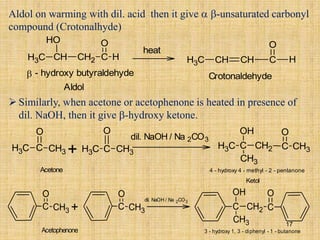
 Similarly, when acetone or acetophenone is heated in presence of
dil. NaOH, then it give -hydroxy ketone.
+
C
H3 C CH3
O
C
O
C
H3 CH3
C
H3 C CH2
OH
C
O
CH3
CH3
Acetone 4 - hydroxy 4 - methyl - 2 - pentanone
dil. NaOH / Na 2CO3
Ketol
+
C CH3
O
C CH2
OH
C
O
CH3
Acetophenone 3 - hydroxy 1, 3 - diphenyl - 1 - butanone
dil. NaOH / Na 2CO3
C CH3
O
Aldol on warming with dil. acid then it give  -unsaturated carbonyl
compound (Crotonalhyde)
C
H3 CH CH2
O
H
C
O
H
 - hydroxy butyraldehyde
Aldol
heat
C
H3 CH CH C
O
H
Crotonaldehyde
17
Reduction of Carbonyl Compounds
1. Clemmensen reduction
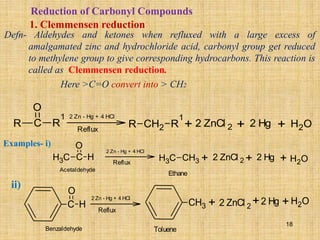
Defn- Aldehydes and ketones when refluxed with a large excess of
amalgamated zinc and hydrochloride acid, carbonyl group get reduced
to methylene group to give corresponding hydrocarbons. This reaction is
called as Clemmensen reduction.
Here >C=O convert into > CH2
R C R
1
O
2 Zn - Hg + 4 HCl
R CH2 R
1
+ 2 ZnCl 2 2 Hg H2O
+ +
Reflux
Examples- i)
ii)
C
H3 C H
O 2 Zn - Hg + 4 HCl
C
H3 CH3 + 2 ZnCl 2 2 Hg H2O
+ +
Reflux
Acetaldehyde
Ethane
C H
O
2 Zn - Hg + 4 HCl
+ 2 ZnCl 2
2 Hg H2O
+ +
Reflux
Benzaldehyde Toluene
CH3
18
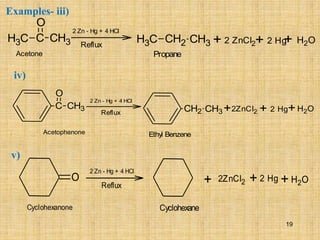
Examples- iii)
C
H3 C CH3
O
2 Zn - Hg + 4 HCl
C
H3 CH2 CH3 + 2 ZnCl2 2 Hg H2O
+ +
Reflux
Acetone Propane
C CH3
O
2 Zn - Hg + 4 HCl
CH2 CH3+2ZnCl2 2 Hg H2O
+ +
Reflux
Acetophenone Ethyl Benzene
iv)
v)
O
2 Zn - Hg + 4 HCl
+ 2ZnCl2 2 Hg H2O
+ +
Reflux
Cyclohexanone Cyclohexane
19
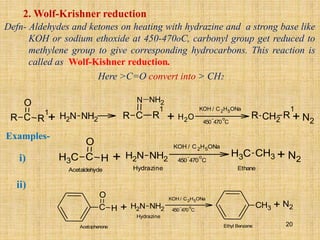
2. Wolf-Krishner reduction
Defn- Aldehydes and ketones on heating with hydrazine and a strong base like
KOH or sodium ethoxide at 450-470oC, carbonyl group get reduced to
methylene group to give corresponding hydrocarbons. This reaction is
called as Wolf-Kishner reduction.
Here >C=O convert into > CH2
R C R
1
O KOH / C2H5ONa
R C R
1
N NH2
+ H2O
+ +
N
H2 NH2 450
-
470
o
C
R CH2
R
1
N2
C
H3 C H
O KOH / C2H5ONa
+ +
N
H2 NH2 450
-
470
o
C
C
H3 CH3 N2
Acetaldehyde Hydrazine Ethane
Examples-
C H
O KOH / C2H5ONa
+ +
N
H2 NH2 450
-
470
o
C
CH3
N2
Acetophenone
Hydrazine
Ethyl Benzene
ii)
i)
20
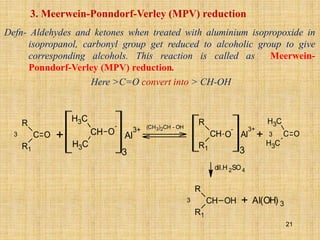
3. Meerwein-Ponndorf-Verley (MPV) reduction
Defn- Aldehydes and ketones when treated with aluminium isopropoxide in
isopropanol, carbonyl group get reduced to alcoholic group to give
corresponding alcohols. This reaction is called as Meerwein-
Ponndorf-Verley (MPV) reduction.
Here >C=O convert into > CH-OH
R
C
R1
O
3 +
C
H3
CH
C
H3
O
-
Al
3+
3
(CH3)2CH - OH
R
CH
R1
O
-
3
Al
3+
C
H3
C
C
H3
O
3
+
dil.H 2SO4
+
R
CH
R1
OH
3 Al(OH) 3
21
Examples-
C
H3 C H
O
[(CH 3)2CHO] 3Al
Acetaldehyde Ethanol
(CH3)2 -CH - OH
C
H3 CH2 OH
C H
O
CH2 OH
[(CH 3)2CHO] 3Al
(CH3)2 -CH - OH
Benzaldehyde Benzyl Alcohol
C
H3
C CH3
O
[(CH 3)2CHO] 3Al
Acetone 2 - Propanol
(CH3)2 -CH - OH
C
H3 CH CH3
O
H
C CH3
O
CH
OH
CH3
[(CH 3)2CHO] 3Al
(CH3)2 -CH - OH
Acetophenone 1 - Phenyl Ethanol
i)
ii)
iii)
iv)
22
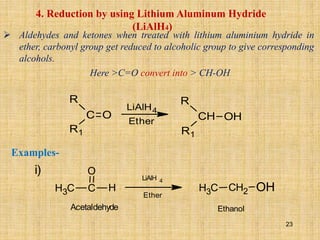
4. Reduction by using Lithium Aluminum Hydride
(LiAlH4)
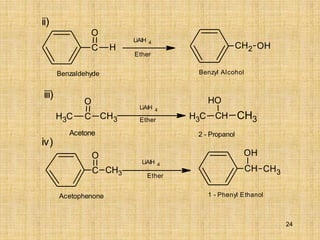
 Aldehydes and ketones when treated with lithium aluminium hydride in
ether, carbonyl group get reduced to alcoholic group to give corresponding
alcohols.
Here >C=O convert into > CH-OH
R
C
R1
O
LiAlH4
Ether
R
CH
R1
OH
C
H3 C H
O
LiAlH 4
Acetaldehyde Ethanol
Ether
C
H3 CH2 OH
i)
Examples-
23
C H
O
CH2 OH
LiAlH 4
Ether
Benzaldehyde Benzyl Alcohol
C
H3 C CH3
O
LiAlH 4
Acetone 2 - Propanol
Ether C
H3 CH CH3
O
H
C CH3
O
CH
OH
CH3
LiAlH 4
Ether
Acetophenone 1 - Phenyl Ethanol
ii)
iii)
iv)
24

Aldehyde & Ketone

  • 1.
    1 Late Ku. DurgaK. Banmeru Science College, LONAR DIST. BULDANA (Maharashtra), India. Aldehydes and Ketones” Mr.Shivshankar Purushottam More Head Of Department Department of Chemistry Late Ku. Durga K. Banmeru Science College, Lonar B. Sc. IInd year Sem-IIIrd Subject:- Chemistry Chapter- III
  • 2.
    Reactions of Aldehydesand or Ketones 1. Cannizzaro Reaction Defn- The reaction in which aliphatic or aromatic aldehydes do not containing -hydrogen, when heated with concentrated alkali, undergo a disproportion reaction to form sodium salt and alcohol this reaction is called as Cannizzaro Reaction.  This reaction given by Italian Chemist Stanisalo Cannizzaro in 1883, hence this reaction is called as Cannizzaro Reaction  Condition of reaction- Aldehyde which do not have -hydrogen atom gives this reaction 50% NaOH (alkali) solution is must for this reaction. 2
  • 3.
    Examples- Formaldehyde andBenzaldehyde which do not have - hydrogen atom gives this reaction H C H O H C H O + 50% NaOH  H C O O Na C H3 OH + Formaldehyde SodiumFormate Methyl Alcohol 1. When formaldehyde heated with 50% NaOH solution, one molecule is oxidized to sodium formate whereas other molecule is reduced to methyl alcohol. 2. When bezaldehyde heated with 50% NaOH solution, one molecule is oxidized to sodium benzoate whereas other molecule is reduced to benzyl alcohol. 50% NaOH  + H O H O O O Na OH O + Benzaldehyde SodiumBonzoate Benzoic acid 3
  • 4.
    Defn-The reaction inwhich two different aldehydes do not containing - hydrogen, when heated with concentrated alkali is called as Cannizzaro Reaction. Cross Cannizzaro Reaction- 1. When formaldehyde benzaldehyde heated with 50% NaOH solution, formaldehyde is oxidized to sodium formate whereas benzaldehyde is reduced to benzyl alcohol. H O H C H O + 50%NaOH  H C O O Na + OH Formaldehyde Bezaldehyde SodiumBenzoate Benzoic acid 4
  • 5.
    2. Reformatsky Reaction Defn-Thealiphatic or aromatic aldehydes and ketones when react with -bromoester and zinc metal in presence of dry ether give - hydroxy esters. This reaction is called is Reformatsky Reaction. Ex-1) When acetaldehyde treated with -bromoester and zinc metal in presence of dry ether, -hydroxy ester is obtained. C H3 C O H + CH2 C O O Br C2H5 Zn Dry ether C H C O O O C2H5 C H3 CH2 Zn Br H OH CH C O O O C2H5 C H3 CH2 H Acetaldehyde  Bromo ethyl acetate Hydroxy ethyl butanoate Hydroxy ester   + Zn OH Br 5
  • 6.
    + CH2 C O O BrC2H5 Zn Dry ether H OH Benzaldehyde  Bromo ethyl acetate Hydroxy phenyl ethyl butanoate Hydroxy ester) + Zn OH Br C O H C H C O O O C2H5 CH2 Zn Br C H C O O O C2H5 CH2 H Ex-2) When benzaldehyde treated with -bromoester and zinc metal in presence of dry ether, -hydroxy ester is obtained. 6
  • 7.
    Ex-1) When acetoneis treated with -bromoester and zinc metal in presence of dry ether, -hydroxy ester is obtained. C H3 C O CH3 + CH2 C O O Br C2H5 Zn Dry ether C C O O O C2H5 C H3 CH2 Zn Br C H3 H OH CH C O O O C2H5 C H3 CH2 H Acetone  Bromo ethyl acetate Hydroxy ester) Hydroxy ethyl butanoate + Zn OH Br H + 7
  • 8.
    + CH2 C O O BrC2H5 Zn Dry ether H OH Acetonphenone  Bromo ethyl acetate Hydroxy phenyl ethyl butanoate Hydroxy ester) + Zn OH Br C O CH3 C C O O O C2H5 CH2 Zn Br C H3 C C O O O C2H5 CH2 H CH3 H + Ex-2) When acetophenone is treated with -bromoester and zinc metal in presence of dry ether, -hydroxy ester is obtained. The formed -hydroxy esters on further acid hydrolysis followed by heating it gives ,  unsaturated acids. 8
  • 9.
    3. Perkin Reaction Defn-Thearomatic aldehydes when heated with anhydride of aliphatic acid (containing at least two -hydrogens) and sodium salt of same acid (catalyst) to form ,  unsaturated acids. This reaction is called is Perkin Reaction.  This reaction is given by Perkin in 1868 and hence this reaction is called is called as Perkin Reaction. Ex.-When benzaldehyde is heated with acetic anhydride and sodium acetate at 180oC for 5 hours, Cinnamic acid is obtained. C O H C H3 O C H3 O O C H3 COONa 180oC C H CH COOH C H3 COOH + Benzaldehyde Acetic Anhydride Cinnamic acid 9
  • 10.
    Q- Explain themechanism of Perkin Reaction. Mechanism- It involves four steps as- Step-I- Sodium acetate dissociates to give acetate ion, which abstracts -hydrogen from acetic anhydride to form carbanion (A) C H3 C O ONa C H3 C O O - + Na + C H3 C O O - C H3 C O C O CH3 O + C H2 - C O C O CH3 O C H3 C O OH + Carbaion (A) 10
  • 11.
    Step-II- Carbanion (A)attacks on carbonyl carbon of benzaldehyde to give intermediate anion (B) + C H O C H2 - C O C O CH3 O Carbaion (A) CH O - CH2 C O C O CH3 O (B) .. Benzaldehyde Step-III- Anion (B) protonated by acetic acid to form intermediate (C). Which on loss water molecule to form , -unsaturated mixed anhydride (D). (B) CH O - CH2 C O C O CH3 O H + CH OH C H C O C O CH3 O H CH CH C O C O CH3 O (D) - H2O (C) 11
  • 12.
    Step-IV- , -unsaturatedmixed anhydride (D) undergoes hydrolysis to give cinnamic acid. +  unsaturated mixed anhydride CH CH C O C CH3 O O CH CH C O OH - H2O CH3COOH Cinnamic acid 12
  • 13.
    4. Mannich Reaction Defn-Aliphatic or aromatic ketones containing -hydrogen when react with formaldehyde and ammonia or primary amine or secondary amine to form -amino ketones, this reaction is called as Mannich Reaction. Ex.- When acetone or acetophenone is reacted with formaldehyde and dimethyl amine in methanol or HCl gives - amino ketone. + Acetophenone C CH3 O C O H H + N H CH3 CH3 CH3OH/ HCl - H2O C CH2 O CH2 N CH3 CH3 Formaldehyde Dimethyl amine 3 - Diemethylamino -1 - phenyl -1 - propanone i) ii) + Acetone C H3 C CH3 O C O H H + N H CH3 CH3 CH3OH /HCl - H2O C H3 C CH2 O CH2 N CH3 CH3 Formaldehyde Dimethyl amine 4 - Diemethylamino - 2 - butanone 13
  • 14.
    Other examples ofMannich reaction using primary amine and ammonia are as follows. + Acetone C H3 C CH3 O C O H H + N H2 CH3 CH3OH/ HCl - H2O C H3 C CH2 O CH2 NH CH3 Formaldehyde methyl amine 4 - Methylamino - 2 - butanone + Acetophenone C CH3 O C O H H + N H2 CH3 CH3OH/ HCl - H2O C CH2 O CH2 NH CH3 Formaldehyde Methyl amine 3 - methylamino -1 - phenyl -1 - propanone + Acetone C H3 C CH3 O C O H H + CH3OH/ HCl - H2O C H3 C CH2 O CH2 NH2 Formaldehyde Ammonia 4 - amino - 2 - butanone + Acetophenone C CH3 O C O H H + CH3OH/ HCl - H2O C CH2 O CH2 NH2 FormaldehydeAmmonia 3 - amino -1 - phenyl -1 - propanone NH3 NH3 1. 2 3 4 14
  • 15.
    5. Benzoin Condensation Defn-Aromatic aldehydes do not containing -hydrogen on treatment with aqueous alcoholic potassium cyanide or sodium cyanide undergoes condensation to form -hydroxy ketones is called as benzoin. This reaction is called as Benzoin condensation. Ex.- When benzaldehyde is reacted with aqueous ethanolic solution of potassium cyanide or sodium cyanide, condensation of two molecules of benzaldehyde takes place to form benzoin. + C H O C O H KCN/ NaCN H2O + C2H5OH Benzaldehyde CH C OH O Benzoin 15
  • 16.
    6. Aldol Condensation Defn-Aromaticor aliphatic aldehydes and ketones -hydrogen on treatment with dil. alkali the it undergoes condensation to form -hydroxy aldehyde called as Aldol or -hydroxy ketone called as Ketols respectively, This reaction is called as Aldol condensation. Ex.-When acetaldehyde is heated with dilute sodium hydroxide or sodium carbonate, the it undergoes condensation of two molecules of acetaldehydes to form -hydroxy butyraldehyde (aldol). + C H3 C H O C O C H3 H C H3 CH CH2 OH C O H Acetaldehyde  - hydroxy butyraldehyde dil. NaOH / Na 2CO3 Aldol 16
  • 17.
     Similarly, whenacetone or acetophenone is heated in presence of dil. NaOH, then it give -hydroxy ketone. + C H3 C CH3 O C O C H3 CH3 C H3 C CH2 OH C O CH3 CH3 Acetone 4 - hydroxy 4 - methyl - 2 - pentanone dil. NaOH / Na 2CO3 Ketol + C CH3 O C CH2 OH C O CH3 Acetophenone 3 - hydroxy 1, 3 - diphenyl - 1 - butanone dil. NaOH / Na 2CO3 C CH3 O Aldol on warming with dil. acid then it give  -unsaturated carbonyl compound (Crotonalhyde) C H3 CH CH2 O H C O H  - hydroxy butyraldehyde Aldol heat C H3 CH CH C O H Crotonaldehyde 17
  • 18.
    Reduction of CarbonylCompounds 1. Clemmensen reduction Defn- Aldehydes and ketones when refluxed with a large excess of amalgamated zinc and hydrochloride acid, carbonyl group get reduced to methylene group to give corresponding hydrocarbons. This reaction is called as Clemmensen reduction. Here >C=O convert into > CH2 R C R 1 O 2 Zn - Hg + 4 HCl R CH2 R 1 + 2 ZnCl 2 2 Hg H2O + + Reflux Examples- i) ii) C H3 C H O 2 Zn - Hg + 4 HCl C H3 CH3 + 2 ZnCl 2 2 Hg H2O + + Reflux Acetaldehyde Ethane C H O 2 Zn - Hg + 4 HCl + 2 ZnCl 2 2 Hg H2O + + Reflux Benzaldehyde Toluene CH3 18
  • 19.
    Examples- iii) C H3 CCH3 O 2 Zn - Hg + 4 HCl C H3 CH2 CH3 + 2 ZnCl2 2 Hg H2O + + Reflux Acetone Propane C CH3 O 2 Zn - Hg + 4 HCl CH2 CH3+2ZnCl2 2 Hg H2O + + Reflux Acetophenone Ethyl Benzene iv) v) O 2 Zn - Hg + 4 HCl + 2ZnCl2 2 Hg H2O + + Reflux Cyclohexanone Cyclohexane 19
  • 20.
    2. Wolf-Krishner reduction Defn-Aldehydes and ketones on heating with hydrazine and a strong base like KOH or sodium ethoxide at 450-470oC, carbonyl group get reduced to methylene group to give corresponding hydrocarbons. This reaction is called as Wolf-Kishner reduction. Here >C=O convert into > CH2 R C R 1 O KOH / C2H5ONa R C R 1 N NH2 + H2O + + N H2 NH2 450 - 470 o C R CH2 R 1 N2 C H3 C H O KOH / C2H5ONa + + N H2 NH2 450 - 470 o C C H3 CH3 N2 Acetaldehyde Hydrazine Ethane Examples- C H O KOH / C2H5ONa + + N H2 NH2 450 - 470 o C CH3 N2 Acetophenone Hydrazine Ethyl Benzene ii) i) 20
  • 21.
    3. Meerwein-Ponndorf-Verley (MPV)reduction Defn- Aldehydes and ketones when treated with aluminium isopropoxide in isopropanol, carbonyl group get reduced to alcoholic group to give corresponding alcohols. This reaction is called as Meerwein- Ponndorf-Verley (MPV) reduction. Here >C=O convert into > CH-OH R C R1 O 3 + C H3 CH C H3 O - Al 3+ 3 (CH3)2CH - OH R CH R1 O - 3 Al 3+ C H3 C C H3 O 3 + dil.H 2SO4 + R CH R1 OH 3 Al(OH) 3 21
  • 22.
    Examples- C H3 C H O [(CH3)2CHO] 3Al Acetaldehyde Ethanol (CH3)2 -CH - OH C H3 CH2 OH C H O CH2 OH [(CH 3)2CHO] 3Al (CH3)2 -CH - OH Benzaldehyde Benzyl Alcohol C H3 C CH3 O [(CH 3)2CHO] 3Al Acetone 2 - Propanol (CH3)2 -CH - OH C H3 CH CH3 O H C CH3 O CH OH CH3 [(CH 3)2CHO] 3Al (CH3)2 -CH - OH Acetophenone 1 - Phenyl Ethanol i) ii) iii) iv) 22
  • 23.
    4. Reduction byusing Lithium Aluminum Hydride (LiAlH4)  Aldehydes and ketones when treated with lithium aluminium hydride in ether, carbonyl group get reduced to alcoholic group to give corresponding alcohols. Here >C=O convert into > CH-OH R C R1 O LiAlH4 Ether R CH R1 OH C H3 C H O LiAlH 4 Acetaldehyde Ethanol Ether C H3 CH2 OH i) Examples- 23
  • 24.
    C H O CH2 OH LiAlH4 Ether Benzaldehyde Benzyl Alcohol C H3 C CH3 O LiAlH 4 Acetone 2 - Propanol Ether C H3 CH CH3 O H C CH3 O CH OH CH3 LiAlH 4 Ether Acetophenone 1 - Phenyl Ethanol ii) iii) iv) 24