Organic Mental Disorders Delirium Dementia  Organic Amnestic Syndrome Other Organic Mental Disorders
Organic – due to  Primary Brain Pathology Secondary Brain Dysfunction to Systemic Disease Organicity /  High index of suspicion for an organic problem :  1.  First Episode  2 . Sudden Onset  3 . Older Age at onset  4 . Hx of Drug/Alcohol abuse  5.  Concurrent medical/neurological problem  6.  Neurological signs: Seizures, LOC, Head injury, sensory motor deficit.  7.  Presence of Confusion/Disorientation  8.  Presence of visual and non auditory (olfactory, gustatory, tactile) hallucinations
 
A. DELIRIUM Commonest organic mental disorder Definition : Acute organic brain syndrome characterized by  clouding of consciousness  and  disorientation  develops over a brief period and  remits  immediately once offending cause is removed. Epidemiology : - 5 to 15% of medical & surgical px; - High in post op patients; - 40-50% recovering from hip surgery; - Highest rate in post cardiotomy patients; - 30% in ICU
Clinical Features Acute Clouding of conciousness Disorientation (mostly time, severe cases place and person) Short attention span/distractibility Perceptual Distortion Disturbance in sleep wake cycle DECREASE AWARENESS TO SURROUNDING DECREASE ABILITY TO RESPOND TO ENVIRONMENTAL STIMULI ILLUSIONS HALLUCINATIONS Mostly Visual INSOMNIA DAY TIME SLEEPINESS
Sun Drowning – sx in evening New Memory Impairement  Relatively intact remote memory Speech  Mood – Fear anger rage Delusions – Fleeting and fragmentary Neuro: Tremors, Dysphasia, Urinary incontinence IMPAIRED IMMEDIATE RECALL IMPAIRED RECENT MEMORY SLURRING of SPEECH INCOHERANCE
Mini MENTAL STATE EXAM for  COGNITIVE IMPAIREMENT Orientation (10), Registration (8), Language (8), Recall (3), Construction (1) < 25/30 = probable impairement < 20/30 = definitive impairement
Predisposing Factors Old age Preexisting brain damage/dementia Past hx of delirium Alcohol drug dependence Chronic Medical illness Surgical procedures Rx with psychotropic drugs Hx of Head Injury
Differential Diagnosis Dementia Mania Schizophrenia Depression
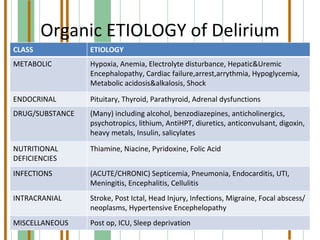
Organic ETIOLOGY of Delirium CLASS ETIOLOGY METABOLIC Hypoxia, Anemia, Electrolyte disturbance, Hepatic&Uremic Encephalopathy, Cardiac failure,arrest,arrythmia, Hypoglycemia, Metabolic acidosis&alkalosis, Shock ENDOCRINAL Pituitary, Thyroid, Parathyroid, Adrenal dysfunctions DRUG/SUBSTANCE (Many) including alcohol, benzodiazepines, anticholinergics, psychotropics, lithium, AntiHPT, diuretics, anticonvulsant, digoxin, heavy metals, Insulin, salicylates NUTRITIONAL DEFICIENCIES Thiamine, Niacine, Pyridoxine, Folic Acid INFECTIONS (ACUTE/CHRONIC) Septicemia, Pneumonia, Endocarditis, UTI, Meningitis, Encephalitis, Cellulitis INTRACRANIAL Stroke, Post Ictal, Head Injury, Infections, Migraine, Focal abscess/neoplasms, Hypertensive Encephelopathy MISCELLANEOUS Post op, ICU, Sleep deprivation
Management of Delirium If cause not known – Do a  battery of investigations  : FBC, Urinalysis, Blood glucose, BUSE, Liver and renal function test, arterial p02, Pco2, Thyroid function, B12, Folate levels, CXR, ECG, CSF, Drug screen, VDRL, HIV, EEG, CT MRI Correct underlying cause  – ex 50mg of 50% IV dextrose for HYPOGLYCEMIA 02 for HYPOXIA IV fluids for electrolyte imbalance
Drugs  given if patient is agitated (most are): Small dose  BENZODIAZEPINES  (Lorazepam, Diazepam) ANTIPSYCHOTIC  (Haloperidol) MAINTAIN WITH ORAL HALOPERIDOL, LORAZEPAM TILL RECOVERY IN 1 WEEK REVIEW DOSE, TAPER AND STOP
DELIRIUM VS DEMENTIA
B. DEMENTIA
Definition :  Chronic  Mental Disorder characterized by  impairement of intellectual functions ,  Impairement of memory  and  deterioration of personality  with the course being progressive, stationary or reversible
CLINICAL FEATURES Duration: 6 months Impaired Intellectual functions Impairement of memory (initially mild, remote memory in later stage) Deterioration of personality with lack of personal care No conscious impairment Orientation-usually normal but falls later
Aphasia – Difficulty in naming an object Hallucinations and Delusions Additional:- - Emotional lability: Marked variable emotional expression - Catastrophic rxn: When asked to do something beyond her intellectual capibility, she goes into a rage
DIFFERENTIAL DIAGNOSIS Normal Aging (usually not sufficient to intefere with social or occupational function) Delirium Depression Factitious disorder – pseudodementia –  complains about impairement, emphasize disability, communicates distress, Don’t know answers (unlike dementia makes mistakes), confabulation rare Schizophrenia
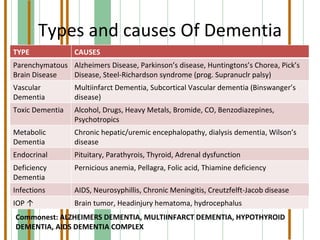
Types and causes Of Dementia Commonest: ALZHEIMERS DEMENTIA, MULTIINFARCT DEMENTIA, HYPOTHYROID DEMENTIA, AIDS DEMENTIA COMPLEX TYPE CAUSES Parenchymatous Brain Disease Alzheimers Disease, Parkinson’s disease, Huntingtons’s Chorea, Pick’s Disease, Steel-Richardson syndrome (prog. Supranuclr palsy) Vascular Dementia Multiinfarct Dementia, Subcortical Vascular dementia (Binswanger’s disease) Toxic Dementia Alcohol, Drugs, Heavy Metals, Bromide, CO, Benzodiazepines, Psychotropics Metabolic Dementia Chronic hepatic/uremic encephalopathy, dialysis dementia, Wilson’s disease Endocrinal Pituitary, Parathyrois, Thyroid, Adrenal dysfunction Deficiency Dementia Pernicious anemia, Pellagra, Folic acid, Thiamine deficiency Infections AIDS, Neurosyphillis, Chronic Meningitis, Creutzfelft-Jacob disease  IOP ↑ Brain tumor, Headinjury hematoma, hydrocephalus
ALZHEIMER’S DEMENTIA Women, Genetic ↓  neurotransmitter AcetylCholine due to degeneration of cholinergic nuclei in basal forebrain Drugs :  Rivastigmine (1.5-6mg/day), Galantamine (4-12mg BID) -> ↑Ach by slowing its degredation Memantine (5-20mg/day) -> N, Methyl D Aspartate (NMDA) antagonist Vitamin E
MULTI INFARCT DEMENTIA Multiple cerebral infarcts causing dementia due to underlying CVS problem Abrupt onset, Acute exacerbations, Step wise clinical deterioration, Fluctuating course Focal Neurological signs Investigations: EEG (focal area of slowing) CT brain (multiple infarct area) Treatment: Underlying (eg HPT) TIA HPT CVS DISEASE PREVIOUS STROKE
AIDS DEMENTIA COMPLEX 50-70% patient of AIDS Triad of cognigtive, behavioral, motoric deficits, -> subcortical dementia Virus cross BBB -> Cognitive impairement Ix ELISA, Western Blot CT may show cortical atrophy
MANAGEMENT OF DEMENTIA Basic investigations Treat underlying cause – mentioned Symptomatic management of anxiety, depression, Psychotic symptoms Education – Family, Financial, Support groups Institutionalize in later stage
C. ORGANIC AMNESTIC SYNDROME Characterized by Memory impairment (anterograde, retrograde amnesia) No impairment in immediate retention and recall, attention, consciousness, global intellect  Caused by Thiamine deficiency in alcohol dependence as part of Wernicke Korsakoff Syndrome Rx: High dose Thiamine
D. Other Organic Mental Disorders Organic Hallucinosis Organic Catatonic Disorder Organic Delusional (Schizo like) disorder Organic Mood (Affective) disorder Organic Anxiety disorder Organic Personality Disorder
THANK U “ I have recently been told that I am one of the millions of Americans who will be afflicted with Alzheimer's Disease... At the moment I feel just fine. I intend to live the remainder of the years God gives me on this earth doing the things I have always done... I now begin the journey that will lead me into the sunset of my life. I know that for America there will always be a bright dawn ahead. Thank you, my friends. May God always bless you” President Ronald Reagen  ( 1911 –2004)

Organic Mental Disorders

  • 1.
    Organic Mental DisordersDelirium Dementia Organic Amnestic Syndrome Other Organic Mental Disorders
  • 2.
    Organic – dueto Primary Brain Pathology Secondary Brain Dysfunction to Systemic Disease Organicity / High index of suspicion for an organic problem : 1. First Episode 2 . Sudden Onset 3 . Older Age at onset 4 . Hx of Drug/Alcohol abuse 5. Concurrent medical/neurological problem 6. Neurological signs: Seizures, LOC, Head injury, sensory motor deficit. 7. Presence of Confusion/Disorientation 8. Presence of visual and non auditory (olfactory, gustatory, tactile) hallucinations
  • 3.
  • 4.
    A. DELIRIUM Commonestorganic mental disorder Definition : Acute organic brain syndrome characterized by clouding of consciousness and disorientation develops over a brief period and remits immediately once offending cause is removed. Epidemiology : - 5 to 15% of medical & surgical px; - High in post op patients; - 40-50% recovering from hip surgery; - Highest rate in post cardiotomy patients; - 30% in ICU
  • 5.
    Clinical Features AcuteClouding of conciousness Disorientation (mostly time, severe cases place and person) Short attention span/distractibility Perceptual Distortion Disturbance in sleep wake cycle DECREASE AWARENESS TO SURROUNDING DECREASE ABILITY TO RESPOND TO ENVIRONMENTAL STIMULI ILLUSIONS HALLUCINATIONS Mostly Visual INSOMNIA DAY TIME SLEEPINESS
  • 6.
    Sun Drowning –sx in evening New Memory Impairement Relatively intact remote memory Speech Mood – Fear anger rage Delusions – Fleeting and fragmentary Neuro: Tremors, Dysphasia, Urinary incontinence IMPAIRED IMMEDIATE RECALL IMPAIRED RECENT MEMORY SLURRING of SPEECH INCOHERANCE
  • 7.
    Mini MENTAL STATEEXAM for COGNITIVE IMPAIREMENT Orientation (10), Registration (8), Language (8), Recall (3), Construction (1) < 25/30 = probable impairement < 20/30 = definitive impairement
  • 8.
    Predisposing Factors Oldage Preexisting brain damage/dementia Past hx of delirium Alcohol drug dependence Chronic Medical illness Surgical procedures Rx with psychotropic drugs Hx of Head Injury
  • 9.
    Differential Diagnosis DementiaMania Schizophrenia Depression
  • 10.
    Organic ETIOLOGY ofDelirium CLASS ETIOLOGY METABOLIC Hypoxia, Anemia, Electrolyte disturbance, Hepatic&Uremic Encephalopathy, Cardiac failure,arrest,arrythmia, Hypoglycemia, Metabolic acidosis&alkalosis, Shock ENDOCRINAL Pituitary, Thyroid, Parathyroid, Adrenal dysfunctions DRUG/SUBSTANCE (Many) including alcohol, benzodiazepines, anticholinergics, psychotropics, lithium, AntiHPT, diuretics, anticonvulsant, digoxin, heavy metals, Insulin, salicylates NUTRITIONAL DEFICIENCIES Thiamine, Niacine, Pyridoxine, Folic Acid INFECTIONS (ACUTE/CHRONIC) Septicemia, Pneumonia, Endocarditis, UTI, Meningitis, Encephalitis, Cellulitis INTRACRANIAL Stroke, Post Ictal, Head Injury, Infections, Migraine, Focal abscess/neoplasms, Hypertensive Encephelopathy MISCELLANEOUS Post op, ICU, Sleep deprivation
  • 11.
    Management of DeliriumIf cause not known – Do a battery of investigations : FBC, Urinalysis, Blood glucose, BUSE, Liver and renal function test, arterial p02, Pco2, Thyroid function, B12, Folate levels, CXR, ECG, CSF, Drug screen, VDRL, HIV, EEG, CT MRI Correct underlying cause – ex 50mg of 50% IV dextrose for HYPOGLYCEMIA 02 for HYPOXIA IV fluids for electrolyte imbalance
  • 12.
    Drugs givenif patient is agitated (most are): Small dose BENZODIAZEPINES (Lorazepam, Diazepam) ANTIPSYCHOTIC (Haloperidol) MAINTAIN WITH ORAL HALOPERIDOL, LORAZEPAM TILL RECOVERY IN 1 WEEK REVIEW DOSE, TAPER AND STOP
  • 13.
  • 14.
  • 15.
    Definition : Chronic Mental Disorder characterized by impairement of intellectual functions , Impairement of memory and deterioration of personality with the course being progressive, stationary or reversible
  • 16.
    CLINICAL FEATURES Duration:6 months Impaired Intellectual functions Impairement of memory (initially mild, remote memory in later stage) Deterioration of personality with lack of personal care No conscious impairment Orientation-usually normal but falls later
  • 17.
    Aphasia – Difficultyin naming an object Hallucinations and Delusions Additional:- - Emotional lability: Marked variable emotional expression - Catastrophic rxn: When asked to do something beyond her intellectual capibility, she goes into a rage
  • 18.
    DIFFERENTIAL DIAGNOSIS NormalAging (usually not sufficient to intefere with social or occupational function) Delirium Depression Factitious disorder – pseudodementia – complains about impairement, emphasize disability, communicates distress, Don’t know answers (unlike dementia makes mistakes), confabulation rare Schizophrenia
  • 19.
    Types and causesOf Dementia Commonest: ALZHEIMERS DEMENTIA, MULTIINFARCT DEMENTIA, HYPOTHYROID DEMENTIA, AIDS DEMENTIA COMPLEX TYPE CAUSES Parenchymatous Brain Disease Alzheimers Disease, Parkinson’s disease, Huntingtons’s Chorea, Pick’s Disease, Steel-Richardson syndrome (prog. Supranuclr palsy) Vascular Dementia Multiinfarct Dementia, Subcortical Vascular dementia (Binswanger’s disease) Toxic Dementia Alcohol, Drugs, Heavy Metals, Bromide, CO, Benzodiazepines, Psychotropics Metabolic Dementia Chronic hepatic/uremic encephalopathy, dialysis dementia, Wilson’s disease Endocrinal Pituitary, Parathyrois, Thyroid, Adrenal dysfunction Deficiency Dementia Pernicious anemia, Pellagra, Folic acid, Thiamine deficiency Infections AIDS, Neurosyphillis, Chronic Meningitis, Creutzfelft-Jacob disease IOP ↑ Brain tumor, Headinjury hematoma, hydrocephalus
  • 20.
    ALZHEIMER’S DEMENTIA Women,Genetic ↓ neurotransmitter AcetylCholine due to degeneration of cholinergic nuclei in basal forebrain Drugs : Rivastigmine (1.5-6mg/day), Galantamine (4-12mg BID) -> ↑Ach by slowing its degredation Memantine (5-20mg/day) -> N, Methyl D Aspartate (NMDA) antagonist Vitamin E
  • 21.
    MULTI INFARCT DEMENTIAMultiple cerebral infarcts causing dementia due to underlying CVS problem Abrupt onset, Acute exacerbations, Step wise clinical deterioration, Fluctuating course Focal Neurological signs Investigations: EEG (focal area of slowing) CT brain (multiple infarct area) Treatment: Underlying (eg HPT) TIA HPT CVS DISEASE PREVIOUS STROKE
  • 22.
    AIDS DEMENTIA COMPLEX50-70% patient of AIDS Triad of cognigtive, behavioral, motoric deficits, -> subcortical dementia Virus cross BBB -> Cognitive impairement Ix ELISA, Western Blot CT may show cortical atrophy
  • 23.
    MANAGEMENT OF DEMENTIABasic investigations Treat underlying cause – mentioned Symptomatic management of anxiety, depression, Psychotic symptoms Education – Family, Financial, Support groups Institutionalize in later stage
  • 24.
    C. ORGANIC AMNESTICSYNDROME Characterized by Memory impairment (anterograde, retrograde amnesia) No impairment in immediate retention and recall, attention, consciousness, global intellect Caused by Thiamine deficiency in alcohol dependence as part of Wernicke Korsakoff Syndrome Rx: High dose Thiamine
  • 25.
    D. Other OrganicMental Disorders Organic Hallucinosis Organic Catatonic Disorder Organic Delusional (Schizo like) disorder Organic Mood (Affective) disorder Organic Anxiety disorder Organic Personality Disorder
  • 26.
    THANK U “I have recently been told that I am one of the millions of Americans who will be afflicted with Alzheimer's Disease... At the moment I feel just fine. I intend to live the remainder of the years God gives me on this earth doing the things I have always done... I now begin the journey that will lead me into the sunset of my life. I know that for America there will always be a bright dawn ahead. Thank you, my friends. May God always bless you” President Ronald Reagen ( 1911 –2004)

Editor's Notes

  • #7 Fleeting: fast, fragmentary: small
  • #19 Factitious disorders are conditions in which a person acts as if he or she has an illness by deliberately producing, feigning, or exaggerating symptoms. Confabulation - a plausible but imagined memory that fills in gaps in what is remembered