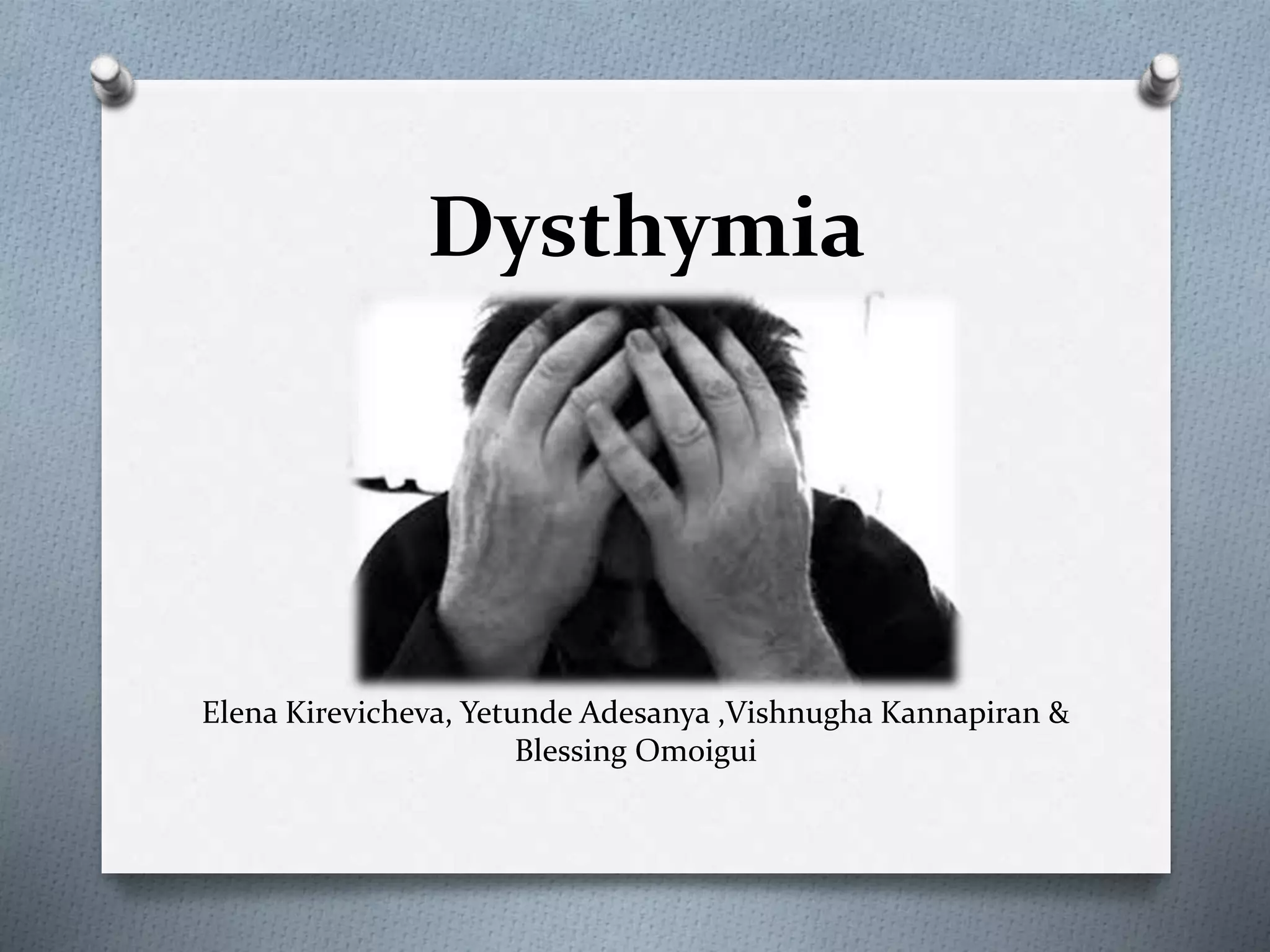
Dysthymia
Elena Kirevicheva, Yetunde Adesanya ,Vishnugha Kannapiran &
Blessing Omoigui
Definition & symptoms
 Dysthymia or dysthymic disorder is a mild form of depression
that lasts for two years and over for adults.
 The condition may last for one year for children and
teenagers.
 Due to its mildness, it is hard to establish when dysthymia
starts and when it fully ends in the individual’s body.
 Some of the common symptoms of dysthymia includes low or
high appetite, fatigue and low energy as well as insomnia.
This complication also creates a feeling of negativity and low
esteem.
 These signs maybe vary with individual; thus, maybe hard to
establish when the complication develops in the individual.
Statistics
 According to Baldwin & Thomas (1995) an estimated 3 to 6
percent of the total US population directly suffer from dysthymia.
 Further, an estimated 30 percent of the Americans receiving
outpatient mental care in the US is also suffering from dysthymia.
 A significant percentage of this population is unaware of the
condition; thus, has never sought medical and psychological
attention
 This complication also occurs together with other forms of
ailments such as anxiety and addiction.
Demographics
 According to Niculescu & Akiskal (2001),
Dysthymia is more prevalent to the African
Americans compared to the Caucasian and Hispanic
Americans in the US.
 Women are at a higher risk of this ailment
compared to men.
Causes for Dysthymia
People develop dysthymia due to Environmental factor,
biological factors and psychological factors
 Environmental factor, such as Families with poor coping
abilities, low levels of communication within the family, and
inconsistent emotional response.
 Biological factors include sleep abnormalities, certain
neurotransmitter (e.g. serotonin) and regulate mood.
 Psychological factor includes stress in childhood and
adulthood, examples are isolation, and lack of support
Psychological perspectives
This disorder can be classified as Psychoanalytic theory,
Behavioural theory as well as cognitive behavioural.
Psychodynamic theory: stressful events in the childhood,
repressed thoughts in the unconscious, conflict between id and
super ego.
Behavioral theory:
 Genetic theory
Cognitive theory: wrong beliefs, irrational perception of self and
the world.
All those factors can trigger the development of the disorder
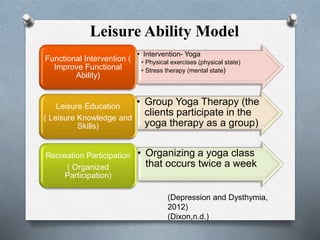
• Intervention- Yoga
• Physical exercises (physical state)
• Stress therapy (mental state)
Functional Intervention (
Improve Functional
Ability)
• Group Yoga Therapy (the
clients participate in the
yoga therapy as a group)
Leisure Education
( Leisure Knowledge and
Skills)
• Organizing a yoga class
that occurs twice a week
Recreation Participation
( Organized
Participation)
Leisure Ability Model
(Depression and Dysthymia,
2012)
(Dixon,n.d.)
Yoga Therapy
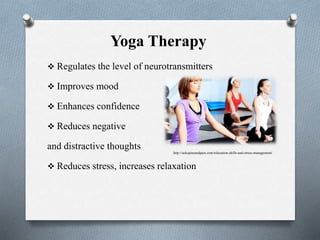
 Regulates the level of neurotransmitters
 Improves mood
 Enhances confidence
 Reduces negative
and distractive thoughts
 Reduces stress, increases relaxation
http://aokspineandpain.com/relaxation-skills-and-stress-management/
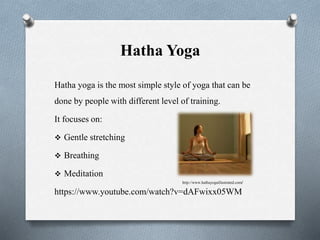
Hatha Yoga
Hatha yoga is the most simple style of yoga that can be
done by people with different level of training.
It focuses on:
 Gentle stretching
 Breathing
 Meditation
https://www.youtube.com/watch?v=dAFwixx05WM
http://www.hathayogaillustrated.com/
References
Baldwin, S. and Thomas, S. (1995). "Dysthymia: Options in Pharmacotherapy". Practical Therapeutics 4 (6):
422 to 430
Niculescu, A. and Akiskal, H. (2001). "Proposed Endophenotypes of Dysthymia: Evolutionary, Clinical, and
Pharmacogenomics Considerations". Molecular Psychiatry 6 (4): 363–366
Harvard Mental Health Letter. (2005). Dysthymia. Retrieved March 3, 2015 from
http://www.minddisorders.com/Del-Fi/Dysthymic-disorder.html
Dixon, C. (n.d.). Leisure Education. Retrieved March 16, 2015, from
http://www.recreationtherapy.com/tx/txleised.htm
Depression and Dysthymia. (2012, January 1). Retrieved March 16, 2015, from
http://cbtclinic.ca/treatment/depression-and-dysthymia/
Rogers, S.E., Windle, M.L., and Spadling, L.S., (2014) Pediatric Dysthymic Disorders. Retrieved March 16
2015 from http://emedicine.medscape.com/article/913941-overview#aw2aab6b2b2
Krans, B. (2013). Healthline. Retrieved March 16 2015 from
http://www.healthline.com/health/depression/yoga-therapy#1
Pizer, A. (2014). AboutHealth. Retrieved March 16 2015 from
http://yoga.about.com/od/typesofyoga/a/hatha.htm

DYSTHYMIA PRESENTATION - MAR 17

  • 1.
    Dysthymia Elena Kirevicheva, YetundeAdesanya ,Vishnugha Kannapiran & Blessing Omoigui
  • 2.
    Definition & symptoms Dysthymia or dysthymic disorder is a mild form of depression that lasts for two years and over for adults.  The condition may last for one year for children and teenagers.  Due to its mildness, it is hard to establish when dysthymia starts and when it fully ends in the individual’s body.  Some of the common symptoms of dysthymia includes low or high appetite, fatigue and low energy as well as insomnia. This complication also creates a feeling of negativity and low esteem.  These signs maybe vary with individual; thus, maybe hard to establish when the complication develops in the individual.
  • 3.
    Statistics  According toBaldwin & Thomas (1995) an estimated 3 to 6 percent of the total US population directly suffer from dysthymia.  Further, an estimated 30 percent of the Americans receiving outpatient mental care in the US is also suffering from dysthymia.  A significant percentage of this population is unaware of the condition; thus, has never sought medical and psychological attention  This complication also occurs together with other forms of ailments such as anxiety and addiction.
  • 4.
    Demographics  According toNiculescu & Akiskal (2001), Dysthymia is more prevalent to the African Americans compared to the Caucasian and Hispanic Americans in the US.  Women are at a higher risk of this ailment compared to men.
  • 5.
    Causes for Dysthymia Peopledevelop dysthymia due to Environmental factor, biological factors and psychological factors  Environmental factor, such as Families with poor coping abilities, low levels of communication within the family, and inconsistent emotional response.  Biological factors include sleep abnormalities, certain neurotransmitter (e.g. serotonin) and regulate mood.  Psychological factor includes stress in childhood and adulthood, examples are isolation, and lack of support
  • 6.
    Psychological perspectives This disordercan be classified as Psychoanalytic theory, Behavioural theory as well as cognitive behavioural. Psychodynamic theory: stressful events in the childhood, repressed thoughts in the unconscious, conflict between id and super ego. Behavioral theory:  Genetic theory Cognitive theory: wrong beliefs, irrational perception of self and the world. All those factors can trigger the development of the disorder
  • 7.
    • Intervention- Yoga •Physical exercises (physical state) • Stress therapy (mental state) Functional Intervention ( Improve Functional Ability) • Group Yoga Therapy (the clients participate in the yoga therapy as a group) Leisure Education ( Leisure Knowledge and Skills) • Organizing a yoga class that occurs twice a week Recreation Participation ( Organized Participation) Leisure Ability Model (Depression and Dysthymia, 2012) (Dixon,n.d.)
  • 8.
    Yoga Therapy  Regulatesthe level of neurotransmitters  Improves mood  Enhances confidence  Reduces negative and distractive thoughts  Reduces stress, increases relaxation http://aokspineandpain.com/relaxation-skills-and-stress-management/
  • 9.
    Hatha Yoga Hatha yogais the most simple style of yoga that can be done by people with different level of training. It focuses on:  Gentle stretching  Breathing  Meditation https://www.youtube.com/watch?v=dAFwixx05WM http://www.hathayogaillustrated.com/
  • 10.
    References Baldwin, S. andThomas, S. (1995). "Dysthymia: Options in Pharmacotherapy". Practical Therapeutics 4 (6): 422 to 430 Niculescu, A. and Akiskal, H. (2001). "Proposed Endophenotypes of Dysthymia: Evolutionary, Clinical, and Pharmacogenomics Considerations". Molecular Psychiatry 6 (4): 363–366 Harvard Mental Health Letter. (2005). Dysthymia. Retrieved March 3, 2015 from http://www.minddisorders.com/Del-Fi/Dysthymic-disorder.html Dixon, C. (n.d.). Leisure Education. Retrieved March 16, 2015, from http://www.recreationtherapy.com/tx/txleised.htm Depression and Dysthymia. (2012, January 1). Retrieved March 16, 2015, from http://cbtclinic.ca/treatment/depression-and-dysthymia/ Rogers, S.E., Windle, M.L., and Spadling, L.S., (2014) Pediatric Dysthymic Disorders. Retrieved March 16 2015 from http://emedicine.medscape.com/article/913941-overview#aw2aab6b2b2 Krans, B. (2013). Healthline. Retrieved March 16 2015 from http://www.healthline.com/health/depression/yoga-therapy#1 Pizer, A. (2014). AboutHealth. Retrieved March 16 2015 from http://yoga.about.com/od/typesofyoga/a/hatha.htm